The advancing Greeks capture the Albanian town of Chimara (Himarë) on the Adriatic Sea. The Greek army, headed northward along the Albanian coast toward the port of Valona, was reported tonight to have captured the Fascist supply base of Chimara and to be pressing home its advantage against retreating Italians. Premier Gen. John Metaxas announced victory in the week-long battle for Chimara, less than 30 miles south of Valona, at a cabinet meeting. He added that further operations were developing satisfactorily and new decisive results could be expected soon. From the Tepeleni-Klisura sector came reports of continued gains against Italian positions pounded heavily by Greek artillery. In the north action was said to be enlarging because of improved weather condition.
The Greeks on 23 December 1940 continue pushing the Italians back along the coast. Or, more accurately, the Greeks chase the Italians up the coast. In addition, Greek II Corps is in action further east, but the weather is horrendous in the mountains and little progress is possible. Fierce and inconclusive battles rage around Klisura Pass.
Mussolini has been despondent ever since the Italian offensive in Albania failed in early November, and recent events only have made it worse. During a private discussion with Count Ciano, his brother-in-law and Foreign Minister, Mussolini moans:
“I must nevertheless recognize that the Italians of 1914 were better than these. It is not very flattering for the regime, but that’s the way it is.”
Of course, “the Italians of 1914” were on the British side, not the German, a point which Winston Churchill makes during his evening broadcast (see below).
The British Army of the Nile in Libya, with some 36,000 Italian prisoners reported already moved to the rear, poured reinforcements into siege lines around beleaguered Bardia today preparatory to an assault on its 20,000 defenders. While the troops were massing outside the Libyan port, British artillery and naval guns pumped shells into positions occupied in the town itself by remnants of the Italian 10th army declared trapped there.
In Libya, Commander-in-Chief of Italian North Africa General Rodolfo Graziani replaced General Mario Berti of Italian 10th Army with his Chief of Staff General Giuseppe Tellera after the failures in the initial stages of the British Operation Compass offensive. Operation COMPASS is at a standstill at this point, with the Italians holding firm in Bardia and Tobruk while the British Army brings up Australian units to assault those long-standing Italian fortresses. The British continue sorting out Italian prisoners, with the number evacuated from Sidi Barrani numbering 35,949, including 1704 officers.
Winston Churchill broadcast an appeal to the people of Italy, telling them to overthrow Mussolini for bringing them into a war against their wishes. “Surely the Italian army, which has fought so bravely on many occasions in the past but now evidently has no heart for the job, should take some care of the life and future of Italy?” Churchill asked. It is unlikely that many Italians heard the speech since they were forbidden from listening to foreign broadcasts. In a bold and surprise effort to speak directly to the Italian people over any barriers intended to forestall reception, Prime Minister Churchill appealed tonight for the overthrow at home of Premier Mussolini. His message was broadcast repeatedly to Italy in English and Italian in the hope that Italians somehow might hear and heed him. “… One man (Mussolini) and one man alone has ranged the Italian people in deadly struggle against the British Empire and has deprived Italy of the sympathy and intimacy of the United States of America. That he is a great man I do not deny. But that after 18 years of unbridled power he has led your country to the horrid verge of ruin — that can be denied by none. It is all one man — one man, who, against the crown and royal family of Italy, against the Pope and all the authority of the Vatican and of the Roman Catholic Church, against the wishes of the Italian people who had no lust for this war; one man has arrayed the trustees and inheritors of ancient Rome upon the side of the ferocious pagan barbarians. There lies the tragedy of Italian history and there stands the criminal who has wrought the deed of folly and of shame.”
Italians are forbidden from listening to any BBC broadcasts, so few are likely to hear it — or at least admit to hearing it. However, people all across Occupied Europe surreptitiously listen to the BBC despite the regulations, and this is a clever way for Churchill to reach them and demoralize them, too.
Rome radio, in a broadcast heard tonight by N.B.C., called British Prime Minister Winston Churchill a “cad” in referring indirectly to his radio appeal today to the Italian people.
Anthony Eden officially replaces Lord Halifax as Foreign Secretary; Halifax becomes ambassador to the USA. Captain David Margesson, Chief Whip in the Baldwin and Chamberlain governments, becomes War Minister. Thus Churchill has balanced a promotion of an old friend with the advancement of an old foe who had a hand in attempts to get Churchill and Eden dislodged from their constituencies.
The Archbishops of Canterbury (Cosmo Gordon Lang) and of York and Cardinal Hinsley, Archbishop of Westminster, with Walter Armstrong, the Moderator of the Free Church Federated Council, have drawn up a letter to the Times, containing five standards calculated to guide statesmen in solving post-war social and economic issues. The fifth point states: “The sense of a divine vocation must be restored to man’s daily work; resources of the earth should be used as God’s gifts to the whole human race and used with due consideration for the needs of the present and future generations.”
Hitler makes a rare tour of coastal fortifications in France. Riding in his train “Amerika,” Hitler inspects railway guns at Audruicq, Rinxent, the Siegfried/Todt bunkers at La Sence, Pointe aux Oies near Wimereux, Wimereux itself, Boulogne, and the defense zone Grosser Kurürst. Hitler will continue his inspection on the 24th, spending the night in his train (parked in a tunnel north of Boulogne). This is as close as he ever gets to England — and one of his closest visits to the enemy until 1945.
Dr. Heinrich Grüber, known throughout the Protestant world for his efforts in behalf of non-Aryan Christians, was arrested by secret police today and taken to the Sachsenhausen-Oranienburg concentration camp, where the Rev. Martin Niemoller is imprisoned. The cause of the arrest was not divulged, but observers presumed it to have some connection with the anti-Semitic government policies. Mr. Niemoller, a U-boat commander in the World war, has been in a concentration camp for more than three years.
Jacques Bonsergeant, a 28-year-old engineer who had a fight with a German sergeant, is the first Frenchman to be executed by the Nazis in Paris. Individual Frenchmen were laying wreaths at the Tomb of the Unknown Soldier, and groups of Parisians gathered in the streets to remember the dead of both wars. In the afternoon, the Germans had begun to disperse the groups, and 123 arrests were made, among them 90 schoolchildren. In the scuffles, four people were hurt. One of those arrested was Bonsergeant, a civil engineer. He was visiting Paris for the wedding of a friend and was caught up inadvertently in the ‘demonstration’. He was jostled by German soldiers and arrested. Bonsergent was convicted on 5 December by a German military tribunal of violating the occupation rules by fighting with a Wehrmacht sergeant. In fact, Bonsergent was only visiting Paris and had no interest in the protest, but got caught up in the melee. He is buried at Malestroit, Brittany, and a station of the Paris Métro on line 5, which has its entrance on Place Jacques Bonsergent, is named after him.
The civil administration of Alsace, in German-occupied France, announced completion today of expulsion of persons regarded as unsuited for incorporation in the region’s new order. Removal of the non-German element, the administration said, has “banished the last doubt that Alsace is and will remain German.” The majority involved (numbers were not given) were persons of French nationality, replaced by many of German nationality who came from France.
The Soviet envoy to Bucharest has presented a stiff note of protest to the Rumanian foreign office against “anti-Soviet activities of the Rumanian government under the pretext of prosecuting Communists,” it was reported tonight. Soviet Russia will not tolerate such activities, the note is said to have stated.
Thousands of German troops with full war gear crossed into Rumania today. Border reports said they would reinforce the Nazi division already patrolling the country and guarding its rich oil wells.
The Red Army begins a conference at the Kremlin. Attending are all the top Generals, including Meretskov, Zhukov, Timoshenko, Voroshilov, and Pavlov.
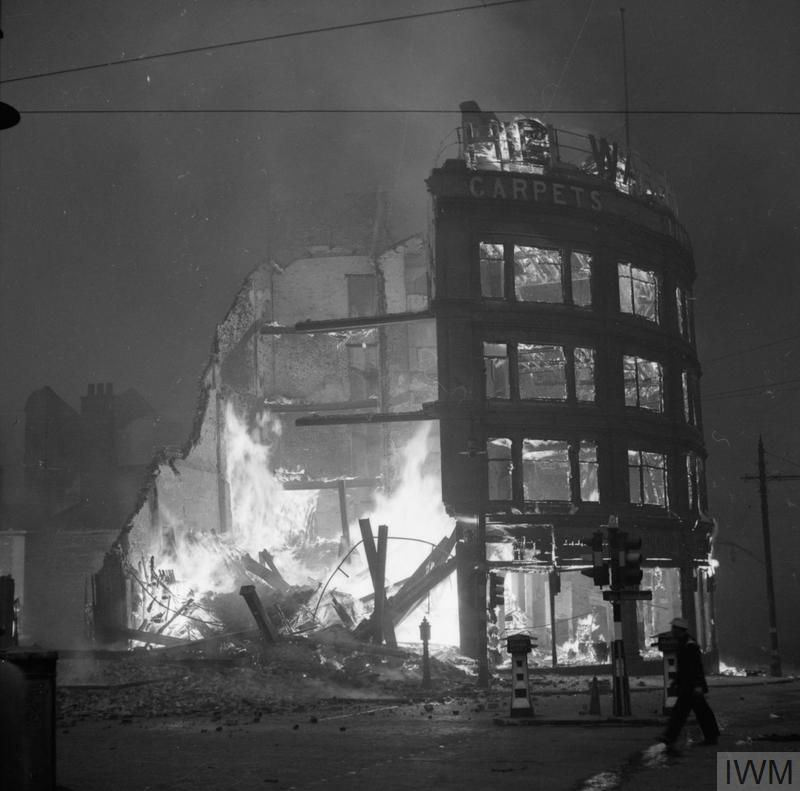
From Germany, Lord Haw Haw warned of a second night of bombing for Manchester, England, United Kingdom. German propagandist Lord Haw-Haw brazenly reveals the Luftwaffe’s plans to bomb Manchester for the second night in a row, and then the attack takes place as he describes. Throughout the night, 171 German bombers drop 195 more tons of high explosives and 893 incendiary bombs on the city. Overall, through the two nights, there are 363 dead and 1183 other major casualties.
Overnight, from 1915 until 0129 hours the next day, 171 German aircraft attacked the still-burning city of Manchester with 195 tons of high explosive bombs and 893 incendiary bombs. In two nights, 363 civilians were killed and 1,183 were wounded.
RAF Bomber Command dispatches 43 Blenheims, Wellingtons and Whitleys overnight to Ludwigshaven, Mannheim and to the ports. 1 Whitley lost 2 O.T.U. sorties.
The Messerschmitt 261 V1 twin-engine, long-range aircraft makes its maiden flight. The aircraft has a range of 6,800 miles, and was originally designed to fly non-stop from Berlin to Tokyo to carry the Olympic Torch for the 1940 Games. With the 1940 Olympics canceled and no real need for long-range transport, the Me 261 is a plane without a purpose — but it is an advanced design, so the design and manufacturing process continues. It does not hurt its state backing that the Me 261 has acquired the nickname “Adolfine” in honor of the Fuhrer, who likes the long-range concept. The test flight goes well, and development continues.
The RAF raids Tripoli and Castel Benito.
Destroyers HMS Wild Swan and HMS Warwick departed Liverpool to refuel at Londonderry prior to joining convoy OB.263. However, off Bar Light Vessel, destroyer Warwick struck a mine and was badly damaged. Destroyer Wild Swan towed her back to Liverpool and Warwick was intentionally beached. Destroyer Warwick was under repair at Liverpool until 9 March 1942.
In attacks on convoy FN.366, the German 1st Motor Torpedo Boat Squadron with S.26, S.28, S.29, S.34, S.56, S.58, S.59, Dutch steamer Stad Maastricht (6552grt) was badly damaged at 2255 by S.59 in 52‑35N, 02‑03E and minesweeping trawler HMS Pelton (358grt, Skipper J. A. Sutherland DSC RNR) was sunk by German motor torpedo boat S.28 alongside 5 Buoy, north of Aldeburgh. Sutherland, A/T/Lt Cdr H. R- Walker RNVR, eighteen ratings were lost on trawler Pelton. Destroyer HMS Verdun reported sinking one of the S boats. Patrol sloop HMS Shearwater stood by steamer Stad Maastricht which was later taken in tow by tugs Norman and Krooman from Yarmouth and tug Kenia from Harwich. The entire crew from the Dutch steamer was rescued. However, she sank on the 25th in 3.6 miles 340° from Gunfleet Light Vessel. The convoy arrived at Methil on the 25th.
Anti-aircraft ship HMS Alynbank departed Scapa Flow at 1030 to meet convoy WN.57 in Pentland Firth and escort the convoy to Buchanness. At 2245 while leaving the convoy, the anti-aircraft ship was damaged in a collision with an unknown vessel. A tug was requested, but later was found not to be needed. The damaged ship arrived off May Island at 0900/24th. She was taken to Rosyth for repairs. Due to other commitments in the repair yard, repairs were not begun until 2 February. Repairs were completed and the ship arrived at Scapa Flow on 1 April 1941 for duty.
Destroyer HMS Douglas and HMS Keppel departed Scapa Flow at 2359 to meet armed merchant cruisers HMS California, HMS Chitral, and HMS Letitia ten miles east of the Butt of Lewis and escort them north. The destroyers arrived back at Scapa Flow at 1600/26th.
Dutch steamer Breda (6941grt) was sunk by German bombing in 56-29-12N, 5-25W. The entire crew was rescued.
Dutch trawler Ystroom (400grt) was sunk on a mine in 53-37N, 3-25W, but all her crew was rescued.
Steamer Pacific Pioneer (6734grt) was damaged by German bombing at Manchester.
Trawler Iwate (314grt) was damaged by German bombing in 52‑55N, 12‑20W.
British steamer Flynderborg (2022grt), drifter Lupina (88grt) and Dutch steamer Tuva (4652grt) were damaged by German bombing at Oban.
Royal Navy minelaying cruiser HMS Adventure lays minefield ZME 9 in the North Sea.
Australian light cruiser HMAS Sydney arrived at Malta to refit. She then departed Malta on 8 January with Australian destroyer HMAS Stuart for Alexandria.
Italian torpedo boat Cairoli was sunk on a mine NE of Tripoli laid by submarine HMS Rorqual on 5 November.
Convoy OB.263 departed Liverpool escorted by destroyer HMS Wild Swan, sloop HMS Rochester, and corvettes HMS Campanula, HMS Fleur De Lys, HMS Gardenia, and HMS Periwinkle. The escort was detached on the 26th.
Convoy FN.366 departed Southend, escorted by destroyers HMS Verdun and HMS Wolsey and patrol sloop HMS Shearwater.
Convoy SC.17 departed Halifax at 1100. Ocean escort was armed merchant cruiser HMS Maloja, which detached on 3 January. On the 7th, destroyers HMS Veteran and HMS Wolverine, sloop HMS Deptford, and corvettes HMS Arbutus, HMS Delphinium, and HMS Erica joined the convoy, which arrived at Liverpool on the 8th.
President Roosevelt’s first fireside talk to the American people since his re-election will be delivered next Sunday evening. It will be about “The Present Emergency ” Starting at 9:30, the President will speak for half an hour over the major radio networks. Although the White House announced only the broad subject of the chat today, informed quarters expect Mr. Roosevelt to outline bluntly the gravity of the world situation and to call upon all sectors to speed the defense program and the supplying of material aid to Great Britain. Officials close to the Chief Executive are known to have urged upon him the need for using the plainest speech to bring the reality of the emergency home to the people. He was said to be in full accord with this point of view. The President devoted himself again today to the defense program. In the morning he conferred for an hour with Mayor La Guardia of New York, who said afterward that Canadian-American defense problems had been discussed.
President Roosevelt was reported today to have evidenced deep interest in a plan for mass production of airplanes when Philip Murray, president of the C.I.O., took it up with him at luncheon. No commitment, however, either for or against, was made by the President, it was said. The plan, which was forwarded. to the President several days ago, was drawn up by Walter P. Reuther, director of the General Motors Division of the United Automobile Workers of America. It was explained in its main outlines by Mr. Murray. As a result of the discussion, copies of the plan were sent this afternoon to the members of the new four-man defense board, known as the Office for Production Management for Defense, and to the seven-man National Defense Advisory Commission. The President is expected to name a time for more detailed discussion of the plan with a committee which will include Mr. Reuther, President R. J. Thomas of the auto union, Mr. Murray and others.
Representative Voorhis, California Democrat, introduced today a bill to give the justice department authority to prosecute acts of sabotage committed in this country against goods or material manufactured for export to friendly foreign nations. Under existing law, Voorhis told the house, the department’s authority is limited to acts of sabotage committed against material made for the United States.
Northrop Aircraft Corp. announced tonight it was being forced to curtail production, effective at once, because of inability to obtain aluminum for its planes. The slowdown order affects 2,000 employees of the concern. These workers will be cut from 10-hour shifts to eight hours. “The plain truth of the matter is that there simply isn’t enough aluminum available to meet the great demand for the metal occasioned by the national defense program,” said LaMotte T. Cohu, general manager of Northrop. “This same situation is bound to affect other aircraft concerns.” Cohu said he understood that increased deliveries of aluminum products would not be available until next September. The Northrop plant has $10,000,000 worth of defense contracts. Deliveries take from 30 to 35 weeks. “It would be impossible for us to speed up production now,” said Cohu. “We have just so much stock on hand, and we hope it will last until such time as we can get more to complete our orders.”
Eddie August Henry Schneider, a famed 1930s aviator who set several transcontinental speed records and became the youngest certified pilot in the United States, perishes at age 29 in an airplane crash. His plane crashes while Schneider is training another pilot at Floyd Bennett Field. The other plane, piloted by a US Naval Reserve pilot, clips his tail and sends his private plane into the sea. Both the Naval Reserve pilot and the air traffic controllers are held accountable for the tragedy. Schneider had flown with the Yankee Squadron supporting the Spanish Loyalists in the Spanish Civil War.
Admiral William D. Leahy (USN, Retired), newly appointed Ambassador to Vichy France, accompanied by his wife Louise, embarks in heavy cruiser Tuscaloosa (CA-37) at Norfolk, Virginia, for the transatlantic passage to take up his diplomatic post “at a very critical time in the relations between the United States and France.” Destroyers Madison (DD-425) and Upshur (DD-144) escort Tuscaloosa on the initial stage of her voyage.
The National Guard’s 35th Division, consisting of units from Arkansas, Kansas, Missouri and Nebraska, is inducted into federal service with the U.S. Army.
Naval Air Station, Key West, Florida, is established.
Shirley Temple and Metro-Goldwyn-Mayer studio are scheduled to sign a contract Thursday that will return the 11-year-old star to the screen. The studio and Shirley’s mother, Mrs. George Temple, have had a tentative agreement on the contract for some time, but the signing has been postponed to enable Shirley to have a full year’s vacation from pictures. Shirley’s year will be up next spring and Mrs. Temple indicated tonight her daughter’s first picture under the new contract would be released then. M-G-M officials said a musical in which Shirley would sing and dance and an original story of dramatic character are under consideration as vehicles for the little girl who once was the No. 1 box office attraction of the movies.
John Van Druten’s play “Old Acquaintance” premieres on Broadway in NYC.
Claire Chennault’s talks with President Roosevelt bear fruit when the US government agrees to provide the American Volunteer Group with 100 P-40B Tomahawk fighters — which are America’s front-line fighters. This will enable Chennault to begin battling the Japanese over China with American pilots. Everything, however, is strictly unofficial — there is no direct government involvement, and Chennault’s AVG is to be managed by a private company.
Due to clashes between Communist and Nationalist forces, Chiang Kai-Shek demands that the Communist Party of China (CPC) army evacuate Anhui and Jiangsu Provinces, where they recently have been battling the Japanese with some success. After some hesitation, the Communist New Fourth Army complies. However, Chiang is not happy with the overall situation despite the CPC bowing to his demand, and he or his minions plot reprisals. This is the start of a brewing civil war in the middle of the far more important war against the Japanese.
The Japanese Navy announced today the extension of its blockade of China’s coast to the southwestern ports of Kwangtung province and notified foreign consulates that Japan would not be responsible for damage to vessels or crews entering the blockaded area. The United States consulate was expected to make its customary reply that the United States would hold Japan responsible for any such damage.
Japanese planes for a week have been heavily bombing the South China supply route from Shayuchung to Tamshui and also other East River towns. Chinese reports admit serious damage. Apparently the Japanese are determined to cut the movement of goods of all kinds to and from Free China in the Hong Kong and Mirs Bay area.
A communiqué from Air Marshal Brooke Popham, the British Commander-in-Chief in the Far East, states that recently large transports of troops from every branch of service have arrived in the Malayan states. This has reinforced the already massive defenses of Singapore and also the fighting power of the other sections of Far East Command. Some units of the 2/15 Punjab arrive in British Borneo from Singapore as garrison troops. Air Marshal Brooke Popham, the British Commander-in-Chief in the Far East, takes the opportunity to give a press conference in which he touts the increase British forces in the Far East. The Japanese, however, are in possession of the Top Secret military assessment of British defenses in that theater by the Churchill War Cabinet. The Japanese thus know that any claims of British strength not only are spurious but evidence of mere puffery designed to mislead them and conceal British weakness.
The Imperial Japanese Navy light carrier HIJMS Hosho was deemed not suitable for modern carrier aircraft. The ship is found to be too small to carry the Mitsubishi A6M Zero, the Aichi D3A “Val”, and/or the Nakajima B5N “Kate” in combat, and in any event it cannot carry enough aircraft to make it useful. However… the Japanese keep it in service anyway, used mainly to provide air cover for capital ships.
Winston Churchill assures the Australian Prime Minister, Robert Menzies, that Australia has a higher defense priority than the Mediterranean.
Dow Jones Industrial Average: 128.41 (-0.48)
Born:
Jorma Kaukonen, American rock guitarist (Jefferson Airplane; Hot Tuna), in Washington, District of Columbia.
Eugene Record, American musician (Chi Lites — “Give It Away”; “Have You Seen Her”), in Chicago, Illinois (d. 2005).
Robert Labine, Canadian politician, in Gatineau, Quebec, Canada (d. 2021).
Died:
Eddie August Schneider, 29, American aviator (plane crash).
Naval Construction:
The Royal New Zealand Navy Isles-class minesweeping trawler HMNZS Sanda (T 160) is laid down by Goole Shipbuilding & Repairing Co. Ltd. (Goole, U.K.); completed by Amos & Smith.
The Royal Australian Navy Bathurst-class minesweeper-corvette HMAS Launceston (J 179) is laid down by Evans Deakin Ltd. (Brisbane, Queensland, Australia).
The Nihon Kaigun (Imperial Japanese Navy) Yūgumo-class destroyer HIJMS Makigumo (巻雲, “Cirrus Clouds”) is laid down by the Fujinagata Shipyards (Osaka, Japan).
The Nihon Kaigun (Imperial Japanese Navy) Yūgumo-class destroyer HIJMS Kazagumo (風雲, “Wind and Clouds”) is laid down by the Uraga Dock Company (Uraga, Yokosuka, Kanagawa Prefecture, Japan).
The Royal Navy LCT (Mk 1)-class landing craft, tank LCT 4 is launched by Vickers Armstrong (Newcastle-on-Tyne, U.K.).
The Nihon Kaigun (Imperial Japanese Navy) No.13-class submarine chaser CH-15 is launched by the Osaka Iron Works (Sakurajima, Kyushu, Japan).
The Kriegsmarine (German Navy) Type VIIC U-boat U-558 is launched by Blohm & Voss, Hamburg (werk 534).
The U.S. Navy Gar-class submarine USS Grampus (SS-207) is launched by the Electric Boat Co. (Groton, Connecticut, U.S.A.).
The Royal Navy Fairmile B-class motor launch HMS ML 141 is commissioned.
The Royal Navy Shakespeare-class minesweeping trawler HMS Hamlet (T 167) is commissioned. Her first commanding officer is T/Lieutenant Charles Robertson, RNR.
The U.S. Navy 70-foot Elco patrol motor torpedo boat USS PT-19 is commissioned.
The Kriegsmarine (German Navy) Type VIIC U-boat U-553 is commissioned. Her first commanding officer is Kapitänleutnant Karl Thurmann.
The Royal Navy Flower-class corvette HMS Aubretia (K 96) is commissioned. Her first commanding officer is Lieutenant Commander Vivian Funge Smith, RNR.
 History Diaries