Chimara (Himarë), Albania was captured by the Greek army. Greek troops were reported today to have skirted the well-defended Adriatic coastal city of Chimara in Albania, leaving other units behind to clean out Italian opposition there. The advance units pressed onward toward the strategic port of Valona about 30 miles farther north, and in fierce hand-to-hand fighting were said to have captured several hundred Italians on important heights bordering the sea. A government spokesman declared Chimara was under the absolute control” of Greek artillery and that the Greek army along the Albanian front was advancing “steadily and securely.” Frontier dispatches said a “very large scale” battle was raging 20 miles northeast of Chimara in the Tepelini-Klisura area in one of the major conflicts of the Italo-Greek war. “Brilliant successes” were claimed by the Greeks in that area where units struggled northwestward to effect a junction with the Greek coastal units and to secure the collapse of all Fascist resistance in southern Albania. One report said an entire Italian regiment had been decimated just outside Tepelini in one of the greatest victories since Greek troops routed the Italians from Greece and began their own counter-invasion.
While a widely touted victory, this is another case of the Italians simply picking up and leaving when the situation “got out of hand.” The Greeks simply occupied the high ground, and the Italians fled. The Greek locals in Chimara are ecstatic and stage mass celebrations, evincing the high morale of both the Greek troops and the population at large. Overall during the battle for Chimara, the Italians have had about 400 casualties and lost 900 prisoners, while the Greeks have had about 100 casualties.
The real prize is Valona, to the north, but there is little chance of the Greeks advancing that far during the winter. This is the final big Greek achievement of the winter counteroffensive. Many read more into the Chimara success than it warrants, concluding that the Italians are now beaten. However, the Italians are not beaten, they simply haven’t been fighting — a subtle but vital distinction.
Elsewhere, the Greek II Corps is fighting in the vicinity of Klisura between the Aöos and the Apsos rivers, but so far has been unable to break through the strategically vital Klisura Pass.
The Royal Navy bombards Valona in southern Albania, a key Italian supply port, while the RAF bombs oil facilities at Kuçovë.
Italian reversals in Egypt and Libya were blamed today by Marshal Rodolfo Graziani, in a report to Premier Mussolini, on the lack of armored cars, tanks and other mechanized equipment which prevented the Fascists from taking the offensive before the British got started. The Italians were also outnumbered, he said.
Things have settled down considerably in Libya. The Italians are defending Bardia and Tobruk with vigor, while the British are moving Australian troops forward to attack them in sequence. This process will take until early January 1941. The RAF stages a night raid on Benina.
British Foreign Secretary Viscount Halifax, erstwhile appeaser and “man of Munich,” today became Britain’s ambassador to the United States in a move that soon restored dapper Anthony Eden as foreign secretary. Eden, leaving his post as war minister, returns to the post which he quit in February of 1938 in protest against the appeasement policies and coddling of dictators under Lord Halifax and the late Neville Chamberlain, then prime minister. The appointments, announced from No. 10 Downing street shortly after midnight by King George VI,” were three-fold in their purpose:
— 1. Filling the Washington ambassadorship suddenly left vacant by the death of Lord Lothian.
— 2. An effort to achieve better relations with Russia because except for venerable David Lloyd George, Eden is the strongest British champion of Anglo-Russian understanding and is well regarded in Moscow.
— 3. Elimination from the British cabinet of the last survivor of Chamberlain’s inner “appeasement circle” — and a man who frequently has been attacked because, of his reputed former standing as a member of the so-called Cliveden set.
While the ambassador spot in Washington may seem vitally important during wartime — and in some ways, it is — Churchill has been personally handling relations with President Roosevelt. In effect, Halifax is being sent to a supposedly prestigious posting which actually has no power and minimal influence and which is of only ceremonial importance — a typical fate of prominent individuals in the British government and military who have been found wanting by their superiors, i.e., Churchill.
Eden’s elevation is more a case of getting rid of Halifax than it is putting the proper man in a key role. Halifax, who came extremely close to becoming Prime Minister earlier in the year instead of Churchill, is tarnished by his association with the disastrous Chamberlain appeasement policy. He also has butted heads with Churchill since Churchill’s elevation about the delicate issue of peace talks with Germany, reinforcing the impression that he is not “all in” for the war. Halifax is the last of Chamberlain’s cronies to leave the Cabinet and will be little-noticed from here on out despite remaining the ambassador to the US throughout the war.
The tall, gaunt-faced Lord Halifax, who will be 60 years old next April 16, was understood in the media to have been selected for the Washington post after Lloyd George had declined it. Churchill replaced Anthony Eden with Parliamentary Secretary to the Treasury David Margesson (later Viscount Margesson) as the Secretary of State for War in the British Cabinet.
Churchill, meanwhile, continues his discussions with the Ministry of Supply today. Among other things, he casually mentions that the government may have to begin requisitioning private property to house refugees from the big cities.
Churchill’s business today includes meeting with the Ministry of Supply. They discuss the state of Britain’s stock piles of drop-forgings (vital for armaments production). Britain needs 441,000 tons annually and is only producing 208,000 tons with 7,000 tons imported from the USA. Britain must expand its own production and obtain more from the United States. He also addresses the serious shortage of accommodation for those bombed out of their homes and suggests that it may be necessary for the government to commandeer suitable property.
Churchill meets with the Home Secretary to discuss the continuing internment of various individuals without trial by jury or habeas corpus. These individuals include Oswald Mosley and his wife, and Pandit Nehru. Mosley is a former MP and Great War veteran who has been interned (with wife Diana) at Holloway Prison since 23 May 1940 under Defence Regulation 18B. The charge against them is Fascist sympathies (he is the founder and leader of the British Union of Fascists). Churchill and Morrison decide to do nothing about the Moseleys. However, while reviewing other cases, Churchill recommends that Pandit Nehru in India — who has been imprisoned in one form or another since engaging in nonviolent protests against British rule over the summer — be handled more respectfully.
Italian submarine Serpente attacked Allied convoy MG1 24 miles east of Cape Bon, Tunisia in the Strait of Sicily at 0156 hours as the convoy attempted to sail from Malta to Gibraltar. Destroyer HMS Hyperion was damaged, killing 2 and wounding 14. HMS Ilex took off the survivors, and then HMS Janus scuttled Hyperion before sunrise.
A condition that might be described as planned anarchy now reigns in Rumania. Order, as it is conceived in other lands, does not exist. Daily there are instances of Iron Guard cruelty, mainly against Jews, whose bodies are being found shattered by involuntary falls from windows.
Two special trains arrived today in Jerusalem with 4,000 Italian prisoners of war from the Western Desert. The prisoners, who had been landed from a troopship at Haifa yesterday evening, included Italian troops hailing from Naples, Palermo, Sicily and Rome, as well as Libyans. Haggard and unshaven, these weary men still bore signs of the desert battle in which they had been captured. Yet they were cheerful enough on the whole and waved to a group of British, Arab and Jewish journalists standing on the platform.
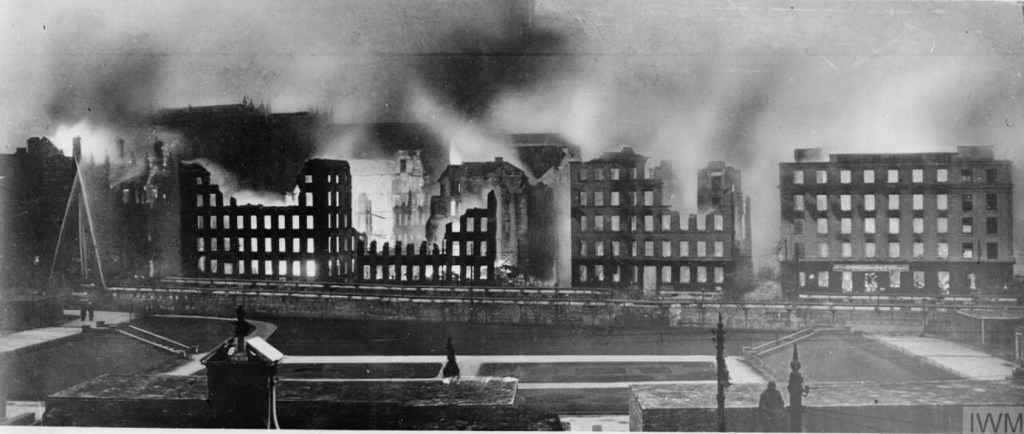
The heaviest raids of the Manchester Blitz began. Over the next two days a total of 654 people were killed and over 2,000 injured. Tonight, 270 Luftwaffe bombers attacked Manchester, England, United Kingdom, dropping 272 tons of high explosive bombs and 1,032 incendiary bombs; the Piccadilly area was engulfed in large fires, while the Gibsons shelter at the Hulme Town Hall collapsed without any deaths. During the same night, Liverpool was bombed for the third night in a row.
Continuing its recent strategy of attacking isolated medium-sized English cities with recurrent air raids, the Luftwaffe tonight switches from Liverpool (two nights of bombing) to Manchester. Previously in this series, the Germans have targeted cities such as Coventry and Sheffield with devastating effect. How much damage is caused to each of these targets depends upon factors such as how heavily protected they are by anti-aircraft guns — usually not very — and whether the citizens have taken to sleeping in shelters yet.
Tonight is the heaviest raid on Manchester during the Blitz. About 270 German bombers attack as night falls at 18:38, followed later in the night by a second wave. Liverpool, with its blazing fires, provides an easy guide for the bombers, who drop 272 tons of high explosives and 1032 incendiary bombs. Hardest hit are the Piccadilly area, the city center, and the docks area. Also hit are Safford and Stretford. Overall during this campaign, there will be 684 deaths and 2364 injured. There is a near-tragedy when a bomb hits a Gibson shelter at Hulme Town Hall, inside which 450 people are trapped. However, unlike some other situations where broken mains and the like flood the shelter and drown many people, these people get out alive.
The Luftwaffe also hits Liverpool again for the third night in a row with a subsidiary effort. In fact, the night is notable for a large number of secondary attacks throughout England. The Corpo Aereo Italiano (CAI) bombs Harwich again, this time with four bombers.
The RAF scores a night fighter success when a No. 141 Squadron Defiant shoots down a Heinkel He 111 of KG 55, which lands at Underwood House in Etchingham, Sussex.
RAF Bomber Command dispatches 59 Blenheims, Hampdens, and Wellingtons overnight to 5 targets but less than half bombed primaries. Bomber Command attacks Mannheim and Ludwigshafen in the Rhineland, the inland docks at Cologne, oil facilities at Frankfurt, and various invasion ports. 1 Wellington lost. 3 Hampdens minelaying off Cuxhaven and 1 O.T.U. sortie.
RAF Coastal Command, meanwhile, attacks the ports of Wilhelmshaven, Brest, and Lorient.
Destroyer HMS Foresight in drydock at Liverpool for repairs was damaged by a near miss. The fore superstructure and the hull above the water line were holed by splinters.
Destroyer HMS Keppel arrived at Scapa Flow at 2230 from Rosyth after repairs.
Destroyer HMS Cotswold departed Scapa Flow after working up at 1730 for Rosyth. From Rosyth, the destroyer continued to the Nore.
Corvette HMS Columbine was in a collision with sloop HMS Aberdeen in 61-08N, 14-25W. The corvette proceeded to Stornoway escorted by destroyer HMS Wolverine. Tug Superman was also sent to assist. Sloop Aberdeen was able to proceed to meet convoy HX.95.
Destroyers HMS Shikari and HMS Sardonyx in convoy OB.262 attacked a submarine contact in 56-38N, 13-34W.
Submarine HMS H.31 sank at Campbeltown due to a loss of buoyancy. The submarine flooded from the engine room aft. The submarine was refloated and arrived at Rothesay on the 25th. Submarine H.31 was repaired at Elderslie from 13 to 25 January.
Motor Attendant Craft MAC.7 was sunk at Portsmouth. The craft was raised in 1940, but was declared unfit in January after a fire.
Tug Poolgarth (179grt) was sunk on a mine off Canada Dock, S. Pier Head, Liverpool. The entire crew of the tug was lost.
British tanker Elax (7402grt) was damaged on a mine off No. 10 Buoy, Liverpool.
British steamers Pardo (5400grt) and Almeda Star (14,935grt) and hopper barge No. 9 (671grt) were damaged by German bombing at Liverpool.
British steamer Llandilo (4966grt) was damaged by a mine between No. 2 and 3 Yantlet Buoys, Thames Estuary.
Greek submarine Papanicolis damaged Italian steamer San Giorgio (364grt) with gunfire and sank Italian steamer Antonietta (70grt) by ramming off Brindisi.
Convoy FN.365 departed Southend. The convoy arrived at Methil on the 24th.
Convoy FS.368 departed Methil, escorted by destroyers HMS Pytchley and HMS Vanity. The convoy arrived at Southend on the 25th.
Convoy HX.98 departed Halifax at 1300, escorted by destroyers HMCS Assiniboine and HMCS Restigouche which were detached the next day. The ocean escort was armed merchant cruiser HMS Laconia. The convoy was diverted to Sydney, C.B. where it arrived on the 29th. The convoy departed Sydney on 2 January escorted by armed merchant cruiser Laconia and escort ships HMCS Laurier, HMCS Rayon HMCS D’or, and HMCS Venosta. The escort ships were detached later that day. On 13 January, destroyers HMS Scimitar and HMS Skate and corvette HMS Mallow joined the convoy. Destroyer Skate was detached on 15 January and the other two escorts on 16 January. The convoy arrived at Liverpool on 17 January.
Convoy SL.60 departed Freetown escorted by armed merchant cruiser HMS Esperance Bay to 7 January, sloop HMS Bridgewater to 24 December, anti-submarine trawlers HMS Bengali to 24 December and HMS Spaniard to 26 December. On 9 January, destroyers HMS Wild Swan to 9 January and HMS Witch, ocean boarding vessel HMS Cavina, sloop HMS Aberdeen, and corvettes HMS Campanula, HMS Fleur De Lys, HMS Gardenia, and HMS Periwinkle joined the convoy. The convoy arrived at Liverpool on 13 January.
Convoy SLS.60 departed Freetown on the 22nd and arrived at Liverpool on 15 January.
The appointment of Viscount Halifax, British foreign minister, as the new ambassador to the United States was warmly received in administration circles tonight. Authorized spokesmen said that Lord Halifax was eminently satisfactory as successor to the late Marquis of Lothian. Secretary Hull and other high officials were represented as having the highest regard for Lord Halifax. His appointment was looked upon here as a sign that the British government considered the Washington post of equal importance with a cabinet portfolio. Although Lord Halifax was closely associated with the late Prime Minister Neville Chamberlain during the so called “appeasement” era of British foreign policy, those familiar with his more recent views were said to be entirely satisfied that he stands for vigorous prosecution of the war.
The No Foreign War Committee announced today it would begin its national campaign by placing full page advertisements in 50 newspapers tomorrow appealing for help in its “last ditch fight” to help keep the nation out of war. Verne Marshall, committee head and editor of the Cedar Rapids, Iowa, Gazette, said his newspaper would defray the $41,000 cost of the advertisements which say “we cannot much longer compete against the resources supporting the William Allen White Committee to Defend America by Aiding the Allies.” Marshall criticized President Roosevelt for “taking sole authority for the granting of approximately $3,000,000,000 in credits to England in defiance of the neutrality and Johnson acts;” and remarked that Col. Charles A. Lindbergh “has been as cruelly treated as it is possible to treat any man.”
Eighteen thousand employees of Lockheed Aircraft Corp. and Vega Airplane Co. today presented the people of Great Britain a $90,000 Hudson bomber as a Christmas gift. Technically it was a gift to employees of the Fairey Aircraft Co. of England, but British Consul Erie A. Cleugh and Air Commodore J. C. Slessor, British air attaché at Washington, D. C, expressed their appreciation. Pilot Jimmie Mattern flew the ship to Palm Springs and will continue to Albuquerque tomorrow, planning to reach Montreal, Canada, Christmas day.
The C.I.O. opened a campaign today against two bills proposed for state legislatures as national defense measures, but described by President Philip Murray as “actually aimed at labor’s right to assemble, picket and strike.” In a letter to all officials and affiliates of the Congress of Industrial Organizations, Murray urged “through vigilance to see to it that measures of this kind which readily lend themselves to suppression of the rights of labor and the freedom of the American people are not placed upon the statute books under any wave of hysteria.”
Philip Murray, president of the C.I.O., proposed a plan for utilizing surplus capacity of motor car factories to produce 500 fighting planes per day after six months. He is a strong supporter of the Roosevelt administration and the war effort, the right man in the right place to ease the industrial transition toward military production.
Mayor Fiorello LaGuardia announces that in the preceding six months 238 arrests have been made in New York for inflammatory and anti-Semitic street speeches as well as other disturbances.
At Norfolk, Virginia, new Ambassador to France Admiral Leahy boards heavy cruiser USS Tuscaloosa — recently back from carrying President Roosevelt and Harry Hopkins on a tour of the Caribbean — for his new position in France.
Having temporarily completed operations off phosphate-producing island Naura, German raider Komet heads to Rabaul with the intention of laying mines. Raider Orion proceeds to Lamutrik in the Mariana Islands for an engine overhaul. Supply ship Kulmerland heads for Japan to re-stock.
The Thai (Siamese) High Command announced tonight that French regulars, including Moroccans, and guerrillas “carried out an intensive violation of Thai territory on Saturday night and early Sunday.”
Born:
Nasser Mohammed Al-Ahmed Al-Sabah, Former Prime Minister of Kuwait, 2006-2011, in Kuwait City, Kuwait.
Elrod Hendricks, Virgin Islander MLB catcher (World Series champions-Orioles, 1970; Baltimore Orioles, Chicago Cubs, New York Yankees), in Charlotte Amalie, U.S. Virgin Islands (d. 2005, of a heart attack).
Died:
Nathanael West, 37, American author, screenwriter and satirist (traffic collision).
Naval Construction:
The Kriegsmarine (German Navy) Type 1936A (Mob) destroyer Z33 is laid down by AG Weser (Deschimag), Bremen (werk 1003).
The Kriegsmarine (German Navy) Type VIIC U-boat U-557 is launched by Blohm & Voss, Hamburg (werk 533).
 History Diaries