German Chancellor Adolf Hitler issued Führer Directive 21, confirming the plans for Unternehmen BARBAROSSA, the German invasion of the Soviet Union.
The Führer and Supreme Commander of the Armed Forces
Führer Headquarters,
18th December 1940.
9 copies
Directive No. 21
‘Case BARBAROSSA’
The German Armed Forces must be prepared, even before the conclusion of the war against England, to crush Soviet Russia in a rapid campaign (‘Case BARBAROSSA’).
The Army will have to employ all available formations to this end, with the reservation that occupied territories must be insured against surprise attacks.
The Air Force will have to make available for this Eastern campaign supporting forces of such strength that the Army will be able to bring land operations to a speedy conclusion and that Eastern Germany will be as little damaged as possible by enemy air attack. This build-up of a focal point in the East will be limited only by the need to protect from air attack the whole combat and arsenal area which we control, and to ensure that attacks on England, and especially upon her imports, are not allowed to lapse.
The main efforts of the Navy will continue to be directed against England even during the Eastern campaign.
In certain circumstances I shall issue orders for the deployment against Soviet Russia eight weeks before the operation is timed to begin.
Preparations which require more time than this will be put in hand now, in so far as this has not already been done, and will be concluded by 15th May 1941.
It is of decisive importance that our intention to attack should not be known.
The preparations of the High Commands will be made on the following basis:
I. General Intention
The bulk of the Russian Army stationed in Western Russia will be destroyed by daring operations led by deeply penetrating armoured spearheads. Russian forces still capable of giving battle will be prevented from withdrawing into the depths of Russia.
The enemy will then be energetically pursued and a line will be reached from which the Russian Air Force can no longer attack German territory. The final objective of the operation is to erect a barrier against Asiatic Russia on the general line Volga-Archangel.
The last surviving industrial area of Russia in the Urals can then, if necessary be eliminated by the Air Force.
In the course of these operations the Russian Baltic Fleet will quickly lose its bases and will then no longer be capable of action.
The effective operation of the Russian Air Force is to be prevented from the beginning of the attack by powerful blows.
II. Probable Allies and their Tasks
- On the flanks of our operations we can count on the active support of Rumania and Finland in the war against Soviet Russia. The High Command of the Armed Forces will decide and lay down in due time the manner in which the forces of these two countries will be brought under German command.
- It will be the task of Rumania to support the attack of the German southern flank, at least at the outset, with its best troops ; to hold down the enemy where German forces are not engaged; and to provide auxiliary services in the rear areas.
- Finland will cover the advance of the Northern Group of German forces moving from Norway (detachments of Group XXI) and will operate in conjunction with them. Finland will also be responsible for eliminating Hangö.
- It is possible that Swedish railways and roads may be available for the movement of the German Northern Group, by the beginning of the operation at the latest. III. Conduct of Operations A. Army (in accordance with plans submitted to me): In the theatre of operations, which is divided by the Pripet Marshes into a Southern and a Northern sector, the main weight of attack will be delivered in the Northern area. Two Army Groups will be employed here. The more southerly of these two Army Groups (in the center of the whole front) will have the task of advancing with powerful armored and motorized formations from the area about and north of Warsaw, and routing the enemy forces in White Russia. This will make it possible for strong mobile forces to advance northwards and, in conjunction with the Northern Army Group operating out of East Prussia in the general direction of Leningrad, to destroy the enemy forces operating in the Baltic area. Only after the fulfilment of this first essential task, which must include the occupation of Leningrad and Kronstadt, will the attack be continued with the intention of occupying Moscow, an important center of communications and of the armaments industry. Only a surprisingly rapid collapse of Russian resistance could justify the simultaneous pursuit of both objectives. The most important task of Group XXI, even during these eastern operations, remains the protection of Norway. Any forces available after carrying out this task will be employed in the North (Mountain Corps), at first to protect the Petsamo area and its iron ore mines and the Arctic highway, then to advance with Finnish forces against the Murmansk railway and thus prevent the passage of supplies to Murmansk by land. The question whether an operation of this kind can be carried out with stronger German forces (two or three divisions) from the Rovaniemi area and south of it will depend on the willingness of Sweden to make its railways available for troop transport. It will be the duty of the main body of the Finnish Army, in conjunction with the advance of the German North flank, to hold down the strongest possible Russian forces by an attack to the West, or on both sides of Lake Ladoga, and to occupy Hangö. The Army Group operating South of the Pripet Marshes will also seek, in a concentric operation with strong forces on either flank, to destroy all Russian forces west of the Dnieper in the Ukraine. The main attack will be carried out from the Lublin area in the general direction of Kiev, while forces in Rumania will carry out a wide enclosing movement across the lower Pruth. It will be the task of the Rumanian Army to hold down Russian forces in the intervening area. When the battles north and south of the Pripet Marshes are ended the pursuit of the enemy will have the following aims : In the South the early capture of the Donets Basin, important for war industry. In the North a quick advance to Moscow. The capture of this city would represent a decisive political and economic success and would also bring about the capture of the most important railway junctions. B. Air Force It will be the duty of the Air Force to paralyze and eliminate the effectiveness of the Russian Air Force as far as possible. It will also support the main operations of the Army, i.e. those of the central Army Group and of the vital flank of the Southern Army Group. Russian railways will either be destroyed or, in accordance with operational requirements, captured at their most important points (river crossings) by the bold employment of parachute and airborne troops. In order that we may concentrate all our strength against the enemy Air Force and for the immediate support of land operations, the Russian armaments industry will not be attacked during the main operations. Such attacks will be made only after the conclusion of mobile warfare, and they will be concentrated first on the Urals area. C. Navy. It will be the duty of the Navy during the attack on Soviet Russia to protect our own coasts and to prevent the break-out of enemy naval units from the Baltic. As the Russian Baltic fleet will, with the capture of Leningrad, lose its last base and will then be in a hopeless position, major naval action will be avoided until this occurs. After the elimination of the Russian fleet the duty of the Navy will be to protect the entire maritime traffic in the Baltic and the transport of supplies by sea to the Northern flank (clearing of minefields!). IV. All steps taken by Commanders-in-Chief on the basis of this directive must be phrased on the unambiguous assumption that they are precautionary measures undertaken in case Russia should alter its present attitude towards us. The number of officers employed on preliminary preparations will be kept as small as possible and further staffs will be designated as late as possible and only to the extent required for the duties of each individual. Otherwise there is a danger that premature knowledge of our preparations, whose execution cannot yet be timed with any certainty, might entail the gravest political and military disadvantages. V. I await submission of the plans of Commanders-in-Chief on the basis of this directive.
The preparations made by all branches of the Armed Forces, together with time-tables, are to be reported to me through the High Command of the Armed Forces.
signed: ADOLF HITLER
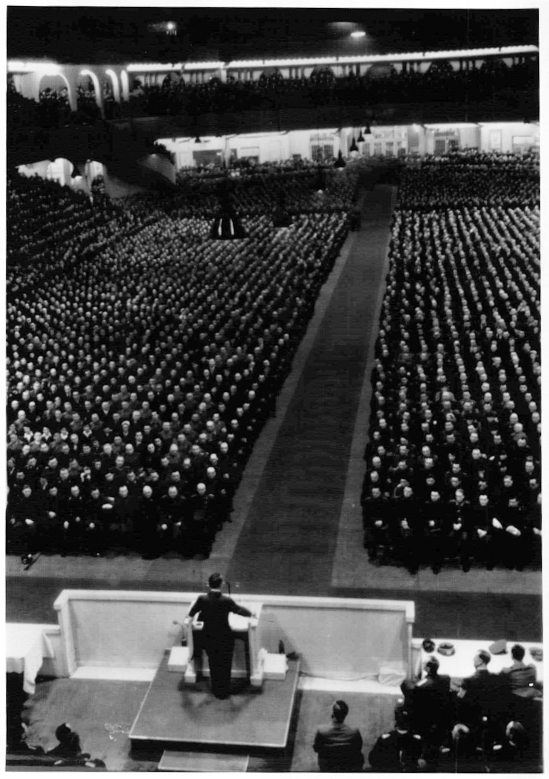
Hitler also gives a speech to students today, at the annual rally of young officer cadets at the Berlin Sportpalast. In it, he compares the populations of nearby nations to that of Germany and finds injustice in the amount of land that Germany occupies relative to its population — quite an interesting rationale for war:
“There are approximately 85 million Germans in Germany. I do not even include in this figure our Low German Volksgenossen. England, the British Empire, has barely 46 million Englishmen at home. The French Empire has barely 37 million Frenchmen at home. Even the American Union, minus Negroes and Jews and Latinos and Germans, has barely 60 million true Anglo- Saxons. Russia has barely 60 million Great Russians.
“And even today the unified racial core in Germany remains the largest by far; not only in value, in itself highly significant, but also in numbers, it is the greatest. By contrast, if we compare the percentage of Lebensraum occupied by the German Volk to that of the earth as such, then we must remark that our Volk is one of the most disadvantaged peoples of the world. Barely 600,000 square kilometers, in fact about 140 persons per square kilometer. 46 million Englishmen rule, control, and organize about 40 million square kilometers. Barely 60 million Great Russians rule an area of about 19 million square kilometers. About 60 million Anglo-Saxons within the American Union determine life within an area which encompasses about nine and a half million square kilometers. 37 million Frenchmen rule over life in an area of nearly ten million square kilometers.”
In other words: the German Volk, in terms of the space it occupies, is by far the most modest there is on this earth.
Hitler also justifies his actions — which, of course, are top secret, but the day’s Directive obviously is what he is commenting upon here — from a candidly Darwinian perspective:
“Truly, this earth is a trophy cup for the industrious man. And this rightly so, in the service of natural selection. He who does not possess the force to secure his ‘Lebensraum’ in this world, and, if necessary, to enlarge it, does not deserve to possess the necessities of life. He must step aside and allow stronger peoples to pass him by.”
This jibes nicely with Führer Directive No. 21 issued to the Wehrmacht today. It is quite possible that he intended this address to serve as a companion piece to the Directive for historians.
[Ed: What an utterly demented son of a bitch…]
The tempo of British operations begins to fall quickly today. Having gained extensive territory and huge numbers of prisoners, the British forces begin some consolidation in southeast Libya in the Sollum/Fort region. Advanced mechanized units are firing on Bardia, but it will take some time to assemble troops for a proper assault.
Australian troops are being brought forward, including the 16th and 19th Australian brigades, to lead assaults on Bardia and the strategically important port and fortress of Tobruk. These troop movements will take roughly two weeks to complete. The British troops are aided by the fact that the Italian strong points, such as Fort Capuzzo, are in excellent shape due to the minimal amount of fighting there.
In Malta, it is the coldest winter in 17 years. Snow even falls on the higher elevations, an unusual occurrence. Two workers at the Malta Dockyard, B J Lewis, Chargeman of Fitters, and Frank Mallia, Chargeman of Labourers, are awarded the George cross for protecting an anti-aircraft gun hit by bomb splinters during an air raid on 24 September. There also is an air raid today by one bomber which causes some damage in the dockyard. The RAF shoots down the bomber.
The Greek 3rd Infantry Division continues struggling forward from Porto Palermo toward Himara on the Adriatic coast. The weather is terrible, but the Greeks are making progress toward capturing the tactically important Giami high ground. The Greeks are readying a coordinated assault on the port on the morrow. The RAF bombs the port of Valona, while the Italians use their fleet to bombard the Greeks along the coast. The Royal Navy also is active along the Albanian coast, with battleships HMS Valiant and Warspite joining in with the RAF’s attack on Valona.
Greek machine-gunners were reported raking the Albanian towns of Klisura and Tepelini from surrounding mountain peaks tonight in an apparent prelude to a major effort to drive out the Italian defenders. The Greeks declared that in bringing the two nearby towns under their guns their troops scored a “brilliant victory” likely to have a decisive influence on the Albanian campaign. Klisura is in middle Albania on a cross mountain road leading to Tepelini, some 12 miles to the west. It also provides an important route to the lower Viousa river valley.
The Greek and Italian units fighting in the mountains are suddenly confronting a common enemy, avalanches. Reports from the front indicate that the violent fire of the heavy artillery has caused the snow on the mountains to shift and that soldiers, mules and guns have been swept away by the tumbling masses of snow.
Winston Churchill visits Harrow School, his alma mater, for the first rendition Harrow songs (he makes these visits annually). After commenting that Hitler had described the war as being between those who had been through the German schools and those who had been at Eton, Churchill comments, “Hitler has forgotten Harrow.” Meanwhile, the Queen makes a tour of ambulance services and ARP depots. Her daughter, the future queen, will work in a motor pool herself, and the Queen may be thinking ahead.
Churchill writes to Wavell “ask and it shall be given.”
Having just arrived in London, Colonel “Wild Bill” Donovan meets with Winston Churchill. Churchill briefs Donovan on the situation in Spain, Turkey, and the Balkans, Donovan’s destinations.
Otto Skorzeny departed the Netherlands for northern France as a member of 2nd SS Division “Das Reich”.
Fernand de Brinon becomes the Vichy French ambassador to the Germans occupying Paris. De Brinon is seen as quite sympathetic to the Germans and has had five private talks with Hitler during the 1930s. He also is friendly with German Foreign Minister Joachim Ribbentrop.
General Andrey Eremenko (Yeryomenko) becomes Commander in Chief of the North Caucasus Military District. Eremenko is a tank expert, as shown during the conquest of eastern Poland in 1939, and has acquired the nickname “the Russian Guderian” — which is both a compliment to him and to General Heinz Guderian.
RAF Bomber Command dispatches 17 Wellingtons and 9 Whitleys to Mannheim, and 5 Wellingtons to the Pirelli factory at Milan overnight. Fires were claimed started near Mannheim main railway station and 3 aircraft which reached Milan claimed a ‘terrific blaze’ there. 1 Wellington was lost.
The Luftwaffe is very quiet today. For more than forty-eight hours no air raid alarm has sounded in London or, quite possibly, anywhere in Great Britain.
In a decision made long before, Air Vice Marshal Keith Park of No. 11 Group, the most prestigious Air Group and the one that defends London, is replaced by his long-time nemesis Leigh-Mallory of No. 12 Group. He and Air Marshal Dowding have been essentially cashiered due to political infighting within the RAF, though both have done sterling work. Once Dowding was removed from his position atop Fighter Command and replaced by Sholto Douglas, Park’s removal was a given, as Park and Dowding continually supported each other during the Battle of Britain. Coincidentally, Dowding departs for the United States today aboard liner Leopoldville as part of his duties for his sinecure position within the aircraft production area. For his part, Park is going to some training duties.
U-96, commanded by Kapitänleutnant Heinrich Lehmann-Willenbrock, damaged Dutch tanker Pendrecht (10,746grt) from convoy OB.259 in 59‑05N, 17‑47W. At 1615 hours on 18 December 1940 the Pendrecht (Master Albert Meinsma), dispersed the day before from convoy OB.259, was hit aft on the starboard side ahead of the engine room by one G7e torpedo from U-96 (Lehmann-Willenbrock) in 59°05N/17°47W after being chased by the U-boat for about one hour. The tanker had left Cardiff for New York in ballast on 7 December. The U-boat surfaced in some distance because they had no torpedoes left in the tubes, only one G7a torpedo stored in a deck canister and the tanker was armed. The crew initially abandoned ship but reboarded the vessel when two other tankers arrived and one of them fired two shots at U-96, keeping her at distance while the Germans moved the spare torpedo into the boat. The U-boat then tried to locate the damaged tanker again but lost her during the night. HMS Legion (G 74) (Cdr R.F. Jessel, RN) then met Pendrecht and escorted her to Rothesay, arrving on 21 December. There were no casualties. The tanker had a hole of 14 meters in her side and went to Glasgow for temporary repairs, later to Swansea because it was planned to transfer her to the USA for permanent repairs. The 10,746 ton Pendrecht was carrying ballast and was bound for New York, New York.
U-100, commanded by Kapitänleutnant Joachim Schepke, sank British steamer Napier Star (10,116grt) in 58‑58N, 23‑13W. At 2020 hours on 18 Dec 1940 the unescorted Napier Star (Master William Walsh) was hit amidships by one of two torpedoes fired by U-100 321 miles 285° from Rockall. The U-boat had followed the ship since 1043 hours. The ship sank by the stern after being hit by a coup de grâce at 2049 hours. The master, 58 crew members and twelve passengers were lost. Nine crew members, one gunner and four passengers were picked up by the Vaalaren and landed at Liverpool on 23 December. The 10,116 ton Napier Star was carrying passengers and general cargo and was bound for New Zealand.
Italian submarine Veniero sank Greek steamer Anastassia (2883grt) from dispersed convoy SC.15 in 54‑24N, 19‑04W. Sixteen crew members were lost, two crewmen were missing, and ten crewmen were made prisoners of war. British steamer Flowergate (5156grt) sighted the wreck of steamer Anastassia awash on the 20th.
Aircraft carrier HMS Formidable and heavy cruiser HMS Norfolk departed Scapa Flow at 2000 to operate as Force K in the South Atlantic to search for the German heavy cruiser. The aircraft carrier and heavy cruiser were escorted from Scapa Flow by destroyer HMS Bedouin, HMS Matabele, HMS Mashona, and HMS Eskimo. The destroyer screen parted company in 55N, 25W. The British ships travelled with convoy WS.5A for the first part of the voyage, but had been detached prior to the attack on the convoy on the 24th.
Destroyers HMS Escapade, HMS Electra, and HMS Eclipse arrived at Scapa Flow at 0130 after taking battleship HMS Rodney to Rosyth.
Battleship HMS Nelson, battlecruiser HMS Repulse, destroyers HMS Cossack, HMS Sikh, HMS Tartar, HMS Brilliant, HMS Bulldog, HMS Beagle, HMS Douglas, HMS Escapade, HMS Electra, and HMS Eclipse departed Scapa Flow to carry out tactical exercises west of the Orkneys. The British force arrived back at Scapa Flow at 0930/20th.
Destroyer HMS Tynedale departed Scapa Flow at 1500 to rendezvous with British steamer Ben My Chree off Aberdeen at 0200/19th and take her to Kirkwall. Following disembarkation, the steamer was taken to Aberdeen. Destroyer Tynedale arrived at Scapa Flow on the 20th after this duty.
Destroyer HMS Vimy departed Scapa Flow at 2020 to rendezvous with armed merchant cruiser HMS Salopian in 61N, 15-30W at 1200/20th. Destroyer Vimy was to have met armed merchant cruiser Salopian, but she could not locate her. When cruiser Salopian reported she had already passed the Butt of Lewis at 1900, destroyer Vimy was ordered back to Scapa Flow. Destroyer Vimy arrived at Scapa Flow at 0800/22nd.
Submarine HMS Tuna attacked Italian submarine Brin, which was returning from Ceuta with submarine Bianchi, in 45-28N, 2-27W. No damage was done to the Italian submarine. Later in the day, submarine Tuna sank French tug Chassiron (172grt) off the Gironde.
British tanker Osage (1010grt) was sunk by German bombing four miles northeast of Arklow Light Vessel, County Wicklow. The crew of the tanker was rescued.
British steamer Tweed (2697grt) was damaged by German bombing in 53‑40N, 04‑40W.
Minesweeping trawler HMS Refundo (258grt, T/Skipper A. S. Dorward RNR) was sunk on a mine off Harwich in 51-56-06N, 1-21-02E. Two ratings were killed in the trawler. The trawler was taken in tow, but sank ten yards west of Beach End Buoy.
German steamer Birkenfels (6322grt) was lost on a mine, laid by British MTBs off the Schelde.
German vorpostenboot (flak ship) V-403 hits a mine and sinks in the Westerscheide (Western Scheldt).
British coaster Ability hits a mine and sinks in the Thames Estuary near Clacton-on-Sea, Essex.
Submarine HMS Triton (Lt G. C. I. StB. S. Watkins) was declared lost after failing to arrive at Malta after patrol on the 17th. She was probably sunk by an Italian mine in the Otranto Strait on the 7th in 40-45N, 18-01E. Lt Watkins, Lt C. J. R- Cave, Lt M. J. R- Smith, Lt R- E. Dean RNR, Warrant Engineer R- G. Milne, the forty nine ratings of the crew were lost with Triton.
Italian light cruisers Eugenio and Montecuccoli and destroyers Pigafetta, Da Recco, Pessagno, and Riboty bombarded Greek positions near Corfu.
German cruiser Admiral Scheer captured British ship Duquesna in the South Atlantic 800 miles south of Cape Verde Islands, capturing 91 crew and 8 passengers. Captain Theodor Krancke of Admiral Scheer purposefully allowed Duquesna to radio to help in order to distract the Royal Navy, hoping to indirectly help cruiser Admiral Hipper to break out into the Atlantic Ocean from the Denmark Strait. Duquesna, with 3,500 tons of frozen beef and 15 million eggs on board, was kept in operation by the Germans in the South Atlantic until 18 Feb 1941 to supply German ships in the area. Aircraft carrier HMS Hermes, light cruiser HMS Dragon, and armed merchant cruiser HMS Pretoria Castle from St Helena were searching for the German cruiser. Heavy cruiser HMS Cumberland and light cruisers HMS Newcastle and HMS Enterprise were searching in the Rio-Montevideo area. Heavy cruiser HMS Dorsetshire and light cruiser HMS Neptune were also searching. Heavy cruiser HMS Berwick was to have joined this group, but did not.
Light cruiser HMS Dunedin was refitting at Portsmouth from 18 to 23 December.
The slow units of Convoy WS.5A departed the Clyde and Liverpool on the 18th. The Clyde section was escorted by anti-aircraft cruiser HMS Cairo and destroyers HMS Bath, HMS St Marys, HMS St Albans, HMS Worcester, and HMS Watchman. The Liverpool section was escorted by destroyers HMS Witherington and HMS Witch, sloop HMS Wellington, and corvettes HMS Clematis, HMS Jonquil, HMS Cyclamen, and HMS Geranium. The corvettes travelled with the convoy for duty in the South Atlantic. Ships from Belfast were escorted by destroyer HMS Venomous. The slow units were met at daylight on the 19th by anti-aircraft cruiser HMS Bonaventure and destroyers HMS Vesper, HMS Harvester, and HMS Highlander. The destroyers were detached on the 21st.
These steamers were British steamers Tamaroa (Commodore, 12, 405grt), auxiliary minelayer HMS Atreus (Vice Commodore), Settler (6000grt), Bhutan (6104grt), Delane (6054grt), Orbita (15,495grt), City of London (8956grt), Neuralia (9182grt), Anselm (5954grt), Stentor (6148grt), Menelaus (10,307grt), City of Derby (6616grt), Arabistan (5874grt), Empire Trooper (13,994grt) and City of Canterbury (8331grt), Belgian steamer Elisabethville (8351grt), and Dutch steamer Costa Rica (8672grt). British steamer Ernebank (5388grt) sailed but was forced to return to Liverpool. Liner Rangitiki (16,984grt) proceeded from Avonmouth and travelled with this section. Belgian steamer Leopoldville (11,509grt) departed with this convoy and proceeded to Halifax. She arrived at 1445/28th escorted into harbor by battleship HMS Royal Sovereign.
The fast units were British steamers Essex (11063grt), Northern Prince (10917grt), Clan Macdonald (9653grt), Clan Cumming (7264grt), and Empire Song (9228grt) which departed the Clyde and Liverpool on the 19th. The convoy was met at daylight on the 20th by escorts anti-aircraft cruiser HMS Naiad, aircraft carrier HMS Argus, and destroyers HMCS Ottawa, HMCS St Laurent, and ORP Piorun from the Clyde, destroyers HMS Highlander (SO), HMS Harvester, and Le Triomphant from Londonderry, and aircraft carrier HMS Furious and destroyers HMS Beverley, HMS Kelvin, and HMS Kipling from Liverpool. Aircraft carrier Furious was carrying aircraft to Takoradi for Operation MONSOON. The destroyers were detached on the 22nd. The fast section and the slow section rendezvoused on the 23rd.
Convoy HX.97 departed Halifax at 1300 escorted by Canadian corvette HMCS Hepatica, which proceeded through for refitting and arming at Greenock. Ocean escort was armed merchant cruiser HMS Worcestershire, which was with the convoy from 18 to 18 December. Destroyers HMS Vanquisher, HMS Viscount, and HMS Whitehall and corvette HMS Gentian were with the convoy from 30 December to 3 January. Corvette HMS Rhododendron was with the convoy on 1 and 2 January. The convoy arrived at Liverpool on 3 January. Heavy cruiser HMS York and light cruiser HMS Gloucester with three destroyers were detached from the Mediterranean Fleet to sweep in the Adriatic.
Convoy BN.11 departed Aden, escorted by light cruiser HMS Caledon and sloops HMS Auckland, HMS Flamingo, and HMS Shoreham. These escorts were detached on the 22nd when joined by sloops HMS Clive and HMS Grimsby. The convoy arrived at Suez on the 25th.
In Washington today, President Roosevelt sent to Congress a veto of the Logan-Walter bill. He discussed the defense program with Secretaries Stimson and Knox and others.
The Senate was in recess.
The House received the Presidential veto and sustained it by 153 to 127. It received the Taber bill for coordination of defense procurement under an administrator and the Kennedy resolution for a special House committee “on peace.” It adjourned at 4:10 PM until noon tomorrow.
While Secretary of State Hull urged that America’s arms production be speeded up toward a war-time basis, administration aides on Capitol Hill prepared to push for legislation implementing President Roosevelt’s plan to lend war supplies to Britain. One expert estimated that this plan, under which the United States would take over future British war orders, pay for materials itself and lease them to Britain, might add about $2,500,000,000 to the $15,000,000,000 authorized and appropriated by the present congress for United States defense. How the additional financing would be handled was not officially explained, but Secretary of the Treasury Morgenthau already has asked congress to increase the national debt limit from $45,000,000,000 to $60,000,000,000 or $65,000,000,000.
The plan under consideration by President Roosevelt to finance production of arms for Britain was branded yesterday by Verne Marshall, chairman of the No Foreign War Committee, as a movement “deliberately calculated” to place this country in a position where war with Germany would follow inevitably.
The New York Times, in a dispatch from Washington, said today that President Roosevelt and cabinet members had reached an agreement “in principle” on a plan to reorganize the administration of national defense to obtain the “utmost speed in the output of vital war supplies for this country and the democracies.” The “agreement,” the newspaper said, was reached by the president, Secretary of Navy Knox, Secretary of War Stimson and Undersecretary of Navy Forrestal. The plan, the Times said, “calls in substance for an over-all defense council composed of Secretaries Stimson and Knox and William S. Knudsen, industrial member of the defense advisory The new “supreme council,” said the Times, “would be charged specifically with getting the rearmament job done and, according to the plan as worked out upon request of the president during his absence in the Caribbean, would be clothed by him and congress with the authority necessary to that end.”
President Roosevelt sent to the House of Representatives at noon today his expected message vetoing the Logan-Walter bill to subject rulings and regulations of administrative agencies to court review and within three hours the House had upheld the veto, thus killing the legislation for this session of Congress. The vote was 153 to override against 127 to sustain the veto, two-thirds being necessary to override. As soon as the vote had been announced, Representative McCormack of Massachusetts, majority floor leader, told newspaper men that Administration forces probably would offer tomorrow a resolution to adjourn the Seventy-sixth Congress sine die. Under the law, its session could last until midnight January 2, but if it should adjourn now it would not meet again unless summoned into special session by President Roosevelt.
A previous motion to adjourn, offered by Administration leaders, was defeated November 19 in the House, and the fact that the Senate had not then acted on the Logan-Walter bill was a factor in the vote. The Senate then passed the bill November 26, by only 27 to 25, and proponents of the measure were all the more determined to keep Congress in session so that President Roosevelt would not have an opportunity for a pocket veto. Mr. McCormack seemed to believe there would be little opposition to adjournment, with the holiday season beckoning the members to their homes. He said he had conferred with Speaker Rayburn and with Representative Martin of Massachusetts, the minority leader, though no agreement had been reached.
Crown Princess Juliana of the Netherlands arrived today for a three-day visit at the White House, with an obviously eager delight in being here that proclaimed here approval and enjoyment of the two-day program planned for her entertainment.
The State Department stated tonight that it acted favorably on all except a dozen of 2,000 names of political refugees abroad whose admission to the United States had been recommended by committees in this country.
Following a half-hour conference this afternoon with Secretary Morgenthau over his proposal that State and local bonds be made fully taxable by the federal government, Mayor La Guardia of New York City told reporters he was still opposed to the idea.
The U.S. Army Air Corps activates four air districts to have administrative and operational control of all tactical units (bombardment, pursuit and reconnaissance) in the continental U.S. Prior to this date, all tactical units in the U.S. had been under the control of three wings, the 1st at March Field, Riverside, California; the 2d at Langley Field, Hampton, Virginia; and the 3d at Barksdale Field, Shreveport, Louisiana. The four new air districts, assigned to General Headquarters Air Force, are the Northeast Air District at Mitchel Field, Hempstead, Long Island, New York; Northwest Air District at McCord Field, Tacoma, Washington; Southeast Air District at MacDill Field, Tampa, Florida; and Southwest Air District at March Field, California.
The thirty-seventh anniversary of the airplane flight of the Wright Brothers at Kitty Hawk, North Carolina, was celebrated today in several observances. The Collier Trophy, for “the greatest achievement in aviation in the United States, the value of which has been demonstrated in actual use during the preceding year,” was presented by President Roosevelt to the country’s commercial. airlines, with a special citation to three men who developed a compact oxygen mask enabling pilots to fly efficiently at high altitudes. The experts were Dr. Walter Boothby and Dr. William R. Lovelace 2d of the Mayo Foundation, and Captain Harry C. Armstrong of the Army Medical Corps, Wright Field, Dayton. The three scientists and a group of airline officials were at the White House for the presentation. Later they were guests at a luncheon given by Colliers Magazine, donor of the trophy.
The Curtiss SB2C Helldiver, U.S. Navy scout-bomber, took its first flight. The plane is reputed to have issues with its small vertical tail, but the flight is without incident.
President Manuel Avila Camacho has drawn up a bill to remove the National Railroads of Mexico from workers’ management. The bill will be sent to Congress soon.
U.S. Navy heavy cruiser USS Louisville (CA-28) arrives at Bahia, Brazil, as she continues to “show the flag” in Latin American waters.
The Thai [Siamese] air force was reported by the High Command tonight to have carried out large scale “reprisal” raids on seven important towns in French Indo-China.
Responding to an address in which Japanese Foreign Minister Yosuke Matsuoka said that Japan desired only to see an end to trouble in China and war in Europe, United States Ambassador Joseph C. Grew declared today that the United States must consider “not alone expressed intentions” but “facts and actions, too, regardless of the persuasive garb in which they may be dressed.” Both addresses were made at a luncheon of the America-Japan Society.
Mr. Matsuoka appealed to “the common sense of our two peoples. to maintain calm judgment and quiet self-restraint in the face of an appalling, unprecedented world situation.” He said that in East Asia, Japan “shut the door to no one.” Mr. Grew, replying extemporaneously, stated flatly: “The door is not to be closed anywhere to anyone. The American people are firmly determined in certain matters.”
Mr. Matsuoka declared: “I owe it to candor to admit that the relations between our two countries are severely strained,” adding that he felt the fundamental cause of this was “American misapprehension of Japan’s aims and aspirations.” “Contrary to the impressions current in America and elsewhere,” he asserted, “Japan is not waging an imperialist war of greed and aggression in China. We are engaged in a moral crusade. “Laugh or shrug your shoulders if you like, ladies and gentlemen, but I am sure time will prove it.”
Japan will give Netherlands Indies a “last chance” to conclude an economic agreement in forthcoming trade. negotiations, responsible Japanese sources here indicated today. A delegation headed by former Japanese Foreign Minister Kenkichi Yoshizawa now is en route to Batavia and is scheduled to open the negotiations early in January. This will be Japan’s second attempt to obtain a favorable economic position in the Indies and, authoritative Japanese quarters asserted, “it will be the last.” They declined to say what will happen if the new discussions fail, but informed neutral quarters in Tokyo have reported direct action might be taken.
Dow Jones Industrial Average: 129.42 (-1.11)
Born:
Lei Feng [Lei Zhengxing], Chinese soldier in the People’s Liberation Army who was the object of several major propaganda campaigns in Communist China, in Wangcheng District, Changsha, China.
Naval Construction:
The Royal Canadian Navy Bangor-class (Diesel-engined) minesweeper HMCS Transcona (J 271) is laid down by Marine Industries Ltd. (Sorel, Quebec, Canada).
The Royal Navy Isles-class minesweeping trawler HMS Brora (T 99) is launched by Cook, Welton & Gemmill (Beverley, U.K.); completed by Holmes.
The American type C3 merchant ship Rio Parana is launched by the Sun Shipbuilding & Drydock Company in Chester, Pennsylvania. After wartime conversion in 1942, she will emerge as the Royal Navy escort aircraft carrier HMS Biter (D 97). Near the end of World War II, she is returned to the U.S. Navy and quickly loaned to France, becoming the Marine Nationale (French Navy) escort carrier Dixmude (A609).
The Royal Navy Fairmile B-class motor launch HMS ML 152 is commissioned.
The Royal Navy Fairmile B-class motor launch HMS ML 156 is commissioned.
The Royal Navy Fairmile B-class motor launch HMS ML 164 is commissioned.
The Royal Navy LCT (Mk 1)-class landing craft, tank HMS LCT 13 is commissioned.
The Royal Navy LCT (Mk 1)-class landing craft, tank HMS LCT 14 is commissioned.
The Вое́нно-морско́й флот СССР (ВМФ) (Soviet Navy) “M” (Malyutka)-class (3rd group, Type XII) submarine M-33 is commissioned.
The Royal Canadian Navy Flower-class corvette HMCS Chambly (K 116) is commissioned. Her first commanding officer is A/Lieutenant Commander Frank Crighton Smith, RCNR.
 History Diaries