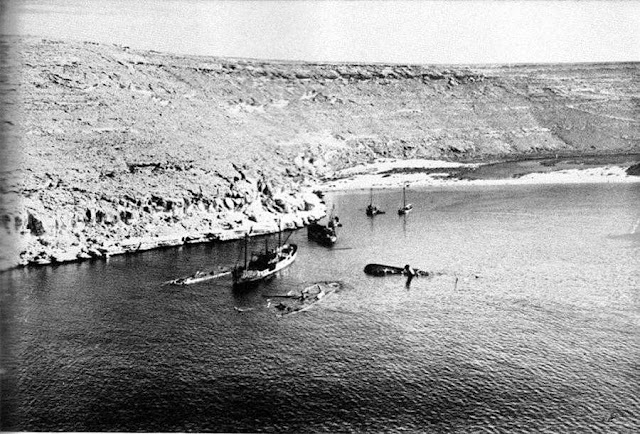
British forces occupied Fort Capuzzo, Sollum and three other Italian positions near the Egypt-Libya border. Italian survivors retreat to Bardia fortress. Britain’s army in Africa reported today the capture of three more Italian frontier forts, and rolled on toward the important Fascist base of Bardia in the counter-invasion of Italian Libya. Reuters, British news agency, reported tonight that British mechanized units were now surrounding and attacking Bardia itself, and that about the town heavy fighting was raging.
British monitor HMS Terror and gunboat HMS Ladybird bombarded Bardia, Libya, sinking Italian ships Galata, Vincenzino, and Giuseppina D. in the harbor. On the same day, the British announced that they had captured 20,000 Italian prisoners, including three generals, in Egypt.
Operation Compass, originally intended by the British to be a five-day tank raid between Italian camps, now, as of 17 December 1940, has bagged Sidi Omar, Sollum and the Halfaya Pass, never even contemplated before the operation. The Western Desert Force has taken 38,300 prisoners, captured 237 guns and 73 tanks, and had minimal casualties for such large gains (133 killed, 387 wounded, eight missing). The captured Italians will be sent to prison camps in India at Ahmednagar, Ramgarh, and Deolali.
British 7th Armoured Division continues advancing westward toward Bardia, but it consolidates its position in the vicinity of Fort Capuzzo while General Wavell brings forward the 6th Australian Division (Major General Iven Mackay) for a large-scale assault. This will take until the new year.
The Royal Navy stands offshore Libya and pounds the Italian positions at Bardia. Monitor HMS Terror, gunboat HMS Ladybird and HMS Aphis, accompanied by HMS Voyager and Vendetta, have little to fear from the disappearing Italians. Among other damage they cause, the British ships sink Italian coasters Giuseppina D. and Vincenzinano in the harbor.
The Columbia broadcasting system’s correspondent in Belgrade declared in a broadcast tonight from that Balkan capital that more than 50,000 German troops have moved quietly into Italy presumably to embark for Libya and Albania to aid Italian forces, according to information reaching highly reliable sources in Yugoslavia. Winston Burdett, the correspondent, said the major part of the Nazi forces were reported at Bad and Naples, southern Italian ports, but some also were reported to be in Genoa and Milan.
Greek I Corps captures Hormova. The Greek 3rd Infantry Division continues its offensive from Porto Palermo toward Himara. The major objective is to capture the intervening Giami Heights. Once those are in the Greek grip, the Italians likely will start evacuating the port. However, the weather is making all operations difficult, and the Italians have an effective artillery battery on the heights nearby, protected by strings of barbed wire. Further north, a fierce battle rages over the pass at Klisura.
The British Home Office announced the hanging death of a third German spy. On the same day, a British housewife was sentenced to death for spying. Dorothy O’Grady was sentenced to death in England for spying. Her appeal would reduce the sentence to 14 years in prison. British housewife Dorothy Pamela O’Grady becomes the first British woman to be convicted of treason during World War II. The sentence is death, but she will appeal. O’Grady had a habit of walking her dog in restricted areas along the Isle of Wight coast after dark. She was noticed, security services started monitoring her, and they found in intercepted mail that she was making detailed drawings of beach defenses. The security services then waited until they caught her red-handed cutting some telegraph wires. Grady has no obvious connection to Germany and later passed the whole incident off as a thrill. The maps drawn by O’Grady are not made public until 2009, and then mysteriously disappear, but apparently, they were quite accurate.
The British government announced a ration increase for Christmas week.
Air Vice Marshal Richard Saul became the commanding officer of No. 12 Group RAF.
The British destroyer HMS Acheron sank after hitting a mine off the Isle of Wight.
The Germans continue to pressure French leader Marshal Petain to restore Pierre Laval to all of his offices, but Petain will not budge. German Ambassador Abetz threatens some kind of retaliation, but Petain holds firm. Matters are not helped by Petain’s gratuitous slight of not appearing with Hitler a couple of days ago at the reburial of Napoleon II in Paris. In any event, Petain’s dismissal of his vice-premier appears to have been motivated more by personal dislike than by larger issues, as his replacement, Pierre Flandin, just continues Laval’s policies anyway.
The Luftwaffe is very quiet throughout the day and night but does manage to lose a bomber during one of the few raids.
RAF Bomber Command dispatches 9 Whitleys overnight to Mannheim, and 8 Blenheims to airfields in France. No losses.
German seaplane base on Sylt Island was bombed. RAF Bomber Command sends 50 Whitley and Hampden bombers against the Island of Sylt in the Frisian Island chain off Holland. The Luftwaffe seaplanes based there have been extremely successful in recent months in their attacks against British shipping.
Running trials after refit, destroyer HMS Acheron (Lt J. R- Wilson) of the 1st Destroyer Flotilla was lost in mining at 0640 off the Needles off the Isle of Wight in 50‑31N, 1‑31W. Wilson, Lt J. E. H. Coleright, Lt W. J. Compton, Sub Lt G. F. Cleveland, P/T/Surgeon Lt C. L. Pretre RNVR, T/A/Boatswain R- Heany, one hundred and forty seven ratings, twenty two dockyard workers were lost in the destroyer. There were only sixteen survivors, T/Sub Lt K. C. Villiers RNVR, Gunner (T) F. H. Reeve, thirteen ratings wounded, from the crew and three survivors of the dockyard workers.
Anti-aircraft cruiser HMS Curacoa arrived at Scapa Flow at 0930 after covering convoy EN.41. The cruiser departed Scapa Flow at 1215 to meet convoy WN.54 in Pentland Firth and cover the convoy until dark. Anti-aircraft cruiser Curacoa arrived at Scapa Flow at 2130.
Anti-aircraft ship HMS Alynbank arrived at Methil at 1400 with convoy WN.53. Anti-aircraft ship Alynbank departed Methil at 2200 with convoy EN.42.
Destroyers HMS Douglas and HMS Beagle arrived at Scapa Flow at 1745 after escorting armed merchant cruiser HMS Chitral.
Destroyer HMS Tartar arrived at Scapa Flow at 1215 after refitting at Plymouth.
Destroyer HMS Georgetown departed Scapa Flow at 1700 for Greenock. The destroyer’s working up was completed. The destroyer was delayed by weather, but was able to arrive at 0031 on the 19th.
Destroyers HMS Active and HMS Antelope with convoy HX.93 attacked a submarine contact in 55-58N, 13-34W.
Between No.1 and No.2 Sea Reach Buoy off Southend, British steamers Inver (1543grt), Malrix (703grt), Beneficent (2944grt), Aqueity (370grt), Belvedere (869grt) were lost on mines. Mines take quite a toll on the British today. The Germans are using multiple types of mines, including contact, magnetic and acoustic, and while there are ways to counter all of them, there simply aren’t the resources to sterilize the waters around Great Britain of mines or protect smaller ships. The British Isles rely upon sea trade for survival, and that must go on regardless. So, brave men venture out every day knowing that it may well be their last.
Steamer Inver (1543 tons, 17 deaths, including the pilot) was lost outside the boom at Southend. Fifteen crewmen, the naval gunner, the pilot were lost.
Steamer Malrix (703 tons, 7 deaths) was lost 1.75 miles 081° from Nore Light Vessel.
Steamer Beneficent (2944 tons, 6 deaths) was lost about two cables off Southend Gate.
Six crewmen were lost on the steamer Aqueity (370 tons).
Steamer Belvedere (869 tons) was lost fifty yards west, northwest from M.Boom Vessel off Southend. Four crewmen were lost on the steamer.
British fishing vessel Carry On (93grt) was sunk on a mine east of Nore Sand Light Vessel. Seven crewmen were missing on the vessel.
British boom defense vessel HMS Thomas Connolly (290grt, T/Boom Skipper A. Martell RNR) was sunk on a mine in Medway Channel off Sheerness. T/Lt R- L. Langridge RNVR, was lost in the vessel. T/Boom Skipper Martell was wounded.
Mines also inflict pain on the Germans today. However, the German economy is not nearly so dependent upon seagoing commerce as is Great Britain’s (though barge traffic in canals indeed is very important to the German economy). German 9425 ton freighter Paranaguá hits a mine and sinks off Den Helder, Holland.
T/Lt (A) C. M. Beavis RNVR, was killed when his Walrus of 701 Squadron forced landed near Dunkeld and struck a wall. The remainder of the crew was badly injured.
Greek steamer Mentor (3050grt) was damaged by German bombing in 52‑48N, 19‑22W.
Monitor HMS Terror and gunboat HMS Ladybird, escorted by Australian destroyers HMAS Voyager and HMAS Vendetta bombarded Bardia, Libya. Italian steamers Galata (618grt), Giuseppina D. (431grt), Vincenzino (190grt) were sunk in the bombardment.
Heavy cruiser HMS Berwick departed Gibraltar for the Azores patrol.
French large destroyer Albatros departed Toulon escorting submarines Aurora, La Psyche, and Oreade. The ships called at Oran on 19 to 21 December and passed Gibraltar on the 22nd. All arrived at Casablanca on the 23rd.
German cruiser Admiral Scheer, operating deep in the Atlantic, captures 8651-ton British refrigerator ship Duquesa. The Duquesa carries 14 million eggs and 3000 tons of frozen meat. Admiral Scheer’s crew is delighted at this delicious find, which they immediately put to good use. The men nickname the ship, which they keep handy, “The Floating Delicatessen” and “Wilhelmshaven South Catering Store.” Spoils of war indeed.
Convoy FN.361 departed Southend. The convoy arrived at Methil on the 19th.
Convoy FN.362 did not sail.
Convoy FS.362 departed Methil, escorted by destroyers HMS Valorous and HMS Versatile. Patrol sloop HMS Shearwater joined on the 18th. The convoy arrived at Southend on the 19th.
Convoy FS.363 departed Methil, escorted by destroyer HMS Vimiera and sloop HMS Weston. The convoy arrived at Southend on the 19th.
U.S. President Franklin D. Roosevelt gave a press conference in which he suggested leasing or selling of arms to Britain “on the general theory that it may still prove true that the best defense of Great Britain is the best defense of the United States, and therefore that these materials would be more useful to the defense of the United States if they were used in Great Britain, than if they were kept in storage here.” U.S. President Franklin D. Roosevelt gave a press conference suggesting that the U.S. lend arms to Britain. Roosevelt stated that “In the present world situation, there was no doubt in the minds of an overwhelming number of Americans that the best immediate defense of the United States is the success of Great Britain in defending herself. Quite aside from our historic and current interest in the survival of democracy, therefore, it is important from the selfish viewpoint of American defense that we should do everything to help the British Empire defend itself.” President Roosevelt announced a sweeping new plan for helping Great Britain tonight under which the United States government would take over future British war orders and release the materials for use abroad on a lease or mortgage basis to be repaid in kind after the war. Under the plan, planes and guns, for example, would be leased to the British. After the war, if they were still in good condition, the British would be expected to give them back. If they had been destroyed, the British would be obligated to furnish this country with equivalent weapons. The president likened it to a man lending a neighbor a hose to put out a fire in his house. In a long discussion of the proposal, he said it was still in the exploratory stage and would require time to work out both here and in London.
He produces one of his great quotes, putting a very complicated arrangement in plain terms that anyone can understand:
“Suppose my neighbor’s home catches fire, and I have a length of garden hose four or five hundred feet away. If he can take my garden hose and connect it up with his hydrant, I may help him to put out his fire. Now, what do I do? I don’t say to him before that operation, “Neighbor, my garden hose cost me $15; you have to pay me $15 for it.” What is the transaction that goes on? I don’t want $15—I want my garden hose back after the fire is over. All right. If it goes through the fire all right, intact, without any damage to it, he gives it back to me and thanks me very much for the use of it. But suppose it gets smashed up—holes in it—during the fire; we don’t have to have too much formality about it, but I say to him, “I was glad to lend you that hose; I see I can’t use it any more, it’s all smashed up.” He says, “How many feet of it were there?” I tell him, “There were 150 feet of it.” He says, “All right, I will replace it.” Now, if I get a nice garden hose back, I am in pretty good shape.”
Of course, “everything” would include a lot more than what the US currently is doing, so it is not quite clear what Roosevelt means by that. If it is “important” to the American defense, why not take direct action? There are some thorny issues involved, some of which are brought up by the reporters at the press conference itself, including who actually owns this “garden hose” while it is being used to spray the Germans. And, of course, if the house burns down and takes the neighbor and the hose as well, there won’t be any satisfactory return of a worn garden hose and you will be at even greater risk yourself from the fire, having given away your garden hose.
However, Roosevelt’s plan is a clever way to sidestep legal niceties. It allows the production of mass quantities of weapons which are then “lent” to an armed combatant to use against an (apparently, but unspoken) common enemy rather than simply “giving” them as aid or using them yourself. Once you start poking even slightly beneath the surface of this ruse, the entire thing collapses, but Roosevelt obviously intends to fight Hitler as best he can without actually going to war. Hitler, of course, notices what is going on,, and this inflames his resentment against the United States in general and Roosevelt in particular.
The Lend-Lease idea floated by President Roosevelt, as everyone knows, becomes Great Britain’s primary source of funding its military operations during World War II (together with low-interest loans). In essence, the British fight while the Americans pay their expenses — sort of like mercenaries. The lending mechanism continues even after the war, and repayments do not commence until 1950. Supposed to take place in 50 annual installments, the repayments pose a tremendous burden on the British economy, especially during the early years when the national debt is 200% of GDP.
One can draw a direct line from their debt repayments to the British devaluations of the pound sterling in the 1960s. These contribute to the destruction of the traditional international currency framework of fixed exchange rates (eliminated under US President Richard Nixon). The British government even is forced, during the 1970s, to seek relief from the International Monetary Fund, a source of funding usually reserved for Third World countries. However, to its eternal credit, Great Britain does finally pay off the debt discussed today, on 17 December 1940, with its final payment made to the United States on 31 December 2006.
Separately, Colonel “Wild” Bill Donovan arrives in London (via Lisbon) by clipper flying boat, the first step of his second fact-finding mission during the war on behalf of President Roosevelt. Roosevelt has a habit throughout the war of sending his cronies such as Donovan and Harry Hopkins as “envoys” to allies and, often, future enemies.
Several hours before President Roosevelt disclosed the outlines of his new scheme for continuing aid to Britain, Henry Morgenthau Jr., Secretary of the Treasury, told a House appropriations subcommittee that. British Treasury officials had warned that their nation could not order any more war supplies in the United States, beyond present commitments, unless financial assistance were assured from this country.
Secretary of the Interior Ickes charged tonight that the axis plans to cripple the United States by sabotage, to sap it by propaganda and to drive a wedge of suspicion between this country and Latin America. In a speech before the Columbia University Institute of Arts and Science, Ickes also denounced Americans whom he described as appeasers. Among them he named Col. Charles A. Lindbergh, whom he called a “peripatetic appeaser who would abjectly surrender… his sword even before it is demanded.”
Philip Murray, president of the Congress of Industrial Organizations, with the approval of the C.I.O.’s six vice presidents, today put the blame of the lagging defense program on the shoulders of industry.
The Duke of Windsor would accept the post of British Ambassador to the United States if he was appointed, he said this evening in Miami just before sailing for Nassau with the American-born Duchess on the yacht Southern Cross.
The thirty-seventh anniversary of the airplane flight of the Wright Brothers at Kitty Hawk, North Carolina, was celebrated today in several observances.
The Collier Trophy, for “the greatest achievement in aviation in the United States, the value of which has been demonstrated in actual use during the preceding year,” was presented by President Roosevelt to the country’s commercial. airlines, with a special citation to three men who developed a compact oxygen mask enabling pilots to fly efficiently at high altitudes. The experts were Dr. Walter Boothby and Dr. William R. Lovelace 2d of the Mayo Foundation, and Captain Harry C. Armstrong of the Army Medical Corps, Wright Field, Dayton. The three scientists and a group of airline officials were at the White House for the presentation. Later they were guests at a luncheon given by. Colliers Magazine, donor of the trophy.
Admiral Stark removes the Navy War Plan Orange from active status. The Orange Plan, he states, is out of date. Naval planners are in the final stages of creating a new plan, Rainbow Three. This is the final Orange plan, all subsequent war plans are Rainbow plans.
Contracts calling for construction as soon as possible of forty more destroyers than were previously contemplated have been signed by the Navy Department. They increase to 365 the number of such naval units either afloat or projected.
Rear Admiral Ernest J. King relieves Rear Admiral Hayne Ellis as Commander Patrol Force, U.S. Fleet, on board battleship Texas (BB-35).
Wang Ching-wei’s new Nanking “government,” together with its sponsoring Japanese authorities, is facing a financial crisis. Chinese bankers and financiers are refusing to cooperate with the new “government” as long as Mr. Wang controls and directs the financial structure of the new “government.”
Dow Jones Industrial Average: 130.53 (-0.54)
Born:
Kåre Valebrokk, Norwegian journalist and director of TV 2, born in Kristiansand, Norway (d. 2013).
Died:
Alicia Boole Stott, 80, Irish mathematician.
Naval Construction:
The Kriegsmarine (German Navy) Type VIIC U-boats U-339 and U-340 are ordered from Nordseewerke, Emden (werk 211 and 212).
The Royal Canadian Navy Bangor-class (Diesel-engined) minesweepers HMCS Melville (J 263) and HMCS Granby (J 264) are laid down by Davie Shipbuilding and Repairing Co. Ltd. (Lauzon, Quebec, Canada).
The Kriegsmarine (German Navy) Type VIIC U-boats U-593 and U-594 are laid down by Blohm & Voss, Hamburg (werk 569 and 570).
The Royal Canadian Navy Flower-class corvette HMCS Moncton (K 139) is laid down by the Saint John Dry Dock and Shipbuilding Co. Ltd. (Saint John, New Brunswick, Canada) .
The Royal Navy Flower-class corvettes HMS Buttercup (K 193) and HMS Chrysanthemum (K 195) are laid down by Harland & Wolff Ltd. (Belfast, Northern Ireland). Chrysanthemum is transferred before completion to the Forces Navales Françaises Libres (Free French Naval Forces) and commissioned as the Commandant Drogou from 26 January 1942.
The Вое́нно-морско́й флот СССР (ВМФ) (Soviet Navy) “L” (Leninec)-class (4th group, Type XIII-modified) submarine L-24 is launched by the Marti Yard (Nikolayev, U.S.S.R.) / Yard 198.
The Nihon Kaigun (Imperial Japanese Navy) Type B1 (I-15-class) cruiser submarine I-28 is launched by Mitsubishi (Kobe, Japan).
The Nihon Kaigun (Imperial Japanese Navy) Type B1 (I-15-class) cruiser submarine I-32 is launched by the Sasebo Naval Arsenal (Sasebo, Japan).
The Royal Canadian Navy Flower-class corvette HMCS Algoma (K 127) is launched by the Port Arthur Shipbuilding Co. (Port Arthur, Ontario, Canada).
The Royal Navy Flower-class corvette HMS Alisma (K 185) is launched by Harland & Wolff Ltd. (Belfast, Northern Ireland).
The Royal Navy Fairmile B-class motor launch HMS ML 139 is commissioned.
The U.S. Navy 70-foot Elco patrol motor torpedo boat USS PT-18 is commissioned.
The Royal Canadian Navy Flower-class corvette HMCS Wetaskiwin (K 175) is commissioned. Her first commanding officer is Lieutenant Commander Guy Stanley Windeyer, RCN.
 History Diaries