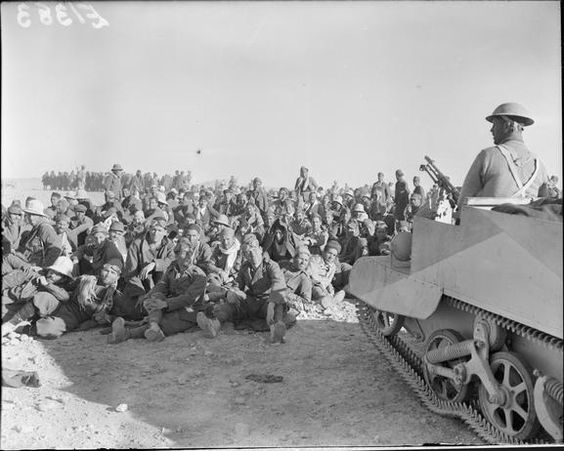
British 4th Armoured Brigade captured Sidi Omar, Egypt, taking 900 Italian troops prisoner. Britain’s Army of the Nile also claimed its first big victory on Italian colonial soil today and simultaneously crushed the last important Fascist threat inside Egypt’s borders by capturing Fort Capuzzo, just within Libya, and overwhelming the bitterly-fighting Italian garrison at Sollum (today Sallum), five miles from the Libyan border. Thus with one stroke reported in a bare announcement at British headquarters, troops of General Sir Archibald P. Wavell, Middle East commander, seized two points of a triangle of Fascist resistance in the western desert and on the Libyan frontier. British advance guards were reported sweeping on into Libya and the next probable objective of the advancing British apparently was Bardia, Libyan port and key Fascist base. The British spearheads of motorized desert troops were reported to have set the Italians back at some points to where they started from three months ago.
Operation Compass reaches its terminal phase on 16 December 1940 — having achieved vastly greater results than envisaged by anyone. The 7th Hussars and 2nd Royal Tanks of the British 4th Armoured Brigade of the Western Desert Force now stand in Sidi Omar and Sollum, while the Italians abandon Fort Capuzzo and other frontier outposts. The British continue resorting to the same trick, circling around behind the Italian camps and attacking from the southwest, and this continues to work because the Italian artillery faces east.
The British gladly take over the fortified Italian positions. Tobruk continues to hold out but is bombarded by sea and surrounded on land. The British turn Fort Capuzzo into their own supply depot, designating it Number 9 Field Supply Depot.
The British are now across the border in force. The Italians are forming a defensive line along the coast road far to the northwest. The next objective is Bardia, and the British plan is to leave a “Golden Road” open from Bardia to the seemingly impregnable Tobruk so that the Italians in Bardia will attempt to get there — and be cut down in the process.
Premier Benito Mussolini has personally ordered trial of food hoarders before a special wartime tribunal and death sentences in “the most severe cases,” in a move to strengthen the Italian home front and secure morale, It was announced early today. The death penalty is now applied in cases of blackout thievery.
General Giovanni Messe forms the Special Army Corps of the Italian 11th Army.
The Greek offensive is stalled virtually everywhere except in the coastal sector, primarily because of the weather. Heavy snow and winds, especially in the mountains, have reduced the pace of advance to a crawl. Greek I Corps (2nd, 3rd, and 4th Divisions) make some progress toward Himarë after restarting their offensive from Porto Palermo on the 15th. Greek II Corps is attempting to capture a key mountain pass near Klisura and facing more difficulty from the weather than the Italians. Greek V Army Corps (a corps in name only, it only has the 10th Division), attempts to secure Mount Tomorr, which divides II and III Corps. The RAF raids the Italian supply depot at Durazzo.
The British government, it was learned authoritatively tonight, has made a formal request for financial assistance from the United States government. The information came from official sources which left no doubt as to its authenticity, but details of the request were not available. However, usually well-informed officials indicated that the British had asked for a “line of credit” probably involving their securities and gold assets, rather than a straight unsecured loan. The official sources through which the request became known indicated that “financial assistance” was a more accurate term to describe the request than the word “loans.”
Discovery by Scotland Yard of a large Communist plot to spread discontent among British workers was reported tonight, 24 hours after a sharp warning to Russia to halt alleged attempts to sabotage Britain’s wartime efforts and morale. Minister of Labor Ernest Bevin, a member of Prime Minister Winston Churchill’s inner war cabinet, warned in a Glasgow speech Sunday night that “the government has to teach Russia that this method of carrying on her foreign policy does not pay in this country.” Discoveries regarding Communist preparations for a large-scale campaign among war industry workers were said to have been turned over in detail to the home office.
Korvettenkapitän Adalbert Schneider became the acting commanding officer of battleship Bismarck while Captain Lindemann was away on Christmas leave.
Finnish Major General Paavo Talvela arrives in Berlin for talks with the Reich’s top soldiers, Reichsmarschall Hermann Göring and General Halder. He has been recalled from civilian life for this task after retiring following the end of the Winter War and will remain on active duty. Talvela is considered to be a “specialist” at interacting with the Germans, most likely because he commanded a Finnish Jaeger battalion in Germany during 1916 and 1917.
The Nobel Committee cancels the Peace Prize for 1940.
In Kenya, the British begin stirring as well. South African troops under Major General Goodwin Austin retake a frontier outpost, Wajir, along the border with Italian Somaliland. The RAF lends support with a small force.
The Luftwaffe sends only occasional raiders against East Anglia and southeast England during the day. After dark, bombers hit London, Liverpool, and the Midlands.
Bombing of Mannheim: The first area bombardment of a German city was conducted by the Royal Air Force when 134 bombers attacked Mannheim during the night, starting large fires on both banks of the Rhine. RAF Bomber Command dispatches 134 aircraft overnight to Mannheim. This raid to Mannheim was probably the most interesting operation of this period of the war. Bomber Command was authorized by the War Cabinet to carry out a general attack on the center of a German city in retaliation for the recent heavy bombing of English cities, particularly Coventry and Southampton. Codenamed Operation Abigail Rachel, this attack constitutes the intentional destruction of Mannheim as a laboratory experiment for the development of RAF area bombardment techniques. Mannheim was chosen and a force of 200 bombers was prepared under the codename Operation Abigail Rachel. Weather forecasts indicated that conditions over the bomber airfields would deteriorate and the force was cut to 134 aircraft — 61 Wellingtons, 35 Whitleys, 29 Hampdens and 9 Blenheims —but this was still the largest force sent to a single target so far. The raid was opened by 8 Wellingtons, flown by the most experienced crews available, who attempted to start fires in the center of Mannheim using all-incendiary bomb loads. Following crews were supposed to use these fires as a guide and attempt to cause as much destruction as possible. For the first time in more than fifteen months of war, Bomber Command was deliberately aiming at a target which was not primarily military or industrial in nature. The general area of the center of Mannheim was the target. This was the first Allied area bombing raid of the war against a populated target, as opposed to targets of military or industrial value. It was an early forerunner of what the RAF would later call ‘area bombing’ and the Germans called ‘terror bombing’. The weather over the target was mainly clear of cloud and there was a full moon; the Mannheim defenses were not heavy. Bomber Command’s own records — the Operations Record Book and the Night Bombing Sheets give figures varying between 82 and 102 aircraft claiming to have bombed Mannheim. But the raid was not a success. The early Wellington ‘fire-raisers’ were not accurate and the largest fires were not in the center of the city. The resultant bombing by the main force of bombers was scattered. The Mannheim report (55 pages long!) shows that the majority of the bombs fell in residential areas. 240 buildings were destroyed or damaged by incendiary bombs and 236 by high-explosive bombs; included in these figures are 13 commercial premises, 1 railway station, 1 railway office, 1 school and 2 hospitals. The hospitals did not sustain serious damage although at one of them, a military hospital, 28 people, including 13 soldiers and 9 nursing sisters, were injured by flying glass caused by the blast of a nearby high-explosive bomb. 4 barges or river steamers were damaged. The total casualty list was: 34 dead, 81 injured and 1,266 bombed out. Of the dead, 13 were male civilians, 1 was a soldier, 18 were women and 2 were children. Of the bombed out, 223 were in the town of Ludwigshafen on the other side of the Rhine. 2 Hampdens and 1 Blenheim were lost and 4 more aircraft crashed in England.
This is a standard area bombing raid of the type the Germans have been sending against British cities since 7 September 1940. Mannheim, in theory, is a significant target because it contains the Mannheim Motorenwerke and naval arms factories. However, those are not the night’s real targets (though that is what the official RAF Operation Record Books states, as a cover-up in advance). Rather, the orders from the RAF to the pilots, apparently only given verbally, simply are to aim for the center of town and hope to cause as much chaos as possible.
The bombers drop 100 tons of high explosives and 14,000 incendiaries, but bombing aim is poor and, as with many of the Luftwaffe’s raids, the damage causes is not nearly commensurate with the ordnance used. The problem is that the pathfinder bombers, which go in advance of the main force and drop flares (a tactic used by both sides) for guidance, drop them in the wrong spot — so all the following heavy bombers drop their bombs also in the wrong spot. Some bomb loads even drop on Ludwigshafen, some distance away. This incident causes the RAF to rethink its tactics and draws it closer to the concept of the “Bomber Stream,” wherein bombers fly in tight formations that concentrate bomb loads closer together and thus wipe out entire sections of a city.
Mannheim straddles the Rhine, and the incendiaries start fires on both sides of the river that burn for days. The RAF loses three planes due to various causes. This is considered the first “area bombardment” by the RAF on a German city, which is a euphemistic term for a standard terror raid. There are 34 killed and 81 injured, with 240 buildings destroyed, including a military hospital. These figures still pale in magnitude with what the Luftwaffe is achieving in England at this time. This raid is considered “experimental” and is not publicized by the British government.
While not a resounding success, it is the first British step toward the RAF’s large-scale city raids that characterize the last half of the war. That said, the RAF returns to its precision attacks on military targets after Operation Abigail Rachel until… well, we’ll get to that when it happens.
The RAF has enough planes now that this isn’t the night’s only raid, either. It also sends bombers against Berlin, Heilbronn, and Speyer-am-Rhein as well. The British bombing offensive is still at such an early stage that the Germans in Berlin immediately send out crews to repair the damage to railway lines.
The Italians send a large force of planes from Italy, including 23 CR 42 fighters and 23 Savoia-Marchetti SM.79s. The SM 79 is considered the best Italian bomber, but the Italian biplane fighters are hopelessly outclassed.
U-37 sank Spanish steamer San Carlos (223grt) off Cape Juby, thirty miles south of Jandia Point. At 1950 hours on 16 Dec 1940, U-37 missed the San Carlos with one torpedo off Cape Juby and decided to attack the vessel at 2000 hours from a distance of 800 meters with the deck gun and the 37mm AA gun, but the deck gun broke down after 21 shots. The 15 crew members and 13 passengers abandoned ship in two lifeboats, but one man was lost. The Germans rowed in a dinghy to the ship and placed scuttling charges on the vessel that later sank the ship. In doing so they noticed that the fired rounds had not been able to penetrate the 20cm strong wooden hull of the ship. The 223-ton San Carlos was in ballast, bound for the Canary Islands.
Battleship HMS Rodney and destroyers HMS Escapade, HMS Electra, and HMS Eclipse departed Scapa Flow at midnight and arrived at Rosyth at 1145/17th.
Light cruiser HMS Birmingham completed a refit at Liverpool begun in September. The light cruiser rejoined the 18th Cruiser Squadron at Scapa Flow on the 27th.
Destroyer HMS Blencathra arrived at Scapa Flow at 1300 from Liverpool to work up.
Anti-aircraft ship HMS Alynbank departed Scapa Flow at 1100 to meet convoy WN.53 in Pentland Firth. The ship covered convoy WN.53 to Methil where she met convoy EN.42.
Submarine HMS Tribune attacked German tanker Karibisches Meer (6864grt) in 46-46N, 2-38E without success.
British steamer Bic Island (3921grt) was damaged by German bombing in 54‑12N, 17‑45W.
German motor trawler Heltraud (103grt) was sunk by enemy action.
In Operation HIDE, battleships HMS Warspite and HMS Valiant, aircraft carrier HMS Illustrious, heavy cruiser HMS York, light cruiser HMS Gloucester, and destroyers HMS Jervis, HMS Janus, HMS Juno, HMS Mohawk, HMS Greyhound, HMS Dainty, HMS Hyperion, HMS Ilex, HMS Hero, HMS Hasty, and HMS Hereward departed Alexandria at 0100 to cover the MC.2 movements. At 0745, heavy cruiser York, light cruiser Gloucester, destroyers Dainty and Greyhound were detached to Suda Bay to refuel.
The Alexandria section of convoy MW.5B with steamers Devis and Hoegh Hood and submarine HMS Parthian, escorted by destroyer HMS Havock, departed Alexandria in the morning. When it was found Hoegh Hood could not keep up, she was detached on the 17th with destroyer Havock to proceed independently.
Convoy MW.5 A of steamers Waiwera and Lanarkshire, escorted by battleship HMS Malaya and destroyers HMS Defender and HMS Diamond departed later in the day.
Light cruiser HMS Orion arrived at Piraeus and transferred correspondence to light cruisers HMS Ajax and HMAS Sydney. Cruisers Ajax and Sydney then departed for Suda Bay.
Allied convoys AS.9 and AN.10 made passage during these movements.
Aircraft carrier HMS Illustrious launched air attacks on Rhodes and Stampalia between 0345 and 0430/17th, but the attacks were hindered by bad weather.
Heavy cruiser HMS York, light cruiser HMS Gloucester, destroyers HMS Dainty and HMS Gallant arrived at Suda Bay at 0500, refueled, sailed at 0700. The cruisers carried out a sweep west of Kithera Channel and the destroyers carried out an anti-submarine patrol while the Fleet refueled at Suda Bay.
Light cruiser HMS Orion arrived at Suda Bay at 0600 and sailed again at 1130 joining light cruisers HMS Ajax and HMAS Sydney west of Crete.
At 0830, the Main Fleet entered Suda Bay at 0830. Aircraft carrier HMS Illustrious, battleship HMS Valiant, and destroyers HMS Jervis, HMS Juno, HMS Janus, and HMS Mohawk proceeded independently at 1130. Battleship HMS Warspite and the ships of the 2nd Destroyer Flotilla departed at 1415. The two groups rendezvoused on the 18th.
Destroyer HMS Griffin departed Malta at 1600 to join the Main Force.
On the 18th at 1600, light cruisers HMS Orion, HMS Ajax, and HMAS Sydney and destroyers HMS Jervis, HMS Juno, and HMS Mohawk were detached to sweep in the Adriatic.
Aircraft carrier HMS Illustrious, heavy cruiser HMS York, light cruiser HMS Gloucester, and destroyers HMS Dainty, HMS Greyhound, HMS Gallant, and HMS Griffin were detached at 1800 for operations in MC.3.
In Operation MC.3, battleships HMS Warspite and HMS Valiant fired one hundred fifteen inch shells at Italian positions at Valona from 0113 to 0120. Destroyers HMS Hereward and HMS Hasty were sweeping ahead of the battleships with minesweeping equipment.
At noon, heavy cruiser HMS York, light cruisers HMS Gloucester, HMS Orion, HMS Ajax, and HMAS Sydney, and destroyers HMS Dainty, HMS Gallant, HMS Greyhound, HMS Griffin, and HMS Hasty were detached to cover the convoys to Malta.
As a diversion for the movement of battleship HMS Malaya to the western basin, Greek destroyers Vasilevs Georgios I, Vasillisa Olga, Hydra, Psara, Spetsai, and Kondouriotis made a sweep in the Adriatic towards Valona.
Submarine HMS Truant sank Italian tanker Bonzo (8177grt) off Punta Stilo in 38-28N, 16-44E.
Italian coastal steamer Arrigoni (103grt) was lost in a marine accident at Francavilla.
Battleship HMS Resolution, repair ship HMS Vindictive, and destroyers HMS Fortune and HMS Foxhound arrived at Gibraltar from Freetown.
Departing Freetown on the 10th, Light cruiser HMS Newcastle arrived on the South America Station on the 16th.
Convoy OB.260 departed Liverpool escorted by destroyers HMS Caldwell and HMS Vansittart, sloop HMS Scarborough, and corvettes HMS Bluebell and HMS Honeysuckle. Destroyer Caldwell was detached on the 18th and the remainder of the escort of 19 December.
Convoy FN.360 departed Southend, escorted by destroyer HMS Vortigern and sloop HMS Egret. The convoy arrived at Methil on the 18th.
Canadian troop convoy TC.8 departed Halifax at 0630 escorted by Canadian destroyers HMCS Restigouche and HMCS Assiniboine with troopships Pasteur (30, 447grt), Capetown Castle (27, 000grt), and Pennland (16,082grt) carrying 2995, 1415, 1865 troops, respectively. Liner Colombia (10,782grt) was also in the convoy. Ocean escort was Battleship HMS Revenge. In Home Waters, the convoy was divided into two sections. TC.8A (fast) was escorted by destroyers HMCS Ottawa (SO), HMCS St Laurent, Le Triomphant, ORP Piorun, HMS Worcester, and HMS Watchman with liners Pasteur and Capetown Castle. TC.8B (slow) was escorted by destroyers HMS Bath (SO), HMS St Marys, HMS Montgomery, HMS Witherington, and HMS Witch with liners Pennland and Colombia. The liners, less Capetown Castle which was detached to Glasgow, arrived safely at Greenock on the 25th.
The ashes of Lord Lothian, British ambassador, were deposited today in a vault beneath the mast of the battleship Maine in Arlington National Cemetery. Secretary of State Hull, diplomats and other officials and citizens watched the ceremonies with bared heads.
President Roosevelt returned from a Caribbean cruise today to tackle the problem of speeding up rearmament in a situation described by William S. Knudsen as one of “terrible urgency.” The chief executive came home to find the capital absorbed in speculation as to whether he might give the chairmanship of the defense commission, and with it substantial powers over industry, to Knudsen. Many persons close to the defense program advocated such a step; other high officials were as firmly opposed to any fundamental change in the setup of the commission, which now has no chairman.
Wide authority over the vast hydroelectric resources of the United States was extended to the federal government when the Supreme Court in a six-to-two decision today sustained the licensing authority of the Federal Power Commission in the fifteen-year-old New River case.
A long report by the Federal Bureau of Investigation on Harry Bridges, West Coast labor leader, which has been submitted to Attorney General Jackson, declares that Bridges is a Communist and that the Communist party advocates the overthrow of the United States Government, J. Edgar Hoover, director of the FBI, said in an interview today. The report was sent to Mr. Jackson by Mr. Hoover on November 28. At the time its contents were described as “confidential” and “factual.” No further description was given. It was said that no recommendations were contained in it. Mr. Hoover declined to divulge the exact nature of the “factual evidence” about communism he said the report contained, and he would not predict what action. would be taken in Mr. Bridges’ case.
William Green, president of the American Federation of Labor, tonight assailed proposals that labor’s right to strike be restricted because of defense requirements. He warned that Americans “must not be stampeded into forcing a war economy upon the nation in peacetime.” His statement was regarded as a reply to the address last week by Defense Production Commissioner William S. Knudsen who said the rearmament drive is lagging and called for greater production efforts, including full-time use of machinery. Green asserted that “we are making great progress in our national defense,” and said: “Let us remember this and let us substitute patience for impatience; self-control for hysteria; praise for work well done, rather than hasty criticism and denunciation.”
Officially announced only three weeks ago and given its first public flight last Friday, the Martin B-26, the Army’s newest and most advanced medium bomber, is now moving down the production line of the Glenn L. Martin factory in Baltimore, it was learned today.
The prototype Grumman XF4F-3 Wildcat carrier fighter is lost in a fatal accident.
U.S. Marine Corps Reserve aviation units were disbanded, and their men were assigned to active duty in the regular U.S. Marine Corps. On the same day, U.S. Marine Corps established the 7th Defense Battalion at San Diego, California, United States. The infantry-artillery battalion was to be assigned to Tutuila, American Samoa.
Joe Louis KOs Al McCoy in 6th round for heavyweight boxing title in Chicago, Illinois.
The White Sox ship pitcher Jack Knott to the A’s for infielder Dario Lodigiani.
U.S. Navy heavy cruiser USS Louisville (CA-28) departs Rio de Janeiro, for Bahia, Brazil, as she continues her goodwill cruise in Latin American waters.
Imperial Japanese Navy Admiral Kiyoshi Hasegawa was named the governor-general of Taiwan.
The German and Italian war in Europe and Japan’s war in China were closely linked today by Admiral Nobumasa Suetsugu, former Cabinet Minister, when he opened a three-day conference of Japan’s new unitary political organization.
U.S. Navy Patrol Wing 10 is formed in Asiatic Fleet organization.
Dow Jones Industrial Average: 131.07 (-1.24)
Born:
Don Hultz, NFL defensive end and defensive tackle (Minnesota Vikings, Philadelphia Eagles, Chicago Bears), in Moss Point, Mississippi.
Dimitri van Toren, Dutch singer-songwriter, in Breda, Netherlands (d. 2015).
Died:
Eugène Dubois, 82, Dutch paleoanthropologist, who discovered human ancestor Pithecanthropus erectus “Java Man”.
Billy Hamilton, 74, American MLB outfielder (Hall of Fame; NL batting champion 1891, 1893; 5 × NL stolen base leader; Kansas City Cowboys, Philadelphia Phillies).
Naval Construction:
The Kriegsmarine (German Navy) Type VIIC U-boat U-761 is laid down by Kriegsmarinewerft (KMW), Wilhelmshaven (werk 144).
The U.S. Navy Gleaves-class destroyer USS Rodman (DD-456) is laid down by Federal Shipbuilding & Drydock Co. (Kearny, New Jersey, U.S.A.).
The Royal Navy LCT (Mk 1)-class landing craft, tank HMS LCT 3 is launched by Vickers Armstrong (Newcastle-on-Tyne, U.K.).
The U.S. Navy 70-foot Elco patrol motor torpedo boat USS PT-19 is launched by the Electric Launch Company Ltd. (Elco), (Bayonne, New Jersey, U.S.A.).
The Kriegsmarine (German Navy) Type VIIC U-boat U-401 is launched by Danziger Werft AG, Danzig (werk 102).
The Royal Navy LCT (Mk 1)-class landing craft, tank HMS LCT 16 is commissioned.
The Вое́нно-морско́й флот СССР (ВМФ) (Soviet Navy) “S” (Stalinec)-class (2nd group, Type IX-modified) submarine S-102 is commissioned.
The U.S. Navy Raven-class minesweeper USS Osprey (AM-56) is commissioned. Her first commanding officer is Lieutenant Commander Cecil Llewellyn Blackwell, USN.
 History Diaries