Plutonium-238 was first produced and isolated by Dr. Glenn T. Seaborg, Joseph W. Kennedy, Edwin M. McMillan, and Arthur C. Wahl by deuteron bombardment of uranium-238 in the 60-inch cyclotron at the University of California, Berkeley. They first synthesized neptunium-238 (half-life 2.1 days) which subsequently beta-decayed to form a new heavier element with atomic number 94 and atomic weight 238 (half-life 87.7 years). It was fitting that element 94 be named after the next planetoid, Pluto following the precedents that uranium was named after the planet Uranus and neptunium after the planet Neptune. Wartime secrecy prevented them from announcing the discovery until 1948. Plutonium is the heaviest primordial element by virtue of its most stable isotope, plutonium-244, whose half-life of about 80 million years is just long enough for the element to be found in trace quantities in nature. Plutonium is much more common on Earth since 1945 as a product of neutron capture and beta decay, where some of the neutrons released by the fission process convert uranium-238 nuclei into plutonium-239. Both plutonium-239 and plutonium-241 are fissile, meaning that they can sustain a nuclear chain reaction, leading to applications in nuclear weapons and nuclear reactors. The fuel cycle which enables the conversion of common uranium-238 into fissile plutonium-239 in a reactor is the basis of any major atomic weapons program (uranium-235 is also fissile but is too difficult to separate to allow the rapid building of a nuclear weapons stockpile). The United States would use uranium-235 only for its first weapon, “Little Boy”, which was used at Hiroshima; “Fat Man”, used at Nagasaki, and most succeeding weapons would use plutonium.
The Italian African army, broken into bits, harassed by unending air attack and declared here to have been effectively driven from Egypt, fought “on and about” its own colonial frontier of Libya tonight in an action that had become a defense of Fascist soil. The term “on and about” was used by the British command itself in an official communique which did not add the obvious implication that something very near to a counter-invasion was developing with the apparent purpose of trying to destroy the entire Fascist force. While no military authority would discuss future British plans, it was indicated that at some points fighting already was going on within Libya.
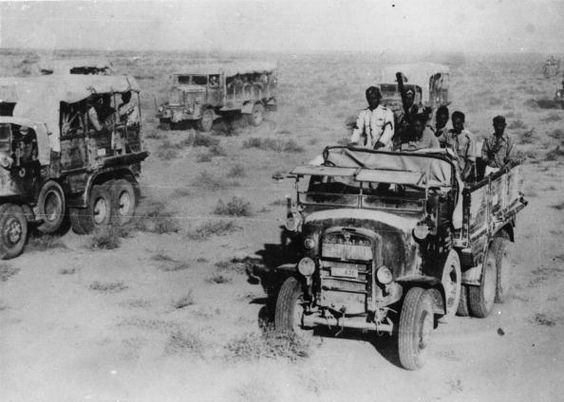
The British pursuit of the fleeing Italian soldiers forced out of their encampments outside Sidi Barrani continues on 14 December 1940. Operation Compass now has accomplished far more than was ever planned. The British 7th Support Group and the 4th and 7th Armoured Brigades sweep south through the desert, circling around Sollum and Halfaya Pass while disregarding Italian outposts further to the south. The 4th Armoured Brigade is across the Libyan border, about 20 miles west of Bardia. So far, the Italians are staying put in their Libyan encampments, which they have had for decades.
The Royal Navy is heavily engaged in transporting the numerous Italian prisoners taken at Sidi Barrani to Alexandria. Armed boarding ship HMS Fiona arrives in Alexandria with 1600 prisoners, HMS Farouk takes 200, and HMS Fawzia transports 1300. This barely makes a dent in the total number of POWs, so all three immediately turn around and return to Mersa Matruh for more.
The Greek offensive continues grinding forward, though it is confronting both the Italians and the elements. The Greek 3rd Infantry Division consolidates its hold on Porto Palermo, which it captured on the 13th. The Italian defense is stiffening the closer the Greeks get to the key port of Himara. The RAF raids Valona. Greek III Corps, facing blizzards in the mountains, suspends operations.
The Italians announced to the world today through the Rome radio that “no peace offer will ever be forthcoming from Italy,” and refused to acknowledge defeat in Africa. The high command’s daily communique asserted Fascist counterattacks had “slowed up enemy pressure” in Egypt, but laid no further claim to successes in the field, and authoritative commentators took the line that what was happening in the desert was a long way from any decision. They spoke of it as an action still raging over a vast area and described the British force as enormous.
Royal Navy destroyers HMS Hereward and Hyperion, conducting a sweep off the Libyan coast with destroyers Diamond and Mohawk, spot Italian submarine Naiade on the surface off Bardia. They shell the submarine, sinking it. There are 25 survivors who are taken as prisoners.
Philippe Pétain declined Adolf Hitler’s invitation to attend the ceremony during which the remains of Napoleon II would be re-interned at the Les Invalides cemetery in Paris, France. In the same message, he also told Hitler that Pierre Laval had been dismissed from his leadership position in Vichy France, which angered Hitler.
Vichy leader Marshall Henri-Philippe Petain expelled Pierre Laval from the French Council of Ministers. The world was permitted to learn tonight that Pierre Laval, No. 2 man of the Vichy government, has been forcibly shown the door, but that his policy of collaboration with Germany will be continued under Pierre-Etienne Flandin. Laval was ousted as vice-premier and foreign minister last night. Flandin took over the foreign ministry. The vice-premiership was left empty. As the hectic events of the past 24 hours unfolded their full story still may not be told informed persons said the action was directed mainly against Laval’s activity at home and not against the principal of German collaboration, which Chief of State Marshal Philippe Petain has endorsed.
It is unclear what motivated Petain to dismiss Laval. Some speculate that it was due to Laval’s marked lack of deference to Petain. However, a clue may be found in two other things that Petain does today:
— Petain declines Hitler’s invitation to attend a ceremony on the 15th marking the return to France of the remains of Napoleon II;
— Petain sends a message to Roosevelt reassuring him that the French fleet will not fall into German hands.
Laval is the prime architect behind French collaboration with Germany, though that is not yet blatantly obvious. Removing Laval appears to be Petain’s way of making a statement about where his own sympathies truly lie. Declining the invitation from Hitler and cabling Roosevelt simply reinforces the impression that Petain feels that his country was getting a little too cozy with Hitler’s Germany. Laval finds support from the German ambassador, though he is not restored to his previous powerful position as Petain’s Vice-Premier.
At Curragh Camp outside Dublin, Irish Republican Army (IRA) detainees revolt against their guards (Garda) and troops called in to quell the violence. They set fire to the camp (which they call “Tin Town” (Baile an Stáin) and clash with British soldiers. There are four casualties. The unrest continues through the night into the next day.
Éamon de Valera has imprisoned these IRA members for the duration of “The Emergency,” as the war is called. Some 2000 men pass through the camp during the war. The camp’s mere existence, incidentally, is proof positive that the Irish government is in some small ways acting to support the British, though not nearly enough to satisfy Winston Churchill.
Winston Churchill arranges a private screening of Charlie Chaplin’s “The Great Dictator,” which opened in Britain on the 11th. British reaction to the film is decidedly mixed, as the climax of the film — a rambling speech by Chaplin’s character posing as the dictator about understanding people and so forth — comes off as a bit late in the game considering the devastation of the Blitz.
Former Prime Minister Anton Korošec passes away in Belgrade. Korošec was a fierce anti-Semite who introduced two laws limiting the rights of Jews, specifically barring them from the wholesale food industry and limiting the percentage of Jewish students in higher education, just a couple of months before his death. The laws only passed because Korošec warned that failure to do so would provoke Hitler.
The Luftwaffe is quiet today due to the weather. The Italian Corpo Aereo Italiano (CAI) sends 11 bombers against its usual target, Harwich.
German fighter pilot Franz von Werra is awarded the Knight’s Cross (Ritterkreuz) for exemplary bravery as Oberleutnant Adjutant of II./Jagdgeschwader 3. Von Werra is a major German propaganda hero who is famous for his pet lion cub.
A dozen RAF Wellington bombers attempted to attack German shipping in the Schillig Roads off Wilhelmshaven. Bad visibility and weather hampered their efforts, and fierce fighter attacks shot down five of the Wellingtons.
Coastal Command attacks Brest and Lorient.
The air war takes another decided turn against the Italians. RAF No. 274 Squadron Hurricanes clearly outmatch the Italian biplane CR 42 fighters, while the lumbering Italian bombers also are easy prey. The Hurricanes shoot down six Savoia Marchetti SM. 79 Sparviero bombers and five CR 42s during the day.
The RAF bombs Naples, damaging Italian cruiser Pola. The Italians once again divide up their fleet there as a result, sending some to Maddalena and others to Cagliari. This is part of repeated comings-and-goings of Italian warships from various ports as they twist and turn to evade RAF attacks.
On Malta, Royal Navy Swordfish take off and bomb Tripoli. RAF No. 148 Squadron forms at Luqa Airfield with Wellington Mk IC bombers, the first bomber squadron actually based on the island.
U-96, commanded by Kapitänleutnant Heinrich Lehmann-Willenbrock, sank British steamer Western Prince (10,926grt) in 59‑32N, 17‑47W and damaged British steamer Empire Razorbill (5118grt) in 59‑31N, 13‑15W.
At 0855 hours the unescorted Western Prince (Master John Reed) was hit in the forward part by one G7e torpedo from U-96 about 400 miles 280° from Cape Wrath. The U-boat had encountered a small freighter during the night and missed it twice with a G7e torpedo before the bigger ship was spotted and also missed with a first G7e torpedo at 0720 hours. While the ship settled by the bow and stopped, the U-boat dived to reload the torpedo tubes and then waited until the crew abandoned ship in lifeboats. At 1021 hours, a coup de grâce hit again the forward part of the vessel and caused her to sink within one minute. The master, eight crew members and six passengers were lost. 98 crew members and 55 passengers were picked up by the Baron Kinnaird and one crew member by HMS Active (H 14) (Cdr E.C.L. Turner, RN) and landed at Gourock. The 10,926-ton Western Prince was carrying passengers, base metal, foodstuffs, and general cargo and was bound for Liverpool, England.
At 2102 hours the unescorted Empire Razorbill, dispersed the day before from convoy OB.257, was attacked by U-96 with six rounds from the deck gun, observing three hits about 120 miles north of Rockall. The U-boat had not been able to get into a favorable attack position due to bad weather and tried to stop the ship with gunfire, but ceased the attack when they saw that Empire Razorbill was armed to wait for the weather to improve, but lost contact in a snow squall during the night. The slightly damaged ship escaped and safely arrived in St. John on 24 December. The 5,118-ton Empire Razorbill was carrying coal and was bound for St. John, New Brunswick.
U-100, commanded by Kapitänleutnant Joachim Schepke, sank British steamers Kyleglen (3670grt) in 58‑00N, 25‑00N and Euphorbia (3380grt) west of Ireland.
There were no survivors from either steamer. At 0816 hours the unescorted Kyleglen (Master Thomas Storer), dispersed on 12 December in 59°04N/15°30W from convoy OB.256, was hit on port side amidships by one G7e torpedo from U-100 about 300 miles west of Rockall. Schepke observed how the vessel, misidentified as Imperial Valley, settled by the stern and the crew abandoned ship in the lifeboats. The U-boat then fired a G7e torpedo from the stern torpedo tube as coup de grâce at 0906 hours, which struck Kyleglen on port side underneath the aft mast and caused her to sink quickly by the stern. The lifeboats were never seen again: the master and 35 crew members were lost. The 3,670-ton Kyleglen was carrying ballast and was bound for Baltimore, Maryland.
At 1955 hours the unescorted Euphorbia (Master Thomas Hilton), dispersed on 12 December in 59°04N/15°30W from convoy OB.256, was hit on starboard side in the foreship by one G7e torpedo from U-100 about 310 miles west of Rockall. The U-boat had spotted the freighter about four hours earlier in bad visibility and missed with one G7a torpedo at 1948 hours. Schepke observed how the ship caught fire and stopped, so he waited nearby but the flames went out and the Euphorbia remained afloat despite a high sea and heavy swell. The ship sank quickly after being hit on port side aft of amidships by a coup de grâce at 2028 hours. The Germans then questioned the survivors in the lifeboats before leaving the area. However, the boats were never found: the master, 32 crew members and one gunner were lost. The 3,380-ton Euphorbia was carrying coal and was bound for Lynn, Massachusetts.
Battleship HMS Ramillies, aircraft carriers HMS Furious and HMS Argus arriving from the Mediterranean, anti-aircraft cruisers HMS Dido and HMS Cairo, and destroyers HMS Kelvin, HMS Eclipse, HMS Cossack, and HMS Sikh arrived in the Clyde at 1410. Battleship Ramillies went to Plymouth for a refitting completed 3 January.
Aircraft carrier HMS Furious went to Liverpool escorted by destroyers HMS Kelvin and HMS Bradford arriving on the 15th. On the 14th, destroyer Bradford sustained damage to her propellers and was taken in tow by tugs Empire Henchman and Abbeville. The destroyer was delivered to Belfast.
Destroyers HMS Cossack and HMS Sikh departed Greenock later in the day and arrived at Scapa Flow at 2300/15th.
Anti-aircraft cruiser HMS Dido was escorted by destroyer HMS Eclipse and proceeded to Scapa Flow.
Anti-aircraft cruiser HMS Curacoa departed Scapa Flow at 0930 to rendezvous with Battleship HMS Queen Elizabeth off Tiumpan Head at 1830 and provide additional escort to Rosyth.
Anti-aircraft ship HMS Alynbank arrived at Scapa Flow at 1430 from convoy EN.40. Due to the weather, she was moored north of Cava Island. Anti-aircraft ship Alynbank was damaged when British steamer Empire Hawkbill (5724grt) dragged anchor and fouled the anti-aircraft ship.
Destroyers HMS Douglas and HMS Beagle departed Scapa Flow at 2200 to rendezvous with armed merchant cruiser HMS Wolfe off the Butt of Lewis and escort her to Reykjavík.
Italian submarine Tarantini was sunk by Submarine HMS Thunderbolt off Bordeaux in 45‑25N, 01‑22W.
Hunt-class destroyer HMS Blencathra was completed. Following working up, she was assigned to the 21st Destroyer Flotilla operating from the Nore.
Free French torpedo boat Branlebas (Lt Cdr H. C. J. McRae, RN), under RN control, had her back broken and was lost in a storm 25 miles SSW off the Lizard off Eddystone Rocks. McRea, Lt E. J. King-Wood RNR, Sub Lt G. L. Keeble, Commissioned Engineer S. G. Hodgson, T/A/Gunner (T) E. C. Balls and most of the crew were lost in the French ship.
On the 18th, French destroyer Mistral arrived at Plymouth with three survivors.
Aircraft carrier HMS Ark Royal, battlecruiser HMS Renown, light cruiser HMS Sheffield, and destroyers HMS Faulknor, HMS Firedrake, HMS Forester, HMS Foxhound, HMS Fortune, HMS Fury, HMS Duncan, HMS Isis, and HMS Encounter departed Gibraltar to patrol in the area of the Azores in reports of an invasion force near the islands. Battlecruiser Renown and aircraft carrier Ark Royal arrived back at Gibraltar on the 19th without contact.
Destroyers HMS Hyperion, HMS Hereward, HMS Diamond, and HMS Mohawk were detached from screening anti-aircraft ship HMS Coventry for a sweep off the Libyan coast. Destroyers Hereward and Hyperion sank Italian submarine Naiade off Bardia in 32‑03N, 25‑26N. Three officers and twenty two ratings were rescued. The four destroyers arrived at Alexandria on the 15th.
Australian destroyers HMAS Vampire, HMAS Voyager, and HMAS Vendetta departed Alexandria to carry out an anti-submarine sweep and cover the bombarding squadron between Sollum and Mersa Matruh.
Destroyer HMS Gallant departed Alexandria to join convoy AN.10 of eight ships, three British, which departed Port Said on the 15th. The convoy was covered by light cruisers HMS Ajax and HMAS Sydney. Convoy AN.10’s escort was taken over by Greek destroyers on the 15th and destroyer Gallant returned to Suda Bay. The convoy arrived at Pireaus on the 17th.
Armed boarding vessel HMS Fiona with 1600 prisoners and auxiliary schooners HMS Farouk with 200 and HMS Fawzia with 1300 arrived at Alexandria. After disembarking the prisoners, the ships returned to Mersa Matruh.
Italian heavy cruiser Pola was damaged by British bombing at Naples, resulting in the Fleet being divided into two sections to protect it from air attack, half to Maddalena and the other half to Cagliari. Heavy cruisers Zara and Gorizia departed Naples for Maddalena. They returned to Naples on the 20th and departed again on the 22nd, when they proceeded to Taranto, arriving on the 23rd.
Convoy OB.259 departed Liverpool escorted by corvette HMS Arabis. The corvette was detached that night. On the 15th, destroyers HMS Scimitar, HMS Shikari, and HMS Skate, corvette HMS Mallow, and anti-submarine trawlers HMS Northern Dawn and HMS Wellard joined. Destroyer Shikari was detached on the 16th and the remainder of the escort on the 17th.
Convoy FN.359 departed Southend, escorted by destroyers HMS Verdun and HMS Wolsey. The convoy arrived at Methil on the 16th.
Convoy FS.361 departed Methil, escorted by destroyers HMS Vanity and HMS Westminster. Patrol sloop HMS Widgeon joined on the 15th. The convoy arrived at Southend on the 16th.
Convoy HX.96 departed Halifax at 1300. Ocean escort was armed merchant cruiser HMS Ranpura, which was detached on the 29th. The convoy was escorted into Liverpool by destroyers HMS Venomous and HMS Wild Swan, sloop HMS Rochester, and corvettes HMS Fleur de Lys and HMS Gardenia. They arrived at Liverpool on the 30th.
President Roosevelt ended a cruise over nearly 4,000 miles of the Caribbean and Atlantic today, assured by a personal inspection that sites for American defense bases in Jamaica, St. Lucia and Antigua were satisfactory, but skeptical about facilities in the Bahamas. Pointing up evidence of Anglo- American friendship, the cruise took the president into the waters of a belligerent power for the first time since the current conflict began in Europe. He paused at more than half a dozen British islands, and also at the French island of Martinique. Mr. Roosevelt came ashore from the cruiser USS Tuscaloosa at the Charleston, South Carolina, Navy Yard this afternoon, tanned by a tropical sun and salt-laden breezes, after 12 days at sea. Immediately, he left by special train for Warm Springs, Georgia, to spend Sunday at the foundation for infantile paralysis victims and then return to Washington Monday. The cruise took him to four of the spots where the United States obtained rights, by turning over 50 old destroyers to Britain, to establish plane and naval bases in British possessions.
President Roosevelt was traveling toward Washington by way of Warm Springs tonight following his arrival late in the afternoon at Charleston, where he indicated that he would veto the Walter-Logan bill which would subject administrative agencies to court review. The President received reporters on the cruiser USS Tuscaloosa at the Charleston Navy Yard soon after it docked at 4 o’clock, ending an eleven-day trip which took the Chief Executive 3,000 miles through the Caribbean on an Inspection trip of bases acquired from Great Britain. While Mr. Roosevelt would not say what he would do with regard to the Walter-Logan bill, he said that guesses on that score had been pretty good. These guesses have uniformly forecast a veto. The President said that he had until Wednesday to act upon the measure.
With regard to aid to Great Britain the President was mute, remarking, when reporters questioned him about the conferences between Secretary Morgenthau and Sir Frederick Phillips of the British Treasury, that the newspaper men knew as much about them as he did. He did not answer a specific question concerning further aid. This was taken as another indication that the question of extension of credits to the British would be left to Congress to decide. The President was enigmatic when questioned about delays in the defense program. When a reporter mentioned that William Knudsen on the Advisory Defense Commission had reported that the plane production program was 30 percent behind schedule, Mr. Roosevelt said that the ship’s paper didn’t say it that way. The same reply was applied to Secretary Stimson’s revelation that building of barracks was lagging two months behind schedule.
Mrs. Elizabeth Deegan, United States embassy receptionist in Paris, was freed today by the Germans after having been held in custody for more than a week on charges of helping British officers escape from Nazi-occupied France. Mrs. Deegan, 40, of Asheville, North Carolina, had been held for questioning by the German Gestapo.
Existing Federal law gives the Department of Justice no jurisdiction over sabotage in American factories manufacturing war materials for a foreign government, Attorney General Jackson informed Representative Voorhis of California today.
The Duchess of Windsor left St. Francis Hospital at Miami Beach this morning and with the Duke motored fifteen miles to the Miami Biltmore Hotel for a few quiet days before returning to Nassau.
The army and navy poured huge new outlays today into the program to convert the Midwest into one of the world’s great arsenals. A $105,867,790 contract was awarded to Western Cartridge Co., East Alton, Illinois, and United States Cartridge Co., Baltimore, Maryland, for equipping and operating a small arms ammunition plant in St. Louis, Missouri. Title to the plant, which ultimately will employ 10,000 to 12,000 persons, will remain with the federal government. It is the largest its kind so far in the defense program. An additional contract approximating $7,000,000 for construction is expected to be announced soon.
Continued development of civil aeronautics for defense as well as commercial reasons was advocated today in a special report prepared by the transportation committee of the Chamber of Commerce of the United States.
At least one plane factory is delivering fewer planes today than it was a year ago; the plane production program is already months behind schedule, and more than 60 per cent of the Army’s cantonment and construction program is behind time, according to a survey of the progress of our national defense program just completed.
Under the stimulus of national defense production, total employment in the United States will increase by 6,000,000 by the Fall of 1942, according to the preliminary findings of a special committee of the Twentieth Century Fund.
The United States Army has undertaken a survey of the highway system of the United States to determine to what extent and where new roads may have to be built to facilitate the movements of a high-speed mobile army of defense, Lieutenant General Hugh A. Drum, commander of the First Army, declared yesterday.
The U.S. Army Air Corp increases its order for Boeing XB-29 bomber prototypes from two to three planes. Consolidated, meanwhile continues to work on its own quite similar heavy bomber, the Model 33, so that the U.S. is not reliant on just the Boeing project. The XB-29 has numerous issues, including finicky Wright R-3350 Duplex-Cyclone radial engines, but overall it is a groundbreaking airframe. It eventually becomes the B-29.
The U.S. Navy aircraft carrier USS Hornet (CV-8), designed to handle eighty-three fighting planes and constructed at a cost of $31,000,000, exclusive of armament, was launched today with Mrs. Frank Knox, wife of the Navy Secretary, as sponsor.
The first plebiscite in the history of Panama will be held tomorrow to vote on the Constitution to replace the original charter adopted thirty-six years ago, soon after the separation of Panama from the Republic of Colombia.
Argentina and Uruguay today reached an agreement to cooperate in their plans for the defense of the River Plate zone against any non-American aggression and to invite neighboring republics to join them in plans for strengthening the entire defense structure of this part of South America.
German raider Atlantis was damaged in grounding at Kerguelen Island in the Indian Ocean. The German commerce raider Atlantis reached Kerguelen, an archipelago situated midway between Africa, Antarctica and Australia. A heavily-armed landing party ashore at Port Couvreux to make sure that the settlement there was uninhabited. Once it was determined that that the port was unoccupied (it had been deserted since 1936) the Atlantis moved into the natural inner harbor but hit a hidden rock, tearing a hole in her outer hull. The ship would remain stuck fast on this rock for nearly three days. The Atlantis would remain at Port Couvreux until January 11, repairing and replenishing her damaged hull and fresh water tanks, and carrying out an engine overhaul and some general maintenance. At some point during this break, crewman Bernhard Herrmann falls while painting the funnel and perishes. His grave on the island is grandly referred to as the southernmost German military cemetery. It is the ship’s first casualty during its phenomenally successful cruise. The ship will stay on the island, where it is summertime, into the new year.
French threats to bomb Bangkok, capital of Thailand, in retaliation for any further Thai air attacks on Indo-China were said today to have brought at least a temporary halt in Thai raids. Informed quarters said there had been no Thal raids on Indo-China for two days. Continued freedom from air attack was expected in view of the French decision to raid Thailand’s capital and other points if necessary.
Plans of native Communist rebels to attack French garrisons and seize arms and ammunition for a march on Saigon, the major city in Southern Indo-China, have been frustrated, French officials said today. More than 1,000 rebels were under arrest and officials said that all rebellious activity in Southern Indo-China had been crushed.Because of crowded jails, about 400 rebels were held aboard ships in Saigon harbor pending military trials. Telegraph lines torn down by rebels on Nov. 23 were restored today.
Further comprehensive restrictions on the reporting of news in Japan are imposed by a new imperial ordinance sanctioned today. It empowers the government to impose two years’ imprisonment or a fine of 2,000 yen for the publication of news under the following categories:
- Secrets connected with national mobilization;
- Military secrets;
- Secrets concerning military resources;
- News that might cause serious inconvenience regarding diplomacy;
- News that should not be disclosed to foreign countries or that requires secrecy;
- News that might obstruct financial or economic policies.
Dow Jones Industrial Average: 132.31 (-0.04)
Died:
Anton Korošec, 68, 10th Prime Minister of Yugoslavia.
Naval Construction:
The Royal Canadian Navy Bangor-class (VTE reciprocating-engined) minesweeper HMCS Quinte (J 166) is laid down by Burrard Dry Dock Co. Ltd. (Vancouver, British Columbia, Canada).
The Kriegsmarine (German Navy) Type VIIC U-boat U-254 is laid down by Bremer Vulkan-Vegesacker Werft, Bremen-Vegesack (werk 19).
The Royal Canadian Navy Flower-class corvette HMCS Timmins (K 223) is laid down by Yarrows Ltd. (Esquimalt, British Columbia, Canada).
The U.S. Navy repair ship USS Vulcan (AR-5), lead ship of her class of 4, is launched by New York Shipbuilding Corp. (Camden, New Jersey, U.S.A.).
The Kriegsmarine (German Navy) Type IID U-boats U-151 and U-152 are launched by Deutsche Werke AG, Kiel (werk 280–281).
The Royal Navy Flower-class corvette HMS Burdock (K 126) is launched by John Crown & Sons Ltd. (Sunderland, U.K); completed by N.E. Marine.
The Royal Navy Hunt-class (Type II) escort destroyer HMS Lamerton (L 88) is launched by Swan Hunter and Wigham Richardson Ltd. (Wallsend-on-Tyne, U.K.); completed by Wallsend.
The U.S. Navy Yorktown-class aircraft carrier USS Hornet (CV-8) is launched by Newport News Shipbuilding and Dry Dock Co. (Newport News, Virginia, U.S.A.).
The U.S. Navy cargo ship USS Regulus (AK-14), formerly the SS Glenora, is commissioned. Her first commanding officer is Commander James H. Doyle, USN.
The Royal Navy ocean boarding vessel HMS Manistee (F 104) is commissioned. Her first commanding officer is A/Commander Eric Haydn Smith, RNR.
The Royal Navy LCT (Mk 1)-class landing craft, tank HMS LCT 11 is commissioned.
The Royal Navy British Power Boat 70 foot-class motor anti-submarine boat is commissioned.
The Kriegsmarine (German Navy) Type VIIC U-boat U-71 is commissioned. Her first commanding officer is Kapitänleutnant Walter Flachsenberg.
The Royal Navy Hunt-class (Type II) escort destroyer HMS Blencartha (L 24) is commissioned. Her first commanding officer is Commander Hugh Waters Shelley Browning, RN.
The Royal Navy Fiji-class (Crown Colony-class) light cruiser HMS Mauritius (80) is completed. Her first commanding officer is Captain Leicester Charles Assheton Curzon-Howe, RN.
 History Diaries