Hitler issues Directive #20 ordering additional planning and preparation for Operation MARITA, the invasion of Greece:
The Supreme Commander of the Armed Forces
The Führer’s Headquarters, 13th December, 1940 12 copies
Directive No. 20 — Undertaking MARITA
- The outcome of the battles in Albania is still uncertain. In the light of the threatening situation in Albania it is doubly important to frustrate English efforts to establish, behind the protection of a Balkan front, an air base which would threaten Italy in the first place and, incidentally, the Rumanian oilfields.
- My intention is therefore: (a) To establish in the coming months a constantly increasing force in southern Rumania. (b) On the arrival of favorable weather — probably in March — to move this force across Bulgaria to occupy the northern coast of the Aegean and, should this be necessary, the entire mainland of Greece (Undertaking MARITA). We can rely upon Bulgarian support.
- The build up of the forces in Rumania will be as follows: (a) 16th Panzer Division, which arrives in December, will join the Military Mission, whose duties remain unchanged. (b) Subsequently a force of about seven divisions will be moved to southern Rumania. Engineer forces in sufficient strength to prepare the Danube River crossings can be incorporated in the transports of 16th Panzer Division (as instruction forces). Commander In Chief Army will apply for my orders for the employment of these troops on the Danube River in due course. (c) Preparations should be made to transport reinforcements until the total limit of twenty four divisions intended for Undertaking Marita has been reached. (d) The Air force must afford air defence for the concentration and will arrange for the necessary headquarters and supply dumps on Rumanian soil.
- Undertaking MARITA itself will be prepared on the following basis: (a) The first objective of the operation is the occupation of the Aegean Sea coast and the Salonika basin. It may become necessary to pursue the attack via Larissa and the Isthmus of Corinth. (b) The flank of the attack will be protected against Turkey by the Bulgarian army; but German units will also be held in readiness to strengthen and support it. (c) It is not yet certain whether Bulgarian formations will play any other role in the attack. The attitude of Yugoslavia is also not yet clearly foreseeable. (d) It will be the task of the Air force to give effective support in all phases to the advance of the Army; to eliminate the enemy Air force; and, as far as possible, to seize English bases in the Greek Islands with airborne troops. (e) The question how far Undertaking MARITA is to be supported by the Italian forces, and how such operations are to be coordinated, is reserved for future decision.
- The political effect of military preparations, which is especially felt in the Balkans, calls for the most precise regulation of all measures taken by the High Command. The movement of troops through Hungary and their arrival in Rumania will be notified, stage by stage, by the High Command of The Armed Forces, and will in the first instance be explained as reinforcements for the Military Mission in Rumania. Conversations with Rumanians or Bulgarians which might reveal our intentions, as well as notification of the Italians, will depend in each case on my approval, as also will dispatch of Reconnaissance Parties and Advanced Headquarters.
- At the conclusion of Undertaking MARITA the forces engaged will be withdrawn for new employment.
- I expect Commanders In Chief to report to me on their plans. The Army has already done this. A precise timetable for the operations should be submitted to me, as well as proposals for the recall of men from the armaments industry where necessary (reestablishment of Leave Divisions).
Signed, Adolf Hitler.
The German Army certainly has the troops to spare, but such a large force heading in the opposite direction must inevitably affect the forces available for his subsequent, and much more significant, operation — Operation BARBAROSSA the planned invasion of the Soviet Union in mid-1941.
While the Germans are creating messes for themselves with all these planned invasions, Mussolini certainly would breathe a sigh of relief if he knew about this directive (and he won’t, for the time being). Hitler is on the way to eviscerate the Greeks from behind while the Italian troops in Albania continue to suck in all the Greek reserves like flypaper grabbing all the flies that land on it. All the Italians have to do now is hold out until the spring, but this looks quite uncertain at the moment. It must be said, though, that rescuing Mussolini is only a secondary objective, as Hitler’s overriding preoccupation is the removal of RAF planes from the Greek mainland. These planes threaten the Rumanian oilfields, which inform many of Hitler’s decisions in the region.
British 4th Armored Brigade crossed the desert between Halfaya and Sidi Omar in Egypt in an attempt to cut the road to Tobruk, Libya. Units of the Mediterranean Fleet including the small ship Inshore Squadron and the Australian Destroyer Flotilla play an important part in supporting and supplying the land campaign. To counter the British naval bombardment, Italian submarine Neghelli attacked British cruiser HMS Coventry 40 miles northeast of Sidi Barrani, Egypt at 2042 hours, nearly blowing off her bow; she was able to sail under her own power to Alexandria, Egypt for repairs.
The British pursuit of the fleeting Italians in Egypt during Operation Compass continues on 13 December 1940. British General O’Connor gets caught up in the victory and converts what was intended to be a five-day tank raid into a major strategic offensive.
The race is on between British and Italian formations to see who can get to the defensive positions on the border first. The Italians have a slight head start on the coast road, but the British 4th Armoured Division is cutting across the desert (just as the 7th Armoured Brigade did on the 12th) and hopes to outflank the Italians if they act quickly. Since it was never contemplated that the Italians would fold as quickly as they did, the British are hampered by lack of planning for this eventuality as well as troops strung out all across the desert. Many British resources are tied up handling the tens of thousands of Italian prisoners. Massive amounts of prisoners continue to be taken at Sidi Barrani and further west at Buq Buq.
In addition, the Italian Navy, probably the most effective of the nation’s three major military services, begins to stir today. The Italians send submarines Naiade, Narvalo and Neghelli off the Libyan coast to counter the bombardment that Italian troops have been facing. Italian submarine Neghelli torpedoes and damages Royal Navy anti-aircraft cruiser HMS Coventry off the Libyan coast. The Coventry loses much of its bow area, forcing the ship to return to Alexandria in reverse in order to prevent further damage from the pressure of the seawater while the ship is underway. There are no casualties. Royal Navy submarine HMS Truant returns the favor by sinking Italian 1546 ton freighter Sebastino Bianchi northeast of Cap Spartivento.
A captured Italian officer, amazed at the fury of the British blitzkrieg in Egypt, tells a reporter that “maybe this war will end soon now.” Philosophical in defeat, the officer declared: “None of us cared much about fighting this war. We’ve had little news from home,” he went on, “and I’m surprised, I can hardly believe the Greek victories in Albania or that the British are now beyond Sidi Barrani. This all happened so suddenly we did know what to think. The British gave us a big shock, attacking from the rear. Well, what we want right now is to get some place where we can write letters to our families.”
Telegram from Churchill to Wavell:
- …Congratulations on your victory….
- … pursuit will hold first place in your thoughts. …No doubt you have considered taking some harbour in Italian territory to which the Fleet van bring all your stuff and give you a new jumping off point.
- I am much inclined to Egypt declaring war on Italy at the moment when we have made her safe. Now is the appointed time.
- As soon as you have come to a full stop along the African coast we can take a new view of our prospects and several attractive choices will be open.
Churchill has mixed feelings about Wavell, who he felt offered insufficient resistance to the Italians during the fall of British Somaliland over the summer. Thus, the telegram is restrained in its praise, with Churchill simply stating “Congratulations on your victory.” Churchill also admonishes Wavell that he trusts “pursuit will hold first place in your thoughts” and “No doubt you have considered taking some harbor in Italian territory to which the Fleet van will bring all your stuff.” One does not have to read too far between the lines of this faint praise to note the condescension being displayed, with Churchill’s advice being akin to a coach telling his star soccer player, “Now, remember to kick the ball when it comes to you.” Churchill obviously still feels that Wavell lacks the fighting spirit, even mere hours after Wavell has won perhaps the most decisive tactical victory of the century.
In Albania, the Greek troops along the coast take the port of Porto Palermo. This inconsequential town is just to the south of Himara, which is of strategic significance because it is a major Italian supply base. The weather, however, is becoming a factor even along the low-lying coastal regions, and the Greeks take some time to consolidate this gain before moving beyond it. The weather will cut both ways, but on the whole, it favors the defense.
The Battle of Himara began. On 13 December, Porto Palermo, a coastal village south of Himara came under the control of the Greek forces. Two days later, the Greek 3rd Infantry Division continued the offensive toward Himara. However, the advance was slowed due to heavy enemy counter-action, supported by air force raids, as well as extremely harsh weather conditions. On 19 December, the Greek forces after a hard fight captured the Giami height. Meanwhile, at the dawn of same day, the 3/40 Evzone Regiment (Colonel Thrasyvoulos Tsakalotos) launched, without artillery preparation, a surprise attack against the Italian troops at Mount Mali i Xhorët (or Mount Pilur), a strategic spot east of Himara. The Evzones of the regiment, after being informed about the topography of the region by locals, performed a charge with fixed bayonets from various positions against the Italian garrison.
The snow was 3 meters (9.8 ft) high, which helped the advancing Greek troops to cross barbed wire and capture an Italian mountain battery. After three days of fierce fighting, the men of the 3rd Division took control of the height, as well as the Kuç saddle. The capture of Kuç saddle gave access to the valley of Shushicë. Furthermore, the Italian troops lost six artillery guns, a mortar company and a multitude of war supplies. The Greek losses did not exceed 100 killed in action and wounded, while the Italians had approximately 400 casualties and more than 900 were taken prisoner. On 21 December, the Greek forces captured the height of Tsipista north-west of Himara. To avoid encirclement, the Italians abandoned Himara. Finally, the Greek troops entered the town in the morning on 22 December, where they were welcomed by the locals with enthusiastic celebrations.
The capture of Himara was celebrated as a major success in Greece and proved that the Greek army was in condition to continue the advance pushing the Italians further north. On the other hand, the Italian headquarters was alarmed by the Greek success, and on 24 December Benito Mussolini addressed his concerns to the Italian military commander, Ugo Cavallero. In his letter, Mussolini does not doubt that one of the causes of the Italian defeat was the high morale of the Greek forces, which led to their capture of Himara.
King George sent a message of thanks today in response to President Roosevelt’s cabled expression of sympathy on the death of the Marquess of Lothian, Ambassador in Washington. The President’s message touched most of the people in London.
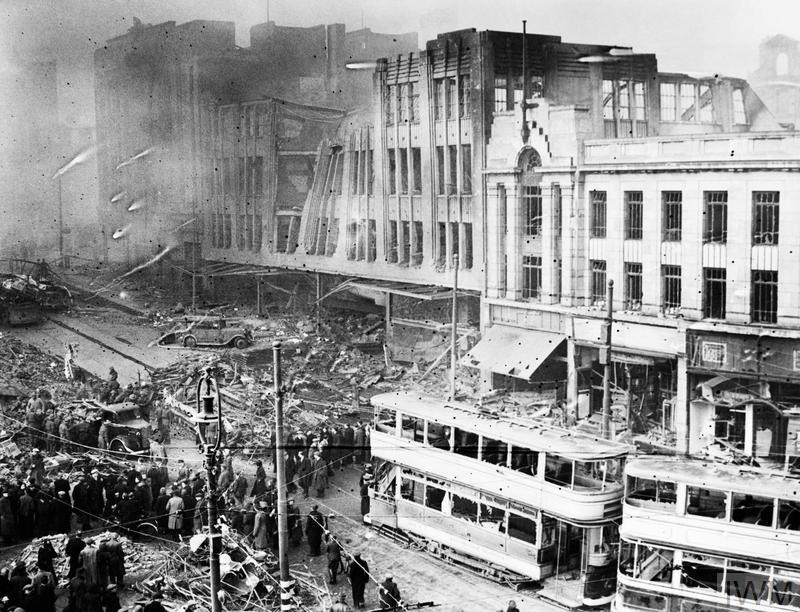
In Birmingham, Great Britain, Station Officer William Mosedale (1894-1971) led the 12-hour task of saving eight people trapped under his bombed fire station and a house. For this he was awarded the George Cross.
In London, Captain Michael Floud Blaney (b. 1910), Royal Engineers, after acts of especial bravery in September and November was killed by a bomb he went to defuse in Manor Park. He was also awarded the George Cross.
Britain’s Minister of Food, Lord Woolton, announced that meat rations would be cut “fairly soon.” In explanation he said that ships formerly used to transport food across the Atlantic were being used to send supplies and munitions to the fighting forces in the Middle East.
The Duke of Windsor (former King Edward VIII) gives a disturbing interview to Fulton Oursler of Liberty magazine at Government House, Nassau, Bahamas. While not published until 22 March 1941, it raises eyebrows on both sides of the conflict. The Duke states that “Hitler was the right and logical leader of the German people,” and proposes that President Roosevelt mediate a peace deal between Germany and Great Britain. Oursler is flabbergasted and arranges an appointment to discuss the interview with President Roosevelt at the White House. Rumors swirl that Wallis Simpson, the Duchess of Windsor, has had an intimate relationship with German Foreign Minister Ribbentrop (in the 1930s) and still communicates with him.
Reichsführer Hitler and Foreign Minister von Ribbentrop departed suddenly from Berlin for what German officials termed a “long weekend.” The German capital buzzed with rumors that the Nazi leaders would confer with Premier Mussolini over recent Italian military reverses, but official Berlin quarters insisted that nothing was known of such a meeting.
German Army units began redeployment in preparation for Operation BARBAROSSA.
Pierre Laval was dismissed as the Vice President of the Council, which in effect was the Prime Minister of France. He was placed under arrest shortly after. Marshal Pétain abruptly dismisses Pierre Laval, his Vice Premier and Foreign Minister. Pétain does it quite cleverly, convening a meeting of his cabinet ministers and requiring them all to sign a collective letter of resignation. Laval, believing he was in no peril, blithely signed along with the others, and then Pétain announced that he was accepting Laval’s resignation (and also that of Minister of Labor M. Belin). Not only that, but Pétain has the police arrest Laval and places him under house arrest. Pétain’s issue with Laval appears to have been personal, with Laval acting casually in Pétain’s presence and even occasionally (so it is said) blowing cigarette smoke in his face. Pétain now views himself as an unassailable dictator on a par with Hitler, and in fact, many others would view that as an apt comparison.
For the first time the existence of concentration camps in Norway was officially acknowledged by Quislingists in a warning published last Saturday by all Alesund newspapers, which also revealed recent mass arrests in that town.
More than 200 Jewish refugees were drowned yesterday in the Sea of Marmara when a ship, the Salvator, carrying 380 refugees from Bulgaria sank in a storm. Sixty children were among the drowned.
Air activity is light on both sides of the English Channel due to the weather. RAF Coastal Command attacks the U-boat pens in Lorient, while Bomber Command sends 33 planes against Kiel, Bremen, and airfields and ports in Holland. The Luftwaffe only sends some fighter-bomber sweeps over England during the day, and after dark makes only scattered attacks along the East Coast. Twelve welcome hours passed — from dawn till dusk yesterday — during which not a single bomb fell on British soil, London announced. After dark minor raids were reported from East Anglia, and London had a short alarm. Sheffield was putting its house in order after Thursday night’s raid, of which Berlin made much but which London minimized.
Douglas Bader was awarded the Distinguished Flying Cross.
RAF Bomber Command dispatches 6 Blenheims to Lorient and Brest in daylight which turned back.
RAF Bomber Command dispatches 33 Wellingtons and Whitleys overnight to Bremen and Kiel. Most bombed but no results seen because of complete cloud cover. The Kiel diary has no mention of bombs in the town. 1 Whitley lost.
During dog-fighting over western Egypt, No. 3 RAAF lose five Gladiator aircraft for one Italian while 274 Sqn. (RAF) lose two Hurricane Mk Is for one CR42 and 33 Sqn. (RAF) shoot down three CR42s and two S79s on one interception. Regia Aeronautica CR 42 biplanes shoot down five Gloster Gladiator biplanes of RAAF No. 3 Squadron for only one loss of their own. RAF No. 274 Squadron also has a bad day, with the Italians shooting down two Hurricanes for a loss of only one CR 42. RAF No. 33 Squadron, however, evens the overall score by claiming victories over three CR 42s and two S79 bombers. Days like this show what the Italians would be capable of if they actually had their heart in the fight against Great Britain. The RAF also stages a raid against Tripoli Harbor, losing a plane from No. 830 Squadron.
U-43, commanded by Oberleutnant zur See Wolfgang Lüth, damaged British steamer Orari (10,350grt) in 49‑50N, 20‑55W. At 2046 hours the unescorted Orari was hit in the stern by one of two torpedoes fired by U-43 and caught fire about 450 miles southwest of Ireland. The U-boat had followed her for six hours and was then not able to finish her off because no torpedoes were left and the deck gun could not be used due to the rough seas. The crew of Orari managed to cover the hole by tarpaulins and made it under own power to the Clyde, where she was repaired and returned to service in March 1941. The 10,350-ton Orari was carrying refrigerated and general cargo and was bound for Avonmouth, England.
Italian submarine Neghelli torpedoed anti-aircraft cruiser HMS Coventry in 32‑37N, 26‑44E at 2042. There were no casualties in the cruiser. Light cruiser Coventry was joined and assisted by destroyers HMS Hyperion, HMS Diamond, and HMS Mohawk at 0015/14th and destroyers HMS Jervis, HMS Janus, and HMS Hereward at 0535. Light cruiser Coventry lost most of her bow below the waterline. The cruiser returned stern first to Alexandria arriving on the 14th, escorted by destroyers Jervis and Janus. She was docked for temporary repairs at Alexandria on the 15th. The ship departed Alexandria on the 29th, but her temporary repairs would not stand up to the heavy sea. Coventry returned to Alexandria. Repairs were completed on 20 January.
Submarine HMS Truant sank Italian steamer Sebastino Bianchi (1546grt) east, northeast of Cape Spartivento in 37‑50N, 16‑15E.
Light cruiser HMS Manchester arrived at Scapa Flow. The light cruiser had been absent from Home Waters since departing on 15 November for COLLAR operations in the Mediterranean.
Destroyer HMS Maori was machine gunned by a German aircraft while repairing in the Tyne. Destroyer Maori had no further time out of service.
Anti-aircraft cruiser HMS Curacoa arrived at Scapa Flow at 1430 after escorting convoy WN.51.
Destroyer HMS Keppel departed Scapa Flow at 1415 for Rosyth for repairs. The destroyer arrived at Rosyth at 0500/14th.
The Destroyer HMS Cotswold arrived at Scapa Flow at 1540 after escorting British steamer Ben My Chree from Lerwick to Aberdeen.
Destroyer HMS Lincoln arrived at Scapa Flow at 1030 from Milford Haven to work up.
British Lt G. F. Russell was killed when his Martlett of 802 Squadron crashed near Inverary.
German steamer Schwalbe (842grt) was lost in a stranding off the Finnish south coast.
Destroyers HMS Faulknor, HMS Forester, HMS Fury, and HMS Isis departed Gibraltar on the 12th. They were ordered to intercept a French convoy six miles off Cape Tresforcas, Spanish Morocco. At 0956, destroyer Forester intercepted French trawler Avant Garde (780grt), which was taken to Gibraltar.
Destroyers HMS Hereward and HMS Hyperion were investigating a barge near Bardia.
Sub Lt (A) R- H. Thompson RNVR and P/T/Sub Lt (A) A. E. Dyer RNVR, of 830 Squadron based in St Angelo were lost, in an attack on Tripoli Harbor.
Convoy FS.360 departed Methil, escorted by destroyer HMS Woolston and sloop HMS Lowestoft. The convoy arrived at Southend on the 15th.
The ashes of the Marquis of Lothian, British ambassador to the United States, will be accorded a temporary resting place in Arlington National Cemetery after a funeral in the famous Washington Cathedral. The announcement was made late today. It added that cathedral services will be held at 2:30 p.m. Sunday. The body will be cremated and on Monday at noon the ashes will be borne to Arlington Cemetery and placed with full military honors In the vault under the mast of the USS Maine, near the amphitheater. There they will remain until arrangements can be made for final disposition, the State Department announced.
The Duke of Windsor discussed United States naval bases in the West Indies with President Roosevelt today in the course of a three-hour visit on board the cruiser USS Tuscaloosa at an undisclosed rendezvous in Bahaman waters. Returning to Miami this afternoon on the Navy plane assigned for the journey, the Duke revealed that he had visited the President solely in his capacity as Governor of the Bahamas; that the call had been planned long before the death yesterday of Lord Lothian, British Ambassador, and that it would have taken place regardless of the presence of the Duchess and himself in Miami, where she is recovering from a dental operation. Questioned about his conversation with the President, the Duke replied: “We discussed naval bases in the whole of the West Indies. We also talked about the economic future of the West Indies and how America might cooperate with Great Britain in their development.” Pressed to say what had been mentioned with regard to the international situation, the Duke dismissed any such aspect of the talk as “very general.”
The USS Tuscaloosa and her escorts, the destroyers USS Mayrant and USS Trippe, headed tonight toward the United States. At Charleston, South Carolina, it was reported that President Roosevelt’s ship would dock there tomorrow. Discussing at a press conference in the afternoon his eleven-day inspection tour of Caribbean defense sites, including those at Jamaica, St. Lucia, Antigua, and the Bahamas, the President told reporters today that obviously the farther a potential attack was kept from the American continent the safer it would be for the continent. That meant, he said, that we wanted to be as far out as we could be. Newfoundland, he said, was as far as we could go in the North, and Bermuda as far off the coast as we could go. With no island between Bermuda and Puerto Rico, he said, the Bahamas was the next best thing and would serve also as a stepping stone for the maintenance of the southern end of the outer defense line in the Windward and Leeward Islands in case of attack.
The long controversy as to whether firms accused of violating the Wagner Act should be denied defense contracts came to a head today with the disclosure that Sidney Hillman, labor member of the defense commission, had protested against a $2,000,000 award to the Ford Motor Co. The order calls for some 1,500 midget cars, designed for high speed scout work, and a number of other automobiles. Aides of Hillman said the protest had been made about two weeks ago on the ground that the award carried no stipulation for compliance with the labor laws, particularly the Wagner act concerning the right of labor to organize and bargain collectively without employer interference.
Strikes in military construction work and in industries supplying material for the housing program, plus private competition for machinery and materials, were blamed today by Secretary Stimson for postponement of original schedules for rapid expansion of the Army. The Secretary’s charges followed by one day a press conference in which he told in detail how delays in building operations had forced the postponement of training plans from one week to two and one-half months, with Camp Dix, New Jersey, furnishing the worst example in his list. Today the War Department issued a “transcript” of that press conference, which included some new parts wherein Mr. Stimson spoke bluntly of labor troubles and of other factors, including competition for machinery and materials between the government and private industry, which has its own set of problems occasioned largely by government contracts for defense material.
William S. Knudsen addressed 2,500 members and dinner guests of the National Association of Manufacturers last night in the Waldorf-Astoria Hotel, expressing “a most earnest request from the National Defense Commission,” of which he is production member. The other members of the commission sat with him at the speakers’ table as honored guests. Defense production, he said, has lagged because the public does not yet appreciate the effort it involves. He emphasized that there was a “blackout” in the industrial picture from Friday to Monday. “We can train the men to operate it,” he said. “Isn’t it possible to put the defense job on a war basis, even if we are at peace?”
Veteran umpire George Moriarty is removed from active staff and transferred to the American League promotional department.
Two Northrop A-17A Nomads collide over Lake Muskoka in Canada while on a rescue mission to help find the pilot of a downed plane. Both crews perish. One of the planes is rediscovered in the lake in July 2010, and that crew (24-year-old pilot Peter Campbell and 27-year-old observer Theodore Bates) is recovered in October 2012 and their remains laid to rest with full military honors. The plane itself is in good condition and was recovered in October 2014 to be restored by the National Air Force Museum and displayed in Trenton, Ontario. Canada purchased 32 Nomads during the war, and none remain there.
The Royal Canadian Naval College HMCS Royal Roads is commissioned at Esquimalt, British Columbia.
The Royal Navy corvette HMS Snowberry arrives at Halifax, Nova Scotia for completion.
Scattered clashes between Thai (Siamese) and Indo-Chinese forces in the disputed border areas of Cambodia and Laos continued today. French officials said that efforts for a diplomatic settlement of Thailand’s territorial demands on Indo-China appeared to be making no progress. A French mission is ready to leave here for Bangkok whenever the Thai government expresses a willingness to resume negotiations, it is said, but so far the Thai government is ignoring all overtures made by the French Legation in Bangkok. The Thai Foreign Office has not even replied to recent communications of French Minister Roger Garreau, it was said. The French said they would ignore unofficial Thai proposals being made by the Bangkok radio. It was announced that French planes, in a “reprisal raid,” had dropped twenty-four bombs on Thai positions at Muk, west of the French border town of Savannakhet. Two bombs hit the air field and two others, incendiaries, hit the porch of the Governor’s residence. On Wednesday, Thai planes had bombed French positions at Saravane and Savannakhet.
Despite continuing clashes on the Thai-Indo-Chinese border, the Bangkok radio said tonight that “If the French make proposals, we are ready to negotiate and consider a peaceful settlement of the border problem” in which this country demands return of former Thai territory ceded to Indo-China. The new Japanese Minister, J. Futami, is arriving from Singapore Saturday. A Japanese medical mission of twelve physicians already is here, and two Japanese tennis stars are arriving soon for exhibition matches. A party of thirty-four Thai naval cadets is leaving for Tokyo tomorrow.
Major American, British and Canadian church properties in Japan, valued at millions of dollars, are in the process of being turned over to the Japanese, foreign church officials announced today, as a result of Japan’s recently enacted religious law.
A division of submarines and 12 naval patrol bombers which left Honolulu under strict official secrecy are en route to the Philippine islands. It disclosed today. Navy officers said they had no confirmation of rumors the planes might go to Singapore, British naval base in the Far East. The planes were said to be of the latest type of twin engine Consolidated patrol bombers. They took off from here last Monday and were to arrive at Manila on Sunday or Monday, it was learned.
Dow Jones Industrial Average: 132.35 (+0.21)
Born:
Nate Oliver, MLB second baseman and shortstop (Los Angeles Dodgers, San Francisco Giants, New York Yankees, Chicago Cubs), in St. Petersburg, Florida (d. 2025).
Steve Harmon, American actor (Ensign Pulver — “Mr. Roberts”), in Brooklyn, New York, New York.
Edith Clever, German actress (“Parsifal”, L’Adolescente”), in Wuppertal, Germany.
Died:
George Regas, 50, Greek actor (“The Mark of Zorro”).
Naval Construction:
The Sjøforsvaret (Royal Norwegian Navy) Fairmile B-class motor launch ML 122 is commissioned.
The Sjøforsvaret (Royal Norwegian Navy) Fairmile B-class motor launch ML 125 is commissioned.
The Sjøforsvaret (Royal Norwegian Navy) Fairmile B-class motor launch ML 128 is commissioned.
 History Diaries