Greek forces capture Pogradetz in eastern Albania. The Greek 13th Division of 3rd Army Corps on 30 November 1940 now is 20 miles past Korçë and captures much of Pogradetz on Ohrid Lake. The city is not particularly significant, but the manner of its loss is troubling: the Italian troops simply abandon it. The local Italian commanders say that the Italian defensive stance is in poor shape. Mussolini loses confidence and considers asking for a truce through Germany (something that the London media has been hinting about for some time). This crisis of confidence will have consequences for the Italian command. However, the Italian defense already is stiffening.
Greek 3rd Infantry Division attacks around Kazania and Boularat.
The Greeks are on the heights overlooking Argyrokastro. However, the Italians there have decided to fight.
Greek civilian air raid casualties since the beginning of the war on 28 October: 604 killed, 1070 seriously injured.
The official Ankara radio reported today that Russia had refused to join the Tripartite pact despite the urgings of Germany and Italy “because she knows the system will be turned against her sooner or later.” The radio charged that the axis “new order” for Europe was based on force alone and said Turkey would have nothing to do with it.
In a macabre climax to elaborate funeral services over the gold casket of Corneliu Zelea Codreanu, the Iron Guard’s “martyred captain,” every one of the Iron Guardists who participated in the prison assassinations of 64 persons high in King Carol’s former regime were reported reliably tonight to have “committed suicide.” At the same time, a diplomatic communication reaching strife-torn Bucharest said revolution had broken out among the 4,000,000 inhabitants of Bessarabia, the territory Rumania ceded to Russia last June 27. Widespread deaths and injuries were reported there. Although this report was denied vigorously in Russian quarters, the diplomatic communications received via the frontier town of Jassy before communications were cut, said the revolt had spread throughout the territory. All communications were severed late in the day between Rumania and Russia. A cryptic official announcement said telephone and telegraph service had been “cut in Russia.” No one was permitted to cross the border.
The turmoil in Rumania continues, largely stirred up by the Iron Guard but also flowing from the country’s recent territorial losses. The police are making mass arrests. It is the second anniversary of the announcement of the murder of Iron Guard Founder Corneliu Zelea Codreanu. The body of Codreanu, which the government dissolved in acid and placed under seven tons of concrete in the prison, is reburied. The Luftwaffe, reflecting a deep German interest in Romania, flies over the ceremony and drops wreaths over the open casket.
Codreanu, incidentally, remains a very popular figure in Romanian society in the 21st Century, fairly recently (2006) coming in 22nd in a Romanian Television poll of “100 Greatest Romanians” of all time. It is illegal in Romania, however, to talk about the fascist Iron Guard in a positive way, and where exactly that line is drawn with regard to Codreanu has become a very controversial issue in Romanian society.
Rumanian Foreign Minister Sturdza leaves Berlin.
Diplomatic dispatches from Hungary revealed today how Count Stephen von Bethlen, Hungary’s venerated statesman, told the Foreign Affairs Committee of the upper house of Parliament that the Hungarian Government should not believe the Axis powers would win the European war.
Following severe night attacks by the Luftwaffe, King George visits to see the damage in Southampton. The business center of the city bears the brunt of the attack with churches, shops, houses, a cinema and a newspaper office all destroyed. Some 137 people are feared to have died and nearly 500 injured in an attack lasting more than seven hours. The style of the attack — using thousands of small incendiary devices to start fires, followed by heavy high explosive bombs — followed the pattern of the raid on Coventry earlier this month. The high explosive bombs fractured 74 water mains cutting water pressure sharply and hampering firefighting efforts. Many fires had to be left to burn themselves out while water was concentrated on the town center and the docks. The local fire brigades were reinforced by 200 men from other authorities which sent 160 pumps from London, Newbury, even Newport, Monmouthshire and Nottingham. But many of them could not be used because their hose couplings did not fit Southampton’s hydrants. Pressure is growing to evacuate all women and children, although some of the bravest ambulance drivers here are female.
Prime Minister Winston Churchill celebrated his sixty-sixth birthday today and received a gift from residents of the Netherlands East Indies of money to purchase seven Spitfires for Britain’s defense.
Prime Minister Winston Churchill appoints legendary Air Marshal Hugh Trenchard to a new position reorganizing the military’s intelligence services. Trenchard is a believer in the RAF fighters taking the fight to France and not remaining in a purely defensive posture — “lean toward France.”
The Germans have deported the Jewish residents of Lorraine (within their zone of occupation) under the Wagner-Burckel Aktion. They also have changed place names from French back to German (Germany held the territory prior to World War I). They even have required the French residents to change their French names to German (e.g., from Pierre to Peter). Failure to comply with the name changes is punishable by arrest and deportation to Germany. All that, however, was just a prelude to today’s action: outright annexation of Lorraine to the Reich. The German press agency states:
“Lorraine’s return to the Reich has closed an historical chapter which liberated age-old German land and righted a political wrong. The century-long battle for the Rhine has now been ended. Within this territory the complete economical and political union of Lorraine and Saarpfalz will be effected.”
A diplomatic communication received here today said revolution had broken out among the 4,000,000 inhabitants of Sovietized Bessarabia because of “public indignation over scarcity and high prices of food, fuel and medicines.”
Royal Navy headquarters Mediterranean reports that the Malta supply situation has eased due to the attack on Taranto, which caused the dispersion of the Italian fleet, and the British presence at Suda Bay. RAF reconnaissance, though, has been hurt by the dispersion of the Italian fleet, and the Taranto thus has had the unexpected effect of making it harder to keep track of Italian fleet operations. This has impaired efforts to attack Italian convoys.
During the day, the Luftwaffe sends a large fighter-bomber raid over southern England. A few of the raiders make it to London.
A six-hour attack occurred in the Southampton Blitz, killing 137 people. The Luftwaffe, which has been targeting individual medium-sized cities for attacks over consecutive nights, switches to Southampton and its suburbs. They send 128 bombers and cause (estimated) 137 deaths and 370 other casualties. The King visits during the day to inspect the damage, which is concentrated in the downtown area. Water pressure drops because 74 water mains are cut, hampering firefighting efforts. The Luftwaffe increasingly has been using incendiary bombs to start fires, then high explosives to spread them. In general, fire-fighting efforts are ineffective in most of the city and the strongest efforts are made to preserve the docks and most important downtown areas.
RAF Coastal Command makes a dawn raid on U-boat base Lorient. However, RAF Bomber Command cancels its night operations due to poor weather.
British air raid casualties for November:
4,588 killed
6,202 wounded
Important steps are taken in the air war when an RAF Sunderland equipped with 1.5-cm wavelength anti-surface vessel (ASV) radar locates a U-boat. This is the first success of its kind with a system that is mainly effective by day, as contact is lost within two miles of the target.
U-101, commanded by Kapitänleutnant Ernst Mengersen, sank British steamer Aracataca (5378grt) in 57‑08N, 20‑50W. At 0041 hours the unescorted Aracataca (Master Samuel Browne) was hit on the starboard side just ahead of the foremast by one G7e torpedo from U-101 while steaming on a zigzag course at 13 knots about 230 miles west of Rockall. The engines were stopped immediately and as the ship was settling by the head with a list to port the master ordered the crew to abandon ship after distress signals were sent. Despite strong wind, rough sea and heavy swell all four lifeboats were lowered safely, occupied by all 66 crew members, one gunner (the ship was armed with one 4in and one machine gun) and two passengers. The Germans observed how the boats remained nearby and prepared to shell the vessel to prevent them from reboarding her, but the weather was too bad to use the deck gun so another G7e torpedo was fired as a coup de grâce at 0111 hours. However, the ship remained afloat after being struck underneath the bridge. The U-boat then went alongside the nearest lifeboat and Mengersen asked the master about the name of the ship, but he could not understand the answer due to the strong wind. Afterwards U-101 returned to the Aracataca and fired one G7e torpedo from the stern tube at 0204 hours. The torpedo hit the engine room and caused the ship to sink fast after a boiler explosion. The lifeboats initially remained in the vicinity, not knowing that their distress signals had not been heard. They began to set sail independently with the boat in charge of the master being the last to leave after 34 hours. 17 crew members and one passenger were picked up by the British motor merchant Potaro and landed at Buenos Aires on 23 December. The master, twelve crew members, one gunner and one passenger were picked up by the British steam merchant Djurdjura after having sailed approximately 180 miles in position 56°48N/16°18W on 3 December and were landed on Christmas Day in St. John, New Brunswick. The remaining two lifeboats were never seen again: 36 crew members were lost. The 5,378-ton Aracataca was carrying bananas and was bound for Avonmouth, England.
German freighter Helgoland, which has eluded the U.S. Neutrality Patrol and the Royal Navy, reaches St. Nazaire, France.
Anti-aircraft cruiser HMS Curacoa transferred from convoy EN.33 to convoy WN.46 in Moray Firth. She continued with the convoy until dark and arrived at Scapa Flow at 2359 on the 30th.
Motor torpedo boats MTB.32 (SO), MTB.31, MTB.30 departed Harwich to investigate German shipping off Flushing. En route, MTB.32 broke down and returned to Harwich. MTB.31 and MTB.30 encountered an anchored German convoy off the Schelde. MTB.30 was damaged by German gunfire and forced to withdraw while MTB.31 damaged German steamer Santos (5943grt) by dropping a depth charge alongside.
Anti-aircraft ship HMS Alynbank departed Scapa Flow at 0600 to join convoy WN.45 from the Pentland Firth.
British naval trawler HMS Chestnut (505grt, Lt J. E. Finch, NZRNVR) was sunk on a mine off North Foreland. There were no casualties on the trawler.
Dutch steamer Gorecht (187grt) was damaged by German bombing at Southampton.
German heavy cruiser Admiral Hipper departed the Elbe to raid in the North Atlantic.
The Warspite/Illustrious group arrived at Alexandria at 1800.
Light cruisers HMS Manchester and HMS Southampton arrived at Alexandria and disembarked their personnel and stores. Light cruiser Southampton departed Alexandria on 2 December and proceeded into the Red Sea to escort convoy WS.4B before further Mediterranean Fleet duties.
Heavy cruiser HMS York and light cruisers HMS Gloucester and HMS Glasgow arrived at Suda Bay with the corvettes.
Drifters HMS Fellowship and HMS Lanner also arrived at Suda Bay.
Monitor HMS Terror departed Suda Bay for Alexandria.
Troopship Ulster Prince, escorted by destroyers HMS Diamond, HMAS Waterhen, and HMAS Vendetta arrived at Port Said. Destroyers Waterhen and Vendetta then sailed with depot ship HMS Woolwich for Alexandria.
Destroyer HMS Encounter departed Gibraltar to meet ocean boarding vessel HMS Marsdale and escort her to Gibraltar.
Submarine HMS Triumph departed Gibraltar to carry out an anti-submarine patrol south of Alboran Island.
Light cruiser HMS Edinburgh departed Freetown.
Convoy OB.252 departed Liverpool escorted by destroyers HMS Vansittart and HMS Veteran. The convoy was joined on 1 December by destroyers HMS Sabre, HMS Scimitar, and HMS Shikari, corvettes HMS Clarkia and HMS Heliotrope and anti-submarine trawlers HMS St Elstan and HMS Wellard. Destroyer HMS Walker joined on 2 December. Destroyer Vansittart was detached on 2 December. On 4 December, destroyers HMS Harvester and HMS Havelock and sloop HMS Wellington joined the convoy. Later on 4 December, the escorts, less destroyer HMS Walker, were detached from the convoy. Destroyer Walker left the convoy on 6 December.
Convoy FN.347 departed Southend, escorted by destroyer HMS Woolston and sloop HMS Lowestoft. The convoy arrived at Methil on 2 December.
Convoy FS.348 departed Methil, escorted by destroyer HMS Vimiera, sloop HMS Weston, and minesweeper HMS Gossamer. The convoy arrived at Southend on 2 December.
Convoy FS.349 departed Methil, escorted by destroyer HMS Vivien and sloop HMS Londonderry. The convoy arrived at Southend on 2 December.
Convoy FS.350 was cancelled.
Convoy SC.14 at 1340 with Canadian armed yacht HMCS Husky as local escort. Husky left the convoy at 1900. Canadian destroyers HMCS St Croix and HMCS Niagara departed St Johns also on the 30th. Destroyer St Croix ran into a hurricane and sustained considerable damage. She arrived back at St Johns on 18 December for repairs. The convoy arrived at Liverpool on 17 December.
Convoy BN.9B departed Aden, escorted by light cruiser HMS Caledon, destroyer HMS Kingston, and sloop HMS Flamingo. The escorts were detached on 2 December and the convoy arrived at Suez on 4 December. Convoy BS.9A departed Suez. The convoy was escorted by light cruiser Caledon, destroyer Kingston, and sloops Flamingo and HMS Yarra. The convoy was dispersed on 5 December.
At the end of November, the following destroyers were under repair — HMS Acheron at Portsmouth repairing, HMS Amazon at Liverpool repairing, HMS Ambuscade at Greenock repairing, HMS Antelope at Greenock repairing, HMS Arrow at Clyde refitting, HMS Ashanti at Sunderland repairing, HMS Atherstone at Chatham repairing, HMS Boreas at London repairing, HMS Brighton at Plymouth repairing, HMS Broadwater at Cardiff repairing, HMS Burwell at Plymouth repairing, HMS Cameron at Portsmouth repairing, HMS Campbeltown at Liverpool repairing, HMS Chelsea at Liverpool repairing, HMS Echo at Clyde repairing, HMS Express at Humber repairing, HMS Fame at Rosyth aground, HMS Fearless at Troon repairing, HMS Foresight at Liverpool refitting, HMS Georgetown at Plymouth repairing, HMS Hambledon at Chatham repairing, HMS Hamilton at St Johns repairing, HMS Holderness at Sheerness repairing, HMS Hotspur at Malta repairing, HMS Imperial at Malta repairing, HMS Inglefield at London repairing, HMS Intrepid at Hartlepool repairing, HMS Impulsive at Humber repairing, HMS Javelin at Plymouth repairing, HMS Kandahar at Bombay repairing, HMS Kelly at Tyne repairing, HMS Mackay at Plymouth reboilering, HMS Mendip at Tyne repairing, HMS Montrose at Chatham repairing, HMS Roxborough at St Johns repairing, HMS Shikari at Cardiff repairing, HMS Skate at Belfast repairing, HMS Tartar at Plymouth refitting, HMS Vega at Hull repairing, HMS Vivacious at Humber repairing, HMS Walpole at London repairing, HMS Whitshed at Chatham repairing, HMS Winchelsea at Liverpool refitting, HMS Winchester at London repairing, HMS Windsor at Humber repairing, HMS Wivern at Liverpool repairing, HMS Wolverine at Falmouth refitting, HMS Zulu at Rosyth repairing, Australian HMAS Stuart at Malta repairing, Canadian HMCS Skeena at Clyde repairing, French Branlebas at Portsmouth repairing, La Cordeliere at Portsmouth repairing, La Flore at Portsmouth repairing, L’Incomprise at Portsmouth repairing, and Leopard at Plymouth repairing, Polish ORP Blyskawica at Clyde repairing, ORP Burza at Clyde repairing. Total destroyers under repair: 57.
The loyalty, morale and technical ability of the United States Navy have no superior in the world, but anything less than a two-ocean naval force for this country would be “hazardous” and “unacceptable,” declares the annual report of the Secretary of the Navy, made public today, It classes the American Navy of today as second to none on any basis of comparison. The report covers the period up to time that Colonel Frank Knox became head of the department and was made by the Assistant Secretary of the Navy, Lewis Comp ton, who was Acting Secretary during the interval between the resignation of Charles Edison as Secretary and the assumption of the office by Colonel Knox.
“The international situation,” the report asserted, “is such that we must arm as rapidly as possible to meet our national defense requirements simultaneously in both oceans against any possible combination of powers concerting action against us. Our aim must always be to have forces sufficient to enable us to have complete freedom of action in either ocean while retaining forces in the other ocean for effective defense of our vital security. Anything less than this strength is hazardous to the security of the nation and must be considered as unacceptable-as long as it is within our power to produce and man the forces necessary to meet these requirements.”
President Roosevelt was represented today as desiring a tax program in the new congress which would provide sufficient revenues to meet routine peacetime expenditures, plus annual installment payments on extraordinary defense outlays. This broad objective was reported to have been laid down by the president to congressional and treasury fiscal experts at a White House conference last night on the government’s finances. Conferees who reviewed their impressions of that meeting said that while the goal had been set, there was no agreement on how much additional revenue would be needed or just how it might be obtained. The conference did arrive at two definite conclusions that there should be no retroactive taxation on 1940 income of individuals or corporations and that there should be no general sales tax.
A double-budget system of Federal financing, under which expenditures for regular functions and those for national rearmament would be separated and each tied to its own plan of taxation or tax-backed borrowing, is being considered seriously by the Administration for submission to the new Congress.
President Roosevelt instructs Secretary of State Hull to reject former Ambassador to Vichy France Bullitt’s request that the U.S. send its fleet to the Mediterranean to over-awe the Fascists (the American embassy in Vichy is being run by Chargé d’Affaires ad interim Robert Murphy due to Bullitt’s dismissal). In a somewhat ironic reply (in light of later events), Hull now tells Murphy:
“The presence of the fleet in the Pacific at this time is a very practical contribution to the maintenance of peace in the Pacific.”
Bullitt, meanwhile, is a controversial figure who is marked for replacement by Admiral Leahy.
About sixty Douglas transport planes ordered by commercial airlines will be taken over by the Army for use in training its new parachute troops, it was stated in authoritative quarters in Washington today.
The industrial production phase of national defense will be studied at the Congress of American Industry, a three-day conference arranged by the National Association of Manufacturers, which will open on December 11 at the Waldorf-Astoria Hotel in New York.
“I Love Lucy” actress Lucille Ball (28) weds Cuban actor and singer Desi Arnaz (23) in Greenwich, Connecticut; they divorce in 1960. Lucille Ball and Desi Arnaz have eloped to Connecticut. They get married with a wedding ring purchased at the last minute from Woolworth’s:
“Eloping with Desi was the most daring thing I ever did in my life. I never fell in love with anyone quite so fast. He was very handsome and romantic. But he also frightened me, he was so wild. I knew I shouldn’t marry him, but that was one of the biggest attractions.”
In Philadelphia on the 50th anniversary of the Army–Navy Game, Navy won 14-0.
The weather in the western North Atlantic is terrible, with a hurricane passing near the Canadian coast.
Manuel Avila Camacho will be inaugurated tomorrow as President of Mexico in a brief ceremony that is not expected to occupy more than twenty minutes.
More than 1,000 peasants armed with new rifles and cartridge belts arrived in the Mexican capital tonight in trucks from the state of Puebla, home of President-elect General Manuel Avila Camacho, to “watch things” tomorrow when he becomes the nation’s chief executive. About 40 others armed with pistols also came here from the state of Veracruz. Although the city was in fiesta mood tonight on inauguration eve, soldiers and police stood guard at strategic points to prevent a rumored plot to assassinate General Avila Camacho at his inauguration. The commander of the federal district military zone has warned publicly that “determined groups” were “plotting subversive acts” and asked the people to cooperate with military and police authorities in suppressing such action. Investigation of a rumor that General Avila Camacho would be assassinated resulted in the death of Major Guillermo Garcia Gallegos last night in a volley of gunfire when he led a detail of soldiers in a raid on a meeting, which police described as “subversive,” at Communist offices. Among 89 persons arrested in the raid was Ester Chapa, who holds a responsible position in the department of interior. A cache of three rifles, 15 pistols, a bomb and a quantity of cartridges was seized, police said. A second shooting in which a detective was wounded occurred in a suburb where police raided a private home for hidden arms.
In a telegram to Secretary of State Cordell Hull, U.S. Ambassador to Uruguay Edwin C. Wilson once again warns of virulent pro-German sentiment in the country. Such worries about Uruguay and Argentina are what have led to the succession of “Show the Flag” operations that are still on-going. Wilson paints a picture of a weak government unable to stop the growth in pro-German sentiment which he claims could lead to an “armed movement.”
German armed merchant cruiser Pinguin captured British steamer Port Wellington (8301grt) in the Indian Ocean in 30‑50S, 73‑20E and scuttled her the next morning in 31‑10S, 70‑37E. Two crewmen were lost on the steamer. The rest of the crew (87) was made prisoners of war. Seeing some of the female captives were shivering in their nightgowns, Pinguin’s First Officer personally returned to the burning wreck and retrieved clothes for the women.
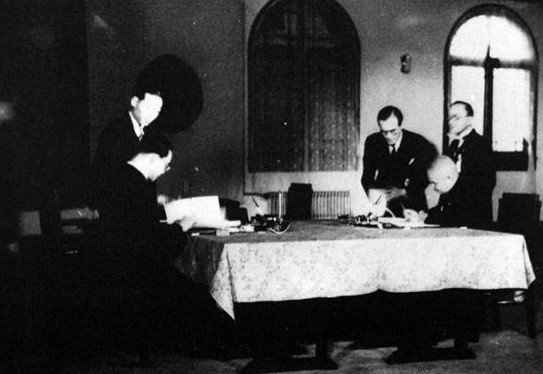
A “peace” treaty signed today by Wang Ching-wei and the Japanese overlords who recognize him as president of a national government of China threatens to end China’s existence as an independent nation if it ever can be carried into practical effect, informed foreigners said tonight. They asserted it was tantamount to complete surrender to domination by Japan which, however, has yet to crush the government and armies of Ching Kai hek (which both Britain and the United States will continue to recognize). Wang and Japanese Ambassador General Nobuyuki Abe signed the treaty this morning in the great Nanking administration hall, while a flock of white doves fluttered in bewildered freedom from their cages, a Japanese warship in the Yangtze fired a 21-gun salute, and Japanese bluejackets, manning swivel-mounted machine-guns, guarded the motor cars of Japan’s representatives. Although the treaty proclaims an end to the 40-nionths-old Chinese war and the beginning of an era of military and economic cooperation between Wang and Japan, the Japanese expect Chiang to continue the fight. The United States pointedly made clear its attitude toward the Tokyo-Nanking “peace” treaty today by reaffirming its recognition of Chiang Kai-shek’s anti-Japanese government and announcing a $100,000,000 credit to it. By agreements signed today Japan undertakes to evacuate all China except the northern provinces and Inner Mongolia within two years after “general peace” is restored. [Ed: Which will never happen, on Japanese terms.]
The national government of China offered a reward of 100,000 Chinese dollars ($6,000) today for Wang Ching-wei, head of the Japanese-recognized Nanking government, “for usurping the presidency and signing with the enemy a treaty detrimental to China’s sovereignty.’ Foreign Minister Wang Ching-hui threatened cessation of normal relations with any foreign power recognizing the Wang regime.
The United States lends $50 million to China for currency stabilization and grants an additional $50 million credit for purchase of supplies. The United States countered Japan’s ratification of a peace treaty with her Nanking puppet regime in China today by arranging to make another $100,000,000 available to the Government of China at Chungking, which is fighting Japanese aggression.
In Hubei Province, China, Chinese troops halted the offensive launched by the Japanese 11th Army five days prior. The Central Hubei Operation and the year-long Battle of South Guangxi ended in Chinese victory. The Japanese 11th Army, facing heavy Chinese counterattacks, retreats to its start line in the Central Hubei sector (Han River Operation). The Chinese 5th War Area re-occupies all territory lost during the failed Japanese offensive.
The districts of Banongkien, Bankokekrabang and Pratuchai in French Indo-China have been occupied by Thai (Siamese) forces, and reprisal raids made against Thakhek and Savannakhet, the high command said today. Thakhok and Savannakljet, towns on the border of French Indo-China, were attacked by the Thai air force, advices said, after the alleged French bombing of Thailand. (Domei, Japanese news agency, reported from Hongkong that Bangkok police had ordered all French nationals to leave Thailand within 48 hours.) The communique said Indo-Chinese troops and Thai soldiers exchanged machine-gun fire today and that the Indo-China forces had fired on refugees crossing into Thailand. Thai sources said the bombings of the two towns were not connected with Thailand’s demands for return of territory from French Indo-China
Japan officially recognized the Nanking government led by President Wang Ching-wei by signing a peace treaty with the regime. The Japanese stated that “Being desirous that these two countries should respect their inherent characteristics and closely cooperate with each other as good neighbors under their common ideal of establishing a new order in East Asia on an ethical basis, establishing thereby a permanent peace in East Asia …”
Dow Jones Industrial Average: 131 (+0.97)
Born:
Glenn English, American politician (Rep-D-Oklahoma, 1975-94), in Cordell, Oklahoma.
Pauli Nevala, Finnish athlete (Olympic gold medal, men’s javelin, 1964), in Pohja, Finland (d. 2025).
Dan Tieman, NBA point guard (Cincinnati Royals), in Covington, Kentucky (d. 2012).
Died:
John A. Hartwell, 71, American football player and coach, military officer and physician.
Naval Construction:
The Kriegsmarine (German Navy) Type 39 torpedo boat T25 is laid down by F. Schichau, Elbing, East Prussia (werk 1484).
The Kriegsmarine (German Navy) Type XIV U-boat U-460 is laid down by Deutsche Werke AG, Kiel (werk 291).
The Royal Navy submarine depot ship HMS Adamant (F 64), sole ship of her class, is launched by Harland & Wolff Ltd. (Belfast, Northern Ireland).
The Royal Navy Flower-class corvette HMS Polyanthus (K 47) is launched by Henry Robb Ltd. (Leith, U.K.).
The Royal Canadian Navy Flower-class corvette HMCS Rosthern (K 169) is launched by Port Arthur Shipbuilding Co. (Port Arthur, Ontario, Canada).
The Royal Navy Fiji-class (Crown Colony-class) light cruiser HMS Gambia (48) is launched by Swan Hunter and Wigham Richardson Ltd. (Wallsend-on-Tyne, U.K.); completed by Wallsend.
The Вое́нно-морско́й флот СССР (ВМФ) (Soviet Navy) “K” (Katjusa)-class submarine K-21 is commissioned. K-21 is preserved as a museum ship in Murmansk today.
The Kriegsmarine (German Navy) Type 1936A destroyer Z25 is commissioned.
The Nihon Kaigun (Imperial Japanese Navy) Kagerō-class destroyer HIJMS Isokaze (磯風; “Wind on the Beach”) is commissioned. Her first commanding officer is Commander Shirahama Masashichi.
For the month of November, 1940, the German U-boats have sunk 33 ships (total of 171,787 tons) and damaged 3 more ships (another 13,409 tons).
Total losses, including those to aircraft, mines, and surface raiders: 86 Allied ships of 294,054 tons in the Atlantic, 11 Allied ships of 91,661 tons elsewhere.
The Kriegsmarine loses two U-boats (one is presumed lost in November, but may, in fact, be lost in December). The Italians also lose a submarine.
 History Diaries