Greek forces, facing a steady stream of fresh Italian troops, were reported today to have won an “important initial success” in a fierce battle for southern Albania by storming a heavily fortified wooded plateau commanding the road to Argirocastro. A Greek officer leading the operation, during which he was wounded twice, was said to have described the plateau as “the hardest position we have tackled yet.” “Every tree and bush seemed to be covering machine-gun nests,” he said. “Mortars and hand grenades met our mountaineer fighters and during the day we were unable to move a foot, so deadly was the fire of the Italian snipers. During the night our mountain guns began shelling, setting the pine trees blazing and lighting up the whole plateau.” Greek forces then stormed the position during the darkness and took it after six hours of fierce fighting. Losses were said to have been heavy on both sides. The Italians were said now to be fighting a defensive battle along the whole south and central fronts, using fresh troops who are heavily armed.
An “Amazon company” of Macedonian peasant women who helped the Greek army defeat 3,000 Italian troops by rolling rocks down on them from the peaks of the Pindus Mountains was described today in a Greek dispatch from the Epirus front. More than 100 women were reported by a Greek correspondent to have followed a Greek army column, against the orders of an officer, and to have fought with the soldiers. The correspondent quoted one middle-aged farm woman, Helen Codjamani, who was wounded in the fighting, as telling him: “A sergeant who passed through our village wanted to know the way to the Chapel of St. George. We told him and when he started off about 10 women took the train after him. When we neared the chapel, we saw many Greek soldiers. When the officer saw us, he got very angry and ordered us to go back, but we started shouting, “We shall not go back. We want to fight with you.”
Premier Mussolini followed a shakeup of his high command with a massing of new troops in Albania tonight for counter-attacks designed to turn the tide of victory toward the Fascists in their month-old war with Greece. With the appointment of General Alfredo Guzzoni as undersecretary of war, II Duce further centered here the direction of a campaign which the Rome radio said had the express mission of “liquidating the Greek incident.” Guzzoni, former commander of troops in Africa and in Albania prior to the Greek war, is expected to be a liaison man between the high command and General Ubaldo Soddu, commander of the Italian forces in Albania.
General Freyberg’s British and New Zealand troops occupied all of Crete.
Fighting between the Rumanian army and Iron Guardists in several cities is verging on civil war, according to diplomatic advices received here tonight, and German intervention in Rumania was believed imminent. In addition to clashes with the army, the Iron Guardists, in raids in many Rumanian cities, were said to have murdered 2,000 persons, mostly Jews, during the past three days. Detachments of the pro-Nazi Iron Guard fought sharply with the Rumanian army at Brasov, Galatt, Ploesti, Craiova and Turnu-Severin and occupied public buildings, these advices said. Counter-attacks regained the telephone exchange and the post office at Brasov for the army, the report said. Several Iron Guardists were reported killed at Brasov, Ploesti and Turnu-Severin. King Mihai, 18, who succeeded to the throne when his father, Carol II, abdicated September 6, was reported to have left Bucharest. Some reports were that he headed for the Yugoslav frontier, others that he was on the outskirts of the city waiting for the situation to clear.
A draft plan is issued by German military leaders for the invasion of the Soviet Union, Operation BARBAROSSA.
New Zealand Division cruiser HMS Leander bombarded a factory and a radio station at Banda Alulu, Italian Somaliland at 1038 hours. Italian aircraft counterattacked without success.
Heavy night air attacks cause severe damage and many fires in London. St. Martin’s Ludgate, the Old Bailey, the Tower of London, St James’ Church Piccadilly are amongst those buildings hit. The cloisters and crypt of the Houses of Parliament are also damaged.
RAF Bomber Command dispatches 42 aircraft overnight to Bremen, Cologne, the Channel ports and airfields; 1 Blenheim lost. 2 Hampdens minelaying off Brest and 1 O.T.U. sortie.
German destroyers Galster, Beitzen, and Lody departed Brest and destroyers HMS Jupiter, HMS Kashmir, HMS Javelin, HMS Jersey, and HMS Jackal departed Plymouth on the 28th.
In operations eight miles off Start Point late on 28 October, the German destroyers sank British tug Aid (134grt) and barge B. H. C. 10 (290grt) and damaged French tug Abeille 14 (126grt). Five crew members were lost and five rescued from the tug Aid. Three crewmen were lost and five rescued from the barge B. H. C. 10.
Destroyer HMS Javelin sighted the gun flashes of the German destroyers attacking the small tugs. In the engagement twenty miles south of the Lizard, destroyer Javelin was hit by two torpedoes from destroyer Lody and lost her bow and stern. A/Lt J. I. A. Mitchell, Midshipman L. E. R- Jack, P/T/Surgeon Lt H. F. Sloan RNVR, and forty three ratings were killed in destroyer Javelin. Lt E. T. L. Dunsterville was wounded. Attended by destroyer HMS Jackal, later the other three destroyers as well, destroyer Javelin was towed to Devonport by tug Caroline Moller (444grt) arriving from Falmouth.
Destroyers HMS Kashmir, HMS Jersey, and HMS Jupiter were in a brief encounter with the German destroyers which were able to escape. German destroyer Lody was struck several times and all three German destroyers had splinter damage, but none suffered appreciable damage and no casualties were sustained.
Destroyer HMS Javelin was under repair at Devonport for thirteen months completing on 28 December 1941.
Destroyer HMS Icarus arrived at Portsmouth on the 26th from Immingham. The destroyer departed Portsmouth on the 28th and laid minefield J H.in the Havre to Cherbourg sea lane early on the 29th. Destroyer Icarus was escorted by destroyers HMS Vanoc, HMS Witch, and HMS Volunteer.
Destroyer HMS Exmoor carried out an oiling sea trial from British tanker Aldersdale (8402grt). The stirrup method was used while the ships were at anchor.
British drifter Young Fisherman (95grt) was lost when she ran around at Oban.
British steamer Fermain (759grt) at Dover was damaged by German shore guns.
Minesweeping trawler Calverton (214grt, T/Skipper J. Fountain RNR) was sunk by a mine at the entrance to the Humber, 3.7 miles 117° from Spurn Light House. Two ratings were lost on the trawler.
British drifter Young Fisherman (95grt) was lost when she ran aground at Oban.
Battlecruiser HMS Renown, heavy cruiser HMS Berwick, light cruiser HMS Sheffield, and destroyers HMS Faulknor, HMS Fury, HMS Forester, and HMS Firedrake arrived at Gibraltar at 1430. Aircraft carrier HMS Ark Royal, battleship HMS Ramillies, light cruisers HMS Newcastle and HMS Despatch and destroyers HMS Duncan, HMS Encounter, HMS Wishart, HMS Kelvin, and HMS Jaguar arrived at Gibraltar at 1530.
Heavy cruiser HMS Berwick was transferred to the North Atlantic Command.
Greek submarine Papanicolis attacked Italian steamer Chisone (6168grt) off Durazzo without success.
Italian submarine Delfino attacked two Greek destroyers twelve miles east of Kalojeri and near missed Greek destroyer Spetsai.
Aircraft carrier HMS Hermes, heavy cruisers HMS Devonshire and HMS Cumberland, and light cruiser HMS Edinburgh arrived at Freetown.
Convoy FS.346 departed Southend, escorted by destroyer HMS Vanity, patrol sloop HMS Widgeon, escort ship/destroyer HMS Gleaner. The convoy arrived at Methil on 1 December.
The Malaya/Eagle force and convoy ME.4 arrived at Alexandria. Steamers Volo, Rodi, and Cornwall, escorted by two destroyers proceeded to Port Said.
Convoy HX.92 departed Halifax at 1400 escorted by Canadian destroyer HMCS Restigouche and corvette HMS Windflower. The local escort parted company at 1652 on the 30th. Ocean escort was armed merchant cruiser HMS Montclare, which was detached on 8 December. Due to a lack of suitable escorts, BHX.92 was cancelled. Ships en route to Bermuda to join were diverted to Halifax to join an HX.serial direct. Destroyer HMS Wolverine joined on 8 December, destroyer HMS Veteran on 10 December, destroyer HMS Chelsea and corvette HMS Camillia on 11 December. The convoy arrived at Liverpool on 12 December.
Joseph H. Kennedy, U. S. ambassador to Britain, tonight described as “nonsense” reports that “I do not expect Britain to win the war” and reiterated his stand against American entry into the conflict. “What I am concerned with is keeping America out of the war,” the ambassador said in reply to a request for a re-statement of his position. “Everyone has known from the beginning that I have been against American entry into the war.”
President Roosevelt conferred for fifty minutes today with Martin Dies, chairman of the House Committee Investigating Un-American Activities. Representative Dies afterward expressed confidence that the committee and the executive departments could work in harmony, but insisted that “fearless disclosure” of subversive activities would continue. The Texan indicated that his views on the subject of publicity for the committee’s findings had not been altered by the chat. Mr. Roosevelt had warned Mr. Dies earlier that premature publication of evidence endangered the government’s investigating activities and that the Executive was responsible for the prosecution of fifth-column agents.
President Roosevelt plans to leave next week on a defense trip which may take him into the Caribbean for participation in Navy exercises off Culebra Island and to some of the island bases leased from Great Britain. The President told a press conference that his plans were vague, but he indicated that he would travel a considerable distance from. Washington. In circles close to the White House, however, it was understood that Mr. Roosevelt might make a sea voyage. The cruiser USS Tuscaloosa, which has carried him on several trips, left Norfolk today for an unrevealed destination, perhaps Miami. Special equipment, customary for the President’s use, was loaded on the vessel Wednesday. The fleet is scheduled to maneuver early in December off Culebra Island, between Puerto Rico and the Virgin Islands. Secretary Knox is scheduled to join it on December 7. Trinidad, off the Venezuelan coast, where a final agreement with the British on base sites is pending, was rumored as a possible destination for the President.
President Roosevelt refused to travel extensively during the political campaign, insisting that the international situation and defense requirements made it unwise for him. to be more than twelve hours traveling distance from Washington. He explained today that if he should go more than twelve hours by rail from the capital, he would have an. airplane ready to fly him back to the White House within that time. The President, in answering questions, conceded that he might go almost anywhere in the continental United States and even into the waters outside the territorial limits, but he insisted that his twelve-hour rule still applied. He would fly only in case of necessity, Mr. Roosevelt said. Asked if the Secret Service did not prohibit his traveling by air, the Chief Executive said that he did not think such a rule had been laid down. If he flew, the Secret Service agents said that they would have to have a whole armada of planes to accompany him, he remarked.
Further retroactive taxes on 1940 incomes of individuals and corporations were ruled out tonight when President Roosevelt and his revenue advisers from Congress and the Treasury took up at a dinner conference the nation’s fiscal problems.
The annual convention of the American Federation of Labor closed today with the adoption of resolutions calling for maintenance of the fortyhour week in national defense industries and for active cooperation between workers in the United States and Latin America to safeguard democracy in the Western Hemisphere. Proposals by Alfred P. Sloan Jr.. chairman of the General Motors Corporation, and other employer spokesmen for lengthening of the work week were denounced by the federation as “neither timely nor economically sound.” The organization reaffirmed its faith in the thirty-hour week as an ultimate objective, but made clear that it would not press for shorter hours until the war emergency passed. “We hold that any lengthening of labor hours in the light of existing unemployment conditions would be a grave mistake and would be certain to react injuriously to the national defense program,” the convention declared in a report adopted by unanimous vote.
Ability of existing steel-production capacity in the United States to supply defense and civilian needs is the subject of debate within the ranks of the Defense Advisory Commission. Some of the commission’s economists believe new steel plants must be established at once; the steel industry disagrees.
A minor fire broke out today aboard the cruiser USS Philadelphia and was extinguished without damage to the vessel, officials at the Mare Island Navy Yard said. The Philadelphia is in the yard for routine repairs. The fire started when sparks from a welding torch landed in a pile of shavings. It was extinguished with emergency fire equipment carried aboard the ship, officials said.
The comedy film “The Bank Dick” starring W. C. Fields was released.
Canada has arranged to acquire 144 American-made combat planes originally ordered by the Swedish government, the United Press learned tonight. Sweden had ordered the planes from the Vultee Aircraft Corp., but the United States subsequently refused to grant an export license ostensibly on grounds that the craft might fall into German hands. The American government, how ever, was said to have had no part in arrangements for Canadian acquisition other than to issue export licenses. A spokesman at the Swedish embassy said he “knew nothing about the arrangements.” “That’s a question between Vultee and anybody who buys the planes from them because Vultee has broken its contract with the Swedish government,” he added.
Officials in Mexico City tonight announced the discovery of what they termed a “Communist plot” to assassinate President-elect Manuel Avila Camacho on the eve of his inauguration after federal soldiers and policemen had shot it out with armed groups in two different raids connected with uncovering the alleged plot. Three persons were killed in the two shooting affrays and at least four wounded. The soldiers raided Communist party headquarters in an old colonial building scarcely half a block from the National Palace. Major Guillermo Garcia Gallegos was killed and at least two other persons were wounded in this raid.
German steamers Rhein (6031grt) and Idarwald (5181grt) departed Tampico and were immediately screened by US destroyers Simpson (DD-221) and Broome (DD-210). The German ships return to Tampico until 3 December when they once again attempt to escape the Caribbean.
In addition, U.S. Navy light cruiser USS Memphis (CL-13) and a destroyer escort departed Key West to patrol the passages into the Atlantic.
U.S. Navy heavy cruiser USS Louisville (CA-28) arrives at Rio Grande du Sol, Brazil, as she continues her goodwill cruise in Latin American waters.
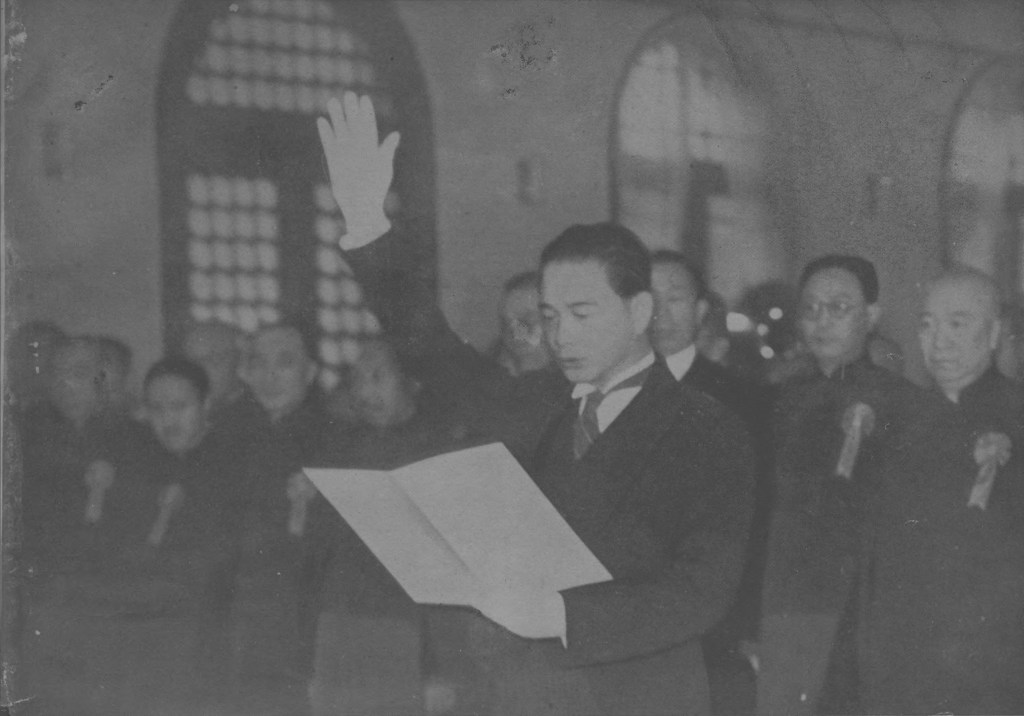
General Nobuzuki Abe, Japanese ambassador, and Wang Ching-wei, head of the Japanese-sponsored Chinese government at Nanking, today signed a treaty of peace, Japanese reports said. The Wang government was set up March 22, 1940 under Japanese auspices in opposition to the Chinese government in Chungking of Generalissimo Chiang Kai-shek, whose guerrilla forces apparently were responsible for dynamiting a Japanese-operated train bound for Nanking yesterday. Between 100 and 400 passengers were reported killed or injured. Chiang Kai-shek ignored a “last exhortation” sent him by the Wang government asking him to declare an armistice with Japan. The Chungking spokesmen have declared a fight to the end with Japan. Five coaches of the train were blasted from the tracks at Soo-chow, about 50 miles west of Shanghai, a third of the way to Nanking. The Wang government was set up to provide “Chinese administration” of the roughly one-third of China conquered by the Japanese who still are at war with the central Chinese government under Generalissimo Chiang Kai-shek. One report had it that the train was carrying Japanese and Chinese officials to participate in the treaty ceremonies and it was considered possible that foreigners were aboard, including American newspapermen en route to Wang’s capital for the treaty-making. Japanese military authorities, who administer the railway, however, denied this. Rail service to Nanking was reported halted by the blast which caused heavy damage to the roadbed.
The Thais begin a ground offensive against French positions. They order French nationals to evacuate border provinces within 24 hours after their patrols engage French Indochinese border guards at the Cambodian border. The Thai Government tonight appeared to be clearing the way for a full-dress war against French Indo-China and planning extensive military operations during the weekend.
Dow Jones Industrial Average: 130.03 (-0.11)
Born:
Chuck Mangione, flugelhorn player, trumpeter and composer, in Rochester, New York.
Mark James [Francis Zambon], American Grammy Award-winning songwriter (“Hooked on a Feeling”, “Suspicious Minds”, “Always on My Mind”), in Houston, Texas (d. 2024).
Thelma Mothershed Wair, American civil rights activist (one of the Little Rock Nine, 1957), school teacher, and guidance counselor, in Bloomburg, Texas (d. 2024).
Jack Martin, Canadian NHL centre (Toronto Maple Leafs), in St. Catharines, Ontario, Canada (d. 2023).
Naval Construction:
The Royal Fleet Auxiliary Dale-class fleet tanker RFA Echodale (A 170) is launched by Hawthorn Leslie and Company (Hebburn, South Tyneside, England)
The Royal Navy Brigand-class HMS Freebooter (W 01) is launched by Fleming & Ferguson Ltd. (Paisley, Scotland).
The Nihon Kaigun (Imperial Japanese Navy) No.13-class submarine chaser CH-14 is launched by Tama Shipbuilding (Okayama, Japan).
The Royal Navy Dance-class ASW trawler HMS Tango (T 146) is launched by Smith’s Dock Co., Ltd. (South Bank-on-Tees, U.K.).
The U.S. Navy Gar-class submarine USS Grenadier (SS-210) is launched by Portsmouth Navy Yard (Kittery, Maine, U.S.A.).
The Royal Navy Flower-class corvette HMS Orchis (K 76) is commissioned. Her first commanding officer is Lieutenant Arthur Denis White, RNR.
 History Diaries