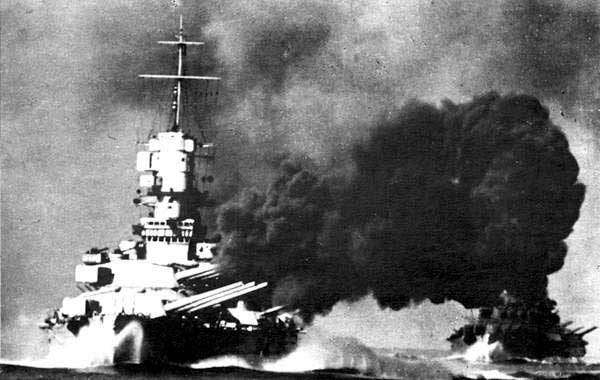
The Battle of Cape Spartivento was fought, ending indecisively. At 1000 hours, spotter aircraft from British Force H (Operation Collar; escorting Allied convoy ME4) and the Italian interception fleet found each other, and a surface battle soon broke out. The British were initially outgunned (especially as the carrier aircraft were held back), but at 1130 hours the arrival of battleship HMS Ramillies and cruisers HMS Berwick and HMS Newcastle evened up the two sides. Italian Admiral Campioni, with orders to avoid combat unless his forces were superior, began to withdraw at about 1230 hours; battleship Vittorio Veneto’s heavy fire stopped the British pursuit. British cruiser HMS Berwick was hit by cruiser Fiume twice at 1222 and 1235 hours (7 killed), while Italian destroyer Lanciere had to be towed back to port after being hit by cruiser HMS Manchester.
The Royal Navy is engaged on 27 November 1940 in one of their typical supply convoys to Malta — Operation COLLAR — but they go to the well once too often. Trying to pull the same trick as in August, with the successful Operation HURRY, Force H goes to the well once too often. The Italian Navy, meanwhile, regains a small measure of self-respect after the disaster at Taranto two weeks ago.
The Italian intelligence service has spotted the Royal Navy south of Sardinia. The British force is seen to be of moderate size. Two Italian battleships and supporting ships set out to intercept. Italian torpedo boat Sirio spots the British fleet late on the 26th and reports its position. The Royal Navy ships then steer north to put open water between them and the freighters. At 09:45, an Italian IMAM Ro.43 floatplane from cruiser Bolzano spots the Royal Navy ships. RAF planes spot the Italian fleet nine minutes later, and the game is on.
Admiral Somerville in command of Force F splits his force, which now fortuitously is joined by Force D from Alexandria, into two main battle groups. The forces are fairly evenly matched. The fire between the two fleets commences at 12:22 at a range of 23,500 meters.
Italian destroyer Lanciere suffers serious damage (towed to port). Royal Navy cruiser HMS Berick takes an 8 inch (203 mm) shell to her Y turret that kills seven men and wounds nine others. Another shell destroys its remaining aft turret. Royal Navy battlecruiser HMS Renown intervenes, but then Italian battleship Vittorio Veneto comes within range and opens fire. This forces the Royal Navy ships to retire, and the battle is over after 54 minutes. It is a minor Italian victory, both because of the damage to the British cruiser Berwick and the fact that the Royal Navy vessels are forced to retire.
British Prime Minister Winston Churchill is not happy. He believes that Admiral Somerville lacks the necessary aggressive spirit and should not have broken off the engagement. A board of inquiry exonerates Somerville. In fact, it is the Italians who had more cause to be upset, because the Vittorio Veneto could have pursued the British ships and perhaps dealt them more damage. Admiral Campioni in charge of the Italian fleet loses prestige as a result of this operation, which, in the absence of any RAF attacks, could have yielded better results.
The Battle of Cape Spartivento claims an unexpected victim when the plane carrying the new Vichy High Commissioner of Syria and Lebanon, Jean Chiappe, is shot down.
A blizzard hits the higher elevations of the Italo-Greek battlefield. On balance, this helps the Italians, who are on the defensive now. The Greeks continue advancing. II Corps, moving in the direction of Frashër, is reinforced with the 11th Division.
The western Macedonia sector was held by the Western Macedonia Army Section (TSDM), the Greeks complete the capture of the Korçë plateau. The TSDM has suffered 624 dead and 2348 wounded in this operation. The Greeks continue to move forward toward the center of Albania, with the 13th Division advancing on Pogradec.
The Greek Liuba Detachment continues its march along the coast toward the Bistritsa River.
The Italian Regia Aeronautica is in action, bombing Epirus, Corfu, Cephalonia, Patras, and Crete.
Mussolini is growing increasingly concerned about the Italian collapse in the mountains. Rumors continue to fly that he will seek a separate peace.
Sir Kingsley Wood, Chancellor of the Exchequer, says that Britain’s average daily war expenditures have risen from £5,300,000 for the first year to £9,100,000 for the first 77 days of the second year. Clearly, the government cannot sustain these types of expenditures indefinitely. Ambassador to the US Lord Lothian already has broadly hinted to the Americans that the days of cash-and-carry are dwindling and likely to end in 1941. In addition, £475,532,981 has been raised for the war.
Telegram from Wavell to Churchill:
“1. Will undertake Compass in spite of risks involved. 2. Possibility of landing on coast has been considered… neither Navy nor myself are very hopeful of results.”
In Rumania, the ruling party Iron Guard arrests and executes over 60 of exiled King Carol II of Rumania’s aides, including former minister Nicolae Iorga. Hotheads of Rumania’s ascendant Iron Guard slew 64 and perhaps more political prisoners in Bucharest’s Jilava prison today in a bloody vengeance for the killing of their leader, Corneliu Codreanu, two years ago. Stern disapproval by both Premier-Dictator Gen. Ion Antonescu and the present Iron Guard leader, Vice-Premier Horia Sima, was expressed in a terse government communiqué which officially announced the unofficial purge after several hours of silence. The communiqué stated simply that “some political prisoners” were shot dead by “legionnaires” (Iron Guards) who were exhuming the bodies of Codreanu and 13 of his followers from the prison courtyard where they were buried during the late regime of King Carol. It said those shot were “considered principally responsible for the crime against Codreanu and other legionnaires under the last regime.” It did not give the number killed or any other details, but unofficial reports said there were 64.
The South African 5th Infantry Division arrives in Mombasa, Kenya.
The Luftwaffe continues its sustained assault on Bristol, attacking it for the fourth time in three days. Plymouth, though, receives the most attention, with 107 bombers. The new German strategy appears to be to focus on mid-sized towns and try to cripple them rather than just relentlessly beating against London (though it is bombed as well, by 57 bombers).
RAF Bomber Command dispatches 7 Blenheims in daylight. Only 2 bombed, but 1 of these hit a merchant ship outside Wilhelmshaven harbor. No losses.
RAF Bomber Command dispatches 62 aircraft overnight to 5 targets in Cologne, less than half reported bombing there. 1 Whitley lost. 8 aircraft to Channel ports and 4 minelaying off Brittany; no losses. Bomber Command attacks Cologne with 62 bombers and also Boulogne. A Blenheim bomber crashes due to pilot error while trying to land back at Swanton Morley, and another gets lost in the foul weather and its crew bails out over Manchester. Another dozen bombers are sent against Antwerp and Le Havre.
A Bf 109E piloted by Lt. Wolfgang Teumer is damaged and force lands at RAF Manston. It is repaired and joins the RAF “Ratwaffe.”
A plane bound for Syria piloted by the French aviator Henri Guillaumet with the newly appointed High Commissioner of the Levant Jean Chiappe among the passengers was mistakenly shot down over the Mediterranean by an Italian fighter plane.
BATTLE OF CAPE SPARTIVENTO
Italian battleships Veneto and Cesare with destroyers Granatiere, Fucliere, Bersagliere, and Alpino of the 13th Destroyer Division and Freccia, Saetta, and Dardo of the 7th Destroyer Division departed Naples.
Heavy cruisers Pola, Fiume, and Gorizia and destroyers Alfieri, Carducci, Gioberti, and ORIANI of the 9th Destroyer Division departed Naples.
Heavy cruisers Trento, Trieste, and Bolzano with destroyers Lancieri, Ascari, and Carabinieri of the 12th Destroyer Division departed Messina.
Also at sea was the 10th Torpedo Boat Division of Alcione, Vega, Sagitarrio, and Sirio and two MAS divisions were in the Sicilian Strait.
The Italian forces engaged British cruisers HMS Berwick, HMS Newcastle, HMS Manchester, and HMS Southampton west of Malta off Cape Spartivento.
In the action, Italian heavy cruiser Fiume suffered an engine breakdown during the battle.
Italian destroyer Lancieri was badly damaged by British gunfire and was left dead in the water. She was towed from the scene by one of the heavy cruisers of the 3rd Division.
Heavy cruiser HMS Berwick was damaged by two eight inch shell hits, one of which put her after turret out of action. T/Surgeon Lt W. W. Wildman RNVR, six ratings were killed on the cruiser. Nine ratings were wounded.
Battle of Cape Spartivento: two U.S. Naval Observers, Lieutenant Commander A. Dayton Clark in British battlecruiser HMS Renown, and Lieutenant Commander Frederick P. Hartman in light cruiser HMS Southampton, witness the action that takes place between British and Italian forces off the coast of Sardinia.
U-104 sank British steamer Diplomat (8240grt), a straggler from convoy HX.88, in 55‑42N, 11‑37W. On 27 Nov 1940 the Diplomat (Master William Augustus Hansen), a straggler from convoy HX.88, was torpedoed and sunk by U-104 128 miles west-northwest of Bloody Foreland. The master and 13 crew members were lost. 39 crew members were picked up by HMS Active (H 14) (Cdr E.C.L. Turner, RN) and landed at Greenock. The 8,240-ton Diplomat was carrying cotton, iron and steel, and general cargo and was bound for Liverpool, England.
U-104 also damaged British tanker Charles F. Meyer (10, 516grt) from convoy HX.87 in 56‑00N, 13‑52W.
U-95 sank British steamer Irene Maria (1860grt) northwest of Ireland. At 0058 hours the unescorted Irene Maria (Master Alfred Peter Evers), a straggler from convoy OB.248, was hit aft by one torpedo from U-95 and sank by the bow within two minutes about 55 miles south-southwest of Rockall. The ship had been missed by two torpedoes at 0042 and 0052 hours. The master, 24 crew members and one gunner (all hands) were lost. The 1,862-ton Irene Maria was carrying ballast and was bound for Bridgewater, Nova Scotia.
U-103 sank British steamer Glenmoor (4393grt) in 54‑35N, 14‑31W. At 1956 hours on 27 Nov 1940 the unescorted Glenmoor (Master Jack Young), a straggler from convoy OB.248 was torpedoed and sunk by U-103 about 167 miles northwest of Sylne Head. The master and 30 crew members died. Two crew members were picked up by HMS Harvester (H 19) (LtCdr M. Thornton, RN) and HMS Havelock (H 88) (LtCdr E.H. Thomas, RN) and landed at Liverpool. The 4,393-ton Glenmoor was carrying coal and was bound for Alexandria, Egypt.
Destroyer HMS Wallace was damaged in a collision with the Newarp Light Float. She was repaired in 48 hours in dock at Rosyth.
Anti-aircraft cruiser HMS Curacoa transferred to convoy EN.32. The cruiser left convoy EN.32 to return to Rosyth for a conference at 1000/28th. Anti-aircraft cruiser Curacoa arrived at Rosyth at 0600/29th.
Destroyer HMS Punjabi departed Rosyth at 0830 after boiler cleaning to return to Scapa Flow where she arrived at 1700.
Destroyers HMS Exmoor and HMS Pytchley departed Scapa Flow at 1445 to patrol east of Fair Isle during the night to investigate reports of ships passing through Fair Island Channel. A damaged German submarine was expected to pass through the Channel. The patrol area was left at 1000/28th. The destroyers met destroyer HMS Southdown to exercise. They then returned to Scapa Flow arriving at 1630/28th.
Submarine HMS H-33, entering Tobermory, was in a collision with corvette HMS Heather. H.33 was repaired at Oban in December.
British steamer Galacum (585grt) was damaged on a mine in 51‑34N, 01‑09E.
British trawlers Charmouth (195grt) and Rattray (182grt) were damaged by German bombing off Milford Haven.
Minesweeping trawler HMCS Elk (181grt, Chief Skipper J. S. Bush RNR) was sunk on a mine 114 cables 185° from Penlee Point at Plymouth. There were no casualties on the trawler.
German trawler Peter (405grt) was lost in stranding on the Swedish coast.
Battleship HMS Ramillies, heavy cruiser HMS Berwick, light cruiser HMS Newcastle joined Force H.at 1130.
Light cruiser HMS Despatch and destroyers HMS Duncan and HMS Wishart turned over the Gibraltar to Malta convoy to anti-aircraft cruiser HMS Coventry and destroyers HMS Gallant, HMS Greyhound, HMS Hereward, HMS Defender, and HMS Griffin which escorted the ships to their destination.
On 26 November, a Fulmar of 808 Squadron crashed astern of aircraft carrier HMS Ark Royal. Lt (E) J. P. Coates was killed.
On 27 November, a Fulmar, piloted by A/Sub Lt (A) R- M. S. Martin RNVR, from 808 Squadron from aircraft carrier HMS Ark Royal was shot down. Martin and Leading Airman A. L. M. Noble were lost.
Gunboat HMS Ladybird bombarded Mersa Matruh.
Italian submarine Tembien unsuccessfully attacked heavy cruiser HMS York and light cruiser HMS Gloucester in 36‑00N, 14‑47E.
Convoy FN.345 departed Southend, escorted by destroyers HMS Valorous and HMS Versatile. The convoy arrived at Methil on the 30th.
Convoy FS.347 departed Methil, escorted by destroyers HMS Verdun and HMS Wolsey. The convoy arrived at Southend on the 29th.
President Roosevelt called on the Dies committee today to be careful not to “defeat the ends of justice” in carrying on its campaign against alleged un-American activities. In a telegram to Chairman Dies, Texas Democrat, the chief executive declared that the executive departments’ work against spies and saboteurs may be “severely handicapped or completely destroyed” by: 1. Premature disclosure of “facts or of suppositions” to the public. 2. Hasty seizure of evidence “which might with a little more patience be obtained in a manner to be admissible” in court. 3.’ Granting immunities to witnesses before congressional committees “as to matters revealed by their own testimony.”
A $50,000,000 allotment to provide oil and other shortage facilities and ship and plane anchorages at the defense bases recently acquired from Great Britain was announced today by Secretary of the Navy Knox. He disclosed also that an additional 31,908 naval and marine reserves might be called to active duty at any moment and had been so advised. He said in addition that reserves from New York and New Jersey had been called to service with destroyers operating in the Panama canal area.
Consideration of legislation for financial aid to Great Britain was deferred until the next session of Congress by unanimous vote today of the Senate Foreign Relations Committee. Senator George of Georgia, the new chairman, said, in announcing the committee’s course, there was no doubt in his mind that the question of further aid to Britain would be presented in some form early in the next session, but he expected today’s decision to stand unless an occasion should arise which demanded immediate steps. An authoritative Administration source predicted that it might be Spring before the executive department made specific recommendations to Congress on the subject. This authority assumed, as did Senator George, that proposals seeking to ease present legal bans would be put forward in line with the Administration’s policy of all aid short of war. They thought, moreover, that these steps would be taken well before Britain had exhausted the resources which she might turn into dollars for purchases of war supplies in the United States.
The American Federation of Labor pledged its full support today to national defense preparations, but warned that it would not allow the American democracy to be transformed into “a dictatorship” through efforts to suppress labor.
Henry Ford declared himself today as a “big Navy” advocate. A Navy strong enough to protect both shores of the United States and equipped with “plenty of airplane carriers,” he said, is one of the most vital factors of national defense.
Legislation to compel young women in California to carry identification cards certifying they are 21 or over was proposed today to curb the sale of liquor to minors. The suggestion was offered at a meeting called by the State Board of Equalization of representatives of the liquor industry and groups advocating return of outright prohibition. It was pointed out that young men are taken care of by draft registration cards indicating their majority. Mrs. Gladys E. Morris, of San Bernardino, member of the W.C.T.U., asked what was being done about liquor law enforcement in her county, saying she understood that agents of the board had been investigating conditions there for 30 days. William G. Bonelli, board member, replied that agents recently uncovered 56 violations of the liquor laws in the Southern California district.
Directors of the Golden Gate Bridge rejected today a proposal to erect a screen on the bridge to prevent suicides. There have been about 25 from the high structure since it was opened to travel. They acted on advice of General Manager William H. Harrelson and Chief Engineer Russell G. Cone, both of whom have made studies of the collapse of the Tacoma narrows bridge. They said such a screen would increase wind resistance, would be expensive and unsightly, and persons could still jump off the approaches.
Heavy snow, cold rains and chilling winds kept northerners under heavy wraps yesterday three and a half weeks before the official advent of winter. The season’s first major snowstorm swept New York state. The fall measured two inches in the southern sector and eight in the north. The storm, earliest in years in New York City, blended snow, sleet and rain and left ankle-deep slush in its wake. The snow cover ranged from 3 to 12 inches in New England while high tides swished along the coast but caused no damage. North central Pennsylvania was burdened with a nine-inch deposit and it drifted to 15 inches in the Pocano mountains. Flurries put a fresh top on the snow blanket in several sections of the Midwest, where Tuesday’s storms had piled flakes up to a maximum depth of seven inches. Temperatures dropped to freezing or below in most of the north central states.
6th Heisman Trophy Award: Tom Harmon, halfback, Michigan.
Convoy BN.10 departed Bombay, escorted by armed merchant cruiser HMS Hector. The armed merchant cruiser was detached on 1 December when relieved by light cruiser HMAS Hobart. Anti-aircraft cruiser HMS Carlisle, destroyer HMS Kimberley, sloops HMS Auckland and HMIS Indus joined on 3 December. The anti-aircraft cruiser and destroyer Kimberley were detached on 5 December. Sloop Indus was detached on 6 December and light cruiser Hobart and sloop Auckland on 7 December. On 7 December, sloops HMS Clive and HMS Grimsby joined the convoy and arrived with it at Suez on 10 December.
Chinese 27th, 31st, and 44th Divisions counterattacked against the Japanese offensive in Hubei Province, China. The Japanese 11th Army continues advancing in the region of Hoyuantien, Tangchianfan, and Huantanchen.
French colonial forces have repulsed an attempt by Thailand’s troops to seize the Cambodian village of Popiet, the Ministry of Colonies announced today.
Japan has established an air base at Saigon, South Indo-China, bringing her air force within bombing range of Britain’s Singapore base, according to information reaching London tonight.
Kichisaburo Nomura was named the Japanese Ambassador to the United States.
Admiral Kichisaburo Nomura’s hope that he would get the support of the people received little encouragement in Japanese comment on his appointment as Ambassador to the United States. The Tokyo press uniformly blames the United States for the tensions between it and Japan.
Japanese newspapers, in remarkably similar phraseology, reported today a sudden burst of anger by the government against the Netherlands East Indies following “discovery” of strong anti-Japanese sentiment there. The papers agreed in saying that the attitude of the Indies islanders had grown steadily worse since conclusion of the tri-partite pact among Japan, Germany and Italy, and lengthily enumerated incidents not previously reported. These were said to include beatings of Japanese and defilement of the Japanese flag. Observers pondered the possibility that this might be the forerunner of new and stronger economic demands on the East Indies. A feeling of impatience at delay was said to have been growing since the recent return home of Commerce Minister Ichizo Kobayashi from an economic mission to Batavia.
New Zealand Division light cruiser HMS Achilles and two liners had departed Wellington on the 7th and arrived at Sydney on the 12th in preparation for convoy US.7.
Australian troop convoy US.7 departed Fremantle with Polish liner Batory (14287grt) and British liners Orion (23371grt), Strathmore (23428grt), and Stratheden (23722grt), escorted by light cruiser HMAS Perth. Heavy cruiser HMAS Canberra joined the convoy on the 28th and escorted it until 3 December when she returned to Fremantle. Light cruiser HMS Capetown escorted the convoy from 3 to 5 December. The convoy arrived at Colombo on 7 December. On 10 December, light cruiser HMS Caledon joined the escort and remained until 12 December. On 12 December, anti-aircraft cruiser HMS Carlisle and destroyers HMS Kingston and HMS Kandahar joined the convoy escort. Light cruiser HMAS Perth arrived at Aden on 12 December and left the convoy escort. On her arrival in the Mediterranean, Perth relieved light cruiser HMAS Sydney in the Mediterranean Fleet. The convoy arrived at Suez on 15 December.
Dow Jones Industrial Average: 129.78 (-2.16)
Born:
Bruce Lee [Lee Jun-fan], American martial artist and actor (“Enter the Dragon”), in Chinatown, San Francisco, California (d. 1973).
John Alderton, British actor (“Please, Sir!”; “Zardoz”; “Upstairs, Downstairs”), in Gainsborough, Lincolnshire, England, United Kingdom.
Ernie Wakely, Canadian NHL and WHA goaltender (NHL All-Star, 1971; NHL: Montreal Canadiens, St. Louis Blues; WHA: Winnipeg Jets, San Diego Mariners, Cincinnati Stingers, Houston Aeros, Birmingham Bulls), in Flin Flon, Manitoba, Canada.
Died:
Jean Chiappe, French civil servant.
Henri Guillaumet, 38, French aviator.
Naval Construction:
The Royal Indian Navy Basset-class minesweeping trawler HMIS Lahore (T 253) is laid down by Shalimar Engineering and Shipbuilding (Seebpore, India).
The Royal Navy Flower-class corvette HMS Borage (K 120) is laid down by George Brown & Co. (Greenock, Scotland); completed by Kincaid.
The Royal Navy “U”-class (Third Group) submarine HMS Uproar (P 31) is launched by Vickers Armstrong (Barrow-in-Furness, U.K.).
The Royal Navy Flower-class corvette HMS Lavender (K 60) is launched by Hall, Russell & Co. Ltd. (Aberdeen, Scotland).
The Royal Navy escort carrier HMS Avenger (D 14) is launched as the mercantile Rio Hudson by Sun Shipbuilding (Chester, Pennsylvania, U.S.A.).
The Royal Navy Fairmile B-class motor launch HMS ML 131 is commissioned.
The Royal Navy Fairmile B-class motor launch HMS ML 169 is commissioned.
The Вое́нно-морско́й флот СССР (ВМФ) (Soviet Navy) “K” (Katjusa)-class submarine K-3 is commissioned.
The Kriegsmarine (German Navy) Type IID U-boat U-150 is commissioned. Her first commanding officer is Oberleutnant zur See Hinrich Kelling.
 History Diaries