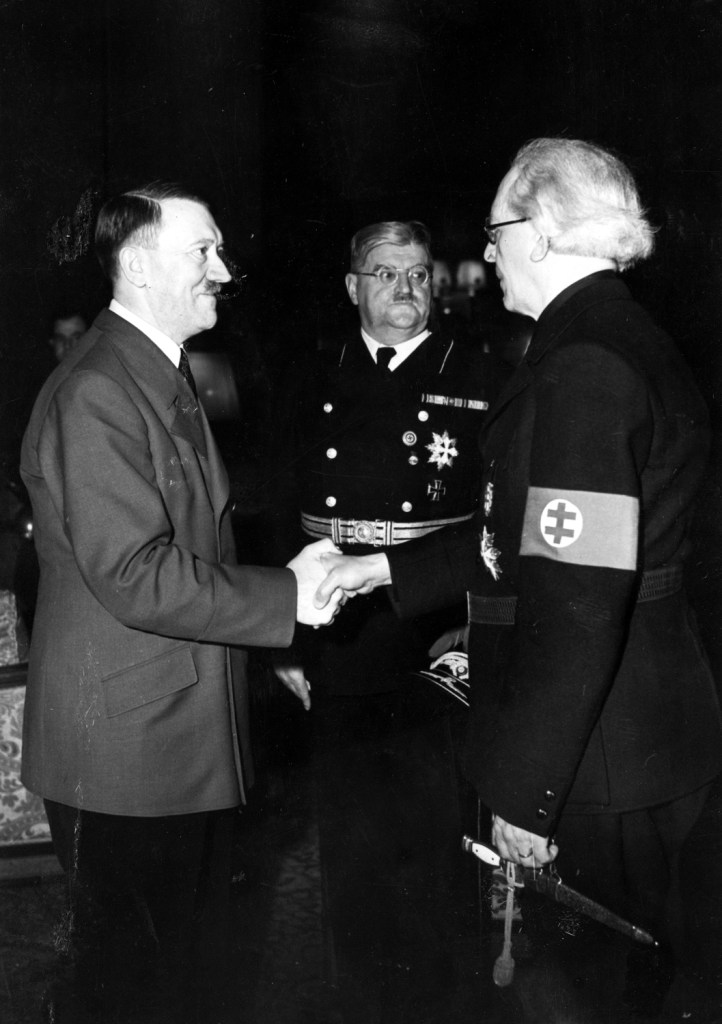
The Slovak Republic signed the Tripartite Pact. The Slovak Republic joined the Tripartite Pact with Germany, Japan, Italy, Hungary, and Rumania. Prime Minister Vojtech Tuka of Slovakia signed the Tripartite Pact. Slovakia, of course, is the breakaway province of Czechoslovakia, which subsequently was absorbed by Germany to become the provinces of Bohemia and Moravia. President Josef Tiso and Prime Minister Vojtech Tuka have an army of three infantry divisions that participated in the conquest of Poland and which may come in handy in Operation Barbarossa. Having Slovakia in his pocket also provides a unanimous front against near-term enemies Greece and (possibly) Yugoslavia.
Greek advance forces today entered the outskirts of Argirocastro, main Italian base in southern Albania, according to report reaching Reuters (British news agency) in Belgrade.
The Greek advance continues on 24 November 1940. It is a steady but slow advance through rough territory, made slower by the fact that the Greek troops are on foot. While the Greeks are on the offensive everywhere, the main axis of attack is shifting toward the port of Salona, which appears vulnerable.
Greek I Corps, advancing toward Salona, begins moving north into Albania along the Drinos River.
The Greek Liuba Detachment captures Smerto and Paravryso in the coastal sector.
Greek II Corps advances toward Frashër.
Greek III Corps, which is part of the Western Macedonia Army Section (TSDM) (Lieutenant-General Pitsikas), continues occupying the Korçë plateau. The Greek 10th Division captures Moscopole (Moschopolis).
The Italian Julia Division sustains attacks by Greek 8th Infantry Division in Kakavia Pass.
Italian leader Benito Mussolini is becoming increasingly worried about the situation in Greece. There is little that he can do, however, as his troops simply are not fighting well. He has ordered the Italian Army to re-mobilize troops that were mustered out of the service only a month before.
German circles openly predicted tonight that Bulgaria “in a very short time” would not only sign up with the axis but also would “seize the golden opportunity to obtain an outlet to the Aegean from Greece.” Such a move might turn Bulgaria into a battlefield. Behind the struggle of this little nation with fewer inhabitants than New York City to maintain some independence of action there still looms the question of the exact nature of the German-Russian relations. It is regarded as significant In diplomatic circles that no denial has emanated from Moscow of reports that Russia advised Bulgaria not to join the axis.
The first chilly warning to Greece from Germany came tonight in a statement by the semiofficial Deutsche Diplomatisch-Politische Korrespondenz asserting that Premier Gen. John Metaxas of Greece has “made himself openly a tool of the British policy of spreading war.” The statement came shortly after Slovakia, tiny nation made up of the remnant of Czecho-Slovakia, had signed the axis military and economic pact and promised to rush to the aid of Germany, Italy and Japan in the event they are attacked by some outside power not already at war. The semi-official publication declared that Gen. Metaxas’s statement that he was fighting for all the Balkans was “extraordinarily risky and dangerous.” “By such a statement,” Korrespondenz said, “Metaxas has made himself openly a tool of the British policy of spreading war.”
Soviet Foreign Minister Molotov prepares a response to the Germans regarding their standing proposal that the Soviet Union join the Tripartite Pact and help create a New World Order.
Canadian Ambassador to Vichy France Pierre Dupuy holds his first official meeting with the French government. He meets with Marshal Henri Philippe Pétain, President of the Council, who reassures him:
“I am obliged officially to maintain the balance between both sides, but you know where my sympathies lie.”
Petain comments that he is engaging in only “passive” collaboration. To him, this appears to encompass all assistance to Germany short of an actual declaration of war against Great Britain.
Drastic new rationing regulations announced by the Nazi occupiers today and effective until January 1 further reduced Parisians’ food allowances.
British Air Vice-Marshal Sir Arthur Harris, commander of RAF No. 5 Group, becomes Deputy Chief of the Air Staff. Harris is more familiarly known as “Bomber Harris.”
British Lord Craigavon (James Craig) passes away. He is succeeded as Prime Minister of Northern Ireland by J.M. Andrews. Carnavon was known for fierce measures against suspected terrorists, including new laws that included the lash for those found carrying guns or bombs.
The British Treasury canceled the bank holiday Boxing Day.
Operation COLLAR: Allied convoy ME.4, with 3 merchant ships and a powerful escort fleet, passed the Strait of Gibraltar into the Mediterranean Sea, sailing for Malta. It includes three merchant ships escorted by three cruisers, and along with supplies they bring 1,370 primarily RAF servicemen. Force H from Gibraltar is at sea to support them and provide diversions. The Mediterranean Fleet based at Alexandria is split into Forces C and D. Led by battleships HMS Ramillies and Malaya, they also are at sea, moving west from Suda Bay, Crete, where they have been in port to refuel.
Pope Pius XII, in an impassioned prayer for “peace in our days,” pleaded anew today for an end to “the whirlwinds of war that in the light of day or in the dark of night scatter terror, fire, destruction and slaughter on humble folk.” The pontiff, vigorous of voice, broadcast his 20-minute homily from the basilica of St. Peter’s where he had just concluded a special mass for the war dead. He called for a new golden rule of war, urging that combatants, under no circumstances, “do to others that, which they would not have done to themselves or their country,” and to fight the war as humanely as possible.
The British claim that, in the continuing battle around the Abyssinian/Sudanese border near Gallabat, the Italians have withdrawn from border town Metemma, Abyssinia.
The first major air raid of the Bristol Blitz took place. German bombers dropped 156 tons of high explosive bombs and 12,500 incendiary bombs on Bristol, England, United Kingdom. The Luftwaffe is very active from 18:00 to midnight. The main raid is against Bristol and is composed of 130 bombers. Bristol is a favorite Luftwaffe target and easy to find from Cherbourg. The damage to the historic city center (Castle Park) is extensive, with four churches (St Peter’s, St Nicholas, St Mary-le-Port and Temple) and an estimated 10,000 homes damaged or destroyed. Historical buildings such as the Dutch House and St Peter’s Hospital, and various buildings in the historical Castle Park district, were damaged. 207 were killed, 689 were injured, and 1,400 were made homeless.
The Lord Mayor of Bristol comments that “The City of Churches had in one night become the city of ruins.”
Another Luftwaffe target is Bath. The raids today are a preview of a series of Luftwaffe raids against historic English cities derisively nicknamed the “Baedeker Raids” after a famous guidebook series.
Hauptmann Joachim Helbig, Staffelkapitän of 4./LG 1, receives the Ritterkreuz. The flow of awards in the Luftwaffe has slowed along with the air offensive.
RAF Bomber Command dispatches 42 Blenheims, Hampdens and Wellingtons overnight to Hamburg. 1 Blenheim and 1 Hampden lost. Hamburg was completely covered by cloud but Hamburg records show 4 fires, 2 people killed, 34 injured and 86 bombed out. 8 Blenheims and Wellingtons to Boulogne docks and 3 Hampdens minelaying off Brittany. No losses. Bomber Command attacks oil installations at Wanne Eickel, losing a plane which crash-lands back at base. In another attack, 42 bombers attack Hamburg, Wilhelmshaven and the Altona gas plant. RAF Coastal Command chips in with raids against Kristiansand, Norway, and Hoek van Holland. Another raid sees 8 bombers attack Boulogne.
After dark and into the next date, aircraft from HMS Eagle struck Tripoli harbor, Libya.
There is another air raid alert on Malta as the air war heats up again. Shortly after 15:00, a half dozen Italian CR 42 fighters carry out a low-level strafing attack on Luqa airfield. They destroy a Wellington bomber and damaged two others. One of the attackers is damaged by antiaircraft fire.
The Times of Malta inadvertently arouses the ire of local authorities by publishing a story that describes the civilian population as fearlessly watching each day’s air battle overhead. The government notes that about 70% of the civilian population is not bothering to seek shelter. It sends letters to both the local Inspector of Police and the Times urging them to encourage more people to seek shelter.
The first trainees from the Empire Air Training Scheme arrived in the United Kingdom. The trainees had come from Canada.
Aircraft carrier HMS Formidable was completed and arrived in the Clyde for trials on the 28th. On 18 December, Formidable and heavy cruiser HMS Norfolk were detached from the Home Fleet for duty as Force K in the South Atlantic.
German destroyers Galster, Lody, and Beitzen departed Brest on the 24th to operate off Plymouth. The German destroyers attacked at 0015 a group of fishing trawlers twelve miles southeast of Wolf Rock sinking Belgian trawler Marguerite Simonne (70grt) eight miles southeast by south of Wolf Rock and damaging British trawler Lent Lily (44grt) six miles east southeast of Wolf Rock. The crew of trawler Marguerite Simonne landed at Newlyn. The destroyers then attacked a small convoy of three steamers, one tug, two barges five miles off Penzance sinking Dutch steamer Apollonia (2086grt) and damaging Norwegian steamer Stadion II (629grt). Fifteen crewmen were lost on the steamer Apollonia. Norwegian steamer Fernwood (4695grt) escaped damage.
Destroyers HMS Javelin, HMS Jersey, HMS Jackal, HMS Jupiter, and HMS Kashmir were at sea south of Prawle Point and proceeded towards the engagement, but were unable to contact the German ships. The German destroyers returned undamaged at Brest on the 25th.
Anti-aircraft ship HMS Alynbank left convoy EN.30 in Pentland Firth and arrived at Scapa Flow at 0830. She departed at 1030 and escorted convoy WN.43 from Pentland Firth.
British steamer Alma Dawson (3985grt) was sunk on a defensive minefield in 55‑32N, 06‑44W. The entire crew was rescued.
Anti-submarine trawler HMS Amethyst (627grt, T/Lt Hon. W. K. Rous RNVR) was sunk on a mine in the Barrow Deep in the Thames Estuary. Seven ratings were wounded in the trawler. Survivors from Amethyst were picked up by anti-submarine trawler HMS Le Tiger (516grt).
Armed yacht HMS Gael (101grt, T/Lt F. J. B. Hart RNVR) was sunk on a mine at the entrance to Humber, northeast by north of the Spurn Light House.
British salvage vessel HMS Preserver (630grt) was sunk on a mine one cable 54° from No. 1 Buoy, Milford Haven. Four crewmen were lost on the vessel.
British steamer Ryal (367grt) was sunk on a mine laid by German torpedo boats on 29/30 October in minefield “Alfred” in 51‑32N, 01‑04E. Only one survivor of a crew of nine was rescued.
British steamer Behar (6100grt) was badly damaged on a mine in 51‑42N, 05‑07W. The entire crew was rescued. Behar was run aground 4½ cables 230° from Great Castle Head Lower Light to prevent her sinking but was a total loss.
British steamer Thomas M. (310grt) was sunk on a mine 1½ miles 135° from Yarmouth Harbor entrance. Seven crewmen were lost.
British steamer Alice Marie (2206grt) was sunk on a mine eight cables 255° from Knob Light Vessel, Barrow Deep. The entire crew was rescued.
British steamer Camroux IV (590grt) was damaged on a mine one mile 45° from East Oaze Light Vessel.
Heavy cruiser HMS Berwick, light cruiser HMS Newcastle, and destroyers HMS Defender, HMS Greyhound, HMS Hero, and HMS Hereward departed Alexandria to escort convoy ME.4 back from Malta. They are joined at sea by anti-aircraft cruiser HMS Coventry and destroyer HMS Gallant which departed Alexandria the day before.
German heavy cruiser Admiral Scheer sank British steamer Port Hobart (7448grt) near the Azores at 24‑44N, 58‑21W. The entire crew of the British steamer was made prisoners of war.
Convoy OB.249 departed Liverpool escorted by destroyers HMS Wanderer and HMS Warwick and corvettes HMS Campanula, HMS Clematis, HMS Fleur De Lys, and HMS Periwinkle. Wanderer was detached on the 27th. The remainder of the escort detached on the 28th.
Convoy FN.341 departed Southend, escorted by destroyer HMS Watchman and sloop HMS Egret, and arrived at Methil on the 26th.
Convoy FN.342 departed Southend, escorted by destroyers HMS Verdun and HMS Wolsey, and arrived at Methil on the 26th.
Convoy FS.344 departed Methil, escorted by destroyers HMS Valorous and HMS Versatile and corvette HMS Snapdragon, and arrived at Southend on the 26th.
President Roosevelt will arrive in Washington tomorrow after a four day’s vacation on the Hudson to face two major problems created by the war. These are Britain’s growing need of United States credits, as revealed yesterday in New York by the Marquess of Lothian, British Ambassador, and Argentina’s desire for financial aid to offset shrinkage of its foreign markets through European hostilities. The President is expected to receive Lord Lothian early in the week for their first conference since they met just before the British Ambassador departed for London a month ago. Whatever decision is reached with regard to further American assistance for Britain, it was deemed unlikely today in circles close to the Chief Executive that any action toward revision of the Johnson or Neutrality Act would be taken before the new Congress convenes in January. Lord Lothian said in New York yesterday that Britain would require financial aid in 1941 because of the near exhaustion of resources. This was just twenty-four hours after President Roosevelt had told a Hyde Park press conference that the government was not at present considering any specific proposal for financial aid to Britain. Mr. Roosevelt’s statement, however, did not preclude future consideration of credits and other new types of assistance for the British.
A nationwide investigation of trade restraints which, exercised by middlemen, increase prices to the consumer and reduce the prices received by the farmer way announced today by the anti-trust division of the Justice Department. The Department of Justice tonight announced a nationwide investigation on whether monopolistic practices have raised the family food budget and cut the income of producing farmers. Twin objectives of the drive, the department said, will be to lower the public’s expenditures for food and to raise the farmers’ income. Its attack will be directed at alleged restraining practices of industrial groups which, the department said, are “so close knit and powerful that they have made satisfactory profits throughout the depression.” All major items in the family food budget will be scrutinized “at every stage from the farmer to the ultimate consumer,” the department said.
The New York Times said today it had “learned authoritatively” that Frances Perkins has resigned as secretary of labor and that President Roosevelt has accepted her resignation. Miss Perkins, labor secretary since 1933 and the only woman member of Mr. Roosevelt’s cabinet, confided the news to “old friends here last week,” the Times said. She also said that her future plans were fixed, but did not disclose them to the friends, according to the Times.
Fires, started by broken power lines, are burning in several parts of Amarillo, Texas. The city water ceased pumping at 6 a. m. today and storage above ground was exhausted at 4:30 p.m. Lights were out except in a small section of the business district. The streets were blocked by poles, wire and trees brought down by tons of ice. Radio operators moved their equipment to temporary locations in areas where there still was electricity. The electric service was reported fading constantly.
For the first time in the nation’s peace time history, groups of men will start compulsory military training today in camps throughout the country. A total of 18,700 will report for duty today and by the end of June 789,000 will be under arms.
The first U.S. air raid shelter is established, in Fleetwood, Pennsylvania.
The Kriegsmarine orders German raider Pinguin to take refuge in the Antarctic, where it is summertime. The Australian Navy has a cruiser out looking for it, though it is unclear if the Germans know this.
Prince Kimmochi Saionji, 92, chief political adviser to Emperor Hirohito and last of the group of statesmen who aided the late Emperor Meiji in forming the modern Japanese State, died tonight of a complication of diseases in his villa at Okitsu.
Royal Navy light cruiser HMS Danae arrived at Singapore.
Born:
Paul Tagliabue, NFL Commissioner (1989–2006), in Jersey City, New Jersey (d. 2025).
Murray Hall, Canadian NHL right wing and centre (Chicago Black Hawks, Detroit Red Wings, Minnesota North Stars, Vancouver Canucks, Houston Aeros [WHA]), in Kirkland Lake, Ontario, Canada.
Died:
James Craig, 1st Viscount Craigavon, 69, 1st Prime Minister of Northern Ireland.
Prince Kimmochi Saionji, 92, Japanese political adviser.
Naval Construction:
The Royal Navy Illustrious-class aircraft carrier HMS Formidable (67) is commissioned. Her first commandiing officer is Captain Arthur William La Touche Bisset, RN.
 History Diaries