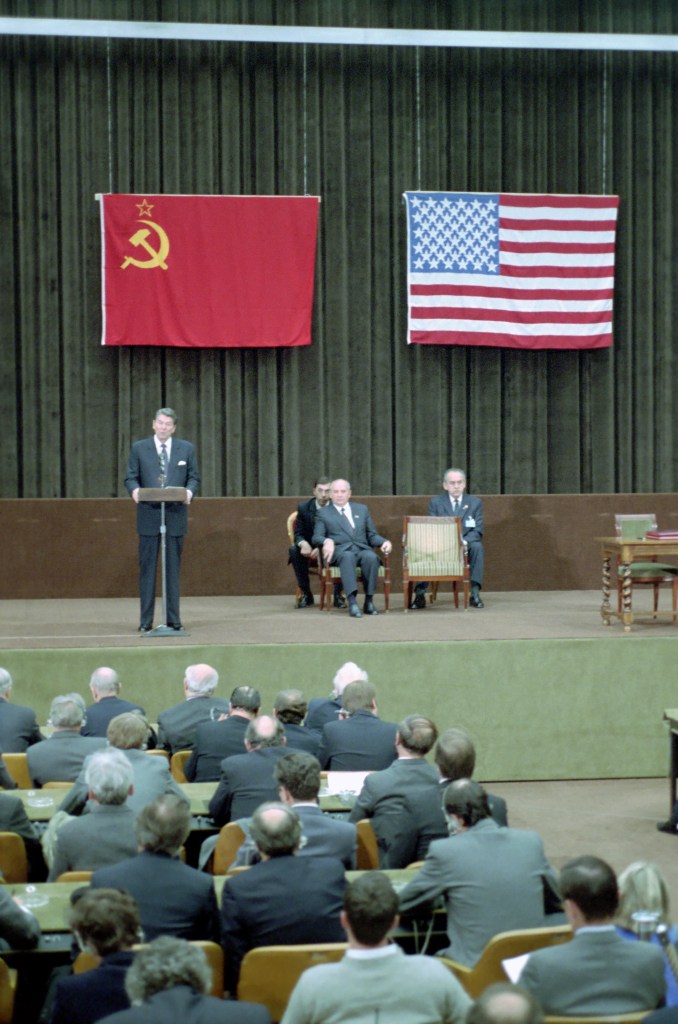
President Reagan and General Secretary Mikhail Gorbachev make closing statements at the conclusion of the U.S.-Soviet summit in Geneva, Switzerland. The U.S. and Soviet leaders ended a two-day summit meeting in Geneva without achieving breakthroughs on key issues. But President Reagan and Mikhail S. Gorbachev approved a joint statement agreeing to step up arms negotiations and to meet more regularly. After two days of intensive conversations, the two men approved a joint statement agreeing to step up arms negotiations and to meet more regularly. They chatted jovially before speaking to about 300 journalists at a brief closing ceremony. But they conceded that “serious differences remain on a number of crucial issues.” Both then left Geneva — Mr. Gorbachev stopping in Prague to brief his allies before flying on to Moscow, Mr. Reagan stopping in Brussels to confer with North Atlantic Treaty Organization leaders before returning to Washington to make a nationally televised speech on his trip. “Neither side got everything they wanted,” the President said in Brussels, adding that he and Mr. Gorbachev “got very friendly.” Asked if he considered the meeting a success, he said, “I believe that it was.”
President Reagan returns to Washington, D.C. from the U.S.-Soviet summit in Geneva, Switzerland. President Reagan flew home and told Congress that his intensive talks with Mikhail S. Gorbachev in Geneva had opened the way for a “new realism” in American-Soviet relations and had created “room for movement, action and progress.” Confirming earlier predictions by White House officials, he said the conference marked the start of a process of discussion that he and Mr. Gorbachev had pledged to continue. “It was a constructive meeting,” Mr. Reagan said. “So constructive, in fact, that I look forward to welcoming Mr. Gorbachev to the United States next year, and I have accepted his invitation to go to Moscow the following year.
Mikhail S. Gorbachev conceded he had failed to budge President Reagan from his commitment to space-based missile defenses, but said the meeting has made him optimistic. Mr. Gorbachev appeared upbeat and animated as he delivered an hourlong opening statement and then answered questions for 45 minutes at a news conference at the Soviet Mission after appearing with Mr. Reagan in a concluding ceremony. It is “unfortunate,” Mr. Gorbachev said, that no agreement had been reached on arms control, a development for which he laid the blame on the American side. But he called the meeting “the beginning of a dialogue aimed at improving the situation and changing it for the better.” After the news conference, Mr. Gorbachev flew to Prague to brief the other Warsaw Pact leaders on the summit meeting. He spent the night in the Czechoslovak capital.
Soviet TV halted usual programs for a live broadcast from Geneva of the joint appearance of President Reagan and Mr. Gorbachev. The broadcast, which was unusual for a television system that generally avoids anything unpredictable or spontaneous, showed Mr. Reagan commenting, through a Russian voice-over translation, on his meetings with Mr. Gorbachev, the Soviet leader. The broadcast included the signing of a new cultural exchange agreement by Secretary of State George P. Shultz and Eduard A. Shevardnadze, the Soviet Foreign Minister.
Democratic leaders in Congress praised President Reagan today for beginning “the important process of reducing tensions between the United States and the Soviet Union.” But they expressed disappointment that the summit meeting had not been more productive in term of substantive achievements. Thomas P. O’Neill Jr., the Speaker of the House of Representatives, issued a formal statement on behalf of the Democratic leadership that said: “We had hoped for more substantive progress in arms control, human rights and regional conflicts.” The President’s speech to Congress was greeted warmly by lawmakers in both parties. Senator Nancy L. Kassebaum, Republican of Kansas, called it “an unusual moment, a beginning.” Senator Alfonse M. D’Amato, a New York Republican, praised the “personal strength” of the President, who appeared on Capitol Hill after completing a trans-Atlantic flight.
Some arms control experts criticized President Reagan today for failing to reach any concrete agreements or to affirm existing arms accords with Mikhail S. Gorbachev, the Soviet leader, during their two-day meeting. But Defense Secretary Caspar W. Weinberger, who had expressed concern that Mr. Reagan might be pressured into statements of support for the 1972 antiballistic missile treaty and the 1979 strategic arms limitation accord, praised Mr. Reagan for standing firm. He said it was “significant and vital” that there were no accords to curb work on space-based defenses. One of the arms control experts, Spurgeon Keeny, president of the Arms Control Association and a former deputy director of the Arms Control and Disarmament Agency, said: “There is no evidence that there was any progress on the central issue of strategic arms control because the President remains adamant on his commitment to strategic defense, which is a fundamental obstacle to achieving substantial reductions in strategic arms.”
The leaders of several Western European nations expressed strong support today for the outcome of the Geneva summit meeting between President Reagan and Mikhail S. Gorbachev. Mr. Reagan arrived here from Geneva to discuss the results of the meeting with 13 government leaders and three foreign ministers of the North Atlantic Treaty Organization. Afterward, the leaders expressed relief at what Mr. Reagan had told them, saying foundations had been laid for a renewal of a dialogue between the world’s two most powerful adversaries. The officials here also expressed strong satisfaction that the summit had meeting had covered the key issues of concern to them, including reductions in strategic and medium-range nuclear arms, chemical weapons, and Mr. Reagan’s plans for an antiballistic missile shield, popularly called the “Star Wars” program. Few of the allied leaders mentioned the continuing broad differences between the American and Russian leaders over such issues as “Star Wars” research.
Although the Geneva summit meeting did not produce an agreement providing for the increased emigration of Soviet Jews, the director of the National Conference on Soviet Jewry said today that he was optimistic that discussions of human rights would continue. “Without the summit, the process for opening up the gates would be a long time away,” Jerry Goodman, the executive director of the Conference, said. “The summit helped push it up forward,” He added, “We’re somewhat disappointed, of course,” that the Soviet leader, Mikhail S. Gorbachev, did not agree to increase the emigration of Jews. “But,” he said, “we did not anticipate a radical breakthrough.”
The Soviet Union aborted a space mission today and brought the three astronauts back to Earth from the orbiting Salyut-7 space station because the commander was ill, the official press agency Tass said. It was the first time a space flight was known to have been shortened by a crew member’s illness either in the Soviet Union or the United States. Tass issued the first word of Comdr. Vladimir Vasyutin’s illness this afternoon, more than an hour after he and his companions made a landing in the Soyuz T-14 capsule on the steppes of Central Asia.
Greek government spokesman Kostas Laliotis resigned in protest over the police shooting of a 15-year-old boy during violent anti-American demonstrations Sunday. Laliotis, 34, who was responsible for state-run television, said his decision “was forced by circumstances and human limits of endurance.” He said he is retiring from “active political life” but will remain loyal to the ruling Pasok (Socialist) party and Prime Minister Andreas Papandreou. Press Ministry official Petros Efthimiou also resigned in protest.
The minority Social Democrats of Portuguese Prime Minister Anibal Cavaco Silva easily survived challenges from opposition parties in Parliament and assumed full control of the government. Deputies in the Assembly of the Republic failed to pass three motions that would have brought down Cavaco Silva’s 13-member center-right Cabinet. The government was formed two weeks ago as a result of balloting in which no party received a majority.
The Irish Parliament voted today to approve an agreement with Britain that gives the Dublin Government a voice in the affairs of Northern Ireland. The party-line vote of 88 to 75 was a victory for the coalition Government of Prime Minister Garret FitzGerald. The agreement, which has drawn strong criticism, threats of violence and an unsuccessful court challenge from Unionist leaders in Northern Ireland, is expected to be approved on Wednesday in the British House of Commons.
Pope John Paul II opened a special meeting of the College of Cardinals today with a strong assertion of papal authority and a defense of the Roman Curia. The Pope’s address was a prelude to nearly three weeks of crucial meetings here that will be dominated by a special Synod of Bishops. The synod, which begins with another papal address on Sunday, will discuss the effect of the Second Vatican Council on the Roman Catholic Church. The council, which closed 20 years ago, had a revolutionary impact on Catholicism and marked a greater openness to the modern world.
Terry Waite, the Archbishop of Canterbury’s envoy who is trying to free U.S. hostages in Lebanon, was pinned down by gunfire between Muslim militias in Beirut. At least five people were killed and 32 wounded in the fighting between the Shia Muslim Amal militia and the Druze sect’s Progressive Socialist Party. Waite, who was trapped in an Associated Press office for about six hours but was not injured, said he was still optimistic about the kidnaped Americans’ chances for freedom and urged their relatives to be brave.
An Indian investigator has concluded that an explosion apparently occurred on the Air-India jumbo jet that crashed into the Atlantic in June, killing all 329 people aboard. The conclusion is contained in a report by Hoshiar Singh Khola, India’s director of air safety. A copy of the document was obtained by The Associated Press. Some Indian investigators have theorized that Sikh extremists planted a bomb aboard the plane in Toronto, where the flight originated. The report seems to support speculation that the crash was caused by an explosion in the cargo hold, but it makes no mention of any evidence pointing to a bomb.
A U.S.-Vietnamese team searching for the remains of four American airmen near Hanoi has confirmed that it found a U.S. Air Force B-52 bomber that went down during the Vietnam War, a spokeswoman said in Bangkok, Thailand. Capt. Virginia Pridyla said the team found a “number of larger aircraft parts” and operator manuals. Vietnamese searchers said four airmen were killed when the B-52 was shot down on December 20, 1972. The continuing excavation has also turned up nearly 20 unidentified bone fragments.
The Senate quietly voted approval today of a long-delayed nuclear cooperation agreement between the United States and China. The action means that American companies can sell China with materials and technology for an ambitious civilian nuclear power program. The agreement was initialed last year by President Reagan, during his trip to China. But the accord had been shelved because of fears that China might use American technology to help other nations build atomic weapons. The Senate held a voice-vote to adopt a resolution approving the agreement. There was no debate. The House has a similar resolution, which it has not acted on, but to block the agreement, both chambers would have had to act by December 11.
Michael Somare, prime minister of Papua New Guinea for eight of its 10 years of independence from Australia, was ousted from office in a no-confidence vote in Parliament. Somare, 49, lost on a 57–51 vote. Chosen to succeed him was Paias Wingti, 34, his former deputy who defected from the ruling coalition last March. The opposition based the no-confidence move on the government’s economic management and budget.
Two French secret agents were sentenced today to 10 years in jail for manslaughter in the death of a crewmen killed in the bombing of the Greenpeace flagship, Rainbow Warrior. They were given seven years each for willful damage to the ship. Sir Roland Davison, Chief Justice of the Auckland High Court, said the sentences were meant to deter terrorist acts in New Zealand. He ordered that the sentences be served concurrently. The maximum possible penalty for the charges was life imprisonment. The two defendants had pleaded guilty. Prosecutors had dropped charges of murder, conspiracy and arson at a preliminary hearing, and the agents pleaded guilty to the lesser charges of manslaughter and willful damage to the ship. The surprise move fueled speculation that New Zealand had struck a deal with France, but Prime Minister David Lange said the agents “are not for sale.”
Efforts to smuggle American arms to the Philippines are on the rise, with some of the weapons intended for close associates of President Ferdinand E. Marcos who have assembled large private armies, according to American officials and Filipino business executives. The resurgence of private armies in the Philippines is a result of the growing turmoil there, according to American and Filipino officials. Some American officials said the private forces could be a threat to the Philippines’ stability, especially should Mr. Marcos’s health deteriorate. George A. Rodriguez, an official with the Bureau of Alcohol, Tobacco and Firearms who until recently headed its program to combat international trafficking in arms, said: “The recent trend is an increase in international arms trafficking to the Philippines. It involves Filipinos in the United States, in San Francisco, Los Angeles, Reno, Las Vegas and Chicago.
The Salvadoran army and air force launched an offensive against leftist guerrilla positions around the Guazapa Volcano, about 15 miles from the capital. Several A-37 aircraft dropped 500-pound bombs in the area, a guerrilla stronghold, and explosions could be heard in San Salvador. The military press office said a counterinsurgency operation involving ground troops and air support was under way on the north side of the mountain.
The government has ordered Nicaragua’s principal independent human rights commission to submit its reports for censorship, the commission’s executive secretary said today. “We were told to bring material to the censorship office on Saturday, but we decided not to go,” said Lino Hernandez, executive secretary of the group, the Permanent Human Rights Commission, in an interview today.
Thousands of people living near the Nevado del Ruiz volcano northwest of Bogota, Colombia, which erupted eight days ago, panicked late Wednesday night when the Government, for the second time in five days, ordered a sudden evacuation of the area. As people rushed through the streets on foot and in cars, a close aide to President Belisario Betancur went on Bogota radio stations to explain that the evacuation was not in response to a new eruption but was merely a drill.
Hundreds of thousands of Chileans chanting “freedom!” and “democracy now!” held a rally today to demand the end of the 12-year-old military Government of President Augusto Pinochet. The government authorized the rally, and the police watched from several blocks away. Previous, unapproved rallies here have ended with rioters setting up barricades and throwing stones and gasoline bombs at policemen armed with clubs and guns. There have often been deaths. The demonstrators, carrying Chilean flags and signs with anti-government slogans, flocked to O’Higgins Park near downtown Santiago, where the rally was held.
Bloody rioting broke out in Khartoum, capital of Sudan, as demonstrators rampaged through the streets throwing stones and smashing car windows. Sudanese police used tear gas to disperse the rioters, mainly Nuba people from western Sudan demanding the release of Philip Abbas Ghabboush, arrested in September for his alleged role in a coup attempt. A day earlier, the United States advised Americans to avoid Khartoum because of Libyan terrorists there. Sudan issued a statement saying it regretted the U.S. advisory and denying the assertion.
Sudanese Prime Minister al-Gazouly Dafallah today denied a State Department assertion that Khartoum was unsafe for Americans, the official Sudan News Agency reported. In a meeting with Ambassador Hume Alexander Horan, Mr. Dafallah asked for an explanation of the State Department warning, the press agency said. On Wednesday, the State Department urged Americans to avoid Khartoum because of “known terrorists,” most of whom were Libyans. A department spokesman, Charles E. Redman, said today that some American Embassy staff members and their families were being brought home. The Sudanese press agency gave no further details of Mr. Dafallah’s session with Mr. Horan, but it quoted an “authoritative source” as expressing regret over the travel advisory for portraying the Sudan as a haven of “international terrorism.” “This contradicts reality,” the source was quoted as saying.
South African police fatally shot six people, including several elderly women, in the black township of Mamelodi near Pretoria, according to witnesses. The police shot dead at least six people today, including several elderly women, according to witnesses. The deaths brought the number killed by the authorities so far this week to at least 23. The police confirmed only two deaths in the township near Pretoria, saying a man and woman were shot dead when groups of blacks attacked police vehicles with gasoline bombs and stones. Hundreds Injured The shootings occurred as thousands of residents gathered at a local government office to protest high rents, the presence of police and army squads in the township and the banning of weekend funerals.
House and Senate negotiators working on a compromise version of budget-balancing legislation said this evening that they had narrowed their differences to two key issues. But after daylong negotiations, they said they would have to wait until after the Thanksgiving recess to try to work them out. The main dispute over the legislation seeking a balanced budget by the 1990’s is House Democrats’ insistence on protecting nine programs, most of them for the poor, from the automatic spending cuts envisioned in the budget-balancing proposals. The House plan would also not let Medicare and Medicaid, the health care programs for the elderly and for the poor, be cut below current spending levels. This evening Senate Republicans, who have opposed protecting these programs, offered the Democrats a compromise that would exempt seven of the nine programs from the automatic cuts. But the two other programs the House wants to protect, migrant health and community health, would be subject to cuts to below current spending levels, as would Medicare and Medicaid. Both chambers have generally agreed to limit any automatic spending cut in the military budget to 50 percent of the total. But the House has insisted that the social programs be exempted as part of this compromise.
A proposal supported by the Reagan Administration to allow states to administer their own food stamp programs was defeated in the Senate Thursday. The plan to reorganize the program, offered by Senator Jesse Helms, chairman of the Senate Agriculture Committee, was rejected by a vote of 30 to 68. The sluggish pace of the Senate’s proceedings rankled Senator Bob Dole, the majority leader, who kept the Senate in session until after midnight, after President Reagan’s speech to a joint session of Congress.
The Senate rejected a food stamp overhaul by a vote of 68 to 30. Senator Jesse Helms had proposed the plan, which was backed by the Reagan Administration, to allow the states to administer the program.
A U.S. Navy analyst was arrested on charges of espionage after military investigators said they learned he was selling classified Navy code information to Israel. An official said the civilian counterintelligence analyst, Jonathan Jay Pollard, had been paid “less than $100,000” by the Israelis over 18 months. Pollard, 31 years old, was arrested near the Israeli Embassy in Washington. Federal officials said he was trying to get the Israeli authorities to grant him political asylum. The Israeli Embassy acknowledged through a spokesman that Mr. Pollard was arrested outside the embassy’s gates this morning. “But we have no further information,” said the spokesman, Gabi Raubitschek.
The head of a Pentagon spy panel that recommended broad changes in the military’s security procedures said he had discussed Soviet espionage techniques with Vitaly Yurchenko, the K.B.G. defector who recently returned to Moscow. Sources familiar with the discussion said that Mr. Yurchenko, a former officer in K.G.B., the Soviet intelligence agency, told General Stilwell that most of the Americans who spied for the Soviet Union were volunteers, not recruits. The commission today announced its recommendations for a broad array of changes in the military’s security procedures. General Stilwell discussed the proposals with reporters and later in an interview. He said the continuing uncertainty over whether Mr. Yurchenko was a Soviet plant or a defector who changed his mind would not affect the commission’s conclusions.
The U.S. Government’s key witness opened his testimony in Federal District Court in Tucson, Arizona today by describing how he infiltrated a group of church workers who are charged with conspiring to smuggle Salvadorans and Guatemalans into the United States. The 11 defendants, who include two Roman Catholic priests, a nun and a Presbyterian minister, are members of a nationwide group that has pledged to offer sanctuary to Central Americans whom they say are political refugees. After a nine-month undercover investigation by the Immigration and Naturalization Service, they were indicted in January on 45 counts of smuggling, transporting and harboring illegal aliens. The witness, Jesus Cruz, testified that he became a government informer in 1980 after being implicated in an alien-smuggling ring in Florida. Mr. Cruz, a 58-year-old Mexican citizen who spoke through a translator, said he agreed to work for the government “because I didn’t want to be sent back to Mexico and I was also worried that I might have to go to prison.” He said that because church workers were involved in this case, he believed the investigation was “somewhat different” from the eight or nine other immigration cases in which he has worked for the Government.
A proposed U.S. hypersonic plane could fly around the globe in less than two hours, according to a senior Air Force officer. The officer, Major General Donald J. Kutyna, said the Pentagon planned to proceed with a $500 million program to design a plane that could provide a relatively low-cost way to launch satellites. If the three-year program to build the airplane’s engines proves successful, General Kutyna told a symposium on space technology here, construction of the plane itself could cost $2 billion to $3 billion more. “It is something we are very serious about, and we think the technology is now within reach,” said General Kutyna, who coordinates the Air Force’s research and development of space systems. “We have been examining the principles for some time, and now we are ready to head into the next phase.”
Education Secretary William J. Bennett, saying he is “distressed by misrepresentation of my views,” defended the Reagan Administration’s proposals to allow use of more English in bilingual education programs. In an interview with a small group of reporters, Bennett denied that the proposals are a “smoke screen” for gutting bilingual programs and said he is “not hostile” to bilingual education.
The Navy has begun a new procurement policy requiring civilian contractors rather than the government to pay for tools used to build ships, planes and other weapons, a spokesman said. The policy, opposed by the defense industry, was begun immediately under an order signed Wednesday by Navy Secretary John F. Lehman Jr. Navy spokesman Lieutenant Max Allen said no estimate was available on the amount of money involved in the change. But Lehman told the Washington Post that the move will save billions of dollars by requiring contractors to invest in their own plants just as they do for commercial business.
Besieged by a flood of complaints, the head of the Thanksgiving parade in Detroit reversed an earlier decision and said a contingent of handicapped people would be allowed to march in the procession. Organizers had said they wanted to shorten the length of the parade so it could be televised nationally. “We regret the public has been given the erroneous impression we are insensitive to the handicapped,” said parade official Carleen Bonner.
A Romanian circus acrobat, prevented from taking a plane from New York to his homeland after his pregnant American girlfriend said he wanted to defect, told immigration officials he wished to go home. An immigration official said the Romanian, Andi Georchescu, 24, had never asked for asylum and would be returned to his country at once.
Hundreds of people gathered at night near the Philadelphia home of an interracial couple in a predominantly white neighborhood where an earlier demonstration caused officials to take action to prevent racial violence. Neighborhood leaders were upset about two black families living there who had called off a planned protest at the request of a task force formed to head off racial violence. Nevertheless, about 300 whites showed up outside the home of a black man and his white wife. Mounted police cordoned off 2 ½ blocks on either side of the row house in the southwest Philadelphia neighborhood where they chanted and milled about. There were no arrests or violence. The only blacks present were police and reporters.
Salvatore Bonanno, son of Joseph Bonanno Sr., a reputed leader in organized crime, has been found guilty of nine counts in a home-improvement scheme that bilked elderly people. The younger Mr. Bonanno, who is 53 years old, was convicted Tuesday of conspiracy and eight counts of grand theft for his involvement in the late 1970’s with a home-improvement contract scheme that bilked nine elderly Alameda County citizens of $110,000 for services paid for but never rendered. Judge Joseph Karesh of Superior Court set Dec. 24 for sentencing.
Smokers in California watched the dancing Cancerettes, in New York’s Harlem they attended a “cold turkey” rally, and even the villainous J. R. Ewing of “Dallas” helped a smoker try to kick the habit during the ninth annual Great American Smokeout. The goal of the American Cancer Society, which sponsored the nationwide anti-smoking day, was to get one in five of the nation’s 55 million smokers to quit for at least 24 hours. A preliminary survey showed that more than one in three smokers made the attempt.
Infants account for 10% of AIDS cases linked to blood transfusions, although they get only 2% of all transfusions, suggesting that babies may be more susceptible to getting the disease in this way than older people, researchers say. Most babies with AIDS, or acquired immune deficiency syndrome, are infected by their mothers before they are born, said Dr. Thomas A. Peterman of the national Centers for Disease Control in Atlanta. Peterman and his colleagues found that 10% of 194 AIDS cases linked to transfusions of whole blood or blood products involved infants.
As New York seeks to slow the spread of AIDS, elected officials in San Francisco and Los Angeles are considering actions to close or strictly regulate bathhouses and other facilities catering to homosexuals that permit sexual activities linked to the disease. New York State has empowered local health officials to close bathhouses and other places where “high-risk sexual activities” take place, and one establishment in Manhattan has been closed. In San Francisco, Mayor Dianne Feinstein, who for nearly three years has advocated the closing of bathhouses to protect public health, met last week with the City Health Director and a member of the City Attorney’s office to urge swift action against facilities that are under court order here to prevent unsafe sexual contact on their premises. AIDS, or acquired immune deficiency syndrome, breaks down the body’s immune system and leaves the victim vulnerable to a variety of deadly diseases. The spread of the AIDS virus has been tied to some sexual acts.
Immigration officials today distributed citizenship cards to a renegade band of Kickapoo Indians who have resisted the ways of the white man for nearly two centuries. The 143 Kickapoos naturalized today, about one-third of those living in Texas, were among the first to apply for citizenship under a Congressional act that recognized them as a “sub group” of the Kickapoo tribe in Oklahoma.
The Texas law that bars students who fail one course from extracurricular activities has been challenged by a class-action suit. However, the effort hit a snag when lawyers for the state undermined a survey purporting to show that the new law discriminated against minority group and handicapped students.
Hurricane Kate, with winds reaching 100 miles per hour, slammed into the white sand beaches and bayous of the Florida panhandle this evening. The 20-mile-wide eye of the storm, believed to be the most powerful November hurricane in United States history, moved ashore near Tyndall Air Force Base and Mexico Beach, about 20 miles south of Panama City, shortly before 6 PM, state emergency workers reported. Aircraft and personnel from the base were evacuated Wednesday as the storm came up the Gulf, military officials said. Storm Heads Into Georgia At 11 PM, the storm was in southwest Georgia, about 40 miles northwest of Tallahassee, heading northeast. Top winds were estimated at 75 mph.
Airline promotional programs that reward frequent fliers are under legal attack by the Government and businesses. Critics increasingly question why such benefits escape taxation and why companies that often pay the travel bills are barred from reaping the benefits.
Dow Jones Industrial Average: 1462.27 (+23.05)
Born:
Carly Rae Jepsen, Canadian singer (“Call Me Maybe”), in Mission, British Columbia, Canada.
Ronny Chieng, Malaysian comedian and actor (“The Daily Show”), in Johor Bahru, Malaysia.
Michael Hamlin, NFL defensive back (Dallas Cowboys, Jacksonville Jaguars), in Lamar, South Carolina.
 History Diaries