Dimitry Statharos’ Greek Army unit is lobbing artillery shells on the Italians in Korçë (Korytsa) which he will capture around the 22nd. The Greek offensive continues on 18 November 1940, but it is not without problems of its own. The “K” Group of Divisions (OMK), which is III Corps, is now added to the 11th Division, so it now has the original III Corps, 11th and 13th Divisions. It is commanded by Lieutenant-General Georgios Kosmas. K Group is advancing on the Korçë plateau against the Italian 9th Army toward the valley of the Devoll river, which would give access to central Albania and ultimately the ports on which the Italians rely for supplies. The main Greek objectives are the city of Korçë and the summit of Morava, which provides the key to the valley.
The K Group’s newly added 13th Division has a bad baptism of fire when certain elements within it panic under fire. An attack, poorly coordinated, stalls, and the Italians almost regain the initiative in the sector. Kosmas replaces the 13th Division’s commander with Major-General Sotirios Moutousis, who manages to hold the line. The Greek advance continues after this brief interlude.
The Italian 9th Army by-and-large has escaped along the roads because the Greeks are traveling on foot and have restricted mobility — though this does help them with their penetrations along the craggy mountains.
On the coastal Thesprotia sector, the Greek Liuba Detachment levers the Italians out of Igoumenitsa and back across the Kalamas River. The Greek 8th Division continues hammering away at the Kalams Sector.
The Royal Navy continues shuttling troops between Egypt and Greece. Today, the cruiser HMS York departs from Port Said with a battalion of troops to reinforce the British presence at Suda Bay, Crete, and also some anti-aircraft artillery bound for Piraeus to protect RAF airfields near Athens.
Benito Mussolini promised the Italians tonight that he would “break Greece’s back” if it takes a year to do it and that he would make no peace until “the modern Carthage England” is annihilated. From the “battleroom” of his Palazzo Venezia, II Duce spoke publicly for the first time since he entered the war against France and England last June 10. The occasion was the fifth anniversary of the imposition of sanctions upon Italy’s Ethiopian adventure, sanctions imposed under Britain’s leadership. His immediate audience was made up of Italy’s Fascist party leaders. Hi insisted that the British lied when they reported the crippling of half of Italy’s six battleships and four other war vessels by torpedo planes in Taranto harbor a week ago. He declared flatly that the Italian high command told the truth when it said that only one warship was damaged seriously enough to require extensive repairs, although three were hit. Italy, said II Duce, has the Strength alone to crush Greece and she will do it . . . “whether in two months or 12 months.” “The rough valleys of Epirus and Its muddy valleys do not lend themselves to lightning war,” Mussolini acknowledged, but he scoffed at claims of Italian reverses by “Greek propaganda and its English loudspeaker.”
Adolf Hitler met with the foreign ministers of Italy and Spain at his mountain home today, and the German press said their conferences meant that Germany has all the trumps in her hand. Neither the press nor official sources offered even a guess as to the concrete ground covered or possible new agreements reached between the fuehrer, Ramon Serrano Suner of Spain and Count Galeazzo Ciano of Italy. (In Switzerland, however, diplomats expressed belief the three talked about plans for axis drives from Rumania through Bulgaria to Greece and through Spain to Britain’s Gibraltar.)
Italian Foreign Minister Count Ciano travels to the Obersalzberg for a meeting with Adolf Hitler. It is not a happy meeting. Hitler is irate that the Italians have invaded Greece and thus brought that country into the war. His real concern, though, is always the British. Ciano met with Hitler at the Berghof. Hitler was pessimistic over the situation in the Balkans but became enthusiastic on the subject of negotiating an alliance with Yugoslavia. Chancellor Adolf Hitler meets with Italian Foreign Minister Galeazzo Ciano over Italian Premier Benito Mussolini’s disastrous invasion of Greece. Hitler, had been caught off guard, especially since Mussolini had led Hitler to believe he had no such intention. Even Mussolini’s own chief of army staff found out about the invasion only after the fact! At their meeting in Obersalzberg, Hitler excoriates Ciano for opening an opportunity for the British to enter Greece and establish an airbase in Athens, putting the British within striking distance of valuable oil reserves in Rumania, which Hitler relies upon for his war machine. Hitler’s absolute priority at all times is the protection of the oil fields centered around Ploesti, Romania because they essentially fuel the entire Wehrmacht and are irreplaceable. The new RAF presence on mainland Greece threatens those oil installations, he tells Ciano.
Hitler at this point still is uncertain what to do about Greece: either pledge neutrality or invade. In particular, he hopes to avoid invading Yugoslavia. However, something will have to be done eventually. Planning for Operation MARITA, the invasion of Greece from Bulgaria continues in the OKW. Hitler will have to divert forces from North Africa, a high strategic priority, to Greece in order to bail Mussolini out. Hitler considers leaving the Italians to fight their own way out of this debacle — possibly even making peace with the Greeks as a way of forestalling an Allied intervention. But Germany will eventually invade, in April 1941, adding Greece to its list of conquests.
Hitler, who likes to combine diplomatic events in one or two days, also meets with Spanish Foreign Minister Serrano Suner. As usual, Serrano Suner is noncommittal about Spain entering the war on the side of Germany.
Hitler also meets with King Boris. Bulgaria is a somewhat shaky ally of Germany, but Hitler needs Bulgarian cooperation for Operation MARITA.
Hitler orders that all confiscated works of art be brought to Germany and placed at his personal disposal.
Gauleiter Josef Bürckel expelled 100,000 Lorrainers who wanted to keep their French citizenship.
Italian bombers were guilty of the raid on Bitolj [Monastir] and Southern Yugoslavia on November 5 and the Italian Government has agreed to pay indemnity for the nineteen killed and thirty-three wounded, as well as all material damages, according to a government communique tonight.
Churchill berates the First Lord of the Admiralty about the number of destroyers available for service in the NW Approaches. Out of 151 destroyers available only 84 are serviceable. Of these only 33 are marked for use in the area. “What has happened to the American destroyers, are repairs and construction falling behind?” he asks.
At Malta, the government removes restrictions on shop hours (stores have had to open later and close earlier than they would prefer in honor of the civilian curfew from 20:30-06:00 curfew). However, it retains civilian curfews. This news is welcomed by shop owners whose customers have had difficulty shopping on their to and from work.
The Luftwaffe sends 70 bombers against London and other targets during the night.
RAF Bomber Command dispatches 5 Blenheims in daylight to Northern Germany. 1 aircraft bombed a tanker but scored no hits. No losses.
RAF Bomber Command dispatches 11 Whitleys overnight to the Leuna synthetic-oil plant at Merseburg.. 1 ‘Whitley to Le Havre recalled. Overnight, RAF bombers raided Gelsenkirchen in the Ruhr region of Germany, bombing the Scholven/Buer hydrogenation plant, which made aviation fuel, and Gelsenberg-Benzin-AG plant, which converted bituminous coal to synthetic oil.
No losses.
A Sunderland flying boat fitted with experimental Air-to-Surface-Vessel (ASVI) radar equipment uses it to locate a U-boat approaching a convoy. This is a first for the equipment.
U-65, commanded by Korvettenkapitän Hans-Gerrit von Stockhausen, sank British tanker Congonia (5056grt) at 08‑21N, 16‑12W. At 1802 hours on 18 Nov 1940 the unescorted Congonian (Master George Washington Irvin) was hit in the engine room by one stern torpedo from U-65 west-southwest of Freetown and sank after being hit aft by a coup de grâce at 1812 hours. One crew member was lost. The master and 34 crew members were picked up by HMS Devonshire (39) (Capt R.D. Oliver, DSC, RN) and landed at Freetown on 29 November. The 5,065-ton Congonian was carrying ballast and was bound for Freetown.
Italian submarine Baracca sank British steamer Lilian Moller (4866grt) from dispersed convoy SLS.53 in 57‑00N, 17‑00W. The entire crew of the British steamer was lost.
Minelaying in St Georges Channel began to extend the SN.1 and SN.2 minefields. On the 18th, minelayers HMS Southern Prince, HMS Agamemnon, HMS Port Quebec, HMS Port Napier, and HMS Menestheus laid minefield SN.3 in the northwest approaches, escorted by destroyers HMS Brilliant, HMS Bulldog, and HMS Beagle. The destroyers had departed Scapa Flow at 1100/17th for Loch Alsh, arriving at 1800. The minelayers and destroyers departed Loch Alsh at 0110/18th for the minelaying. The force arrived back at Loch Alsh at 1340/19th after the operation.
Australian heavy cruiser HMAS Australia arrived at Liverpool. Australian heavy cruiser Australia was docked and refitting at Liverpool from 22 November. During an air raid on Liverpool a 3000 pound dud bomb just missed the cruiser and landed in the dry dock. The heavy cruiser was under repair until 27 December. Heavy cruiser Australia departed Liverpool on 29 December.
Anti-aircraft ship HMS Alynbank transferred to convoy EN.28 at Methil. The convoy was escorted to Pentland Firth.
British Sub Lt (A) L. E. H. Scholefield, in a Whitley of RAF 502 Squadron from Aldergrove, was killed when his aircraft ditched off Londonderry.
British steamer Nestlea (4274grt), which was a straggler from convoy SL.53, was sunk by German bombing in 50‑38N, 10‑00W. The entire crew of the British steamer was rescued.
Motor barge Ability (293grt) was sunk on a mine in 51‑45ZN, 01‑11E. The entire crew of seven was all rescued. The mine was laid by German torpedo boats on 29/30 October in minefield “Alfred.”
British drifter Go Ahead (100grt) was sunk in a collision at Sheerness.
German bombers attacked convoy FN.337.
British steamer S. N. A. 8 (2569grt) was damaged by German bombing off Swin Light Vessel.
British steamer Langleetarn (4908grt) was damaged by German bombing off Lowestoft.
Norwegian steamer Favorit (2826grt) was damaged by German bombing in 52‑26N, 02‑03E.
Sloop HMS Lowestoft, escorting convoy FN.336 off Lowestoft, shot down a Heinkel bomber.
British steamer Biela (5298grt) was damaged by German bombing in 52‑26N, 16‑31W.
Heavy cruiser HMS York departed Port Said with a battalion of troops for Suda Bay and anti-aircraft guns for Piraeus. The cruiser arrived at Suda Bay on the 19th and departed that day for Piraeus. The guns were delivered and cruiser York departed Piraeus on the 20th.
On the 10th, Heavy cruiser HMS Dorsetshire turned over convoy WS.3 to Red Sea escorts. The heavy cruiser then departed Aden for Durban. In operation ROPE on the 18th, Heavy cruiser Dorsetshire bombarded Dante, Italian Somaliland.
British tanker El Nawras (323grt) was damaged by Italian bombing at Alexandria.
Italian coastal steamer Ardita IV (54grt) was sunk by Greek bombing at Valona.
Convoy OB.245 departed Liverpool escorted by destroyer HMS Sabre and corvettes HMS Asphodel and HMS Picotee and anti-submarine trawler HMS Vizalma. Corvettes Asphodel and Picotee was detached later that day. On the 19th, destroyers HMS Malcolm and HMS Sardonyx, corvette HMS Heliotrope and anti-submarine trawler HMS Wellard joined the escort. On the 20th corvette Mallow joined. The escort was detached on the 22nd.
Convoy FN.337 departed Southend, escorted by destroyers HMS Wallace and HMS Westminster. The convoy arrived at Methil on the 20th.
Convoy FS.338 departed Methil, escorted by destroyer HMS Vimiera and sloop HMS Weston. The convoy arrived at Southend on the 20th.
Convoy BN.9 departed Aden, escorted by light cruiser HMS Leander, destroyer HMS Kingston, and sloops HMS Auckland, HMIS Hindustan, and HMS Shoreham. Destroyer Kingston and sloop Shoreham were detached on the 20th. Light cruiser Leander and the two remaining sloops were detached on the 22nd. Sloop HMS Clive joined on the 22nd and arrived with the convoy at Suez on the 25th.
Convoy BS.9B departed Port Sudan, escorted by destroyer HMS Kimberley and sloop HMAS Yarra. The convoy was joined on the 21st by sloop HMIS Indus. The convoy was dispersed off Aden on the 21st.
In Washington, President Roosevelt returned from a week-end cruise, conferred with legislative leaders, discussed Mexican relations with Henry A. Wallace, who will represent him at the inauguration of President-elect Avila Camacho of Mexico and transacted other official business.
The State heard demands that the Logan-Walter bill be considered before sine die adjournment of Congress and adjourned at 12:08 PM until noon tomorrow. The Commerce Committee approved the nomination of Wayne Chatfield Taylor to be Undersecretary of Commerce and John J. Dempsey to be a member of the Maritime Commission. An Interstate Commerce subcommittee resumed hearings on wire-tapping charges.
The House amended and passed a bill creating the post of Undersecretary of War, considered minor bills and adjourned at 3:11 PM until noon tomorrow.
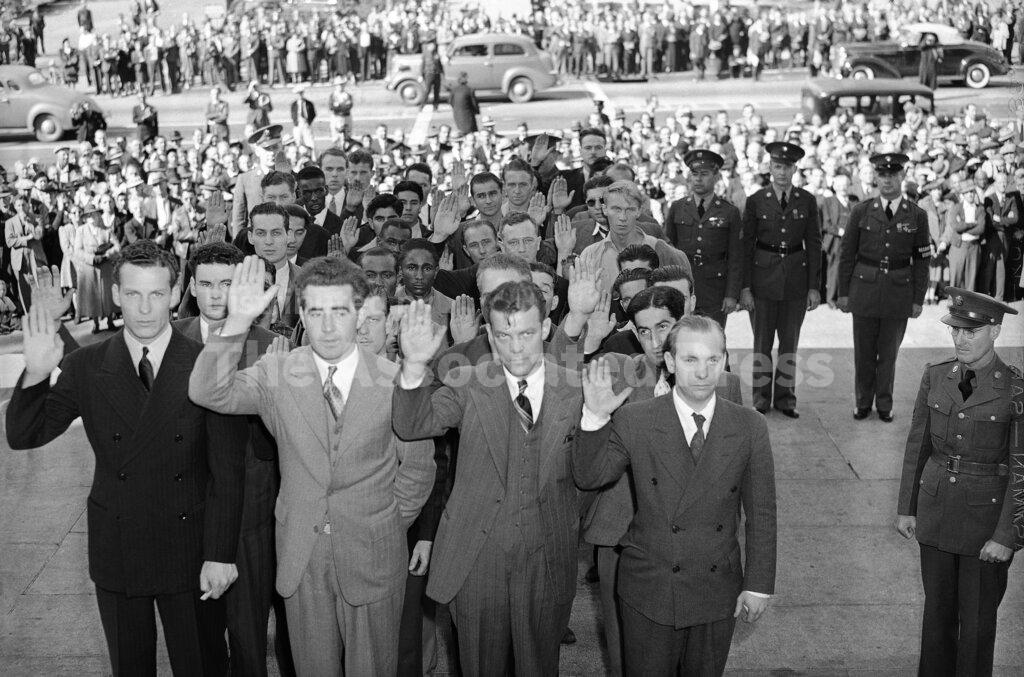
Hundreds of young men from the eight western states virtually all of them volunteers began reporting for duty today as the first of an initial contingent of 1,630 being taken from the Ninth corps area for a year’s military service. Many of the “selectees,” as the army classifies them, were passed through the various induction centers and started already on their way to army camps, after a physical checkup, fingerprinting and after taking the oath. Four months of basic military training faces the young men from 21 to 36, after which they will be taken into the regular army for their final eight months in capacities to which they are best fitted.
The prospect of sine die adjournment of Congress tomorrow appeared to dim today, and a lively battle was foreseen, with the fight centering first in the House, where a resolution to that end will be put to a vote. Democratic leaders regarded the outcome with pessimism today because of complications over pending legislation which some members at each end of the Capitol are loath to see discarded. They sent telegrams during the day to absent House party members urging them to return for the vote. The Republican leadership seemed confident it could muster practically all the minority votes against adjournment. According to Representative Martin, the minority leader, the Republicans will follow the advice of Wendell L. Willkie, the Republican Presidential nominee, and vote to keep Congress in a “standby status” during the emergency period.
Senator Austin, acting Senate minority leader, also was confident that most of his colleagues would oppose the adjournment resolution. He conceded that the Democratic majority was large enough to carry the day if it did not get tangled over pending bills which some of them said they would insist on considering. The key to adjournment was admitted to be in the hands of House Democrats. There were two questions bothering the leaders tonight: First, how many Democrats would return to vote; and, second, how many Democrats would desert their own ranks to ballot with the Republicans against quitting.
A 23-year-old alien, until recently an agent of the German Gestapo, appeared before a secret hearing of the house committee on un-American activities tonight with photographs of United States industrial plants and admitted he had engaged in both plant and military espionage in this country, Representative Martin Dies, Texas Democrat, announced. Dies, committee chairman, said the witness, Heinrich Peter Fassbender, alias Harry Smith, had admitted receiving checks from the German government in amounts from $100 to $200.
Acting Secretary of State Sumner Welles directs Chargé d’Affaires ad interim H. Freeman Matthews to communicate President Roosevelt’s concern over the French battleships Richelieu and Jean Bart being moved to a port such as Toulon to Marshal Henri Philippe Pétain, and reiterate the United States’ offer to acquire those two ships “as well as any other vessels of the French Navy” (see 21 November).
George Metesky, New York City’s Mad Bomber places his first bomb at a Manhattan office building used by Consolidated Edison. He placed his first bomb on a Consolidated Edison office building in Manhattan on November 18, 1940. The bomb was found on a window ledge and did not explode, but it was accompanied by a note stating, “Con Edison crooks, this is for you!”. This marked the beginning of a 16-year campaign of bombings that terrorized the city.
One of the youngest brigadier generals in the army, 54-year-old Robert L. Eichelberger, today became the thirty-eighth superintendent of the U. S. military academy at West Point. Veteran of war service at such opposite points as the hot Mexican border and the frozen Siberian wastes, he succeeded Major Gen. Jay L. Benedict, whose four-year tour here ended with his. transfer to the command of the new fourth army corps at Camp Blanding, Florida.
President Roosevelt wants committees of the two warring labor factions to meet with him and resume peace negotiations, William Green told delegates at the opening session of the American Federation of Labor convention today.
John L. Lewis swept aside a “draft” movement of tumultuous proportions today and disclosed to the delegates of the convention of the Congress of Industrial Organizations his supposed determination to retire as president of the organization in a few days.
Federal court power to grant injunctions in labor disputes solely because supposed violations of the Sherman Anti-Trust act were involved was denied by the Supreme Court today as contrary to the meaning of the Norris-La Guardia act and the purpose of Congress.
Milo J. Warner, national commander of the American Legion, said today that the American people “must be prepared to do our fighting outside the United States, not for the salvation of any other country, but for America.”
Three Texas National Guard cavalry units are inducted into Federal Service, the 56th Cavalry Brigade and the 112th and 124th Cavalry Regiments (Horse).
“Phantom of Chinatown” is released, starring Keye Luke as Mr. Wong. Directed by Phil Rosen and produced by Paul Malvern.
An indication that the trip to Mexico of Henry A. Wallace, Vice President-elect, might be more than a visit of official courtesy emerged today when Mr. Wallace discussed his plans to attend the inauguration of Mexican President-elect Manuel Avila Camacho with President Roosevelt.
After forty months of war in China, Japan was reported today to be seeking direct peace negotiations with Chinese Generalissimo Chiang Kai-shek. These reports, attributed to Tokyo sources, lacked any official confirmation. Rumors of Japanese peace feelers circulated last week in Chungking, but Chinese military spokesmen there said that, instead of thinking of peace, China was preparing for three years more of war if necessary. The Japanese decision to make peace overtures, the Tokyo reports said, was reached November 13 by the Imperial Conference, which includes Japan’s highest military and political leaders. There is, of course, no peace that Japan is willing to offer, that Chiang Kai-shek is willing to accept.
Heavy fighting is going on in the jungles along the Thailand-Annam (Indo-China) borders, where Thailand has mobilized 100,000 men, according to information that the radical nationalist newspaper Yomiuri says that it has received from reliable sources in Bangkok.
German armed merchant cruiser Pinguin sank British steamer Nowshera (7920grt) in the Indian Ocean in 31‑02S, 100‑51E. All Europeans on the steamer were made prisoners of war. The Pinguin takes what it needs from the Nowshera — which is armed with a 4-inch gun on its stern and a Lewis gun on its bridge — and then scuttles it. The 113-man crew — 103 Indian crew — is transferred to the Pinguin. The Europeans on board become POWs and ultimately wind up at Stalag XB (Marlag und Milag Nord) near Westertimke, Germany.
Australian heavy cruiser HMAS Canberra was in the area returning to port after searching for the ship that sank Norwegian tanker Ole Jacob, but no contact was made.
Dow Jones Industrial Average: 134.74 (+0.01)
Born:
Qaboos bin Said al Said, Sultan of Oman, in Salalah, Oman (d. 2020).
Cal Koonce, MLB pitcher (Chicago Cubs, New York Mets, Boston Red Sox), in Fayetteville, North Carolina (d. 1993, from lymphoma).
Bob McCullough, AFL guard (Denver Broncos), in Helena, Montana.
Dave Raimey, NFL defensive back (Cleveland Browns), in Dayton, Ohio.
Died:
Ivane Javakhishvili, 64, Georgian historian.
Naval Construction:
The Royal Navy Isles-class minesweeping trawler HMS Islay (T 172) is laid down by the Smith’s Dock Co., Ltd. (South Bank-on-Tees, U.K.).
The Royal Navy Isles-class minesweeping trawler HMS Canna (T 161) is launched by Cochrane & Sons Shipbuilders Ltd. (Selby, U.K.); completed by Amos & Smith.
The Вое́нно-морско́й флот СССР (ВМФ) (Soviet Navy) “S” (Stalinec)-class (2nd group, Type IX-modified) submarine S-33 is commissioned.
The Royal Navy Flower-class corvette HMS Tulip (K 29) is commissioned. Her first commanding officer is Lieutenant Commander (retired) John King Pollock, RN.
 History Diaries