The Battle of Korçë (Korytsa) began during the Greco-Italian War of 1940–41 in the town of Korçë in southern Albania between the defending Italian 9th Army and the attacking Greek III Army Corps. The Greek III Army Corps broke through the Italian 9th Army defensive line at Korcë (Korytsa), Albania. After the initial Italian invasion starting 28 October had been stopped, Greek forces launched a counter-offensive in early November. The battle for Korytsa formed the first part of the operation against the Italians and marked the final stage of the Greek penetration in the Battle of Morava–Ivan heights sector. The Italian 9th Army was entrenched around the town, but fierce fighting over two days led to the break-through of the Italian defensive line by the Greeks and its capture. Remnants of the 9th Army itself avoided capture, as the opposing Greek forces were poorly motorized and unable to pursue the retreating Italians.
The Battle of Korytsa, at the town of Korçë, opens on 16 November 1940 in southern Albania in the Morava Mountains. The Italian 9th Army defends the sector against the Greek III Army Corps. This is part of the larger Battle of Morava–Ivan heights. The Italians have strong defenses around the town, but the Greeks are highly motivated and operating on foot, infiltrating through unexpected areas of rough terrain. The Italians also are taken by surprise, overconfident in the balance of forces and who has the initiative — which in fact has switched to the Greeks.
Elsewhere, the news is no better for the Italians. The Greeks attack in the Korytsa sector with the 9th, 10th, and 15th Greek divisions. A Greek cavalry division enters Konitsa in the Pindos sector. The Greek 1st Infantry Division takes control of the Kamenik Heights. In the coastal sector, the Greek 8th Division continues its offensive on the Negrades sectors and the Kalamas River.
The British continue using cruisers to ferry troops to Piraeus. At this point, 4230 troops have arrived, many in support of RAF operations.
The Warsaw Ghetto was officially sealed, cutting off 380,000 Jews from the rest of the world. The Warsaw ghetto in Poland was sealed from the rest of the city, enclosing 400,000 Jews inside. The wall was typically 3 meters (9.8 feet) high and topped with barbed wire. Armed guards patrol the wall. Escapees could be shot on sight. The borders of the ghetto changed many times during the next years. The ghetto was divided by Chłodna Street, which due to its importance (as one of Warsaw’s major east-west arteries) was excluded from it. The area south of Chłodna was known as the “Small Ghetto”, while the area north of this street was the “Large Ghetto”. Those two parts were connected by Żelazna Street, and a special gate was built at its intersection with Chłodna Street. In January 1942, the gate was closed and a wooden footbridge was built in its place, which after the war became one of the symbols of the Holocaust. The first commissioner of the Warsaw ghetto was his chief organizer SA-Standartenführer Waldemar Schön.
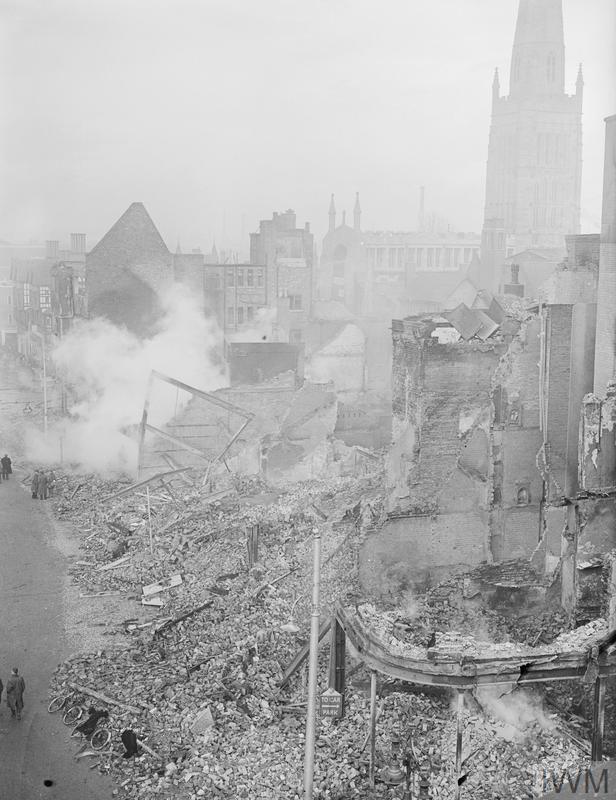
The RAF bombed Berlin, Hamburg, Bremen and other cities in retaliation for the Coventry bombing.
King George V tours devastated Coventry.
A correspondent with the Daily Express asks the Mayor of Coventry, J.A. Moseley if he intends to order an evacuation of the city. He replies:
“Of course not. We stay.”
While the Daily Express highlights the Coventry raid’s devastation on its front page, other newspapers downplay the damage and instead focus on things like the need to maintain war production there (the Guardian) or simply give short shrift to the entire affair (The Times makes the raid only the third leading article of the day). The Daily Express expresses a need for “more action to beat the night bomber” and “less talk about the so-called slackening of the blitz.”
Germany expelled 70,000 Lorrainers from northeast France.
Acting Secretary of State Sumner Welles has asked (on 13 November) the Chargé d’Affaires ad interim, H. Freeman Matthews, to meet with the French about the status of the French battleships Jean Bart and Richelieu. Accordingly, Matthews meets with French leader Marshal Henri Philippe Pétain. Mathews asks if the US can buy the battleships. Pétain demurs. He says that the ships will only be used to defend French territory and not against the British and adds: “Under present circumstances, I have neither the right nor the possibility of selling them.”
German Colonel General Heinz Guderian, one of the stars of the Polish and French campaigns while commanding XI Corps, is promoted to command of Panzer Group 2 (these formations are not yet designated Panzer Armies) in Germany. Guderian is one of the most respected men in the Wehrmacht (and internationally) due to his widely read book about tank tactics. Colonel-General Hermann Hoth, another successful panzer leader, takes over Panzer Group 3 in France.
More than 100 Nazi warplanes dropped explosives and fire bombs on London early today, starting scores of fires, leveling apartment buildings and homes, and burying more civilians following the devastating assault on Coventry Thursday night in which 1,000 were killed or injured. One whole block of apartments caved in. Casualties were believed heavy. Sweating rescuers toiled in ruins amid falling anti-aircraft shrapnel and bomb explosions. ‘Sand,” went the cry from fire men working their bucket brigades In central London.
The Luftwaffe sends raids against the south coast of England. For the first time, Luftwaffe planes attack the Hebrides. After dark, the Luftwaffe sends 87 planes against London.
The RAF creates a photo-reconnaissance unit of adapted Spitfire fighters.
RAF Bomber Command dispatches 6 Blenheims to Northern Germany in daylight. 4 aircraft bombed but none of the targets were in Germany. No losses.
RAF bombers attacked Hamburg, Germany again for the second day in a row. RAF Bomber Command dispatches 130 aircraft to 4 targets in Hamburg. Weather conditions were unfavorable. Only 60 aircraft reported bombing Hamburg; 25 bombed alternative targets. Hamburg records show 6 fires, 2 people killed, 36 injured and 786 bombed out. Kiel, 50 miles north of Hamburg, had 5 people killed and 16 injured on this night. 2 Wellingtons and 1 Blenheim were lost and 5 more aircraft crashed in England. 12 further aircraft bombed airfields and 3 were minelaying, all without loss.
Italian bombers raid Alexandria during the night.
Malta continues a period free of air raids. Many from the harbor areas who have evacuated to the interior are returning to their homes. There are practical reasons for this, as living far from work is a burden for many people. Estimates are that over 20,000 people have repopulated the area around Grand Harbour and Marsamxett Harbour. While this is a nice sign of confidence in the war effort, the lack of underground or “rock” shelters is becoming a major concern.
U-65, commanded by Korvettenkapitän Hans-Gerrit von Stockhausen, sank the steamers Fabian and Planter, approximately 350 miles south-southwest of Freetown, Sierra Leone in the eastern Atlantic Ocean. At 1429 hours the unarmed Fabian (Master Montague Hocking), dispersed from convoy OB.234, was hit in the foreship by one torpedo from U-65 about 350 miles south-southwest of Freetown. At 15.54 hours, the U-boat surfaced and sank the ship with five of eight rounds from the deck gun. The Germans then questioned the survivors, treated two injured men and provided food and water. The master and 32 crew members were picked up by the British steam tanker British Statesman and landed at Freetown. Six crew members were lost. The 3,059-ton Fabian was carrying general cargo and was bound for Istanbul, Turkey.
At 2015 hours the steamer Planter (Master Dennis Henry Bryant), a romper from convoy SLS.53, was torpedoed and sunk by U-137, commanded by Kapitänleutnant Herbert Wohlfarth, about 30 miles north-northwest of Bloody Foreland. Twelve crew members and one passenger (DBS) were lost. The master, 58 crew members and one gunner were picked up by HMS Clare (I 14) (LtCdr C. Gwinner) and landed at Liverpool. The 5,887-ton Planter was carrying Egyptian produce and was bound for Manchester, England.
Heavy cruiser HMS Norfolk completed repairs in the Tyne begun in October.
Anti-aircraft cruiser HMS Curacoa transferred from convoy WN.38 to convoy EN.26 and escorted it to Pentland Firth.
Anti-aircraft ship HMS Alynbank departed Scapa Flow at 0545 to meet convoy WN.38 in Pentland Firth and escorted it to Methil.
Destroyer HMS Sikh was detached from the battlecruiser HMS Repulse’s screen to refuel at Skaalefjord. The destroyer refuelled and departed on the 17th to rejoin the force.
Hunt-class destroyer HMS Cotswold was completed. Destroyer Cotswold departed Greenock to work up at Scapa Flow. She arrived at Scapa Flow at 1520/17th. Following working up, the destroyer was assigned to the 21st Destroyer Flotilla operating in the Nore.
Polish destroyer ORP Burza accidently sank anti-submarine trawler HMS Arsenal (550grt, Skipper C. R. Radford RNR) in a collision off the Clyde, four miles south of Toward. The trawler sustained no casualties. Destroyer HMS Arrow and tug Superman stood by. Destroyer Arrow was damaged by the explosion of trawler Arsenal’s depth charges. Repairs to her machinery were done in the Clyde, completing on 14 January. Destroyer Burza was repaired in the Clyde completing on 27 January 1941.
German bombers attacked convoy FS.335.
British steamer Sherbrooke (2052grt) was damaged by German bombing eight miles southeast of Orfordness.
British steamer Dagenham (2178grt) was damaged on a mine two and a half cables east, northeast of Mouse Light Vessel.
Submarine HMS Triumph arrived at Gibraltar from England.
In accordance with Acting U.S. Secretary of State Sumner Welles’s request of 13 November, Chargé d’Affaires ad interim H. Freeman Matthews meets with Marshal Henri Philippe Pétain concerning the possible move of French battleships Richelieu and Jean Bart. Pétain assures the U.S. envoy that the two capital ships would be used to defend French territory and would never be used against the British. “Under present circumstances,” Pétain informs Matthews, “I have neither the right nor the possibility of selling them” (see 18 and 22 November).
Chairman of the House Un-American Affairs Committee Martin Dies, Texas Democrat, declared today that his committee had evidence that Germany, Italy, Japan and Russia are “working very closely” in this country to prevent United States preparedness and to prevent aid to England. The Texan, back In the capital after an absence of more than two months, said he will ask Congress “for at least $1,000,000” to combat such activity and will also request broader powers for the committee to publicize persons known to have connections with subversive groups. The committee chairman asserted that his committee has a list of 300,000 persons and that hj proposes to bring them before the committee “one by one.”
Congress, after a holiday of five weeks for the national election campaign, will reassemble Monday to face the question of whether to take up half a dozen provocative issues or end its eleven-month session. Democratic Senate and House leaders are hopeful that the legislators will agree to quit. Opposing adjournment are the Republican minorities in both Senate and House and some Democrats who argue that the uncertain state of international affairs makes it advisable for Congress to stay on the job. Nominally, Congress has been in session in recent weeks but, under a gentleman’s agreement, has done nothing since October 11 except to meet and recess for three-day periods. Only a handful of members have reported for any meeting of the House or Senate. The agreement expires Monday, making regular business the order of the day. Democratic leaders have not yet decided on the date for which they will propose adjournment, although saying that it will be some time next week.
The Communist party of the United States voted yesterday to dissolve all affiliation with the Communist International and all other foreign organizations, for the specific purpose of removing itself from the terms of the so-called Voorhis Act,” signed by President Roosevelt last October and effective January, 1941, which will require groups under foreign control to register with the Department of Justice.
Striking C.I.O. unionists reverted today to their original demands for a minimum wage of 75 cents an hour at the Vultee aircraft factory and issued a statement contending that if they are hampering national defense, then the company likewise is hampering it. Peaceful picketing continued at the plant, which was closed yesterday about two hours after some 3,000 members of the United Automobile & Aircraft Workers union walked out. A proposal to reinstate the 75 cents demand was adopted at a mass meeting of strikers near the plant this morning. The company has been paying 50 cents minimum. In the course of negotiations, the union offered to accept 65 and will still negotiate on that basis if the company will offer it, union leaders said. Company officials withheld comment.
Army Air Corps pilots will pass through picket lines at the Vultee aircraft plant Monday to take delivery on seventeen training planes needed by the government, Major Oakley G. Kelley, Army representative at the plant, said tonight.
The national defense program will create jobs for 6,000,000 to 8,000,000 men and women, it was predicted here Friday by Secretary of Labor Frances Perkins and William Conover of the National Defense Advisory Commission.
Communists are in control of labor unions in many fields, F.J. Schlink, former attaché of the United States Bureau of Standards, said today.
Expenditure of more than $3,000,000 on research and experimentation with television is proposed by ten television projects which received the approval of the Federal Communications Commission yesterday.
Severe freezing weather blanketed the south today, making it the coldest section of the nation and threatening damage to truck crops and fruit trees. Temperatures shattered records for the date in some cities. No estimate of the damage to crops was available. Freezing temperatures reached into Florida and into the sugar and trucking regions of Louisiana. Florida’s multimillion dollar citrus crop escaped damage, but the weather bureau warned of lower temperatures early Sunday.
In American college football, the famous Fifth Down Game was played between Cornell and Dartmouth. College official Red Friesell mistakenly gives Cornell an extra down during the last seconds of the game. This mistake provides the opportunity for Cornell to score a touchdown which apparently wins the game for it 7–3. Officials (and everyone else) reviewing the game film quickly notice the error and forfeit the win, handing it to Dartmouth. The game is notable not only for the bad call and the reversal but for its unique status as a game. The outcome and score are decided by film only after the game is over and the teams have left the field. Cornell, incidentally, was on an 18-game winning streak at the time, and Dartmouth was only 3–4; the decision was a cruel blow to Big Red supporters.
Dow Jones Industrial Average: 134.73 (-0.86)
Protests continue about the results of the 7 July 1940 Presidential election in which Manuel Ávila Camacho prevailed over war hero General Juan Andreu Almazán. Many protesters are jailed. The election results, in which Camacho received 93.9% of the vote, have spurred many of Almazán’s supporters to riot to protest a supposedly fraudulent result. Almazán himself has fled the country in hopes of stirring up support for his cause in the United States. The inauguration of Camacho is scheduled for 1 December 1940. The wave of protest against the result is called almazanismo. It is fair to point out that such lopsided election returns in hotly contested elections are rare in democracies, especially those where there is obvious widespread street support for the loser. The U.S., for its part, does not want to get involved in this foreign quarrel and is not supporting Almazán.
German steamers Phrygia (4137grt), Idarwald (5181grt), and Rhein (6031grt) departed Tampico in an attempt to return to Germany. A fourth German steamer, steamer Orinocco (9660grt) also departed Tampico, but broke down near the mouth of the Rio Panuco which connects Tampico with Gulf of Mexico. She was towed back to Tampico by the tug that was accompanying her to sea. American destroyers USS Plunkett (DD-431, LCDR P. G. Hale), USS McCormick (DD-223, CDR T. V. Cooper, CDD 63), and USS Broome (DD-210, LCDR T. E. Fraser) were on patrol off Tampico. Immediately shadowed by the US destroyers, steamer Phrygia thought she had been intercepted and scuttled herself. After unsuccessful attempts to throw off the US destroyers, steamers Idarwald and Rhein arrived back at Tampico on the 18th.
U.S. Navy PBY Catalina flying boats are now patrolling the North Atlantic from bases in Bermuda, supported by seaplane tender USS George E. Badger. They operate from a base obtained in the September 1940 destroyers-for-bases deal with the UK. The deal helps both sides because the British are no longer required to allocate manpower to Bermuda, and the US air patrols can provide useful intelligence to the Royal Navy.
New Zealand Division light cruiser HMS Achilles departed Sydney to patrol off Auckland Island on the 20th and Campbell Island on the 21st. The light cruiser arrived at Lyttleton on the 23rd.
The German commerce raider Atlantis rendezvoused with the captured Norwegian tankers Teddy and Ole Jacob. After using the Teddy’s cargo of diesel fuel to refuel, the Teddy was sunk using demolition charges. The Ole Jacob would be sent to Japan with her entire load of high-octane aircraft fuel along top-secret documents about the defenses of the port of Singapore and other information about British military situation on the Far East captured from the British freighter Automedon. Because of this action the Japanese Government granted the Germans the use of Muag Island, a small island in the Mariana Islands, as a rest-refitting-replenishment area for raiders and blockade runners.
War has started between French Indo-China and Thailand (Siam) as the result of the French government’s rejection of Thailand territorial demands, it was officially announced here tonight. A battle is raging at several points along the Thailand-Indo-Chinese border, presumably as the re sult of an attempted invasion of French territory by Thai forces.
Born:
Buster Narum, MLB pitcher (Baltimore Orioles, Washington Senators), in Philadelphia, Pennsylvania (d. 2004).
Died:
Patrick MacSwiney, 54, Irish Catholic priest and scholar.
Naval Construction:
The Royal New Zealand Navy Isles-class minesweeping trawler HMNZS Inchkeith (T 155) is laid down by J. Lewis & Sons Ltd. (Aberdeen, Scotland).
The Royal Australian Navy Bathurst-class minesweeper-corvette HMAS Townsville (J 205) is laid down by Evans Deakin Ltd. (Brisbane, Queensland, Australia).
The Royal Navy Flower-class corvettes HMS Vervain (K 190) and HMS Bryony (K 192) are laid down by Harland & Wolff Ltd. (Belfast, Northern Ireland).
The Royal Navy Flower-class corvette HMS Montbretia (K 208) is laid down by Fleming & Ferguson Ltd. (Paisley, Scotland). She is transferred and enters service for the Royal Norwegian Navy as the HNoMS Montbretia in September 1941.
The Kriegsmarine (German Navy) Type IID U-boats U-147 and U-148 are launched by Deutsche Werke AG, Kiel (werk 276 and 277).
The Kriegsmarine (German Navy) Type VIIC U-boat U-751 is launched by Kriegsmarinewerft (KMW), Wilhelmshaven (werk 134).
The Royal Navy LCT (Mk 1) class landing crafts, tank HMS LCT 5 and HMS LCT 6 are launched by the Cammell Laird Shipyard (Birkenhead, U.K.).
The Royal Navy Isles-class minesweeping trawler HMS Arran (T 06) is launched by Cook, Welton & Gemmill (Beverley, U.K.); completed by Holmes.
The Royal Australian Navy Bathurst-class minesweeper-corvette HMAS Gouldburn (J 167) is launched by the Cockatoo Docks and Engineering Co Ltd (Sydney, New South Wales, Australia).
The Royal Indian Navy Black Swan-class sloop HMIS Jumna (U 21) is launched by William Denny & Brothers (Dumbarton, Scotland).
The Royal Navy Flower-class corvette HMS Pimpernel (K 71) is launched by Harland & Wolff Ltd. (Belfast, Northern Ireland).
The Royal Canadian Navy Flower-class corvettes HMCS Sorel (K 153) and HMCS Camrose (K 154) are launched by Marine Industries Ltd. (Sorel, Quebec, Canada).
The Royal Navy Fiji-class (Crown Colony-class) light cruiser HMS Jamaica (44) is launched by Vickers Armstrong (Barrow-in-Furness, U.K.).
The Royal Navy harbour defence motor launch HMS HDML 1011 is commissioned.
The Royal Navy British Power Boat 70-foot-class (ex-French) motor anti-submarine boat HMS MA/SB 53 is commissioned.
The U.S. Navy Raven-class minesweeper USS Osprey (AM-56) is commissioned. Her first commander is Lieutenant Commander Cecil Llewellyn Blackwell, USN.
The Royal Navy Hunt-class (Type I) escort destroyer HMS Cotswold (L 54) is commissioned. Her first commander is Lieutenant Commander Peter John Knowling, RN.
 History Diaries