Attacking Greek forces today continued to drive the Italians before them in the three main sectors of the 120-mile front, frontier reports said tonight. The Greek offensive gathers steam on 15 November 1940. Advancing through the valley of the Devoll River (also Devoli River), the Greeks continue to make progress against light resistance. Advances are swift around Mount Morava. The Greek 8th Infantry Division attacks in the Kalamas and Negrades sectors, the Greek 1st Infantry Division attacks in the Pindos sector, while the Greek 9th, 10th and 15th Infantry Division attacks in the Koritsa sector.
General Keitel and Marshal Badoglio conclude their talks at Innsbruck. Badoglio promises that the Italian offensive in Albania will be resumed in mid-February with 20 divisions. However, no further advance in Egypt is contemplated.
The Germans seal off the Warsaw Ghetto. It contains 400,000 Jews in a very restricted space. While there are numerous dates that are available as the “start” of the Warsaw Ghetto, this is when it actually becomes a walled prison.
The British Government placed new restrictions on the manufacture of luxury and “near necessity” goods tonight and appealed to the people to remember that every man released from the production of unnecessary goods could be employed in a munitions or aircraft factory.
A Swiss totalitarian group delivered today what some newspapers called an “ultimatum” to the government, demanding the right to disseminate party propaganda and the “rehabilitation of persecuted and imprisoned” colleagues. The group is known as the “Swiss national movement.” It is not strong numerically, but neutral foreign observers considered its demand important in view of Switzerland’s position, sandwiched as she is between the axis powers.
The Hungarian press displayed today under large headlines reports of a revolt in the ranks of Rumamian Iron Guardists, in which one person was said to have been killed and seven injured at Bucharest.
Three unidentified bombers crossed the Yugoslav frontier tonight and again bombed the southern city of Bitolj [Monastir] at 10:05 o’clock, dropping six large bombs about 150 yards from the railroad station.
At Sidi Barrani in Egypt, as Italian troops work to fortify this remote coastal village, the limit of their advance towards the Nile Delta, British troops are carrying out clandestine preparations for a major counter-offensive. Moving only by night, and lying low under camouflage netting by day, they are burying large quantities of water and fuel in secret dumps along the 75-mile “no-man’s-land” from Mersa Matruh and westward. Marshal Graziani shows no sign of advancing further. An Italian observer reports a “holiday atmosphere” in their ranks as more British tanks arrive in Egypt.
A large convoy of nine Greek troopships departs from Suda Bay, bound for Salonika. They are escorted by four cruisers and other ships in Operation BARBARITY.
At Malta, the government warns the public not to send postcards abroad with pictures of Malta that might be useful to the Italians.
In Gabon, Brigadier General Charles DeGaulle, Commander-in-Chief Free French Forces, visits Vichy prisoners in an attempt to win them over to Free France. Most reject the offer and are interned along with Air Force General Marcel Tetu, the Vichy Governor-General of French Equatorial Africa, at Brazzaville. The French now focus on Libya. Gabon is the first territory controlled by the Free French.
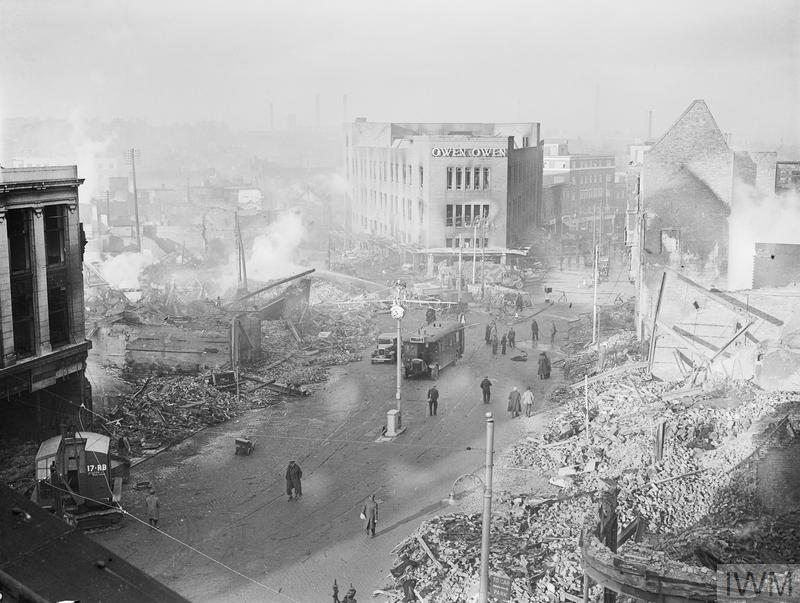
Coventry, chosen by the German high command for the most concentrated aerial bombardment of the battle of Britain, emerged today from that scourge with more than 500 dead and many wounded, not counting unknown numbers trapped in her smoking wreckage. Berlin dispatches quoting the high command represented the assault as vengeance for the British bombardment of Munich, birthplace of Naziism. The 14th-century St. Michael’s Cathedral was turned into smoking rubble and many factories making munitions, engines for tanks and aircraft and other war supplies were badly damaged. 568 people were killed and 863 seriously injured. “Coventry is finished” said one survivor. Many have fled, the army wants to impose martial law until essential services are restored. There is no water supply or transport and the telephone system has been disrupted. The air is still warm from the fire which raged through the city centre and daylight is obscured by a pall of sooty fog.
The Luftwaffe’s Operation MOONLIGHT SONATA, a massive air attack against the industrial city of Coventry, concludes in the early morning hours. Aside from the devastation to the city, it is a major propaganda coup for the German news services. The Reich media coins and uses the verb “Coventrate” for the destruction of British cities, as in, “We will Coventrate all of England.”
After dark, the Luftwaffe launches another major raid, this time against London with 358 bombers. London is bombed heavily tonight. More than a 100 bombers drops HE’s and incendiaries. Drury Lane Theatre is hit.
Feldwebel Karl Hier of JG 76 is shot down and killed by Spitfires over London. He had 15 victories.
RAF Bomber Command dispatches 1 Blenheim to Lorient in daylight which turned back.
RAF Bomber Command dispatches 67 Hampdens, Wellingtons and Whitleys overnight to Hamburg in 2 separate waves 8 hours apart. Returning crews reported good bombing conditions. Hamburg records show that 68 fires were started and that heavy damage — for this period of the war — was caused at the Blohm & Voss shipyard. 26 people were killed, 102 injured and 1,625 bombed out. This was almost certainly the most successful Bomber Command raid of the war so far. 56 Blenheims, Wellingtons and Whitleys — mostly Blenheims — continued the raids on Luftwaffe bomber airfields in the occupied countries. All operations on this night were free from loss.
The Italians send a strafing mission against Mersa Matruh with 25 CR 42 biplane fighters.
U-65, commanded by Korvettenkapitän Hans-Gerrit von Stockhausen, sank British steamer Kohinur (5168grt) and Norwegian tanker Havbør (7614grt) in 4‑24N, 13‑46W.
At 1511 hours the Kohinur (Master Leslie Hugh Bonnand), dispersed on 31 October from convoy OB.235, was torpedoed and sunk by U-65 about 250 miles north of the Equator. The second officer was taken prisoner by the U-boat. The master, 45 crew members and two gunners were lost. 31 of them died in the explosion of the tanker Havbør, which was also torpedoed by U-65 three hours later, while picking up the survivors. 36 crew members were picked up on 16 November by the British merchant City of Pittsburg and landed at Freetown on 19 November. One crewman was made a prisoner of war. The one prisoner of war was transferred to supply ship Nordmark when U-65 refueled at sea on 28 and 29 November. The 5,168-ton Kohinur was carrying government stores and was bound for Port Said, Egypt.
The Norwegian motor tanker Havbør was also torpedoed and sunk by the U-65 approximately 250 miles north of the Equator off the coast of Africa in the eastern Atlantic Ocean. At 1816 hours the Havbør (Master Halvor Skarrebo) was hit on the port side aft by one torpedo from U-65, while picking up 31 men from rafts from the Kohinur, which had been torpedoed three hours earlier by the same U-boat. The men on the raft had warned the Havbør that the U-boat was nearby, but boats were lowered anyway. The ship immediately caught fire after being hit and some of the rafts and lifeboats were trapped by burning oil. The Germans initially planned to question the survivors but after observing the results of their attack left the burning tanker, which sank about 7 hours after the attack. The master, 27 crew members and all the rescued men died in the flames. Three Norwegian and two Danish crew members of the tanker jumped overboard and swam towards the abandoned raft from the other ship, tore a plank loose and paddled for life away from the burning oil. Later the survivors encountered a lifeboat from Kohinur and asked to be taken on board, but after having inquired how much water they had on the raft, the lifeboat sailed away from the raft, because it was already filled to capacity. The raft kept drifting and on 16 November, one of the Danish men died; he had been badly burnt. On 24 November, the remaining survivors were picked up by the British steam merchant Baron Ardrossan and taken to Freetown. Of the ship’s complement, 60 died and 4 survivors were picked up by the British steam merchant Baron Ardrossan. The 7,614-ton Havbør was carrying crude oil and was bound for the United Kingdom.
In Operation STRIPE, aircraft carrier HMS Furious departed Liverpool with 34 Hurricanes of 73 Squadron and 3 Fulmars. The aircraft carrier joined anti-aircraft cruiser HMS Dido which departed the Clyde also for Takarodi. British steamer New Zealand Star departed with the aircraft carrier and destroyers HMS Havelock and HMS Hesperus escorted the ships from Liverpool.
Light cruisers HMS Manchester, which had just completed a refit at Rosyth, and HMS Southampton departed Scapa Flow. At Gibraltar they would embark troops carried in troopship Franconia. They were joined by destroyers HMS Jaguar and HMS Kelvin from Plymouth. British steamers Clan Forbes, Clan Fraser, and Franconia also proceeded to Gibraltar. The two forces rendezvoused in North Channel and escorted the merchant ships to Gibraltar.
Aircraft carrier HMS Furious arrived at Freetown, escorted by destroyers HMS Foxhound and HMS Fortune, on the 25th. Furious arrived at Takoradi on the 27th and the aircraft flown off to Takoradi on the 29th. Aircraft carrier Furious arrived back at Liverpool on 15 December.
Anti-aircraft cruiser HMS Naiad (Rear Admiral, 15th Cruiser Squadron) departed Scapa Flow on the 11th. On the 13th, the cruiser was detached from the battlecruiser HMS Repulse group to raid the wireless station in Jameson Bay on Jan Mayan Island. This raid was covered by battlecruiser Repulse and destroyers HMS Sikh, HMS Matabele, and HMS Punjabi. On the 15th, the cruiser arrived and the wireless station was burnt. British naval trawlers HMS Elm (530grt) and HMS Wistaria (515grt) arrived from Iceland for support on the 16th. On the 16th, light cruiser Naiad chased and drove ashore German trawler Hinrich Freese (384grt). The ships returned to Scapa Flow at 0015/19th. Cruiser Naiad was weather damaged in this operation.
Minelaying cruiser HMS Adventure laid a series of minefields.
On the 15th, designated ZME.1.
On the 20th, designated ZME.2.
On 23 November, designated ZME.3.
On 2 December, off Little Sole Bank, designated GQ 1.
For GQ 1, minelayer HMS Adventure departed Milford Haven at 1000 on 1 December. She rendezvoused with destroyer HMS Kashmir and HMS Kipling off Hartland Point. At 1345, destroyer HMS Jupiter joined. At 1730, the escort was sent to Plymouth. The minefield was laid at 0318 to 0358. The minelayer arrived back at Milford Haven at 1730 on 2 December.
On 7 December, designated ZME.4.
On 10 December, designated ZME.5.
On 14 December, designated ZME.6.
On 17 December, designated ZME.7.
On 20 December, designated ZME.8.
On 23 December, designated ZME.9.
On 30 December, designated GQ 2.
Operation GQ 2 was originally set for 5 December, but was cancelled due to weather.
Minelayer HMS Adventure departed Milford Haven at 1000 on 29 december and met destroyers HMS Jersey, HMS Jupiter, and HMS Kashmir off Trevose Head. The mines were laid the minelayer arrived back at Milford Haven at 1700 on 30 December.
On 2 January, designated ZME.10.
ZME 11 to ZME.14 were conducted in the first two weeks of January.
On 16 January, designated ZME.15.
Cruiser HMS Adventure conducted sixteen operations in sixty days.
The cruiser, returning from ZME.15, was badly damaged on 16 January entering Liverpool Bay when she struck a mine.
Minelayer HMS Plover took over the ZME.minelays beginning with ZME.16. The series was completed with ZME.31 on 21 April.
Anti-aircraft cruiser HMS Curacoa transferred to convoy WN.37 and escorted it from Pentland Firth to Buchanness.
Destroyer HMS Vimy departed Scapa Flow at 0930 for Lerwick. At Lerwick, destroyer Vimy joined British steamer Ben My Chree and escorted her to Aberdeen. The steamer arrived off Aberdeen at 0303 on the 16th and destroyer Vimy continued on to Rosyth.
Destroyer HMS Southdown called at Holyhead at 1130 to land passengers. Later, she encountered Armed patrol trawler HMS Lord Collingwood (116grt) at 2035 and took her in tow towards the Clyde. Destroyer Southdown arrived with the trawler in tow on the 16th. Destroyer Southdown oiled at the Clyde. She departed at 1515/16th and arrived at Scapa Flow at 0930/17th.
In a British raid on Barley airfield, Lt T. G. Bentley and P/Sub Lt (A) A. R- J. Davis RNVR, in a SWORDFISH of 812 Squadron from HMS Daedalus were shot down and made prisoners of war.
British steamer Amenity (297grt) was sunk on a mine in 53‑33N, 00‑09E. The entire crew of seven was rescued.
British steamer Apapa (9333grt, convoy Commodore Rear Admiral G. H. Knowles DSO Rtd was sunk from convoy SL.53 by German bombing in 54‑34N, 16‑47W. Anti-submarine trawler HMS St Apollo (580grt) stood by the steamer. Eighteen crew and five passengers were missing from the steamer. Survivors from the steamer were rescued by British steamers Mary Kingsley (4017grt) and New Columbia (6574grt).
British steamer Blue Galleon (712grt), in convoy FN.34, was sunk by German bombing in 52‑57N, 01‑56E. Three crewmen were lost on the steamer.
British trawler Dungeness (263grt, P/T/Skipper C. W. Neesham RNR) was badly damaged by German bombing at Haisborough and considered a constructive total loss. There were no casualties on the trawler.
British tug Guardsman (102grt) was sunk on a mine off North Foreland, one half cable east by northeast of Spit Buoy. Two crewmen were lost on the tug.
In operation BARBARITY, Heavy cruisers HMS Berwick and HMS York and light cruisers HMS Glasgow and HMS Gloucester of the 3rd Cruiser Squadron and light cruiser HMAS Sydney departed Alexandria at 1500 with 3400 troops for Piraeus. All five cruisers arrived on the 16th at Piraeus. These cruisers ran twenty one hours at an average of thirty knots. After disembarkation, the cruisers patrolled in the Aegean before arriving back at Alexandria on the 18th. Light cruisers HMS ORION and HMS Ajax departed Alexandria to take general control of the operation and to call at Suda Bay, Pireaus, and Candia as necessary. The cruisers arrived at Piraeus on the 16th. After disembarking the troops, cruisers HMS Berwick, HMS Gloucester, and HMS Glasgow that day departed for Alexandria. Heavy cruiser HMS York departed that day for Port Said. All arrived on the 17th.
Anti-aircraft cruiser HMS Coventry with destroyers HMAS Vampire, HMS Nubian, and HMS Mohawk departed Alexandria on the 15th with steamers Clan Macaulay, Imperial Star, and Nieuw Zeeland. Steamer Johann De Witt, escorted by destroyer HMAS Waterhen, departed Port Said on the 14th and joined the convoy at sea. The convoy arrived at Piraeus on the 16th. On their return, destroyers Vampire, Mohawk, and Nubian conducted an anti-submarine sweep in the Aegean. Destroyer HMAS Waterhen had been detached to Suda Bay to refuel and rejoined before the destroyers arrived back at Alexandria on the 18th.
Convoy AN.7 of five transports carrying 830 men and 710 vehicles and a bulk petrol carrier departed Alexandria and Port Said, escorted by trawlers, anti-aircraft ship HMS Calcutta, destroyer HMS Ilex. The convoy was covered by cruisers HMS Orion and HMS Ajax. The convoy arrived at Piraeus on the 19th. The trawlers returned to Suda Bay. Calcutta and Ilex proceeded to Alexandria.
Battleships HMS Barham and HMS Valiant, aircraft carrier HMS Eagle, and destroyers HMS Hyperion, HMAS Vendetta, HMS Dainty, HMS Diamond, HMS Jervis, HMS Greyhound, HMS Gallant, and HMS Griffin departed Alexandria early on the 16th to cover these movements. The covering force called at Suda Bay on the 17th. Later that day, engine problems in battleship Barham forced the ships to return.
Nine Greek troopships, escorted by eight Greek destroyers, departed Suda Bay at 1800/17th for Salonika. Anti-aircraft ship HMS Coventry departed Pireaus and joined this convoy on the 18th until arriving in the Petali Gulf. The cruiser arrived back at Alexandria on the 19th. The convoy arrived on the 20th. All warships were back at Alexandria on the 19th.
Force H of battlecruiser HMS Renown, aircraft carriers HMS Ark Royal and HMS Argus, light cruisers HMS Sheffield and HMS Despatch, destroyers HMS Faulknor, HMS Forester, HMS Fury, HMS Wishart, HMS Firedrake, HMS Foxhound, HMS Fortune, and HMS Duncan departed Gibraltar on Operation WHITE.
The forces were divided into Force A with aircraft carrier HMS Argus, light cruiser HMS Despatch, and destroyers HMS Faulknor, HMS Forester, HMS Firedrake, HMS Foxhound, and HMS Fortune. Force B was battlecruiser HMS Renown, aircraft carrier HMS Ark Royal, light cruiser HMS Sheffield, and destroyers HMS Fury, HMS Wishart, and HMS Duncan.
This was a flyoff of Hurricanes from aircraft carrier Argus to Malta. Flyoff took place on the 17th in two flights of six Hurricanes each, each lead by a Fleet Air Arm Skua. Two Hurricanes crashed short of Malta in the first flight; the pilot of one was rescued by a Sunderland Flying Boat. The rest of this flight, the Skua and four Hurricanes, arrived at Malta. The second flight was lost en route to Malta through a navigational error, with no survivors from the Hurricanes. The Skua crashed landed on southwest coast of Sicily. The pilot, Petty Officer (A) W. E. J. Stockwell, observer P/T/A/Sub Lt (A) R- C. Neil were taken prisoner.
Light cruiser HMS Sheffield arrived back at Gibraltar on the 18th and the rest of Force H.arrived back on the 19th.
Destroyers HMS Vidette and HMS Wrestler departed Gibraltar to meet battleship HMS Royal Sovereign, arriving from Freetown. The ships arrived at Gibraltar on the 18th.
Light cruiser HMS Colombo was off Mogadishu in a patrol established on the 12th. On the 15th, Colombo bombarded merchant ships off Mogadishu and reported two hits. On the 18th, Colombo was bombed sixty miles east, northeast of Kismayu. On the 28th, Colombo was relieved on this station by light cruiser HMS Ceres.
Convoy FN.335 departed Southend, escorted by destroyers HMS Verdun and HMS Wolsey. The convoy arrived at Methil on the 17th.
Convoy FS.336 departed Methil, escorted by destroyers HMS Wallace and HMS Westminster. The convoy arrived at Southend on the 17th.
In the United States, the first 75,000 conscripted men are called to armed forces duty during peacetime.
President Roosevelt today appointed Dr. Harry A. Millis of Chicago to succeed J. Warren Madden, former chairman of the National Labor Relations Board. Dr. Millis, who is 67, served on the old NRA Labor Board in 1934 and 1935, prior to its reconstitution under the Wagner Act.
The U.S. west coast’s fourth largest airplane factory was closed by a strike today, partially crippling the national aerial defense program for the first time. Union employees of the Vultee Aircraft Co. in Downey, California, which has on hand $50,000,000 in orders for military aircraft, walked out at 5 a.m. in support of a demand for a wage increase. Two hours later the company announced shutdown of the huge plant, in which scores of airplanes are in all stages of production. The company said the suspension also affected “more than 20” airplanes ready for delivery tomorrow.
The award of an $18,529,500 contract to the Consolidated Aircraft Corporation for construction of additional patrol bombers was reported today by the Navy Department, and the War Department let a contract totaling $29,139,793 to the Curtiss Wright Corporation for planes to be delivered to the Navy.
Former President Herbert Hoover in an address at Vassar College tonight renewed his plea for international assistance to the conquered nations of Europe, with a warning that famine and its accompanying epidemic diseases would reach an acute stage there this Winter or next Spring.
The Midtown Tunnel linking Manhattan and Queens in New York City is opened to traffic. The $58,000,000 Queens Midtown Tunnel under the East River was opened to the public at 1:20 P.M. yesterday, nearly an hour after the close of dedicatory exercises held under lowering skies in the presence of 3,000 guests of the New York City Tunnel Authority.
The comedy team of Abbott and Costello made their screen debut in the comedy film “One Night in the Tropics.”
“Three Men From Texas” starring William Boyd as Hopalong Cassidy premieres today.
“Popeye the Sailor with Poopdeck Pappy #89” premieres today.
U.S. Navy heavy cruiser USS Louisville (CA-28) arrives at Santos, Brazil, as she continues her goodwill cruise in Latin American waters.
U.S. naval air operations began from Bermuda, one of the bases involved in the destroyers-for-bases pact with the U.K.. First to operate are the PBY-2 Catalinas of Patrol Squadron Fifty Four (VP-54) based on the seaplane tender (destroyer) USS George E. Badger (AVD-3).
An official statement by the Soviet Tass news agency yesterday denying reports that Russia had pledged to Japan that she would cease military assistance to the Chinese Government in Chungking was interpreted in Chinese circles in Chungking to mean that the negotiations in Moscow for a broad Russo-Japanese accord had hit a snag. Chinese informants who are in close touch with affairs in Chungking said that the Soviet Government still was giving Generalissimo Chiang Kai-shek and his associates major assistance and that there was no reason to believe this assistance would be stopped.
Isoroku Yamamoto was promoted to the rank of admiral.
Hiroaki Abe became the commanding officer of Japanese Navy Destroyer Squadron 6.
Vice Admiral Teruhisa Komatsu succeeded Vice Admiral Boshiro Hosogaya as the commanding officer of the Ryojun Military Port (previously known as Port Arthur; now Lushunkou, Liaoning Province, China), Kwantung Leased Territory in northeastern China.
Aircraft carrier HIJMS Akagi was assigned as special duty ship in Yokosuka Naval District, Japan.
Cruiser HIJMS Tenryu began a period of modernization, replacing her coal boilers and receiving better anti-aircraft weaponry. Captain Yuji Takahishi was named her new commanding officer.
Captain Tamotsu Takama was named the commanding officer of Nachi.
Rear Admiral Shigeki Ando was named the chief of staff of Chinkai Guard District in southern Korea.
Manuel Quezon, in a speech today as the Philippine Commonwealth celebrated its fifth anniversary, declared that, although the people of the Philippines were only halfway toward their goal, “our accomplishments show that we are able even now to manage alone the affairs of our country.”
German raider Pinguin rendezvouses with converted minelayer Passat at their prearranged meeting spot several hundred miles west of Australia. Both ships have completed extensive minelaying operations off Australia.
Dow Jones Industrial Average: 135.59 (-1.38)
Born:
Sam Waterston, actor (“Capricorn One”, “Law and Order”), producer and director, in Cambridge, Massachusetts.
Whit Tucker, Canadian Football HOF wide receiver (Grey Cup 1968, 69 Ottawa Rough Riders; CFL All-Star 1967), born in Windsor, Ontario, Canada (d. 2024).
Ike Lassiter, AFL-NFL defensive end and defensive tackle (AFL All-Star, 1966; Denver Broncos, Oakland Raiders, Boston-New England Patriots), in Wilson, North Carolina (d. 2015)
Roberto Cavalli, fashion designer, in Florence, Italy (d. 2024).
Naval Construction:
The Royal Navy Bangor-class (Turbine-engined) minesweeper HMS Worthing (J 72) is laid down by George Philip & Sons Ltd. (Dartmouth, UK); completed by B.T.H.
The Royal Navy Bar-class boom defense vessel HMS Barrington (Z 59) is launched by W. Simons & Co. Ltd. (Renfrew, Scotland).
The U.S. Navy 70-foot Elco patrol motor torpedo boat USS PT-15 is launched by the Electric Launch Company Ltd. (Elco), (Bayonne, New Jersey, U.S.A.).
The U.S. Navy seaplane tender USS Curtiss (AV-4), lead ship of her class of 2, is commissioned. Her first commanding officer is Commander Samuel Paul Ginder, Sr., USN.
The U.S. Navy 70-foot Elco patrol motor torpedo boat USS PT-13 is commissioned.
The U.S. Navy Tambor-class submarine USS Trout (SS-202) is commissioned. Her first commanding officer is Lieutenant Commander Frank Wesley Fenno, Jr., USN.
The Royal Navy Flower-class corvette HMS Delphinium (K 77) is commissioned. Her first commanding officer is Commander (retired) Robert Lees Spalding, RN.
 History Diaries