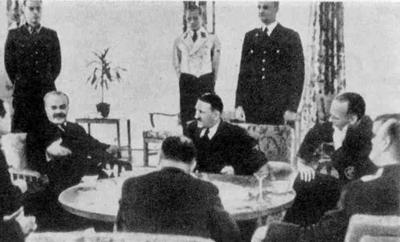
Hitler, Ribbentrop, and Molotov continued their meeting in Berlin, Germany. Hitler attempted to divert Soviet aggression out of the Balkan Peninsula and Finland, and instead focus, together with Germany, to defeat the United Kingdom, with the ultimate prize being the partition of the British Empire among Germany, the Soviet Union, Italy, and Japan. Molotov, who was not moved, asked Hitler whether Germany would feel comfortable with a Soviet guarantee of Bulgarian borders much like how Germany had recently guaranteed Rumanian borders; unable to answer that question, Hitler again broke off the discussion on the excuse of potential British bombings as the hours were getting late. Indeed, having known that Molotov was visiting Berlin, the British RAF launched bombers to attack Berlin as a show of force to convince Molotov that Britain was still in the fight. Ribbentrop and Molotov continued the meeting in a underground bunker amidst the bombing where Ribbentrop failed to entice Molotov with a four-power (Germany, Italy, Japan, and Soviet Union) military alliance proposal.
Soviet Foreign Minister Molotov continues his visit to Berlin on 13 November 1940. He meets with Adolf Hitler again during the afternoon. Molotov now has had a night to digest Hitler’s expansive and air proposals for world domination and thus gets more precise in his responses.
Molotov stresses that the USSR has certain non-negotiable demands prior to any military alliance. The largest of these concern Finland. That country, Molotov emphasizes, lies within the USSR’s sphere of influence pursuant to the August 1939 Ribbentrop-Molotov pact. The Stavka is aware of German troop movements in the country – primarily related to transit from Finnish Baltic ports to Narvik – and wants those troops withdrawn.
Another hot spot is in Rumania. The Soviet Union already has swallowed part of Rumania, and Molotov points out that Hitler has recently guaranteed the reduced Romanian frontiers. This seems aimed at the Soviet Union, which Molotov indicates is not a friendly act.
Molotov also raises other, less critical issues. He indicates that the Soviet Union intends to enter into some kind of arrangement with Bulgaria – the country that Hitler wants to use as a springboard to invade Greece (though Molotov likely has no idea of this). Molotov also indicates that the Soviet Union will be blocking off the Black Sea with bases on the Dardanelles – which raises issues about Turkey and the Balkan states’ outlet to the Mediterranean.
Hitler has difficulty responding to some of these points. Regarding German activities in Finland, he responds that German activities there are of no matter and certainly of no concern to the Soviet Union. In fact, Hitler’s position throughout the war is that the Soviet Union must be prevented from acquiring Finnish ports in the Baltic. The bases on the Dardanelles and the issue of the Soviet Union’s relationship with Bulgaria are not something he can agree to without consulting his allies.
If there is anything that seals the fate of the Third Reich, it is this discussion. Hitler sees that, rather than cooperating in the destruction of the British Empire, the Soviet Union is pushing back against Germany. A military alliance drifts out of the range of feasibility, and the only remaining question becomes how confrontational relations will be.
After this meeting, German Foreign Minister Ribbentrop has dinner at the Soviet embassy. An air raid during the dinner forces them to take shelter under the Wilhelmstrasse. Ribbentrop decides to give the negotiation – going very badly – a final shot.
Ribbentrop proposes a treaty, including – as with their August 1939 agreement – secret protocols. The USSR would join the Three-Power Pact and acquire a specific sphere of influence, along with Italy, Japan and Germany. The secret protocols would outline what these spheres were and would recognize the Soviet Navy’s rights in the Dardanelles.
Molotov is fairly noncommittal in response to Ribbentrop’s offers about spheres of influence and the Dardanelles. However, he gets very specific about what the Soviet Union wants in Europe. The Soviet Union, he says, has interests in Romania, Hungary, Yugoslavia, Finland, Bulgaria, Poland and Greece. It also needs a way to ensure Swedish neutrality or at least acquiescence to Soviet passage through the Kattegat and Skagerrak to the Atlantic.
None of Molotov’s demands are even remotely acceptable to the Germans.
This meeting between Molotov and Ribbentrop gives rise to an enduring legend. The discussion is held in a shelter (with liveried waiters bringing hors d’oeuvre on trays) to the sound of RAF bombs dropping fairly close by (they rattle the plate glass windows at the Wilhelmstrasse before the guests adjourn to the shelter). Supposedly, Molotov responds to one of Ribbentrop’s repeated claims that Britain is finished and the war basically over with a tart observation:
“If that is so, why are we in this shelter and whose are these bombs which fall?”
This is considered by virtually everyone to be apocryphal. It has that “wise guy” insouciance that smacks of a British propaganda invention, though that is unproven (it may also be an example of sardonic Germanic wit). In fact, however, the British do play an intentional role in this discussion: Winston Churchill later confides that he knew of the meeting (probably from Ultra, though he does not disclose that fact as Ultra remains Top Secret until well after his death). He felt that “it was only right that we should have some say in the matter.” Thus, Churchill sent over RAF bombers to pay a special visit at that time.
The Battle of Pindus ended in Greek victory. By the end of the day, Greek troops had pushed most Italian troops in northern Greece back to the Albanian border. The Greek high command declared tonight that in “successful attacks” in the Pindus Mountains region its troops had occupied a new series of hilltops on Albanian territory. No more precise location of the counter-offensive was given, but a government spokesman had said earlier that the Greeks were moving forward rapidly in a mop-up of territory abandoned by the Italian invaders in the Pindus region and along the Greek west wing.
Today generally is considered the definitive end of the Italian offensive into Greece. In fact, the offensive has been crumbling almost since the day it began, but today is when the Greeks set the stage for their own offensive.
The Greeks complete the occupation of the Grammos and Smolikas mountain ranges in the Pindus sector. The Julia Division is wiped out, losing 5,000 men, and the Greek forces now occupy the initial positions that they held before the war. This concludes the Battle of Pindus with a total Greek victory. Many people attribute a large part of the Greek victory to the efforts of civilians, particularly women, who help with logistics, scouting, shelter and in other ways.
On the coastal sector, the Greek forces stand all along the Kalamas River, having pushed the Italians back across everywhere.
Performing one of the many public duties she will be called on, as a member of the Royal House, to fulfill as she grows older, Princess Elizabeth made her radio debut today, broadcasting a three-minute speech to British girls and boys evacuated overseas or to various places in the island fortress of Great Britain.
An urgent session of the French government was called for tomorrow following a surprise cabinet session tonight. Contrary to custom, no communique was issued and ministers declined to give any hint as to the important questions under consideration. Political observers pointed out that this in all likelihood meant that the government had failed to resolve major problems before it. Simultaneously with the cabinet session, the government issued a communique denying what it called foreign rumors concerning high personalities in France’s African colonies and French Indo-China. Whether this statement concerned General Maxime Weygand, Petain’s personal representative in French Africa, and Admiral Jean Deconx, governor-general of French Indo-China, was not disclosed.
Additional Russian troops are being posted along the Danube across from Galati, it was reported here today. The plateau of Horocea, near Cernauti, is being leveled into a vast landing field. Hangars for as many as 300 planes are being built.
The Luftwaffe raids Bristol during the night. Both sides lose a plane in a so-far rare night dogfight.
Hauptmann Walter Adolph (III,/JG 27) receives the Ritterkreuz (Knight’s Cross) for 15 victories.
RAF flight lieutenant Guy Gibson, a bomber pilot who has been shuttling between units, has volunteered to fly night fighters. This is in response to an appeal b Air Marshal Sholto Douglas and AVM Leigh-Mallory for new recruits to the night units from bomber pilots, who are used to flying at night. Arthur “Bomber” Harris, currently Air Officer Commanding (AOC) No. 5 Group (and not yet known by the nickname “Bomber,”), writes a letter of recommendation calling Gibson “the best” of the volunteers. Today, Gibson is ordered to report to No. 29 Squadron at RAF Digby (actually at RAF Wellingore). He will be the commander of ‘A’ Flight. As usual with Gibson, he is not particularly liked at this unit at first, partly for reasons beyond his control (the others resent his being promoted over them).
RAF Bomber Command dispatches 9 Blenheims during daylight. 2 aircraft bombed targets in France. No losses.
RAF Bomber Command dispatches 72 Hampdens, Wellingtons and Whitleys to 5 targets. 1 Hampden was mistakenly shot down by a Spitfire soon after its take-off. A further Hampden and a Whitley were lost. Only 15 aircraft reached primary targets. RAF Bomber Command, aware of reports of high-level Nazi-Soviet negotiations in Berlin, conducts air raids over the German capital. The raids do little physical damage, but succeed in embarrassing the hosts by forcing them to re-locate the discussions to an air raid shelter and cause the Soviet delegation to question German claims regarding the supposedly imminent British defeat.
Two RAF aircraft of the Wireless Intelligence and Development Unit made the first direct attack on German navigational radar installations on the Cherbourg Peninsula by homing in on their transmission signals. The aircraft were part of No. 80 (Signals) Wing, the RAF’s first electronic warfare unit.
The Handley Page Halifax bomber was introduced.
U-137, commanded by Kapitänleutnant Herbert Wohlfarth, sank British steamer Cape St Andrew (5094grt), which was under tow and escorted by one destroyer, in 55‑14N, 10‑29W. At 2108 hours the unescorted Cape St. Andrew (Master Albert Roy Bebb), a straggler from convoy OB.240, was torpedoed by U-137 west-northwest of Aran Island. The ship was taken in tow by the rescue tug HMS Salvonia (W 43) (Lt G.M.M. Robinson, RNR) and escorted by HMS Hurricane (H 06) (LtCdr H.C. Simms, RN), but foundered the same day. The master, 13 crew members and one gunner were lost. 52 crew members and one gunner were picked up by the tug and landed at Greenock. The 5,094-ton Cape St. Andrew was carrying ballast and was bound for Bombay, India.
Battleship HMS Revenge with destroyers ORP Garland, HMCS Ottawa, and HMCS St Laurent departed the Clyde and met destroyer HMS Highlander escorting liner Leopoldville for Halifax. Destroyer Garland in the escort sustained heavy weather damage and lost two crewmen overboard. The destroyer was repaired at Govan from 17 November, completing on 26 December.
Light cruiser HMS Newcastle, escorted at first by destroyers HMS Kelvin and HMS Jersey, departed Plymouth for Force H.
Minelayers HMS Southern Prince, HMS Port Napier, HMS Port Quebec, HMS Menestheus, and HMS Agamemnon laid minefield SN.45 off the northwest coast off Ireland, escorted by destroyers HMS Bath, HMS St Marys, and HMS St Albans.
Destroyer HMS Douglas departed the Faroes at 1500 escorting British steamer Adda (7816grt). Destroyer Douglas and the steamer arrived at Liverpool at 2207 on the 15th.
Destroyer HMS Cossack (Captain D.4) departed Scapa Flow at 0130 to raid Jan Mayen Island. Destroyer Cossack was recalled and she arrived back at Scapa Flow at 2145. The raid was later carried out by anti-aircraft cruiser HMS Naiad.
Destroyer HMS Mashona was detached from the battlecruiser HMS Repulse screen at 1100 to return to Scapa Flow due to buckling of forecastle plates. The destroyer arrived at Scapa Flow at 1000/14th. At 0015/15th, the destroyer departed Scapa Flow for repairs at Rosyth.
Destroyer HMS Escapade departed Greenock at 0830 after repairs. Destroyer Escapade arrived at Scapa Flow at 0900/14th.
Destroyer HMS Southdown departed Portsmouth at 1730 for Scapa Flow to work up. Due to heavy weather, the destroyer put into Dartmouth for shelter and to effect repairs. The destroyer was able to continue at 1745/14th for Scapa Flow.
Submarine HMS Tigris sank French trawler Charles Edmonde (201grt) sixty miles west of the Gironde in 45-41N, 2-57E. On the 14th, the submarine attacked another trawler 100 miles west of Rochelle, without success.
British steamer Empire Wind (7459grt) was sunk by German bombing in 53‑48N, 15‑52W. The entire crew was picked up by destroyer HMS Arrow.
British tanker Leon Martin (1951grt) was sunk on a mine 5.2 cables 202° from St Anthony Point, near Falmouth. Sixteen crewmen were lost on the British tanker.
Belgian steamer Anvers (4398grt) in convoy WN.35 was sunk by German bombing four to five miles northeast of Rattray Head, in 57-43N, 1-49W. One crewman was killed on the Belgian steamer.
Anti-aircraft cruiser HMS Curacoa departed Scapa Flow at 0830 to cover convoy WN.35 to the Firth of Forth. She was in the escort for this convoy at the time of the attack.
British tanker British Prestige (7106grt) was damaged by German bombing off Humber Boom.
Destroyer HMS Decoy, which had just arrived from escorting convoy ME.3, was bombed by Italian bombers in Alexandria Harbor and suffered heavy damage aft. Sub Lt W. J. Hurst RNVR, P/T/Surgeon Lt J. Gilbertson RNVR, six ratings were killed and three ratings were wounded on the destroyer. Destroyer Decoy departed Alexandria on the 25th for Malta arriving on the 28th for repairs. Decoy was under repair for ten weeks. Destroyer Decoy was replaced in the 10th Flotilla by escort vessel HMS Wryneck.
Convoy OB.243 departed Liverpool escorted by destroyers HMS Achates and HMS Active, corvettes HMS Asphodel and HMS Picotee, anti-submarine trawlers HMS Lady Madeleine and HMS Norwich City. The corvettes were detached on 17November and the remainder of the escort on the 18th.
Convoy FN.333 departed Southend, escorted by destroyers HMS Garth and HMS Vimiera. The convoy arrived at Methil on the 15th.
Convoy SC.12 departed at 1200 escorted by ocean escort Sloop HMS Leith. On 27 November, destroyers HMS Verity and HMS Witherington, sloop HMS Folkestone, corvettes HMS Arbutus and HMS Camellia joined the convoy. The convoy arrived at Liverpool on the 29th.
A pledge “to work shoulder to shoulder with all who place true Americanism above all other considerations” was President Roosevelt’s answer today to the thousands of men and women who had congratulated him on his reelection. In particular, he said, messages from those who did not vote for the administration “reflect a spirit of national unity in essential things.” Describing these communications as “most welcome,” the president added: “In union we shall find our true strength.” Telegrams and letters of con-gratulations have been piling up at the White House since last Tuesday’ s balloting, and extra clerks were required to handle them. Since it was impossible for Mr. Roosevelt to reply personally to all of them, he responded through a formal statement. “To all who have sent their greetings,” he said, “I give this assurance of gratitude and heartfelt appreciation. In acknowledging these pledges of loyal support and full cooperation in forwarding the interests of the nation, I pledge anew my determination to work shoulder to shoulder with all who place true Americanism above all other considerations.”
President Roosevelt urged the country tonight to give freely to private charity to maintain national morale in the face of the crisis abroad.
A Federal Bureau of Investigation official said tonight no evidence had been found to indicate sabotage was responsible for yesterday’s three explosions in the east or for other recent incidents throughout the country. The three blasts occurred within 50 minutes, but the official expressed the view this merely was a coincidence. The production speedup in connection with national defense, he said, was almost certain to increase industrial accidents. He reasoned that high pressure and fatigue from extra hours of work increased tension; faster work meant less caution, and a rush of new employees increased the danger of mistakes due to lack of familiarity.
The toll of deaths in regions raked by wintry storms passed the 100 mark yesterday amid indications that the turbulent waters of Lake Michigan would cast up the bodies of many more victims. Fatalities attributed directly and indirectly to cold and buffeting winds since Sunday increased to 102. The total Included 18 sailors known to have drowned, but excluded 49 members of lake boat crews who were missing and who were believed to have perished. Two big freighters, the William B. Davoek and the Anna C. Minch, and two fishing tugs, the Richard H. and the Indian, were presumed to have foundered with the loss of all hands 65.
Acting Secretary of State Sumner Welles, on the strength of a report that French battleships Richelieu (then at Dakar) and Jean Bart (then at Casablanca) were to be moved, perhaps to Toulon, France (within the German sphere of influence), requests the Chargé d’Affaires ad interim in Spain, H. Freeman Matthews, to let the appropriate French authorities know that the U.S. government would be prepared to contemplate purchase of both capital ships if the French government were willing to dispose of them with the agreement that they would not be used in the present war (see 16, 18 and 22 November).
Secretary Morgenthau issued a statement tonight denying Wendell L. Willkie’s assertion on Saturday that the Treasury Department had delayed the defense program through refusal to make tax concessions.
Congressional leaders will try again tomorrow to obtain a compromise agreement for a recess, but a lack of a quorum in one branch or the other might cause a failure.
Willys officially delivers its two pilot models, called Quads, of what later become known as Jeeps. The Jeeps are identical to the Bantam prototype which Willys has studied, with the addition of four-wheel steering. The Quads are put through tests at Camp Holabird, Maryland.
The Japanese liner Tatsuta Maru arrived at San Francisco, California.
The Walt Disney animated film “Fantasia,” the first commercial film shown in stereophonic sound, had its world premiere at the Broadway Theatre in New York City. It was the first box office failure for Disney, though it recouped its cost years later and became one of the most highly regarded of Disney’s films.
The Giants sign catcher Gabby Hartnett, recently released as the Cubs’ manager.
The U.S. Navy heavy cruiser USS Louisville arrived at Santos, Brazil as she continued “showing the flag” in Latin American waters.
Two representative members of the All-India Congress party have been selected to invite arrest in the first tests of Mohandas K. Gandhi’s plan for limited individual passive resistance to the law banning the preaching of pacifism in India.
Recapture from the Japanese of Matang, Yangtze River port in Northern Kiangsi Province, was reported today by the Chinese Central News Agency.
Air Chief Marshal Sir Robert Brook-Popham was appointed commander-in-chief of Britain’s strengthened, fighting forces in the Far East today, with headquarters at Singapore. At the same time it was disclosed, without amplification or details, that further reinforcements had reached the far east. Sir Robert’s command will include Malaya, Burma and Hongkong. He will cooperate with the naval commanders-in-chief of China and the East Indies and with the commander-in-chief of India.
An agreement allotting Japan 1,800,000 tons of Netherlands East Indies oil a year was initialed today by representatives of the Japanese Mitsui intrests, the Royal Dutch Shell and the American Standard-Vacuum companies in the presence of Dutch officials. The agreement came after several weeks of negotiations, during which the Dutch had objected to Japanese requests for large shares of the islands’ oil output. Under the agreement, Japanese oil companies will get 1,306,000 tons a year to ship home, and the Royal Dutch and Standard-Vacuum companies will distribute 494,000 tons a year in Japan as they have done in the past.
As a significant development in the Far Eastern situation, it is learned here today that American oil companies operating in the Far East have begun moving their large surplus stocks of oil and gasoline from Shanghai and Hong Kong to Singapore.
Dow Jones Industrial Average: 136.61 (-0.8)
Born:
Jimmy Burson, NFL cornerback and safety (St. Louis Cardinals, Atlanta Falcons), in La Grange, Georgia.
(Farrell) “Pharoah” Sanders, American jazz saxophonist (John Coltrane groups; “Karma”), in Little Rock, Arkansas (d. 2022).
Chris Farlowe [John Henry Deighton], British rock singer (“Out of Time”), in London, England, United Kingdom.
Died:
Johann Urban, 77, Austrian chemist and industrialist.
Naval Construction:
The Royal Navy “S”-class (Third Group) submarine HMS Shakespeare (P 221) is laid down by Vickers Armstrong (Barrow-in-Furness, U.K.).
The Royal Australian Navy Bathurst-class minesweeper-corvette HMAS Warrnambool (J 202) is laid down by the Morts Dock & Enginering Co. Ltd. (Sydney, New South Wales, Australia).
The Royal Navy Fairmile B-class motor launch HMS ML 124 is commissioned.
The Kriegsmarine (German Navy) Type IID U-boat U-149 is commissioned. Her first commander is Oberleutnant zur See Horst Höltring.
 History Diaries