In one of the most sordid acts in the history of the United Nations, by a vote of 72–35 (with 32 abstentions), United Nations General Assembly Resolution 3379 was approved, equating Zionism with racism. The chief American delegate, Daniel Patrick Moynihan, excoriated the vote. Sixteen years later, on December 16, 1991, the General Assembly would adopt another resolution revoking the 1975 measure, with 111 nations approving the recission.
The countries voting to support this despicable at were:
Afghanistan
Albania
Algeria
Bahrain
Bangladesh
Brazil
Bulgaria
Burundi
Byelorussian SSR
Cameroon
Cape Verde
Chad
China
Congo
Cuba
Cyprus
Czechoslovakia
Dahomey
South Yemen
Egypt
Equatorial Guinea
The Gambia
East Germany
Grenada
Guinea
Guinea-Bissau
Guyana
Hungary
India
Indonesia
Iran
Iraq
Jordan
Kampuchea
Kuwait
Laos
Lebanon
Libya
Madagascar
Malaysia
Maldives
Mali
Malta
Mauritania
Mexico
Mongolia
Morocco
Mozambique
Niger
Nigeria
Oman
Pakistan
Poland
Portugal
Qatar
Rwanda
São Tomé and Príncipe
Saudi Arabia
Senegal
Somalia
Soviet Union
Sri Lanka
Sudan
Syria
Tunisia
Turkey
Uganda
Ukrainian SSR
United Arab Emirates
Tanzania
Yemen
Yugoslavia
In his address to the United Nations General Assembly the same day, 10 November 1975, Israeli Ambassador Chaim Herzog stated:
“I can point with pride to the Arab ministers who have served in my government; to the Arab deputy speaker of my Parliament; to Arab officers and men serving of their own volition in our border and police defense forces, frequently commanding Jewish troops; to the hundreds of thousands of Arabs from all over the Middle East crowding the cities of Israel every year; to the thousands of Arabs from all over the Middle East coming for medical treatment to Israel; to the peaceful coexistence which has developed; to the fact that Arabic is an official language in Israel on a par with Hebrew; to the fact that it is as natural for an Arab to serve in public office in Israel as it is incongruous to think of a Jew serving in any public office in an Arab country, indeed being admitted to many of them. Is that racism? It is not! That … is Zionism.”
Herzog ended his statement, while holding a copy of the resolution, with these words:
“For us, the Jewish people, this resolution based on hatred, falsehood and arrogance, is devoid of any moral or legal value. For us, the Jewish people, this is no more than a piece of paper and we shall treat it as such.”
As he concluded his speech, Herzog tore the resolution in half.
The Soviet Union originated the idea of equating Zionism with racism in the 1960s during the debate in the U.N. leading to the passage of the International Convention on the Elimination of All Forms of Racial Discrimination, which was published in 1965 and went into effect in 1969. During that debate, the United States and Brazil wanted to include in the convention a clause denouncing antisemitism. The Soviets, fearful that such a clause could be used to rebuke them for their persecution of Jews, introduced a counterproposal: “State parties condemn anti-Semitism, Zionism, Nazism, neo-Nazism and all other forms of the policy and ideology of colonialism, national and race hatred and exclusiveness” (Gil Troy, Moynihan’s Moment: America’s Fight Against Zionism as Racism, New York: Oxford University Press, 2013, p. 75). Neither clause was included in the convention.
Israel’s victory in the June 1967 Six-Day War strengthened the resolve of the U.S.S.R. and its Arab allies to battle politically against Israel. They created propaganda and pushed for resolutions that equated Israel with the Nazis and Israeli policy with the apartheid practices of South Africa. Throughout the early 1970s, both the Palestinians and the Soviet Union increasingly tied the Palestinian opposition to Israel to the struggle of other countries, mostly African ones, in their nationalist battles against European imperialism.
In 1974, the Party Central Committee of the Soviet Union put together a seven-point plan to strengthen anti-Zionist propaganda as part of an initiative to improve patriotic feelings among the youth of the nation.
Upon the passage of Resolution 3379, American Ambassador to the United Nations Daniel Patrick Moynihan addresses the U.N. General Assembly, saying in part: “The United States rises to declare before the General Assembly of the United Nations, and before the world, that it does not acknowledge, it will not abide by, it will never acquiesce in this infamous act. … The lie is that Zionism is a form of racism. The overwhelmingly clear truth is that it is not.”
The resolution is finally revoked in December 1991 after Israel made the reversal a condition of its participation in the Madrid Middle East Peace Conference.
At a news conference in Washington, Secretary of State Henry Kissinger expressed annoyance with the Soviet Union for rejecting the latest American arms control proposals without apparently offering any kind of “reasoned response.” The proposals, submitted in late September, put a ceiling of 2,400 on each nation’s missiles and bombers. Mr. Kissinger also acknowledged that he had some “differences” with former Secretary of Defense James Schlesinger over approaches to the arms limitation talks, but he took pains to emphasize that the problems in reaching an accord at this time were more the result of the Soviet positions than of disputes in Washington.
The United States and the Soviet Union are entering a period in which their foreign policies, and especially the policy of détente, will undergo serious scrutiny at home — in the United States because of the Presil dential campaign, in the Soviet Union because of the 25th Communist Party congress. The warm‐ups for these events, both of which take place in 1976, have begun. They underscore the degree to which caution and even mutual suspicion have remained corollaries to the main proposition that tension must be reduced and cooperative relations enhanced. Last Friday President Ford, speaking in Boston, and Defense Minister Andrei A. Grechko, speaking in Moscow, made strikingly similar remarks on the need for strong military capabilities even while pursuing improved Soviet‐American relations. In the face of “aggressive imperialist forces,” Marshal Grechko declared, the Soviet, Unon will “make untiring efforts, to strengthen the economic and defensive might of our motherland.” “America’s armed forces today are second to none,” President Ford asserted, “and I will take whatever steps are necessary to see that they remain second to none.”
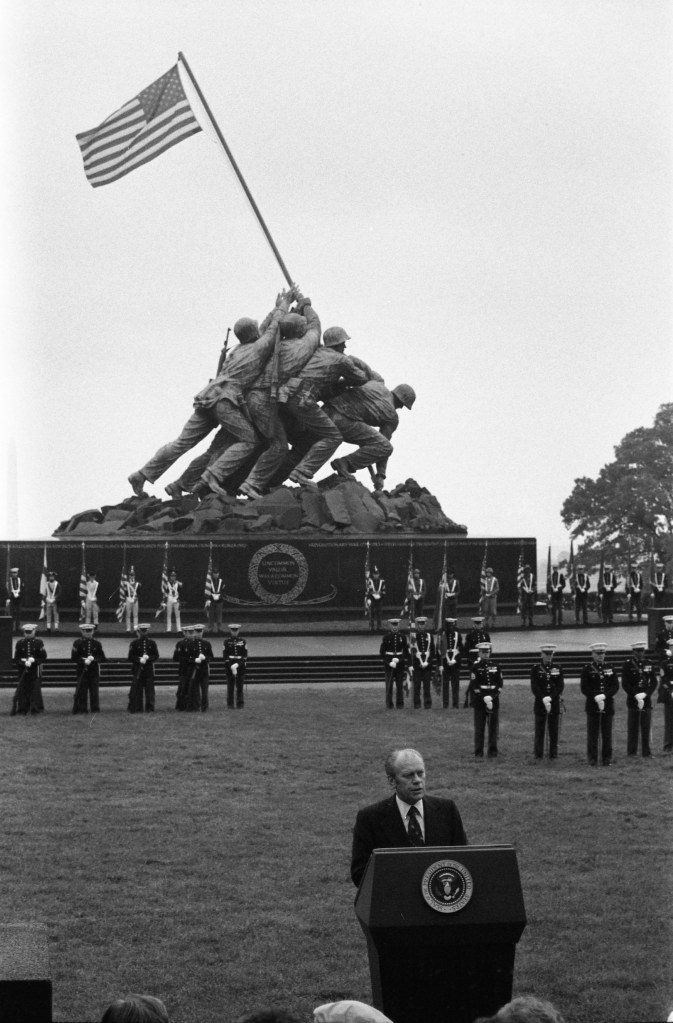
President Ford, saying the United States “will be put to many tests around the world,” saluted the Marine Corps on its 200th birthday before a statue in Washington depicting one of the corps’ toughest fights -the raising of the flag on Iwo Jima. “The United States must be constant and credible when we speak of American strength at home and on the seas of the world,” Ford said in an hour-long ceremony at Arlington National Cemetery. Also present was Rene A. Gagnon of Manchester, New Hampshire, one of the two surviving men who raised the flag on the Pacific Island on which 4,590 Americans and 20,000 Japanese were killed in World War II.
An eight-nation force of 65 ships, several hundred planes and more than 17,000 men began NATO’s biggest sea exercise of the year off the west coast of Scotland. Two Russian ships and long-range Soviet aircraft were keeping an eye on the 10-day maneuvers.
Burning boats and drifting trawlers have signaled the outbreak of a war in the west of the Irish Republic over the country’s richest natural oyster beds. Angry fishermen in the tiny villages nearest the beds, Fenit and Kilfenora, have turned on competitors who they think are trying to poach part of what may be a record oyster harvest. They have burned 15 small boats and set seven trawlers adrift in the Atlantic.
The Treaty of Osimo was signed between Italy and Yugoslavia, resolving the dispute over Trieste, claimed by both nations. Under the agreement, 233 km2 (90 sq mi) and 302,000 residents went to Italy, while the other 340 km2 (130 sq mi) and 73,500 inhabitants went to Yugoslavia.
Lev Leshchenko revived “Den Pobedy”, one of the most popular World War II songs in the Soviet Union.
Israeli soldiers fired into the air and used riot sticks in Ramallah this morning to break up crowds of Palestinian students in their third day of demonstrations against Israeli occupation of the West Bank of the Jordan. Dozens or students were arrested and several hospitalized over the weekend after stickwielding soldiers broke into the walled courtyard of a girls’ high school here and dispersed the chanting, demonstrating students. Most of the students were released after being warned by the police not to go into the streets again. One American, a volunteer teacher at the American Friends’ school for boys here, was taken in by Israeli military policemen when he tried to stop soldiers who he said were beating the high school students with riot batons.
Kidnapping has replaced rocket and machine‐gun fire as the principal terror in the streets of the Beirut area. In the first week of the current cease‐fire in the war between Christians and Muslims, 200 people, most of them ordinary citizens, have been abducted at gunpoint. Most were released in a day or two, but some of those freed have been mutilated — one Muslim had his ears cut off — and at least eight are believed to have been killed. As of today, unofficial estimates put the number of those still missing at about 50. The kidnappings have also threatened to re‐ignite the war after a week of cease‐fire, the twelfth and most successful truce in the last two months of the fighting that has killed more than 1,000 people and injured some 3,000. Because a kidnapping could spark off the war again, most of the groups are cooperating in an effort to have abducted persons released as quickly as possible.
A Tunisian bartender holding four hostages in the Belgian Embassy in Tunis gave authorities 12 hours to bring his German wife and $75,000 in savings to him. He had threatened to kill two of the hostages, two diplomats and two secretaries, but postponed the deadline 12 hours. The bartender, Tijana Merzi, 34, armed with a submachine gun, seized the hostages and demanded the return of his wife and the money, saying she had walked out on him in Belgium about ten days ago. Officials were negotiating with Merzi through an office door where he held the hostages.
A $2 million contract between Lockheed Corp. and Libya should be canceled because Libya transferred seven jet fighters bought from the United States to Turkey, Rep. Les Aspin (D-Wisconsin) said. The State Department has confirmed the transfer of the F-5A jets, purchased in 1967, although such transfers are prohibited under the Foreign Military Sales Act.
Morocco said today that an understanding had been reached with Spain on Morocco’s claim to Spanish Sahara. “There is no agreement yet,” Information Minister Ahmed Taibi Benhima said at a news conference in Agadir, “but there is an understanding and an accord is in sight.” Mr. Benhima, his government’s chief spokesman, said that a Moroccan delegation would be going to Madrid “in 24 or 48 hours.” The make‐up of the delegation has not been disclosed. The minister, in a reference to the speech last night in which King Hassan II ordered Moroccan marchers who swarmed into Spanish Sahara last week to return to their country, said the King’s order did not mean that the goal of annexing the territory had been abandoned.
Three Chinese Communist bombers flew more than 40 miles into South Korean airspace before they were turned back by South Korean fighters. The Ilyushin-28 short-range bombers were escorted back to international waters by four F-5 Freedom fighters. Western diplomats said the air violation Saturday apparently was due to navigational error rather than deliberate intent.
Filipino Muslim rebels demanded the release of two jailed guerrillas in exchange for six kidnaped Japanese fishermen, military sources in Manila said. Habib Abubakar of the Sugabu Fishing Co. said he was able to contact the rebels on Basilan Island, 500 miles south of Manila and across a channel from Zamboanga, and their prisoners are safe and in good health. The military sources said the government is prepared to meet the guerrilla demand.
Australia’s Governor General, in an action unprecedented in Australia’s 75-year history as a federation, dismissed Prime Minister Gough Whitlam and ordered the leader of the Opposition to form a caretaker government. However it was not immediately clear whether Mr. Whitlam would accept the Governor General’s action. Events were moving so rapidly that it was not clear who was Prime Minister, Mr. Whitlam or Malcolm Fraser, the leader of the Opposition.
The freighter SS Edmund Fitzgerald sank at 7:20 PM during a storm in Whitefish Bay on Lake Superior, taking the 29-member crew with it.. The 729-foot Edmund Fitzgerald had radioed that it was taking on water and had asked another ship to accompany it in case of further trouble. About 50 miles west of Sault Ste. Marie, Michigan, the accompanying ship abruptly lost radio and radar contact with the Fitzgerald in waters torn by 20-foot waves. The Coast Guard began a sea and air search for the vessel, which was carrying a load of taconite. Singer Gordon Lightfoot would later write a ballad about the ship’s demise.
Chile said that it had detected and frustrated an invasion of the country by more than 1,200 guerrillas from Cuba and Argentina. Reports by the Chilean secret police said that the invasion was to have been carried out November 15 by 40 guerrillas trained in Cuba and 1,200 more from Argentina. The government said 14 persons had been arrested.
The Argentine Army, which has not fought a war for nearly 100 years, is engaged in close combat with a guerrilla force operating in the mountains that overlook this sugar cane growing region. From all indications, the military task force of 2,500 men is getting much the better of the fight against a guerrilla band of about 200 men led by Cuban‐trained Marxist revolutionaries. Since the campaign began here in Tucuman Province in February, military spokesmen say, the army has killed more than 110 guerrillas and collaborators while losing fewer than 20 officers and men. These included four national policemen killed when guerrillas placed explosives in a water drain under the Tucuman airport runway and blew up military transport plane as it was taking off. It is a war in which there are apparently no prisoners and in which the military make little distinction between guerrillas carrying weapons and collaborators serving as couriers or supplying the men in the hills.
On the eve of Angola’s independence from Portugal, the Marxist MPLA was able to defeat the FNLA in the fight for control of the capital, Luanda, effectively making Agostinho Neto the first President of the new nation, rather than FNLA Commander Holden Roberto.
The Portuguese in Angola took down their flag, leaving their first, and last, colony in Africa to the Angolan people, who are fighting a civil war. The departing Portuguese High Commissioner, Admiral Leonel Cardoso, lowered the green and red standard — symbol of Portugal’s authority since 1485 — at Fort Sao Miguel in Luganda.
Uganda demanded the immediate recall of Soviet Ambassador Andrei Zakharov, accusing him of interfering in Uganda’s affairs and showing disrespect for President Idi Amin. Earlier, Amin had threatened to break diplomatic relations with Moscow to protest Soviet intervention in the Angolan civil war.
Senate Democratic leaders met with President Ford in an attempt to muster a “cooperative” effort for the $4 billion loan-guarantee bill proposed for New York City, and said afterward that they had the votes needed to break any Senate filibuster against the bill. L. William Seidman, one of Mr. Ford’s chief economic advisers, who was also at the meeting, said afterward that “the President said that if he had that proposition on his desk today, he would veto it.” Five Democratic senators visited President Ford but failed to soften his opposition to legislation to help New York City and New York state agencies avoid defaulting on their debts. “I would say he said ‘no’,” said William Proxmire (D-Wisconsin) after asking Ford during the 75-minute meeting to reconsider his opposition to a loan guarantee bill produced by Proxmire’s Senate Banking Committee. “You can say there is no change in the President’s position,” said Deputy Press Secretary William I. Greener. The bill would provide up to $4 billion in guaranteed loans and force the city to balance its budget.
R. Sargent Shriver announced he would enter New Hampshire’s presidential primary, the first in the nation, and “was in the race to stay” for the Democratic nomination. Shriver, 60, his party’s unsuccessful vice presidential nominee in 1972, declared his candidacy at a news conference in Manchester, New Hampshire, before about 30 supporters and his wife, Eunice. He added that he would not withdraw if his brother-in-law, Senator Edward M. Kennedy (D-Massachusetts), should enter the race. But Shriver said he was convinced that Kennedy would not run. adding: “Truthfully, I’m in the race to stay.”
On the parade ground of the Pentagon, Defense Secretary James R. Schlesinger bade farewell today to the armed forces with a parting message that the nation’s military strength depends upon a rekindled sense of national purpose and unity. The ceremony was also an occasion for the military to muster out a Defense Secretary who earned the high respect of the generals and admirals but who in the end was dismissed by President Ford because of the tension Mr. Ford felt he was causing within the Cabinet. The military ceremony almost did not take place. Some Staff members of the Joint Chiefs of Staff had initial reservations about holding the traditional ceremony for a departing civilian leader for fear it would offend the White House. Mr. Schlesinger, who according to associates has been going through sleepless nights and restless days since his dismissal a week ago, also had reservations about participating in such a ceremony. He was ultimately prevailed upon by aides that he should leave the Pentagon, not quietly in apparent disfavor, but “with his head held high before the troops.”
Judge Robert Muir Jr. of New Jersey’s Superior Court refused to authorize the removal of the respirator that is sustaining the life of 21-year-old Karen Anne Quinlan, who has been in a coma for nearly seven months in a Denville, New Jersey, hospital. The removal had been requested by her parents. “There is a duty to continue the life-assisting apparatus if, within the treating physicians’ opinion, it should be done,” Judge Muir said. “The single most important quality Karen Anne Quinlan has is life,” Judge Muir said. “This Court will not authorize that life to be taken away from her.”
Most of the Justices of the Supreme Court expressed concern that some aspects of the new federal campaign financing laws might impinge on rights guaranteed by the First and Fifth Amendments. In an unusual four and a half-hour session of arguments before a packed courtroom, eight of the nine Justices — all but the ailing William O. Douglas, who attended only part of the session — carefully questioned the lawyers arguing before them. The concern evident in much of the questioning indicated that the Court might strike down some of the law’s provisions.
Attorney General Edward H. Levi refused today to give the Federal Bureau of Investigation immediate permission to build a computerized communications network that had been criticized as possibly leading to the creation of a national police force. Mr. Levi, in a letter to Senator John V. Tunney, Democrat of California, said he was deferring action on the F.B.I. request pending approval by Congress of legislation controlling criminal justice information. The F.B.I. plan for an expanded communications and record‐keeping network has been criticized as a potential threat to civil liberties by the White House Office of Telecommunications Policy, the Domestic Council’s Committee on Privacy and the Law Enforcement Assistance Administration, a branch of the Justice Department.
A former Gulf Oil Corp. official has acknowledged making illegal campaign contributions to at least 15 senators and congressmen. Gulf was convicted in 1973 of making illegal contributions to the 1972 presidential campaign of Richard M. Nixon and to the campaigns of Rep. Wilbur D. Mills (D-Arkansas) and Senator Henry M. Jackson (D-Washington). But the list has been expanded to at least nine present and former senators, including presidential hopeful Fred Harris of Oklahoma, six present and former representatives, former Kansas Governor William Avery and Pennsylvania’s “Mr. Republican,” George Bloom, sources said. The allegations were made in a statement Oct. 30 to the Securities and Exchange Commission by Frederick Myers, who retired in June as Gulf’s legislative coordinator.
At least 50 nuclear power plants may be scattered throughout the western states by 1990 to meet the country’s energy needs, a 12-state commission reported. The Western Interstate Nuclear Board said the West would be a natural site for the power plants, since the region contains about 85% of the nation’s known uranium reserves. The WINB, whose members include representatives from California, said five nuclear plants now are licensed to operate in the West with 25 additional in various stages of planning and construction.
Private researchers charged there is lax enforcement of strip mining laws in Appalachia for reasons ranging from intimidation by the coal industry to corruption among mine inspectors. The Center for Science in the Public Interest said its study of strip mining focused on West Virginia, Kentucky and Pennsylvania, where about half the nation’s coal is mined. The center charged that many blatant violations are never reported by inspectors in return for favors from coal companies. The report said “some diligent inspectors have encountered personal threats and beatings.”
Betty Ford, perhaps the most outspoken First Lady the nation has had, is also one of the most popular and is “a solid asset” to her husband, the Harris Poll reported. In a national survey of 1,519 adults, a 60% to 27% majority agreed with Mrs. Ford when she said she “would not be surprised if her daughter had an affair.” And a majority of 64% to 23% supported Mrs. Ford’s statement that, if her daughter were having an affair, “she would want to know. if the young man were nice or not.” The First Lady’s strong endorsement of the Equal Rights Amendment drew 70% to 15% approval. The Harris organization said Mrs. Ford drew strongest support from persons 30 years of age or under and the least from persons 50 and over. “In short,” the survey concluded, “Betty Ford has a wide and deep following in the mainstream of American life and surely must be judged a solid asset to her husband in the White House.
“I am proud to be here,” said former President Richard M. Nixon after attending ceremonies at Camp Pendleton to commemorate the 200th birthday of the Marine Corps. He arrived at the base with Mrs. Nixon and they viewed the pageantry seated on a VIP platform on the main parade ground. “I thought the Marine Corps put on a splendid, moving ceremony,” Nixon said. “I know the spirit of the Marine Corps is to make America continue to meet its responsibilities in the world.”
Marine 2nd Lt. Mary Niflis, accused of sexual misconduct with enlisted men, received her general discharge in Yuma, Arizona, under honorable conditions. The young woman had faced a court-martial on charges of “conduct unbecoming an officer and a gentlewoman” by allegedly having sexual intercourse with six enlisted men at the Marine Corps Air Station in Yuma. None of the men in the case has been charged. Asked about the charges against her, she said, “I never said anything one way or the other. As my lawyer said, it’s up to the military to prove it. And they decided to drop the charges.”
The Kansas City Royals release slugger Harmon Killebrew, ending a 22–year career marked by 573 home runs, good for 5th on the all-time list.
NFL Monday Night Football:
Ed Podolak, who scored two touchdowns within 23 seconds near the end of the first half, produced a third — and winning — score with 10 minutes remaining tonight and the Kansas City Chiefs took advantage of five fumble recoveries to upset the Dallas Cowboys. 34–31. Podolak’s 5‐yard touchdown reception from Mike Livingston finally ended a scoring barrage that saw the lead change hands six times. Mike Sensibaugh, safety, and Willie Lanier, linebacker, then protected the Kansas City lead with interceptions that ran the Cowboys’ turnover total to seven. The victory improved Kansas City’s won‐lost record to 4–4 and kept alive the Chiefs’ hopes of catching Oakland in the American Conference’s Western Division. Dallas fell a game back of Washington and St. Louis in the National Conference East with a 5–3 record. Kansas City had produced a 51‐yard field goal by Jan Stenerud and a touchdown by John Matuszak, a defensive end, on a fumble recovery but still trailed 17 015010 with time running out in the first half. But Podolak scored from the 1. with 1:20 remaining in the second quarter and, following a fumble by Doug Dennison on the ensuing kickoff, ran over from the 11 to put the Chiefs in front at the half, 24–17. After Dallas had tied the game in the third quarter, Stenerud put the Chiefs back in front with a 44‐yard field goal, and after Dallas moved in front again late in the third quarter, Kansas City came up with another fumble recovery and the Livingston‐to‐Podolak touchdown pass that decided the game.
Kansas City Chiefs 34, Dallas Cowboys 31
Dow Jones Industrial Average: 835.48 (-0.32, -0.04%)
Born:
Jim Adkins, American rock singer-songwriter and guitarist (Jimmy Eat World — “The Middle”), in Mesa, Arizona.
Chris Lilley, Australian actor and comedian (“We Can Be Heroes: Finding The Australian of the Year”), in Sydney, New South Wales, Australia.
Halina Reijn, Dutch actress (“Red Light”) and director (“Babygirl”), in Amsterdam, Netherlands.
Died:
Ernest M. McSorley, 63, Captain of ore cargo ship Edmund Fitzgerald, lost with 28 other men when she sank in a Lake Superior storm.
 History Diaries