Greek forces dug in tonight in their main fortifications near the Ionian Sea to fight It out with the Italians, whose grand assault appeared under way. The Italians, launching a massive offensive by land and air, were reported reliably to have established contact with the main Greek lines at some points on this extreme loft of the slanting battlefront after the Greeks made a “slight” retreat to new positions. Neutral observers said, however, the Greeks were firmly entrenched in their well-fortified emplacements blasted from the sides of the rugged mountains and that the Italians would have an extremely difficult time dislodging them.
The slow Italian advance against stiffening Greek resistance reaches its point of maximum advance along the coast on 7 November 1940. The Italians that have crossed the Kalamas River reach Margariti, Greece. On the Greek side, the Thesprotia Sector begins receiving reinforcements from Katsimitros. On the other fronts, the situation remains unchanged, with the Greeks gradually destroying the remnants of the Julia Division on the Pindus front.
OKH Chief of Staff General Franz Halder has a meeting with Colonel Heusinger and his adjutant, Major Gehlen. They review Heusinger’s preliminary plans to invade Greece from Bulgaria, as adjusted by Halder. Key issues are the fact that German troops would have a long march through Poland or Hungary and through Romania. Once they reached Bulgaria, moreover, the launching points themselves would be remote and conspicuous to the enemy. In addition, the Greeks have fortified the border with the “Metaxas Line” chain of barriers and fortresses. Even after the German troops broke through this line, they would be far removed from their allies, the Italian troops in the west, and require breaking out of Thrace over inhospitable terrain. This would create supply issues, no small matter with an advance by 100,000 men or more. Thus, the Wehrmacht would face large problems even before they began the campaign.
All of these issues point to a single solution: take the short route through Yugoslavia. That is something that Hitler already has considered, and of course, the decision rests with him. This all eventually comes under the rubric of Operation MARITA.
Irish Taoiseach Éamon de Valera rejected a British request that strategic naval ports and air bases on Irish territory be rendered or leased to Britain. Despite Winston Churchill’s anger, Eire will remain neutral and continue to refuse to allow the use of its ports as British bases, the prime minister, Eamon de Valera, told the ‘Dail’ [parliament] today. He denied rumors that German submarines were being refueled and re-provisioned in Eire. “I say it is a lie,” he said. “And I say further that it is known to be a falsehood by the British government itself.” In a speech last week, Churchill spoke of the handicap under which Britain was suffering as a result of being denied naval and air facilities in Eire. He described it as a “grievous burden which should never have been placed on our shoulders”. The use of Irish ports could extend the range of convoy escorts by several hundred miles, and the fact that Irish ships themselves are being protected is being stressed in a major British propaganda campaign in the United States.
Anna Wolkoff, the daughter of a former Russian naval attaché in London, has been jailed for ten years for offences under the Official Secrets Act and the Defense Regulations. Mr Justice Tucker said that she had tried to send a coded letter to Lord Haw-Haw, “a traitor who broadcasts from Germany for the purpose of weakening the war effort of this country”. In the same case, ex-U.S. Embassy clerk Tyler Kent is sentenced to seven years in prison.
The Italians attempt to retake Gallabat, on the Abyssinia/Sudan border, which the British have just taken. There are fierce dogfights overhead. The 10th Indian Brigade which took the base finally retreats under pressure due to tank losses and RAF losses. At the end of the day, the Italians occupy the town.
Force H departs from Gibraltar, led by the aircraft carrier HMS Ark Royal and battleship HMS Barham. The Barham actually leads a separate group that will split off from Force H. This is Force F, and it is carrying 2000 troops to Malta. The Italians are aware of these movements and send three destroyers to intercept Force F.
At Malta, Governor Dobbie sends a letter to Secretary of State for War. He expresses the impression that “it would not take a great deal to get the Italians to quit.” He suggests replacing the large Wellingtons operating on the island with Blenheims (two of the Wellingtons recently crashed upon take-off).
Soviet Russia poured new guns and formations across Red Square today on the twenty-third anniversary of her revolution, and her Defense Commissar announced that “at any moment the Red Army is ready to deal a crushing blow to any one who dares to violate the holy frontiers of the U.S.S.R.” The army, which paraded its choicest units past Joseph Stalin and his lieutenants, has been reorganized in the last six months. The progress of its artillery — completely mechanized — was particularly conspicuous today.
[Ed: Maybe not quite as ready as all that…]
Free French troops of the Foreign Legion land at Libreville. They arrive in troopships Fort Lamy, Casamance, and Nevada. These troops are necessary to complete the conquest of the territory, as Vichy French troops still control key areas. The Free French forces are under the command of Colonel Leclerc.
The Vichy naval forces are operating in the area. Submarine Poncelet attacks troopship Milford but misses. It then is attacked as described above under “Battle of the Atlantic.”
The Luftwaffe attacks across the Thames Estuary and sends two attacks against Portsmouth. The attacks accomplish little. After dark, the Luftwaffe concentrates on London, hitting a children’s hospital, and sends a few bombers against the Midlands and southwest. Overall, the Luftwaffe loses seven planes and the RAF five.
Ten-victory ace Wilhelm Müller is killed in combat over England.
RAF Bomber Command dispatches 12 Blenheims dispatched during the day but only 1 aircraft bombed (Haamstede airfield). 1 aircraft lost.
RAF Bomber Command dispatches 91 aircraft overnight to Essen, Cologne and other targets. The largest raid was by 63 aircraft to the Krupps factory at Essen. The British Official History* makes comment on the reports submitted by the crews of different groups (2, 3 and 5 Groups) taking part in this raid. Bomber Command Headquarters found many inconsistencies and came to the conclusion that a lot of crews who had reported successful attacks on Essen must have been some distance from that target. The only bombing photographs developed showed some woods. It was probably a typical experience of this period. It is possible that the ‘many fires’ reported by some crews were at a decoy fire site in open country, an early example of a device which the Germans would later use whenever possible. The largest decoy site for the city targets in the western part of the Ruhr was near the small town of Rheinberg, a few miles north-east of Duisburg. By coincidence, it was near Rheinberg that a large post-war Commonwealth War Graves Commission cemetery was established for British airmen who were killed in this part of Germany. Of the 3,326 graves in the cemetery, 2,895 are of RAF men. 3 Hampdens were minelaying off Brittany ports and there were 2 O.T.U. sorties. There were no losses from any of the above operations.
After dark, RAF Bomber Command sends 50 bombers against the Krupp munitions factory at Essen, synthetic oil installations at Cologne, Dusseldorf blast furnaces, the Oberhausen docks in the Dortmund-Ems Canal, the port of Duisburg, Dunkirk Harbor, Lorient U-boat installations, and various airfields in northwestern Europe.
The RAF raids Valona, Albania, a big Valona airbase. The planes come in low and strafe the field in addition to bombing it.
Light cruisers HMS Edinburgh and HMS Dido, the only available Home Fleet units at Scapa Flow, were placed on one hour’s notice from 0800 to 1543 after D/F reports placed an enemy surface unit to the southeast of Fair Isle Channel.
Anti-aircraft ship HMS Alynbank transferred from convoy WN.31 to EN.20 in the vicinity of Aberdeen.
Anti-aircraft ship HMS Alynbank escorted convoy EN.20 to Pentland Firth.
Submarine HMS Swordfish (Lt M. A. Langley) departed Gosport on the 7th to relieve submarine Usk on patrol off Ushant. Submarine Swordfish struck a mine sinking off Portsmouth and was declared lost on the 16th. Lt Langley, Lt H. A. Stacey, Lt A. F. Fry RNR, Sub Lt M. E. P. Ratcliffe, Warrant Engineer H. T. Selway, the thirty six ratings of the crew were lost with Swordfish. The wreck of Swordfish was found in 1983 putting to rest many theories as to her loss.
British steamer Herland (2645grt) was sunk on a mine two cables 146° from Nore Light Vessel. Sixteen crewmen and two naval gunners were lost with the British steamer.
Free French minesweeping trawler Poulmic (O E Vibert, 350grt) was sunk on a mine near Plymouth. Eleven crewmen were missing. Seven survivors were rescued.
German bombers attacked convoy FS.28 in Barrow Deep. British steamer Astrologer (1673grt) was sunk by German bombing in 51‑32N, 01‑06E. The entire crew of the steamer was rescued. Steamer Astrologer was beached on the 7th, but was wrecked in a gale on the 15th.
British steamer Dago II (1993grt) was damaged by German bombing in 51‑32N, 01‑09E.
British steamer Medee (2163grt) was damaged by German bombing 51‑10N, 01‑12E.
Sloop HMS Egret shot down a JU-88. Sloop Egret sustained some casualties from a near miss.
Minesweeping trawler HMS William Wesney (364grt, A/T/Skipper F. J. Farrow RNR) was sunk on a mine off Orfordness, in 51-53-48N, 1-33-36E. One rating was killed and four crewmen were missing on the British trawler. Two accompanying trawlers and sloop HMS Sheldrake rescued the survivors.
British drifter Reed (99grt) was sunk on a mine in the Thames Estuary, in 51-46N, 1-14-05E. T/Skipper G. E. Utting RNR, thirteen ratings were killed on the drifter. T/Lt K. H. Empson RNVR, died of wounds on the 8th.
German torpedo boats T.1, T.4, T.9, T.10 of the 1st Torpedo Boat Flotilla and T.6, T.7, T.8 of the 2nd Torpedo Boat Flotilla departed Trondheim to strike at a Convoy between Kinnaird Head and Smith Bank. The force crossed a British minefield forty miles off Kinnaird Head and T.6 was mined and sunk. German torpedo boats T.7 and T.8 rescued the survivors. The German torpedo boat force returned to Trondheim without proceeding further.
Force H with aircraft carrier HMS Ark Royal, battleship HMS Barham, heavy cruiser HMS Berwick, light cruisers HMS Sheffield and HMS Glasgow, and destroyers HMS Duncan, HMS Gallant, HMS Griffin, HMS Faulknor, HMS Firedrake, HMS Forester, HMS Fury, HMS Fortune, HMS Foxhound, HMS Greyhound, and HMS Isis departed Gibraltar on Operation COAT.
Force F of Battleship HMS Barham, heavy cruiser HMS Berwick, light cruiser HMS Glasgow, and destroyers HMS Greyhound, HMS Gallant, and HMS Griffin carried 2000 troops for Malta, then were to go on to the Mediterranean Fleet for duty. The troops had been brought from the UK in liner Pasteur.
Destroyers HMS Faulknor, HMS Fortune, and HMS Fury carried 150 troops to Malta and travelled with the HMS Barham force. Following the disembarkation of the troops, these destroyers returned to Force H.
Italian destroyers Vivaldi, Da Noli, and Malocello were sent to intercept the Barham force which was able to reach Malta safely.
Free French troops on cargo ships Fort Lamy (5234grt), Casamance (5817grt), and Nevada (5693grt) were landed at Libreville.
On 8 November, Vichy submarine Poncelet torpedoed Sloop HMS Milford at Port Gentil off Libreville, but the torpedo did not explode. The submarine was damaged by sloop Milford and the air attack of one of heavy cruiser HMS Devonshire’s Walrus. Submarine Poncelet was scuttled at 0‑20S, 8‑50E and her crew was picked up by destroyers HMS Foxhound and HMS Fortune. On 29 November, sloop Milford transferred the Poncelet crew to light cruiser HMS Delhi.
On 9 November, Free French sloops Savorgnan De Brazza and Commandant Domine sank Vichy sloop Bougainville off Libreville.
On the 10th, Libreville fell to Free French forces and on the 11th Port Gentil also fell.
The Royal Navy force, which included heavy cruiser HMS Devonshire and light cruiser HMS Delhi, played no active role in the Libreville campaign, but did remain off the port to assure that Vichy units from Dakar did not intervene.
Vice Admiral J. H. D. Cunningham transferred his flag from heavy cruiser HMS Devonshire to light cruiser HMS Neptune after the Libreville campaign.
Convoy FS.330 departed Methil. The convoy arrived at Southend on the 9th.
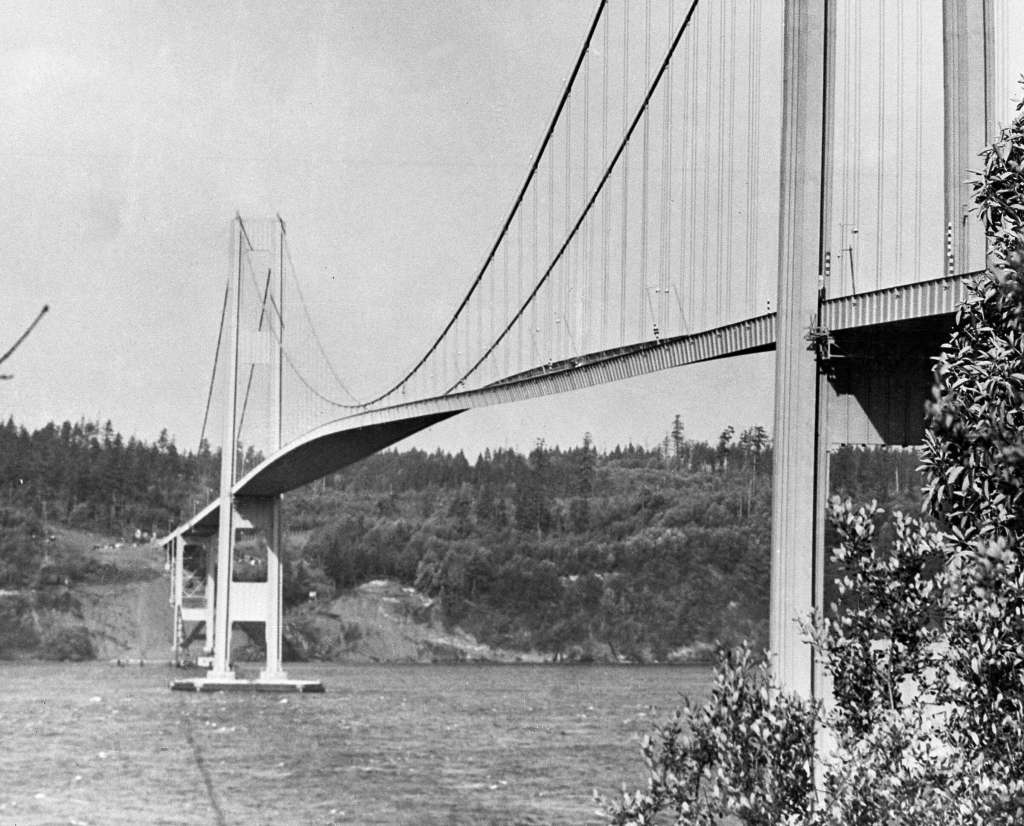
The $6,400,000 Tacoma Narrows Bridge, third largest suspension bridge in the world, fell 190 feet into Puget Sound after swaying like a hammock in yesterday’s gale. Wreckage is hanging stringlike in center section, which had the long span. No lives were lost, but one automobile and a logging truck plunged into the water along with, big chunks of concrete, guy wires and cables. Only the two 425-feet high steel towers which supported the 2,800-foot suspension span withstood the force which reduced the rest of the bridge to ruins. Leonard Coatsworth, driver of the automobile, abandoned his car 500 yards from one end of the bridge and crawlpd off the crumbling mass on his hands and knees. By a stroke of luck, Capt. Bill Thompson of the tugboat Arab said he and his crew of two barely missed being caught under the falling’ mass. The Arab was about 100 yards from the bridge when Captain Thompson noted the sway. He turned about and at a safe distance watched the collapse.
Pursuant to the meeting between engineering Professor F. Bert Farquharson of the University of Washington and state engineers on 6 November, state bureaucrats are drafting up contracts to modify the brand-new Tacoma Narrows Bridge. Farquharson recommends installing wind deflectors in order to disperse the effect of the strong gales that sweep down the river valley during the fall change of seasons.
Professor Farquharson has found from studying scale models of the bridge that these winds can cause extreme oscillations in the bridge deck, vertical wave motions that cause the roadway to “bounce.” Well, you learn something new every day, right? Farquharson’s studies, however, have taken about eight months to complete and lasted into the high-wind autumn season that is most dangerous.
The condition, which has given the bridge the nickname “Galloping Gertie,” has been noticed by bridge workers and others even before the bridge was completed. Now, with all of their boxes checked — formal study completed, a conference held to discuss the issue, higher officials notified and so forth — state engineers finally take steps to correct the issue. They understand the urgency and plan to implement the remedies within ten days, which is an extreme speed for such a massive project which requires making architectural sketches, obtaining steel and other materials, and finding workers.
At this point, Mother Nature intervenes. Before dawn, the winds pick up from the southwest. As it has before, the Tacoma Narrows bridge begins undulating, or “galloping.” These are not small waves — some are as high as 5 feet high. The wind speed increases after daylight and reaches 38 miles per hour at 07:30 and 42 mph at 09:30. The chief bridge engineer drives across the bridge at 08:30 and decides that the undulations, while noticeable, are not as large as in some previous instances.
Professor Farquharson arrives at 09:30 from Seattle and begins filming the bridge for his engineering study, with no notification that anything unusual is in store. The undulations are so intense that a college student walks out on the bridge around this time “for a thrill” and to watch a coast guard ship, the Atlanta, pass under it. Just before 10:00, the last few vehicles pay their tolls and start driving across. At 10:30, the bridge adds a lateral twisting motion to the vertical oscillations. The movements seem to feed on each other (resonance), and the undulations reach 28 feet, with the roadway tilting 45 degrees.
The State Police close the bridge, but there are people still on it, some clinging to the railings for their lives. One of the cars gets tossed against the curb, and the driver crawls on the roadway toward one of the towers. The Tacoma News Tribune hears about the situation and sends out a photographer. At 10:30, the bridge starts coming apart, with concrete chunks falling into the river.
The winds die down for a little while but soon pick back up again. At around 11:00, the bridge span begins to rip apart. The entire span then starts ripping from the cables which hold it up. Farquharson, who has run onto the bridge to save a dog left in a car, runs for his life as the bridge starts oscillating in 60-foot waves (the dog, Tubby, wedges himself under the seat, biting the owner who tries to get him out). The entire bridge then twists apart and crashes into the river at around 11:10.
The event receives world-wide attention due to the excellent color filming of the collapse. American POWs in the jungles of southeast Asia a few years later report being ribbed about the incident by their guards, who find it quite amusing. The bridge only lasted four months. Incidentally, the concrete remains of the bridge that fell into the river remain in situ, forming a natural reef. New bridges with better wind tolerance have replaced the collapsed bridge.
Facing the big question of higher taxes, an increase in the national debt limit and the whole broad subject of defense and assistance to Great Britain, President Roosevelt returned to the capital today, received a roaring welcome from Washingtonians, and engaged in a long series of conferences. The national capital gave its first third-term President-elect a tumultuous reception today on his return from Hyde Park, where he kept a tally on the poll that resulted in his victory over Wendell L. Willkie. An estimated 200,000 persons met him at Union Station, or cheered him as he rode through the streets, and one part of the crowd, gathered on the lawn of the White House, chanted “We Want Roosevelt!” until the President and Mrs. Roosevelt appeared on the north portico of the White House a second time to respond to their greeting.
The reception was a novelty to Washington, which ordinarily musters scarcely a corporal’s guard to view the passage of any dignitary, including Presidents. Naturally, a large number of those who cheered were government workers, to whom leave was granted to attend the welcoming ceremony. There were others, however, made voteless by their residence in the District of Columbia, who apparently joined the demonstration to find an outlet for political enthusiasm which residents of other cities have found in cheering the candidates at pre-election demonstrations.
New defense taxes and an increase in the statutory debt limit which would raise it from its present $49,000,000,000 to $60,000,000,000 or $65,000,000,000 were foreshadowed by Secretary Morgenthau today. Mr. Morgenthau emphasized that the new debt limit which he would request of Congress might not hold good beyond June 30, 1942, the end of the next fiscal year. At his first press conference since the election he said he wanted the public to know the facts, and added: “We are just beginning to rearm.” Mr. Morgenthau said that besides a higher debt maximum he would ask for new taxes and the end of the practice of issuing tax-free bonds.
Wall Street professed to see definite inflationary implications in the statement yesterday of Secretary Morgenthau regarding the national debt limit, and security and commodity markets turned upward with a push not duplicated since last June.
Wendell L. Willkie announced tonight, two days after his defeat as the Re publican presidential nominee, that on Monday night he will address the nation over all major networks on the role he believes he and millions of followers should play during President Roosevelt’s third term. On radio time donated by the Columbia, National and Mutual networks, Willkie will speak from 7:30 to 8 p.m. (P.S.T.), outlining his personal recommendations. He said he had both a duty and an obligation to advise the millions who voted for him what they should do next.
The promotion of Brigadier General Frank M. Andrews, chief of the Army’s G.H.Q. Air Force and to a large degree creator of it, to be temporary major general, was sent by the President to the Senate today for approval.
The “Symphony in C” by Igor Stravinsky was premiered by the Chicago Symphony Orchestra.
Siamese military quarters said today that further French air force violations of Siamese territory “would mean trouble” after an authorized statement had charged the French with 33 violations of the Thai frontier since April.
Increasing anti-Japanese agitation in Indo-China, particularly in the southern part, was alleged today in a protest by the chief of the Japanese military mission, General Raishiro Sumita, who interviewed Admiral Jean Decoux, Governor General of French Indo-China, at Hanoi.
Japanese newspaper readers observed today an underlying similarity between the attitude of Rome and Berlin to the United States election result and the attitude of their own press.
The United States, Great Britain and Australia have agreed in principle on defense cooperation in the Pacific, including the use of bases, it was reported reliably tonight. The agreement in principle, reached after conferences among the three nations, was said ‘to be such that an emergency decision might be taken on short notice. Details were not divulged and officials were reticent regarding possible use of the great British base at Singapore by the United States navy.
In the “Blue Draft,” which is the training of RAAF pilots in Canada, Draft No. 3, which had embarked at Sydney on 16 October, arrives in Vancouver.
British freighter Cambridge is sunk by mine (laid by German auxiliary minelayer Passat on 31 October-1 November) off Wilson’s Promontory, Australia (see 8′- November).
Dow Jones Industrial Average: 137.75 (+5.77)
Born:
Mike Clark, NFL placekicker (NFL Champions, Super Bowl VI-Cowboys, 1971; Pro Bowl, 1966; Philadelphia Eagles, Pittsburgh Steelers, Dallas Cowboys), in Marshall, Texas (d. 2002).
Clarence Jones, MLB outfielder, pinch hitter, and first baseman (Chicago Cubs), in Birmingham, Alabama.
Guido Provoost, Belgian historian, born in Bruges, Belgium (d. 1981).
Naval Construction:
The U.S. Navy 70-foot Elco patrol motor torpedo boat USS PT-14 is launched by the Electric Launch Company Ltd. (Elco), (Bayonne, New Jersey, U.S.A.).
The Kriegsmarine (German Navy) Type VIIC U-boats U-553 and U-554 are launched by Blohm & Voss, Hamburg (werk 529 and 530).
The U.S. Navy submarine USS Gar (SS-206), lead boat of her class of 6, is launched by the Electric Boat Co. (Groton, Connecticut, U.S.A.).
The Royal Canadian Navy Flower-class corvette HMCS Saskatoon (K 158) is launched by Canadian Vickers Ltd. (Montreal, Quebec, Canada).
The Royal Navy Fairmile B-class motor launch HMS ML 127 is commissioned.
The U.S. Navy Catbird-class minesweeper USS Curlew (AM-69) is commissioned. Her first commanding officer is Lieutenant William Thomas Patrick, USNR.
The Royal Navy Bangor-class (Diesel-engined) minesweeper HMS Bangor (J 00), lead ship of her class of 111, is commissioned. Her first commanding officer is Commander Jack Peterson, RN.
The Royal Navy White 73-foot-type motor torpedo boat HMS MTB 41 is commissioned. Her first commanding officer is Lieutenant Commander John Colin Cole, RN.
The Вое́нно-морско́й флот СССР (ВМФ) (Soviet Navy) “M” (Malyutka)-class (3rd group, Type XII) submarine M-31 is commissioned.
The Вое́нно-морско́й флот СССР (ВМФ) (Soviet Navy) “M” (Malyutka)-class (3rd group, Type XII) submarine M-32 is commissioned.
The Kriegsmarine (German Navy) Type VIIC U-boat U-551 is commissioned. Her first commanding officer is Kapitänleutnant Karl Schrott.
 History Diaries