The House Intelligence Committee has obtained what its staff director, A. Searle Field, termed “substantial information” indicating an effort within the Ford administration to distort official American estimates of Soviet nuclear weapons strength and deployment. Field, told the 13‐member select committee at a public hearing that, according to his information, the apparent distortions could have been undertaken “by either those who are in favor of détente and seeking a second SALT provision, or by those who oppose that.” SALT is the term for strategic arms limitations talks between the United States and the Soviet Union. In 1972, a first accord was reached in the talks to curb offensive nuclear missiles and antimissile
Following Mr. Field’s testimony, the House committee voted to subpoena from the White House documents provided by the Arms Control and Disarmament Agency and other agencies since May 1972 relating to the adherence by both signers of the 1972 treaty on strategic‐arms limitation between the United States and the Soviet Union, and a second-stage agreement reached last year Mr. Field did not elaborate on his assertion, except to say that some sort of “double bookkeeping” might have taken place in the Administration on the extent of United States deployment of nuclear weapons as well as its estimates of Soviet strength.
U.S. House Majority Leader Thomas P. O’Neill Jr. of Massachusetts said that 433 of the 434 members of the House had cosponsored a resolution condemning the action of the Social, Humanitarian and Cultural Committee of the United Nations that equates Zionism with racism. The only member who was not a cosponsor was House Speaker Carl Albert, who was unable to sign because of House procedure. Four nonvoting delegates — from Puerto Rico, Guam, the Virgin Islands and the District of Columbia — also support the House resolution.
Doctors indicated last night that Generalissimo Francisco Franco was holding his own in his fight to stay alive. Only two medical bulletins were issued yesterday and they were among the tersest in the more than two weeks that the 82‐year‐old leader has lain desperately ill in the Pardo Palace outside Madrid. With each bulletin Spanish political reformers are becoming increasingly worried and impatient about the “paralysis,” as one put it, of Spain’s political life.
Military and civilian leaders met in an unusual joint session today in Lisbon to discuss ways to enhance their authority. At the same time, leftist demonstrators fought with the police outside the Information Ministry. President Francisco da Costa Gomes presided over the meeting of the Revolutionary Council, the powerful group of military officers who set Portugal’s course, and the Cabinet. Normally the two groups meet separately. Although no agenda was announced, the joint discussions appeared to have special significance.
Kidnapper Eddie Gallagher threatened to shoot Dutch businessman Tiede Herrema unless police removed a stack of mattresses outside a besieged two-story house in Monasterevin, Ireland, police sources said. The mattresses were intended earlier as a cushion for a leap to freedom by Herrema, but the victim either misunderstood a signal to jump or was prevented by Gallagher and his woman accomplice, Marian Coyla, 19. Police sources later said the mattresses had been removed.
The volcano on the tiny island of Stromboli off Italy’s Sicilian coast erupted twice, sending streams of molten lava into the sea. The activity followed an earthquake in southern Italy. None of the 450 inhabitants of the island has been threatened by the lava.
A multimillion‐dollar Israeli Government development plan for Galilee, denounced by its critics as a thinly disguised attempt to “Judaicize” the predominantly Arab area, has aroused and alarmed the Israeli Arabs who farm and own much of the land in this beautiful, mountainous region. The controversial five‐year plan calls for a sharp increase in the Jewish population — now only 45 percent of the total, as well as more housing and industry in Jewish settlements. The government has unveiled plans to requisition large tracts of land owned or claimed by Israeli Arabs. Although they would be compensated, the Arabs who have lived here since before the establishment of the state of Israel are staunchly opposed to giving it up. Incensed by reports of the plan, which has yet to receive final government approval, several thousand Israeli Arabs gathered in Nazareth recently for a noisy but nonviolent protest rally. Arab and Jewish speakers, most representing the Israeli left, took the rostrum in the Nazareth Theater to denounce the threatened requisitioning of Arab land.
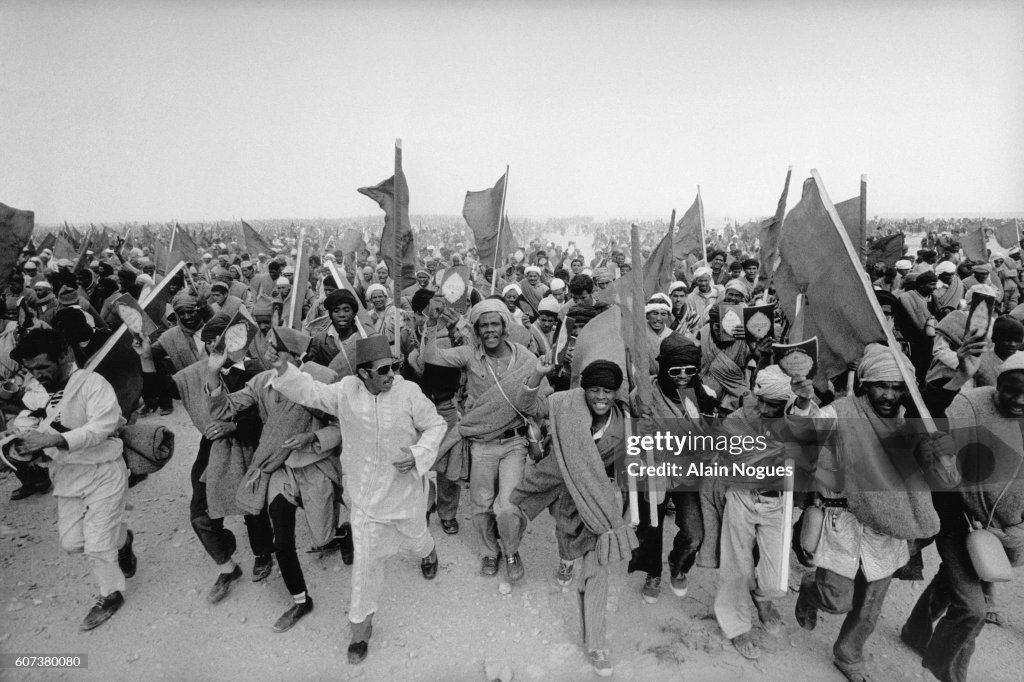
The “Green March” began as 524,000 unarmed civilians crossed the border from Morocco into the Spanish Sahara, despite warnings from Spain that they would be shot. Tens of thousands of Moroccans, shouting the glory of Allah, entered Spanish Sahara this morning to carry out the attempt by King Hassan II to annex the colony without recourse to arms. They met no resistance and the area that the marchers intend to occupy appeared to have been totally deserted by Spanish troops. Whether their advance will continue unhindered depends on continuing diplomatic efforts and on whether Algeria, the major contesting party, will stand by idly while its rival and neighbor aggrandizes its territory. After leaving Tarfaya, the group halted after crossing the border and camped, rather than approach the defensive line and minefields set up by Spain. Spain would agree to relinquish the territory eight days later.
The Security Council, informed by Spain that it had received what is considered an ultimatum from Morocco over the Spanish Sahara, called on Morocco tonight to immediately withdraw all its participants in the march into the desert territory. The Council deplored the fact that Morocco had started the march, and asked it, as well as the other parties to the disputo over the Spanish Sahara, to cooperate with Secretary General Kurt Waldheim in his search for a settlement.
India’s chief justice upheld Prime Minister Indira Gandhi’s election to Parliament in 1971 and set aside a high court conviction against her for election offenses. However, Justice A. N. Ray’s decision is not necessarily final. The four other judges who sat with him on the case were scheduled to read out individual judgments later. The issue will be decided by majority judgment.
Khondaker Mostaq Ahmad, who had become President of Bangladesh in August after the assassination of Sheikh Mujibur Rahman, was overthrown in a coup and replaced by Chief Justice Abu Sadat Mohammad Sayem. The coup leaders freed Major General Ziaur Rahman, the Chief of Army Staff who was the strongman for the regime and who had been imprisoned two days earlier.
A survey of American opinion conducted by the Gallup organization for the Chinese Nationalist Government on Taiwan has found that while 61 percent of those polled favored United States diplomatic recognition of the Communist Government in Peking, an even larger majority of 70 percent would not want to see American recognition of Taiwan withdrawn as part of an arrangement to recognize the Communist Government.
A ceiling on immigration in Canada has been proposed by a joint parliamentary policy committee on the basis of public hearings held across the country on the sensitive immigration issue. The limit would be set annually for the ensuing year by the Immigration Department. The committee’s report suggests that the figure might be as high as 150,000. The number of newcomers in recent years has ranged from 147,713 in 1970 to 218,465 in 1974.
Talks aimed at ending a 17-day strike by Canada’s 22,000 postal workers broke off indefinitely after the latest government offer was refused. Postmaster General Bryce MacKasey walked out of talks after the workers refused his offer of a salary increase of $1.70 an hour over 30 months. The average wage now is $4.59 an hour. The union has persisted with its proposal for a 51% increase over 27 months.
Guatemala denounced the British military buildup in neighboring Belize and said it was prepared to meet force with force if necessary to support its territorial claims on the tiny colony. Britain sent in more troops and warned it would fight back if Guatemala attacked. Guatemala was reported to have massed troops along the Belize border and to have placed its air force — which includes a number of Israeli‐supplied Arava troop‐carrying transports and a squadron of ground‐attack planes capable of bombing runs — in a state of alert. It also reportedly placed at least 12 armed patrol boats off the Caribbean coast of Belize. Dispatches from Belize City indicated the build‐up of British troops, which began Wednesday with units from the Devon and Dorset Regiments, was continuing. They said troops and military equipment were pouring in aboard Royal Air Force planes including big C‐130 Hercules and Canberra transports.
Former Peruvian Agriculture Minister Enrique Valdez Angulo, a retired general, has been arrested in connection with an alleged $2 million fraud, court officials announced in Lima. Valdez, who held the post for three years until December, 1974, is the first former minister to be arrested since President Francisco Morales Bermudez launched an anticorruption campaign shortly after taking over in August.
Two Administration officials told Senate committee today that the Administration was covertly supplying arms to liberation groups in Angola, according to officials with direct knowledge of the testimony, which was given in a closed session. Under Secretary of a Steate Joseph J. Sisco and William E. Colby, Director of Central Intelligence said that the Administration wanted Congressional support for a substantial amount of budgeted arms aids for Zaire, Ethiopia and Kenya. They defended both types of aid on the grounds that the United States needed “bargaining chips” with the Soviet Union and that it is as important to maintain the balance of power in Africa as it is anywhere else, the sources related. Mr. Sisco said that the much preferred American policy would be to let the African nations settle their own problems peacefully by themselves. He said that Secretary of State Henry A. Kissinger had made efforts to talk to the Russians about mutual restraint and had promised to do so again.
At dusk yesterday a lone single-engine plane flew just over Luanda’s main street dropping leaflets of the National Front for the Liberation of Angola, the Zaire‐supported nationalist force that controls a sector of the country that begins some 40 miles from here. The leaflets proclaimed: “The hour is coming when Luanda will return to the hands of the real Angolan nationalists. To our Portuguese brothers and Angolan brothers we give our assurance that you are not going to be molested and you are not‐going to be bothered.” A minute after the leaflets fell, military policemen of the Popular Movement for the Liberation of Angola, the Soviet-aided faction that commands the capital, snatched up the leaflets and mounted roadblocks on the main streets looking for people carrying weapons. The Popular Movement is organizing its independence celebration and awaiting the 1,500 guests it has invited, mostly from the Socialist camp. Meanwhile, there are reports here of Popular Movement setbacks at the port and railroad towns of Lobito and Benguela, 450 miles south of here.
The Senate Appropriations Committee approved today a $90.7 billion defense appropriations bill for the current fiscal year — $7.1 billion, or 7 percent, below the Ford Administration’s request. The committee bill, which is expected to be approved by the Senate next week, is $564 million higher than the defense appropriations approved by the House last month. While some compromises and changes will be made in a Senate‐House conference, it is now apparent that Congress will make an unusually large reduction in Pentagon funding. Defense Secretary James R. Schlesinger has deplored the Congressional reduction as “savage and arbitrary” — criticism that is believed to have contributed to his dismissal this week by President Ford.
“Party squabbles” made him decide to withdraw as President Ford’s running mate in 1976, Vice President Rockefeller explained at a nationally televised news conference in Washington. The squabbles, he said, arose from conservative opposition to his presence in the administration and caused President Ford difficulty. He said he believed Mr. Ford would be nominated by the Republican Party and added “he is my candidate.” But his statements of support for Mr. Ford were viewed by many listeners as lukewarm. He sidestepped repeated opportunities to declare that he would not be a candidate if Mr. Ford’s campaign for the nomination ran into trouble.
For almost three decades, three international telegraph companies secretly supplied to the United States Government copies of most of the messages they carried, the Senate Select Committee on Intelligence disclosed today. The committee made public its report on Operation Shamrock, a secret program to scan cable traffic for intelligence data, begun under the Administration of President Truman and discontinued last May by James R. Schlesinger, Secretary of Defense. Though the intrusion by the government into cable traffic had been disclosed at earlier Congressional hearings and in the press, the report made public today was the first formal history of an operation that several members of the committee said they believed had violated the Constitution and the Federal Communications Act.
The House Ethics Committee dismissed disciplinary action against Rep. Michael J. Harrington (D-Massachusetts), who admitted disclosing secret House testimony about CIA involvement in Chile. The vote was 7 to 3. The committee acted after it discovered the House Armed Services Subcommittee session at which CIA Director William E. Colby testified in April, 1974, had violated House procedures in holding the closed-door meeting. Harrington appeared pleased but said he would continue to press for a thorough examination of House rules regarding classified material.
Inflation increased in October as the nation’s Wholesale Price Index moved up by 1.8 percent, the largest monthly Increase in a year, according to the Labor Department. The news surprised most government and private economists. It could mean an acceleration in consumer prices.
The American Federation of Labor and Congress of Industrial Organizations opposed as regressive pending congressional legislation that would authorize loan guarantees to New York City. This erosion of expected support, coupled with the determined opposition of conservatives and some moderates in Congress, led House Speaker Carl Albert to postpone a floor debate on the bill, scheduled for Tuesday. The A.F.L.-C.I.O. opposed placing the city’s fiscal affairs under a federal board that would have the power to cancel labor contracts, alter pensions and change the terms and conditions of municipal employment. If the labor group continues its opposition, the legislation is regarded as doomed.
A man identified as an official of the Federal Energy Administration was arrested in a suburban Springfield, Va., motel as he allegedly accepted a $10.000 bribe from a coal brokerage company, the FBI announced. FBI agent Robert G. Kunkel said John H. Waller, 39, of Upper Marlboro, Maryland, offered no resistance when confronted. A search of his person turned up $10,000 in $100 bills. Kunkel said. The agent said Waller, whose job title was not given, had solicited the bribe from the Brush Creek Coal Brokerage Co. of West Virginia in exchange for his reversal of an FEA decision not to permit the firm to continue its negotiation for a federal coal contract. He said coal company officials had notified the FBI of the alleged solicitation.
New York state police have gathered extensive noncriminal intelligence records on thousands of private citizens and organizations, including elected officials and dissenting political groups, the Long Island newspaper Newsday reported. Most of the intelligence was gathered during Nelson A. Rockefeller’s 15 years as governor, the paper said. Newsday added that the new state police superintendent. William Cornelie. was supervising a massive “purge” of the records. Aides of Assembly Speaker Stanley Steingut said a subcommittee would investigate the disclosure. In Washington, Vice President Rockefeller commented when told about the affair: “This is something I know nothing about. You’re telling me something for the first time.”
New York state Assembly speaker Stanley Steingut and his son, Robert, were indicted on charges of arranging a $2,500 cash contribution to the younger Steingut’s 1973 New York City Council campaign in return for a political appointment. Brooklyn Dist. Atty. Eugene Gold said one indictment, handed up by a Kings County grand jury, charged both Steinguts with two counts of corrupt use of authority, a felony. Gold said a second indictment charged Robert alone with making a false statement and offering a false instrument for filing, both felonies. According to the indictments, the Steinguts agreed to furnish an honorary public position in the New York City government to Hans Rubinfeld in exchange for a campaign contribution.
The state was not successful in raising $150 million which New York City needs to meet its debts through next week, but officials continued to express the conviction that the city would not default this month.
Deep concern over the potential consequences of a New York City default has spread through the overseas banking community and could result in foreign withdrawals from New York banks if a default occurs. Many foreign bankers, according to interviews and a survey, also feel that a default would have a major negative impact on the international financial markets and might create problems in municipal financing in other parts of the world.
People died of cancer at a higher rate in the first seven months of 1975 than at any time since the government began gathering mortality data 42 years ago. In 1933 — the first year for which comprehensive data are available — 105.9 persons per 100,000 died of cancer. By the end of 1974 the figure was 169.5. As of last July 31, it was 176.3. The rate has gone up about 1% annually since 1933. In 1972 the rate reached 3.3% but it fell back to 1% in the next two years. This year the increase was 5.2%, although more cancer victims are surviving. The National Cancer Institute said it had no explanation for the 5.2% increase so far this year.
The U.S. Coast Guard filed charges against the owners and master of a Liberian tanker that reportedly dumped 50,000 gallons of crude oil near the Florida keys last July. Rear Admiral Austin C. Wagner, commander of the 7th Coast Guard District, Miami, said 247 ships on the East and Gulf coasts were boarded in the course of an investigation that finally produced “conclusive proof” of the guilt of the 825-foot, 42,000-ton tanker Garbis, owned by Garbis Maritime Corp., London. The spill blackened beaches from Marathon, Florida, to the Dry Tortugas. The next time that ship touches an American port, Admiral Wagner said, its captain will be arrested. In addition, the ship’s owners will be notified that they face a maximum fine of $5,000, plus costs of the cleanup, which came to $367,430.60.
The San Francisco Bay Area smog board has refused to delay a January 1, 1976, deadline for requiring service stations to capture at least 90% of fumes emitted from auto gas tanks during fill-ups. The Air Pollution Control District voted to hold public hearings next year on possible regulation of fluorocarbon-powered aerosols, which have been accused of breaking down the protective ozone layer of the earth’s atmosphere. About 120 persons, most of them service station owners, turned out for the hearing on vapor recovery systems.
Sale of oil drilling leases off the Southern California coast has been rescheduled by the Department of the Interior from December 9 to December 11. Federal officials will offer leases for 235 offshore tracts that total about 1.25 million acres between Point Mugu and Dana Point.
Lionel Trilling, a literary critic of international reputation and University Professor Emeritus at Columbia, died Wednesday of cancer at his home near the Columbia campus. He was 70 years old.
Film adaptation of Neil Simon’s comedy “The Sunshine Boys”, starring Walter Matthau and George Burns premieres; Burns wins an Academy Award.
Revival of Jerry Herman’s musical “Hello, Dolly!” starring Pearl Bailey, opens at Minskoff Theater, NYC; runs for 51 performances.
Dow Jones Industrial Average: 840.92 (+4.65, +0.56%)
Born:
Mike (now Maven) Maurer, Canadian CFL fullback (Grey Cup, 2000-Lions, 2005-Eskimos; Saskatchewan Roughriders, BC Lions, Ottawa Renegades, Edmonton Eskimos), in Saskatoon, Saskatchewan, Canada.
Pollyanna Johns Kimbrough, Bahamian WNBA center (Charlotte Sting, Cleveland Rockers, Miami Sol, Houton Comets), in Nassau, Bahamas.
Died:
Ernst Hanfstaengl, 88, German confidant of Adolf Hitler who defected to the Allies and then provided information on Nazi leaders to the United States.
Shimun XXI Eshai, 67, Patriarch of the Assyrian Church of the East since 1920, and leader of Assyrian Christians, was assassinated at his home in San Jose, California, bringing an end to the hereditary succession of the “Shimun line” that had existed since 1600.
Annette Kellermann, 87, Australian swimmer, silent-film actress (“A Daughter of the Gods”; “Venus Of The South Seas”), and author.
 History Diaries