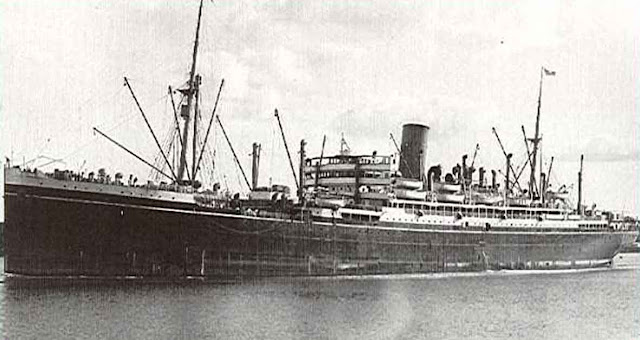
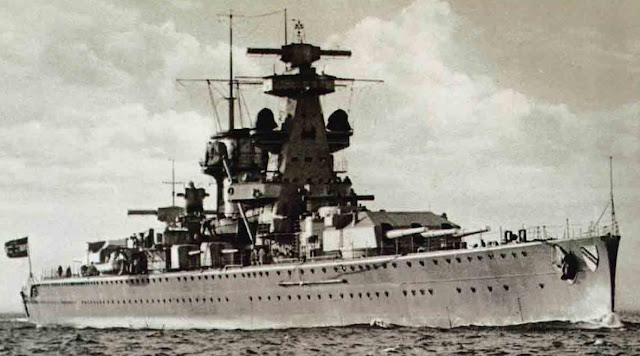
German pocket battleship Admiral Scheer approached Allied convoy HX.84 in the North Atlantic in the late afternoon, and British armed merchant cruiser HMS Jervis Bay moved in to intercept. Hopelessly outgunned, Jervis Bay was sunk quickly; 190 were killed and 65 survived; Captain Fegen of Jervis Bay would be awarded the Victoria Cross posthumously for his efforts to slow Admiral Scheer. Nevertheless, Admiral Scheer was able to sink 5 additional British ships in the convoy before the convoy scattered and escaped, killing an additional 208 sailors.
The British Home Fleet for some time has been aware (either through spies or Ultra intercepts or both) that German heavy cruiser Admiral Scheer (KzS Theodor Krancke) was going on a raiding mission in the Atlantic. The British have made various fleet moves as a result. However, the Kriegsmarine cruiser has broken out despite attempts to block it. Today, the Admiralty finally locates Admiral Scheer — though it wishes it hadn’t.
Having broken through the Denmark Strait on 31 October, Admiral Scheer has intercepted radio messages indicating the nearby presence of Convoy HX.84. Her Arado Ar 196 seaplanes have located it about 1400 km southwest of Iceland. Convoy HX 84 only has one escort, armed merchant cruiser (AMC) HMS Jervis Bay.
On the way to attack the convoy, Admiral Scheer gets an unexpected bonus. It finds independent British 5389-ton banana boat Mopan. The entire crew is taken as POWs and Krancke then sinks the abandoned ship.
Upon intercepting Convoy HX.84 around noontime, Jervis Bay radios the Admiralty and then instructs the convoy to scatter — a planned maneuver upon the presence of an imminent threat. Then, the AMC heads straight for the heavy cruiser despite the virtual certainty of its own destruction.
Admiral Scheer’s gunfire is accurate. Its first shots destroy the AMC’s wireless and steering control, and the next salvo hits the bridge and wounds/kills Captain Edward Fegen (posthumous VC). Jervis Bay sinks fairly quickly (65 survivors, 136 dead, accounts vary) after 22 minutes. It causes little damage to Admiral Scheer with its 6-inch guns (Admiral Scheer’s radar goes out), which then hunts down the scattered freighters. It picks off five ships, which is quite reasonable considering that the freighters are all racing at top speed in different directions.
Captain Fegen’s citation reads in relevant part:
“any ships it was his duty to protect. On the 5th of November, 1940, in heavy seas, Captain Fegen, in His Majesty’s Armed Merchant Cruiser Jervis Bay, was escorting thirty-eight Merchantmen. Sighting a powerful German warship he at once drew clear of the Convoy, made straight for the Enemy, and brought his ship between the Raider and her prey, so that they might scatter and escape. Crippled, in flames, unable to reply, for nearly an hour the Jervis Bay held the German’s fire. So she went down: but of the Merchantmen all but four or five were saved.”
This is another in a series of Royal Navy encounters in which a ship sacrifices itself for the greater good. The Jervis Bay is reasonably well-remembered, ships like HMS Rawalpindi which did basically the same thing, less so. There are memorials to the crew of the Jervis Bay in several countries, including London, England, Hamilton, Bermuda, and Saint John, New Brunswick.
Ships sunk in Convoy HX.84 by Admiral Scheer:
British 1042 ton freighter Beaverford (all 77 perish);
British 4955 ton freighter Fresno City (1 dead, 36 survivors);
British 5225 ton freighter Kenbane Head (24 survivors, 23 dead);
British 7861 ton freighter Maidan (all 91 perish);
British 4202 ton freighter Trewellard (16 perish, 25 survive)
However, the ships sunk are only part of the story. The Beaverford (Captain Hugh Pettigrew) uses its 3-inch bow gun against the cruiser, then tries to outrun Admiral Scheer. It manages to elude it in the darkness for four and a half hours, drawing fire whilst running in and out of smoke screens, before being sunk by a torpedo. This helps other ships to escape to a much greater extent than the Jervis Bay and its quick end did — but the Jervis Bay is the ship everyone remembers.
In addition, Admiral Scheer shells 8073-ton British tanker San Demetrio. Tankers are notoriously difficult to sink due to their compartmentalized construction, and Admiral Scheer departs with the ship ablaze and the crew abandoning ship. However, after a day at sea, one of the lifeboats drifts back near the San Demetrio and the men — after a great deal of hesitation, as blazing tankers are not the safest place to be — re-board the ship. The crewmen take the badly damaged tanker in hand, put out the fires, and manage to re-start the engines (the Chief Engineer is in the lifeboat). They eventually reach the River Clyde on the ship’s own power. The crew, incidentally, gets rich due to being able to claim salvage rights. Second Officer Arthur G. Hawkins receives the OBE, Chief Engineer Charles Pollard and Deck Apprentice John Lewis Jones receive the Lloyd’s War Medal for Bravery at Sea.
The San Demetrio ultimately is repaired and returns to service. The episode concerning the San Demetrio becomes perhaps the most well-known part of the entire encounter because it is adapted into the 1943 film “San Demetrio London” starring Walter Fitzgerald, Mervyn Johns, Ralph Michael, and Robert Beatty.
During the entire day-long incident, Admiral Scheer sinks seven ships. This is often reduced to five in most accounts by the magic of ignoring the sinking of the Mopan and the Jervis Bay. Captain Krancke, satisfied with his day’s haul and running low on ammunition, heads Admiral Scheer off to a scheduled rendezvous with a supply ship.
The Royal Navy sends massive forces (including battlecruisers HMS Hood and Repulse) to look for Admiral Scheer. For those who disparage the effect of surface raiders as a waste of money and resources versus U-boats, forcing the Royal Navy to allocate a large fraction of its resources to searching for raiders like Admiral Scheer is a major benefit that is usually overlooked.
Greek cavalry troops under General Georgios Stanotas began a new attack on the enveloped Italian Julia Division in the Vovousa valley in northern Greece.
On the coastal sector, the Italian Littoral Group establishes a secure bridgehead across the Kalamas (Thyamis) River. They advance on Igoumenitsa. The Italians continue trying to re-take the Grabala Heights without success. The Italians are using light tanks, with little effect.
In the Pindus sector, the Italian disaster continues. The Italians are surrounded and surrendering. Relief forces are unable to reach them. General Georgios Stanotas launches cavalry attacks on them in the Vovousa Valley. The Italian position is hopeless.
In the Koritsa sector, the Greek 9th Infantry Division and 15th Infantry Division attack across the Albanian border.
The Regia Aeronautica bombs the Greek border town of Monastir, and the ports being used by the British — Piraeus and Patra. The RAF bombs Brindisi, Naples, and Bari.
On 5 November 1940, it is one year from the meeting between army commander Walther von Brauchitsch and Hitler, in which many revisionist historians believe that the General was thinking of killing Hitler due to his dangerous plans. However, now the entire situation has changed. Hitler is now a near God-like figure due to the German successes in Scandinavia, the Low Countries, and France. There are few who can or want to challenge Hitler about anything — and that spells future trouble for the Reich because he has big and dangerous plans.
Subsequent to the OKW (military high command) meeting with Hitler on 4 November, General Halder has Colonel Adolf Heusinger, the chief of the operations unit at OKH (the army high command), draft up a plan for the invasion of Greece. This will become Operation Marita. Having OKH draft the plan, and not OKW (which also has good operational planners) is the start of a bifurcation of German planning between OKW and OKW which will last throughout the war and cause many issues, especially in terms of force allocation.
At this point, the plan is to invade just Greece and not Yugoslavia (though Hitler already has expressed the idea of invading the latter as well). The attack would be launched from Bulgaria — another somewhat iffy German ally — because of its border with Greece. Heusinger has all sorts of idle forces to choose from — four army groups, in fact — but the invasion will only require a small fraction of them. He chooses XXXXth army corps, which will be joined by another as-yet-unspecified corps under the command of Colonel-General (Generaloberst) Ewald von Kleist. He is to command Panzergruppe Kleist, which would be somewhere in size between a corps and an army.
The allocation of such a small force to invade an entire county, which is being supported by the British, and not even under a full field marshal (of whom the Wehrmacht has many doing essentially nothing) is indicative of the high levels of confidence in the Wehrmacht at this time. However, von Kleist has one of the sharpest minds in the Wehrmacht and now has a chance to show it. Colonel Kurt Zeitzler is Panzergruppe Kleist’s chief of staff. While their ranks may be small, the talent assembled for this operation is huge.
Hermann Göring issued an order to loot the art treasures at the Louvre museum in Paris, France, which were to be distributed to German museums and private collections of Nazi leaders, with a large portion of the art reserved for himself.
Free French troops captured Lambaréné, French Equatorial Africa (in present day Gabon) about 100 kilometer inland up the Ogooué River. Meanwhile, Free French, Foreign Legion, and Colonial troops set sail from Douala, French Cameroun for another Vichy-held city in French Equatorial Africa, Libreville.
The Luftwaffe bombs London, East Kent and Ramsgate. Night attacks resume, with London, East Anglia, Scotland, South Wales, and the Midlands hit. The Corpo Aereo Italiano attacks Harwich again with 8 bombers.
RAF Bomber Command dispatches 1 Blenheim to Haamstede airfield during the day; it turned back.
RAF Bomber Command dispatches 97 aircraft overnight to many targets. 2 Whitleys and 1 Hampden were lost. Hamburg, target for approximately 10 Wellingtons, reports 15 fires and casualties of 7 killed, 32 injured and 236 bombed out, some only temporarily. 8 Hampdens minelaying off the island of Rugen in the Baltic; 1 aircraft lost. Bomber Command attacks various ports, including Hamburg, Boulogne, Dunkirk, Antwerp, Flushing, Bremerhaven, Bremen, and Emden.
Losses for both sides are roughly a handful.
At Malta, there are two air raid alerts, one at night and one during daylight. However, they both are false alarms because the Italian aircraft, as they often do for unknown reasons, turn back while still offshore. During the evenings, one bomber does get through and drops a bomb on Grand Harbour. It is the first air attack in several days. An Italian CR 42 strafes flying boats lying off Kalafrana after following a Wellington bomber back from a raid on Italy.
At 1240, German heavy cruiser Admiral Scheer sank British steamer Mopan (5389grt) in 52‑59N, 32-12W. Steamer Mopan had departed Kingston, Jamaica, was en route to England. The German battleship rescued the steamer Mopan’s sixty eight survivors.
At 1710, German heavy cruiser Admiral Scheer attacked Convoy HX.84 of thirty seven ships (Convoy Commodore Rear Admiral H. B. Maltby Rtd on British steamer Cornish City (4952grt)) escorted by armed merchant cruiser HMS Jervis Bay. The Captain of Jervis Bay, Edward Fegen, ordered the convoy to scatter; and set a course towards the German warship to draw its fire, with guns firing more as a distraction than in the hope of doing damage. Jervis Bay was hopelessly outgunned and outranged by the 28 cm (11 inch) guns of the German ship. Heavy cruiser Admiral Scheer sank armed merchant cruiser HMS Jervis Bay (Captain E. S. F. Fegen (act)) at 2003 in 52-50N, as well as 52-15W, British steamers Maidan (7908grt) in 52 28N, 32 08W, Trewellard (5201grt) in 52 27N, 32 09W, Kenbane Head (5225grt) in 52 26N, 32 34W, Beaverford (10, 042grt) in 52 26N, 32 34W, Fresno City (4955grt) in 51 47N, 33 29W and damaged tanker San Demetrio (8073grt) in 52 48N, 32 15W, steamer Andalusia (3082grt) and and troopship Rangitiki (16, 984grt). Jervis Bay’s sacrifice bought enough time for the convoy to scatter and the remaining ships of the convoy escaped.
Captain Fegen, T/Lt (E) J. W. P. Barry RNR, T/Lt (E) D. H. J. Bigg RNR, T/Cdr (E) J. H. G. Chappell RNR, Surgeon Lt Cdr T. G. Evans, MRCS, LRCP RNVR, T/Sub Lt (E) R- L. Hall RNVR, T/A/Sub Lt (E) G. D. Green RNVR, T/Lt W. Hill RNR, Midshipman C. C. T. Latch RNR, T/Lt Cdr (E) M. A. Leddra RNR, Lt Cdr K. M. Morrison RNR, T/Lt (E) W. Newton RNR, T/Lt Cdr G. L. Roe RNR, Gunner E. R- Stannard, T/Paymaster Lt A. W. Stott RNR, T/Paymaster Lt Cdr W. E. White RNR, ninety seven RN ratings, thirteen RCN ratings were lost on the armed merchant cruiser. T/A/Sub Lt (E) H. M. Pattinson RNVR, nine ratings died of wounds. Six RN ratings and two RCN ratings were wounded.
Swedish steamer Stureholm (4575grt) rescued sixty five survivors and recovered three bodies from HMS Jervis Bay. The steamer arrived at Halifax on the 12th. Most of the survivors were transferred to armed merchant cruiser HMS Comorin for return to England.
British steamer Gloucester City, from a dispersed OB.convoy rescued ninety two survivors from the steamers — twenty five survivors from Trewellard, twenty three survivors from San Demetrio, twenty survivors from Kenbane Head, and twenty four from Fresno City.
On 9 November, Greek steamer Mount Taygetus (3286grt) rescued a further twelve crewmen from the Fresno City.
On steamer Beaverford, all seventy seven crewmen were lost. On steamer Maidan, all ninety one crewmen were lost. One crewman was killed on steamer Fresno City. Twenty three crewmen were lost on steamer Kenbane Head. Two crewmen were killed and fourteen crewmen were missing on steamer Trewellard.
Steamer Gloucester City arrived at St Johns on the 13th.
U-99, commanded by Kapitänleutnant Otto Kretschmer, sank British steamer Scottish Maiden (6993grt) from convoy HX.83 in 54‑36N, 14‑23W. At 0255 hours the Scottish Maiden (Master John William Albert Gibson) was torpedoed and sunk by U-99 about 225 miles west by south of Bloody Foreland. The U-boat fired its last torpedo at three overlapping ships from a distance of 3600 metres and observed a hit in the stern of a tanker. 16 crew members were lost. The master and 27 crew members were picked up by HMS Beagle (H 30) (LtCdr R.H. Wright, RN) and landed at Liverpool. The 6,993-ton Scottish Maiden was carrying diesel and marine fuel oil and was bound for Avonmouth, England.
Convoy HX.83 was at that time escorted by destroyers HMS Active, HMS Achates, HMS Beagle, HMS Hesperus, HMS Hurricane, and HMS Wild Swan and corvette HMS Picotee.
In the counter attack after the sinking of steamer Scottish Maiden, destroyer HMS Beagle damaged U-123, which was able to return to Lorient.
Anti-aircraft ship HMS Alynbank transferred from convoy WN.30 to convoy EN.19 off the Firth of Forth. Anti-aircraft ship Alynbank escorted convoy EN.19 to Pentland Firth.
Anti-aircraft cruiser HMS Cairo arrived in the Clyde.
Hunt-class destroyer HMS Tynedale was completed. Following working up, she was assigned to the 1st Destroyer Flotilla in the Portsmouth Command.
The units of the British Home Fleet at Scapa Flow at this time were:
Battleships HMS Nelson and HMS Rodney
Battlecruisers HMS Hood and HMS Repulse.
Aircraft carrier HMS Furious at Scapa Flow but due to repair to her rudders and was not available. Her speed was limited to twenty three knots.
Light cruiser of the 18th Cruiser Squadron HMS Southampton
Anti-aircraft cruisers of the 15th Cruiser Squadron HMS Naiad, HMS Bonaventure, HMS Phoebe, and HMS Dido (Dido unfit for sea after structural defects developed at sea in late October).
Destroyer of the 1st Destroyer Flotilla under orders of Home Fleet HMS Brilliant
Destroyer of the 3rd Destroyer Flotilla HMS Electra
Destroyers of the 4th Destroyer Flotilla HMS Cossack and HMS Maori
Destroyers of the 6th Destroyer Flotilla HMS Somali, HMS Mashona, HMS Matabele, HMS Punjabi, and HMS Eskimo
Destroyers of the 12th Destroyer Flotilla HMS Keppel and HMS Douglas
Destroyer of the 21st Destroyer Flotilla HMS Vimy
Other Home Fleet units were
Heavy cruisers of the 1st Cruiser Squadron HMAS Australia at the Clyde with machinery defects, HMS Norfolk which arrived in the Tyne in late October to correct structural defects completing on the 8th, and HMS Sussex and HMS Suffolk which were under long repairs to bombing damages.
Light cruisers of the 2nd Cruiser Squadron HMS Aurora was detached and at Sheerness, HMS Arethusa was repairing minor collision damage in Tyne, HMS Galatea was repairing mine damage Chatham, and HMS Penelope under long repairs for grounding damage sustained in Norway.
Light cruisers of the 10th Cruiser Squadron HMS Nigeria and HMS Kenya working up and HMS Fiji repairing torpedo damage at Greenock.
Light cruisers of the 18th Cruiser Squadron HMS Manchester detached and at Humber, HMS Newcastle detached and at Plymouth, HMS Edinburgh at Scapa Flow working up after long refit, and HMS Birmingham refitting at Liverpool from 27 September to 27 December.
Destroyers of the 3rd Destroyer Flotilla under repairs HMS Eclipse at Scapa Flow, HMS ECHO at Clyde, and HMS Escapade at Troon.
Destroyers of the 4th Destroyer Flotilla under repair HMS Sikh at Leith, HMS Zulu under repair at Rosyth, and HMS Fame at Rosyth aground.
Destroyers of the 6th Destroyer Flotilla under repair HMS Bedouin at Southampton, HMS Ashanti at Rosyth aground, and HMS Tartar at Plymouth.
Destroyer of the 12th Destroyer Flotilla HMS Anthony at Greenock.
Destroyers of the 1st Destroyer Flotilla on loan to Home Fleet operating in the Western Approaches HMS Beagle and HMS Bulldog.
Destroyer of the 4th Destroyer Flotilla operating in the Western Approaches HMS Fearless
Destroyers of the 12th Destroyer Flotilla operating in the Western Approaches HMS Ambuscade, HMS Arrow, HMS Active, and HMS Amazon.
British steamer Haig Rose (1117grt) was lost in Bristol Channel to unknown agent.
Battlecruisers HMS Hood and HMS Repulse, anti-aircraft cruisers HMS Phoebe, HMS Naiad, and HMS Bonaventure of the 15th Cruiser Squadron, and destroyers HMS Eskimo, HMS Mashona, HMS Matabele, HMS Electra, HMS Somali (D.6), and HMS Punjabi departed Scapa Flow at 2330/5th to German heavy cruiser Scheer’s last position, 52-50N, 32-15W at 2003.
Later, battlecruiser HMS Hood, cruisers HMS Phoebe and HMS Naiad, destroyers HMS Somali, HMS Eskimo, and HMS Punjabi proceeded to cover the approaches to Brest and Lorient. Battlecruiser HMS Repulse, anti-aircraft cruiser HMS Bonaventure, and destroyers HMS Mashona, HMS Matabele, and HMS Electra continued towards German heavy cruiser Admiral Scheer’s last position.
Battleships HMS Rodney and HMS Nelson departed Scapa Flow at 0700/6th with light cruiser HMS Southampton and destroyers HMS Cossack (D.4), HMS Maori, HMS Brilliant, HMS Douglas, HMS Keppel, and HMS Vimy to cover the Iceland-Faroes Channel.
Battleship HMS Rodney was sent to escort HX.83 and once she was safe, HX.85 from Halifax.
Armed merchant cruisers HMS Chitral, which was to the northwest of Iceland, HMS California and HMS Worcestershire, which were to the south of Iceland, departed their stations for the Clyde on the 8th.
Light cruiser HMS Southampton replaced armed merchant cruiser HMS Chitral on her Northern Patrol station.
Armed merchant cruiser HMS Worcestershire joined the battleship HMS Nelson group at 1400/9th.
Submarine HMS Trident was ordered to patrol south of Belle Ile in the approaches to St Nazaire.
Submarine HMS Usk was ordered to the Brest approaches.
Submarine HMS Tuna off Gironde was relieved by submarine TIGRIS.
Submarine HMS Tuna then proceeded to position off the Scilly.
Submarine HMS Triumph on passage to Gibraltar was ordered to a station in 47-30N, 08-00W.
Destroyers HMS Churchill, HMS Ludlow, HMS Lincoln, and HMS Lewes, recent additions to the Royal Navy compliments of the U.S., had departed Halifax on 31 October and refueled at St Johns on the 3rd before beginning the Atlantic crossing. These destroyers intercepted signals from convoy HX.84 and rushed to its location. However, they never made contact and only sighted one empty life boat. The destroyers went on without incident arriving at Belfast on the 9th.
Destroyer HMS Stanley, also an addition from the U.S., which had departed Halifax on the 1st and St Johns on the 5th and Canadian destroyer HMCS St Francis, ex-USN, departed Halifax to aid the convoy and escorted the convoy HX.85 back to Nova Scotia.
On 8 November, battleship HMS Nelson, light cruiser HMS Southampton, and destroyers HMS Cossack, HMS Maori, HMS Brilliant, HMS Douglas, HMS Keppel, and HMS Vimy were between Iceland the Faroes.
Destroyers HMS Douglas, HMS Vimy, and HMS Bulldog rendezvoused with the Commander in Chief at 1200/9th in 62-46N, 11-58W after refueling at Skaalefjord.
Battlecruiser HMS Repulse, anti-aircraft cruiser HMS Bonaventure, and destroyers HMS Matabele, HMS Mashona, and HMS Electra were in 52‑45N, 32‑15W.
Australian heavy cruiser HMAS Australia was at the Clyde with turbine problems, probably a broken turbine blade, could not sail until 1749 on the 8th.
On 31 October, battlecruiser aircraft carrier HMS Ark Royal, heavy cruiser HMS Berwick, light cruiser HMS Glasgow, destroyers HMS Isis, HMS Duncan, and HMS Foxhound, and liner Pasteur had departed Greenock to rejoin Force H.
Aircraft carrier HMS Ark Royal arrived at Gibraltar with destroyers HMS Vidette and HMS Wrestler at 1315/6th, cruisers HMS Berwick and HMS Glasgow at 1430/same day, the liner and destroyers at 1630 that day.
Light cruiser HMS Sheffield arrived from Azores patrol at Gibraltar at 0600/6th.
Battlecruiser HMS Renown and destroyers HMS Encounter, HMS Forester, and one other departed at 0500/6th to escort convoys HG.46 and SL.53 in 40‑00N, 20‑30W at this time.
Flag Officer Force H.transferred his flag to battleship HMS Barham and after the arrival of aircraft carrier HMS Ark Royal on the 6th to her.
At 1225/6th in the Atlantic off Cape St Vincent, submarine HMS Utmost was identified as enemy by destroyer HMS Encounter. Destroyer HMS Encounter rammed submarine HMS Utmost. Utmost proceeded to Gibraltar arriving at 0800/7th. Submarine Utmost departed Gibraltar on the 30th for Malta, arriving on 8 December, was under repair until 2 February.
Destroyer HMS Encounter was escorted to Gibraltar by destroyer HMS Forester. They arrived at 0800/7th. The destroyer was repairing until 23 November.
On the 11th, Australian heavy cruiser HMAS Australia relieved the HMS Renown group of convoy HG.46 and they arrived back at Gibraltar on the 12th.
On 8 November, battleship HMS Rodney was in 56‑30N, 28‑30W proceeding towards 45‑20N, 52‑00W to escort convoy HX.85.
Battlecruiser HMS Hood, anti-aircraft cruisers HMS Phoebe and HMS Naiad, destroyers HMS Eskimo, HMS Somali, and HMS Punjabi were in 45‑50N, west of 20W.
Aircraft carrier HMS Argus (Captain E. G. N. Rushbrooke), light cruiser HMS Despatch, destroyers HMS Vesper, HMS Venomous, and HMS Windsor, which departed the Clyde on the 7th, were in 53‑00N, 17‑00W. Aircraft carrier Argus and light cruiser Despatch were in 45N, 19‑13W at 1300/11th. Light cruiser Despatch went to Gibraltar arriving on the 14th. Destroyers HMS Wishart and HMS Wrestler departed Gibraltar on the 11th and destroyer HMS Vidette departed Gibraltar on the 12th and joined aircraft carrier Argus which went north to join heavy cruiser HMAS Australia escorting convoys HG.46 and SL.53 the convoy brought north by the HMS Renown group. Aircraft carrier Argus with destroyers Wishart, Wrestler, and Vidette arrived at Gibraltar later on the 14th for operation WHITE.
Destroyers HMS Maori, HMS Keppel, and HMS Brilliant departed Skaalefjord at 1600/10th after refueling. The destroyers joined the Commander in Chief at 1200/11th in 62-46N, 11-58W.
On the 10th, Anti-aircraft cruiser HMS Bonaventure and destroyer HMS Mashona searched the area of the HX.84 attack.
Destroyers HMS Brilliant and HMS Vimy arrived at Skaalefjord at 1300/11th to refuel.
Norwegian tanker Solfonn (9925grt) of convoy HX.84 arrived in the Clyde on the 10th.
British tanker Erodona (6207grt), British steamer Andalusia (3082grt), British steamer Cornish City (4952grt), British tanker James J. Maguire (10525grt), British steamer Danae II (2660grt), British steamer Castilian (3067grt), British steamer Briarwood (4019grt), Norwegian steamer Varoy (1531grt), British tanker Atheltemplar (8939grt), British steamer Lancaster Castle (5172grt), British steamer Dan-Y-Bryn (5117grt), British tanker Athelempress (8941grt), British tanker Oilreliance (5666grt), Norwegian steamer Hjalmar Wesel (1742grt), Belgian steamer Emile Francqui (5859grt), Belgian steamer Persier (5382grt), Swedish steamer Delhi (4571grt), British steamer Rangitiki (16698grt), Greek steamer Anna Bulgaris (4603grt), British oiler Delphinula (8120grt), British tanker Cordelia (8190grt), British steamer Pacific Enterprise (6736grt), and British steamer Empire Penguin (6379grt) of convoy HX.84 arrived independently at Clyde, Belfast, Oban, Liverpool on the 12th.
British tanker Sovac (6724grt) arrived in the Mersey on the 13th, British steamer Trefusis (5299grt) arrived at Rothesay on the 13th, Swedish tanker St Gobain (9959grt) arrived at Liverpool on the 14th, Swedish steamer Stureholm (4575grt) arrived at Halifax on the 12th, Norwegian steamer Cetus (2614grt) arrived at Oban on the 13th, Polish steamers Puck (1065grt) arrived at Greenock on the 13th and Morska Wola (3376grt), which had been straggling from the start, arrived at Oban on the 13th.
British tanker San Demetrio (8073grt) arrived at Rothesay accompanied by British tug Superman (359grt) and escorted by destroyer HMS ARROW on the 16th.
Swedish steamer Vingaland (2734grt) survived the attack, but was lost after bombing damage of 8 November and a submarine attack on the 9th.
Battlecruiser HMS Repulse and destroyers HMS Matabele and HMS Electra arrived at Scapa Flow for refueling at 1100/11th.
Anti-aircraft cruiser HMS Bonaventure and destroyer HMS Mashona arrived at Scapa Flow at 1120/11th for refueling.
The battlecruiser HMS Hood, anti-aircraft cruisers HMS Phoebe and HMS Naiad, destroyers HMS Somali (D.6), HMS Eskimo, and HMS Punjabi returned to Scapa Flow at 1400/11th for refueling.
Destroyer HMS Eskimo with weather damage to her asdic dome and her forecastle deck plates buckled was under repair from repair ship HMS Maidstone at Scapa Flow from 13‑16 November in the floating drydock.
Anti-aircraft cruiser HMS Bonaventure departed Scapa Flow at 2300/11th to continue to search for survivors. Armed merchant cruiser HMS Chitral was also at sea on this duty. The cruiser arrived back on the 19th. The anti-aircraft cruiser was weather damaged and was repaired at Rosyth from 25 November to 4 December.
Anti-aircraft cruiser HMS Phoebe was weather damaged and was repaired at the Clyde from 18 November to 14 December.
Armed merchant cruiser HMS Letitia departed the Clyde at 1300/11th to continue Northern Patrol duties.
Battlecruiser HMS Repulse, anti-aircraft cruiser HMS Naiad and destroyers HMS Sikh, HMS Matabele, HMS Mashona, and HMS Punjabi returned to sea at 1330/12th to continue patrol and cover the Northern Patrol.
Battlecruiser HMS Repulse and destroyers HMS Matabele, HMS Mashona, and HMS Ashanti returned to Scapa Flow at 0015/19th.
Battleship HMS Nelson with destroyers HMS Beagle, HMS Maori, HMS Bulldog, and HMS Keppel arrived at Scapa Flow at 1630/13th. Destroyer Keppel began boiler cleaning.
Battleship HMS Rodney arrived at Scapa Flow at 1400/23rd.
Submarine HMS Sturgeon attacked Norwegian steamer Uly (1200grt) off Lister without success.
On patrol in the Bay of Biscay, Submarine HMS L-27 was damaged when her bridge was wrecked by depth charges. Submarine L-27 was able to return to Portsmouth on the 7th and was under repair there until 21 January 1941.
German destroyers Jacobi, Eckholdt, Ihn, Steinbrinck, and Riedel departed Brest to return to Wilhelmshaven for repairs. The destroyers had been involved earlier in an operation in the Bay of Biscay towards Cape Finisterre, but mechanical problems forced cancellation of the sweep. On 7 November, destroyers Eckholdt, Ihn, and Steinbrinck arrived at Hamburg, Stettin, Hamburg, respectively, for repairs. Destroyers Jacobi and Riedel were repaired at Wilhelmshaven and Kiel, respectively.
Steamer Brisbane Star (11, 076grt), Royal Fleet Auxiliary RFA Brambleleaf (5917grt), armed boarding vessels HMS Chakla and HMS Fiona, netlayer HMS Protector for Suda Bay travelled in company and was dropped off near Crete with anti-aircraft cruiser HMS Calcutta and destroyer HMAS Voyager.
Australian light cruiser HMAS Sydney and Light cruiser HMS Ajax loaded troops, ammunition, stores and departed Port Said for Crete. The cruisers disembarked their charges at Suda Bay and departed Crete. Cruiser Sydney departed on the 6th and joined the Mediterranean Fleet at 1700/7th. Cruiser Ajax departed later and joined at 1700/8th.
Submarine HMS Rorqual laid mines north of Tripoli in 34-14N, 11-56E. Italian steamer Caffaro (6476grt) was damaged on this minefield on 27 December. This minefield was extended by submarine Rorqual on the 9th.
Italian torpedo boats Calipso and Fratelli Cairoli were lost on this minefield on 5 and 23 December, respectively, at Ras Misurata.
Convoy SC.10, fourteen ships escorted by Sloop HMS Folkestone, was one hundred miles southeast of HX.84. The convoy was ordered away from the area of the attack.
Convoy FS.328 departed Methil, escorted by destroyer HMS Winchester and sloop HMS Egret. Patrol sloop HMS Sheldrake joined on the 6th. The convoy arrived at Southend on the 7th.
Convoy HX.86 departing Halifax was immediately recalled. Convoys HX.85 which departed Halifax on the 1st and HX.86 which departed Halifax on the 5th were recalled to Halifax.
Convoy BHX.66 departed Bermuda on the 3rd escorted by armed merchant cruiser HMS Montclare, but returned to Bermuda on the 5th.
Convoy MW.3 of British steamers Waiwera (10, 800grt), Devis (6054grt), Volo (1587grt), and Rodi (3220grt) and tanker RFA Plumleaf (5916grt) departed Alexandria for Malta escorted by anti-aircraft cruisers HMS Calcutta and HMS Coventry, destroyers HMS Diamond, HMAS Vampire, HMAS Voyager, and HMAS Waterhen, and minesweeper HMS Abingdon.
The people of the United States voted in the 1940 Presidential election. Early returns hint at a Roosevelt victory. As the day ends FDR is clearly leading but Willkie has not conceded defeat. United States President Franklin Roosevelt ultimately won an unprecedented third term in office, beating Republican challenger Wendell L. Willkie.
It is fair to say that this is quite possibly the least competitive Presidential election of the century, and possibly of all time — though not in terms of states won, because Willkie does better than later candidates such as George McGovern and Walter Mondale (both of whom, incidentally, are alive for this election though ineligible to vote. However, there has been no suspense about the outcome of this election whatsoever. Few want to “change horses in midstream” with Hitler on the march and Roosevelt taking care of such matters more or less the way the country wants.
As a footnote to this campaign, District Attorney Thomas E. Dewey of New York had gone into the Republican National Convention with more delegates than Willkie and may have put up a better fight against Roosevelt. He won most of the primaries but lost the nomination on the fifth ballot. Since the main rap against him in 1940 is his relative youth (38), Willkie’s crushing defeat leaves Dewey as the presumptive front-runner for the 1944 nomination.
With “full returns” still lacking, President Roosevelt told a jamboree of his Hyde Park neighbors early today that “it looks all right” and that he thought in the future they would find him “just the same Franklin Roosevelt you’ve known a great many years.”
Vice-President John N. Garner took a walk today. Unlike his wife, secretary and hundreds of Uvalde citizens, he did not vote in the general election. When his precinct box closed at 7 p.m. he had cast no ballot there and county officials said he had not voted absentee. Secluded in his big brick residence, he gave no reason for breaking his voting habits of many years. Election attaches said they could not recall when the vice-president had failed to vote heretofore. At many elections Garner has voted ballot No. 1 and Mrs. Garner No. 2. This year Mrs. Garner voted at 8:15 a.m., 15 minutes after the polls opened.
Former Washington hurler Walter Johnson, who won 416 games for the Senators, goes down in defeat as a Republican candidate for the U.S. House of Representatives from Maryland.
American “A Farewell to Arms” novelist Ernest Hemingway (41) weds for a third time, to American novelist and war correspondent Martha Gellhorn (31); they divorce in 1945.
Born:
Elke Sommer [Elke Baronesse von Schletz], German actress (“The Prize”, “A Shot in the Dark”, “The Oscar”), in Berlin, Germany.
Gene Iba, American college basketball coach (Houston Baptist 1977-85, Baylor 1985-92, Pittsburg State 1995-2010), in Joplin, Missouri (d. 2025).
Andy Von Sonn, NFL linebacker (Los Angeles Rams), in Los Angeles, California.
Died:
Edward Fegen, 49, Royal Navy officer and Victoria Cross recipient (killed in the Jervis Bay sinking).
Otto Plath, 55, German-born American author, professor of biology, entomologist and father of poet Sylvia Plath.
Naval Construction:
The Royal Navy Bangor-class (Reciprocating-engined) minesweeper HMS Eastbourne (J 127) is launched by Lobnitz & Co. Ltd. (Renfrew, Scotland).
The Royal Navy Fairmile B-class motor launch HMS ML 154 is commissioned.
The Royal Navy Hunt-class (Type I) escort destroyer HMS Tynedale (L 96) is commissioned. Her first commander is Lieutenant Commander Hugo Edward Forbes Tweedie, RN.
 History Diaries