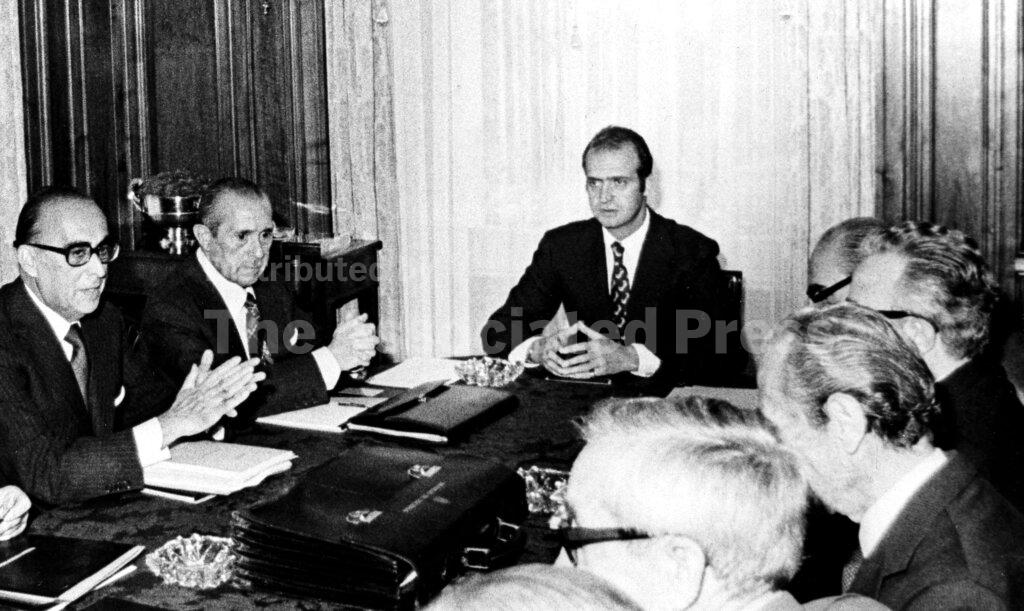
On his first day as Spain’s acting chief of state, Prince Juan Carlos de Borbon presided over a four-hour cabinet meeting that was mainly concerned with the worsening crisis in North Africa, where Algeria warned of war if Morocco continued her efforts to annex Spanish Sahara. Talks between Spain and Morocco over whether Spain would relinquish her dominion over Spanish Sahara were broken off. Meanwhile, a medical bulletin from Generalissimo Francisco Franco’s physicians said that he had developed peritonitis, but that his coronary condition had improved. His vital signs were described as normal, and his “habitual lucidity” was being maintained, his doctors said.
The feud betweer the rival Official and Provisional wings of the Irish Republican Army brought two more violent deaths here today. Seamus McCusker, a leading member of the Provisional faction, was shot in the head from a passing car. Police officials said that they believed the murder was in retaliation for this week’s Provisional attacks on members of the less militant but Marxist Official wing. A few hours later, outside a club run by the Officials, gunman ambushed and killed Tom Berry, one of the few Protestants in the I.R.A. Mr. Berry, in his 20’s, was a leading member of the so‐called Republican clubs, the political agency of the Officials. The Provisional I.R.A. is behind the campaign to drive the British out of Northern Ireland by violence and unite the province with the Irish Republic. The Officials favor political means to the same end.
East Germany has released to the West some 200 political prisoners in the last few weeks, a statement by a West Berlin refugee organization said today. The statement from Organization 13 August, named for the date the Berlin wall was started by the East German Communists in 1961, said that almost all the 200 had been sentenced to two to four years for trying to flee to West Germany, and that further releases, were expected. For the first time since 1974, the statement added, those released included doctors. Of some 50 doctors known to have been sentenced, 14 were among those released.
The Portuguese Army today began discharging thousands of soldiers while the Communist party cautioned that fascists were planning a coup in connection with the independence of Angola November 11. Leftist soldiers from various regiments stationed around Lisbon today voted against the demobilization, which affects 18 per cent of army personnel, but the army command said that it was going ahead as planned. With rebellious troops still sealing off the main Lisbon arsenal, the Council of the Solution met for another attempt to solve the political and military crisis.
The United States and Egypt were reported to be close to an agreement in principle under which Egypt would purchase American nuclear fuel, technology and power reactors. High administration officials and congressional sources said that they expected a formal announcement on Wednesday when President Anwar Sadat of Egypt, completing a 10-day visit to the United States, addresses a joint session of Congress.
President Anwar el‐Sadat of Egypt said today he was displeased with President Ford’s foreign-aid package, which would provide $1.5‐billion in military aid to Israel but none to Egypt. Mr. Sadat, on a 10‐day tour of the United States, called on Mr. Ford to enforce an “even-handed policy in the Middle East.” Yesterday, Mr. Ford unveiled a $4.7‐billion foreign‐aid package that included $3.38‐billion for Middle East countries. The proposal would give Israel $1.5 billion in military aid and $740 million in economic aid. Egypt would get $750‐million in economic assistance. At a news conference here, Mr. Sadat also said that the Arab countries had agreed to oppose any move by Israel to intervene in the fighting in Lebanon. “All the Arab nations, represented by their foreign ministers, have agreed that if Israel tries to exploit the situation, the whole Arab world would be against Israel,” Mr. Sadat said.
The State Department today told the American Ambassador to Israel, Malcolm Toon, that he had spoken out of turn in criticizing President Anwar el-Sadat of Egypt and speculating on the possibility of United States intervention in Lebanon.
Suez Canal officials today processed a Greek freighter carrying cement for Israel in preparation for the first canal trip by Israeli‐bound cargo since 1959.
Officials said paperwork for the 6,752‐ton Olympus might be completed in time for the freighter to begin the historic journey from Port Said to the city of Suez tomorrow morning. The trip is expected to take from 12 to 14 hours. The Olympus, carrying 8,500 tons of cement for the southern Israeli port of Eilat, was to have entered the canal today. The Israeli radio, quoting Premier Yitzhak Rabin, said the freighter was delayed because it took on water in the cargo hold.
A lull in the factional fighting in Beirut followed a truce arranged late Wednesday night, but as night fell, there were heavy exchanges of rocket and mortar fire in the suburbs. About 7 PM a number of rockets fell around a Palestinian cemetery near the Sabra quarter, and Muslim militiamen were mobilized in the Basta section after the area was shelled. Heavy machine‐gun fire resounded in the downtown hotel quarter of the city. Gun flashes were also reported south of the capital, in the district of Zahle in Bekaa Valley and close to the Syrian border. Premier Rashid Karami announced that there has been a relaxation in the general situation and that he expected additional moves to restore calm in the next few days. In keeping with Mr. Karami’s tone of optimism, Muslim and Christian armed men began to pull out of the downtown Kantari district and the seafront area where the major hotels are situated.
Internal security forces, supported by patrols of Palestinian guerrillas, were still trying to clear the area of snipers, however, who remained on the roofs. If and when the area is completely cleared of gunmen, attention will be turned to cooling the main combat zones in the suburbs, especially between Ain el‐Rummaneh and Chiyah, where exchanges of machine-gun fire continued during the night. Since the new cease‐fire went into effect shortly after midnight Wednesday, 32 peopla have been killed. Also eight identified bodies were recovered from parts of the Lebanese capital and its suburbs. Heavy exchanges of fire continued between Muslim and Christian villages on the coastal Beirut‐Saida highway. The highway has been cut off by gunmen for four days.
Beirut was once a lively, cosmopolitan place, a bit imitative, a bit nouveau riche, but undeniably a city of some consequence. It was where Arabs from the Persian Gulf countries, weary of the ascetic desert ethic, came to play, where one could buy Pierre Cardin suits at twice the Paris prices and where international businessmen came to maneuver with money and influence. But now it is a mournful, desolate place, its streets frighteningly empty, its citizens terrified by the gunmen, a law unto themselves, roaming almost everywhere. “This is a city on the edge of a nervous breakdown,” said a Lebanese journalist, whose house is regularly inspected by gunmen looking for snipers. The few drug stores still open in Beirut, their shelves picked almost clean, report that valium and other tranquilizers are sold out. Tens of thousands of people have fled Beirut, which in winter usually had a population of 1.2 million. They have gone to home villages or resort towns in the mountain range that rises dramatically from the Mediterranean, or by back roads to Damascus — the main road is often unsafe — or abroad by plane.
Tun Mustapha resigned as Chief Minister of Sabah, a state in Malaysia, bringing to an end speculation that he would attempt to lead secession for Sabah to become an independent nation.
The Racial Discrimination Act 1975 took effect in Australia.
French sources said today that President Valery Giscard d’Estaing had decided not to invite Canada to a mid‐November economic conference, despite considerable pressure from the United States. Secretary of State Kissinger had termed Ottawa’s presence “crucial,” and one of his deputies, Helmut Sonnenfeldt, said earlier this month that he believed Canada would participate. The French sources gave no reason for the exclusion of Canada from a meeting that will bring leaders together from the United States, France, West Germany, Britain, Japan and Italy to try to get the world economy rolling again.
The Chilean national intelligence service said today that a Communist inspired plot to kill President Augusto Pinochet and set up a Marxist state in Chile had been broken. A statement issued by the intelligence office said Ortensia Allende, widow of former President Salvador Allende Gossens appeared to be involved in the plot, which the office said was uncovered after several ringleaders were arrested. The statement said the conspirators, using money supplied by international Communists, had planned to set up a patriotic national liberation front, based in nine cities and linking all extremst left‐wing groups operating in the country. Captured documents and statements from those arrested revealed that the front planned to make attempts to kill President Pinochet, carry out attacks aimed at overthrowing the government by force and set up a Marxist-Leninist government, the intelligence office said.
Rhodesian Prime Minister Ian D. Smith of Rhodesia held talks in Salisbury today with the African nationalist leader, Joshua Nkomo, on the country’s constitutional dispute. It is the first contact between the white minority government and nationalists since the African National Council split into two factions last month, one led by Mr. Nkomo and the other by Bishop Abel Muzorewa. Both men claim to represent the majority of the country’s six million blacks. The first reaction from a spokesman for Bishop Muzorewa was to describe the talks as “useless.”
David Packard, chairman of President Ford’s 1976 campaign finance committee, has resigned. He is a wealthy California conservative whose recruitment six months ago was considered a political coup. He had been an ally of Ronald Reagan. His resignation was the second in a month by a high Ford campaign official. A campaign official said that there had been “some differences” about Mr. Packard’s preoccupation with amassing contributions of $1,000, the limit under the 1974 campaign reform law, from customary Republican contributors. “There was a feeling that the money wasn’t coming fast enough,” the official said. The campaign organization is seeking smaller contributions that would be matched by the maximum amount of government funds under the new law, which provides matching funds for only the first $250 of a donation.
By a vote of 10 to 6, a House banking subcommittee approved legislation, resembling but more generous than the aid bill approved Thursday by the Senate Banking Committee, that would give New York City up to $7 billion in loan guarantees before or after a default.
Secretary of State Kissinger told the House Intelligence Committee that during his more than six years as National Security adviser under two presidents, no covert intelligence operations had been undertaken by the United States without presidential approval. His testimony followed that of James Gardner, a former State Department aide, who told the committee Thursday that about 40 covert operations were approved by a four-man subcommittee of the National Security Council, whose members never held a formal meeting. Mr. Kissinger said that if Mr. Gardner had meant to imply that any of those operations had not been passed on personally by former President Nixon, he was “mistaken.”
The House Ways and Means Committee finished its current round of work on the tax bill today by strengthening a provision relating to taxpayer rights and enlarging the tax credit for day‐care expenses. The issue of taxpayer rights that the committee dealt with involves the Internal Revenue Service’s access to taxpayers’ bank records. Internal Revenue now has essentially unrestricted access to such records, whether the individual whose records are sought is the taxpayer under investigation or merely someone who is believed to have had some financial transactions with a taxpayer under investigation. Under the procedure approved by the committee, anyone whose bank records are being sought by Internal Revenue would get 14 days’ notice from the agency, during which he or she could initiate legal action to require the service to show why it needs the records.
Martha Moxley, the 15-year-old daughter of a Greenwich, Connecticut, business executive, was found bludgeoned to death in a clump of bushes 200 feet from her home in the exclusive Belle Haven section of Greenwich. The police said that the girl was last seen Thursday evening when she left the home of Thomas Skakel, a classmate, who is a nephew of Ethel Kennedy.
Kidnapping charges were dropped tonight in a bizarre case in which an elderly widow was allegedly held against her will for as long as two years. The charges were dropped by Magistrate Robert Collins. The defendants were Richard Villaurubia and Noel Dube, who were arrested October 24. The Magistrate said that the kidnapping charges would not hold up, although he felt there were a number of other counts on which the men could he prosecuted. The Orleans Parish District Attorney, Harry Connick, said that a grand jury investigating the case would take more testimony Tuesday. Mr. Connick said in an affidavit that there were a number of reasons to believe that the victim, Edna Halbedel, was being held against her will by the two men, one of whom was named in her will.
The Federal Bureau of Investigation arrested an 18-year‐old Mississippi man and hunted his father in the kidnapping of a woman real estate dealer missing for a week. The F.B.I. said Alma Charbonneaux Hartley, 52, of Pensacola, had not been found. Her husband, following the kidnappers’ instructions, left a $40,000‐ransom for her but it was never picked up.
A local grand jury today urged the United States Department of Justice to investigate why a former Justice Department aide took no action on documents given him in 1970 and allegedly identified at the time as the fruits of a burglary in the Indianapolis law offices of an associate of United States Senator Vance Hartke. The six‐member jury’s request came as a companion report to indictments of five persons and a continuing inquiry into alleged political espionage, including possible bugging, break‐ins and other “dirty tricks” against Indiana Democrats from mid‐1970 through early 1973.
The Civil Aeronautics Board announced yesterday a series of rulings that were seen as setbacks to a broad Eastern Airlines plan for new individual and group bargains on scheduled flights to Florida and the Caribbean. The Eastern program was devised as an answer to a recently inaugurated C.A.B. experiment offering new types of of low‐cost charter (nonscheduled) flights to domestic and foreign points. The board did not kill the Eastern proposals outright but seemed to make it all but impossible to implement them in the important winter vacation season just ahead.
A Federal jury interrupted its deliberations today in the perjury and bribery conspiracy trial of former Michigan Gov. John B. Swainson to rehear tape recordings made by the Federal Bureau of Investigation.
Sarkis O. Paskalian, an Armenian diamond cutter who pleaded guilty last month to charges of transmitting secret United States defense information to the Soviet Union, was sentenced yesterday to 22 years in prison by Federal Judge Mark A. Costantino in Brooklyn.
Irish singer-songwriter Bob Geldof’s first appearance with The Boomtown Rats.
The band Queen released one of its most celebrated songs, the single “Bohemian Rhapsody,” initially in the UK. The song was also on the group’s album “A Night at the Opera,” released on November 21, and the single went on sale in the U.S. in December.
Dow Jones Industrial Average: 836.04 (-3.38, -0.40%)
Born:
Carla Boyd, Australian National Team and WNBA forward (Olympic bronze medal, 1996; Detroit Shock), in Wynyard, Tasmania, Australia.
Died:
Joseph Calleia, Maltese-American stage, screen, and radio actor (“The Book”; “Gilda”; “Touch of Evil”).
Rolando Masferrer, 57, Cuban exile who published the anti-Castro weekly newspaper Libertad in Miami, was killed by a bomb placed under his car. The murder remains unsolved.
 History Diaries