Όχι (“No!”) Day.
An Italian ultimatum was presented to the Greeks during the night. Greek Prime Minister Ioannis Metaxas replied, “Alors, c’est la guerre” (“Then, it is war”).
The Greco-Italian War began when the Italians invaded Greece. October 28 is celebrated as Oxi Day in Greece and Greek communities throughout the world to commemorate Ioannis Metaxas’ rejection of the Italian ultimatum.
At dawn, before the ultimatum expired, Italian forces in Albania began to cross the border into Greece. 85,000 Italian troops crossed the border from Albania, outnumbering the 30,000-strong Greek Army. Italy attacked Greece by land, sea and air, hurling at least 10 divisions of Italian troops across the Greek-Albanian frontier. Reports from the Yugoslav frontier said troops of Greece’s small army flung themselves into the path of the Fascist advance through mountain passes. Italian warships and fighting planes were believed to have joined in the onslaught. At the same time, British sources here declared warships of the British Mediterranean squadron were steaming from their patrol posts to the assistance of Greece, who holds a British guarantee of aid in event of attack. (There was no immediate confirmation of this report from London.) It was not known here what action if any Germany would take. Germans in Belgrade said they had no knowledge of any plan by the Reich to take part in the conflict. However, there are hundreds of Germans in Greece, and Yugoslavia’s main fear was that Germany might take a hand and demand passage for her troops along rail routes from Hungary to the Greek border. Greek Minister Rosetti declared today that a state of war exists between Italy and Greece and fighting started at 6 a.m. (8 p.m. P.S.T. Sunday.) Deep interest centered in what action Turkey might take. The Turkish press has indicated that an attack on Greece would be regarded as aimed directly, at Turkey and the Dardanelles. The Greek minister said the first fighting came immediately at 6 a.m. when Italian motorized troops swarmed across the frontier from Albania, where Fascist forces have been massed.
Greek dictator Ioannis Metaxas on 28 October 1940 rejects all demands from Italian dictator Mussolini by silence and appoints General Papagos as Commander in Chief. Half an hour before the expiration of the deadline, the Italians attack.
At 05:30, the Italians, under the command of General Visconti Prasca, attack with a total of 27 (understrength and ill-equipped) divisions (85,000 men, or less than 4000 men per division) at three points on the narrow frontier between Albania and Greece:
— The Adriatic Coast;
— The Pindus Mountains;
— Macedonia.
Employing 380 (largely obsolete) aircraft, 163 (light) tanks and large naval forces (which must look over their shoulders toward the Royal Navy) along the coast, the Italian land forces march forward. It is an odd time to attack, as the weather already is turning, especially at the higher elevations. This favors the defense. The power of air supremacy is limited against dug-in defensive positions in the mountains, too.
The Greeks are ready for the attack, being well-positioned and holding excellent defensive positions supported by natural geographical features. They have 30,000 men in position, but no armor and only 77 (also obsolete) planes.
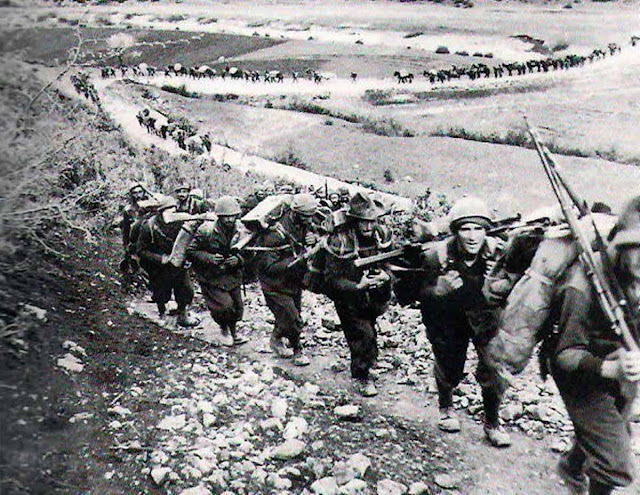
The Italians cross the Kalamas River five miles off the front along the coast, but this direction basically leads nowhere. In the mountains, which is the strategic direction, they face poor weather and make virtually no progress. The Italian Julia Division moves forward in the opening moves of the Battle of Pindus. Their objective is the vital communications point of Metsovo, whose capture would decide the battle to the north. A long column of men advances single-file up narrow tracks. The Italian command deployed the Julia Division with the objective of capturing the strategic mountain passes of the Pindus Mountains as swiftly as possible. During an Italian war council, the Italian commander in Albania, General Visconti Prasca, stated that the mountain range of Pindus would be no problem for the Italian units, and foresaw no difficulty in getting his divisions straight to Athens, like a modern Hannibal.
The Italians bomb Patras, Greece, the main port of Athens in the Morea, and airfields around Athens.
This day becomes known as Όχι (No!) Day in Greece in celebration of Metaxas’ rejection of Mussolini’s ultimatum. The Greeks view their defense against Italy as a defense of their religion, their homes, of Western Civilization itself. The Greeks still, incidentally, revere the day that Constantinople to the Turks in 1453, they have a long memory. US Undersecretary of State Sumner Welles, reflecting on the Greek decision to fight, states:
“The Greeks shattered forever the myth of Axis invincibility.”
Metaxas asks the British ambassador for assistance. Great Britain promises aid to Greece. Churchill goes into rhetorical overdrive, saying:
“When you speak of Greek warriors, don’t say Greeks fight like heroes but that heroes fight like Greeks.”
Churchill is probably secretly relieved by the invasion because it dilutes Italian strength away from the Egyptian front and also takes the pressure off of Malta. He plans on sending British troops to Crete, which shields the British naval base at Alexandria. However, he is not the only one eyeing Crete.
All Greek ships in the Atlantic and Pacific oceans were instructed in a British radio broadcast heard by C.B.S. today to proceed to American, British or Dutch East Indies ports. The announcement said that the Greek government gave the instructions. It added that no Greek ships were to go to France or to ports in French possession.
Adolf Hitler traveled to Florence, Italy for a meeting with Benito Mussolini in an attempt to stop the Italians from attacking Greece, but it was too late. German Chancellor Adolf Hitler and Italian Prime Minister Benito Mussolini met in Florence. Hitler concealed his anger at not being apprised of the Italian plans and informed the Italians that German troops were available if it is necessary to keep the British out of Greece and to protect the Rumanian oil fields. Hitler and Mussolini met in Florence to exchange the latest war information. Hitler might have intended to use the meeting to dissuade Mussolini from attacking Greece had the invasion not, as it turned out, gone ahead that morning. Mussolini was in high spirits and told Hitler, “Don’t worry, in two weeks, it will all be over.” Hitler wished Mussolini the best of luck and refrained from expressing any disapproval, though after the meeting he fumed to his inner circle that what Mussolini had done was “pure madness” and that he should have attacked Malta instead.
In Malta, the garrison is on edge because of the Italian invasion of Greece. The British War Cabinet meets at 17:00 and decides that Malta would be the best spot from which to launch air raids on Italy. It is close enough to attack Rome and achieve some political effects. They decide, however, to send a battalion which had been allocated to Malta to Crete instead. The Royal Navy priority from this point forward will be Crete, not Malta, with naval forces focusing on defending it. In essence, Malta increasingly will have to fend for itself.
Pierre Laval became the Foreign Minister of Vichy France. Laval, who has been acting unofficially as Marshal Petain’s right-hand man in dealings with Germany, officially becomes Foreign Minister.
In occupied Belgium, the Germans place new limits on Jewish employment and business dealings.
The troopship Empress of Britain was bombed northwest of Ireland by a German Focke-Wulf Fw 200 Condor long-range bomber, forcing passengers and crew to abandon ship. She was sunk shortly afterwards by a U-boat while being towed to a British port.
An additional 489,000 children had been evacuated from the greater London area in England, United Kingdom.
Alan Turing, in charge of the Enigma code-breaking operation, writes to Winston Churchill complaining about lack of support. Churchill orders that the code-breakers be given what they need.
General Neil Ritchie becomes commander of the British 51st Infantry Division.
Himmler inspects the Gross-Rosen concentration camp in Silesia.
A second escape from Auschwitz results in a rollcall from 12 noon to 9PM in bitter weather, during which 200 prisoners die.
The Rumanian Government has requested the extradition of Mme. Magda Lupescu and General Ernest Urdareanu, former King Carol’s confidential adviser, it was learned today. The request reportedly charged them with the murder of Corneliu Codreanu, the Iron Guard leader, on November 30, 1938.
South African Prime Minister Jan Smuts, Anthony Eden, General Wavell and Emperor Haile Selassie of Abyssinia meet in Khartoum to discuss strategy.
At 1300 and 1430 hours, German fighters conducted sweeps towards the British airfield at Biggin Hill in England, United Kingdom, but were turned back. Between 1630 and 1710 hours, Bf 109 fighter-bombers and Ju 88 bombers attacked various sites in southern England; 2 Bf 109 and Ju 88 aircraft were shot down without any British aircraft losses. Overnight, London and Birmingham were bombed.
The weather remains acceptable for flying, though low-hanging clouds make the conditions quite different at ground level, with typical drizzly weather. There are only a few big raids during the day and long periods of little activity.
The Luftwaffe focuses on convoy attacks in the morning and does not attack inland until the afternoon. At 13:00, German fighter-bombers (Jabos) crosses into Kent and splits up to attack various targets. The RAF sends up No. 257 Squadron to intercept the fighters of JG 27. The Germans claim two Spitfires, but the RAF does not lose any planes.
At 16:00, the Luftwaffe sends across a variety of formations, including medium bombers such as Dornier Do 17s, some heading up from the south. They attack the Isle of Wight and Portsmouth without apparently any losses on either side. Other raiders, all Jabos, cross over at Dover and points south. This is a moderate-sized raid, and the RAF puts up nine squadrons in the defense. JG 51 and 53 tangles with the Hurricanes and Spitfires and comes off the worse for wear.
After dark, the Luftwaffe starts strong but the attacks peter out quickly. London, Birmingham and the Midlands are the primary targets, but there are scattered attacks all across southern England. Several RAF fields are attacked by a bomber or two each including Biggin Hill, Digby, Linton-on-Ouse, Driffield, Binbrook, and Massingham. In London, there is a huge fire at the Royal Arsenal at Woolwich and a public shelter is hit at Southwark, which causes 100 casualties.
Biggin Hill is the airfield hit the hardest, with an estimated 300 bombs falling. The Luftwaffe drops a new kind of incendiary which acts somewhat like napalm on RAF Digby, but by the time it hits the ground, it is inert.
Birmingham also is hit with incendiaries as well as high explosives. New Street Station is hit by incendiaries at platforms 3, 4 and 5, while the Midlands Parcel Office also is hit.
Overall, the Luftwaffe took a beating in the air. It loses about ten planes, while the RAF records show no losses. It is a half-hearted attempt at best by the Luftwaffe, which almost seems bored with the whole campaign by this point.
RAF Bomber Command dispatches 13 Blenheims during the day to France, Belgium and on a sea sweep. 3 aircraft bombed coastal targets. No losses.
RAF Bomber Command dispatches 97 aircraft overnight to various targets. The biggest raid was by 20 Hampden to Hamburg, where 1 person was killed, 3 injured and 44 bombed out, but no fires were started. 1 Blenheim and 1 Whitley lost. Bomber Command attacks the ports of Kiel, Wilhelmshaven, Bremen, Hamburg, Emden, Cuxhaven, and Boulogne. In addition, it bombs oil installations at Cologne, Hamburg, and Homburg and railway infrastructure at Cologne, Coblenz, Krefeld, and Mannheim. Other targets include various airfields in northwest Europe.
At 0205 Hours, the damaged British steam passenger ship Empress of Britain was torpedoed and sunk by the U-32, commanded by Oberleutnant zur See Hans Jenisch, northwest of Ireland in the northern Atlantic Ocean. Two of three torpedoes fired by U-32, which followed the convoy for almost 24 hours, struck the Empress of Britain and sank her northwest of Bloody Foreland, Co. Donegal. The ship had been damaged by two 250kg bombs from a German Fw200 Condor aircraft on October 26, 1940. Of the ship’s complement and passengers, 45 died (25 crew and 20 passengers) and 578 survived. The 42,348 ton Empress of Britain was carrying passengers, sugar, and government stores and was bound for Liverpool, England. The Empress of Britain was one of the largest ships sunk during the war.
Weather is worsening in the North Atlantic as a late-season hurricane heads north. This is going to damage ships over the next few days. All of the mining that the Luftwaffe has been doing recently continues to pay off, though the ships sunk tend to be smaller craft, coasters, and tugs.
British steamer Mahout (7921grt) was ordered to heave to by an unknown ship. The British ship made off and reported the incident.
Battlecruisers HMS Hood and HMS Repulse, aircraft carrier HMS Furious, light cruiser HMS Southampton, anti-aircraft cruisers HMS Dido and HMS Phoebe, and destroyers HMS Mashona, HMS Somali (D.6), HMS Eskimo, HMS Punjabi, HMS Douglas, HMS Keppel, HMS Cleveland, and HMS Vimy departed Scapa Flow at 1430 to operate in the Denmark Strait in search of the German armed merchant cruiser in 56-46N, 25-44W steering east, northeast. Destroyers Cleveland and Vimy were detached at midnight and arrived at Scapa Flow at 1000/29th. However, heavy weather culminating in a hurricane damaged the British ships.
On 29 October, shells came adrift in light cruiser HMS Dido in the heavy weather, causing her turrets to jam. She was forced to put into the Faroes for shelter and repairs. She was able to arrive at Scapa Flow at 0040 on 1 November escorted by destroyer HMS Keppel.
On 30 October, light cruiser HMS Southampton intercepted Finnish steamer Dore K. The light cruiser turned her over to armed boarding vessel HMS Northern Sky which took the steamer to Kirkwall.
No contact was made and battlecruisers HMS Hood and HMS Repulse, aircraft carrier HMS Furious, and destroyers HMS Somali (D.6), HMS Eskimo, HMS Mashona, HMS Punjabi, and HMS Douglas arrived back at Scapa Flow on 1350 on 1 November. Destroyer HMS Matabele departed Scapa Flow at 1000/31st to join the battlecruiser Hood force. Destroyer Matabele arrived back at Scapa Flow at 2200.
British minefield BS.43 was laid by minelayers HMS Teviotbank and HMS Plover and destroyers HMS Intrepid and HMS Icarus.
Light cruiser HMS Newcastle after repairs departed the Tyne. The light cruiser arrived at Scapa Flow on 1 November.
Anti-aircraft ship HMS Alynbank arrived at Scapa Flow at 1400 after escorting convoy EN.13 and carrying out anti-submarine exercises in Scapa Flow.
Destroyer HMS Walpole, en route to Sheerness, was mined and badly damaged. The destroyer was towed into port by destroyer HMS Windsor. Destroyer Walpole was repaired at London in twenty two weeks.
British steamer Devonia (98grt) was sunk on a mine in 51-23N, 03-15W. Of a crew of four, three crew were lost on the British steamer.
British steamer Sagacity (490grt) was sunk on a mine at 4000 yards 148° from Spurn Main Light. The entire crew of the British steamer was rescued.
British steamer Wythburn (420grt) was sunk on a mine in 51-22N, 03-15W. Five crewmen were lost on the British steamer.
British steamer Sheaf Field (2719grt) was sunk on a mine two miles southwest of Sunk Light Vessel. There were twenty six survivors from the steamer.
British drifter Harvest Gleaner (96grt) was sunk by German bombing 0.75 mile 048° from Southwold Pier Light. Four ratings were killed on the drifter.
Belgian steamer Katanga (5183grt) was damaged by mining three cables 100° from Pillar Buoy, River Mersey.
Force H with Battleship HMS Barham, battlecruiser HMS Renown, destroyers HMS Greyhound, HMS Griffin, HMS Gallant, HMS Fortune, HMS Forester, and HMS Firedrake departed Gibraltar in response to a rumor that four French destroyers were at sea en route from Casablanca to Dakar. Force H returned to Gibraltar on 1 November without contact.
Submarine HMS Utmost departed Portsmouth for Gibraltar, conducting a patrol in Biscay en route. On 6 November off Cape St Vincent, submarine Utmost was identified as enemy by destroyer HMS Encounter. Destroyer Encounter rammed submarine Utmost. Utmost proceeded to Gibraltar arriving on 7 November. Submarine Utmost was taken on to Malta, arriving on 8 December, was under repair until the 2 February. Destroyer Encounter escorting Force H was able to continue, but entered the dockyard on her return and was repairing until 23 November.
Heavy cruiser HMS York, light cruiser HMS Gloucester, destroyer HMS Decoy departed Alexandria on Operation CHURCH. The ships were recalled later in the day. In addition, destroyer HMS Ilex on convoy escort duty was recalled to Alexandria and armed boarding vessel HMS Fiona and destroyer HMS Defender were sailed from Port Said to Alexandria. These ships were to participate in Operation BN, the establishment of a fuelling base at Suda Bay.
French destroyers L’Alcyon and Tempete departed Toulon and destroyers Brestois, Boulonnais, and Simoun departed Bizerte. The five destroyers were at Oran on 29 and 30 October. On 30 October, the five departed and arrived at Casablanca on 1 November.
Greek steamers Belgion (2844grt) and Leontios Teryazos (4479grt) were seized by German forces at Bordeaux.
Greek steamers Athinai (2897grt) and Maria Nomikou (1165grt) was seized by Italian forces off Messina. The steamers were renamed Palermo and Arezzo, respectively for Italian service.
Heavy cruiser HMS Kent, which departed Alexandria on the 26th for Port Said, departed Suez with convoy SW 20 en route to Plymouth arriving on 27 December for repairs.
Heavy cruiser HMS Dorsetshire arrived at Capetown.
Convoy HX.84 departed Halifax at 1400 escorted by Canadian destroyers HMCS Columbia and HMCS St Francis which turned to the convoy over to ocean escort, armed merchant cruiser HMS Jervis Bay. The convoy dispersed on 5 November when the convoy was attacked by German heavy cruiser Admiral Scheer and the armed merchant cruiser was sunk.
President Roosevelt told a cheering throng in Madison Square garden tonight that the “responsible leadership of the Republican party” had tried to “sabotage” increased defense appropriations and block aid to Britain prior to the present election campaign.
The United States is prepared to apply its neutrality statutes to Greece as soon as official information has been received that a state of war exists. Secretary of State Cordell Hull indicated at his press conference today that this might be done by Presidential proclamation tomorrow. President Roosevelt, fearing that the Italo-Greek conflict may presage a complete Balkan and Mediterranean explosion, prepared tonight to freeze Greek credits in the United States and to proclaim American neutrality in that area. White House Secretary Stephen T. Early said that the new developments in the Balkans have placed a conditional qualification on Mr. Roosevelt’s plans to visit Boston Wednesday for a major political address, Brooklyn on Friday, and Cleveland on Saturday.
Curtailment of part of President Roosevelt’s campaign plans appeared possible tonight as he left New York because of the new crisis involving war between Italy and Greece.
Wendell L. Willkie described the two-term tradition tonight as “the common law of the United States” and said President Roosevelt’s reelection would mean “the destruction of our two-party system.”
The noisiest and most tightly packed crowd that has yet greeted President Roosevelt on his campaign tours first cheered him on his arrival at Newark station yesterday morning and then jammed about him so closely that police had to break a lane through spectators to permit his journey to start.
President Roosevelt campaigned through fifty-eight miles of New York streets yesterday, showing himself to at least 2,000,000 persons. They shouted for him, waved at him, inundated him with impromptu confetti, and generally gave him a full-scale welcome back to his home State on the occasion of his first appearance as an outright campaigner for re-election.
Television as a vote-getting medium was used in a political campaign for the first time last night when scenes of the Democratic party’s Presidential rally at Madison Square Garden were flashed to an estimated audience of 40,000 long-distance viewers at 4,000 sight/sound receivers in the metropolitan New York area.
Secretary of the Interior Harold L. Ickes defended the administration’s record in the interior department tonight, assailed Wendell L. Willkie’s position on power before his nomination, and charged Willkie with “running on a platform of ignorance and promises.”
Officers of the International Woodworkers of America, a C.I.O. affiliate claiming membership of about 50,000 loggers and mill workers, tonight dispatched a telegram to C.I.O. President John L. Lewis pledging “unqualified support” In his endorsement of Wendell L. Willkie.
The U.S. Navy heavy cruiser USS Louisville arrived in Montevideo, Uruguay as she continued “showing the flag” in Latin American waters.
In the continuing Battle of South Kwangsi, the Japanese withdraw from Lungching and head for Nanning to recover it. The Chinese take possession of Lungching.
Chinese army spokesmen today announced officially the recapture of Nanning, strategic communications center in Kwangsi province which the Japanese said they were abandoning yesterday. The Central Chinese News agency reported that other Chinese successes in Kwangsi included recapture of the border town of Lungchow, near French Indo-China, and Mingkiang, east of Lungchow. Japanese forces are retreating at three points toward French Indo-China, the agency declared. Foreign military observers commenting on the Japanese army’s withdrawal from Nanning said Japan had abandoned any plans she may have had of invading Yunnan province to the west. Widespread illness among Japanese troops plus the successful Chinese “scorched earth” tactics were mainly the reasons for the withdrawal, in their opinion.
Light cruiser HMS Dauntless arrived at Singapore.
German armed merchant cruiser Pinguin laid forty mines in the Sydney-Newcastle track during the night of 28/29 October. After dark, German raider Pinguin and converted minelayer Passat begin laying mines, the Pinguin off Sydney, Australia and the Passat in the Banks Strait off Tasmania on the shipping lanes to Melbourne. They will continue doing this for the next ten days.
The New Zealand 8th Infantry Brigade begins leaving Wellington for Fiji.
Dow Jones Industrial Average: 131.77 (-0.49)
Born:
Susan Harris, American television writer and producer (“It Takes Two”), in Mount Vernon, New York.
Naval Construction:
The Royal Navy Bar-class boom defense vessel HMS Barstoke (Z 32) is laid down by W. Simons & Co. Ltd. (Renfrew, Scotland).
The Royal Indian Navy Basset-class minesweeping trawler HMIS Baroda (T 249) is laid down by Shalimar Engineering and Shipbuilding (Seebpore, India).
The Royal Navy Flower-class corvette HMS Rockrose (K 51) is laid down by Charles Hill & Sons Ltd. (Bristol, U.K.); completed by Richardson, Westgarth & Clark.
The Royal Canadian Navy Flower-class corvette HMCS Nanaimo (K 101) is launched by Yarrows Ltd. (Esquimalt, British Columbia, Canada).
The Royal Navy Flower-class corvette HMS Snapdragon (K 10) is commissioned. Her first commanding officer is Lieutenant Commander Edward Campbell Hulton, RN.
 History Diaries