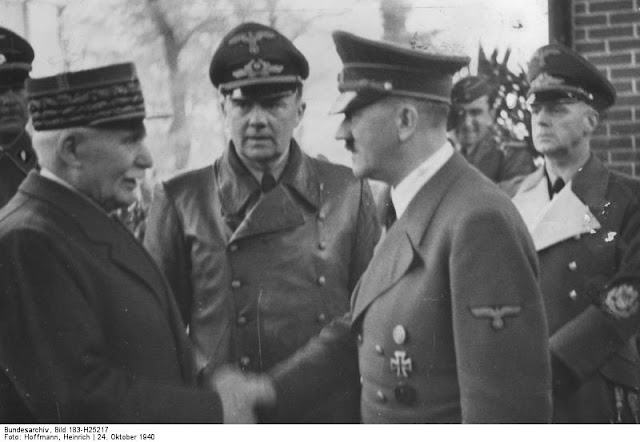
German Chancellor Adolf Hitler met with Vichy French leader Marshal Philippe Pétain at Montoire-sur-le-Loir, France. Pétain agreed to collaborate against Britain, in return for compensation in Africa and a high place in the New Europe. Pétain, however, refused to declare war on Britain.
Following his unproductive meeting with Franco at the Spanish border, Hitler travels to Montoire-sur-le-Loir and meets with Marshal Philippe Pétain. This location is both convenient to the main railway line from Berlin-Paris-Hendaye but also has a tunnel nearby in case of an air attack. That railway tunnel, in fact, has steel doors affixed to it for this meeting that still remain in the 21st Century.
Hitler is on much more solid footing with Petain than with Franco, but things do not go particularly well in this meeting. Yes, Petain does state that he is willing “to collaborate,” but those are just words that must be fleshed out with substance to have any real consequences. As in his meetings with Mussolini and other leaders, Hitler engages in long monologues while Petain says little. Petain says nothing that could be considered sympathetic to Germany. At the end of the meeting, Petain takes out a list of French demands for collaboration and sticks it in Hitler’s pocket.
The most important thing that happens at the meeting is that Petain says “no” when Hitler asks him to join the war against England. This is usually what the French take away from this meeting, that Petain “said no to Hitler.” However, to the Allies, collaborating alongside the Germans was almost as bad. French resources prove immensely valuable to the Reich’s war effort from this point forward.
There is also a feeling among some that Petain “stared Hitler down.” The story goes that Petain’s advisor, Rene Gillouin, had told Hitler to stare at him unflinchingly. This very basic trick supposedly unnerves Hitler. It is fair to say that modern French opinion about Petain is overwhelmingly negative, but there is an undercurrent of pride in the way he handled this meeting.
An interesting outcome in this meeting is in the way that Petain describes it a week later in a radio broadcast. On 30 October, he refers to “the new European order,” a phrase that resonates with one Ribbentrop has been using in secret communications with the Soviet Union (though there he uses “New World Order”). In that speech, Petain also states that he will “enter today the path of collaboration.” While Montoire is not the start of a new war for France, it is the beginning of the long, dark collaborationist journey that blackens the name of the Vichy regime. In that sense, the meeting constitutes an overwhelming success for Hitler.
Mussolini is outraged that Germany has been dickering with Spain and France behind his back without offering him (and Italy… of course) any stroking at the same time. “Since this is how it is going to be,” he has ordered his Foreign Ministry to start making noises about Italian demands for further cooperation — including cession by France of large stretches of the French coastline stretching clear to Marseilles.
The Italians hint darkly that Petain and de Gaulle are actually in cahoots to hoodwink Hitler and demand numerous territorial and economic demands to be imposed upon France, including her overseas colonies. Basically, Spain and Italy now both want to dismember France to their own benefit — or, put more accurately, they want Hitler to do it for them.
Having, at last, realized that Italy — or at least Mussolini — is acting like a spurned lover over the German wooing of Spain and France, German Foreign Minister Ribbentrop (traveling with Hitler in his own separate train) springs into belated action. Ribbentrop calls his Italian counterpart, Count Ciano, during the evening. The call does not go well — Ciano conveys his “fears and suspicions” that Germany is about to sell out its staunch ally Italy in favor of the French and Spanish floozies. Ribbentrop immediately drafts a letter which summarizes the current situation:
— The talks with Spain had failed;
— France was willing to cooperate with Germany (how far he does not explain, and in fact that remains an open question);
— Hitler would soon send Mussolini a letter of his own summarizing matters and would like to set up another meeting with Mussolini ASAP in northern Italy.
Ribbentrop’s sudden agitation about the Italian situation is underlined by the extreme speed with which he prepares this soothing letter (Ribbentrop is notorious for going through numerous drafts): he stays up all night and has the letter typed out on the large-lettered “Fuhrer typewriter” and approved by Hitler in the early morning hours (also a sign of how sensitive the matter is). The signed letter is at the Foreign Ministry for delivery before daylight. Sent by a fast courier plane, Ribbentrop’s letter is in the hands of German ambassador Mackensen in Rome by 08:00 on the 25th, only about 12 hours from start to finish. He just could have, you know, called a florist and sent over some roses instead.
The Italian Air Corps saw its first action during the Battle of Britain.
Taking a much different route than France, Belgium opens a government-in-exile in London. It is led by Hubert Pierlot and Paul-Henri-Spaak, who only recently escaped from detention in Francoist France, and Camille Gutt. The new government quickly declares war on Italy for operating air missions from Belgian airfields.
The recent call to outlying cities to supply buses to London produces its first results. The first provincial buses appear on London streets. Driving in London is increasingly dangerous due to the deteriorating streets and the continued need for the blackout. You never know when a recent bomb hit may have left some debris in the road, and that is tough to see in the dark. Ultimately, about 2000 buses will go into service to keep the capital functioning.
British Summer Time was extended through the winter.
The U.S. State Department cautions the Vichy government not to permit the Germans to use French warships.
Protestant churches in France protest against dismissal of Jewish civil servants.
The expected departure of Ambassador Joseph P. Kennedy from Lisbon, Portugal, for the United States was delayed yesterday by a twenty-four-hour postponement of the Atlantic Clipper’s scheduled flight because of unfavorable weather.
The exiled former King Carol of Rumania, detained in Seville, Spain, with red-haired Mme. Magda Lupescu, sought today through a faithful follower to put himself under the “protection” of President Roosevelt. Jean Pangal, one-time Rumanian minister to Lisbon and now the harassed ex-monarch’s personal representative, asked Warden M. Wilson, the United States Charge D’Affaires here, to appeal to Mr. Roosevelt for help in Carol’s behalf. Specifically requested was the president’s intercession to induce the Spanish authorities to allow Carol, Madame Lupescu, and his former palace minister, Ernst Urdareanu, to come to Portugal. They have been promised asylum here and Carol, in turn, has pledged himself to remain here throughout the war and to refrain from all political activity.
Reports were released today of two successful British patrol actions, one of which left fifty Italians dead and 400 wounded in the Kassala sector on the Sudan-Eritrean border area.
Air Marshal Dowding, still in charge of Fighter Command on 24 October 1940 despite being targeted for removal, remonstrates with AVM Keith Park at No. 11 Group, telling him to cut AVM Leigh-Mallory some slack at No. 12 Group. Leigh-Mallory has been dilatory in responding to requests for assistance over London, standing firm in his commitment to the “Big Wing” strategy which takes longer periods of time to assemble. Relations between the leaders of the two groups continue to deteriorate, and Dowding is helpless to smooth over their differences.
During the day, poor weather restricted German efforts against Britain, limiting missions to that of reconnaissance only; one Do 17 bomber was shot down on such a mission. Overnight, London and Birmingham were bombed.
The weather remains poor for flying, rainy and low-hanging clouds. However, this is an important day in the Battle of Britain because the Italians join in. They are based in Belgium, the zone of Luftflotte 2, and engage in operations with them against Harwich and Felixstowe after dark. The standard Italian fighter is a biplane long past its prime, and Italian bombers are 1930s tri-motor marvels that are, by late-1940 standards, lumbering and inadequately armed. Handled properly, though, they can be effective.
The morning is extremely quiet. A Dornier Do 215 reconnaissance plane is shot down over St. Neots by a Hurricane of RAF No. 1 Squadron around 11:00. That is about the only activity until the afternoon.
Around 14:30, the Luftwaffe sends across a small formation of Dornier Do 17s. They attack Hayes and damage the Farley Aviation Company.
As has been happening quite a bit lately, the weather causes some casualties. Two Hurricanes collide in the clouds near Taunton. One pilot is killed, the other plane, which only suffered damage to its tail, makes it back to base. The third Hurricane of No. 43 Squadron crashes upon landing due to fierce cross-winds, killing pilot Sgt. D.R. Stoodley. Another Hurricane of No. 303 Squadron crashes during dog-fight exercises.
After dark, the primary targets are London, Liverpool, and Manchester. The raids begin around 19:00 and come from all along the Channel coast. In London, New Street Station is engulfed in flames. Bombing accuracy in the iffy weather is poor, and bombs drop at random. The RAF somewhat charitably figures that the Luftwaffe was aiming for water mains and the like, and indeed there are some lucky hits. The Luftwaffe also continues mining the Thames Estuary and all along the eastern coastline.
The Italians send twelve BR.20Ms of 13o Stormo and six from 43o Stormo against Felixstowe and Harwich. They get off to a bad start when one of the bombers crashes shortly after takeoff near the church at Houtem, Belgium. Ten of the bombers make it to the target and drop their bombs, but two get lost on the way back and the crews have to bail out. A third bomber lands at the wrong airfield (Lille-Epinoy), damaging the aircraft. Only 8 of the 12 bombers sent off manage to return to their original base.
Losses for the day are low — assuming that you do not include the Italian bomber losses — at about 8 for the Luftwaffe and 4 for the RAF.
Hurricane V7303, No. 43 Squadron
Sgt. D.R. Stoodley killed. Dusk-flying accident at base. Made six attempts to land cross-wind and finally stalled at 250ft.
Hurricane P3404, No. 87 Squadron
P/O D.T. Jay killed. Collided with P/O Cock during routine patrol. Pilot baled out but believed to have hit the tailplane as he did not pull ripcord.
Hurricane V6807, No. 303 Squadron
P/P J. Bury-Burzymski killed. Crashed during dog-fight practice.
Italian General Corso Fougier has his Corpo Aereo Italiano (CAI, literally, “Italian Air Corps”) HQ in Petite Espinette of Rhode-St-Genesis (between Brussels and Waterloo) and other operations are based at Evere airfield. The Italians operate under the command of II Fliegerkorps.
RAF Bomber Command dispatches 15 Blenheims on daylight sea and coastal sweeps. 5 aircraft bombed various targets. No losses. Bomber Command attacks shipping off Zeebrugge, industrial targets around Calais, and the ports of Gravelines and Ostend.
RAF Bomber Command dispatches 113 aircraft to many targets overnight. 1 Wellington was lost and a Whitley of 102 Squadron was shot down by a German aircraft while taking off from Tholthorpe. The RAF launches the first attacks on Berlin which produce extensive civilian casualties. Other targets include oil installations at Hamburg, Hanover, and Gelsenkirchen; the ports of Hamburg, Bremerhaven, Cuxhaven, Wilhelmshaven, Rotterdam, Le Havre, and Lorient; and various airfields in northwest Europe. Hamburg reports describe a particularly sharp raid on this night. The Wellington force attacking this target found that cloud conditions prevented observation of bombing results but 13 fires were started, of which 5 were large ones — 3 people were killed, 20 injured and 217 bombed out of their homes. A wooden dockyard warehouse was completely destroyed by fire but 18 loaded railway wagons were removed safely. The compensation claimed for damage in Hamburg on this night was nearly 3 million Reichsmarks (£300,000). 5 further Hampdens laid mines off Brest and there were 7 O.T.U. sorties. No losses.
The RAF bombs Italian supply lines in both Libya/Egypt and East Africa. Also attacked are Benghazi, Berka, Gura, and Asmara. Swordfish flying out of Fuka lay mines in Tobruk Harbor.
In Malta, there is an air raid alert around noontime. As they often do, however, the Italian raiders stay far off the coast, circle for a while, then return to base. It is a curious routine, perhaps the pilots are not interested in actually attacking the island but want to make it look like they did to their superiors. The citizenry on the island shows increasing signs of anti-Italian sentiment, with many wishing to change street names and accusing neighbors of being secret Italian sympathizers. The sight of Italian POWs also sets off many residents.
Things at sea continue to quiet down after the massive destruction recently visited upon Convoys SC 7, HX 79 and elsewhere. The U-boats are returning to port for re-stocking — but they will be back. It is this stage of the war — the “Happy Time — that the Kriegsmarine would most benefit from having more U-boats of ocean-going design.
At 1135 three miles southeast of Barrell of Butter, Hunt-class escort destroyer HMS Mendip (Lt Cdr G. N. Rolfe DSC) was damaged by the explosion of one of her depth charges. Destroyer Mendip’s stern was blown off and she was taken to Scapa Flow for docking and temporary repairs from 24 October to 7 November when the destroyer was undocked on 7 November. Destroyer Mendip underwent four more days of repairs prior to departing Scapa Flow. Destroyer Mendip was towed by tug HMS Champion at 0900 on 11 November escorted by anti-submarine trawler HMS Loch Tulla south for repairs. The destroyer arrived in the Tyne at 1510 on 13 November for repairs completed on 17 February 1941.
Due to the mining of destroyer HMS Mendip, movement in the Flow was prohibited and the forces returning from the Norwegian coast were delayed in entering harbor.
Anti-aircraft cruiser HMS Curacoa transferred from convoy HX.79 A to OA.234 off the Firth of Forth.
Destroyer HMS Foxhound departed Sheerness at 1330 after repairs. The destroyer arrived at Scapa Flow at 1800/25th.
Fleet Air Arm Swordfish aircraft flying from shore bases in North Africa, bombed Tobruk and mined the harbor
Destroyer HMCS Annapolis damaged by a boiler room fire. Annapolis was under repair in Halifax until the end of Jan 41 & again from Mar 41 until the end of May 1941. The unfamiliar boiler systems of the Town-class destroyers made them a substantial Maintenance problem for the RCN. Several members of the group suffered engineering fires & other breakdowns due to improper operation by their novice Canadian crews (and their own poor physical condition).
German steamer Helgoland (3664grt) departed Puerto Columbia, Colombia for return to German waters. Steamer Helgoland was able to evade patrolling US destroyers Bainbridge (DD-246), Overton (DD-239), Sturtevant (DD-240) and passed the Antilles near St Thomas on 3 November. The U.S. destroyers pursued the Helgoland over the ensuing days but she made good her attempt to escape the confines of the Caribbean. Steamer Helgoland arrived at St Nazaire on 30 November.
Convoy OA.234 departed Methil escorted by anti-aircraft cruiser HMS Curacoa, sloop HMS Rochester, and corvette HMS Primrose from 24 to 26 October. The convoy rendezvoused with convoy OB.234. OA.234 was the last of the OA.series.
Convoy OB.234 departed Liverpool escorted by destroyer HMS Arrow, corvettes HMS Geranium and HMS Heartsease, and anti-submarine trawlers HMS Lady Lillian and HMS St Apollo. On 26 October, anti-aircraft cruiser HMS Cairo, sloop HMS Rochester, destroyer HMS Amazon, corvette HMS Primrose joined the escort. Anti-submarine trawler Lady Lillian was detached on the 27th, anti-aircraft cruiser Cairo and destroyer Amazon were detached on the 28th, the remainder of the escort departed on the 30th.
Convoy FN.318 departed Southend, escorted by destroyers HMS Vanity and HMS Wolfhound. The convoy arrived at Methil on the 26th.
Convoy FS.319 departed Methil, escorted by destroyer HMS Vivien and sloop HMS Londonderry. The convoy arrived at Southend on the 27th.
Convoy HX.83 departed Halifax at 1230 escorted by Canadian destroyers HMCS Assiniboine and HMCS Columbia and auxiliary patrol boat HMCS Elk. At 1730/25th, the destroyers turned the convoy over to ocean escort, armed merchant cruiser HMS Ascania and returned to Halifax. The armed merchant cruiser was detached on 2 November. On 4 November, destroyers HMS Active, HMS Beagle, HMS Hurricane, HMCS Saguenay, HMCS Skeena, and HMS Wild Swan and corvette HMS Picotee joined the convoy. Destroyers Saguenay, Skeena and Wild Swan were detached on 5 November and destroyer Active on 6 November. The convoy arrived at Liverpool on 7 November.
Convoy SC.9 departed St Johns escorted by auxiliary patrol vessel HMCS Elk and Sloop HMS Deptford. The patrol vessel was detached on the 25th. On 4 November, corvette HMS Gentian joined the convoy. On 5 November, destroyers ORP Garland, HMCS Saguenay, HMCS Skeena, and HMCS St Laurent joined. Corvette HMS Mallow joined on 7 November. The convoy arrived at Liverpool on 7 November.
In Washington today, President Roosevelt conferred on the foreign situation with Secretary Hull and later with General George C. Marshall, Chief of Staff, and Robert P. Patterson, Assistant Secretary of War. In a letter to Representative McCormack he approved pending legislation which would give jurisdiction over inspection of coal mines to the Interior Department.
The Senate received nominations of thirteen State Selective Service Directors, heard Senator Holt request an explanation of the proposed purchase of the steamship President Harding for use as a troop transport and recessed at 12:10 PM until noon on Monday.
The House transacted no business and adjourned at 12:06 PM until noon on Monday.
Against foreign propagandists whom he accused of seeking “to divide us with their strategy of terror,” President Roosevelt today hurled Abraham Lincoln’s declaration of a faith that “right makes might.” While the Civil war president’s statement of faith gives the American answer to these propagandists, Mr. Roosevelt said in a radio address, the nation is not neglecting its might. Rather, he asserted, it is arming to defend the Americas and the oceans serving as their highways.
Returning today from Philadelphia, President Roosevelt started speculation by calling into conference at the White House Secretary Hull, and then summoned Robert P. Patterson, Assistant Secretary of War, and General George C. Marshall, Chief of Staff, for a talk in the afternoon.
Wendell L. Willkie last night, in an address at Akron, Ohio, described the new deal concept of collective bargaining as “reactionary” and said he wanted “to put an end to this era of bad feeling” between labor and industry. Earlier, answering President Roosevelt’s Philadelphia speech, the G.O.P. candidate charged that the new deal had written a record “of broken promises and failures of performance.”
Henry A. Wallace, Democratic candidate for vice-president, asserted in an address at Detroit that election of Willkie would weaken America’s defenses. He charged that the Republican party offers no security for the future of the nation.
Herbert Hoover, declaring that his successor, Franklin D. Roosevelt, had obtained extraordinary powers which point to “an American breed of totalitarianism,” said at Columbus, Ohio, that the new deal is creating an economic system which drifts “down the suicide road of national socialism.” Viewing the third term tradition as a check upon personal power which he said President Roosevelt had built “to a dangerous point,” the ex-president urged election of Willkie.
A compilation of official and unofficial estimates of registrations and polltax payments in the forty-eight States indicated today that the American electorate might cast its biggest vote in history on November 5, roughly 50,000,000.
The U.S. Fair Labor Standards Act of 1938 comes into effect, including the minimum wage, and 44-hour workweek. The same basic scheme, now with a 40-hour workweek, has been in place ever since.
Production of war planes in the United States for defense and for British requirements has been speeded up Secretary Morgenthau said today at his press conference.
A thorough reorganization and expansion of the Army Air Corps to make it competent to defend any part of the Western Hemisphere was announced today by the War Department. The tour wings in continental United States (besides one wing each in Hawaii and the Panama Canal Zone) will be increased to seventeen wings, as fast as trained personnel and equipment become available. The present twenty-five combat groups are to be increased to fifty-four, more than doubling the air fighting service, and necessary increases in ground personnel will be made.
The fifty-four combat groups are to be provided with 12,800 planes of all classes and types, plus a small reserve, and plus planes needed for basic and advanced flying training. They are part of the 18,000 planes on the aviation expansion program already contracted for or received. The program is scheduled to be completed late in 1942, but Air Corps officers said today that they expected the 12,800 planes to be completed sooner. The reorganization calls for an increase in annual output of trained pilots from 7,000 to 12,000. Enlisted Air Corps personnel is to be increased from 45,000 to 163,000. The Air Corps must also increase its technical training facilities to provide trained personnel.
More attempts at sabotage are to be expected in this country than took place in the last war, Secretary Stimson said today in emphasizing the usefulness of the home defense forces to be created by authority of the State guard bill signed by President Roosevelt on Monday.
The U.S. Navy light cruiser USS St. Louis arrived at Hamilton, Bermuda with the Greenslade Board aboard.
The U.S. Navy heavy cruiser USS Louisville departed Rio de Janeiro, Brazil bound for Montevideo, Uruguay as she continued “showing the flag” in Latin American waters.
A Russo-Japanese non-aggression treaty, preliminary to a broad general accord between the two powers, probably will be signed shortly, diplomatic observers predicted tonight after arrival of the new Japanese ambassador, Lieut. Gen. Yoshitsugu Tatekawa. It was understood preliminary conversations looking to the agreement already have been completed here and in Tokyo. The Moscow negotiations were started early this month between the retiring Japanese ambassador, Shigenori Togo, who now is returning to Tokyo, and Premier and Foreign Commissar Vyacheslav Molotov and other Soviet statesmen. Parallel negotiations were under way at the same time in Tokyo between the Soviet embassy and the Japanese foreign office. Diplomats said the conversations so far have been held in a friendly and cordial atmosphere and predicted that General Tatekawa’s mission will result in an era of Russo-Japanese friendship.
Japan’s Autumn offensive in East China has ended in failure, with Japanese troops suffering at least 10,000 casualties in Chekiang, Anhwei, and Kiangsu provincial border districts south of the Yangtze River, a Chinese military spokesman said today. It was also claimed that, despite daily Japanese aerial bombardments of the reopened Burma Road, 200 Chinese trucks which made a dash from Lashio, Burma, had reached Kunming. Yunnan Province, Tuesday. Japanese aerial attacks have failed to halt the flow of traffic over the Burma Road, the spokesman said. No damage was suffered by the trucks, despite numerous air-raid alarms. The trucks are said to have carried munitions, gasoline and electrical supplies.
Neutral representatives have extended feelers directed toward negotiating a peace in the three-year-old Japanese conflict with China, apparently well grounded reports said today. Influential Chinese, not connected with either the Chinese Government at Chungking or the Japanese-sponsored Nanking regime, were understood to have established contact with the Japanese, first in Hong Kong and later in Tokyo, to sound out the possibilities of ending the conflict.
There were indications here that Japan was willing to employ Premier Prince Fumimara Konoye’s statement of December 12, 1938 as a basis for possible negotiations. In that statement, the Prince promised that Japan would respect Chinese sovereignty, discuss abolition of extra-territoriality and would not demand either territory or indemnity from China. In return, the statement said. Japan would ask for Chinese economic and political cooperation.
Japan eliminates U.S. terms (strike, play ball) from baseball.
Some of the 110 military airplanes built for the Swedish Government and requisitioned this week by the United States will not be used for advanced training purposes as at first announced. Instead, they will go to the Philippines to bolster defenses there.
Dow Jones Industrial Average: 131.36 (-1.04)
Born:
David Sainsbury, English billionaire, politician (House of Lords, 1997-2021), philanthropist, and Chancellor of Cambridge University (2011-), in England, United Kingdom.
Naval Construction:
The Royal Navy Bar-class boom defense vessel HMS Barclose (Z 174) is laid down by the Blyth Shipbuilding & Drydock Co. Ltd. (Blyth, U.K.).
The Royal Canadian Navy Flower-class corvette HMCS Dauphin (K 157) is launched by Canadian Vickers Ltd. (Montreal, Quebec, Canada).
The Royal Navy Thornycroft 55 foot-class motor torpedo boat HMS MTB 213 is commissioned.
 History Diaries