German Chancellor Adolf Hitler and Vichy France Vice-President of the Council Pierre Laval conferred at Montoire, France where he offered his collaboration. Laval also arranged a meeting to be held two days later at which Vichy French leader Marshal Philippe Pétain pledged the collaboration of the French State as well. Adolf Hitler received Vice-Premier Pierre Laval of France in French territory; today, it was announced officially tonight, climaxing indications of a developing attempt to mass the surviving French warships with those of Germany and Italy for a showdown with the British fleet. But 84-year-old Marshal Henri Philippe Petain, damned for surrendering France to the Germans, may have thrown a monkey-wrench into Adolf Hitler’s plans for the “final assault” on Britain. Hitler and swarthy-faced Pierre Laval, pro-Nazi No. 2 man of the Petain regime at Vichy, met in or near Paris Tuesday in a conference that may well have been a direct result of Petain’s stubborn stand. Laval and some other of the more pro-German members of the Vichy regime were willing to agree to Hitler’s plan under promise of Nazi leniency when it comes time to draw up a permanent peace treaty between Germany and France but Marshal Petain, supported by former Allied Generalissimo Maxime Weygand, was said to have refused.
Having traveled somewhat leisurely on his Special Train (Führersonderzug) “Amerika” from Berlin to France, Adolf Hitler at 18:30 meets at Montoire-sur-le-Loir with French Vice-President of Vichy’s Council of Ministers Pierre Laval. Conferring with Hitler and German Foreign Minister Ribbentrop an hour later, Laval is non-committal about signing any documents but expresses his personal willingness to work (collaborate) with the Germans. The conference is encouraging for Hitler but does not provide Ribbentrop with any opportunities to have Laval sign the agreement he has brought which would create a formal alliance between Germany and France on economic, political, and military grounds. Anything along those lines obviously would have to be approved (and signed) by Marshal Petain, with whom Hitler will meet on his return trip.
Some like to portray this meeting as a German “failure” to form an alliance with France. Perhaps, but that really is vastly overstating matters. Instead, the meeting is inconclusive. Laval has no real power. All power in Vichy France resides in Petain, who can dismiss him or anyone else at will. Hitler stays the night at Montoire in his train before proceeding to his meeting with Spanish leader Franco at Hendaye.
On the same day that Hitler is conferring with Laval, Petain’s representative Louis Rougier arrives in London from Vichy to discuss Anglo-French reconciliation.
Hubert Pierlot, Belgian Premier, and Paul-Henri Spaak, Foreign Minister, arrive in London by airplane from Lisbon. After being imprisoned by the Francoist regime at the Hotel Majestic in Barcelona, they had escaped Spain recently by hiding in a truck and then crossing the border to Portugal (Their escape is still commemorated at the Hotel Majestic with a plaque.). Lisbon is a well-known destination for fugitives, providing one of the few safe (relatively) conduits between the German and British orbits due to the truly neutral attitude (extremely rare in Europe) of Portuguese leader António de Oliveira Salazar. Their new digs are the Carlton Hotel in London.
The German railways are preparing to run 75 special trains between now and the end of October for the removal of children from Berlin to other parts of the Reich and especially to the eastern provinces. Families in those areas have been asked to volunteer to receive one or two children.
Benito Mussolini set the date of the invasion of Greece to 28 October 1940. He had decided to attack Greece without informing Germany, as Germany had a history of starting wars without sharing advance information with Italy.
Mussolini previously has asked King Boris III to participate in the invasion of Greece. This would stretch Greek forces out by requiring them to defend two widely separated fronts. King Boris, however, declines.
Mussolini has the Regia Marina form a “Special Naval Force” for a landing on Corfu contemplated at the end of the month (later canceled). This includes cruisers, numerous destroyers, landing craft, and other supporting units.
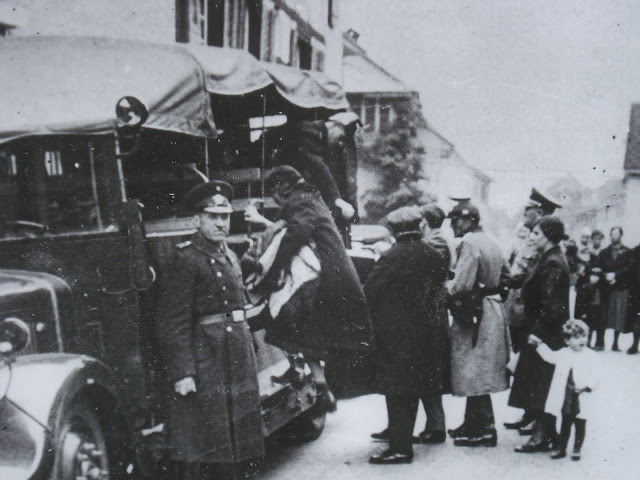
Aktion Burckel: 29,000 Jews in Alsace-Lorraine, Saarland, and Baden were deported to Southern France. The German government deports more than 15,000 German Jews from the Rhineland to several internment camps in France, at the foot of the Pyrenees. Terrible conditions in these camps result in the deaths of nearly 2,000 deportees.
Aktion Wagner-Burckel (often referred to as just Aktion Burckel) begins. This is an operation in the German frontier wine region begun by Gauleiters Robert Wagner of Baden and Josef Burckel of the Saar and Pfalz (now, in 1940, reworked together as Westmark). Deportation begins of almost 30,000 Jews from the German-occupied zone of France to the Vichy-controlled area, basically expelling them from the Reich. They are not much safer there — but anything is better than Poland. Burckel, in particular, is a virulent anti-Semite who has been working to achieve his schemes since Hitler first came to power in 1933.
Early in the morning, teams of police fan out and pound on doors. They have lists of names of everyone to be deported, secretly compiled in July 1940 shortly after the fall of France. Everything is done by a strict timetable: victims are told how much time they have to pack, what they could bring with them (not much), and how their remaining property left behind was to handled. Pets are given to neighbors and receipts for them obtained. It is all very orderly and brutal.
Burckel’s and Wagner’s motivations are to “cleanse” or “sterilize” the frontier region of both Jews and its historical culture so that it may be absorbed as just another nondescript region of the Greater Reich. Partly, they aim to stamp out “Landesgeschichte,” or regional identity/history, and replace it with “Volksgemeinschaft,” or “common history of the people.” This attitude flows from the fact that, in the past, all of Germany had been composed of local fiefdoms, and the idea of a national, as opposed to regional, identity is new in the grand scheme of things. This type of “cleansing” later also will be undertaken by Reinhard Heydrich in the provinces of Bohemia and Moravia (formerly Czechoslovakia), with mixed success (people tend to protect their own history). The Aktion Wagner-Burckel operation will continue for a year and basically achieve the “cleansing” ends to one extent or another for the duration of the war.
Speaking of Poland, some pinpoint 22 October 1940 as the true establishment of the Warsaw Ghetto. Hans Frank has been working on that all year long, and it has been a gradual process with several dates possible as the true “beginning” of this walled-off community.
After evading French and Spanish authorities, Belgian prime minister Hubert Pierlot arrived in London, marking the beginning of the Belgian government in exile.
High Rumanian authorities tonight confirmed that Colonel Josef Beck, former Polish foreign minister, had been arrested at the frontier and now is being held by Rumanian authorities.
Joseph Stalin accepted Joachim von Ribbentrop’s invitation for Vyacheslav Molotov to visit Berlin, Germany.
British Ambassador to Moscow attempted to distance the Soviet Union away from Germany.
At Malta, Governor Dobbie works on getting gas masks and related equipment. Recent reinforcements are unprotected and vulnerable. The basic problem, of course, is that getting any supplies at all to Malta is extremely hazardous and costly for the Royal Navy.
Charles de Gaulle reviews troops in Cameroon.
As the heavy fog dissipated in the afternoon, two German fighter sweeps attacked southern England, United Kingdom; 3 German fighters and 6 British fighters were shot down. Overnight, London, Liverpool, and Coventry were bombed; Coventry suffered 150 fires.
The weather remains poor throughout the day of 22 October 1940, only clearing up a bit in the afternoon. On days like this, simply flying can be almost as dangerous as encountering the enemy. The Germans lose a handful of planes (and pilots) to crashes caused or aided by the weather. While offensive operations are curtailed, those that do occur generally face little opposition, as interceptions are extremely difficult in the wet, cloudy air.
During the morning, there are some pirate raids and the like. Eastbourne is hit at about 10:30, killing two and injuring 16. A stick of bombs may not destroy anything industrial of strategic value, but it can wipe out a neighborhood in an instant.
Around 14:00, the Luftwaffe mounts its largest raid of the day. A few dozen fighter-bombers (Jabos) cross over toward London. RAF Nos. 74 and 605 Squadrons intercept, and bombs fall on RAF Brockworth, where there are two dead and 32 injured.
Other, smaller raids take place throughout the afternoon, including a large raid around 16:00. Many of the raiders turn back before attacking due to the weather, others head for the usual airfields around London such as Biggin Hill and Hornchurch. The two top Luftwaffe fighter formations, JG 26 (Galland) and 51 (Molders) are in action, and the RAF sends up eight squadrons to intercept. It is one of Werner Molders’ best days, as he claims three Hurricanes to bring his score to 50, tops in the war to date.
The night raids on London are notable for how small they are in comparison to other raids since the start of the Blitz on 7 September. Many call this the easiest night of the Blitz. The bulk of the raids occur right after darkness sets in between 18:30 and the next few hours. Coventry is hit hard, suffering 150 fires and extensive damage to goods yards and factories. KGr 606 Dornier Do 17s bomb Liverpool at about 20:30, but the damage is not as great as at Coventry. Bombing accuracy is especially poor on a poor-weather night like this, and a lot of damage is avoided when bombs drop in undeveloped areas.
Total losses for the day are minimal. The RAF loses a handful of planes (4 pilots killed) and the Luftwaffe roughly the same number of Bf 109s.
British Losses:
Hurricane R4074, No. 46 Squadron
Sgt. J.P. Morrison killed. Shot down in combat with enemy fighters over Dungeness
Spitfire P7431, No. 74 Squadron
F/O P.C.B. St.John killed. Shot down in combat with Bf 109s.
Hurricane R4195, No. 257 Squadron
P/O N.B. Heywood killed. Hit by anti-aircraft fire whilst in combat with Bf 109s over Folkestone.
Hurricane V6851, No. 257 Squadron
Sgt. R.H.B. Fraser killed. Shot down in combat with Bf 109s over Folkestone.
Unexploded bombs remain a real problem. They are everywhere in major cities, and it can take weeks to address them. Meanwhile, they sit silently, nobody knowing if they will suddenly go off — and this includes some large land mines. At Seal, a bomb disposal officer working on such a bomb that had sat quietly for three weeks does something wrong with the fuse as he is working on it, and the bomb goes off — no trace of the body anywhere.
The Luftwaffe loses two Focke-Wulf FW 200C-1 Condors at sea near Ireland, one while attacking a ship near Cape Clear.
The coastal guns at “Hellfire Corner” (the Dover Strait) exchange a few shells between 07:50 and 09:04. While not achieving much strategically, the German shelling does make life worse for many in Dover. The occasional “lucky hit” destroys numerous houses and cuts roads. Today, 30 houses suffer light damaged and four people are lightly injured, while the A259 road to Folkestone is hit and partially closed. It is a “keep calm and carry on” situation.
Werner Mölders claimed his 50th victory.
RAF Bomber Command dispatches 1 Blenheim during the day which claimed bomb hits on a cargo ship off the Hook of Holland.
The weather continues to be poor, so RAF Bomber Command does not get in the air during the night.
A series of low-flying attacks by British bombers on Italian working parties and transport columns along the Egyptian coast yesterday caused extensive damage, the air ministry announced tonight.
The Italian Air Force raids Alexandria with fifteen S-81 bombers.
The South African Air Force raids Birkau in Italian East Africa. This is the fifth time they have done this.
Canadian destroyer HMCS Margaree (Cdr J. W. R. Roy RCN), which had departed Londonderry on the 19th with the five ship OL.8 convoy as her first mission as an RCN ship was sunk in a collision with British steamer Port Fairy (8337grt) in 53-24N, 22-50W. Destroyer Margaree was former Destroyer HMS Diana transferred to the Canadian Navy on 6 September. Most of the crew were survivors from the destroyer HMCS Fraser. Cdr Roy, Lt A. E. McMurtry RCNVR, Temporary Lt R. C. Pope RCNVR, Commissioned Gunner B. A. Lewis, 138 ratings were lost with Margaree. McMurtry, Pope, Lewis and eighty three of the ratings were survivors of the destroyer Fraser. Lt W. M. Landymore and Acting Temporary Surgeon Lt T. B. McLean RCNVR which were also survivors from destroyer Fraser, Lt P- F. X. Russell, Lt F. C. Smith RCNR, Acting S/Lt R. W. Timbrell, Commissioned Engineer E. J. Sawdy, twenty eight ratings survived the sinking, but two ratings were lost during rescue efforts.
Destroyers HMS Somali, HMS Matabele, and HMS Punjabi departed Scapa Flow at 1120 for Sullom Voe and then for operation DNU. On arrival in Yell Sound, the destroyers were ordered to remain at sea to search for a U-boat reported in 60-00N, 6-47W. They proceeded to Muckle Flugga. They carried out a patrol eastward of the Shetlands in the longitude of 00-30W due to a possibility of invasion that night. At dawn, they returned to patrol off Muckle Flugga.
Naval trawler HMS Hickory (505grt, Lt R. E. Harding RNVR) was sunk on a mine south of Portland in the English Channel. Temporary Lt C. W. Jackson RNVR, Temporary Lt E. K. Karlsen RNR, twenty two ratings were lost on the trawler.
German destroyer Beitzen, which departed Wilhelmshaven on the 20th, arrived at Brest.
The Italian “Special Naval Force” was formed with old light cruisers Bari and Taranto, destroyers Mirabello and Riboty, torpedo boats Calatafimi, Castelfidardo, Curtatone, Monsambano, Confienza, Solferino, Prestinari, Cantore, Fabrizi, Medici, and Stocco, armed merchant cruisers Ramb III, Capitaino Cecchi, Lago Tana, and Lago Zuai, four MAS boats of the 13th Flotilla, and three landing ships of the SESIA type. Italian torpedo boats Antares, Altair, Andromeda, and Aretusa of the 12th Torpedo Boat Division was assigned as a fighting force to support the operation. This force was formed for a landing on Corfu. The force departed on the 31st, but on 1 November, the orders were changed to land troops at Valona instead and the Corfu operation was cancelled.
Convoy OA.233 departed Methil escorted by anti-aircraft ship HMS Alynbank on 22 and 23 October, sloop HMS Aberdeen and corvette HMS Gardenia from 22 to 24 October. The convoy rendezvoused with convoy OB.233.
Convoy FS.317 departed Methil and arrived at Southend on the 25th.
Convoy SLF.52 departed Freetown escorted by armed merchant cruiser HMS Dunnottar Castle to 8 November. The convoy rendezvoused with convoy SL.52 on 5 November. On 6 November, destroyers HMS Castleton, HMS Vanquisher, HMS Viscount, and HMS Whitehall and corvette HMS Fleur De Lys joined the convoy. Destroyers HMS Saladin and HMS Shikari joined on 7 November and were detached on 8 November. The convoy arrived at Liverpool on 10 November.
In Washington, President Roosevelt issued an executive order giving priority in private industrial plants to defense manufacturing requirements and signed a Congressional resolution providing that funds from the Oliver Wendell Holmes estate be used to publish a memorial volume of selected writings of the jurist and to establish the Oliver Wendell Holmes Garden near the Supreme Court Building. He conferred with Governor Herbert O’Connor on the Maryland political situation and announced at his press conference that he would make a political speech at the Brooklyn Academy of Music on November 1. The White House announced his itinerary for a trip to Delaware, New Jersey and Pennsylvania, with a speech at Philadelphia tomorrow night.
The Senate and the House were not in session.
President Roosevelt will make the first of his five scheduled political speeches tonight before a Democratic rally at Philadelphia’s Convention hall. It will be entitled “America Looks to the Future,” and will be broadcast over N.B.C. at 6:30 p.m. (P.S.T.) and C.B.S. at 6:15 p.m. Wendell L. Willkie will speak to the nation at 7:30 p.m. (P.S.T.) over C.B.S. as a feature of “National No-Third Term day.” Willkie, In an address at Chicago last night, demanded that the president tell the people whether he (Willkie) had “falsified the record” in contending that the New Deal failed to keep pledges for a sound currency, improved world trade, lower taxes and federal economy.
President Roosevelt said today that he saw no reason to revise his personal predictions on the result of the election. The expression of confidence came indirectly in reply to a question at a press conference as to whether the President had made a new guess about the outcome. The reporter who asked the question referred to Mr. Roosevelt’s recent statement that he had placed a prediction in a sealed envelope and filed it away three weeks ago. Mr. Roosevelt replied that if he should make another forecast today it would be substantially the same as the other.
Reports that he would make a campaign speech in Brooklyn, at the Academy of Music, on the night of November 1, were confirmed by the President. This speech displaces an address formerly scheduled for October 30, either in Washington or Baltimore, but he said he would keep the originally reserved radio time, either for his own use or that of someone else. Mr. Roosevelt smiled and remarked that it was good to have extra time up your sleeve. The President confirmed an announcement by his secretariat yesterday that he would not go to Baltimore, in response to an invitation by Wendell Willkie to share a platform already reserved by the Republican candidate for the night of October 30.
Asserting that President Roosevelt had repeatedly broken his promises to the American people, Wendell L. Willkie tonight challenged the truthfulness of the President’s assertion that he would do all he could to keep war away from the United States for all time. Speaking at the Chicago Stadium, where President Roosevelt was renominated for a third term, the Republican Presidential candidate recited a list of what he called broken pledges by Mr. Roosevelt, and after each specification addressed Mr. Roosevelt directly as “the third term candidate,” asking him if “Wendell Willkie” had falsified the record, as the President recently charged had been done. “That is the promise,” Mr. Willkie said of the President’s statement that he would keep war away from America. “My fellow-citizens, in the light of the record I challenge its truthfulness. The third-term candidate has not kept faith with the American people. How are we to know that he will begin to keep it now? “If his promise to keep our boys out of foreign wars is no better than his promise to balance the budget they’re already almost on the transports.”
Wendell L. Willkie and his wife were struck tonight by missiles thrown by a middle-aged man as they prepared to board their special train. Willkie suffered a slight bruise on the temple. Police immediately seized a man who gave the name of Charles Mulrain, 58, Chicago, and carried a social security card identifying him as a W.P.A. worker. Police Capt. Thomas Duffy said Mulrain denied the attack but added, “He’s a liar. I saw him do it.” The assailant threw the missiles as the nominee and his wife were about eight feet from the rear platform of their train. An apple or an egg struck Willkie directly on the temple, raising a slight bump. An egg struck Mrs. Willkie in the small of the back and splattered over her dress. A third egg struck the shoulder of a policeman. Willkie took the attack in stride, remarking: “I’m only disturbed that Mrs. Willkie was hit.”
Democratic Vice-Presidential Nominee Henry A. Wallace tonight inferentially endorsed Senator Robert M. LaFollette Jr., Wisconsin Progressive, for reelection, touching off an intra-party dispute in which four Democratic candidates for state office walked out on his speech. The endorsement, made after White House consultation, was seen as completing an alliance between the Democratic national organization and the Wisconsin state Progressive organization. But it caused immediate resentment among some state Democratic candidates.
Secretary of the Navy Frank Knox indicated today the United States may assume a more expanding role in the Pacific, asserting that “we have Pacific bases but we need more and we will have them.” “How far flung these must be awaits the outcome of events now in the making,” he added. Knox made the statement in an address before the annual New York Herald Tribune forum on current affairs. “A great, sea-going, far-ranging navy consists of more than ships and men,” Knox continued. “It must have bases from which to operate.” He did not disclose any details of what negotiations if any might be going forward for acquisition of additional bases, or in what parts of the Pacific these might lie. “Immense gains in sea power have already been made,” Knox added. Among these, he said, was the acquisition of eight new Atlantic bases which “added tremendously to our naval strength in the Atlantic, These, with those already held, make our Atlantic defense well nigh impregnable.” The bases were obtained by leases from Great Britain when the United States recently sent 50 destroyers to Britain.
The present war was described as essentially “a war of food and oil” by Colonel Frank Knox, Secretary of the Navy, in an address to 5,000 delegates to the tenth annual New York Herald Tribune Forum on Current Problems yesterday at the Hotel Waldorf-Astoria. Colonel Knox declared that if the war was one of long duration “the nation which controls the sea approaches to Europe holds an immense advantage.” He added that “sea power is British.” In the course of his address, Colonel Knox also asserted that the United States now had the “most powerful fleet afloat.” He characterized its enlisted personnel and commanding officers as “outstanding in the world.”
Mrs. Eleanor Roosevelt and other speakers at the same forum warned of the need for higher morale, both military and civilian. Mrs. Roosevelt suggested that if democracy was to survive, its fighting forces and civilians must be moved by faith in democracy matching the fervor of totalitarian youth which has supplanted religion. In addition, Mrs. Roosevelt advocated universal service “for improving the life of the community” as basic to national defense.
The German commerce raider Atlantis, disguised as the Dutch freighter MV Tarifa, fired upon, stopped and captured the 5,623 ton Yugoslavian freighter Durmitor in the eastern Indian Ocean near the Sunda Strait at 08-30S, 101-30E. The Durmitor was bound for Japan from Spain with a cargo of salt. When it was established that Durmitor had enough coal on board to get her as far as Japan, Captain Rogge decided to use the vessel as a prison ship. Rogge sent the Durmitor to a rendezvous point while the Atlantis sent into the Sunda Strait in search of a ship with provisions. Steamer Durmitor was renamed Radwinter and later sent to the Italian port of Mogadishu. When that port fell to British forces on 25 February 1941, Durmitor was returned to allied control. Allied crewmen on the steamer were freed.
Chinese regular and guerrilla forces battled Japanese armies over a 1,500-mile front from North to South China today and the Chinese reported victories at many points.
British subjects in Japan and Japanese-occupied areas of China have been advised to leave unless they have urgent reasons to remain, it was announced officially in London today.
Several high diplomats in Tokyo, the informants said, have told their home governments during the past week that Japan’s reaction to growing British-American solidarity in the Far East indicates that the Japanese feel they have lost the initiative in the Pacific, at least for the time being, and will delay any plans they may have had for early action in the Netherlands East Indies and elsewhere in new areas of southeast Asia. The fact that the head of the Japanese economic mission in the Netherlands Indies, Minister of Commerce Ichizo Kobayashi, has been called back to Tokyo was given as proof that the Japanese are at least delaying their efforts to force major concessions from the Dutch colony.
Heitaro Kimura was named the chief of staff of Kenkichi Ueda (Japanese Kwantung Army in northeastern China).
Dow Jones Industrial Average: 131.98 (+0.61)
Born:
Ernie Park, AFL guard and tackle (San Diego Chargers, Miami Dolphins, Denver Broncos, Cincinnati Bengals), in San Angelo, Texas.
Naval Construction:
The tanker Esso Trenton is acquired by the U.S. Navy. She will be commissioned the following day as USS Sangamon (AO-28).
The Kriegsmarine (German Navy) Type IXC U-boat U-68 is launched by AG Weser, Bremen (werk 987).
The Kriegsmarine (German Navy) Type IXB U-boat U-108 is commissioned. Her first commanding officer is Kapitänleutnant Klaus Scholtz.
 History Diaries