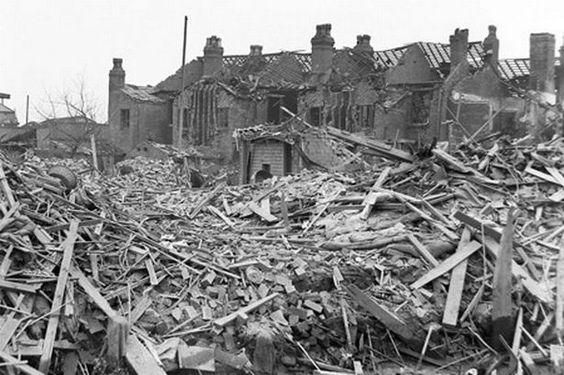
Hardly a man, woman or child was left today in this world’s largest city who had not known some form of the terror of German bombing. For some it was damage to their homes, their workshops, their churches, schools or streets. And for a great, great many it simply was a case of their world rocking and crashing about them. The unavoidable fact that London is taking a terrible thrashing no longer will be downed. On the other hand, any impression that London is in ruins is entirely erroneous. A couple of weeks ago one could scout through big areas in the metropolitan district without seeing a sign of damage. That no longer is the case, as a reporter determined today in a 60-mlle, four-hour tour to see how far the German air force had got in its six weeks of endeavor to execute Adolf Hitler’s threat of wiping London off the map.
Two ARP rescue workers who helped themselves to £16 they found in a bombed-out house were each jailed for 12 months at the Old Bailey in central London, England, United Kingdom for looting. Looting is always a problem in dire situations. Stiff penalties are in place to discourage it. Today, two Air Raid Precaution workers are sentenced to one year in prison at the Old Bailey for taking £16 from a bombed residence. A similar scene is portrayed in the film “Slaughterhouse 5” with somewhat difference consequences for the looter. Incidentally, while that seems like a small amount, it is roughly US$4200 in current value, so it wasn’t as if they just grabbed a few cups and saucers.
The Petain/Laval government prohibits the manufacture, export or movement of war materiel. This likely (but perhaps not) is due to Italian pressure, as the Italians are very concerned about French rearmament. Germany, on the other hand (specifically Hitler), desires (or at lease would not mind) a military buildup in France to assist in the war against Great Britain. At this point in the war, Italy is flexing its diplomatic muscles in what turn out to be counterproductive ways.
Francisco Franco appoints his Ramón Serrano Suñer as Foreign Minister. Suñer is the brother-in-law of Franco and has been acting unofficially in that role. He is widely viewed as pro-German, but later confesses a marked dislike of German Foreign Minister Ribbentrop. His background is in the EFE press agency and the large blind person’s organization ONCE.
German authorities ordered the establishment of Warsaw ghettos for Jews in occupied Poland.
The German embassy in Moscow is still translating German Foreign Minister Ribbentrop’s massive missive to Stalin about a New World Order. Ribbentrop is known to be wildly impatient about such delays and, if true to form, is bombarding the embassy with inquiries about when the job will be completed. It will not be ready until tomorrow.
Nine months of drought have ended, and soon the desert over which Marshal Rodolfo Graziani’s Italian legions must roll, if they are to reach Alexandria and Suez, will be a quagmire. The rains came yesterday, a lashing subtropical cloudburst. Parched land absorbed it quickly, but today it rained again. Bedouin tribesmen say that for two months we may expect rain. The Italians may still try to drive towards Alexandria, but moving armored cars and tanks through the mud would be virtually impossible, and they have had difficulties enough as it is to supply their forces. The British, on the other hand, have solidly reinforced the railway line which stretches from Matrah to Alexandria and will have considerably less trouble maintaining their front lines. The Italians still hold a 70-mile strip of coastline within Egyptian territory, and for the last month have been consolidating their position by building a road.
In London, the British War Cabinet decides to send three battalions to Malta to shore up its defenses. Additional anti-aircraft artillery also will be sent from the UK. Additional air units (12 Hurricanes) will be transported from HMS Argus and half a dozen Genn Martin reconnaissance plans will fly in on their own. Generally, the plan is to make Malta more of an active base and not just an isolated and vulnerable outpost. At this time, the Axis does not have much interest in Malta.
Anthony Eden begins a tour of Middle East Command in Egypt. Eden, British Secretary for War, has arrived in Egypt and is having converastions with the Middle East commander, General Sir Archibald Wavell.
Heavy fog during the day limited operations, thus the day’s losses were limited to 1 German aircraft damaged and 1 British Hurricane fighter lost. Overnight, London, Bristol, Liverpool, Birmingham, Perth, and other locations in the United Kingdom were bombed.
The variable weather of 1940 continues on 16 October 1940 with fog throughout the day. This leads to reduced operations today, a welcome relief for London, which has been savaged by both day and night attacks in recent days. The strategy remains fighter-bomber (Jabo) sweeps during daylight hours and regular bombing missions on major cities and military production facilities at night, with occasional participation of regular bombers during the day.
The RAF has instituted standing patrols at 20,000 feet, but this does not prevent losses from well-positioned German fighters, and in fact makes some of the fighters vulnerable to attacks out of the clouds. RAF No. 302 (Polish) Squadron, one of the elite RAF formations, learns this when it loses several planes. The poor visibility also makes barrage balloons with their dangling cables particularly effective.
The Luftwaffe beings the day with a Jabo mission between 08:00 and 09:00. One formation heads over Kent to the south London area, while others head for east London. The Jabos fly high and fast. Fighter Command generally shoos them off, and there are no reports of major damage.
Another Jabo formation crosses the Kent coast around 11:30, heading for the Thames Estuary area. Fighter Command sends up six squadrons in defense. The Jabos attempt to bomb some hangars and nearby buildings at RAF Ternhill. Another raid around the same time comes from the south and hits the Southampton/Isle of Wight region. The third formation of fast Junkers Ju 88 bombers crosses near Falmouth and is welcomed there by Spitfires of Nos. 92 and 222 Squadron.
There is a lull during the afternoon, and at 16:00 another Jabo raid crosses the Kent coast heading for east London again. Most of these bombers get through, and there is extensive damage to railway tracks at Ashford.
After dark, the Luftwaffe mounts another major effort that is about half as large as on previous nights. The night raids begin at 16:30 and hit the usual areas: London, Birmingham, Glasgow, Aberdeen, Stoke-on-Trent, and Liverpool. There is some mine-laying in the Thames Estuary, the Bristol Channel and off the coast of East Anglia.
Given the quiet nature of the day, losses are few. The Luftwaffe loses a handful of planes, while the RAF loses two in accidents.
Despite the day’s poor visibility, the night of 16/17 October saw a determined return to wide-ranging bombing across the British Isles. Beginning around 18:30 hours, up to 200 enemy aircraft penetrated British airspace, many originating from Luftwaffe bases in Holland and northern France.
Between 19:00 and 21:00 hours, multiple waves of German bombers crossed from the Dutch coast, entering via the Thames Estuary and approaching London from the north. Others fanned out across East Anglia and into the Wash and Humber regions. Formations from the Somme and Baie de la Seine areas crossed the Channel near Beachy Head and Shoreham, all converging on the capital. Meanwhile, aircraft from Cherbourg pushed westward, with raids reaching Bristol, South Wales, and even as far north as Liverpool. During this phase, two German bombers crashed under unknown circumstances—one near Bishops Stortford at approximately 19:20 hours, and another near Denbigh around 19:30.
From 21:00 to 23:00 hours, enemy activity remained intense. Further waves from the Dutch coast entered southeastern England, many continuing on toward London. Several were believed to be conducting minelaying operations off Harwich. A single bomber from the direction of Norway or Denmark entered near Leuchars, flew inland to Perth, circled the area, and then exited the coast near Montrose.
After 23:00 hours, the number of incoming raids began to decrease, but London and its surrounding suburbs remained under heavy pressure. The majority of these attacks now originated from the direction of Dieppe, suggesting a concentration of effort from Luftflotte 3’s bases in northern France. From 01:00 to 05:00 hours, isolated enemy aircraft continued to approach London, and by 06:00 several were observed departing the Inner Artillery Zone. Elsewhere in the country, conditions were largely quiet.
Although the bombing of central London was less intense than on previous nights, significant damage was reported across several areas. At Lambeth, the Great Western Railway Goods Depot was struck by a newly employed type of high-penetration, light-cased bomb. These munitions combined high explosive and incendiary effects, with fragmentation patterns that spread low along the ground as well as upward. In Dagenham, major fires were reported at the Ford Motor Works, Mays & Baker, and several other industrial firms, though the overall impact on production remained under review. The Non-Ferrous Die Casting Company on North Circular Road was forced to halt production due to a disrupted gas supply. At Ritchings Park, housing the Air Ministry’s Intelligence Section, an air-dropped mine caused severe structural damage, while another unexploded mine remained nearby.
In north London, the slaughterhouses of Caledonian Market were struck by a high-explosive bomb that failed to detonate. Its presence threatened to severely impact meat distribution across the region. Elsewhere, enemy aircraft machine-gunned residential streets in Brockworth and twice strafed a goods train near Yockleton, close to Shrewsbury. Fortunately, there were no reported casualties.
Transportation across London and its outskirts faced widespread disruption due to unexploded bombs and mines. Rail and road traffic was suspended or diverted in several areas, including St. Pancras, Crayford, Chadwell Heath, Sutton, Wimbledon, and Beckton Gas Works in East Ham. Residents in some districts were evacuated as a precaution.
RAF stations also suffered. At North Weald, bombs were dropped at around 03:00 hours, with at least one unexploded high explosive and blast damage near the Cable and Wireless station to the east of the airfield. RAF Ternhill, previously hit during the day, sustained further damage during the night, compounding the destruction of hangars, aircraft, and surrounding buildings. Several injuries were reported.
Inside the Luftwaffe, morale and strategic clarity continued to deteriorate. Pilot Siegfried Bethke recorded his disillusionment in his diary, lamenting the inability to break the RAF as swiftly as Göring had promised. He noted, “Important things did not happen.” Meanwhile, captured or downed pilots like Ulrich Steinhilper would later testify to the psychological and physical exhaustion wrought by constant combat.
Rumours also swirled among the British public of a failed German invasion attempt during the late summer, with tales of bodies washing ashore and “the sea set on fire.” In reality, any such casualties were Luftwaffe airmen shot down during earlier battles.
British Losses:
Spitfire R6714, No. 65 Squadron
Sgt. I. Pearson killed. Crashed following flying accident over Gateside.
Hurricane P3143, No. 310 Squadron
Sgt. S.J. Chalupa killed. Crashed near Ely during routine training flight. Cause unknown.
RAF Bomber Command dispatches 12 Blenheims on daylight sea and coastal sweeps. 1 aircraft bombed a convoy without scoring hits. No losses.
RAF Bomber Command dispatches 73 Hampdens and Wellingtons overnight to attack Bremen, Kiel, Merseburg and Bordeaux. The Merseburg force also dropped incendiary devices into the Harz forests. Kiel again reports many bombs from the Wellingtons attacking here, with 20 people injured, a garage, with 12 vehicles inside, destroyed, and much minor damage. 2 Hampdens and 1 Wellington were lost and 10 Hampdens and 4 Wellingtons crashed in England when fog covered their bases on return. 6 Hampdens laid mines without loss. Bomber Command attacks the ports of Bordeaux, Kiel, Hamburg, Bremen, and Cuxhaven. Some industrial targets are hit in Germany, including various targets in Saxony and oil installations in Leuna.
Aircraft of British carrier HMS Furious bombed German oil storage tanks, seaplane base, and shipping at Tromsø, Norway. This is aimed at supplies for the U-boat fleet stationed there.
The Luftwaffe raids the Orkneys at 19:20, bombing Deerness and Shapinsay.
Reichsmarschall Göring promotes Oberst Josef Kammhuber to Generaloberst and appoints him to the new position of General der Nachtjägd (General of Night Fighters). Kammhuber works out of Utrecht, Holland. His duties are to both defend against RAF attacks on the Reich and prepare night attacks on RAF bomber bases. He becomes famous for the “Kammhuber Line” of night fighter bases across northwest Europe which works fairly well at first. Kammhuber is a good strategist and organizer, which the Battle of Britain has shown the Luftwaffe badly needs. The new position itself also is a sign of things to come in the air war. This is one area in which the Luftwaffe is slightly ahead of the RAF in the air war, as the RAF night fighter force is still in the process of becoming fully operational.
The RAF attacks targets near Benghazi and Halfaya Pass outside Sollum.
The South African Air Force raids the Italian airfield at Neghelli, Abyssinia.
A wolfpack is gathering around Convoy SC.7, a 30-ship convoy from Sydney to Aberdeen. It is still three days or more out of port, plenty of time for the U-boat fleet to disrupt the final portion of its journey around Scotland. Today is just the start of their attacks. This will go down as one of the most disastrous convoys of the war.
U-124, commanded by Kapitänleutnant Georg-Wilhelm Schulz, sank Canadian steamer Trevisa (1813grt), a straggler from convoy SC.7, in 57-28N, 20-30W. At 0350 hours on 16 Oct 1940 the Trevisa (Master Robert C. Stonehouse) was hit aft by one torpedo from U-124 and sank by the stern 218 miles west of Rockall. The ship had been spotted at 1600 hours the day before and missed with a torpedo at 1829 hours. Seven crew members were lost. The master and 13 crew members were picked up by HMS Bluebell (K 80) (LtCdr R.E. Sherwood, RNR) and landed at Gourock. The 1,813-ton Trevisa was carrying lumber and was bound for Aberdeen, Scotland.
Battleship HMS King George V had completed construction at Vickers Armstrong, Tyne, in mid-October and was to be taken away from the Tyne for final completion and working up at Rosyth. Due to the acoustic mine threat, six destroyers were to run up the Tyne to simulate the magnetic field of the battleship prior to King George V’s departure. Anti-aircraft cruisers HMS Naiad (Rear Admiral CS 15) and HMS Bonaventure and destroyers HMS Fame, HMS Ashanti, HMS Maori, HMS Sikh, HMS Electra, and HMS Brilliant departed Rosyth on the 16th.
The destroyers proceeded up the Tyne to detonate acoustic mines. They were then to pick up the battleship and escort her to Rosyth with anti-aircraft cruisers HMS Naiad and HMS Bonaventure. At 0459 on the 17th at Whitburn Rifle Range near Sunderland in 54-47-05N, 1-21W, destroyers HMS Fame and HMS Ashanti ran aground and were badly damaged and destroyer HMS Maori ran aground, but was able to get herself off with light hull damage. The damaged destroyer crews went ashore during the night of 17/18 October due to heavy swells. Only the anti-aircraft crews, damage control, salvage personnel remained on board.
Destroyer HMS Ashanti was refloated on 1 November and towed to Sunderland. On 9 November, the destroyer was towed to the Tyne. She was repaired at Wallsend completing at the end of August 1941.
Destroyer HMS Fame was refloated on 1 December. She was under temporary repair at Sunderland until 5 February 1941. She then was taken to Chatham and rebuilt on a new hull. She was repairing until 29 August 1942.
Meanwhile, battleship HMS King George V was joined by anti-aircraft cruisers HMS Naiad and HMS Bonaventure and destroyers HMS Maori, HMS Sikh, HMS Brilliant, and HMS Electra at 0900/17th. The screen was augmented at 1000 by destroyers HMS Beagle, HMS Westminster, and HMS Wallace. At 1030, destroyer HMS Fearless joined the screen. At 1440, the force reached the Oxcars Boom at Rosyth. Destroyer HMS Maori lost her asdic dome in the grounding and was repaired at Rosyth by the end of the month.
Light cruiser HMS Manchester, on passage from the Firth of Forth to the Humber, detonated a mine in 54-21N, 0-18W. There was no damage to the cruiser.
Light cruiser HMS Southampton departed the Humber for Scapa Flow.
Submarine HMS Tigris sank French trawler Cimcour (250grt) in 45-44N, 3-45W.
German aircraft raided the Orkneys at 1920. Bombs were dropped on Deerness and Shapinsay. There was suspected minelaying in the area 58-20N to 58-30N, 2-20W to 2-35W.
Anti-aircraft cruiser HMS Curacoa departed Scapa Flow at 1000 to meet convoy OA.230 before dusk and escort her to Pentland Firth.
In Operation P S, British monitor HMS Erebus, escorted by destroyers HMS Garth and HMS Walpole, departed the Nore and bombarded Calais from 0010 to 0042 on the 17th. On the return, Erebus’s port engine broke down and the monitor was assisted by British tug St Clair (255grt).
British escort ship HMS Vivien, escorting convoy FN.9, engaged German motor torpedo boats in 52-55. 5N, 2-03. 7E.
Minesweeper HMS Dundalk (Lt Cdr F. A. I. Kirkpatrick Rtd) of the 4th Minesweeping Flotilla was badly damaged on a mine off Harwich in 51-57N, 1-27E at 1831. She was taken in tow by minesweeper HMS Sutton but sank in tow at 0242 on the 18th. Four ratings were lost in the minesweeper. Seven ratings were wounded.
Motor torpedo boat MTB.106 (S/Lt I. A. B. Quarrie RNVR) was sunk on a mine near the Nore Light Vessel in the Thames Estuary.
British motor fishing vessel Pride (25grt) was sunk on a mine off Scarborough East Pier. Four crew were lost on the vessel.
British steamer Activity (358grt) was damaged on a mine in 51-31N, 00-55E.
Destroyers HMS Faulknor, HMS Fortune, HMS Fury, and HMS Escapade, which had arrived at Freetown on the 7th after leaving Duala on the 6th, departed Freetown with destroyer HMS Forester.
Submarine HMS Pandora on patrol in the Otranto Strait made unsuccessful attacks on Italian submarines on 16 and 17 October.
Italian steamer Verace (1219grt) was sunk on a mine at Benghazi.
The fifth group of ships involved in the destroyers-for- bases agreement transfer to Great Britain arrived at Halifax, Nova Scotia. This group included the USS Twiggs, USS Philip, USS Evans, USS Wickes, USS McCalla, USS Rodgers, USS Conner, USS Conway, USS Stockton and USS Yarnall.
Convoy OA.230 departed Methil escorted by sloop HMS Fleetwood and corvette HMS Clematis. The sloop was detached on the 20th and the corvette on the 21st when the convoy rendezvoused with OB.230.
Convoy FN.310 departed Southend, escorted by destroyers HMS Vega and HMS Vimiera. The convoy arrived at Methil on the 18th.
Convoy FS.311 departed Methil, escorted by destroyer HMS Woolston and sloop HMS Black Swan. The convoy arrived at Southend on the 19th.
Convoy HX.81 at 1130 escorted by Canadian destroyers HMCS Columbia and HMCS St Francis and auxiliary patrol boats HMCS Husky and HMCS Reindeer. At 1750/17th, the destroyers returned to Halifax and armed merchant cruiser HMS Voltaire took the ocean escort. The armed merchant cruiser was detached on the 27th. On 27 October, destroyers HMS Caldwell, HMS Vansittart, and HMS Walker, sloop HMS Aberdeen, and corvettes HMS Calendula. HMS Gardenia, and HMS Gloxinia joined the convoy. The convoy arrived at Liverpool on 2 November.
In Washington, President Roosevelt delivered a radio address to registrants under the Selective Service Act, signed a bill appropriating $1,640,000 for flood control works at East Hartford, Connecticut, greeted twenty-three General Staff officers of eleven Latin-American countries, conferred with Secretary Hull on foreign affairs; Milo Warner, National Commander of the American Legion, on defense; William G. McAdoo on the political situation in California, and Richard G. Casey, the Australian Minister.
The Senate and the House were not in session.
Draft registration began in the United States. U.S. President Franklin D. Roosevelt announced the opening of the draft over the radio. “Calmly, without fear and without hysteria, but with clear determination, we are building guns and planes and tanks and ships-and all the other tools which modern defense requires… Today’s registration for training and service is the keystone in the arch of our national defense… The duty of this day has been imposed upon us from without. Those who duty of dared to threaten the whole world with war — those who have created the name and deed of total war — have imposed upon us and upon all free peoples the necessity of preparation for total defense.” Over 16 million men would register as the first step towards expanding U.S. military forces. According to the provisions of the Selective Service Act the men affected were aged 21-31 years and resided in the United States, whether native born, naturalized, or alien.
The youth of America, in response to the government’s call, registered yesterday for the peacetime draft and a possible year of toughening and training in the camps of the army. Sixteen million strong and more sons of the poor and wealthy, truck drivers, Hollywood glamor boys, big league ball players, shifty-eyed waterfront drifters, college students, aliens devoid of English they streamed in and out of the registration places throughout a day unparalleled in American history. From them will be picked 900,000 of the best. Henry Ford II, grandson of the automobile manufacturer, stood side by side with a Filipino domestic at a municipal building in suburban Detroit awaiting his turn to sign up. Draft day in Hollywood found many a movie star signing his right name for the first time in years and giving lady registrants the thrill of their lives. About 100 stars and featured players signed up for selective service. They were headed by Jimmy Stewart and Henry Fonda, who arrived so early at their polling places they had to hang around in front until the registration board showed up at 7 a.m.
Native Americans also are required to register, though some tribes deny the authority of the U.S. government to compel them to do so (being technically separate nations). While many Native Americans willingly comply, some do not. U.S. officials in southern Arizona today raid the O’odham tribe. This begins the Machita Incident.
Acting under President Roosevelt’s executive order the Export Control Administration took steps to requisition machine tools owned by foreign nations. It was said there would be no need to requisition domestic orders, because manufacturers were cooperating with the government.Officials said that the government was ready “almost immediately” to requisition unexported machine tools owned by foreign purchasers, which are mainly governments. Letters also were sent by the National Defense Advisory Commission to all machine-tool manufacturers, requesting information on the type, number and location of machine tools affected by the new order. All requisitioned goods are to be paid for by the government at a fair price.
Colonel Louis A. Johnson, former Assistant Secretary of War, replied last night over the Mutual Broad- casting System network to the broadcast made by Colonel Charles A. Lindbergh on Monday night, charging that Colonel Lindbergh was advocating appeasement of Germany and Japan because they were strong and we were weak. In taking this stand, Colonel Johnson said, “Lindbergh displays alike his ignorance of the United States, of its state of preparedness and, most of all, of its iron will.”
Land to form a maneuver area for approximately 30,000 regular and National Guard troops in California is being purchased from the Hearst interests, west and southwest of King City in Monterey County, War Department sources disclosed today. Congress recently appropriated $2,000,000 to finance acquisition of 154,000 acres. An army officer is now in California completing the deal. The vast training ground will be used by the 40th National Guard division and miscellaneous units from the new $5,000,000 permanent tent camp being established at San Luis Obispo. Besides these 20,000 soldiers, troops from the 7th division of the regular army at Fort Ord will maneuver on the new tract.
Benjamin Oliver Davis Sr. is promoted to brigadier general, the first African-American person to become a general in the U.S. military.
Fred Morgan Kirby, 79, one of the founders of the vast Woolworth store chain, died tonight at his summer home in Glen Summit, near Wilkes-Barre. Kirby became vice-president of the fast-growing 5-and-10 system in 1912 when his 96 stores merged with those of Frank W. Woolworth to form the present company. Kirby began his business career in the store of Moore & Smith at Watertown, N. Y., where the 5-and-10 idea was originated by Frank Woolworth.
Three Japanese planes in a twilight raid on Chungking tonight bombed the modern suburbs and hit the dining hall of the Syracuse Hospital, where a Chinese doctor and six typhoid fever patients were buried in debris. Five of the entombed persons were rescued. Officials said that about twelve bombs were dropped, two persons being wounded in the streets and several houses damaged.
The Japanese military command based in this French colony served positive notice tonight that Japanese warplanes will “make the utmost effort to strike a fatal blow” at American and other war supplies for China on the 780-mile Burma road, which Britain is reopening tomorrow. Major-Gen. Raishlro Sumita, the chief, announced “Japan is resolutely determined to prevent war materials supplied by the United States or any third power from reaching Chiang Kai-shek’s armies.” Planes attacking this “road to Mandalay,” ordered opened after three months’ closure as a consequence of Japan’s adherence to the Rome-Berlin axis, will fly from Indo-China bases newly acquired by Japan, the general indicated.
French authorities said today they had been ordered by the government at Vichy to resist by force any attempt by Thailand [Siam] to violate the Cambodia or Laos boundaries of the French colony of Indo-China.
A conference of Germany, Italy, Japan, and Russia at the Kremlin in November was forecast by the Tokyo newspaper Hochi, but Berlin denied it. Japanese Premier Konoe told financiers Japan must establish an “East Asia economic solidarity sphere.”
The Japanese are hard at work on improving their air fleet, particularly naval aviation. Japanese aviation engineers Ichiro Sekine (Nakajima), Joji Hattori (Mitsubishi), Yu Nakajima (Mitsubishi), Shuzo Kito (Mitsubishi), and Tomio Kubo (Mitsubishi) were awarded the Nagao Memorial Award for the excellence for aviation engineering.
While the Germans conquered and occupied Holland back in May, the country remains a regional power in Asia. Their possessions in the Dutch East Indies have extensive oil fields. It is well-known that the Japanese covet this oil, particularly since the US imposed a ban on oil exports to Japan for its military activities in China. Today, the two countries negotiate towards an agreement whereby the Dutch will supply 40% of Japanese oil needs for the next six months. The British Empire, which also is a regional power, notice and begin steps to try to stop this agreement. They are in a position of some influence, as the Dutch royal family is sheltering in British territory.
While this transaction may seem fairly minor, in fact, it is a symptom of a growing Japanese problem that is going to play a major role in coming events of world-wide importance whose effects will be felt for generations.
Dow Jones Industrial Average: 131.97 (+0.49)
Born:
Dave DeBusschere, NBA power forward and small forward (NBA Champions-Knicks, 1970, 1973; NBA All-Star, 1966–1968, 1970–1974; Detroit Pistons, New York Knicks), MLB pitcher (Chicago White Sox), and last commissioner of the ABA, in Detroit, Michigan (d. 2003).
Barry Corbin, American actor (“Northern Exposure”; “One Tree Hill”), in Lamesa, Texas.
Ivan Della Mea, novelist, journalist, folk musician and political activist, in Lucca, Italy (d. 2009).
Naval Construction:
The Regia Marina (Royal Italian Navy) Acciaio-class submarine Giada is laid down by Cantieri Riuniti dell’Adriatico (Montfalcone, Italy).
The Kriegsmarine (German Navy) Type VIIC U-boat U-458 is laid down by Deutsche Werke AG, Kiel (werk 289).
The Royal Australian Navy Bathurst-class minesweeper-corvette HMAS Geelong (J 201) is laid down by the Williamstown Dockyard (Williamstown, Victoria, Australia).
The U.S. Navy Gleaves-class destroyer USS Hambleton (DD-455) is laid down by the Federal Shipbuilding & Drydock Co. (Kearny, New Jersey, U.S.A.).
The Royal Navy tug HMS Alligator (W 51), sole ship of her class, is launched by Richard Dunston Ltd. (Hessle, U.K.).
The Royal Navy Bar-class boom defense vessel HMS Barmill (Z 67) is launched by Blyth Shipbuilding & Drydock Co. Ltd. (Blyth, U.K.).
The Royal Navy MMS I-class motor minesweeper HMS MMS 12 is launched by J & G Forbes & Co. Ltd. (Sandhaven, England, U.K.).
The Royal Navy Shakespeare-class minesweeping trawler HMS Laertes (T 137) is launched by Cook, Welton & Gemmill (Hull, U.K.) ; completed by Holmes.
The Royal Canadian Navy Flower-class corvette HMCS Chicoutimi (K 156) is launched by Canadian Vickers Ltd. (Montreal, Quebec, Canada).
The Royal Canadian Navy Flower-class corvette HMCS Trail (K 174) is launched by the Burrard Dry Dock Co. Ltd. (Vancouver, British Columbia, Canada).
The Royal Navy tug HMS Calshot, sole ship of her class, is commissioned.
The Royal Navy Fairmile B class motor launch HMS ML 122 is commissioned.
The Kriegsmarine (German Navy) command ship and fleet tender Hela is commissioned. Her first commanding officer is Korvettenkapitän Paul Schulze.
The Kriegsmarine (German Navy) Type IID U-boat U-145 is commissioned. Her first commanding officer is Oberleutnant zur See Heinrich Driver.
The Royal Navy Flower-class corvette HMS Carnation (K 00) is commissioned. Her first commanding officer is Lieutenant Commander George William Houchen, OBE, RNR. In March 1943 she will be transferred to the Royal Netherlands Navy and become the HNLMS Friso.
The Royal Navy Flower-class corvette HMS Candytuft (K 09) is commissioned. Her first commander is Lieutenant Commander (retired) Frank Bentley Collinson, RD, RNR. In June 1942 she will be transferred to the U.S. Navy under Reverse Lend-Lease and become the USS Tenacity.
 History Diaries