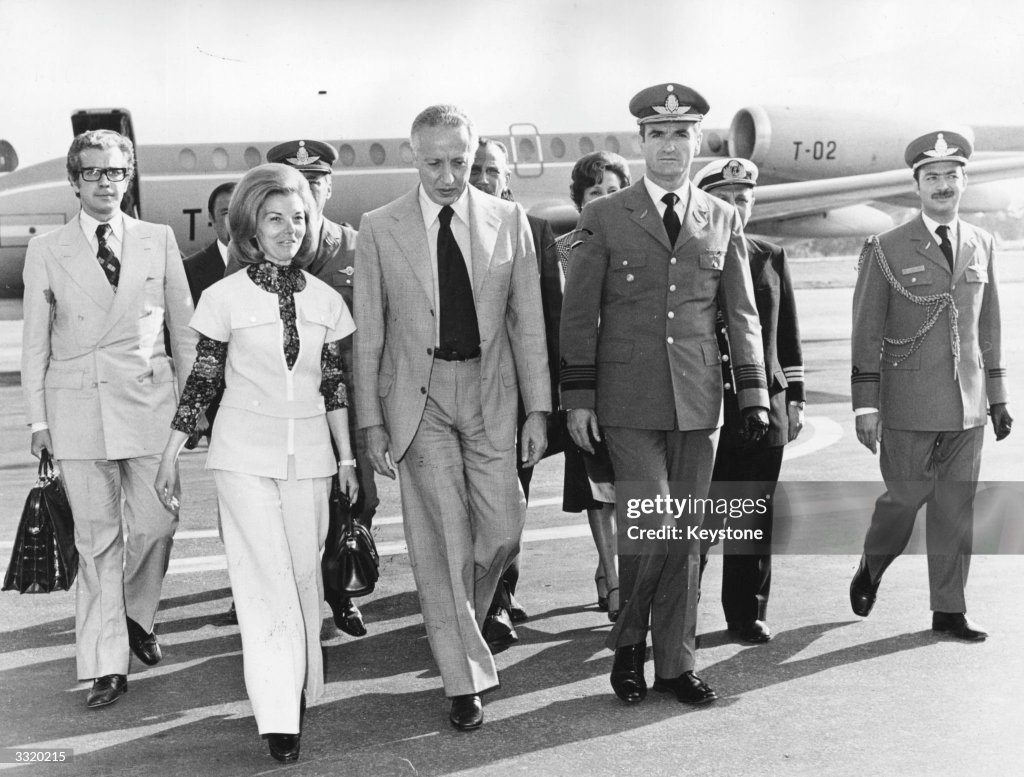
A new Arab political move against Israel formally denouncing Zionism as a “form of racism and racial discrimination” gathered momentum in the United Nations in spite of strong Western opposition. The Arab proposal, tabled in the General Assembly’s social, humanitarian and cultural committee as a lengthy draft resolution, would pave the way for further U.N. action against Israel once it is labeled as a “racist” state. The committee is expected to vote on it today.
The Presidential press secretary, Ron Nessen, today disputed a report that American‐Soviet negotiations for a new strategic arms accord limit were in trouble. He also denied that Secretary of State Kissinger and Secretary of Defense James R. Schlesinger had major differences of opinion over the American position in the negotiations. Mr. Nessen’s comments came in response to questions about a report in The New York Times today quoting unnamed Ford Administration officials as saying that the talks were in trouble and that there were important philosophical differences between Mr. Kissinger and Mr. Schlesinger. “The basic premise is not right,” Mr. Nessen said of the article.
Diplomatic and journalistic circles in Moscow were in a flutter today over rumors and speculation on the reasons for the postponement of a scheduled talk yesterday between the visiting French President, Valery Giscard d’Estaing, and Leonid I. Brezhnev, the Soviet party leader. On the surface, the failure to hold one of four planned meetings on time seemed little more than a slight ripple of irregularity. But in the context of the secrecy that shrouds diplomacy in Moscow, the postponement quickly took on deep significance for every Kremlinologist in town.
Andrei D. Saltharov, the Soviet physicist, was reported yesterday to be apprehensive of reprisals against his family and fellow dissidents in the Soviet Union. His apprehension and an appeal for Western vigilance against Soviet repressions were reported at a news conference by the International League for the Rights of Man, at 777 United Nations Plaza. The League is a civil‐rights group accredited to the United Nations. The news conference was organized to discuss the award of the Nobel Peace Prize to Mr. Sakharov last week and the publication today of his latest book of dissenting views, “My Country and the World,” published by Alfred A. Knopf. The book dissects a broad range of shortcomings in Soviet society, chides Western intellectuals for “leftist‐liberal faddishness” and naiveté about the Soviet system, and proposes fundamental reforms in Soviet rule.
Police in Spain announced the arrest of six alleged Marxist urban guerrillas and said they murdered a Barcelona policeman last month. Under a new antiterrorist law, convicted slayers of policemen automatically are sentenced to death. The six were arrested in Barcelona. Police identified them as members of the Revolutionary Anti-Fascist Patriotic Front and said those detained included “the material author of the murder,” a man identified as Lorenzo Jurado Perez alias Tangue (The Tank).
An Icelandic gunboat cut the nets of a West German trawler as it fished inside Iceland’s new unilaterally declared 200-mile fishing limit, Reykjavik sources said. Shortly afterward, West Germany lifted its boycott on landings of Icelandic fish at its North Sea ports and said it would send a delegation to Iceland on October 28 to negotiate a new fishing agreement.
Britain blocked attempts by the European Common Market to set minimum standards for cleansing community rivers and lakes. Informed sources said Denis Howell, British minister of state at the Department of Environment, refused to accept proposals approved by his eight Common Market colleagues. The plans were for strict communitywide limits on the dumping of certain highly toxic wastes into Common Market waters and other more general norms for the discharge of less dangerous substances.
Eighteen Arab countries warned today that they would use “all their resources” in concerted action if Israel used the civil strife in Lebanon as a pretext for taking over southern Lebanon. The warning was contained in a resolution adopted by the foreign ministers of the countries at the end of a two‐day meeting of the Arab League on the Lebanese crisis. The meeting was boycotted by three of the 20 members of the league — Syria, Libya and the Palestine Liberation Organization. The three had let it be known they would attend only if the meeting dealt with the over‐all Middle Eastern situation, notably with the Egyptian‐Israeli agreement on Sinai, which they oppose bitterly. Syria and the Palestine Liberation Organization are key factors in the Lebanese crisis. In their absence, no effective action can be taken by the other league members, Arab diplomats conceded today. The warning to Israel was proposed by Egypt. The phrase “all their resources” was interpreted by Arab officials as meaning military action and an oil embargo.
The United States has suggested to Syria that President Ford would be willing to confer with President Hafez al-Assad in Europe next month before or after Mr. Ford attends a Western economic meeting in France. The Syrians have not replied to the month-old informal offer, but some Ford administration officials are still hopeful that Mr. Assad will accept it.
King Hassan II of Morocco announced that he would lead a march of 350,000 civilians across the border into the Western Sahara in order to stake claims for the area as part of Morocco. His broadcast announcement followed a statement by the World Court in The Hague that it could not “establish any tie of territorial sovereignty” over the Spanish Sahara for either Morocco or Mauritania.
About 1,600 refugees who fled South Vietnam before the Communist take‐over sailed for their homeland today with no assurance that they would be welcomed back. They sailed aboard the Thuong Tin I, a former South Vietnamese merchant ship. Today North Vietnam joined South Vietnam in condemning the United States for letting the refugees leave.
U.S. military intelligence sources dispute a report by Aviation Week and Space Technology magazines that Communist China has deployed long-range missiles capable of striking Moscow. These sources say such missiles, in the 3,000- to 3,500-mile range, have been used by the Chinese to launch satellites into space but have not been put into combat position yet. About three or four silos for such missiles have been built in western China, the intelligence sources say, but have not been occupied by the weapons themselves.
The Balibo Five, television journalists who were reporting for two networks in Australia, were murdered at the town of Balibo by Indonesian forces that had invaded Portuguese Timor. Reporter Greg Shackleton and soundman Tony Stewart of Australia, cameraman Gary Cunningham of New Zealand worked for the Melbourne station of the Seven Network, while reporter Malcolm Rennie and cameraman Brian Peters, both British, were in East Timor for the Sydney station of the Nine Network.
The Australian Senate rejected the government’s annual budget today and the Opposition said that it would block its passage until Prime Minister Gough Whitlam resigned. Hours before the Senate vote of 29 to 26, Prime Minister Whitlam told the House of Representatives that rejection of his budget would result in “utter financial chaos.” The vote in the 60‐seat Senate was along strict party lines, with 29 opposition Liberal Country party senators voting against the budget and 26 of the Government’s Labor party senators voting for it. Two senators were absent.
The Canadian government proposed sentences of up to five years imprisonment for anyone violating the wage and price controls imposed by Prime Minister Pierre Elliott Trudeau four days ago. The powerful United Automobile Workers’ Union has said it would oppose the controls, and other unions have claimed the controls would allow profits to rise while wages would be kept down.
Canadian airline pilots called off a 24-hour strike planned for Saturday which would have been a protest against an experiment using both English and French in air traffic control. The Canadian Airline Pilots’ Association called off the action after the Quebec Supreme Court issued an injunction against any walkouts by Air Canada pilots.
College students and professors seized 50 empty city buses in Puebla, Mexico, and demanded the release of 400 peasant farmers held by the government. A “solidarity committee” from the University of Puebla accused the government of arresting the farmers when they met with an official to demand water for their lands from a nearby dam. Government sources said the farmers planned to sabotage the Pan American Games in Mexico.
President Jomo Kenyatta of Kenya has governed better than most African leaders, but he faces mounting public disenchantment. Mr. Kenyatta, a pragmatic conservative, has helped to build a solvent, working and, until recently, fairly free society in which steady economic growth has produced an everlarger pie for the fast‐multiplying population of 13 million. In recent years, however, Mr. Kenyatta has damaged his political image and alienated more and more Kenyans by abuses of power, by piling up a growing fortune and by moving to stifle the development of a freer society in this East African nation. Mr. Kenyatta warned Parliament Thursday that dissidents would not be tolerated, Reuters reported. “People appear to have forgotten that the hawk is always in the sky and ready to swoop on the chickens,” he reportedly told Parliament, which had just seen two prominent members placed in detention.
President Kenyatta, who has just placed two prominent leaders of Kenya’s Parliament in detention, warned other legislators that dissidents would not be tolerated.
The Federal Reserve Board further confirmed that the nation’s economic recovery has been much sharper than expected. The board reported that industrial production rose more in September than it had in the previous four months of gains. The increase in output was 1.9 percent — the biggest advance in one month since November, 1964, after an auto strike was settled.
The nation’s welfare expenditures shot up 20% in the last fiscal year when the rolls of the biggest family assistance program-Aid to Families With Dependent Children-climbed to a record high, the Department of Health, Education and Welfare reported. Total welfare spending in the fiscal year ended June 30 reached $22.6 billion, about $3.8 billion over the previous year. The AFDC caseload averaged 11,078,000 persons a month, an increase of 2.1%.
An unprecedented 35% increase in the Blue Cross-Blue Shield health insurance premiums for nearly 6 million federal workers and dependents is expected January 1. The Civil Service Commission and Blue Cross-Blue Shield officials said that the increase would reflect what was happening to health costs in general. The total cost of U.S. public and private health care reached $118.4 billion in the fiscal year ended June 30, according to new federal figures, up 13.6% in one year.
The Food and Drug Administration said it would crack down on the amounts of lead in canned baby foods in view of a survey suggesting that some young children might be getting too much of such toxicity. Surveyed were 2,900 samples of 41 foods produced in 1973. “Of the baby foods, orange juice had the highest mean lead level,” the survey said. “Next in order in the baby foods were apple juice, applesauce and peaches Vegetables and beef, and mixed vegetables, had the lowest means.” The canning industry has told the FDA that lead levels in canned juice have dropped to about half of what they were at the time of the survey.
The Federal Election Commission voted to reject an attempt to exempt the fees of accountants and lawyers from the new spending limits on federal election campaigns. Excepted will be accounting or legal costs that are created by formal challenges to a campaign’s compliance.
Two underworld figures cited patriotism as their reason for turning down a CIA offer of perhaps as much as $100.000 to poison Cuban Premier Fidel Castro, informed investigators said in Washington. The two, identified as Los Angeles mobster John Rosselli and the late Chicago rackets kingpin Sam Giancana, offered instead to undertake the assassination mission for free, the sources said. One of the sources said he was skeptical of Rosselli’s expressed patriotism, explaining that Castro’s death would have been worth more in terms of regaining the Mafia’s gambling interests in Cuba.
Former Senator Sam J. Ervin Jr. (D-North Carolina) said he shared the conclusion of a Watergate prosecutors’ report that Richard M. Nixon could have been indicted without first being impeached. But Ervin, who served as. chairman of the Senate Watergate committee, joined former special prosecutor Leon Jaworski in disagreeing sharply with a recommendation that the Constitution be amended to allow criminal prosecution of a President. “There are too many factors that enter into a situation of that kind,” Jaworski said. “The mere fact of a constitutional amendment isn’t going to help that much.”
Secretary of State Kissinger’s remarks about former President Richard M. Nixon and other prominent figures at a private party in Ottawa have caused a spate of apologies to and by the Secretary. A tape recording of his observations at a dinner in the Canadian capital Tuesday has Mr. Kissinger calling Mr. Nixon “a very odd man,” “an unpleasant man,” and “an artificial man.” The remarks were inadvertently transmitted to a lounge in the Canadian National Press Club where journalists were waiting to record toasts exchanged between Mr. Kissinger and his host, Allan MacEachen, External Affairs Minister of Canada. A recording was made by a Canadian radio reporter.
Merrill Lynch, Pierce, Fenner and Smith submitted to the S.E.C. a “model” it had requested for an electronic national market system for securities transactions. The plan Is expected to raise strong opposition among traditionalists on the New York Stock Exchange because it would limit the exchange’s ability to restrict most trading in its listed securities to its own floor.
Persons who have been denied credit by a lender will have the right to be told the reason for the denial under new rules implementing the Equal Credit Opportunity Act that were issued in final form by the Federal Reserve Board. The law is intended primarily to bar discrimination by lenders against women.
In a bitter clash, 32 families face eviction from dilapidated homes in Hutchinson, West Virginia, to make way for a $15 million coal-processing plant. The plant promises major economic benefits to the region, but the proposed evictions have evoked unexpected anger from Appalachian residents long cowed by authority.
The 1975 Nobel Prize in Physiology or Medicine was awarded to two Americans and an Italian for findings involving the interaction between tumor viruses and the genes. The researchers are Drs. David Baltimore, Howard Martin Temin and Renato Dulbecco.
Water of poor quality should be used as much as possible for energy purposes, delegates to an interstate I conference on water problems said. Stressing the need for protection of resources, the 200 delegates in Las Vegas adopted a policy statement that said, “The competitive position of water for energy (versus) water for food and fiber and other potable environmental industrial purposes should be carefully weighed, not on an economic basis only, but also including the basis of the need for long-term conservation of all resources.”
The first of the Geostationary Operational Environmental Satellite (GOES) series, GOES 1, was launched by the United States and placed in geosynchronous orbit over the Indian Ocean to gather meteorological data.
The last case of Variola major, one of the two smallpox viruses, was diagnosed and treated, with the victim being a two-year-old girl.
Louis LaRusso II’s stage drama “Lampost Reunion”, starring Danny Aiello, opens at the Little Theatre, NYC: runs for 77 performances.
1975 World Series, Game Five:
The Reds win the 5th game 6–2. Reds’ lefty Don Gullett pitched like an ace as the Reds won their final home game in Game 5 to put Cincinnati on the brink of their first World Series championship in 35 years. Cincinnati first baseman and cleanup hitter Tony Pérez broke out of an 0–for–15 World Series slump with a pair of home runs while driving in four runs off Boston starter Reggie Cleveland. Pete Rose contributed an RBI double and Dave Concepción hit a sacrifice fly for the other Reds runs, while Gullett pitched 8 ⅔ innings, limiting the powerful Boston lineup to five hits. Reds closer Rawly Eastwick came on to strike out Boston third baseman Rico Petrocelli for the game’s final out.
Boston Red Sox 2, Cincinnati Reds 6
Dow Jones Industrial Average: 837.85 (+0.63, +0.08%)
Born:
Kellie Martin, American actress (“Life Goes On”, “Cristy”), in Riverside, California
Jacques Kallis, South African cricket superstar and all-rounder, in Pinelands, South Africa.
Jamila Wideman, WNBA guard (Los Angeles Sparks, Cleveland Rockers, Portland Fire), in Denver, Colorado.
 History Diaries