Reports of two German troop movements in the Balkans raised new fears tonight of an extension of the war, and there was talk that Soviet Russia is negotiating a military assistance pact with pro-British Turkey. Men in Sofia, Bulgaria, who are friendly to the Soviet declared they had been informed that Moscow was prepared to promise the Turks armed support if Germany and Italy should try to seize the Dardanelles. They added on the authority of “high Communists” that Russian-Turkish negotiations had “every chance of success.” The official Russian news agency, Tass, disclosed that Russia had not received what it considered satisfactory advance notice of Germany’s already accomplished military penetration of Rumania, and thus it seemed to many observers that German-Soviet relations clearly had suffered.
Adolf Hitler noted that about half the Czechs in occupied western Czechoslovakia could be assimilated into the German population. The other half, which included the intellectuals, were to be eliminated. His view is that half the population will assimilate, and the rest is expendable. Naturally, the usual groups — intellectuals, Jews and other minorities such as the Gypsies, clergy — fall into the latter category.
Italian Prime Minister Benito Mussolini and the Italian War Council made the final decision for an attack on Greece with operations set to begin at the end of the month. The Italians hoped that the campaign would last only two weeks and it was decided that German Chancellor Adolf Hitler would not to be told beforehand and instead be presented with a fait accompli. Mussolini obtains permission from the Italian War Council (Ciano, Badoglio, Jacomoni, Visconti-Prasca, Roatta, Cavagnari, and Pricolo), which is a mere formality (despite misgivings they almost all privately have). He does not tell German Foreign Minister Ribbentrop, who complains around this time that there is a strange “inability” of Germans to learn the Italian plans. Marshal Badoglio, no fan military adventures with a weak army, succeeds only in gaining a postponement of two days for the start of the invasion, which will have to go through the mountains in northern Greece.
The planned attack date of the invasion is 26 October. The Commando Supremo projects a quick two-week operation to defeat the Greeks. This is a decision of far-reaching ramifications — some say it directly affects the outcome of World War II itself by a direct chain of events — that will not become fully apparent for some time.
Italy asks Bulgaria to assist the projected invasion of Greece. This would require the Italians to defend two fronts rather than one.
The German embassy in Moscow is still translating Ribbentrop’s massive mission to Stalin about a New World Order. It will take a few more days.
Prime Minister Winston Churchill sends a message to all ambassadors via the Foreign Office that “nothing can compare with the importance of the British Empire and the United States being co-belligerent.” This, of course, is not the official policy of the United States — at least openly.
The British submarine HMS Triad was shelled and sunk south of Cape Colonne (Calabria) by the Italian submarine Enrico Toti.
The German Luftwaffe launched 5 fighter sweeps toward London and 1 over Southampton, both in England, United Kingdom; the Germans lost 16 fighter and 3 bombers, while the British lost 15 fighters with 6 pilots killed. Overnight, 400 German bombers dropped 530 tons of high explosives on London, killing 400 and wounding 900; Bristol and Birmingham were also attacked.
Reichsmarschall Hermann Göring continues with his perpetual tinkering of the Luftwaffe operations over England on 15 October 1940. In this case, he basically just codifies what has been the program for weeks now anyway. He orders that there be three priorities in descending order:
London;
aircraft factories;
factories in the Midlands and air bases.
More importantly, the weight of the offensive from now on is to be at night, something that already has been the case throughout the month. With the nights getting longer, this makes good tactical sense, although not so much strategic sense. The British night fighter force composed of Bristol Beaufighters is still embryonic, and the only real defense to the bombers is the fierce anti-aircraft ring defending inner London and some other major cities. Recent raids have been tactically devastating but strategically almost worthless, as they destroy random buildings in the cities while leaving the RAF’s growing power unchecked.
The RAF also is tinkering with its strategy. While the British do not have the initiative at the moment — fighter operations by RAF fighters at this stage over the Continent are rare and usually accidental — their decisions greatly affect the course of the battle because the Luftwaffe repeatedly has shifted its own strategy in response.
Number 11 Group today issues new instructions to its units. From now on, there are to be standing patrols at 20,000 feet or higher. This is considered necessary due to the new Luftwaffe tactic of using fighter-bombers (Jabos) during the day rather than the slower (and lower-flying) bombers. This allows for an interception on somewhat equal terms, as the British fighters do not need ten minutes to get up to altitude. It also, however, somewhat plays into the Luftwaffe’s own strategy of desiring air battles in order to continue harvesting Fighter Command’s assets.
The weather is unsettled, cloudy over the Channel and France but clearing from the west. The day begins with a “pirate raid” at 06:10 by a lone Heinkel He 111 of III,/KG 55 upon the British Aeroplane Company located at Filton. Another attack at 07:00 targets Birmingham and RAF Ternhill, destroying two Blenheims and some other aircraft. Thereafter, the raids are almost continuous, of small scale but coming from all directions.
At 08:00, the Luftwaffe sends a Jabo raid against southern England. As is often the case with the Jabos, the initial group reaches its targets before the RAF can respond. Their target is London, and King George V Dock in West Ham, Waterloo Station and south London, in general, take the brunt of the attack.
Another attack crosses at 09:45. This time, the RAF is waiting and the Jabos don’t reach their targets.
Around noontime, the day’s major raid occurs when sixty fighters, including Jabos and Bf 110s, cross near Folkestone with London as their target. The RAF performs a successful interception, chasing away the Bf 110s and forcing the Bf 109 Jabos to drop their bombs at random in the Ashford/Gravesend/Maidstone region. Both sides use the clouds to their advantage, which reduces the number of losses on both sides.
Another large formation crosses the Isle of Wight around the same time. This time, the RAF has a clear-cut victory, attacking out of the sun and shooting down several Bf 109s and leading to more dogfights. The Germans, though, have a numerical advantage in this engagement, so some of the Jabos get through to their target of Southampton.
JG 26, perhaps the premier Luftwaffe formation at the time, bounces some Hurricanes east of London during the afternoon as the Luftwaffe continues raids on the Maidstone/Ashford area. Just as the RAF earlier had a clear-cut victory, this battle goes to the Germans. They shoot down several RAF planes.
The skies clear completely during the day, and there is a bright moon. After dark, the Luftwaffe mounts another major effort against London. 400 bombers pound the financial district (City of London) with 530 tons of bombs, starting 900 fires and killing hundreds of people. There is extensive damage that severs rail and road communications at five main railway stations. Oxford Street is blocked, as well as the road above Balham Underground Station from the night before. Damage also is caused to key installations such as the Royal Docks, Beckton Gasworks, Battersea Power Station, and a Handley Page aircraft. The vital water pipeline at Enfield is severed, shutting off a 46-million Imperial gallon per day pipeline.
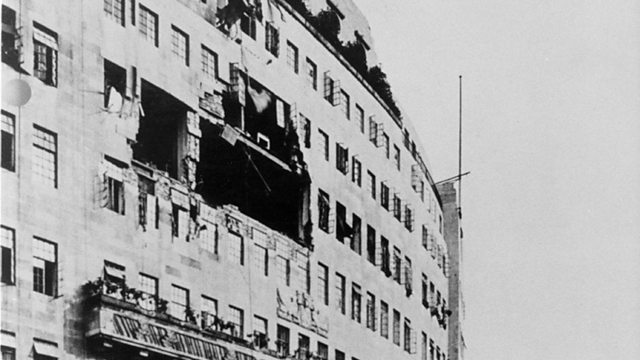
An especially noticeable incident occurs when bombs fall on the BBC during its 21:00 news broadcast. Seven people lose their lives after the bomb crashes through the exterior wall into an interior library, causing extensive damage. However, the equipment still functions. Broadcaster Bruce Belfrage, sitting in the basement with Hell itself breaking loose above, carries on throughout the broadcast despite being covered in plaster. The home audience never suspects a thing. “Keep calm and carry on” indeed.
Birmingham, Kent, and Bristol also are hit during the night but don’t receive nearly the attention as does London. The Luftwaffe loses only one bomber, as the British night fighter force remains ineffective.
Overall, it is another reasonably good day for the Luftwaffe. The score is usually given as 14 losses for the Luftwaffe and 15 by the RAF — and that generally does not include either RAF bombers lost over Europe over planes destroyed on the ground. The Luftwaffe has found a workable strategy against the British, but the question, as previously, is how long they will stick to a good thing. In the past, the answer has been… not long enough.
British Losses:
Spitfire X4178, No. 41 Squadron
Sgt. P.D. Lloyd killed. Shot down in a surprise attack by Bf 109 of 4/JG 51.
Hurricane N2480, No. 46 Squadron
P/O P.S. Gunning killed. Shot down in combat with Bf 109s over the Thames Estuary.
Hurricane V6550, No. 46 Squadron
F/Sgt. E.E. Williams killed. Shot down by Bf 109s over the Thames Estuary.
Spitfire R6838, No. 92 Squadron
Sgt. K.B. Parker killed. Shot down in combat with Bf 109s over the Thames Estuary.
Hurricane V6722, No. 501 Squadron
Sgt. S.A. Fenemore killed. Shot down in combat with Bf 109s over Redhill.
Hurricane N2546, No. 605 Squadron
F/Lt. I.J. Muirhead killed. Shot down by Bf 109s over Maidstone.
It is a big day for the big names of the Luftwaffe. Major Werner Mölders of Stab/JG 51 downs a Hurricane during the morning for victory number 47. Adolf Galland of Stab/JG 26 gets his 45th victory, a Spitfire during the afternoon battles, staying hot on the heels of Mölders. Hauptmann Walter Oesau of Stab III./JG 51 also claims a Hurricane for his 37th victory. “Pips” Priller also gets two victories, and Hauptmann Helmut Wick downs a Spitfire for victory no. 42. When the Experten rack up the scores, you know the Luftwaffe is having a good day — for those who return to base.
On the English side, Section Commander George Walter Inwood of the Home Guard pulls two unconscious men from a gas-filled center but perishes on his third go-round. He posthumously receives the George Cross.
Lieutenant Eric Charles Twelves Wilson previously has received the Victoria’s Cross for actions in Somaliland during the Italian invasion, but there is a twist. At first, it is believed that the award is posthumous, but today he turns up in a POW camp. Wilson really earned the award, maintaining a machine-gun post-operational from 11-15 August despite being wounded… and having malaria. The stiff upper lip and all that.
General Alexander Holle replaces Generalmajor Robert Fuchs as Kommodore of KG 26.
With all the other big Luftwaffe names in the news today, there’s also another one who does something important. This Luftwaffe legend, however, is still unknown. Erich “Bubi” Hartmann joins the Luftwaffe Military Training Regiment 10 at Neukuhurn near Koenigsberg in East Prussia.
RAF Bomber Command dispatches 1 Blenheim during the day to the Dortmund – Ems Canal, which was recalled.
RAF Bomber Command dispatches 134 aircraft overnight to bomb many targets in Germany, with much of the effort on oil targets, and to the Channel ports. A report from Kiel, attacked by Wellingtons, tells of an oil-storage tank set on fire and bomb damage in the naval dockyards but no civilian casualties. 3 Hampdens were also minelaying off Kiel and there were 2 O.T.U. sorties. There were no losses from any of these operations. The raid by 9 Fairey Battles on Calais and Boulogne was the last occasion on which this aircraft operated with Bomber Command.
The Fleet Air Arm chips in with attacks on Dunkirk.
At Malta, a French Loire 130 reconnaissance aircraft with three aboard unexpectedly lands (after being shadowed by three Hurricanes) at Kalfrana from Bizerta. It is a crew of Vichy airmen switching sides. The pilot has never flown a Loire before, but he brings the plane down in a manner described as “a bit shaky” by ground observers. The men provide valuable intelligence about aircraft at Bizerta. It is a solid victory for the propaganda service, as the men are carrying a leaflet dropped by the RAF.
U-65, leaving Lorient, was attacked by a British submarine.
U-93, commanded by Kapitänleutnant Claus Korth, sank British steamer Hurunui (9331grt) from convoy OB.227 in 58-58N, 09-54W. At 0018 hours on 15 Oct 1940 the Hurunui (Master Benjamin Evans) was torpedoed and sunk by U-93 about 120 miles west of Butt of Lewis. The fired torpedo had missed the targeted ship and hit the Hurunui behind. Two crew members were lost. The master, 71 crew members and one gunner were picked up by the St. Margaret, transferred to HMS Fowey (L 15) (Lt C.G. de L. Bush, RN) and landed at Greenock on 20 October.The 9,331-ton Hurunui was carrying ballast and was bound for Auckland, New Zealand.
U-103, commanded by Korvettenkapitän Viktor Schütze, sank British steamer Thistlegarth (4747grt) from convoy OB.227 in 58-43N, 15-00W. At 1933 hours the Thistlegarth (Master Donald Plummer, MM), dispersed from convoy OB.227, was hit amidships by one torpedo from U-103 45 miles west-northwest of Rockall. Initially the crew abandoned ship due to the list, but reboarded the vessel when it remained afloat. The U-boat surfaced and opened fire with the deck gun, but had to cease fire after three rounds and crash dive due to return fire. The ship sank in two minutes after being hit by a coup de grâce. The master, 28 crew members and one gunner were lost. Nine crew members were picked up by HMS Heartsease (K 15) (LtCdr E.J.R. North, RNR). The 4,747-ton Thistlegarth was carrying ballast and was bound for Father Point, New Brunswick.
U-138, commanded by Oberleutnant zur See Wolfgang Lüth, in attacks on convoy OB.228 sank British steamer Bonheur (5327grt) and damaged British tanker British Glory (6993grt) in 57-10N, 08-36W. At 0510 hours, U-138 fired torpedoes at the convoy 38 miles northwest of Butt of Lewis and hit the Bonheur and five minutes later the British Glory.
The Bonheur (Master Leon Otto Everett) foundered later in 57°14N/08°20W. The master and all 38 crew members were picked up by HMS Sphene (FY 249) (Chief Skipper W.J.J. Tucker, RNR) and landed at Belfast. The 5,327-ton Bonheur was carrying general cargo and was bound for Rosario, Argentina.
Sailing with Convoy OB.228, the British motor tanker British Glory was hit aft in the engine room by one G7a torpedo, killing three men on watch below and destroying the engines. The disabled tanker was towed to Kames Bay, arriving on 18 October. She was later repaired at the Clyde and returned to service in January 1942. The 6,993-ton British Glory was carrying ballast and was bound for Abadan, Scotland.
Italian submarine Cappellini sank Belgian steamer Kabalo (5186grt) from convoy OB.223 in 31-59N, 31-20W. One crewman was lost from the steamer. Survivors from Kabalo were picked up by American steamer Pan American (9862grt).
Battleship HMS Revenge departed Portsmouth late on the 15th escorted by destroyers HMS Wanderer and HMS Witch and Polish destroyer ORP Burza, arriving at Plymouth early on the 16th.
In operation DHU, Battlecruiser HMS Hood departed Scapa Flow at 1550 to screen aircraft carrier HMS Furious and heavy cruisers HMS Berwick and HMS Norfolk with destroyers HMS Matabele and HMS Punjabi to raid Tromso on the 16th.
Destroyers HMS Somali, HMS Eskimo, and HMS Mashona departed Scapa Flow at 1550 and were exercising in the Pentland Firth prior to DHU. These destroyers joined aircraft carrier HMS Furious.
Aircraft carrier HMS Furious aircraft attacked oil tanks and the seaplane base and shipping at Tromso on the 16th.
Lt H- S. Hayes and Lt E. G. Savage in a Skua of 801 Squadron landed in Sweden and eventually to return to England.
At 1540/17th, destroyers HMS Duncan, HMS Isis, and HMS Douglas departed Scapa Flow to join the Furious force.
On 18 October, Phase II of the DHU operation was abandoned due to low visibility. The forces returned to Scapa Flow.
Destroyer HMS Douglas and HMS Isis proceeded to Skaalefjord to meet tanker Montenol and take her to Scapa Flow.
Destroyers HMS Somali, HMS Eskimo, and HMS Mashona arrived in Pentland Firth and carried out full caliber firings before arriving at Scapa Flow at 1230/19th.
Aircraft carrier HMS Furious, heavy cruisers HMS Berwick and HMS Norfolk, and destroyers HMS Duncan, HMS Punjabi, and HMS Matabele arrived back at Scapa Flow at 1300/19th.
Destroyers HMS Douglas and HMS Isis arrived back at Scapa Flow at 1100/20th escorting tanker Montenol.
British minefield BS.41 was laid by minelayer HMS Teviotbank and destroyer HMS Intrepid, escorted by destroyer HMS Vortigern and minesweeper HMS Lydd.
Anti-aircraft cruiser HMS Curacoa arrived at Scapa Flow at 1000 after covering convoy OA.229 to Pentland Firth.
Destroyer HMS Quorn departed Lerwick at 1735 escorting British steamer Lochnagar to Aberdeen.
Submarine HMS L 27 (Lt R. E. Campbell) attacked a German convoy off Cape Barfleur in 47-55N, 1-30E and claimed three torpedo hits on a 7000 ton steamer, escorted by seven trawlers. However, there is no confirmation for the damage.
British drifter Apple Tree (84grt) was lost in a collision with RAF Pinnace No.50 in Oban Harbour.
River patrol vessel HMS Mistletoe (19grt) was sunk on a mine, eight cables 310° from Bull Sand Fort. Four crew were lost from the vessel. Two crew were rescued.
Submarine HMS Triad (Lt Cdr G. S. Salt) departed Malta on the 9th to patrol in the Gulf of Taranto. She was then to proceed, via the Libya coast, to Alexandria to arrive on the 20th. The submarine was on the surface 50 miles south of Cape Collonne in Otranto Strait in 38-15N, 17-37E.
Early on the 15th at 0140, Italian submarine Enrico Toti, which because of a mechanical breakdown could not submerge, encountered submarine HMS Triad.
In a gun engagement and torpedo engagement, submarine HMS Triad was sunk by Italian submarine Toti. Lt Cdr Salt, Lt M. Keith-Roach, Lt L. J. Brown RNR, Lt (E) W. E. Collinge, S/Lt H- Dean, the forty seven ratings of the crew were lost with Triad.
Battleship HMS Barham and destroyers HMS Echo, HMS Escapade, and HMS Fortune arrived at Gibraltar from Freetown. Battleship Barham, which had been damaged off Dakar, was docked at Gibraltar on the 16th.
Heavy cruiser HMAS Australia arrived at Gibraltar from patrol.
Also, arriving on this date were transports Ettrick and Karanja, escorted by destroyers HMS Greyhound, HMS Wishart, and HMS Vidette, arriving from Freetown.
Italian submarine Foca, while laying a minefield, was sunk in mining off Haifa.
Convoy OB.229 departed Liverpool escorted by destroyers HMS Chelsea, HMS Sturdy, HMS Whitehall, corvettes HMS Arabis and HMS Heliotrope, and anti-submarine trawlers HMS Blackfly and HMS Lady Elsa. Destroyer Chelsea was detached on the 16th and the rest of the escort on the 18th.
Convoy FN.309 departed Southend, escorted by destroyer HMS Vivien and sloop HMS Londonderry. The convoy arrived at Methil on the 18th.
Convoy FS.310 departed Methil, escorted by destroyer HMS Winchester and sloop HMS Egret. The convoy arrived at Southend on the 18th.
Convoy SC.8 departed St Johns at 1343 escorted by Canadian armed yacht HMS Elk and ocean escort Sloop HMS Sandwich. The convoy was joined on the 26th by sloop HMS Weston, corvettes HMS Campanula, HMS Clarkia, and HMS Gladiolus, and anti-submarine trawlers HMS Fandango, HMS Man O’ War, HMS Stella Capella, and HMS Vizalma. Destroyers HMS Harvester and HMS Highlander joined the convoy on the 27th. Destroyer HMS Sturdy joined the convoy on the 30th, but was lost that day. The convoy arrived at Liverpool on the 31st.
In Washington, President Roosevelt ordered that an official survey be made of critical war materials ordered by but not delivered to foreign governments, announced that he would make two political speeches before the November elections, stated at a press conference that Ambassador Kennedy would return from London for consultation but would not resign, conferred on Canadian-American problems with Loring Christie, the Canadian Minister, bestowed upon Donn Fendler of Rye, New York, a medal of valor; received pledges of cooperation in the defense program from a delegation representing the American Pilots Association, and discussed the political situation in Michigan and Nebraska with political leaders from those States.
The Senate confirmed the nomination of Dr. Clarence A. Dykstra as Director of Selective Service, and recessed at 12:20 PM until noon on Thursday.
The House was not in session.
The government announces that, pursuant to the new peacetime draft, 16 million already have registered for the peacetime draft. The young men of the United States will place themselves at their country’s call for military training tomorrow in the first draft registration ever conducted with America at peace. In every community the men, some 16,500,000 in all, will go to designated registration places, answer a series of 11 questions, sign their names and await the results of a gigantic lottery that will determine which of them must spend a year in military camps. All men between 21 and 35, Inclusive, must register. Though registration places precinct voting headquarters, schools and other buildings designated by the local authorities will open at 7 a.m., local time. At 7 AM (P.S.T.), President Roosevelt will make a radio address on the draft. At 9 p.m., local time, the registration places will close, unless there are men still waiting in line. All waiting at that hour will be registered if it takes until morning.
Urging the cooperation of the entire machine-tool industry, which he characterized as the “hardest part” of the national defense program, William S. Knudsen, member of the National Defense Advisory Committee, told more than 500 leading industrialists, businessmen and publishers gathered in the Waldorf-Astoria Hotel yesterday for a luncheon given by Alfred P. Sloan Jr., chairman of General Motors Corporation, that the entire output of the industry for next year was sold out. Emphasizing the shortage of tool capacity, Mr. Knudsen said: “We must have all equipment for 1,200,000 men and all heavy equipment for 800,000 more by April 1, 1942. There is the problem — and the time is so short. If you gentlemen figure you are going to need a lot of machine tools in order to carry out your American way of life you had better take another look. I say this frankly because I think we ought to appreciate the seriousness of the situation as far as the tools are concerned. The industry in 1932 and 1933 produced about $130,000,000 worth of tools a year, and this year they are going to be asked to turn out $500,000,000 worth.”
President Roosevelt approached nearer to the conduct of a frankly political campaign today with an announcement that he would make two formal political speeches on October 23 and 30. In outlining a tentative travel schedule at his regular press conference, however, he spoke only of short trips which he put exclusively in the category of defense inspection tours. Where he would speak was not discussed. He indicated, however, that his tours would take him in the near future into Massachusetts, Connecticut, New Jersey and Pennsylvania, with perhaps an additional visit to New York City to view the Brooklyn Navy Yard and to participate in ground-breaking ceremonies of the Battery Tunnel. His first trip, it appeared, would include a swing through the Connecticut Valley, where again he would cross, as he did last week in Pennsylvania, the path followed by Wendell L. Willkie, the Republican Presidential candidate.
On the eve of registration for military service, Wendell L. Willkie declared tonight that the nation had a double obligation to the young men who will register — to see that they are provided with the finest equipment possessed by any armed force in the world and to see to it, when their military obligations are over, that they shall have opportunity to obtain a good job, earn a living. marry and get ahead. “These two objectives are the overwhelming issues of this campaign, defense and jobs,” he said. “The present Administration has and is falling down in the fulfillment of those obligations. It has had a free hand and it has failed.”
Republican hopes of capturing California’s 22 electoral votes in November were buoyed tonight by an announcement of the G.O.P. national committee in Chicago that Senator Hiram Johnson, long a political power in the state, would endorse the candidacy of Wendell L. Willkie in a radio address Friday night.
Passport restrictions inhibiting travel by Americans to the Far East, similar to regulations in effect concerning travel in Europe, were issued by the State Department. There are no restrictions on passports for the Western Hemisphere.
A “flying wedge” of A.F.L. sailors fought their way through a C.I.O. ship scalers picket line today in a riot that sent five men to the hospital and left a score of others nursing bruises, black eyes and superficial cuts. Scene of the riot was the water front pier where the American President liner President Taft awaited loading of supplies for American armed forces in the Pacific and the Orient, where the ship is scheduled to help evacuate American refugees. Loading of the ship was halted by a line of nearly 200 members of the ship scaler’s and painter’s union, who protested sailors were doing work that the scalers should be doing. Led by Harry Lundeberg, international head of the Sailors Union of the Pacific, the seamen in the President Taft’s crew, fought their way through the picket line.
The movie “The Great Dictator” premiered in New York City. Charlie Chaplin starred in the role of a Jewish barber who is inadvertently mistaken for his country’s evil dictator, Herr Hynkel. The obvious (and hilarious) parallel with Hitler and the Nazi regime delighted American cinema audiences in the USA, even before the USA had entered the war. The movie became more popular still after Pearl Harbor. Actor Jack Oakie played Benzino Napaloni — a zany take-off on Italy’s Benito Mussolini.
The U.S. Marine Corps mobilized its reserve battalions, ordering that these reserve personnel to be assigned to active duty no later than 9 Nov 1940.
U.S. Naval Air Station, Jacksonville, Florida is established, Captain Charles P. Mason in command.
Diplomats today believed that there was a “strong probability” that a Russo-Japanese pact, probably in the form of a non-aggression treaty, would be signed in the near future.
Captain Sadayoshi Yamada was named the commanding officer of the IJN aircraft carrier HIJMS Kaga.
Captain Matsuji Ijuin was named the commanding officer of the IJN cruiser HIJMS Naka.
President Manuel Quezon said today that it was incumbent on the United States to provide air-raid shelters and other civilian defense measures for the Philippines until the Independence Act becomes effective in 1946.
Dow Jones Industrial Average: 131.48 (+0.75)
Born:
Peter C. Doherty, Australian veterinary surgeon and Nobel laureate (Nobel Prize for Physiology or Medicine, 1996), in Brisbane, Queensland, Australia.
Arron Afflalo, NBA shooting guard and small forward (Detroit Pistons, Denver Nuggets, Orlando Magic, Portland Trailblazers, New York Knicks, Sacramento Kings), in Los Angeles, California.
Steve McKinney, NFL center and guard (Indianapolis Colts, Houston Texans), in Galveston, Texas.
Fanny Howe, American novelist and poet (“Second Childhood”, “The Definitions”), in Buffalo, New York (d. 2025).
Died:
Lluís Companys, 58, Spanish politician, 123rd President of the Generalitat of Catalonia (1933-40), executed by Franco’s regimeat Montjuïc Castle in Barcelona).
Naval Construction:
The U.S. Navy Aloe-class net tender USS Mimosa (AN-26) is laid down by the American Shipbuilding Co. (Cleveland, Ohio, U.S.A.).
The Royal Navy Isles-class minesweeping trawler HMS Bute (T 168) is laid down by the Goole Shipbuilding & Repairing Co. Ltd. (Goole, U.K.).
The Royal Navy Bangor-class (Reciprocating-engined) minesweeper HMS Seaham (J 123) is laid down by Lobnitz & Co. Ltd. (Renfrew, Scotland).
The Royal Canadian Navy Bangor-class (VTE Reciprocating-engined) minesweeper HMCS Outarde (J 161) is laid down by North Vancouver Ship Repairs Ltd. (Vancouver, British Columbia, Canada).
The Sjøforsvaret (Royal Norwegian Navy) “U”-class (Third Group) submarine HNoMS Uredd (P 41) is laid down by Vickers Armstrong (Barrow-in-Furness, U.K.).
The Kriegsmarine (German Navy) Type VIIC U-boat U-441 is laid down by F Schichau GmbH, Danzig (werk 1492).
The Royal Navy Flower-class corvettes HMS Aster (K 188) and HMS Bergamot (K 189) are laid down by Harland & Wolff Ltd. (Belfast, Northern Ireland).
The Royal Navy Flower-class corvette HMS Orchis (K 76) is launched by Harland & Wolff Ltd. (Belfast, Northern Ireland).
The Kriegsmarine (German Navy) Type 1936A destroyer Z29 is launched by AG Weser (Deschimag), Bremen (werk 963).
The Royal Navy ocean boarding vessel HMS Cavina is commissioned. Her first commanding officer is Captain Newell Herbert Gale, RD, RNR.
 History Diaries