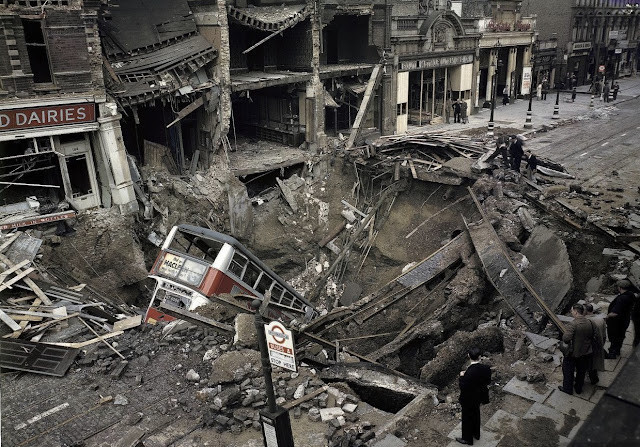
A German bomb exploded on the road above Balham station in south London, creating a large crater which a double-decker bus drove into during blackout conditions. A total of 66 people were killed and pictures of the bus in the crater were published around the world.
King George VI and Queen Elizabeth visited Neville Chamberlain on his deathbed.
Benito Mussolini is the in final stages of planning his strategy following the meeting with Hitler at the Brenner Pass earlier in the month. He has decided not to invade Yugoslavia, but Greece is an open question. He is not keeping the Germans informed of his decision-making process. Today, he meets with General Staff Marshal Badoglio and Army Chief of Staff General Roatta, both of whom are known to be very realistic about Italian military capabilities — but they have little influence on Mussolini.
Mussolini protects Italy’s historic interest in the Balkans by sending air officers to Bucharest. They join the German troops who have arrived there and elsewhere in the country. Their purpose is to set up a seaplane base at the Rumanian port of Constanta on the western coast of the Black Sea, 179 nautical miles (332 km) from the Bosphorus Strait.
In a sign of further attempts by the Rumanian authorities to ingratiate themselves with the Germans, they ban Jewish students from Rumanian schools.
Hitler’s fears about British sabotage in Rumania are perhaps heightened today when a fire breaks out in Băicoi, a train stop away from the main oil center of Ploiești. The fire destroys three oil wells.
Dr. Goebbels fine-tunes his ministry’s depiction of the effect of the air war on England’s capital and Berlin. He cautions his press people via the Reich Press Chief to keep accounts of damage to the respective cities moderate. The aim, the Press Chief writes, is that “the possibility of intensified attacks must be preserved.”
Russia has given Turkey a promise of at least moral support against any Italo-German pressure as a result of Germany’s military penetration of Rumania, it was reported in well-informed diplomatic quarters early today. German anti-aircraft guns were posted Monday along Rumania’s frontier with Russia, beyond which the Soviets have massed formidable military forces. With nearly 50,000 German troops and air force men on Rumanian soil already, a Nazi naval mission arrived Monday and is expected to supervise the building of a naval base and a U-boat plant at Galatz on the Danube close to Russian territory. Germany, it was reported, has assigned 10 Nazi divisions or about 150,000 men to Rumania.
Tass, Soviet official news agency, described as “fantastic invention” today reports abroad that Russia, Britain, Turkey, Yugoslavia and Greece are negotiating on the question of Germany’s move into Rumania. The news agency, which asserted the reports were published in two London newspapers and circulated by Reuters, British news agency, said they “do not correspond with reality.”
The German embassy staff in Moscow is still translating von Ribbentrop’s interminable letter to Stalin about a New World Order ruled by Germany, the USSR, Italy and Japan. It will take several more days.
The Politburo stamps its approval on the war plan recently submitted to it by the Stavka for an attack on Germany. There is no such operation currently contemplated but one is a contingency plan for the future. The plan is in some respects the mirror image of the war plans currently being drafted at OKW headquarters at Zossen for Operation Barbarossa.
At Malta, Governor Dobbie and the local military institute new rules for shore-based artillery. They are to wait until opening fire until the target has approached within 5000 yards by day and 1800 yards by night. Local gunners are given independent authority to open fire if they deem the intruder to be hostile. In addition, it is “fire at will” on any submarine unless they have been notified of a friendly submarine in the vicinity. The cargo from the recent convoy is still being processed, with ammunition being dispersed to the gunners.
Poor weather limited German ability to attack southern England, United Kingdom, thus only a few small attacks were launched against coastal areas; no losses were suffered on either side on this day. Overnight, London, Birmingham, Coventry, Liverpool, Blackburn, and Preston were bombed; at 2002 hours, a 1,400-kg armor piercing bomb hit Balham Tube Station in London, causing flood that killed 66 of the about 600 civilians using the station for shelter.
The fickle weather of 1940 continues on 14 October 1940. Today there are clouds and intermittent shows. Missions are scattered throughout the day until the skies clear after dark.
Before dawn, a Dornier Do 17 from 4(F)./14 drops a stick of bombs on Bristol. Otherwise, it is a fairly quiet early morning. The first real operations begin at 10:30 when high-altitude fighter-bombers (Jabos) fly up from the Cherbourg area. The attack does not accomplish much, however, due to the weather and the lurking presence of RAF fighters.
RAF North Weald receives attention late in the morning. Four squadrons are based there, so it is a vital link in the chain of fighter airfields across southern England. While the attacks are small-scale affairs, bombing accuracy during the day is notably better than at night.
Since the weather is poor, the Luftwaffe apparently feels better about including more lumbering Heinkel He-111s and other medium bombers in the mix. London, Portsmouth, East Anglia and nearby points are bombed. Airfields hit in the London region include RAF Hawkinge and Duxford, with bombs also falling over nearby South London either intentionally or due to bombing inaccuracy. A direct hit on an air-raid shelter in Middlesex kills 20 people.
An odd incident happens during the afternoon. Fighter pilots of RAF No. 17 Squadron spot a Dornier Do 17 bearing British markings on all the upper surfaces. As it banks to turn, however, German markings are seen on the underside. When attacked, the bomber fires two Very rockets — but of the wrong color. Despite being damaged, the odd plane makes it away safely through the balloons over Harwich.
After dark, the pace of attacks increases dramatically. The Luftwaffe sends a total of 240 across the Channel, helped by a full moon. London, Birmingham, Coventry, Liverpool, Preston, Bristol, Avonmouth, and East Anglia take damage. The scale of the attacks is reflected in the fact that 565 people are killed and 2125 seriously injured. Coventry, with many medieval wooden buildings, is consumed by fires caused by incendiary oil bombs. In London, The Carlton Club is hit, but nobody is hurt.
In a notorious incident which since has become iconic for The Blitz, a 1400 kg armor-piercing bomb hits the Balham underground station at 20:02. It sends those inside who survive (66 people perish) fleeing when the water mains, a gas pipe, and a sewer pipe burst and flood the north-bound tunnel with a tidal wave of smelliness. The water rises 25 feet above the trackbed. Many people drown in the slurry. A bus drives into the immense creator in the blackout darkness, but nobody in it is hurt. The underground line is out of operation until 1941, with bodies being recovered past Christmas. This incident features in the Ian McEwan novel “Atonement,” made into a feature film starring Keira Knightley. A plaque is laid at the site in 2010 to commemorate the 70th anniversary of the tragedy.
In London alone, 500+ casualties are taken to the hospital or killed.
Due to the small-scale of the raids, the inability of the RAF to manage effective interceptions due to the weather, and the majority of the raids being undertaken at night, both sides take less than a handful of casualties (some accounts say no losses on either side). The day is a successful one for the Luftwaffe, which takes sustainable losses but still inflicts measurable damage both to civilian and RAF targets.
British Losses:
Hurricane P3107, No. 605 Squadron
F/O R. Hope killed. Aircraft brought down by balloon cable or anti-aircraft fire.
Ancient London was alight with fires and rocked by explosions early today as Nazi airmen rained tons of bombs from moonlit skies in the undeniably fiercest assault yet made on the capital. Firemen careened through narrow streets from blaze to blaze; rescue workers tossed themselves headlong against buildings trembling with the raid’s impact. The raids began last night and continued for hours into the morning. In the seventh hour it slackened somewhat with only sporadic blasts. Added to the inferno of explosives were the “breadbaskets” of fire bombs sprayed over the city. One blaze severely damaged the top floor of a restaurant, another, a movie theater.
Rear Admiral I.B.B. Tower, DSC, perishes in an air raid “on the steps at the bottom of Regent’s Street.” He has been in charge of gunnery training ship HMS President and has held a number of senior staff positions, including chief naval liaison officer to the Commander-in-Chief Home Forces, General Sir Alan Brooke.
KG 53’s Major Friedrich Kless receives the Knight’s Cross of the Iron Cross.
RAF Bomber Command dispatches 18 Blenheims during the day, 12 on cloud-cover raids, 6 on sea sweep. 1 aircraft lost.
RAF Bomber Command dispatches 78 Hampdens, Wellingtons and Whitleys overnight to Berlin, Stettin, Bohlen, Magdeburg and Le Havre. 2 Hampdens and 1 Wellington were lost and a Whitley bound for Le Havre crashed after hitting a barrage-balloon cable at Weybridge; the crew was all killed. Bomber Command raids Berlin, oil plants in Stettin, the ports of Hanover, Hamburg and Le Havre, and various airfields in northwest Europe.
Night fighter ace Werner Streib, Gruppenkommandeur of I./NJG 1 and the man considered to be the “Father of German night-fighter forces,” scores his tenth night-fighter victory during the evening.
The RAF bombs Italian forces in Benghazi.
In the early hours of the morning, Royal Navy aircraft carrier HMS Illustrious, returning to Alexandria after escorting a convoy to Malta, detaches briefly from the main force with cruisers HMS Gloucester and Liverpool. It conducts airstrikes against the Italian bases at Leros. The Illustrious then returns to the main battle group.
At 16:55, the Italians reciprocate for the attack on Leros by launching their own strike on the Royal Navy forces nearby. An Italian Savoia-Marchetti SM79 bomber torpedoes HMS Liverpool, which sets off fuel and other flammables in the ship and blows off its bow from just ahead of the bridge. There are 30 deaths when all is said and done, with 42 others wounded. Light cruiser HMS Orion takes the Liverpool in tow back to Alexandria. Liverpool eventually will go to Mare Island, California for full repairs shortly before the Pearl Harbor attack.
U-138 torpedoed armed merchant cruiser HMS Cheshire (10, 552grt) in 55-13N, 13-02W. At 2128 hours on 14 Oct 1940, HMS Cheshire (F 18) (Capt M.R. Bernard, Rtd, RN) was struck by one torpedo from U-137 (Wohlfarth) northwest of Ireland in 55°13N/13°02W. 220 crew members were taken off by HMCS Skeena (D 59) (LtCdr J.C. Hibbard, RCN) and HMS Periwinkle (K 55) (LtCdr P.G. MacIver, RNR) and the ship was towed to Belfast Lough where she was beached. The ship was later taken to Liverpool for repairs that took six months.
Destroyer HMS Douglas made high speed runs in Scapa Flow in view of suspected minelaying, to fire acoustic mines. No mines were located.
Destroyer HMS Mendip arrived at Scapa Flow at 0730 to work up.
Steamer Reculver (683grt) was sunk on a mine 1.2 miles 195° from Spurn Point Light House. The entire crew was rescued.
Anti-submarine trawler HMS Lord Stamp (448grt) was sunk on a mine seventeen miles southwest of Portland Bill in the English Channel. Chief Skipper J. D. McKay RNR, Lt Cdr M. E. C. Miller RNR and twenty one ratings were lost.
Collier Glynwen (1076grt) was lost to enemy attack.
German steamer Euler (1879grt) was sunk on a mine near St Nazaire.
Early on the 14th, aircraft carrier HMS Illustrious, escorted by cruisers HMS Gloucester and HMS Liverpool and destroyers HMS Nubian, HMS Havock, HMS Hero, and HMS Hereward launched air strikes against the Italian Dodecanese Island of Leros. The raid was successful and the ships returned to the Main Force at 0840/14th. At 0900, heavy cruiser HMS York, which was short of fuel, and destroyer HMS Defender were detached to Alexandria.
Destroyers HMAS Vampire and HMAS Vendetta attacked submarine contacts at 1132.
At 1855 on the 14th, HMS Liverpool was torpedoed by an Italian torpedo plane in the Aegean, in 33-58N, 26-23E. A fire was started and an explosion of her petrol and ammunition wrecked the bow which later broke away just ahead of the bridge. Lt Cdr A. H- Browne, Midshipman R. C. Norris, Lt Cdr (E) P- Ross, and twenty four ratings were lost, with three more ratings dying of wounds. Forty two ratings were wounded.
Destroyers HMS Hereward and HMS Decoy were sent to stand by the cruiser. Tug St Issey was dispatched at 2345 on the 14th.
HMS Liverpool was taken in tow stern first by light cruiser HMS Orion and screened by anti-aircraft cruiser HMS Calcutta. She arrived at Alexandria on the 16th, with destroyers HMS Dainty, HMS Decoy, HMS Diamond, HMAS Vampire, which had been sailed from Alexandria at 1420 and joined at 1900/15th. After temporary repairs at Alexandria, completed in April 1941, Liverpool proceeded to Mare Island, California for repairs from 16 June to 15 November 1941.
The Mediterranean Fleet arrived back at Alexandria at 0100/16th.
Battlecruiser HMS Renown and destroyers HMS Gallant, HMS Firedrake, and HMS Griffin arrived at Gibraltar.
Light cruiser HMS Sheffield arrived at Gibraltar from a month in Home Waters after carrying out a patrol off the Azores, and rejoined Force H
Convoy OA.229 departed Methil escorted by escort vessel HMS Jason and corvettes HMS Coreopsis and HMS Hibiscus from 14 to 19 October.
Convoy FN.308 departed Southend, escorted by destroyer HMS Wolsey and sloop HMS Lowestoft. The convoy arrived at Methil on the 16th.
Convoy FS.309 departed Methil, escorted by destroyers HMS Verdun and HMS Watchman. The convoy arrived at Southend on the 16th.
The U.S. Nationality Act of 1940 required that resident aliens register annually at post offices and keep the government apprised of any address changes. 91,858 Japanese aliens registered after this legislation was enacted. President Roosevelt signs into law the Nationality Act of 1940. It provides for three classes of persons eligible for citizenship and defines how one could lose citizenship. It is the first comprehensive attempt at a nationality and naturalization policy in U.S. history. Among other things, the Act specifies that U.S. citizens can lose their citizenship if they emigrate abroad to, say, England and stay there. The law in effect requires many Americans living in Great Britain to return to the United States or risk losing their citizenship — which in fact happens to hundreds of people.
In Washington, President Roosevelt discussed the foreign situation with Congressional leaders and the political situation with Henry A. Wallace, Vice Presidential candidate, and Attorney General Jackson. He signed the $150,000,000 Defense Housing Bill and the “Truth-in-Fabrics” Bill. The White House announced his acceptance of the withdrawal of Thad Brown, whose renomination as a member of the Federal Communications Commission is pending in the Senate.
The Senate received from the White House President Roosevelt’s nomination of Dr. Clarence Dykstra to be Director of Selective Military Service but, on the objection of Senator Holt, postponed action on his confirmation and adjourned at 12:29 PM until tomorrow at noon.
The House completed Congressional action on the bill authorizing the establishment of home guard units and adjourned at 2:41 PM until noon on Thursday.
Asserting that it was not the real Democratic party of Jefferson, Madison, Monroe, Jackson, Cleveland and Woodrow Wilson that had abandoned the third-term tradition and was seeking to set aside the precedent established by Washington, Wendell L. Willkie declared tonight that the New Deal of Hopkins, Ickes, Corcoran, Cohen and Wallace had “kidnapped” the Democratic party in an attempt to perpetuate itself in office. Speaking to a huge crowd in the Syracuse baseball park, the Republican Presidential candidate again warned that abandonment of the third-term tradition would lead to dictatorship and asked what there was in the record of President Roosevelt to justify his re-election on the theory that in this time of world crisis he was “the indispensable man.” “We saw the real nature of the third-term movement revealed in the convention in Chicago,” the Republican standard bearer declared. “We saw there how Carter Glass and other statesmen of that party were howled down by the voice, from the sewers.
“We saw a man who had given long years of devoted and faithful service cast aside. When James A. Farley was dropped, the New Deal dropped one of the most trustworthy pilots that had ever guided the Democratic party ship. And since then we have seen day after day how real Democrats have been compelled by conscience and loyalty to the principles of their party to reject the leadership which has captured it.” Before his main speech of the day Mr. Willkle spoke at Schenectady, Amsterdam, Utica and Rome and made two street speeches in New York City. His reception was generally favorable, with crowds ranging from 2,000 to 5,000 hearing him and many he drove more seeing him through Utica, Rome and Syracuse. At Rome, as he was returning to the railroad station through an underpass, someone dropped a tomato into his lap from an embankment. State policemen seized a youth of about 17 and turned him over to the local police. Many Republican leaders and candidates for public office accompanied Mr. Willkie on his trip across the State.
Charles Lindbergh makes another national broadcast radio speech. In it, he all but endorses Republican candidate for President Wendell Willkie, though he does not mention him. Lindbergh, in particular, implies indirectly that President Roosevelt has a hidden agenda to embroil the United States in the European War — which the evidence supports to one degree or another — and states that the country should elect a leader “whose promises we can trust, who know where they are taking us, and who tell us where we are going.”
An unexpected reference to Election Day came from Mrs. Eleanor Roosevelt, wife of the president, in a speech before more than 1,000 Democratic women today. “I know quite well,” said Mrs. Roosevelt, “that whatever happens Nov. 5, this nation lives, it goes on. It will continue to go on safely if the people have the courage to stand for what they believe to be right, regardless of the cost to them, and if they demand of the government that it does what they believe to be right.”
Joseph H. Ball, 34-year-old political reporter for the St. Paul Dispatch and Pioneer Press, was appointed today by Minnesota Gov. Harold Stassen to the United States senate in succession to the late Senator Ernest Lundeen. Ball is a Republican, like the governor. Senator Lundeen was a Farmer-Laborite.
The United States and Canada and the British Government are planning to begin the construction of Atlantic air and naval bases, without awaiting final signature of the last details of their contracts for this undertaking, Secretary of State Cordell Hull declared at his press conference today.
Part of the U.S. Navy “Task Force No. 1”, that portion of the United States fleet which has been in California waters for two weeks for overhaul and vacation, started back toward Hawaii today. Some of this detachment, however, the navy announcement said, “will depart later in the week for navy yards.” There was no amplification. Four destroyers left San Diego harbor early today and a dozen other warships apparently were prepared to follow. Thirty warships left Honolulu today, presumably headed for the mainland. The detachment, headed by the battleships Colorado, West Virginia and Maryland and the carrier Yorktown, included a number of unidentified cruisers and destroyers. The battleship Oklahoma, the aircraft carrier Saratoga, the cruisers Helena and Boise and the oil tanker Neches left Los Angeles harbor this afternoon to join the westward procession. Three battleships were still In the harbor.
U.S. Navy heavy cruiser USS Louisville (CA-28) departs Recife, Brazil, for Rio de Janeiro, as she continues “showing the flag” in Latin American waters.
With war tensions rising, the U.S. State Department announces that it is sending three passenger liners (Monterey, Mariposa, and Washington) to Japan and China for the purpose of repatriating American citizens. This move was made because of the shortage of accommodations on the ships already engaged in the Far East trade. China, in particular, is a top destination for missionaries. The Monterey is headed for Yokohama and Shanghai, and the Mariposa to Shanghai, Chinwangtao, and Kobe, Japan.
American fuel stocks are moved from Shanghai and Hong Kong to Singapore.
In the continuing Battle of South Kwangsi, the Japanese 22nd Infantry Division fights off the Chinese Nationalist attack on Lungchin.
A shot fired at a motor car carrying Japanese naval officers caused a flurry of nervousness in Shanghai tonight and led the Japanese Army to close off the Japanese-held Hongkew region from the rest of the International Settlement for two hours.
The Japanese air force has received orders to begin bombing the Burma road to prevent reopening of that munitions route into Nationalist China when the present British-Japanese agreement expires October 17, informed Japanese sources said today. In line with these orders, it was stated, the northern terminus of the road at Kunming, capital of Yunnan province, was “intensively bombed” on Sunday and repair shops, warehouses and machine dumps destroyed.
The Labor party in Australia today re-elected Leader John Curtin and other officers without opposition. Other parties will meet tomorrow.
German raider Orion stops and sinks 7302-ton Norwegian freighter Ringwood in the Pacific about 600 miles Northwest of New Ireland, Papua New Guinea. The 35 neutral crewmen and the ship’s cat become the ship’s “guests” and eventually are repatriated to Norway.
Meanwhile, German raider Pinguin and converted minelayer Passat continue heading south toward their destinations off the coast of southeastern Australia. The voyage will take roughly two weeks.
Dow Jones Industrial Average: 130.73 (-0.31)
Born:
Cliff Richard, pop singer and actor, in Lucknow, United Provinces, British India.
Naval Construction:
The U.S. Navy net tender USS Aloe (AN-6), lead ship of her class of 30, is laid down by the Lake Washington Shipyard (Houghton, Washington, U.S.A.).
The U.S. Navy 77-foot Elco patrol motor torpedo boat USS PT-20 is laid down by the Electric Launch Company Ltd. (Elco), (Bayonne, New Jersey, U.S.A.).
The Royal Navy “U”-class (Third Group) submarine HMS P-39 is laid down by Vickers Armstrong (Barrow-in-Furness, U.K.).
The Royal Navy Hunt-class (Type III) escort destroyer HMS Belvoir (L 32) is laid down by the Cammell Laird Shipyard (Birkenhead, U.K.).
The Royal Navy “Q”-class destroyer HMS Quiberon (G 81) is laid down by J.S. White & Co. (Cowes, U.K.). She is transferred to the Royal Australian Navy on completion and commissions as HMAS Quiberon (G 81).
The Royal Navy Fairmile B class motor launch HMS ML 129 is commissioned.
 History Diaries