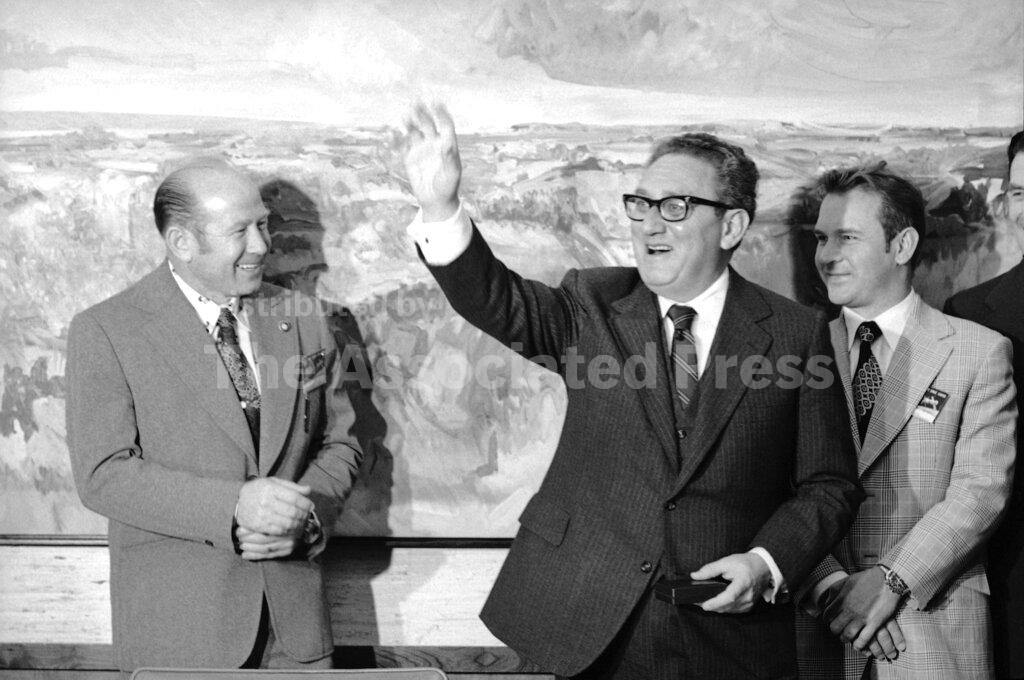
A new long-range missile, which the Department of Defense hopes will be tested next year, is already influencing arms-limitation talks with the Soviet Union and Soviet strategic calculations, United States and European military analysts say. The Soviet missile industry, according to reports from North Atlantic Treaty Organization headquarters in Brussels, has intensified research and development of a similar weapon, known as a cruise missile. Such missiles are pilotless aircraft propelled by air‐breathing engines and can carry any warhead. The Russians, who are known to be behind the United States in the advanced technology required for such devices, have suggested in informal discussions at the talks on limitation of strategic arms that their number and range be limited. According to diplomatic sources in Washington, Moscow has not mentioned any balancing reduction in Soviet strategic weapons. Nor has it budged from its long‐standing opposition to on‐site inspection.
Members of the Senate Foreign Relations Committee and the International Relations Committee of the House of Representatives say that a substantial majority in both have quietly agreed on a two-year phasing out of the program of direct military aid. Under this program about $40 billion has been given to allies since 1949 as part of the strategy of containing Communism. Congress seems virtually certain to go along. Proposed bills in both committees contain provisions to increase the credit program for military sales temporarily after direct aid is terminated.
Rebellious leftist soldiers who have been defying Portugal’s northern military commander tonight ended their week-long occupation of an artillery barracks in the northern city of Oporto. A spokesman for the rebels said by telephone from the barracks that the soldiers had decided to accept proposals by the army Commander in Chief, General Carlos Fabiao. The soldiers, who had sworn to remain until a leftist transport regiment was reopened, were leaving the barracks and returning to their homes, he said. General Fabido flew to Oporto earlier today to negotiate with the rebels. Hundreds of radical demonstrators surrounded his car, chanting and waving their fists, when he arrived at the barracks.
Several Spanish military commanders made public statements today asserting that the armed forces remained united in their loyalty to the Government of Generalissimo Francisco Franco despite a few defections. The statements, widely pubished by the Government‐supervised press, were apparently intended to rebut assertions made in Paris yesterday by a dissident Spanish Air Force officer. The officer, Captain Juan Ignacio Domingo, was one of 13 officers ordered arrested last Thursday on political charges. Twelve, including two majors and a captain, were taken into custody, but Captain Domingo was in Turkey and decided not to return to Spain.
Labor unrest among Britain’s 19,000 junior physicians swelled, with more strikes promised in protest against a new contract provision reducing overtime pay. Even as about 100 junior doctors — those just beginning in the government-run National Health Service — returned to work in Plymouth after a 24-hour strike, others refused to handle any but emergency cases to back demands for a contract revision. Some doctors threatened complete walkouts today.
An RAF Avro Vulcan bomber exploded and crashed over Żabbar, Malta after an aborted landing at RAF Luqa. The aircraft crashed in a residential area in Żabbar, and five crew members and one civilian on the ground were killed. The two pilots managed to eject and survived the accident. The crash caused extensive damage to many buildings in Żabbar. An investigation of the accident cited pilot error as the primary cause.
Tjalling Koopmans of Yale and Leonid Kantorovich of the Soviet Union will share the Nobel Memorial Prize in Economic Science. The announcement by the Swedish Royal Academy of Science said they were cited for their contribution to the theory of optimum allocation of resources, leading to improved economic planning. The two men conducted broadly similar work, largely independent of each other but with some contact in the last 20 years.
In one of the sharpest attacks on Andrei D. Sakharov since he won the 1975 Nobel Peace Prize last Thursday, the Soviet newspaper Literaturnaya Gazeta today accused the Russian physicist of supporting Nazi and Fascist causes and likened him to a laboratory rat. The article in Ltteraturnaya Gazeta — which was carried by Tass, the official press agency a day before the literary paper appeared — denounced the Norwegian Nobel committee for “blasphemously” having given the prize to Dr. Sakharov in the name of peace. At the total extent of his extremely limited political views, he did everything he could to flame hostility and mistrust between nations and states,” the paper said.
The United States is willing to discuss the previously untouchable issue of an inflation index in its dialogue with developing and oil-producing nations, said Thomas O. Enders, assistant secretary of state, during a break in the preparatory meeting for the world economic conference scheduled for Paris December 16. Indexing, pushed strongly by the petroleum producers, would link the price of oil and other raw materials to price rises in Western industrial goods.
Israeli soldiers shot and killed two Syrian shepherds on the front line of the occupied Golan Heights in the first incident of its kind since the Middle East war of October, 1973, the military command in Tel Aviv reported. A communique said the shepherds were guiding their sheep into a no-man’s-land near the fence marking the inner perimeter of Israeli-held territory. It said the soldiers had first shouted warnings to halt and fired their guns into the air.
President Anwar Sadat told a group of American businessmen that he will ask President Ford for a nuclear reactor, the semi-official newspaper Al Ahram reported in Cairo. Sadat is to visit Washington at the end of this month. The reactor is needed to desalt seawater and expand irrigation to produce more food for the country’s zooming population.
Saudi Arabia favors freezing the oil price recently agreed upon by the Organization of Petroleum Exporting Countries until the end of 1976, Saudi Arabia’s Minister of Petroleum, Sheik Ahmed Zaki Yamani, said in Bonn today. The oil producers agreed in Vienna last month to increase their price level 10 percent and to hold it at the new level until at least June 30, 1976. Sheik Zaki said he expected opposition to the Saudi position from other OPEC countries at the group’s meeting next summer to discuss its next step. “There will be another conference next June and another fight,” he said.
China accused the United States today of supporting Tibetans who seek to restore the exiled Dalai Lama to power in Tibet, which the Chinese Communists control. A strongly worded statement by the Foreign Ministry charged the United States with “undisguised interference in China’s internal affairs” and “a flagrant violation of the principles of the Shanghai Sino-U.S. communique.” The communique, signed in 1972 by President Richard M. Nixon and Premier Chou En‐lai, has formed the basis for gradual normalization of Chinese-American relations. This is the third occasion this year in which the Chinese have accused the Americans of not observing it. The allegations, coming less than a week before Secretary of State Kissinger is due in Peking, appeared likely to complicate his task of paving the way for President Ford’s visit, scheduled for next month.
Typhoon Elsie pounded Hong Kong with 100 mph winds, wrenching ships from their moorings, paralyzing transport, leaving hundreds homeless and sending others scurrying for cover from flying debris. For eight hours, Elsie buffeted the colony with gale force winds accompanied by squally rain before crossing the China coast about 60 miles west of Hong Kong. At least 46 persons suffered minor injuries from flying glass, collapsing scaffolding and slippery pavements.
Members of the armed forces came under unusual criticism in the closely guided Philippine press, and diplomatic sources in Manila speculated that a military shakeup was in the offing. The criticism — appearing in, among other papers, the Philippines Daily Express, the paper considered closest to President Ferdinand E. Marcos’ thinking — focused on alleged military misdeeds since the start of Marcos’ imposition of martial law three years ago.
The Minister for Minerals and Energy, Rex Connor, one of the most powerful figures in the Australian Cabinet, resigned today, precipitating a political crisis that could bring down the administration of Prime Minister Gough Whitlam. The 68‐year‐old Mr. Connor, known as “the strangler” because of his tough, brusque policies and manner, was forced out of the 27‐man Labor party Cabinet because of his involvement in Government attempts to borrow $8‐billion in foreign funds — mostly Arab oil money. The Opposition has accused the Labor party of being unfit to govern because of its secret attempts to raise dollars through freelance financial operators instead of through normal treasury channels.
A State Department spokesman told the Joint Congressional Economic Committee that the United States and Canada are fairly close to agreement on an oil pipeline treaty. The statement was made by Alexander Watson at a hearing conducted by Senator Hubert H. Humphrey (D-Minnesota). Watson indicated that any future oil exchange agreements between private industry in the two countries would presumably be covered by the proposed agreement.
Political repression by Chile’s military junta continues in a “systematic and devastatingly far-reaching manner,” a U.N. panel reported. In a 132-page report, the five-member panel accused the Chilean regime headed by General Augusto Pinochet of taking steps “absolutely contrary to many fundamental concepts of generally recognized human rights.” Drawing on testimony and written material from “all sources” outside Chile, the report said Chileans are “hounded, arrested, detained or subjected to unlimited degrading or inhuman treatment, including torture.” The panel was refused entry into Chile for an on-the-spot investigation.
President Isabel Martinez de Perón will return to the Argentine capital tomorrow to resume her duties after a month-long rest cure, the presidential press secretariat announced here tonight. It did not specify when the official handover of power by Italo A. Luder, the Senate speaker who has been interim persident, would take place. The transfer is expected on Thursday or Friday at a mass rally being organized by the Peronist labor movement to welcome back Juan D. Perón’s 44‐year‐old widow. Friday will be the 30th anniversary of General Perón’s release from prison after mass demonstrations in his favor. He was elected president of Argentina the following year.
In Operation SAVANNAH, less than one month before Angola’s scheduled independence from Portugal, troops from the South African Defence Force invaded by crossing the border from the trust territory of South-West Africa (now Namibia). Battle Groups Alpha and Bravo rendezvoused in the Cunene Province near Katwitwi. Cuba would begin sending combat troops on November 8 to fight the SADF force.
The limousine carrying President Ford from Hartford, Connecticut, to the airport after a brief visit was struck broadside by an automobile in downtown Hartford. The President was not hurt. A fender was bent to the tire on his limousine. The other car, driven by a young man with four young passengers, was badly damaged.
President Ford released a report he called “realistic” from a Domestic Council task force, urging that federal drug control efforts should concentrate on “priority” targets such as heroin, de-emphasizing law enforcement against reputedly less “destructive” drugs such as marijuana and cocaine. Administration sources said that Customs Commissioner Vernon Acree had called the report unprofessional and grossly misleading. Mr. Ford said it would be analyzed in the next 60 days. The report did not recommend that criminal penalties for simple possession and use of marijuana be abolished.
The Ford administration, uncertain of the legality of a large part of the National Security Agency’s foreign intelligence gathering, has reportedly devised a plan that it hopes will protect the rights of Americans while continuing the intelligence operation. Sources in the administration said that most laws on electronic eavesdropping had been written in connection with domestic criminal investigations without significant consideration of national security needs. President Ford, they said, is considering an executive order empowering the Attorney General to approve or disapprove specific intrusions by the N.S.A.
The Internal Revenue Service is considering a plan to divide taxpayers into groups and give each group its own income tax filing deadline, IRS Commissioner Donald Alexander said. He said the current January 1–April 15 filing period had created problems for both taxpayers and the IRS, which could be eased by a staggered filing system. Alexander told a gathering of certified public accountants in San Antonio that the refund returns that pile up at the beginning and end of the present filing period prevent quick refunds.
Former Senator Fred Harris and former Gov. Jimmy Carter have filed financial reports with the Federal Election Commission indicating that their Presidential campaigns are operating on very narrow margins. Both Democrats, regarded as long shots for the party’s 1976 nomination, continued to improve their fund‐raising record during the third quarter of the year, however, indicating that they will be on hand to seek Federal campaign subsidies next year. Mr. Carter, the former Georgia Governor, had an operating deficit of $10,000 for the three-month period ending September 30. For the first nine months of 1975, he took in $505,000 and spent $507,000 for a $2,000 deficit. Despite the relatively large amount of money he collected, Mr. Carter had only $15,000 in cash on hand on September 30. He listed $30,000 in debts but said that $29,500 was owed to his campaign.
The alleged ringleader of a prison break that freed five convicts from a maximum security penitentiary was captured without a struggle while walking along railroad tracks near Bloomfield, Indiana, about 100 miles from where he was being sought. Henry M. Gargano, 43, of Chicago, who was serving a 199-year sentence for murdering two Chicago policemen during a bank robbery, was the fourth escapee captured since the Friday night escape at Illinois’ Marion Federal Penitentiary. The band escaped by opening electronic doors with two gadgets they had built in the prison shop. The FBI said the manhunt would continue for the fifth convict, Dennis D. Hunter, 26, of Salem, Ohio, but a spokesman said there was “a good chance he’s slipped through our perimeter.”
Teachers and other employees struck Atlanta public schools and union leaders declared the strike would continue despite a back-to-work order issued by a federal judge. “We’re prepared to go to jail if it comes to that,” said James Williams, a spokesman for the strikers. School officials said about 75% of 84,000 pupils attended classes and were served cold lunches instead of the usual hot meals. Between 25% and 40% of 9,000 teachers, custodians, maids and maintenance workers stayed off the job, according to various estimates.
Former President Richard M. Nixon’s 1972 campaign committee reported it still had more than $1.5 million on hand, most of it the subject of lawsuits and other demands by key Watergate scandal figures. The liquidation trust set up to handle the money said in a report filed with the Federal Election Commission that in recent months it had paid only $41,000 of the numerous demands made by a score of people and companies. Claimants include former Attorney General John N. Mitchell and former Commerce Secretary Maurice F. Stans.
A consensus is emerging among New York City’s business and government leaders that economic decline is at the root of its troubles. The fiscal plight of “too much spending” is seen as another way of saying “too little income.” The crisis really began in 1969, when the city’s rapidly growing economy began to shrink. Since then, 501,800 jobs have disappeared, and with them an estimated total of $1.5 billion in tax revenues. Adding jobs is seen as the only permanent solution to the money problems of New York City.
After 25 years of economic growth, Puerto Rico is experiencing economic contraction, record unemployment and a sobering reassessment of its future. Economic troubles on the United States mainland are said to offer only part of the explanation. Tourism, manufacturing and construction are all suffering declines.
Heavy snows ranging from 5 to 8 inches gave the Northern Plains an early blast of winter as near blizzard conditions lashed the northern edge of North Dakota, stranding some families. Winds caused drifting and blowing snow in some areas. At the same time, record heat lingered in parts of the Midwest. In Chicago, the temperature soared for the second straight day, tying a 78-year-old record when it hit 86. It was 83 in Indianapolis and 85 in St. Louis. Thundershowers were widely scattered along the Gulf Coast and just ahead of a cold front from southwest Texas to the Upper Great Lakes.
The Federal Power Commission said it would take enforcement measures against pipeline companies and gas producers that fail to deliver contracted quantities of natural gas without a sound reason. Some major pipelines have warned of sharp curtailments of service this winter because of a natural gas shortage. The FPC did not say if it knows of any cases requiring tough enforcement, but it said the new policy was required because of “questions concerning deliverability and supply obligations…”
A letter signed by 38 House members asked the Environmental Protection Agency to shake off its “inertia” and get started on regulations requiring deposits on canned and bottled beverages sold on federal property. The EPA proposed rules requiring federal agencies to place a 5-cent deposit on beverage bottles and cans sold on military installations, National Parks and similar federal facilities. The congressmen said that despite the fact the deposit proposals have received “widespread public support wherever they have been put into effect,” their efforts have been stymied by “an intensive lobbying campaign by both industry and organized labor.”
1975 World Series, Game Three:
In a game featuring 6 home runs, 3 by each team, the Reds prevail 6–5 in the 10th inning. At home, the Reds prevailed in another squeaker in a game that featured the first major controversy of the series that involved the umpires. For nine innings, the game was a homer-fest as each team put three over the wall. Fisk put the Sox on the board in the second with a homer off Reds starter Gary Nolan. The Reds countered by taking a 2–1 lead in the fourth when Tony Pérez walked and Johnny Bench hit a two-run shot off Sox starter Rick Wise. The Reds then chased Wise in the fifth when Dave Concepción and César Gerónimo hit back-to-back home runs. Pete Rose followed with a one-out triple and scored on Joe Morgan’s sacrifice fly to give the Reds a 5–1 lead. The Sox scratched back in the sixth when Reds reliever Pat Darcy issued consecutive walks to Carl Yastrzemski and Fisk, wild-pitched Yastrzemski to third, and then gave up a sacrifice fly to Fred Lynn. In the seventh, former Cincinnati Red Bernie Carbo closed the gap to 5–3 with a pinch-hit homer off Clay Carroll. In the top of the ninth, with Reds closer Eastwick on the mound, Rico Petrocelli singled and Evans hit the game-tying home run, sending the game into extra innings.
After the Red Sox failed to score in the tenth, the Reds sent the bottom of the order to lead off the bottom of the tenth. Cesar Geronimo led off with a single off Jim Willoughby. Reds manager Sparky Anderson then sent pinch-hitter Ed Armbrister up to sacrifice in place of reliever Rawly Eastwick. Armbrister’s bunt bounced high near the plate toward the first-base line. Boston catcher Carlton Fisk was quick to pounce on the ball in front of the plate as Armbrister was slow to get out of the box. He hesitated before running and appeared to collide with (or at least impede) Fisk as he was retrieving the ball. Fisk’s hurried throw to second base to force out Geronimo sailed over shortstop Rick Burleson into center field as Geronimo went to third base and Armbrister to second. Fisk and Boston manager Darrell Johnson argued that Armbrister should have been ruled out for interference, but home plate umpire Larry Barnett ruled otherwise. The play stood and the Reds had the potential winning run on third with no outs. Willoughby then intentionally walked Pete Rose to load the bases and set up a force play at any base. Johnson then brought in left-hander Roger Moret, to face Ken Griffey, but Anderson countered with right-handed hitting Merv Rettenmund. Rettenmund struck out for out No. 1, but Joe Morgan knocked in Geronimo with the game-winner by hitting a deep fly to center over a drawn in outfield.
Boston Red Sox 5, Cincinnati Reds 6
Dow Jones Industrial Average: 835.25 (-2.52, -0.30%)
Born:
Floyd Landis, American cyclist and 2006 Tour de France winner who was later stripped of his title, in Farmersville, Pennsylvania.
 History Diaries