There is another “baby step” on 12 October 1940 on the long, tortuous unwinding of Operation SEALION, the proposed German invasion of England. There is no one date when Operation SEELÖWE truly “disappears”; it is more a gradual withering of the operation’s prospects until, eventually, it is stricken from the books entirely as a mere clerical formality, all hope of anything of the sort long since passed.
Hitler, basically admitting the obvious, today officially postpones the invasion until 1941. This frees up forces allocated to the operation for other purposes, which sounds impressive, but they don’t have much to do anywhere else, either. The issue is so trivial to Hitler that, rather than issue another pompous Führer Directive as he did in July to start the process, he simply has General Keitel issue a somewhat indifferent order which states in relevant part:
“The Führer has decided that until next spring the preparations for SEELÖWE are to be continued with the sole intention of maintaining political and military pressure on England. Should the projected landing be resumed in spring or early summer, orders will be given for new preparations. In the meantime, it is necessary to shape conditions in the military sphere to suit a final invasion.”
In essence, this order simply confirms what almost undoubtedly was the case all along, that Operation SEALION was a sham deception operation with virtually no chance of being undertaken.
Battle of Cape Passero: On the previous day, the British Mediterranean Fleet departed Malta after an escort mission, and was detected by Italian aircraft. At 0200 hours, Italian torpedo boats Ariel, Alcione, and Airone caught up with the fleet and attacked British cruiser HMS Ajax east of Malta; Ariel and Airone were sunk by Ajax. At 0215 hours, Ajax’s radar detected Italian destroyers Artigliere and Aviere and opened fire, damaging Aviere and rendering Artigliere dead in the water; Artigliere returned fire and hit Ajax four times, damaging gun turrets and disabled the radar while killing 13 and wounding 20. Ajax was able to retire from the battle under her own power, while Artigliere was towed away by destroyer Camicia Nera.
The Italians send heavier forces, led by Heavy cruisers Bolzano, Trento, and Trieste of the 3rd Cruiser Division, to support the destroyers. However, they arrive late.
HMS Eagle was damaged by near misses from bombs released by Italian SM.79 bombers.
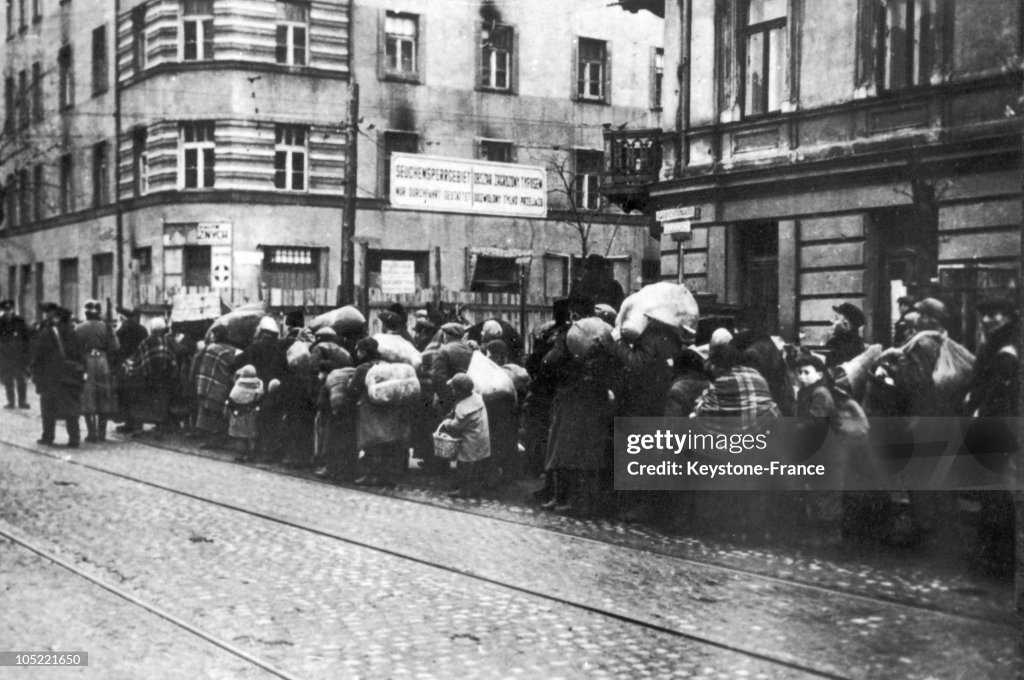
German Governor-General of Poland Hans Frank issues new orders for the 138,000 Polish Jews living in occupied Warsaw. They are to move into the Jewish Ghetto, euphemistically called the Jewish residential quarters. This area is vastly overpopulated, with 30% of the city’s 400,000 people crammed into 2.4% of the city’s land area. They also, of course, are penned in by a large wall.
Turkey, it was learned tonight, has promised to assist Syria in event of Italian attack and is sounding out Moscow in an effort to learn the Soviet position if the axis should move on Greece. Haidar Aktay, Turkish ambassador, arrived in Moscow today with Instructions to obtain an immediate interview with Soviet Premier V. M. Molotoff on the Balkan crisis. Turkey, it was said, urgently de sires to ascertain Russia’s policy in event the Turks come to the aid of Greece to “resist an ‘attack by Italy and Germany. Indications were Moscow will refrain from any commitments to Turkey but it was thought possible Turkey would be promised the Red army would not attack Turkey while that nation is engaged with the defense of Greece.
A new German military mission was set up in Bucharest, Rumania to direct the training program for the Rumanian Army.
The German troops taking up positions in Rumania continue fanning out to specific billets. Some four hundred Wehrmacht troops arrive in Bucharest to set up a new military mission. The ostensible purpose of this is to supervise the training of the Rumanian Army pursuant to a request by Rumanian leader Ion Antonescu. Erik Hansen leads the mission. The Aerian Mission or the Deutsche Luftwaffenmission in Rumänien commanded by General Wilhelm Speidel also arrives. The 13th Motorized Infantry Division is the source of the troops. The primary focus of German duties in Rumania will be anti-aircraft protection of the oil fields against Allied bombers and security against sabotage.
The Soviet General Staff was reported today to have begun massing troops on the Northern Bukovina frontier in the region of Hertza and Dorohoi.
German reconnaissance aircraft scouted England, United Kingdom between 0650 and 0900 hours, and then between 0900 and 1715 hours several raids attacked southern England, many of which reached London. Biggin Hill and Kenley are attacked in daylight. During this day, Germans lost 9 Bf 109 fighters and 1 Ar 95 seaplane over the Dover Strait; the British lost 10 fighters with 4 pilots killed. Overnight, London received light bombing, while Birmingham and Coventry were also attacked.
The National Gallery was hit by a bomb today, but Myra Hess carried on her Gallery concerts as she has been doing for the past year. Against the bare walls of the central galleries (the pictures are safe in a Welsh slate quarry), lunch-time chamber-music concerts are given to 1,500 people, who pay a shilling a head to hear pianists like Solomon and Denis Mathews as well as Myra Hess’s Bach and Beethoven. Much of the music — like the bomb damage is German.
The day itself is fairly clear again, and the aerial action is virtually a repeat. Once again, the Luftwaffe concentrates on high-altitude fighter-bomber (Jabo) attacks, which don’t cause a lot of damage but do manage to draw up RAF fighters for combat.
The raids start a little later than yesterday. At 10:00, a raid crosses into Kent and is intercepted by RAF Nos. 72 and 92 Squadrons flying out of Biggin Hill. It is a fairly heavy Luftwaffe commitment by JG 54, JG 77 and LG 2. The Luftwaffe loses two fighters and the RAF one.
Another formation approaches over Hastings. Another massive dogfight results. This action is notable because Major Werner Mölders, Kommodore of JG 51, claims three Hurricanes of RAF No. 145 Squadron. Hptm. Walter Oesau, Stab III./JG 51, gets a Hurricane for his 36th victory.
The raids come in waves thereafter, not particularly large but steady. Around 13:00, a formation over Maidstone leads to a fierce dogfight in which both sides take losses.
At 15:30, the Luftwaffe sends over some Junkers Ju 88 bombers escorted by fighters from JG 53 and JG 54. They are intercepted off Beachy Head, and another battle ensues.
By 17:00, the raids are pretty much over, with only some lone raiders and reconnaissance aircraft appearing on the radar scopes.
After dark, the Luftwaffe hits the usual targets: London, the Midlands, East Anglia, the Northeast. This night is particularly bad for London, as the bombers stay overhead until the first light. Trafalgar Square Station takes a bad hit, killing seven people and injuring 30 in the Tube. The National Gallery takes a hit, but Myra Hess performs her Bach and Beethoven selections as usual. Coventry also takes damage, starting fires. Some scattered raids along the southern coast hit some factories and put out the telephone exchange for a while.
Overall, losses again are about even. The Luftwaffe loses eleven planes, the RAF ten. The Luftwaffe seems to have found a successful formula at long last — though how long they will stick to it is an open question, given the OKL’s predilection for constantly changing strategy.
British Losses:
Spitfire P9338, No. 72 Squadron
P/O H.R. Case killed.
Spitfire X4591, No. 92 Squadron
F/O A.J.S. Pattinson killed. Shot down and killed by Bf 109s over Hawkinge.
Hurricane V7426, No. 145 Squadron
Sgt. J.V. Wadham killed. Shot down and killed by Bf 109s over Hastings.
Blenheim L1113, No. 219 Squadron
P/O R.V. Baron killed. Bailed out of aircraft but parachute failed to open.
Hurricane P3022, No. 605 Squadron
Sgt. P.R.C. McIntosh killed. Shot down in action against Bf 109s over the Channel off Dungeness.
Werner Mölders shot down three British Hurricane fighters over England, United Kingdom, bringing his total kills count to 51.
James Lacey shot down a German Bf 109 fighter over Britain.
British and German heavy artillery fought a mighty engagement early today the longest bombardment and counter-bombardment of the war across the Dover strait and British planes leapt the star-lit channel to bomb heavily the Nazi gun emplacements. British guns opened the action last night and for the first time two German batteries on the French shore- opened simultaneous fire in reply, one near the Cap Griz Nez lighthouse and the other at Calais, Some three hours later the great duel still went on. Shells fell upon the English shore at three-minute intervals at times. The channel itself was smooth and untroubled, bright in the moonlight but overlain by mist.
RAF Bomber Command dispatches 6 Blenheims on a daylight sea sweep and 1 to Hamburg. No losses.
RAF Bomber Command dispatches 93 Battles, Blenheims, Hampdens and Wellingtons overnight to 5 targets in Germany, to the Channel ports, minelaying and O.T.U. leaflet flights. There were no losses. The 24 Blenheims and 6 Battles of the above force sent to bomb shipping in the Channel ports represent the last major raid on these targets in the invasion-threat period. Bomber Command raids Berlin, attacking the usual power stations, gas works, and warehouses. In addition, the aluminum factory at Heringen, the Krupp factory at Essen, the Fokker factory at Amsterdam, oil installations at Cologne and Hanover, an aqueduct at Dortmund-Ems, and smaller targets receive attention. at Other raids target points along the Channel Coast, including the coastal guns at Cap Gris Nez.
RAF Bomber Command Operational Statistics, 26 June to 12/13 October 1940 (109 days/nights): Number of days with operations: 105. Number of nights with operations: 102. Number of daylight sorties: 1,885, from which 66 aircraft (3.5 percent) were lost. Number of night sorties: 8,804, from which 180 aircraft (2.0 percent) were lost. Total sorties: 10,689, from which 246 aircraft (2.3 percent) were lost. Approximate bomb tonnage in period: 6,010 tons. Averages per 24-hour period: 98.1 sorties, 2.3 aircraft lost, 55.1 tons of bombs dropped.
German aircraft crossed Scapa Flow during the night. All exercises were prohibited and movements were restricted during the day.
Directive Warschau-Sud is issued. This is an instruction to aircraft companies Junkers and Messerschmitt to develop gliders to carry assault forces for invasion purposes. The companies are given a fortnight to come up with designs, but it is a much larger project than that and requires much more time. Messerschmitt is mandated to use steel tube and fabric, while Junkers must use non-strategic materials such as wood. This project eventually leads after a long and winding road to the Ju 322 “Mammut” and the Me 261w, Me 263, Me 321 and Me 323 — none of which were used for invasions.
The TsKB-57 prototype aircraft of the Soviet Ilyshin Il-2 Shturmovik ground attack aircraft design made its maiden flight.
The RAF in North Africa bombs Bardia and Tobruk, Libya, causing extensive damage and fires. The South African Air Force chips in with an attack on Javello Airfield in East Africa.
At Malta, Governor Dobbie writes to the War Office proposing an increased bomb disposal service. Unexploded bombs have become a major issue on the island. In addition, some downed Italian pilots picked up at sea by a Sunderland flying boat (their Cant 501 flying boat had been shot down by a Fulmar) are interrogated and give some insight into Italian reconnaissance practices.
German U-boats U-48, U-59, and U-101 attacked Allied convoy HX.77 150 miles northwest of Ireland, sinking Norwegian tanker Davanger just after 0000 hours (17 killed, 12 survived), British ship Pacific Ranger at 1800 hours (entire crew of 55 survived), and Canadian steamer Saint Malô at 2325 hours (28 killed, 16 survived).
U-48, commanded by Kapitänleutnant Heinrich Bleichrodt, sank Norwegian steamer Davanger (7102grt) from convoy HX.77 in 57-00N, 19-10W. At 0014 hours, U-48 attacked the convoy HX.77 about 300 miles west of Broadhaven, Ireland and sank the Davanger (Master Elliot K. Karlsen) in station #61 The tanker was hit on the starboard side in the engine room by one torpedo and sank by the stern within 4 minutes. The master, 16 crew members and one gunner were lost. The 12 survivors set sail in their lifeboat and arrived in Broadhaven on 18 October. The 7,102-ton Davanger was carrying fuel oil and was bound for Liverpool, England.
U-59, commanded by Joachim Matz, sank steamer Pacific Ranger (6895grt) from convoy HX.77 in 56-20N, 11-43W. At 1803 hours on 12 Oct 1940 the Pacific Ranger (Master William Evans) in convoy HX.77 was hit amidships by one torpedo from U-59 and sank slowly 134 miles 302° from Bloody Foreland. The U-boat tried to give provisions to the survivors in the lifeboats, but due to rough seas it did not work. The master, 52 crew members and two passenger (naval ratings) were rescued: 19 crew members were picked up by a British escort, the master and twelve survivors after nine days by the Icelandic trawler Þormóður and landed at Reykjavik on 21 October and the chief officer and 22 crew members made landfall at Glencolumbkille near Killybegs, Co. Donegal. The 6,865-ton Pacific Ranger was carrying general cargo, including lumber and metals and was bound for Manchester, England.
U-101, commanded by Kapitänleutnant Fritz Frauenheim, sank Canadian steamer Saint Malo (5779grt), a straggler from convoy HX.77, in 57-58N, 16-32W. At 2325 hours on 12 Oct 1940 the Saint Malô, a straggler from convoy HX.77, was hit amidships by one torpedo from U-101, broke in two and sank after 30 minutes. 13 Canadian and three French crew members abandoned ship in one lifeboat and some rafts. The U-boat fished the 17 years old ship´s boy out of the water and transferred him to the boat after questioning. Two days later, the boat was taken in tow by a lifeboat from Port Gisborne, which had been sunk by U-48 (Bleichrodt) on 11 October. The survivors transferred into the other lifeboat on 21 October and were all rescued by HMS Salvonia (W 43) (Lt G.M.M. Robinson, RNR) on the following day. The 5,779-ton Saint-Malô was carrying general cargo, including steel and grain and was bound for Liverpool, England.
On 11 October, Yugoslavian steamer Orao (5135grt) had been intercepted by destroyer HMS Hotspur and ordered to Gibraltar with an armed guard. Then on the 12th, Italian submarine Tazzoli torpedoed Orao in 35-34N, 10-35W, with two crew killed. Destroyers HMS Wishart, HMS Gallant, HMS Griffin, and HMS Vidette were detached from battlecruiser HMS Renown, with Gallant and Griffin picking up the survivors, and Wishart scuttling the Yugoslavian vessel. The destroyers were then ordered to meet arriving transports Ettrick and Karanja, being escorted by destroyer HMS Greyhound. The destroyers, plus destroyer HMS Firedrake, rejoined on 0724 on the 13th and the force met the transport convoy at 1300. Vidette was detached to join the transport convoy and the next day, Wishart was detached to join as well.
Aircraft carrier HMS Furious, heavy cruisers HMS Norfolk and HMS Berwick, and destroyers HMS Somali (D.6), HMS Eskimo, HMS Mashona, and HMS Duncan departed Scapa Flow at 1800 for operation DH and to cover the destroyer sweep off Egero. Destroyers HMS Matabele and HMS Punjabi departed Skaalefjord at 0310/13th to join Furious. At 1230/13th, Eskimo and Duncan were detached to Scapa Flow arriving at 0900/14th. Somali and Mashona arrived at Scapa Flow at 1400/14th.
Captain D.12 on destroyer HMS Keppel was transferred ashore at Greenock.
Hunt-class destroyer HMS Mendip was completed. She worked up at Scapa Flow, but was badly damaged by the explosion of one of her own depth charges on the 24th. She was assigned to the 21st Destroyer Flotilla and joined the Flotilla following completion of repairs.
Destroyer HMS Bulldog departed Rosyth at 1500 to join submarine HMS Clyde off Dundee at 1830, and escorted the submarine to Cape Wrath. Bulldog arrived at Scapa Flow at 1730/13th.
Destroyer HMS Quorn departed Scapa Flow at 0900 for Aberdeen, and left there at 1500 with steamer Lochnagar for Lerwick.
Minesweeper HMS Kellet hit the pier at Leith, and had to be docked for repairs.
Monitor HMS Erebus, escorted by destroyer HMS Cattistock, bombarded German invasion barges at Dunkirk.
Trawler Longscar (215grt) was damaged by German bombing off Hartlepool.
Minesweeping trawler HMS Resolvo (231grt, Temporary Skipper A. Affleck RNR) struck a mine six cables 083° from Knob Bell Buoy in the Thames Estuary. Two ratings were wounded, and the survivors rescued by minesweeping trawler HMS Peter Carey (280grt). Resolvo was beached outside the entrance to Sheerness at the Outer Bar Buoy and abandoned on the 13th.
German schnellboote S.37 was sunk on a mine off Orfordness.
Steamer Starling (1320grt) was damaged by German bombing four miles southwest of San Sebastian Light.
Anti-aircraft cruiser HMS Calcutta was subjected to high level Italian bombing near Crete on the 12th.
Italian and British Naval forces engaged east of Malta. In the first phase of the battle between the Italian torpedo boats and radar-equipped light cruiser HMS Ajax (Captain E. D. B. McCarthy) which was proceeding to cover the eastbound convoy, Italian torpedo boats Ariel and Airone were sunk in 35-37N, 16-42E, with Ajax hit three times, twice on the bridge and once amidships starting a fire. Temporary Instructor Lt M. P- Gamon, B. Sc., Acting Temporary S/Lt G. H- K. Strathey RCNVR, and ten ratings were lost, with Lt Cdr J. G. T. Inglis, Commissioned Gunner C. W. Lewis, and twenty two ratings wounded. Italian torpedo boat Alcione picked up the survivors of Airone.
In the second phase of the battle between the Italian destroyers which were coming to the aid of the torpedo boats and HMS Ajax, Italian destroyer Aviere was damaged and escorted back to base by undamaged destroyer Geniere. Destroyer Artigliere was badly damaged and destroyer Camicia Nera stood by and later attempted to take her into tow. Ajax was hit four times in this phase putting out action, one four inch gun and her radar.
Early on the 13th while under tow, Italian destroyer Artigliere was subjected to fierce air attacks from aircraft carrier HMS Illustrious after being located by a Sunderland flying boat. Alerted by Illustrious’s report, heavy cruiser HMS York (Captain R. H- Portal), HMS Ajax, and four destroyers including HMAS Vampire and HMS Nubian, located Artigliere.
Destroyer Camicia Nera cast off her tow and retired, leaving Artigliere to be torpedoed and sunk in 35-47N, 16-25E by HMS York, HMAS Vampire and HMS Nubian. Rafts were dropped and the crew was later picked up by an Italian hospital ship. HMS Ajax and Australian cruiser HMAS Sydney pursued Camicia Nera but did not catch her.
The Italian 3rd Cruiser Division, heavy cruisers Bolzano, Trento and Trieste with destroyers Vivaldi, Da Noli and Tarigo of the 14th Destroyer Flotilla departed Messina to support destroyers Artigliere and Camicia Nera, but did not arrive in time and did not contact the British force.
Light cruisers HMS Orion, HMAS Sydney and HMS Ajax rejoined the Main Fleet during the morning of 12 October.
At 1000/12th, destroyers HMS Dainty, HMS Defender, and HMS Diamond and battleship HMS Ramillies with destroyers HMS Janus, HMS Jervis, HMS Hereward, and HMS Decoy rejoined the Main Fleet.
Reports of further Italian destroyers caused HMS York and light cruisers HMS Liverpool, HMS Orion, and HMAS Sydney to return to support convoy ME 4.
One hundred survivors were picked up by Italian ships from Artigliere. Eighty four survivors from Airone and forty one from Ariel were rescued.
Destroyer HMS Kimberley on Perim patrol was attacked by Italian bombers three miles from Perim. There was no damage in the attack.
Convoy OA.228 departed Methil escorted by sloop HMS Fowey and corvette HMS Bluebell from 12 to 16 October.
Convoy OB.227 departed Liverpool escorted by destroyer HMS Arrow and corvette HMS Calendula from 12 to 15 October.
Convoy FS.307 departed Methil, escorted by destroyer HMS Vivien and sloop HMS Londonderry. The convoy arrived at Southend on the 14th.
Convoy HX.80 departed Halifax escorted by Canadian destroyers HMCS St Croix and HMCS Niagara and auxiliary patrol boats HMCS Husky and HMCS Reindeer. The local escort was detached on the 13th. Ocean escort was armed merchant cruiser HMS Laconia, which was detached on the 22nd. On 23 October, destroyers HMS Castleton and HMS Wanderer, sloop HMS Hastings, corvettes HMS Fleur De Lys and HMS Picotee, and anti-submarine yacht HMS Philante joined the convoy, which arrived at Liverpool on the 27th.
Convoy SL.51 departed Freetown escorted by armed merchant cruiser HMS Alcantara to 31 October. On 30 October, destroyers HMS Achates and HMS Arrow, sloop HMS Rochester, corvette HMS Primrose, and anti-submarine trawler HMS St Apollo joined. On 31 October, destroyer HMS Amazon joined, and the convoy arrived at Oban on the 31st.
Speaking in Dayton, Ohio, President Roosevelt rejects appeasement, and promises to defend America and its seas against aggression. President Roosevelt gives a speech in which he reassures the country that the U.S. is only arming for the defense of the western hemisphere. He is in the midst of his re-election campaign, and indications from polls and the like are that public sentiment remains strongly in favor of non-intervention.
Speaking by radio to the Western Hemisphere, but with obvious reference to Germany, Italy and Japan, he rejected any theory of appeasement, and grouped the American republics as a single unit within the neighborly defense program of this country. “No combination of dictator countries of Europe or Asia,” he said, “will stop the help we are giving to almost the last free people fighting to hold them at bay.”
This country, he added, will defend now, as in 1798, the right of peaceful commerce in the Atlantic and Pacific Oceans. The United States is keeping the nations of this hemisphere fully advised on defense preparations. Then the President said: “We intend to encourage this frank interchange of information and plans because we shall be all for one and one for all.”
On this Columbus Day, Mr. Roosevelt noted the widely varying racial origins of the Americans, among them Italian, German, Spanish and Portuguese, and pledged the might of the United States to perpetuate the friendly association of countries developed by their descendants.
Wendell L. Willkie tonight denounced as scurrilous and indecent the attack upon him in a pamphlet issued by the colored division of the Democratic National Committee, as reported in today’s issue of The New York Times. Republicans and Democrats deplored yestrday as “vicious smear campaign tactics” the pamphlet issued Friday to campaign speakers by the Colored Division of the Democratic National Committee, which called attention to Wendell L. Willkie’s German ancestry.
Sudden increases in the number of Work Projects Administration employes as the election draws near cannot be excused with the assertion that they were planned in the Spring, Representative J. William Ditter, chairman of the Republican Congressional Campaign Committee, said today.
Tom Mix, 60, the best known cowboy actor, is killed in a car accident in Florence, Arizona. While driving at about 80 mph (128.7 km/h), he lost control of the car after hitting a dirt detour and is instantly killed. Driving his bright yellow Cord Phaeton sports car, Mix is heading north from Tucson at 80 mph when he fails to notice a sign warning that a bridge is out on the road ahead. The Phaeton flies through the air and crashes into a dry wash. Tom Mix is killed when a heavy aluminum suitcase in the convertible’s backseat strikes his head. The area is now known as the Tom Mix Wash, with a small commemorative iron statue of a riderless horse. Mix appeared in over 300 motion pictures between 1909 and 1935 and was one of the highest-paid actor in silent films during the 1920s making US$7,500 (US$73,529 in year 2000 dollars) per week.
Former U.S. Senator William Dieterich, 64, was found dead of a heart attack tonight in a hotel room. Dieterich had come from his home at Beardstown, Illinois, today on Democratic campaign business, and registered at a hotel. A bellboy found him sprawled on the hotel room floor tonight with the telephone off the hook. Physicians surmised he was attempting to call help when he died. Dieterich retired from the senate in 1939 after serving a six-year term. He was elected in 1932.
A telegram from William Green, president of the American Federation of Labor, to Herbert Hoover in which Mr. Green opposed the lifting of the British blockade to feed the conquered peoples of Europe, was made public yesterday.
Dr. Clarence A. Dykstra, President of Wisconsin University, accepted today the post of Director of Selective Service and it was expected efforts would be made to have the Senate confirm his nomination speedily, inasmuch as the draft registration will be made Wednesday.
Commander Atlantic Squadron (Rear Admiral Hayne Ellis), in the destroyer USS Rhind (DD-404) visited Port-au-Prince, Haiti. The timely goodwill visit came in the wake of an extensive cabinet shakeup by the Haitian president the previous day. Rear Admiral Ellis later wrote that the USS Rhind’s visit had a “very soothing effect on the minds of the people” in the Haitian port.
The aircraft carrier USS Wasp (CV-7), operating off the Virginia coast, launched 24 USAAC P-40 Warhawks and 9 O-47 observation planes to gather data on comparative take-off runs of naval and army aircraft. This was the first time U.S. Army planes were flown off a U.S. Navy carrier.
The U.S. Navy awarded a contract for various construction projects immediately outside the Pearl Harbor Navy Yard in the Hawaiian Islands.
Destroyer USS Rhind visits Port-au-Prince, Haiti as part of the continuing Show the Flag operations.
Juan Manuel Fangio, a former soldier now become a race car driver, wins the Turismo Carretera, Gran Premio del Norte, the Grand Prix International North. The two-week race involves a 9500 km drive through Argentina, Bolivia, and Peru. In particular, the racers have to drive up through the Andes to Lima, Peru and then back down again in stages. His time is 109 hours 36 minutes. Fangio is the first TC Argentine Champion to win the race with a Chevrolet. It is Fangio’s first major victory and leads him to become Argentine National Champion for 1940.
Gunboat HMS Cricket departed Hong Kong in the tow of tanker War Sirdar. Owing to a typhoon, both ships were recalled. They departed again on the 18th and arrived at Singapore on the 24th.
Gunboat HMS Tarantula departed Hong Kong on the 22nd, escorted by light cruiser HMS Durban and arrived at Singapore on the 29th.
The Canadian Pacific liner Empress of Russia sailed for the United States today with the first Americans to heed their State Department’s advice to get out of the Orient, about 100 wives and children of American business men.
MacArthur drafts memorandum to Quezon detailing America’s refusal to commit to a defense plan for the Commonwealth and emphasizing that the Philippines could only remain independent if shielded by guarantees of U.S. military support. The memorandum highlights the failure by both the War and Navy Departments to develop a specific plan, be this withdrawal or reinforcement, for the Islands, and warns Quezon that “strategic abandonment” by the U.S. was a possibility.
German raider Pinguin, which captured Norwegian tanker Storstad on the 7th of October, has been working it up into being a minelayer. Today, the process is complete and the ship (renamed the Passat) heads for the Banks Strait off Tasmania and for the east and west ends of the Bass Strait off Melbourne. Pinguin, meanwhile, heads for Sydney to lay mines as well. The presence of the Passat, manned by German sailors, doubles the effectiveness of Pinguin.
Born:
Glenn Beckert, MLB second baseman (MLB All-Star 1969-1972; Chicago Cubs, San Diego Padres), in Pittsburgh, Pennsylvania (d. 2020).
Irv Goode, NFL guard, tackle, and center (NFL Champions, Super Bowl VIII-Dolphins, 1973; Pro Bowl, 1964, 1967; St. Louis Cardinals, Miami Dolphins), in Newport, Kentucky.
Larry Jeffrey, Canadian NHL left wing (NHL Champions, Stanley Cup-Maple Leafs, 1967; Detroit Red Wings, Toronto Maple Leafs, New York Rangers), in Goderich, Ontario, Canada (d. 2022).
Died:
Tom Mix, 60, American film actor (auto accident).
Naval Construction:
The Вое́нно-морско́й флот СССР (ВМФ) (Soviet Navy) “M” (Malyutka)-class (3rd group, Type XII) submarines M-102 and M-103 are launched by Sudomekh (Leningrad, U.S.S.R.) / Yard 196.
The Kriegsmarine (German Navy) Type VIIC U-boat U-70 is launched by F. Krupp Germaniawerft AG, Kiel (werk 604).
The Royal Navy Flower-class corvette HMS Arbutus (K 86) is commissioned. Her first commanding officer is Lieutenant Commander Hugh Lloyd-Williams, RNVR.
The Kriegsmarine (German Navy) Type VIIC U-boat U-98 is commissioned. Her first commanding officer is Kapitänleutnant Robert Gysae.
The Royal Navy Hunt-class (Type I) escort destroyer HMS Mendip (L 60) is commissioned. Her first commanding officer is A/Commander Guy Neville Rolfe, RN.
 History Diaries