A large number of German troops entered Rumania to train the Rumanian Army and protect the country’s oil fields. Romania was now effectively under German occupation. German troops entered Rumania ostensibly to help reorganize and train the Rumanian army. The main aim of the action, however, was to block the Soviets and protect their access to Rumania’s valuable oil fields. German troops pour across the Romanian border — with the acquiescence of Ion Antonescu — to occupy various key points throughout the country. Their ostensible mission is to train Romanian troops — which don’t really need much training. However, the Germans (Hitler) want them there to protect the oil fields (from the Soviets and British sabotage), while Antonescu wants them there to tighten ties with Germany and protect the country — which has been losing territory to all of its neighbors — from the Soviets. Many accounts state that the Germans now “occupy” Romania, but that is an immense exaggeration — they only secure specific points important to Hitler and, presumably, Antonescu.
Premier Benito Mussolini s newspaper today warned the United States that it faces war against Italy, Germany and Japan unless it joins in their “new world order” and the promised reward of U. S. territorial expansion on the American continent. The newspaper Popolo d’ltalia of Milan said that: ‘If the Washington government prefers to place its solidarity with Britain . . . and prefers to assume a defiant attitude in the international field then Berlin, Rome and Tokyo are ready to accept the challenge and fight.”
Charles de Gaulle arrived in Douala, French Cameroons. General de Gaulle meets with General LeClerc in Cameroon. They discuss using the territory to conduct air attacks on the Italians in North Africa. There remains a strong Vichy French presence throughout the region.
British scientist Henry Tizard returns from the U.S. to England.
Already a Knight Grand Cross of the Royal Victorian Order since 23 January 1937, Air Marshal Hugh Dowding becomes a Knight Grand Cross of the Order of the Bath.
The German Luftwaffe mounted 4 raids of 30 to 160 aircraft consisted mostly of fighter-bombers and fighters, with few medium bombers, against London, England, United Kingdom; various government offices in Whitehall and the Charing Cross Railway Station were damaged by bombs. The Germans lost 1 Bf 109 fighter and 3 bombers; the British lost 4 fighters with all 4 pilots killed. Overnight, London, East Anglia, East Midlands, Portsmouth, and Southampton were bombed, with a serious fire damaging wharves and nearby warehouses.
The weather is good on 8 October 1940, and there is constant action throughout the day. However, the Luftwaffe mounts primarily very small raids and not the large raids which have provided it with such mixed results. Once again, though, the Luftwaffe uses medium bombers during the day — which is counter to the supposed new policy of relying on fighter-bombers (Jabos). The Battle of Britain is petering out, but it does so in fits and starts. The whole conclusion simply reinforces the utter formlessness of Luftwaffe strategy throughout the entire affair.
During the morning, there are Jabo attacks on London that begin around 08:30. Around that time, over 50 aircraft cross near Dungeness and hit London and the nearby airfields such as Biggin Hill, Hornchurch and Kenley. These Jabos can fly high, so Fighter Command has difficulty intercepting them. The flip side, of course, is that their bomb loads are small and thus can’t cause much damage. The bombs cause the most damage around Tower Bridge, Whitehall (Paymaster General’s Office, Ministry of Agriculture and Great Scotland Yard), Charing Cross Station, BBC House and houses in Bermondsey, Lewisham and West Ham.
Around 11:00, Dornier Do 17 bombers cross near Lympne. After an early RAF interception, the bombers drop their loads at random and scatter back to France.
After lunch, Junkers Ju 88 bombers cross over the Sussex coast at 13:00. They hit RAF West Hampnet and destroy a Boston bomber and damage a Blenheim. The raid is particularly effective and puts the airfield out of action. Other targets are Shoreham, West Malling and the Thorney Island airfield.
More small-scale raids continue throughout the afternoon. The most interesting incident is a special bombing mission against the Rooters aircraft factory at Speke by one specially equipped Junkers Ju 88 (M7+DK of KG 2,/806). It has four 250 kg bombs and has a Photographic War Correspondent (Bildberichter) on board. RAF No 312 (Czech) squadron based at Speke intercepts the plane, forcing it to make a crash landing at Bromborough Dock around 16:15. The plane is in good condition, is put on display, paraded through Liverpool, and then scrapped.
After dark, the Luftwaffe raids London, Portsmouth, Southampton, Liverpool, the Midlands, and East Anglia. It also conducts minelaying off the northeast coast. There is random damage to various factories and railway lines, but nothing major. There are large fires at the docks and warehouses of Bermondsey.
British Losses:
Spitfire R6779, No. 66 Squadron
P/O G.H. Corbett killed. Shot down by Bf 109s.
Spitfire N3043, No. 66 Squadron
Sgt. R.A. Ward killed. Shot down by Bf 109s over north Kent.
Spitfire P7329, No. 72 Squadron
P/O D. Hastings killed. Mid-air collision with Spitfire P7373 during practice attacks over base.
Spitfire P7373, No. 72 Squadron
P/O F.W. Buckland killed. Mid-air collision with Spitfire P7329 during practice attacks over base.
Hurricane V6820, No. 229 Squadron
Sgt. J.R. Farrow killed. Lost formation in cloud and fell out of control over Bovingdon.
Defiant N1627, No. 264 Squadron
Aircraft crashed at Marlow, possibly as a result of enemy action.
P/O H.I. Goodall killed.
Sgt. R.B.M. Young killed.
Hurricane R4175, No. 303 Squadron
Sgt. J. Frantisek killed. Aircraft crashed on Cuddington Way in Ewell, Surrey. Cause unknown.
The Royal Air Force announces formation of the first Eagle Squadron, A Fighter Command unit to consist of volunteer pilots from the United States. An American fighter squadron soon will take the air in the front line of Britain’s defenders, Air Minister Sir Archibald Sinclair announced today. Wearing the regular R.A.F. uniform of sky blue, the fliers will be known as the “Eagle Squadron,” with special badges approved by King George VI depicting a spread-winged eagle surmounted by the letters “E.S.” The badge to be worn on the shoulder is almost the same as the great seal of the United States except for deletion of the medallion above the eagle’s head and the “E Pluribus Unum” in the eagle’s beak. Sir Archibald said the group, ranging from 18-year-old Gregory A. Daymond, who gave his address as the United States embassy, London, to 48-year-old Paul J. Haaren of Monterey, California, “joined spontaneously, following the glorious example set in the World war by the Lafayette escadrille.”
The German coastal guns at Cap Gris Nez (Hellfire Corner) fire upon a couple of convoys during the afternoon, but accuracy at the distance is difficult and no hits are scored.
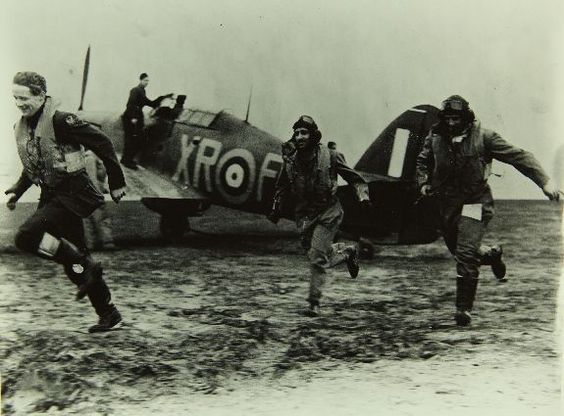
Czech-born fighter ace Sergeant Josef Frantisek of No. 303 “Warsaw-Kosciuszko” Squadron RAF was killed when his Hurricane crashed whilst landing at RAF Northolt at Ruislip near London, England, United Kingdom. At the time of his death Frantisek had a score of 17 kills and had been awarded the British Distinguished Flying Medal. Posthumously he was commissioned lieutenant, and awarded a Bar to his DFM, the Czech Military Cross, the Polish Cross of Valour (with three bars) and the Polish Virtuti Militari.
Luftwaffe fighter pilots have small dinghies, worn on the pilot’s back, and one accidentally inflates during a mission today. Lt. Heinz Escherhaus of 1./JG 77 is forced forward against the throttle, which blows out the engine and forcing him to force-land in Kent. It is the only recorded incident of a plane being brought down by a dinghy.
RAF No. 309 (Polish) Squadron begins forming at RAF Renfrew near Glasgow. The unit has used Westland Lysander Mk III two-seater reconnaissance planes.
Wing Commander John Harvey Hutchinson hits a barrage balloon cable at Langley, crashes and perishes.
RAF Bomber Command dispatches 8 Blenheims during the day. 2 aircraft bombed Boulogne harbour. No losses.
RAF Bomber Command dispatches 108 Blenheims, Hampdens, Wellingtons and Whitleys overnight to many targets. The largest raids were by 38 Blenheims on the Channel ports and by 17 Hampdens on the battleship Tirpitz in Wilhelmshaven dry dock. There were no losses from any operations. Bomber Command is active during the night over the north German ports of Bremen and Wilhelmshaven. It makes other raids over various other places in northwest Europe, including the Channel ports. During the night, 17 bombers take off from Waddington, Lincolnshire to attack the Tirpitz under construction, with no effect.
The RAF bombs Italian bases at Sollum and Bardia in Libya, and also at Aden and Assab.
At Malta, there is an air raid around Delimara at 19:35, but most of the bombers drop their ordnance at sea or at random. Two bombers are brought down.
U-58, commanded by Oberleutnant zur See Heinrich Schonder, badly damaged steamer Confield, a straggler from convoy HX.76, in 56-48N, 10-17W, and then sank her before noon on the 9th. At 2131 hours on 8 Oct 1940 the unescorted Confield (Master Walter Austin Sage) was hit on the starboard side in #2 hold by one torpedo from U-58 while steaming on a non-evasive course at 7 knots 88 miles west of Barra Head. The ship had been in convoy HX.76, but became a straggler after she had to heave to when her deck cargo of heavy logs began to shift in bad weather. At 2139 hours, the U-boat fired a second torpedo which struck in the engine room and caused the boilers to explode. The ship settled slowly by the bow with an increasing list to starboard when the crew began to abandon ship in the lifeboats. Most survivors left in a lifeboat on the starboard side as another boat had been destroyed and the one on the port side was difficult to launch due to the list and left with only six crew members and one gunner (the ship was armed with one 4in and one 12pdr gun). The boats could not wait alongside for some missing men because more and more logs of timber from the deck cargo fell overboard. The U-boat left the area after missing with a third torpedo at 2155 hours, assuming that their victim will sink anyway. The next morning, HMS Weston (L 72) (Cdr J.G. Sutton, RN) picked up the master and four crew members from a raft and then scuttled the wreck by gunfire as the Confield was beyond salvage. One crew member was lost. The sloop then began a search for the lifeboats and met HMS Periwinkle (K 55) (Lt Cdr P.G. MacIver, RNR) which had been detached from convoy OB.225 to search for survivors. The corvette then first located the wreckage of the ship and at dusk sighted red flares from the boats, picking up the 31 occupants and landing them at Londonderry on 10 October. The 4,956-ton Confield was carrying timber, grain, and lead and was bound for Portishead, England.
Anti-aircraft cruiser HMS Curacoa departed Rosyth at 0830 to overtake convoy OA.226 and give them anti-aircraft cover until midnight. She then proceeded to Scapa Flow arriving at 0720/9th.
Light cruiser HMS Dunedin departed Greenock after refitting there in September and October.
Destroyer HMS Mashona departed Greenock after refitting at 1840. She arrived at Scapa Flow at 1630/9th.
Destroyer HMS Eskimo sank a floating British mine in 59-07N, 3-56W at 1200 in the Fleet exercise area.
Submarine HMS Trident and U-31 were in a gun duel in the Bay of Biscay. Trident missed U-31 with torpedoes, but hit the German submarine with gunfire, doing minor damage.
Minesweeper HMS Kellet was damaged in a collision with the West Pier at Granton. She repaired at Rosyth in October.
Gunboat HMS Locust struck a mine three and a half cables north of N. W. Shingles Beacon, and was seriously damaged. She was able to proceed under her own power until weather deteriorated when she was taken in tow. Locust repaired at Tilbury, completing on 7 January 1941.
Steamer Bellona II (840grt) was hit by German bombing four miles east of Gourdon, Kincardineshire, then went ashore at Streathlethan Bay, south of Stonehaven. Six crew and three cargo workers were lost.
Troopship Oronsay (20,043grt) of convoy WS 3 was damaged by German bombing 56-00N, 10-00W, and forced to leave the convoy, escorted by armed merchant cruiser HMS Cheshire and destroyers HMS Arrow and HMCS Ottawa. Oronsay was joined by anti-aircraft cruiser Cairo which took her safely into Lough Foyle.
Destroyer HMS Sabre departed Londonderry to join the damaged troopship. HMS Cairo, armed merchant cruiser HMS Cheshire, and destroyers HMS Douglas, HMS Viscount and HMS Sabre escorted the troopship to the Clyde arriving at 0937 on the 9th. Destroyer HMS Verity was also signaled to escort Oronsay, but was unable to join.
U.S. Destroyer Divisions 68 and 71 destroyers were transferred to the Royal Navy under Lend Lease.
US Name — British Name — Commanding Officer
USS Satterlee (DD-190) — HMS Belmont — Cdr P J Fitzgerald Rtd
USS Mason (DD-191) — HMS Broadwater — Cdr C H de H Bell RD RNR
USS Hunt (DD-194) — HMS Broadway — Lt Cdr T Taylor
USS Branch (DD-197) — HMS Beverley — Cdr E F Fitzgerald Rtd
USS Aulick (DD-258) — HMS Burnham — Lt Cdr J Bostock
USS Laub (DD-263) — HMS Burwell — Lt Cdr S.R J Woods RNR
USS McLanahan (DD-264) — HMS Bradford — (Lt Cdr M. T. Collier)
USS Edwards (DD-256) — HMS Buxton — (Lt Cdr The Earl Beatty (Emgcy)
On 15 October, HMS Beverley, HMS Belmont, HMS Broadway, HMS Broadwater, HMS Burnham and HMS Bradford departed St Johns and arrived at the Clyde on the 26th going on to Plymouth arriving on 28 and 29 October. HMS Buxton departed with the group, but had to return with defects arriving at St Johns on the 16th, and did not make the Atlantic crossing until September 1941 after a major refitting at Boston. HMS Burwell departed after the rest of her group and arrived at Devonport on 11 November.
German armed merchant cruiser Thor attacked British refrigeration ship Natia, 350 miles northeast of Natal, Brazil, killing 2. After the remaining 83 crew members were captured, Natia was sunk by a torpedo and two more shells from Thor’s 150-mm gun; after this attack, Thor now had 368 prisoners aboard, outnumbering her crew.
German trawler Hecht (222grt) was sunk by enemy action.
During the night of 8/9 October, German torpedo boats Greif, Seeadler, Kondor, Falke, Wolf and Jaguar operated off the Isle of Wight.
The British Mediterranean Fleet with battleships HMS Warspite, HMS Valiant, HMS Malaya, and HMS Ramillies, aircraft carriers HMS Eagle and HMS Illustrious, heavy cruiser HMS York, light cruisers HMS Liverpool and HMS Gloucester of the 3rd Cruiser Squadron, light cruisers HMS Orion, HMS Ajax, and HMAS Sydney of the 7th Cruiser Squadron, destroyers HMS Hyperion, HMS Havock, HMS Hero, HMS Hereward, HMS Hasty, HMS Ilex, HMS Imperial of the 2nd Destroyer Flotilla, HMAS Vampire, HMAS Vendetta, HMS Dainty, HMS Decoy, and HMS Defender of the 10th Destroyer Flotilla, and HMS Jervis, HMS Nubian, HMS Juno, and HMS Janus of the 14th Destroyer Flotilla departed Alexandria to cover Malta bound convoy MF 3 (Operation MB 6) of British steamers Memnon (7,506grt), Lanarkshire (11,275grt), Clan Macauley (10,492grt), Clan Ferguson (7,347grt), escorted by anti-aircraft cruisers HMS Calcutta and HMS Coventry and HMAS Voyager, HMAS Stuart, HMAS Waterhen, and HMS Wryneck.
At 0524 on the 9th, HMS Nubian made a submarine contact in 35-11N, 27-20E and HMS Hyperion reported a torpedo at the end of its run near HMS Malaya.
On 9 October, light cruiser HMS Liverpool and destroyer HMS Diamond, which had been delayed in leaving Alexandria, joined the Main Fleet.
Submarines HMS Triad, HMS Rover, HMS Proteus, HMS Rainbow, HMS Regent and HMS Parthian were at sea to cover the operation.
The Italian Fleet status at that time at Taranto were in the 1st Squadron, 9th Division, battleships Littorio and Veneto; 5th Division, battleships Cesare and Cavour; 6th Division, battleship Duilo; 1st Cruiser Division, heavy cruisers Pola, Zara, Gorizia, and Fiume; 7th Cruiser Division, light cruisers Eugenio, Montecuccoli, Aosta, and Attendolo; 8th Cruiser Division, light cruisers Abruzzi and Garibaldi.
At Messina was the 4th Cruiser Division, light cruisers Diaz and Giussanno. Under repair were light cruisers Bande Nere, and Cardona at Spezia, and Di Barbiano at Pola.
Four Italian battleships and their covering forces were at sea during the passage of Convoy MF 3.
On 10 October, destroyers HMS Jervis, HMS Juno, and HMS Ilex were sent ahead of the fleet to investigate a submarine contact reported by aircraft.
At 1715 on the 10th, battleship HMS Ramillies and destroyer HMS Nubian, HMS Hero, and HMS Hereward were detached to refuel at Malta. At 1800, destroyers HMS Hyperion, HMS Hasty, and HMS ILEX were also detached to refuel.
Destroyer HMS Defender attacked a submarine contact at 1825.
Heavy cruiser HMS Shropshire arrived at Aden and joined the Red Sea Force. In December, she returned to the East Indies Command.
Convoy OA.226 departed Methil escorted by sloop HMS Aberdeen and corvette HMS Primrose from 8 to 11 October. The convoy rendezvoused with convoy OB.226.
Convoy FN.303 departed Southend, escorted by destroyers HMS Vega and HMS Vimiera. The convoy arrived at Methil on the 10th.
Convoy FS.304 departed Methil, escorted by destroyer HMS Woolston and sloop HMS Black Swan. The convoy arrived at Southend on the 10th.
Convoy HX.79 departed Halifax at 1330 escorted by Canadian destroyer HMCS Saguenay and auxiliary patrol boats HMCS French and HMCS Reindeer. Convoy commodore was on steamer Salacia (5,495grt). Patrol boat French departed convoy at dusk and destroyer Saguenay departed convoy at 1400/9th. Ocean escort was armed merchant cruiser HMS Montclare and Dutch submarine O-14, which were detached on the 18th. Armed merchant cruiser HMS Alaunia later supplemented escort. After the convoy duty, O-14 arrived at Rothesay on the 29th. On 19 October, destroyers HMS Sturdy and HMS Whitehall, escort ship HMS Jason, corvettes HMS Arabis, HMS Coreopsis, and HMS Hibiscus, and anti-submarine trawlers HMS Blackfly and HMS Lady Elsa joined the convoy. The escort ship and the trawlers were with the convoy only on the 19th. Destroyer HMS Sardonyx joined on the 20th. Corvette HMS Coreopsis was detached on the 22nd. The convoy arrived at Liverpool 23 October.
In Washington today. President Roosevelt signed the $1,482,000,000 Defense Appropriation Bill. He conferred with Admiral James O. Richardson, commander in chief of the fleet, and Admiral William D. Leahy, Governor of Puerto Rico; with the British Ambassador and with William L. Leiserson, member of the National Labor Relations Board.
The Senate completed Congressional action on the bill authorizing and appropriating funds for the $150,000,000 national defense workers housing program, approved a resolution for a special Senate committee to investigate the problems of small business, approved a bill requiring submission to the Bureau of Marine Inspection and Navigation of employment records of seamen on oceanic vessels, and recessed at 5:28 PM until noon tomorrow.
The House passed the bill carrying $150,000,000 in authorizations and appropriations for the housing program for defense workers, completed Congressional action on bills authorizing a flood-control program at East Hartford, Connecticut, and banning interstate transportation of stolen livestock and adjourned at 4:11 PM until noon tomorrow. The committee investigating the NLRB questioned Secretary Knox, Attorney General Jackson, Assistant Secretary of War Patterson and Sidney Hillman of the National Defense Commission on labor policies in connection with national defense contracts.
A stroke of the presidential pen late today released funds to finance a conscript-national guard army of more than 1,000,000 men and completed the mightiest defense appropriation program ever undertaken by congress in peacetime. The “final” defense appropriation bill carries $1,482,000,000 in cash and contract authorizations. It boosts to $12,580,000,000 the total army-navy outlay voted by this session of congress. This figure does not include the two-ocean navy program which ultimately will cost $4,734,000,000.
Congress completed today all legislation on the immediate program except a few odds and ends, but found itself in a strange and amusing situation in regard to taking a recess. Many members of the House, Republicans and Democrats, were absent from three roll calls today. and others threatened to quit the capital regardless of what the body decides to do about taking a long recess, a series of short ones or remaining in daily session. The Republicans generally favor staying in session except for short recesses and some Democrats support them. The Democratic leaders are for a recess until November 18. But neither side would budge an inch today, with the result that the House session reflected the frayed tempers as both branches easily passed several bills, virtually clearing the calendars.
Wendell L. Willkie, making one of his most vigorous speeches last night to a large crowd at the Theodore Roosevelt High School in the Bronx, turned his fire directly on President Roosevelt, indicating his own doubt as to the President’s truthfulness and coupling with it a demand that the President tell the American people whether he has made any secret commitments that will drag this country into war. Referring to the President, Mr. Willkie said: “His pose and the pose of the New Deal are both fakes, hams and misrepresentations.” At another point he declared: “An administration that is not telling the truth is not qualified to head the country in time of crisis, or at any other time. I want to ask the President, and I demand an answer: “Are there any international understandings to put America into the war that we citizens do not know about?”
Vice-President Garner headed for Texas again tonight, silent as ever about political matters. “Well, goodbye boys and good luck to you,” Garner told newspapermen as he left his office before catching a train. The vice-president returned to Washington about two weeks ago from his home in Uvalde, Texas. He had gone there in July after the Democratic national convention had rejected his bid for the presidential nomination. Tonight, he greeted all questions with his usual “No comment,” adding at one point: “That’s the way I came in and that’s the way I’m going out.” When a reporter asked if it would be necessary for him to return to Washington in January to turn over his office to his successor, Garner replied: “Maybe you had better get an opinion from the attorney-general about that.”
William S. Knudsen announced tonight as chief of the $12,000,000,000 production division of the National Defense Advisory Commission that he disagreed with the “informal” labor relations opinion that Attorney General Robert Jackson gave to the Defense Commission last week.
The War and the Navy Departments will not feel impelled to withhold defense contracts on the basis of decisions by the National Labor Relations Board, according to assurances by Secretary Knox and Assistant Secretary of War Patterson, who testified today before the Smith committee investigating the NLRB. The Army and Navy officials stated that purchasing policies of their departments were geared for speed in obtaining orders and not to labor policies of contractors, but that one of the factors relating to speed would be the contractor’s labor policy. While the labor situation was taken into consideration in awarding a contract they insisted that it would not be the sole determining factor.
In a plea for women to help make democracy worth defending, Mrs. Franklin D. Roosevelt warned yesterday that American women are being called upon, because of the war “to decide what conditions shall be for our own children and what their country shall mean to them.”
Detroit Judge Arthur E. Gordon ordered Miss Doris Le Roue, 31-year-old typist, held for trial on a charge of felonious assault following a preliminary hearing today. Miss Le Roue, who lost her job with the Reconstruction Finance Corporation because of the incident, is charged with having tossed a wastebasket. from a 16-story hotel window during an open-air reception for Wendell L. Willkie, Republican presidential nominee. The metal basket struck Miss Betty Wilson, 19-year-old autograph hunter, on the head, inflicting a gash that required a dozen stitches.
Legislation was approved that authorized the appointment to commissioned rank in the Line of the Regular Navy of those Naval Reserve officers who received their commissions upon graduation from the Naval Reserve Officer Training Corps.
The John Ford-directed drama film “The Long Voyage Home” starring John Wayne, Thomas Mitchell and Ian Hunter premiered at the Rivoli Theatre in New York City.
1940 World Series, Game Seven:
The Reds win Game Seven, 2–1, and their second championship. With only one day’s rest, Bobo Newsom comes back for the Tigers and nearly has enough to win at Crosley Field. Game 7 was over in 1 hour, 47 minutes. Detroit and pitcher Bobo Newsom clung to a 1–0 lead, courtesy of Charlie Gehringer’s third inning RBI single off Paul Derringer, until the seventh. Frank McCormick hit a leadoff double. Jimmy Ripple came up and then hit a double to score McCormick and tie the game. Jimmie Wilson came up and delivered a perfect sacrifice bunt to advance Ripple to third base. Ernie Lombardi, placed in the game to pinch-hit for Eddie Joost, was then intentionally walked to bring up Billy Myers. He hit a sacrifice fly on a ball to deep center that scored Ripple to deliver the go-ahead run. While Charlie Gehringer had a leadoff single in the 8th inning, the Tigers would not record a single hit afterwards, with Earl Averill grounding out to clinch the game and Series for the Reds. Derringer gives up 7 hits in the first 6 innings but sets the Tigers down in order in the final 3 frames. Old Jimmy Wilson catches 6 of the 7 games, hits .353, and has the only stolen base of the Series. The Reds’ share is $5,803 and the Tigers get $3,532.
Detroit Tigers 1, Cincinnati Reds 2
German raiders Orion and Komet meet and begin operating together.
Sir Robert Leslie Craigie, British Ambassador to Tokyo, notified Foreign Minister Yosuke Matsuoka yesterday that the Burma road to China would be reopened upon expiration of the Japanese-British agreement October 17.
Although the atmosphere between Japan and the democracies has never before been so vibrant with menace, immediate signs suggest that the Japanese Government does not intend to permit a storm to break just yet. The press today in unanimous chorus finds the reopening of the Burma Road just what had been expected and minimizes its effects. The Japanese Government does not regard the British action as important, does not propose to negotiate further with Britain regarding it and will “sternly go ahead with its determined policy,” says the newspaper Asahi. That policy consists in exploiting all the military advantages Japan has obtained through the occupation of French Indo-China.
The United States Department of State released an announcement advising American citizens to leave the Far East and return to the US. The United States government urged more than 16,000 Americans to leave the Far East yesterday coincident with the disclosure that Great Britain fears a “general crisis” in that area after October 17 when the Burma Road to China is reopened. A new embargo halted flow of subsidized American wheat to Far Eastern ports under Japanese control. The state department indicated it may consider removing 1,600 U. S. marines from Shanghai.
Japan protested the U.S. embargo on aviation gasoline and scrap metal.
The Japanese Navy has landed forces on Liu Kung Island, off the Shantung Peninsula, on which the Chungking government recently granted Britain a renewal of a ten-year lease.
Japanese authorities indicated today that they might demand additional airdromes in Indochina and a “credit loan” to the Japanese Army to support Japanese forces in the country.
Inspector General of Colonies Cazaux sends a telegram to General de Gaulle indicating his sympathies for Free France. However, at this point, General de Gaulle has no ability to take advantage of this, and French Indochina is dominated by the Japanese.
Australian light cruiser HMS Adelaide arrived back at Sydney from Noumea, having departed on the 5th.
Dow Jones Industrial Average: 131.31 (-2.2)
Born:
Fred Cash, American soul singer (Impressions — “People Get Ready”; “It’s All Right”), in Chattanooga, Tennessee.
Died:
Josef František, DFM & Bar, 26, Czech fighter pilot (plane crash).
Naval Construction:
The Royal Navy Fairmile B-class motor launch HMS ML 120 is commissioned.
The Kriegsmarine (German Navy) Type IXB U-boat U-107 is commissioned. Her first commander is Kapitänleutnant Günther Hessler.
The Royal Navy Town-class destroyer HMS Buxton (H 96), formerly the U.S. Navy USS Edwards (DD-265), is commissioned. Her first commander in British service is Lieutenant Commander (emergency) Earl Beattie, RN.
 History Diaries