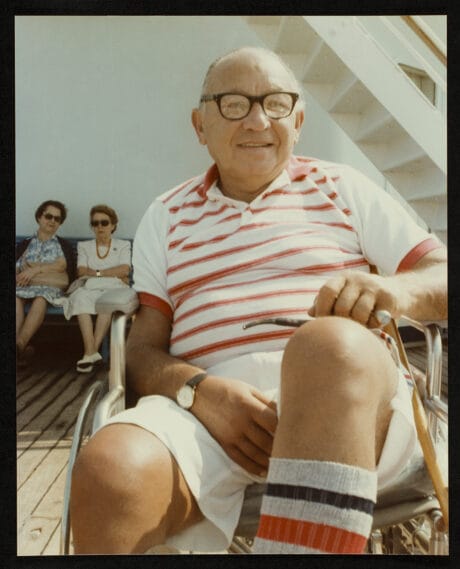
The hijackers of the Italian cruise ship Achille Lauro kill American passenger Leon Klinghoffer, dumping his body and wheelchair overboard. As a 3:00 p.m. deadline neared, the terrorists began to decide who to kill by shuffling the U.S., British, and Austrian hostages’ passports. They selected Leon Klinghoffer to be killed first. Several reasons have been proposed that may have contributed to why Klinghoffer was chosen. Earlier in the hijacking, he had refused to be silent when gunmen took his watch and cigarettes, becoming brusque and complaining in his slurred speech; this antagonized some of the hijackers, though one of them gave Klinghoffer his possessions back. Additionally, Klinghoffer was Jewish and American, and his wheelchair made him both difficult to move around the ship and his absence less likely to cause resistance among the surviving hostages. One of the hijackers, Youssef Majed al-Molqi, later gave a statement on why he was chosen: “I and Bassm [al-Ashker] agreed that the first hostage to be killed had to be an American. I chose Klinghoffer, an invalid, so that they would know that we had no pity for anyone, just as the Americans, arming Israel, do not take into consideration that Israel kills women and children of our people.”
Klinghoffer’s body was found by Syrians on October 14 or 15, and it was returned to the United States about October 20. His funeral, with 800 mourners in attendance, was performed at Temple Shaaray Tefila in New York City.[12] Klinghoffer was buried at Beth David Memorial Park in Kenilworth, New Jersey. On February 9, four months after his death, his wife Marilyn (1926–1986) died of cancer. They were survived by two daughters, Ilsa and Lisa Klinghoffer. Palestine Liberation Organization (PLO) Foreign Secretary Farouq Qaddumi said that perhaps the terminally ill Marilyn had killed her husband for insurance money. However, the PLF leader Muhammad Zaidan said in 1996 that the hijacking was a mistake, and apologized for killing Klinghoffer.
The hijacking of an Italian cruise ship with more than 400 people aboard went into its second day today with the hijackers repeating their vow to kill the passengers and crew unless Israel frees 50 Palestinian prisoners. The standoff in the Mediterranean came amid unconfirmed reports that some hostages had been slain. The 23,629-ton ship, the Achille Lauro, was at one point today reported heading toward Beirut, then she moved toward the Syrian coast. Later, she was reported to be heading toward Cyprus. In Washington, the State Department said tonight that the ship was heading southwest from Cyprus. [Reuters later reported that Israeli radio monitors said that the ship had anchored 20 miles north of Port Said, Egypt, and that the hijackers were negotiating with Egyptian officials. The hijackers were said to be demanding to talk with the American, British and West German Ambassadors to Egypt. A Christian radio station in Beirut broadcast what it said was a recorded radio conversation with the captain of the liner, in which he said everyone on board was “in very good health.”
President Reagan attends a National Security Council meeting regarding the hostages on board the hijacked Italian cruise ship.
The Reagan Administration has undertaken a worldwide effort to deny the hijackers of the Italian cruise ship a sanctuary in any port, high-ranking Administration officials said today. They said that the United States, in diplomatic messages, has urged Syria and other Mediterranean nations not to allow the ship, the Achille Lauro, to dock. The ship apparently tried to dock in Syria today but was turned away. There were reports late today that the ship was near Cyprus, one of the countries that received a message from Washington. State Department officials said they had no reason to believe that the Cyprus Government would let the ship dock.
An Israeli Cabinet spokesman, asked whether the Government would consider the Mediterranean hijackers’ demands to free 50 Palestinian prisoners, said today that Israel opposes negotiations with terrorists as a matter of principle. But the Cabinet spokesman, Yossi Beilin, said after the regular Cabinet meeting that Israel was willing to consider any request from Italy concerning the hijacking of the liner Achille Lauro. Later in the day, after a meeting here with Foreign Minister Hans-Dietrich Genscher of West Germany, Prime Minister Shimon Peres accused the hijackers of trying to sabotage peace efforts in the Middle East. He said Israel would never bow to terrorism.
11 devoted friends were separated when the Palestinian terrorists seized the Italian cruise liner. “We call them the beach people,” said 34-year-old Lisa Klinghoffer, whose parents, Marilyn and Leon Klinghoffer of Manhattan, are members of the group and now hostages aboard a cruise ship in the Mediterranean. This fall the Klinghoffers and their friends — men and women in their 60’s and 70’s, several of them in frail health — booked a cruise aboard the Italian ship Achille Lauro. But through a quirk of fate involving a simple decision to take a sightseeing excursion in Egypt or to remain on board, the 11 have been separated. Five are safe in Cairo. Six, including the Klinghoffers, are among the 413 people estimated to be held by Palestinian hijackers aboard the Achille Lauro.
A rescue operation to retake the hijacked cruise liner Achille Lauro might be possible, but would risk the lives of some hostages or even the sinking of the ship, several experts said today. “It is perfectly feasible to liberate the ship,” said Admiral Elmo R. Zumwalt Jr., a retired Chief of Naval Operations. But he added that “you might take heavy damage to the ship and put innocent lives in hazard.” Malcolm Dicks, president of Gibbs and Cox, a New York firm of naval architects, said he believed it “would not be difficult” for the terrorists holding the ship to sink her. Admiral Zumwalt and other experts, who declined to be named, agreed that this would be true if some of the terrorists had demolition training. Although the ship has several watertight compartments, expertly placed explosive charges would probably cause her to sink, Mr. Dicks said.
Pentagon officials declined to discuss the tactics that might be useful in a rescue operation. But some experts said that troops could probably be put aboard from helicopters. Armed helicopters or door gunners on troop helicopters could probably suppress fire from the terrorists in such an action. The Navy has several models of “swimmer delivery vehicles,” which carry two, four or six men. These are submersible craft that can be carried in a “dry deck shelter,” which is a kind of pod on the deck of a submarine. There are a number of ways in which frogmen could board such a ship, but at best this could be very difficult while she was under way. Such ships have a small boat port, or door, which is used to take on and drop off harbor pilots and for other boat operations. Specially trained units such as the Navy’s Sea, Air and Land commandos, known as Seals, can blow their way into almost any door with special demolition charges.
The chief American negotiator at the arms talks here has been quoted as saying that the United States will be both “patient and stubborn” in dealing with the Soviet Union, but will not be lulled by Soviet declarations of “peaceful intentions.” The negotiator, Max M. Kampelman, in informal remarks made public today, told a group of American business executives here October 1 that the object of the talks was to negotiate a fair, mutual and verifiable agreement. “We are going to come to an agreement when it is in the American interest to come to that agreement,” Mr. Kampelman was quoted as as telling the group, known as the World Business Council. “We’re not going to come to an agreement because we’re impatient — there is too much at stake.”
The Reagan Administration, in its first full response to the recent Soviet arms proposals, said today that the measures could be the start of a “successful process” in the effort to reduce the nuclear weaponry of the two sides. It was the first time the Administration has made it plain that the Soviet proposal, and the negotiations over it, could lead to a positive outcome at the Geneva arms talks. But a ranking Administration official made it plain that President Reagan and his aides have serious reservations about the proposal, saying it was “highly unequal” and would insure that the Soviet Union retained “major advantages in the numbers of nuclear weapons, nuclear delivery vehicles and ballistic missile throw weight.” The official, who briefed reporters at the White House, said that the Soviet proposal was “a place to start.” He added, “The President finds that the very fact that the Soviet Union has made a counterproposal is a promising development.”
Nearly half the world’s countries tortured political prisoners, held them without charge or executed them in 1984, London-based Amnesty International charged in its annual report on human rights. In Nicaragua, the report said that there were some reports of ill treatment by the leftist government and that mistreatment of captives by U.S.-backed rebels was “frequently reported.” Although focusing on Asia, Africa and Latin America, it noted there were 21 executions in the United States, the most since 1963, and said 1,464 people are awaiting execution, the highest U.S. figure ever recorded.
Britain’s Conservative Party opened its annual convention in Blackpool, England, amid massive security aimed at averting a repetition of the bomb attack by the outlawed Irish Republican Army at last year’s convention that killed five people and injured 30. Prime Minister Margaret Thatcher, target of the 1984 attack, was staying at an undisclosed location.
Proud Britain is still declining only four decades after she was a Great Power that had ruled a third of the world in the 19th century. Britons have become accustomed to an armed forces that are small and bound to get smaller and to finding themselves just another medium-sized West European power, but many are shocked to find their economy and standard of living inferior to those of Italians.
Bombs exploded overnight in Brussels and Paris, slightly wounding one passer-by in Paris but causing no casualties in Brussels, the police said. A car bomb went off in front of the headquarters of the Brussels gas and electricity company, Sibelgaz. It shattered all the windows in the building, which is in a park well away from any other structures. Leaflets left by the bombers said the attack was conducted by the Fighting Communist Cells, a group that has been responsible for 15 other bombings in Belgium against industrial and political premises and NATO targets. Two firemen were killed May 1 in the explosion of a car bomb set by the group at the headquarters of the Belgian Employers Federation. A second bomb, made up of several pounds of explosives, exploded at 3 AM outside a Paris theater. A passer-by was hit by flying glass but did not require hospital treatment.
A conference that could determine the future of the United Nations Educational, Scientific and Cultural Organization opened here today with an appeal to the United States to rejoin the agency. The opening of the six-week session, Unesco’s 23rd general conference, was also marked by unsuccessful Soviet moves to oust delegates from Israel, Grenada, West Germany and Chile. The United States left Unesco last year, complaining of poor management and bias against Western values. Said Tell of Jordan, who presided at the opening session, appealed to the United States to rejoin Unesco and urged Britain to reconsider its threat to leave if changes are not made. Unesco’s Director General, Amadou-Mahtar M’Bow, denounced “campaigns of denigration and attempts at destabilization” that he said had been aimed at Unesco in recent years.
A Tunisian security officer fired into a group of people on the Tunisian island of Djerba, killing three people and wounding several, the official Tunisian news agency said today. The officer, who the agency said was “suddenly seized by a fit of madness,” was reported to have been wounded by his colleagues and overpowered. Djerba, a popular resort for Tunisians that is in the Mediterranean just off the Tunisian coast, about 200 miles southeast of Tunis, is the home of an ancient Jewish community. The Tunisian news agency, in a report monitored here, said the group shot at by the officer reportedly included Jews. After the Israeli bombing of the headquarters of the Palestine Liberation Army near Tunis last week, the Tunisian Jewish community quickly proclaimed its solidarity with the Government of President Habib Bourguiba and criticized the attack.
Soviet and Afghan forces pounded guerrilla strongholds west and south of the capital of Kabul last week, forcing the rebels to start pulling out of some areas, Western diplomats and Afghan exiles said. Most of the attacks reportedly took place around Paghman, a former royal resort in the mountains northwest of Kabul, and at Maidan Shahr in the Loghar Valley south of the capital, a key transit area. The diplomats, based in Pakistan, also reported that Cuba’s charge d’affaires in Kabul had been shot to death, apparently accidentally by a staff member. They had no details.
President Reagan greets Prime Minister of the Republic of Singapore Lee Kuan Yew at the White House.
French naval officers boarded the flagship of the activist organization Greenpeace, but only to warn the anti-nuclear protesters to stay away from France’s South Pacific test site. The boarding came almost three months after French secret agents, acting on orders from Paris, blew up the former Greenpeace flagship Rainbow Warrior in the harbor at Auckland, New Zealand.
Former New Zealand military chiefs criticized the government’s anti-nuclear policies today and said a ban on visits by nuclear ships could lead to a complete breakdown in relations with the United States. The statement by 16 former New Zealand Air Force, Navy and Army chiefs broke the tradition of political silence normally observed by country’s military establishment. There was no immediate reaction from Prime Minister David Lange.
Salvage workers who had hoped to rescue a 9-year-old boy buried under the rubble of an apartment building felled in the Mexico City’s September 19-20 earthquakes found the body of the child’s grandfather, Luis Maldonado Perez, 57. Rescuers said he probably died in a fire caused by the first earthquake. They were still searching for the child, Luis Ramon Nafarrate, but there was no longer believed to be any hope of finding him alive.
President Reagan today imposed restrictions on the entry into the United States of Cuban officials. The action, effective immediately, was seen as retaliation against Cuba’s suspension of an immigration agreement with the United States. Fidel Castro, the Cuban leader, took that step in May in response to the Reagan Administration’s decision to begin operation of Radio Marti, an anti-Castro radio station. A proclamation signed by Mr. Reagan bars the entry of Cuban Government and Communist Party officials unless they are coming exclusively to conduct business at the Cuban Interests Section in Washington, the Cuban Mission to the United Nations in New York or the United Nations itself.
Brooklyn Rivera, coordinator of the Misurasata Indian rebel group fighting Nicaragua’s leftist Sandinista government, charged that a U.S.-backed guerrilla organization has threatened to attack his forces if they don’t submit to its leadership. At a news conference in Washington, Rivera said that units of the Nicaraguan Democratic Force “have seized and intimidated community leaders, demanding that they either support the FDN or be killed.” A spokesman for the contras, as the guerrillas are known, denied the charges.
The leader of a South African-backed rebellion in this country appealed today for United States aid to help him fight what he said was a Soviet-directed Angolan offensive against him. At the same time, the guerrilla leader, Jonas Savimbi, asserted that his rebel forces had driven off a Soviet-directed push against his forward headquarters here. The Angolan Government forces, he said at a news conference in a bunker hewn from the savanna, were “in very bad shape.”
Five more South African blacks were killed in anti-apartheid violence. Police said they found the bodies of two blacks burned to death near New Brighton, outside Port Elizabeth. Officers shot two blacks to death and wounded two in a crowd throwing gasoline bombs near Cape Town. Near Johannesburg, a government worker with a shotgun killed a black man in a crowd attacking an official vehicle.
Hundreds of people apparently died in a mudslide that buried a shantytown north of Ponce, Puerto Rico, after a three-day rainstorm, according to the authorities. Governor Rafael Hernandez Colon called it “the worst tragedy to ever strike” Puerto Rico. He proclaimed an emergency. By evening, rescue workers had uncovered 29 bodies from the claylike muddy earth that sealed the crumpled community of Mameyes. But the authorities said hundreds of people were missing here, and in towns throughout the island, thousands who had to evacuate their homes were in shelters. They said there were more than 60 confirmed dead in Puerto Rico. Clear skies helped in the rescue operations today but heavy equipment had to be moved into the Mameyes area in an effort to bring out some of the bodies believed buried there.
Senate leaders failed to agree on a short-term increase in the Government’s debt ceiling. The Republican and Democratic leaders were also still at odds over a proposal to balance the budget by 1991.
The Treasury, out of cash, pursued two stop-gap financing efforts to allow it to continue borrowing to pay bills. One effort calls for the public sale of debt securities by the Federal Financing Bank. The alternative, if Congress has acted by then on the debt ceiling, calls for the emergency sale of $5 billion worth of Treasury bills today.
President Reagan’s big increases in defense spending have resulted in a “lack of marked improvement” in most measurable standards of U.S. military capability, the Congressional Budget Office said. Although American defenses are somewhat better than they were when Reagan took office five years ago, most areas of the military have not improved in keeping with the vast new sums of money poured into them, Rudolph G. Penner, director of the budget office, told the House Armed Services Committee. At the Pentagon, spokesman Robert B. Sims suggested that some who question readiness do a disservice to Congress and the armed forces.
[Ed: LMAO. Ask Saddam what he thinks, six years from now.]
President Reagan plans to nominate former New York Senator James L. Buckley and another prominent conservative, Michael J. Horowitz, to the U.S. Court of Appeals in Washington, the Washington Post reported. The newspaper said the expected nominations of Buckley and Horowitz, general counsel of the White House Office of Management and Budget, would end more than two decades of liberal domination of the appeals court. Buckley will be nominated to the United States Court of Appeals for the District of Columbia rather than to the United States Court of Appeals in New York, according to Reagan Administration officials. The New York City Bar Association has said that Mr. Buckley, a former Republican-Conservative Senator from New York, has failed to prove his qualifications for an important judicial appointment.
A farm bill that would cost $141 billion over five years was approved in the House. Most of the money would go toward propping up prices paid to farmers and for the food stamp program. The vote was 282 to 141 in an unusually bipartisan vote. The majority included 184 Democrats and 98 Republicans; 62 Democrats and 79 Republicans opposed the bill. The Reagan Administration, which originally threatened to veto the bill, softened its position once the House removed a clause that could have led to mandatory limits on wheat and feed grain production. A spokesman for Secretary of Agriculture John R. Block said tonight, “It’s a bill that we can now work with in conference and fashion something that’s acceptable.”
The Nuclear Regulatory Commission said it has given the Three Mile Island nuclear plant, near Harrisburg, Pennsylvania, permission to increase power so it can produce electricity for the first time in 62 years. The plant will “go on line” today after it reaches 15% of power. TMI-1 has not been on the regional power grid since February 17, 1979, more than a month before the adjacent Unit 2 was mangled in the worst accident at a U.S. commercial nuclear power plant. The plant will be taken up to 40% power over the next two weeks.
People will drown and drug smugglers’ jobs will be made easier if Congress endorses a Senate Appropriations Committee decision to cut the Coast Guard budget by $200 million, the chairman of the House Coast Guard subcommittee said. Chairman Gerry E. Studds (D-Massachusetts) said the Senate panel voted last week to pare the Coast Guard budget to $1.58 billion, about $200 million less than the House approved last month and $182 million less than President Reagan had sought.
The FBI confirmed that Robin Ahrens, the bureau’s first woman agent to be killed in action, was shot in the eye by fellow agents who mistook her for a robbery suspect’s girlfriend. Herb Hawkins, special agent in charge of the Phoenix bureau, said no other details would be released at this time. Ahrens, 33, who had been with the FBI since last November, was shot when she appeared in a dimly lit hallway at a Phoenix apartment complex, shortly after agents arrested robbery suspect Kenneth Barrett, 27.
Marine Corps officials say they were duped into sending a color guard to a burial service for more than 16,000 fetuses that was staged Sunday by an organization opposed to abortion. “No decision has been made on possible action.” Major Bill Wood, public affairs officer of the 4th Marine Division, said today. “We just want to make it clear we didn’t do it deliberately.” The nonreligious service, which included a eulogy from President Reagan, was held Sunday. Major Wood said the Marines were told three times by an organizer that a military color guard was needed for the burial of a Vietnam combat veteran. A three-man guard from a Marine Corps Reserve Center was provided. “The noncommissioned officer in charge of the detail arrived and was faced with a large crowd, high-ranking political figures and the media,” Major Wood said. “He knew he was not supposed to be involved, but decided to remain and not cause a scene.”
No honorary Harvard degrees will be awarded at the university’s 350th anniversary celebration next year, under a decision by Harvard’s top governing body. The decision cut short a bitter dispute among faculty and alumni over the prospect that President Reagan would be among the degree recipients.
A Philadelphia panel began hearings on the May 13 police bombing of the house of a radical group, Move, that killed 11 Move members and caused a fire that destroyed 61 rowhouses, leaving 250 people homeless. The panel’s chairman, William H. Brown 3d, promised to determine the facts without regard to any official’s personal interests.
The espionage trial of a former naval intelligence analyst began here today with prosecutors arguing that he had passed classified information to a British military journal to gain a job on its staff. An attorney for Samuel Loring Morison, the defendant, contended that his client “couldn’t hurt the United States if you put a gun to his head.” Mr. Morison, a grandson of the American historian Samuel Eliot Morison, is charged with espionage and the theft of Government property. His trial marks only the second time the Government has used the espionage laws to prosecute an official or former official on charges of disclosing classified information to the news media. Mr. Morison is accused of illegally passing classified satellite photographs of a Soviet aircraft carrier under construction to Jane’s Defence Weekly, the British publication.
The parents of three surviving septuplets filed a malpractice and wrongful death suit today seeking more than $2.2 million from the doctor and clinic that gave the mother fertility drugs. The suit by Samuel and Patricia Frustaci charges medical malpractice, four wrongful deaths, and loss of earnings and earning capacity as a result of overprescribing of fertility drugs at Tyler Medical Center by Dr. Jaroslav Marik. Dr. Marik declined comment on the lawsuit.
Kent Hance, a former Democratic member of Congress who switched parties in May after losing a bid last year for the United States Senate, has announced that he would enter the Republican primary for Governor of Texas next year.
The Writers Guild of America and major public broadcasting stations announced an agreement on a three-year contract that includes salary increases and more creative control for writers. The 8,200 members of the Writers Guild of America East and Writers Guild of America West have been without a contract since July 1. The pact provides for increases of 6% and 6 ½ % for each script written during each year of the contract, with the increases retroactive to July 2.
The rise in television viewing options and the increased ability of viewers to control how and when they watch programs have dramatically altered viewing habits, according to experts. Among the changes detected are an increase in the number of hours television is watched, a greater restlessness in the selection of programs and an increasing appetite for the visually exciting.
“Rembrandt & Hitler or Me” premieres in Amsterdam.
Alain Boubil and Herbert Kretzner’s musical “Les Misérables” premieres in London at the Barbican Centre.
Little Richard seriously injured in a single car accident in Los Angeles.
American League Championship Series, Game One:
The Toronto Blue Jays entered the series as the favorite to win the series. The first game featured Toronto pitcher Dave Stieb and Kansas City pitcher Charlie Leibrandt at Exhibition Stadium in Toronto. Neither team was able to score runs in the first inning; however, in the second inning the Blue Jays offense became productive. Jesse Barfield singled and advanced to second base when Willie Upshaw was hit by a pitch. Garth Iorg forced Barfield out at third, but with Iorg on first and Upshaw on second, Ernie Whitt singled to score Upshaw with the first run of the series. Tony Fernández singled to shortstop allowing Iorg to score, and a single by Damaso Garcia loaded the bases with one out. Leibrandt induced a pop fly out by Lloyd Moseby and a ground ball out by George Bell.
After nearly breaking the game open in the second inning, the Blue Jays increased their lead in the third inning and Leibrandt was removed from the game. A double by Cliff Johnson was followed by a base on balls to Barfield. Upshaw’s single loaded the bases with no outs and led to relief pitcher Steve Farr entering the game. Rance Mulliniks singled to score Johnson and keep the bases loaded. A walk to Whitt scored Barfield to increase the score to 4–0. A sacrifice fly from Fernandez made it 5–0. Farr finally settled down and proceeded to get next two batters out; however, the Royals were down 5–0 en route to a 6–1 loss. The final Jays’ run was scored when George Bell singled and scored on a throwing error by Steve Balboni on a fielder’s choice to the next batter, Cliff Johnson.
Willie Wilson scored the Royals’ only run in the ninth inning when he singled, moved to third on a George Brett single, and scored on a fielder’s choice ground out by Pat Sheridan. The Blue Jays scored six runs and left nine runners on base. Leibrandt was credited with the loss while Stieb pitched eight innings for the win and Tom Henke pitched the ninth inning. The victory gave the Jays a one-game to none lead in the ALCS.
Kansas City Royals 1, Toronto Blue Jays 6
Dow Jones Industrial Average: 1325.49 (+1.12)
Born:
Bruno Mars, American pop and R&B singer-songwriter (“Just the Way You Are”, “The Lazy Song”; “Uptown Funk”), in Honolulu, Hawaii.
Cody Eppley, MLB pitcher (Texas Rangers, New York Yankees), in Harrisburg, Pennsylvania.
Died:
Leon Klinghoffer, 69, American murdered by hijackers of the Achille Lauro when they threw him off the ship.
Malcolm Ross, 65, American balloonist and atmospheric physicist.
 History Diaries