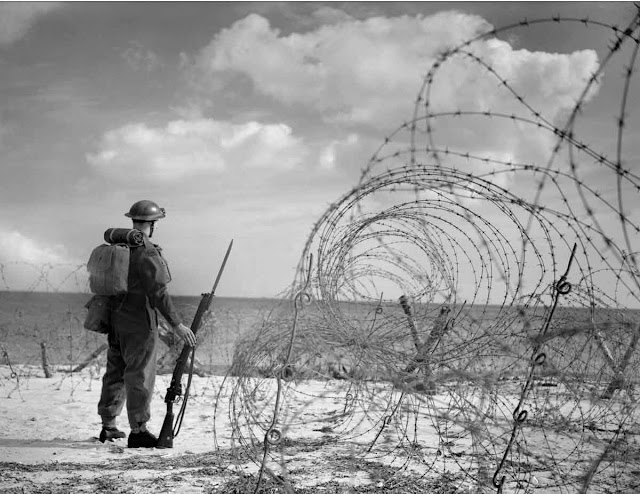
German troops enter Rumania, supposedly to help reorganize its army. Two divisions of German troops, totaling 30,000 men, along with token Italian units today passed through Hungary to take control of the oilfields and the harbors from which the oil is shipped. The Germans claim that their soldiers have been sent to Rumania, “in accordance with an agreement with the Rumanian government, for training and reorganizing the Rumanian army, with all the equipment essential for modern warfare.” In another announcement, however, the Germans claim that their action was taken to protect Rumania from British plans to sabotage the oilfields. Certainly the oilfields, developed largely by British capital, are the prime reason for the invasion. Last week the government of the dictator Ion Antonescu arrested British officials on allegations that they were plotting to set fire to the oilfields. Some of these officials have been subject to ill-treatment. It is apparent that the entry of the Germans has been made with the consent and co-operation of the Antonescu regime. Barracks in the capital have been evacuated by the Rumanian army to make way for the Germans. An expeditionary force GHQ has been set up and contact established with the Rumanian General Staff.
Reinhard Gehlen, a liaison officer to Army Commander-in-Chief Field Marshal Walther von Brauchitsch, transfers over to an operations planning post on the staff of Army Chief of Staff General Franz Halder. Gehlen is heading for a key intelligence position in the planning and execution of Operation BARBAROSSA. Gehlen also is considered to be a legendary figure in the post-war West German Bundeswehr. He definitely is a key player in the shadowy spy business both during the war and afterward.
The Germans order all Jews in occupied France to register immediately with its authorities. Approximately 50,000 French Jews, it is estimated, will be affected by the Jewish census decree issued for the occupied zone by the German military authorities.
Algerian Jews are deprived of their French citizenship.
British Prime Minister Winston Churchill regularly receives reports on civilian morale. These reports are derived from postal inspectors secretly opening mail and reviewing the contents. Today, he orders that the latest report on “Home Opinion – As Shewn in the Mails to USA and Eire” be circulated to the entire War Cabinet. The report finds that morale is highest in London, but the provinces run a good second, and only a few letters from Liverpool, mostly from Irish writers, show any sign of panic.
What is most interesting about this report — and possibly the reason that Churchill finds it particularly significant — is that it shows that, exactly one month after the beginning of the bombing of London, morale there is higher than elsewhere in the country. This, of course, is exactly the opposite of many pre-war theorists claimed might be the case.
Operational control of salvage became administered by a section of No. 43 Group RAF (Maintenance), known as No. 43 Group Salvage, with a headquarters at the Morris Motor Works in Cowley. Maintenance units responsible for salvage were responsible for vast areas of the country.
Fascist legions, prepared for war, displayed their prowess before Premier Mussolini today in Northeastern Italy while Rome diplomatic quarters speculated on a variety of events, among them the possibility that Signor Mussolini might be about to make a speech on the next move of the Axis.
The U.S.S.R. is “disturbed” by reports that German and Italian troops are moving into Rumania, highly placed Soviet quarters in London told International New Service today. While the Russians haven’t much doubt concerning the Soviet’s priority of interest in the Rumanian sphere, “it is the tendency we don’t like, particularly if troops begin to arrive in large numbers,” a Russian authority declared.
German Luftwaffe dispatched large raids of 50 to 100 aircraft against southern England, United Kingdom, with fighters being 66% to 75% of each wave. On this day, 21 German fighters and 6 bombers were shot down, while the British lost 16 fighters with 6 pilots killed. Overnight, London, Bristol, Liverpool, Firth of Forth, and other locations were bombed.
The weather is good on 7 October 1940 after a long stretch of clouds and rain, and the Luftwaffe gets busy. Daylight raids have become increasingly unprofitable, but they are essential to “keep the RAF honest” and prevent it from building an overwhelming force of fighters which might make an invasion impossible in 1941, too. While there apparently is no official order to change tactics, the Luftwaffe resumes including medium bombers in its daylight attacks.
Things get started at 10:30, when the Luftwaffe mounts a large raid of 127 aircraft, including Dornier Do 17s that appear after the initial formation composed solely of Bf 109s and 110s. The RAF intercepts, led by the elite No. 303 (Polish) Squadron, but some of the bombers penetrate to East London. The German escort fighters have some success, but most of the bombers are turned back.
Around 12:30, another formation of similar size crosses at Dover. Some medium Junkers Ju 88 bombers are escorted rather than just fighter-bombers (Jabos). Fighter Command disrupts the formation, turning most of the bombers back after they drop their bombs (and cause some random damage). The London dockyards are hit, starting fires at Rotherhithe and Tidal Basin
Another mixed formation of bombers and fighters approaches around 14:00. Once again, London is the target, particularly the nearby airfields. Strong Fighter Command opposition blunts the attack, and there are massive dogfights.
The day’s fourth attack, at 16:00, targets primarily areas along the southern coast and slightly inland. At Yeovil, the Wrestland factory is hit, as is Portland Harbour and areas in Dorset. Government House and a furniture warehouse are hit and burn.
At the same time, a raid approaches against Kent and Sussex. This raid is entirely by fighters and Jabos, focusing on Thames River docks. Large fires start in several areas.
After dark, London is the main target. Other areas hit include Liverpool, Newcastle, South Wales, and the Bristol area, East Anglia Montrose, Sunderland and scattered areas in the Midlands. The railways at Sedgefield and Mill Hill East are disrupted.
Overall, it is a fairly even day. The Luftwaffe loses about 20 planes and the RAF a few less. In a way, it is one of the better days for the Luftwaffe, because previous daylight bombing raids using regular bombers usually resulted in much heavier losses. In fact, on a relative damage basis, the larger and more precise bombing made probably more than compensated for losing a few planes more than the RAF.
British Losses:
Airmen: 9 | Aircraft: 17
Spitfire N3039, No. 152 Squadron
P/O H.J. Akroyd died of injuries 8/10/40. Shot down during combat with enemy fighters over Lyme Regis.
Spitfire P9469, No. 222 Squadron
P/O J.W. Broadhurst killed. Shot down during an attack on enemy bombers.
Hurricane N2707, No. 245 Squadron
P/O J.J.I. Beedham killed. Engine failure during landing.
Hurricane V6800, No. 501 Squadron
F/O N.J.M. Barry killed. Shot down over Wrotham by Bf 109s. Pilot baled out but was found dead at Wilmington, south of Dartford.
Spitfire X4016, No. 602 Squadron
Sgt. B.E.P. Whall died of injuries. Aircraft damaged by Ju 88 off Beachy Head. Spun-in near Court Farm, Lullington whilst attempting forced-landing.
Spitfire N3109, No. 603 Squadron
F/O H.F.K. Matthews killed. Shot down in combat with Bf 109s of II/JG 26.
Hurricane P3677, No. 605 Squadron
P/O C.E. English killed. Shot down by Bf 109s over Westerham.
Hurricane L1728, No. 607 Squadron
F/O I.B. Difford killed. Mid-air collision during squadron patrol. Aircraft crashed at Eartham Farm, Slindon, Sussex.
Spitfire N3238, No. 609 Squadron
Sgt. A.N. Feary killed. Shot down in surprise attack by Bf 109s over Yeovil. Pilot baled out but was too low.
No. 80 (Signals) Wing was formed. This unit became the RAF’s first electronic warfare unit. An example of what the unit accomplished occurred November 13-14, 1940, when two aircraft of the Wireless Intelligence and Development Unit made the first direct attack on German navigational radar installations on the Cherbourg Peninsula by homing in on their transmission signals.
Major Bernd von Brauchitsch, Reichsmarschall Goering’s adjutant, presents the Knight’s Cross (Ritterkreuz) to Wolfgang Falck. Falck, for his part, breaks protocol afterward and complains (to General Milch) that pensions are not being awarded to the families of new (less than 10 years service) Luftwaffe men who have perished in action. This group, of course, covers virtually all Luftwaffe personnel.
Viktor Mölders, brother of leading scorer Werner, is shot down and captured. After his force-landing, the plane is repaired and joins the RAF’s “Ratwaffe.”
Lt. Erich Meyer, 2./JG 51, is shot down over the Channel and also becomes a POW. His plane is recovered in 1976 and restored.
Luftwaffe ace Oblt. Josef “Pips” Priller of 6,/JG 51 shoots down a Spitfire near Canterbury and another later in the day over the Thames.
Acting RAF No. 605 Squadron Leader “Archie” McKellar claims five Bf109Es during the day. Ace James Lacey also puts in a claim.
Major Gotthard Handrick moves from JG 26 to become Gruppenkommandeur of III./JG 52 after the loss of Hptm. Wolf-Heinrich von Houwald.
James Lacey claimed a probable kill on a German Bf 109 fighter over Britain.
RAF Bomber Command dispatches 18 Blenheims to Germany and on sea sweep during the day. Only 1 aircraft bombed barges in Holland. No losses.
RAF Bomber Command dispatches 140 Blenheims, Hampdens, Wellingtons and Whitleys overnight to many targets, with the main raid being by 42 Wellingtons and Whitleys on 12 individual targets in Berlin. There were also 10 O.T.U. and 6 minelaying sorties, 1 Wellington from the Berlin force was lost. Bomber Command targets the barges still in Dutch and French ports. It also attacks Berlin power stations again, the coastal guns at Cap Gris Nez, an aircraft factory in Amsterdam, and the U-boat base at Lorient. While not large by late-war standards, the Berlin raid is the largest of the war so far. The RAF’s bomber force continues to gradually expand, and tonight it uses 140 planes.
The RAF bombs Aisha, a railway station on the Italian supply line heading from Djibouti to Addis Ababa, Abyssinia.
At Malta, Rome radio is monitored making some false claims about air victories. Otherwise, it is a quiet day with some normal reconnaissance.
U-59, commanded by Joachim Matz, sank Norwegian steamer Touraine (5811grt) in 55-14N, 10-34W. At 1601 hours on 7 Oct 1940 the unescorted Touraine (Master Sigfred Ahlgren), a straggler from convoy OB-225 since the previous night, was hit near #4 hatch by one torpedo from U-59 west of Bloody Foreland, Ireland. The crew abandoned ship in three lifeboats as the ship rapidly settled by the stern and they feared more attacks. Because the ship remained afloat, the U-boat attacked again but the two torpedoes fired at 1925 and 1932 hours passed underneath the ship. A coup de grâce fired at 2043 hours hit the ship and caused her to sink slowly at 2139 hours. All boats remained near the ship, but they lost each other in rough seas, bad weather and the darkness in the following night. 12 survivors in one boat were picked up in the evening of the next day by the British steam merchant Derbyshire and landed at Greenock on 9 October. On 10 October, the boat of the master made landfall at Arranmore Island, Donegal and were later taken to Glasgow. The last lifeboat landed at Tory Island on the morning of 10 October. The cook was admitted to a hospital, but died of his injuries on 11 October. The 5,811-ton Touraine was carrying ballast and was bound for Sydney, Nova Scotia.
Anti-aircraft ship HMS Alynbank joined convoy HX.75 A on meeting in Pentland Firth at 1100. She remained with the convoy until midnight, then proceeded to Scapa Flow.
Destroyer HMS Bedouin departed Rosyth at 0600 for Portsmouth to deammunition. She then proceeded to Southampton to refit.
The Liverpool section of Convoy WS 3 departed Liverpool with troopships Orontes (20,097grt), Duchess of York (20,021grt), and Monarch of Bermuda (22,424grt) escorted locally by destroyers HMS Arrow, HMS Achates and HMS Whitehall which had departed Londonderry on the 7th. The Clyde section of WS 3 departed the Clyde with troopships Georgic (27,759grt), Capetown Castle (27,000grt), Winchester Castle (20,109grt), and Oronsay (20,043grt) and were escorted locally by destroyers HMCS Ottawa, HMS Active, HMCS St Laurent and HMS Douglas which had difficulty meeting the convoy in heavy weather, finally joining in 56-02N, 09-35W. On 7 October, light cruiser HMS Kenya departed Scapa Flow to escort convoy WS 3 (fast). St Laurent and Douglas departed Liverpool at 1510 to join the escort. Anti-aircraft cruiser Cairo was with the convoys for anti-aircraft protection. The two sections joined on the 12th and arrived at Freetown on the 18th. They departed Freetown on the 20th and arrived at Capetown on the 28th.
Once again, the LUCID operation was attempted with mainly the same force as was deployed on 3/4 October, but without Mytilus. Destroyer HMS Hambledon (Cdr S. H- Carlill; Captain A. W. S. Agar embarked) was mined and badly damaged in 51-08N, 01-21E near South Foreland. She was taken in tow by destroyer HMS Vesper. The LUCID operation was again cancelled. Hambledon was repaired at Chatham completing on 14 May 1941.
Lt M. C. Hoskin and Temporary Lt (A) T. E. Rose-Richards were killed when their Walrus of 765 Squadron was shot down seven to eight miles south of Anvil Point.
Submarine HMS Tribune after returning from a patrol in Biscay with a defect was repaired at Ardrossan from 7 October to 26 October and in the Clyde from 12 November to 26 November.
During the night of 7/8 October, Italian destroyers Vivaldi, Da Noli and Tarigo laid mines off Cape Bon. Destroyer HMS Hyperion was later lost on this minefield.
During the night of 7/8 October, Dutch liner Westernland put troops ashore off Manoko at the mouth of the Duala River. This operation was covered by heavy cruiser HMS Devonshire and light cruiser HMS Dragon. Dragon grounded briefly on the 7th.
Convoy OB.225 departed Liverpool with destroyer HMS Shikari and corvettes HMS Clarkia and HMS Perwinkle. The escort was detached on the 10th.
Convoy FN.302 departed Southend, escorted by destroyer HMS Vivien and sloop HMS Londonderry. The convoy arrived at Methil on the 9th.
Convoy FS.303 departed Methil, escorted by destroyer HMS Winchester and sloop HMS Egret. The convoy arrived at Southend on the 9th.
The Senate in Washington passed a bill empowering the Secretary of State to withhold payment of foreign gold and cash deposited in the United States by countries dominated by Germany; approved the Wheeler resolution for investigation of control by foreign interests of United States defense industries; approved the conference report on the bill authorizing $150,000,000 in housing projects for national defense workers and the conference report on the bill authorizing $34,500,000 in rivers and harbors improvements for national defense, completed Congressional action on the Overton bill suspending certain civil liabilities of Guardsmen and conscripts called to military training, and recessed at 6:30 PM until noon tomorrow.
The House completed Congressional action on the bill requiring registration of foreign-controlled political organizations in the United States, and on the $34,500,000 Rivers and Harbors Improvement Bill; approved the conference report on the Overton bill; returned to conference the Ramspeck Civil Service Bill; received the Smith joint resolution to prevent withholding of defense contracts from violators of the National Labor Relations Act until the courts had passed upon cases in controversy; and adjourned at 4:35 PM until noon tomorrow. The committee investigating the National Labor Relations Board subpoenaed several officials for questioning on labor policies with relation to national defense contracts.
Selective service officials emphasized today there would be no discrimination against newly-married men in choosing conscripts. “The selective service law operates for five years, and we don’t want to stop all marriages during that time,” remarked Frederick Osborne, chairman of the president’s advisory committee on the draft. Questioned about recent reports of a rush of marriages in the face of the draft law, Colonel William Draper, another member of the president’s committee, emphasized that the question of deferring from service those men recently married would be decided on the same basis as the cases of all other married men.
Rapid-fire developments in the controversy aroused by Attorney General Jackson’s opinion to the National Defense Commission that findings of the National Labor Relations Board were “binding and conclusive” upon other agencies until they were reversed in court resulted in the following actions today:
- Chairman Howard W. Smith of the House Committee Investigating the National Labor Relations Board introduced a joint resolution of supersedeas declaring that, notwithstanding the Attorney Gener al’s opinion or any law to the contrary, no ruling of any government agency shall be binding while an appeal from such a ruling is pending in the courts.
- The Smith committee immediately sought the presence of Attorney General Jackson, Secretary of the Navý Knox, Assistant Secretary of War Robert P. Patterson, Rear Admiral Samuel M. Robinson, Chief of the Bureau of Engineering, and Sidney Hillman, labor member of the Defense Commission, at a hearing tomorrow morning to explain the circumstances surrounding the issuance of the Jackson opinion.
- Charges were filed in the Congressional Record by Representative Harry N. Routzohn, Republican, of Ohio, a member of the Smith committee, that Mr. Jackson, as a “pliable” Attorney General, working with Mr. Hillman, planned to sabotage national defense.
- Representative Anderson, Democrat, of Missouri accused Harry Bridges and fellow-officials in the C.I.O. National Maritime Union, allegedly Communists or “fellow travelers,” of having obtained “a death grip on the American merchant marine” to the detriment of the defense program.
Wendell L. Willkie topped a day of hammering against Jersey City’s Mayor Frank Hague and other Democratic “bosses” by telling a roaring Republican rally tonight that President Roosevelt seeks to perpetuate his power “through petty Hitlers right here in our own land.” Speaking to a flag-waving, cheering crowd estimated at 22,000, the Republican presidential nominee linked New Jersey, New York and Illinois Democratic leadership together as “the pillars of the new deal democracy”.
The McCollum memo was sent by Lieutenant Commander Arthur H. McCollum, suggesting that the United States provoke Japan into committing an act of war. Lieutenant Commander Arthur H. McCollum, director of the Office of Naval Intelligence’s Far East Asia section, submits the “Eight Action Memo” to Navy Captains Dudley Knox and Walter Stratton Anderson. It proposes:
— Make an arrangement with Britain for the use of British bases in the Pacific, particularly Singapore;
— Make an arrangement with the Netherlands for the use of base facilities and acquisition of supplies in the Dutch East Indies;
— Give all possible aid to the Chinese government of Chiang-Kai-Shek;
— Send a division of long-range heavy cruisers to the Orient, Philippines, or Singapore;
— Send two divisions of submarines to the Orient;
— Keep the main strength of the U.S. fleet now in the Pacific[,] in the vicinity of the Hawaiian Islands;
— Insist that the Dutch refuse to grant Japanese demands for undue economic concessions, particularly oil;
— Completely embargo all U.S. trade with Japan, in collaboration with a similar embargo imposed by the British Empire.
Beyond some general suggestions regarding military preparedness with other Allied Pacific rim nations, the “McCollum Memorandum” is notorious for its suggestion that the US intentionally provoke the Empire of Japan into making a hostile act of war — so it can be attacked and subdued once and for all. This memo becomes a cornerstone of later conspiracy theories that President Roosevelt manipulated Japan into the Pearl Harbor raid, but Roosevelt had nothing to do with it (as far as is known). It is “the smoking gun” showing that the US manufactured its entry into World War II out of whole cloth.
The McCollum Memo and its interpretation/use are quite controversial topics. There are no clear answers on what effect, if any, it may have had on US strategy. Possibilities — refuted by some major historians — are that it either gave the US military some ideas about provoking Japan into war or perhaps just reflected thinking common in the Navy at the time. However, the McCollum Memo undeniably did exist and any evidence of its influence or lack thereof is entirely circumstantial. In other words: we just don’t know what it really means in terms of later historical events.
Admiral James O. Richardson arrived in Washington for conferences with the U.S. President Franklin D. Roosevelt and U.S. Navy and U.S. State Department officials concerning the retention of the U.S. Fleet in Hawaiian waters as a deterrent to Japan. Richardson would depart to return to the fleet on October 11, 1940. Less than 5 months later he would be relieved of his post early as a result of his continuing disagreement over basing the Pacific Fleet at Pearl Harbor.
The first U.S. Army operational radar, a lab-built SCR-270 goes on air atop Fort Sherman in Panama.
Soap opera “Portia Faces Life” debuts on the NBC Red Network (radio), which eventually becomes the foundation of NBC-TV. The soap is an instant success.
“Drums of the Desert” is released by Monogram Pictures, starring Ralph Byrd, Lorna Gray, and George Lynn. The film is interesting because, despite current developments in Africa, the film completely ignores them and instead concentrates on a plot involving the French Foreign Legion fighting Arabs. It illustrates the degree of distance between the US and the war very much in progress in Africa, particularly since much more interesting current real events are taking place in the film’s locale than some contrived boilerplate plot.
Artie Shaw and his Orchestra record Hoagy Carmichael’s classic song “Stardust” for Victor Records. This version of “Stardust” was voted the Number 1 all-time favorite record in “Billboard’s” 1956 Disc Jockey poll. Artie Shaw and his orchestra record “Star Dust” in a version arranged by Shaw and Lenny Hayton, and recorded for Victor on 7 October 1940. The trumpet solo is played by Billy Butterfield (2nd Trumpet), with a trombone solo by Jack Jenny. The song, written in 1927 by Hoagy Carmichael with lyrics added in 1929 by Mitchell Parish, will become an American standard and one of the most recorded songs in history, with over 1500 versions. In 2004, Carmichael’s original 1927 recording of the song was one of 50 recordings chosen by the Library of Congress to be added to the National Recording Registry. Shaw’s version of Star Dust is the best known and if you are going to listen to an “original version,” the one you are likely to choose. Incidentally, “Star Dust” is the actual title, though over time it has been corrupted to Stardust. The song helps summarize the era in Woody Allen’s 1980 film “Stardust Memories,” though Allen uses a Louis Armstrong version and technically the “Stardust” in the title refers to a fictional hotel.
1940 World Series, Game Six:
Back in Cincinnati, Bucky Walters evens the Series for the Reds with a 4–0 shutout, scattering 5 hits. He helped his own cause with an RBI fielder’s choice in the sixth with the bases loaded off Johnny Gorsica and a solo home run in the eighth off Fred Hutchinson. Walters becomes the first pitcher in 14 years to hit a home run in the Series. Schoolboy Rowe was knocked out after just ⅓ of an inning, allowing four hits, including RBI singles to Ival Goodman and Jimmy Ripple. The Reds’ 4–0 win forced a final Game 7.
Detroit Tigers 0, Cincinnati Reds 4
U.S. Navy heavy cruiser USS Louisville makes port at Recife, Brazil as part of a “Show the Flag” mission in Latin America. This is but the latest in a series of such efforts.
German armed merchant cruiser Pinguin captured Norwegian tanker Storstad (8998grt) in the Indian Ocean at 15-07S, 107-50E, 500 miles northwest of Australia. With 12,000 tons of diesel oil on board, Storstad was taken as a prize ship and sent back to Germany; she would later be commissioned into German Navy service as Passat. 25 of Storstad’s crew became captives aboard Pinguin, while 5 of them chose to serve the Germans aboard Storstad/Passat. Thirty of the crew were repatriated to Norway. Storstad arrived in Gironde on 4 February 1941 with some of the crew from steamers Automedon and Maimoa.
Governor Jean Decoux’s rejection of the demands of Thailand [Siam] on Indo-China caused a grave strain today on relations between the Hanoi and Bangkok governments.
The Japanese ambassador, in Washington, Kensuke Horinouchi, warns the USA that the embargo on scrap metal exports “cannot fail to be regarded as directed against Japan and, as such, an unfriendly act.”
Foreign Minister Yosuke Matsuoka made an implicit appeal to the Chinese Government today to align itself with Japan, Germany and Italy instead of “playing a role in the front line of European and American capitalism.”
Japan is to become a one-party state with the inauguration next week of the ultra-nationalistic Imperial Rule Assistance Association, which will replace all existing political parties. The two leading parties, Rikken Seiyukai and Rikken Minseito, which dominate Japan’s parliament, will be voluntarily dissolved. The new organization, the brainchild of Prince Konoe, is intended to capitalize on the growing patriotic fervor among the Japanese and mobilize mass political support for land-hungry Japan’s plans to expand its territorial borders in China and south-east Asia. The IRAA, with offices in every prefecture, will mirror precisely Japan’s current legislative structure. Discussions on the IRAA began in July, with moderate and nationalists battling over how closely it would imitate the totalitarian aspects of Europe’s Nazi and Communist parties.
Dow Jones Industrial Average: 133.51 (-0.39)
Born:
Bruce F. Vento, American politician (Rep-D-Minnesota, 1977-2000), in Saint Paul, Minnesota (d. 2000).
Richard H. Stallings, American politician (Rep-D-ID, 1985-93), in Ogden, Utah.
Dino Valenti [Chester “Chet” Powers], American rock guitarist/vocalist (Quicksilver Messenger Service), in Danbury, Connecticut (d. 1994).
Morrie Steevens, MLB pitcher (Chicago Cubs, Philadelphia Phillies), in Salem, Illinois (d. 2024).
Naval Construction:
The Royal Navy LCT (Mk 1) class landing craft tank HMS LCT 14 is laid down by the John Brown Shipbuilding & Engineering Company Ltd. (Clydebank, Scotland).
The Royal Navy Isles-class minesweeping trawler HMS Ronaldsay (T 149) is laid down by Cochrane & Sons Shipbuilders Ltd. (Selby, U.K.); completed by Amos & Smith.
The Regia Marina (Royal Italian Navy) Soldati-class destroyers (2nd series) Mitragliere and Bombardiere are laid down by Cantiere Navale Riuniti (Ancona, Italy).
The Royal Navy Bangor-class (Reciprocating-engined) minesweeper HMS Cromer (J 128) is launched by Lobnitz & Co. Ltd. (Renfrew, Scotland).
The U.S. Navy 70-foot Elco patrol motor torpedo boat USS PT-11 is launched by the Electric Launch Company Ltd. (Elco), (Bayonne, New Jersey, U.S.A.).
The Royal Navy Fairmile B-class motor launch HMS ML 118 is commissioned.
The Royal Navy Dance-class ASW trawler HMS Morris Dance (T 117) is commissioned. Her first commanding officer is Lieutenant Alexander Bruce, RCNVR.
The U.S. Navy Gleaves-class destroyer USS Livermore (DD-429) is commissioned. Her first commanding officer is Lieutenant Commander Vernon Huber, USN.
 History Diaries