Ion Antonescu assumes command of the Iron Guard, strengthening his position in Rumania. Antonescu presides over a massive rally by the Iron Guard in Budapest. He thereby skillfully creates the appearance of being in charge of the Iron Guard, when in fact that position is still held by Horia Sima. In fact, Antonescu, for now, continues a relatively moderate policy of tolerating the opposition parties (PNT and PNL) without massive reprisals or persecutions.
The Iron Guard pledges allegiance to Antonescu and Sima. The Iron Guard has gained a poor historical reputation for fascism and violence, but at least its ethos has a mystical, heroic quality that transcends current politics:
“Walk only on the path of honour. Fight and never exhibit cowardice. Leave to lesser men the ways of infamy. Better to fall in battle, struggling on the path of honour, than to win the battle through the ways of infamy.”
— Corneliu Zelea Codreanu, leader of the Iron Guard in “Cărticica şefului de cuib.”
Lord Croft, British Under-secretary for War, predicted today that Britain’s armies would counterattack and drive the Nazis back into Germany after the Royal Air Force had wiped out their air force and leveled their war factories.
The Petain Government today insisted that it has no intention of declaring war against Britain on the side of Germany and Italy and it was believed generally in Vichy that Spain also intended to remain on the sidelines of the conflict.
The headquarters of General Charles de Gaulle, leader of the French forces still fighting with Britain, announced today that national committees of Frenchmen had been formed in the United States and nine other countries “to act in close cooperation with the free French forces.”
Mussolini made a surprise inspection of armed forces in northern Italy as the Fascist press predicted that “something big” was coming soon.
Pope Pius XII urged 14,000 Italian girls gathered in a Vatican City courtyard today to fight the “immodesty” of present day fashion, likening young women who “risk their chastity” by bowing down to the “tyranny of style” to insane persons who unwittingly throw themselves into fires and rivers. He urged them to keep their faces free of “artifices,” and quoting from First Corinthians, Chapter 11, verses 13 and 15, he said hair was given to women for a veil.
German Bf 109 and Bf 110 fighter-bombers conducted day time raids against British factories and RAF airfields, accompanied by a small number of medium bombers. On this day, the Germans lost one Do 17 bomber and the British lost one fighter with the pilot killed. Overnight, London, England, United Kingdom sustained a small raid.
The poor weather returns, with more clouds and rain over England. In fact, the Luftwaffe actually begins a large raid at one point, but it turns back due to the weather. Instead, the day is characterized by lone “pirate” raiders conducted by specially trained crews who make hit-and-run raids on selected targets.
Late in the morning, a raider bombs Middle Wallop, while at 12:45 it is the turn of RAF Biggin Hill. Another raid on Eastbourne damages gas/water lines.
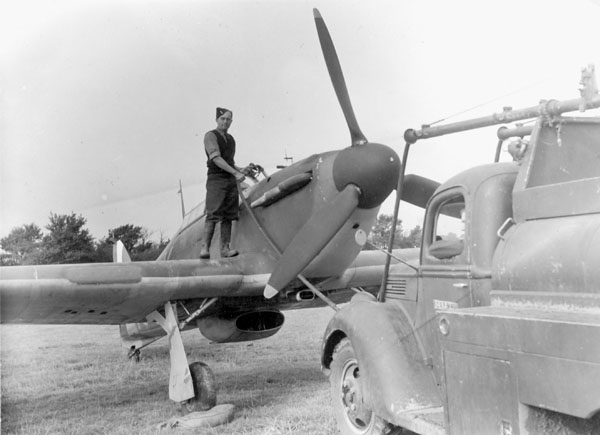
The Luftwaffe attacks the same convoy at 13:30 and then again an hour later. This is the largest raid of the day, with maybe a dozen bombers, but it accomplishes nothing. At 16:19, a bomber from Chartres starts to come across but turns back. A little while later, a Junkers Ju 88 strafes RAF White Waltham and Farnborough, and a bomber scores some minor hits on the Hawker Aircraft Factory at Stough. Another strafing attack on RAF Northolt catches a Hurricane about to take off and destroys it and kills the pilot, while the Junkers Ju 88 is hunted down and destroyed at Leatherhead, Surrey. Other attacks during the afternoon take place at Biggin Hill and Croydon.
London does have a few minor attacks during the day, but after dark, everything is very quiet. An occasional bomber crosses over, such as one at 20:00 and another at 21:00, but they don’t accomplish much. There are a couple of more lone raiders before midnight, then the remainder of the night is peaceful.
Overall, losses are in the single digits for both sides. The RAF loses two planes, and the Luftwaffe about nine.
The RAF suffers a friendly fire incident when a Hampden bomber of RAF No. 106 Squadron shuttling between bases on a quiet day is mistakenly attacked by a pair of Hurricanes. A quick burst of fire kills the bomber’s navigator, Sgt K.S Powers, but then the Hurricane pilots recognize their mistake. The bomber lands intact and without any great damage, but the man is dead. These kinds of things can happen on days of low visibility such as this, but generally, there is little tolerance for such incidents within the RAF. The Hurricane pilots hear about it with great emphasis from their commander when they land.
Sergeant Frederick Fenton Vinyard, flying a Spitfire for RAF No. 64 Squadron, has some kind of mechanical or weather issue and crashes into the sea near Beverley, Yorkshire. It is a typical incident, no glory, an accident, just another casualty of the war. However, sometimes we remember an individual now and then. His name is listed at the Air Forces Memorial, or Runnymede Memorial, in Englefield Green, near Egham, Surrey, England.
British Losses:
Spitfire R6683, No. 64 Squadron
Sgt. F.F. Vinyard killed. Aircraft was seen to crash into the sea off Flamborough Head.
Hurricane P3102, No. 303 Squadron
Sgt. A. Siudak killed. Aircraft destroyed on the ground by enemy raider attacking Northolt.
Hauptmann Helmut Wick, the Gruppenkommandeur of 1/JG 2, was awarded Oak Leaves to his Knight’s Cross, making him only the third German fighter pilot (after Mölders and Galland) to be so honored.
Oblt. Werner Streib, Gruppenkommanduer of I./NJG 1 is awarded the Ritterkruez. He is instrumental in developing the Luftwaffe’s night fighter force.
Perhaps the biggest news of the day is that the Luftwaffe has a new version of the Bf 109 to play with. Geschwaderkommodore Werner Mölders of JG 51, the top scorer in the battle, is given the honor of being the first to fly the new Bf 109 F-1 WNr. 5628 ‘SG+GW’ in action. The weather is so bad that he makes no interceptions.
RAF Bomber Command dispatches 21 Blenheims on daylight cloud-cover raids; none of the designated targets in Germany was reached but 11 aircraft bombed alternative targets. No losses. Bomber Command bombs several ports along the Channel coast, including Boulogne, Calais, and Ostend. along with the airfield at Diepholz. Coastal Command attacks a German convoy off the Dutch coast and loses a Hudson.
At Malta, there are no air raids, continuing a lengthy pause in operations. There are various patrols by Short Sunderland Flying Boats that spot an Italian hospital ship and a Greek freighter, but otherwise, it is a very uneventful day.
A trawler on patrol off Malta today picked up the deceased remains of an Italian airman from the sea. The senior officer of HMS Coral contacted the Air Commodore, RAF Malta with details of the incident. He reported that evidently the body had been in the water for some time. The trawler’s crew collected as much evidence from the sea as possible in order to identify the deceased man. From correspondence and identification tags he was identified as Antonio Girandola of 235 Squadron, R Aeropuerto, Reggio Emilia. All the personal effects which have been salvaged will be carefully dried before being forwarded to Air HQ in Malta.
U-37, commanded by Kapitänleutnant Victor Oehrn, badly damaged British tanker British General (6989grt) in 51-42N, 24-03W. At 1855 hours the British General (Master Frank Oswald Armstrong), dispersed from convoy OA-222, was hit underneath the bridge by one torpedo from U-37 about 550 miles west of Valentia Island. The hit had not much effect but the tanker stopped after being hit aft by a second torpedo at 2310 hours. The U-boat stayed nearby during the night to wait for the ship to sink, but the disabled British General remained afloat. U-37 could not finish her off with the deck gun because she was armed and around noon the tanker crew even tried to communicate with the U-boat by Morse signals. The tanker finally sank in 51°42N/24°50W at 2000 hours on 7 October, after being hit by two coups de grâce. The master and 46 crew members were lost. The 6,989-ton British General was carrying ballast and was bound for Abadan, Iran.
U-103, commanded by Korvettenkapitän Viktor Schütze, sank Norwegian tanker Nina Borthen (6123grt) in 54-00N, 26-00W. At 2204 hours the Nina Borthen (Master Bjarne Nielsen), dispersed from convoy OB-222 the day before, was hit by one torpedo from U-103 and developed a list, but this was corrected by the crew. The ship was then hit by two coups de grâce at 2214 and 2238 hours and began to list to port, when she was hit by a fourth torpedo at 2330 hours, broke in two and sank. 28 Norwegians and seven British crew members were lost. The tanker was reported missing after the convoy in which she left Britain was dispersed during a gale in 54°N/26°W on 5 October. Only an empty lifeboat drifted ashore near Dunmore, Ireland on 19 December. The 6,123-ton Nina Borthen was carrying ballast and was bound for Abadan, Iran.
U-123, commanded by Kapitänleutnant Karl-Heinz Moehle, sank British steamer Benlawers (5943grt) in 53-20N, 26-10W. At 1304 hours the Benlawers (Master W.G. Scott-Campbell), a straggler from convoy OB-221 , was torpedoed and sunk by U-123 northeast of St.Johns. 23 crew members and one gunner were lost. The master, nine crew members and one gunner were picked up by the British merchant Forest and landed at Bermuda. The second officer, 14 crew members and one gunner were rescued by the Bengore Head. The 5,943-ton Benlawers was carrying army stores, including lorries and was bound for Port Said, Egypt.
Italian submarine Tricheco sank in error Italian submarine Gemma in the Aegean Sea in 35-30N, 27-18E. Italian submarine Tricheco mistakes her fellow submarine Gemma for an enemy and torpedoes and sinks it five miles south of Karpathos (near Leros) in the Dodecanese. Everyone aboard perishes. The Italian Naval Command (Supermarina) fails at notifying both crews of the others’ presence.
Destroyer HMS Fame completed her repairs at Rosyth and joined the 4th Destroyer Flotilla at Rosyth.
A Swordfish of 825 Squadron from aircraft carrier HMS Furious crashed off Clacton. Temporary Lt (A) D. A. N. Watt RNVR, was killed.
Drifter Scotch Thistle (84grt) was lost after stranding in the Thames Estuary.
Steamer Hull Trader (717grt) was damaged by German bombing in the London Docks.
Steamer Firecrest (538grt) was damaged by German bombing two and a half miles southwest of Sunk Light Vessel, Thames Estuary.
Destroyer HMS Vidette departed Gibraltar escorting storeship City Of Auckland for Alexandria, via Durban. The destroyer detached at dark on the 7th.
Yugoslavian steamer Vido (1919grt) was sunk on a mine eighteen kilometers east of Sulina.
Convoy OL.6 departed Liverpool. No escorts were listed.
Convoy OA.225 departed Methil escorted by sloop HMS Weston and corvette HMS Gardenia from 6 to 11 October.
Anti-aircraft ship HMS Alynbank departed Scapa Flow at 0900 to meet convoy OA.225 before dusk and escort it towards Pentland Firth.
Convoy FN.301 departed Southend, escorted by destroyer HMS Verdun and sloop HMS Lowestoft. The convoy arrived at Methil on the 8th.
Convoy FS.302 departed Methil and arrived at Southend on the 9th.
The defense legislative slate tonight was considered in tiptop shape by Congressional leaders, but they still were uncertain that their colleagues would accept their views that Congress ought to quit for a five weeks’ period. There was nothing concrete to suggest that Congress would have to stay in session beyond Tuesday night to finish the defense bills before taking a recess that practically all members would welcome. But two factors having political implications were admitted deterrents to an adjournment and powerful arguments against recessing except for short periods.
The first is the possibility that the German-Italian-Japanese agreement may have its repercussions. The second was brought to the fore by the opinion of Attorney General Jackson that the National Labor Relations Board’s rulings were binding upon other governmental agencies until reversed by the courts, a ruling that many conceived would have the effect of putting the board into the position of being the arbiter concerning the award of defense contracts as between those firms against which labor has not complained and those against which it had complained.
The newspaper accounts of Japanese official positions in the wake of the announced German-Italian-Japanese pact have tended to make Congress conscious of the possibility of strained relations between the United States and Japan. While the view is held here that there is no probability of an early outbreak of war involving the United States, many members say they do not believe it expedient to leave Washington at the moment when their presence might be a deterrent to any act that would produce hostilities. In regard to the foreign situation, many say privately they prefer to remain on the job to see what will happen. They cannot bring themselves to the position that Congress — as a coordinate branch of the government — has discharged all its obligations in voting defense measures in record peace-time appropriations.
Mr. Jackson’s ruling, it may be said, had a much more profound reaction in Congress than is generally credited. This was because the Democratic members, reluctant to speak out in the face of the political battle now going on, do not want to contribute to a possible Democratic defeat. At the same time they do not want to place in the hands of the Labor Board any more power than it already has. Many have said privately they hope the matter of defense contracts will not be permitted by the Administration to hinge upon the Labor Board’s rulings as to violations of the Labor Act by this or that industry.
Official circles tonight reflected a growing conviction that the axis powers have sharply shifted their attitude toward the United States, and are prepared to bring “moral pressure” to retard the tempo of aid to Britain. Diplomatic sources said that the increasingly critical tone of the German, Italian, and Japanese press toward the United States marks a complete change from the former policy of mollifying the United States as much as possible.
President Roosevelt today added to his travel schedule a trip for tomorrow that will take him to the Watervliet Arsenal, near Troy, New York and on a long drive through the Saratoga Battlefield region.
Herbert Hoover said yesterday that he did not think any one desired to “injure the British cause” in advancing proposals by which food could be got to the conquered nations of Europe.
Wendell L. Willkie conferred privately for a half hour yesterday with William Green, president of the American Federation of Labor. The conference between the Republican nominee and the labor leader, who is personally strongly pro-Roosevelt, was held in Mr. Willkie’s suite at his campaign headquarters at the Hotel Commodore shortly before noon. When questioned about the meeting Mr. Willkie merely replied that he had “a very pleasant conversation” with Mr. Green but declined to disclose the nature of the visit. Mr. Green was not reached for comment. After the meeting it was learned that the Republican nominee had held a similar conference recently with John L. Lewis, president of the Congress of Industrial Organizations. It was ascertained that the Lewis meeting had occurred during the candidate’s one-day visit to New York last Sunday.
Governor Henry Horner of Illinois died early today after a two year illness. He never recovered from a coma into which he lapsed several hours before. He was 61. The two-term Democratic governor died at 2:30 o’clock at his temporary residence in suburban Winnetka from a heart and kidney ailment.
Elliott Roosevelt, son of the president, will report Wednesday at Wright field to begin a year of military service ,as captain in the specialist reserves, army officials announced tonight. Roosevelt recently resigned his business connections to devote the next year to military training.
The San Francisco Zoological Gardens opens at Sloat & Skyline Boulevards in San Francisco, California.
1940 World Series, Game Five:
Detroit regains the advantage with Bobo Newsom pitching even better than he had in the first game. Newsom’s 8–0 three-hit whitewash is the first Detroit shutout in the world series since 1909. Bobo Newsom allowed only three singles and two walks in the shutout, the day after his father died. Detroit got on the board on Hank Greenberg’s three-run home run after two leadoff singles in the third. Next inning, Billy Sullivan drew a leadoff walk, moved to second on a sacrifice bunt and scored on Dick Bartell’s double. Two walks by starter Junior Thompson and reliever Whitey Moore loaded the bases before Hank Greenberg’s sacrifice fly and after another walk, Bruce Campbell’s two-run single made it 7–0 Tigers. They got another run in the eighth on Johnny Hutchings’s wild pitch with two on and were just one win way from the championship heading back to Cincinnati. The Tigers now have a 3–2 advantage in the series and the Reds are facing elimination. But both the next two games will be played in Cincinnati.
Cincinnati Reds 0, Detroit Tigers 8
Two waves of Japanese planes bombed Chungking, capital of the central Chinese government today, wrecking the French consulate, damaging the Canadian hospital and causing heavy casualties among Chinese gathered in a Japanese-designated safety zone. Doctors from the hospital, which is bordered by the safety zone, treated 150 injured persons from the area within two hours. Hospital patients had been moved to dugouts and none was injured. Doors and windows of the hospital were blown in. It was the first Japanese raid here in weeks.
Reopening of the Burma route to China through Anglo-American cooperation would lead to world war, the newspaper Hochi said today. “The Pacific Ocean is facing imminent danger, therefore it is advisable for the United States to avoid any silly move or commitment,” Hochi said.
London dispatches, indicating that the Burma Road would be reopened by Britain on October 18 after being closed three months by agreement with Japan, said that Washington and London had been in close consultation on the situation and that Washington had made known its desire to see the route reopened. Except for the overland route from Russia, the Burma route is the sole remaining outside contact of the Chinese Government at Chungking and the only route over which military supplies may be obtained from Britain or the United States.
The newspaper Chugai said the fate of the Pacific Ocean depended on whether or not the United States respected Japan’s position in the Far East. The newspaper Mikayo said that Premier Prince Fumimaro Konoye represented the sentiment of the entire nation when he said last week that the signatories of the tripartite pact were determined to accept the challenge of any power.
Can the Philippines be successfully attacked? Some say “yes,” particularly some army men in the United States. Others of highest rank here, men who know the problems connected with defense, utter an emphatic “no!” Navy men in the United States Asiatic squadron are inclined toward the “successful defense” school of thought. Until 1946, the defense of the Philippines is the obligation of the United States. Perhaps, with the situation as it is now developing in the Far East, the United States will hold onto the islands. In any event, it is the consensus in Manila — as contrasted with some to the contrary at home — that, following whatever status the United States grants the Filipinos as of 1946, a naval squadron and base as well as at least one division of United States Army troops will be maintained on the islands.
Born:
Ellen Travolta, American actress (“Grease”; “Charles in Charge”), in Englewood, New Jersey.
John Warnock, American computer scientist, and businessman (co-founder of Adobe Systems), in Salt Lake City, Utah (d. 2023).
Wyche Fowler Jr, American attorney and politician (U.S. Representative-D-Georgia, 1977-87; U.S. Senator from Georgia, 1987-93), in Atlanta, Georgia.
Boris Dmitriyevich Andreyev, Russian cosmonaut (Civilian Specialist Group 4; backup crews only), in Moscow, Russian SFSR, Soviet Union (d. 2021).
Sukumari, Indian film actress, in Nagercoil, British India (d. 2013).
Naval Construction:
The Royal Navy Dance-class ASW trawler HMS Valse (T 151) is laid down by the Smith’s Dock Co., Ltd. (South Bank-on-Tees, U.K.).
 History Diaries