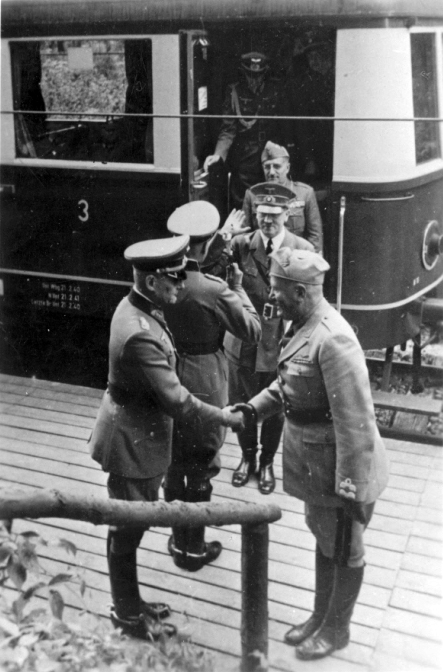
Adolf Hitler and Benito Mussolini met at the Brenner Pass to discuss a strategy that included the possibility of Francoist Spain entering the war on their side. Mussolini had already decided to attack Greece and hinted at his intention by speaking scornfully of the attitude of the “double-dealing” Greek government, but Hitler brushed such talk aside and said that the Axis powers should avoid any initiative that was not “absolutely useful.” Hitler did not reveal his intention to attack the Soviet Union.
Hitler and Mussolini meet in the Brenner Pass, which is convenient for their command trains. They talk for three hours. The main subject apparently is new plans in the Mediterranean, as the Germans have given up on Operation Sealion. This pleases Mussolini militarily because his priority always is the “Italian Lake.” However, there may be more to Mussolini’s good humor than merely a convenient military decision. Foreign Minister Count Ciano confides to his diary that Mussolini appears to be delighted by this setback for the Germans, happier than at almost any other time. This is an attitude that Mussolini reprises throughout the war even as it can’t be good news for himself personally in the long run.
However, Hitler also is in an expansive mood and declares “The war is won” — which somewhat contradicts the topic of the conference, to change the Axis’ focus away from the country that he cannot defeat, Great Britain, to the Mediterranean. Hitler states that the British people are about to “crack” — a constant refrain of his about his accumulating enemies throughout the conflict.
Hitler offers his support for Italy’s (now stalled) drive into Egypt. Mussolini, however, indicates that he doesn’t need the help yet, perhaps during the final drive into Alexandria and Cairo. Mussolini still sees his armed forces as capable of defeating Allied resistance and Italy being an equal partner in the relationship. Perhaps Mussolini feels it would be a slight to Italian prestige to require German help. This is one of Mussolini’s quirks — perhaps fantasies is a better word — that leads him into a lot of difficulties and actual loss of prestige.
Another major issue at this conference is France. Hitler wants to upgrade Vichy France to virtually a full partner in the war. Mussolini, however, adamantly opposes any French rearmament, perhaps because he has his eyes cast in a completely different direction. France recently has shown its potential value in the successful defense of Dakar against Charles de Gaulle’s and the Royal Navy’s Operation Menace, and Hitler wants to build upon that. Vichy France occupies vast overseas dominions such as Madagascar and could be a big help to the Axis. The outcome of the discussion on this point is unclear, but Hitler seems to have succeeded in keeping Mussolini from interfering with his plans for Vichy France.
What is most significant about this meeting is what is not said. Hitler does not bring up Operation Barbarossa — which is consuming Wehrmacht planning. Mussolini also (apparently) does not mention that he also has plans of his own. These involve perennial Italian nemesis Greece, Italy’s ancient enemy stretching back before even Roman times. Mussolini has a springboard against Greece in Albania — the traditional European route of the Middle Ages to attack Constantinople/Istanbul — and he intends to use it, and soon. In Mussolini’s defense, these meetings according to accounts of other meetings usually turn into Hitler monologues, with Mussolini probably trying to stay awake in a comfortable chair.
Little is known about this meeting, and there are some subtle indications that maybe the topic of an Italian invasion of Greece did come up, at least tangentially. It is known that Mussolini speaks at the meeting with contempt of Greek “double-dealing,” but Hitler may not “take the hint.” Hitler’s later reaction to the Italian invasion suggests that this meeting at least did not bring him completely on board. Immediately after this meeting, Mussolini quickly gives up plans to invade Yugoslavia as well — which is almost always overlooked by historians — so Hitler and Mussolini may have made some kind of deal on that score.
Back in Berlin, one of the Foreign Ministry’s tasks is to brief neutral governments (such as the United States) about what is going on with things like the Mussolini/Hitler meeting. A spokesman says that the discussion at the Brenner Pass was about reaching a peace deal with Great Britain — which is far-fetched because Great Britain would need to be interested, or at least consulted, and it isn’t. The Italian newspaper Il Popolo di Roma harps on the fact a German invasion of Great Britain is impossible in 1940. There is always an underlying resentment during World War II of the Italians at their military domination by the Germans, who in the 1920s were seen as little more than beggars across the Alps.
In Berlin, foreign office spokesmen told neutral journalists that the principal subject discussed by the two leaders and their foreign ministers was an appeal to the British to call off the war. However, the Italians were quick to note that Hitler no longer talks about invading Britain.
Count Ciano, notes in his diary, that this obvious setback for their Axis partner put Mussolini in an exceptionally good mood. “Rarely have I seen the Duce in such good humor.”
In Rome, Il Popolo di Roma (newspaper) commenting on the talks, speaks of a long war in prospect, with Germany unable to invade Britain this year.
Southeastern Europe awaits with morbid interest the concrete results of the meeting today between Chancellor Hitler and Premier Mussolini. The Axis press reports to local papers feature statements that each time the two dictators get together something important happens.
Herbert Morrison became UK Home Secretary.
Force H, which participated in Operation H, returns to Gibraltar.
A new law gives Vichy France the power to intern Jews even outside the Unoccupied Zone.
The Petain/Laval government continues the persecution of communists that has lasted ever since the first days of the German invasion and arrests communists in Paris.
General Charles de Gaulle arrived in Douala, French Cameroon via British cruiser HMS Devonshire to organize the invasion of Gabon, which was controlled by Vichy French forces. His arrival fits into grand British strategy to wrest all of Africa from the Axis by picking off the low-hanging fruit first. While an overlooked part of World War II, control of central and southern Africa is of immense importance for many reasons, not least the ability it gives to extend the range and scope of U-boat and Luftwaffe operations against vulnerable British supply routes.
In Britain, German bombers attacked Kent in southern England and the area near London, damaging homes, farms, and factories. The Germans lost 2 Ju 88 bombers and the British lost 3 fighters with 1 pilot killed. Overnight, London was bombed between 1900 and 2100 hours.
The weather remains lousy on 4 October 1940, and air operations remain minimal. In any event, given the pattern of the battle so far, this probably would have been an “off” day for the Luftwaffe anyway, which has alternated periods of attacks and quieter days since June.
RAF Fighter Command, for its part, is focusing on developing more lead-time for its fighters. These measures, championed by Air Vice-Marshal Keith Park, include a new reconnaissance squadron based at Gravesend. Keith Park issues new observations and instructions to sector controllers and to squadron commanders, whose pilots are becoming fretful at the frequency with which they are still at an unfavorable height when they meet the enemy. Park assured them: “I wish the squadron commanders and sector controllers to know everything humanly possible is being done by group to increase the warning received of incoming raids. … With the prevailing cloudy skies and inaccurate heights given by the RDF the group controllers’ most difficult problem is to know the height of the incoming raids.” Park then detailed what steps were being taken to correct this situation, including the formation of a special reconnaissance flight at Gravesend. “Whatever time permits I wish you to get the readiness squadrons in company over sector aerodromes. Spitfires 25,000 feet, Hurricanes 20,000 feet, and wait until they report they are in good position before sending them to patrol lines or to intercept raids having a good track in fairly clear weather.”
The new pattern of using primarily fighter-bombers by day and regular bombers by night continues, but especially on days like this with heavy clouds and rains, the Luftwaffe does sneak a fair number of Junkers Ju 88s, Dornier Do 17s and Heinkel He 111s into the mix.
The morning is occupied with lone bombers seeking out specific targets. Some hit London, others various other targets in the southeast. Among the areas hit are RAF Penrhos, which destroys some buildings, and Fairlight (home of the Air Ministry). Some bombers are intercepted at sea before they can even make land.
Around 13:00, the Luftwaffe sends over some Bf 109E-7 Jabos (fighter-bombers) and Bf 110s. This is the first organized raid, but does not accomplish much in the muck.
Another raid at 17:00 crosses the coast apparently heading for London. A timely interception by RAF No. 605 Squadron Hurricanes, though, sends them running.
The weather clears up a bit after dark, just in time for the Luftwaffe to get to its main task, the bombing of English cities. Airfields around Abbeville send out a steady stream of bombers beginning around 19:00. The aircraft are in parade formation, regularly spaced in true Germanic precision. These raids last for about two hours and all head for London, which is fairly easy to find even in the poor weather conditions. Southwest and Northwest London take the brunt of the attack, with some bombers hitting the RAF stations at North Weald and Debden. The most significant damage to infrastructure is at the Hawkers Aircraft Factory at Kingston, the New Cross Telephone Exchange, and the railroad track near Crews Hill Station. This last attack stops all rail traffic on the line in both directions for a while.
The Luftwaffe also mines all along the Norfolk and Suffolk coasts.
Losses are light today. The Luftwaffe loses about 10 planes, the RAF about 3.
Squadron Leader M. Lister Robinson, DSO, DFC, becomes commanding officer of RAF No. 609 Squadron.
Hauptmann Walter Adolph becomes Gruppenkommandeur of II./JG 26.
Sir Cyril Newall retired as British Chief of Air Staff and was replaced by Sir Charles Portal. Newall becomes Governor-General of New Zealand.
Sir Richard Peirse became Commander-in-Chief of the British RAF Bomber Command.
RAF Bomber Command dispatches 30 Blenheims on daylight cloud-cover raids; 15 bombed. 6 further Blenheims on sea sweep. No losses.
The RAF sends raids against railway infrastructure serving Italian bases in Eritrea and Abyssinia (Ethiopia).
At Malta, there is a sustained Italian air raid shortly after 10:00. The formation is composed of fighters, and the defending Hurricanes only rise to defend when they attack Luqa and Hal Far airfields. The Italians lose one Macchi C.200 Saetta (“Arrow”) and the pilot perishes.
In another LUCID operation, first attempted on 25 September, Force A, old tankers War Nizam (5605grt) and Mytilus (5693grt) with destroyers HMS Campbell, HMS Cattistock, HMS Mackay, and HMS Walpole, minesweepers HMS Salamander, HMS Sutton, HMS Selkirk, and motor torpedo boats and launches MTB.31, MTB.32, ML 108, and ML 110 departed Sheerness for Calais. Force B, old tanker Oakfield (ex War African, 5244grt), destroyers HMS Hambledon (Agar embarked), HMS Garth, HMS Venetia, and HMS Witch, minesweepers HMS Elgin, HMS Hussar, HMS Speedwell, with MTB.34, Norwegian MTB.5, ML 106, and ML 110 departed Harwich for Boulogne. Force C was destroyers HMS Verity, HMS Venomous, and HMS Wild Swan. They were dispatched to destroy ports on the English coast that housed German invasion barges. Heavy weather caused the operation to be once again be cancelled.
Light cruisers HMS Manchester, HMS Dido, and HMS Phoebe arrived at Scapa Flow.
Anti-aircraft cruiser HMS Cairo departed Rosyth to provide anti-aircraft support for convoy OA.224 as far as Scapa Flow. At Scapa Flow, Cairo embarked stores before going to the Western Approaches Command.
Destroyer HMS Ashanti departed Rosyth to cover convoy EN.7. Ashanti departed Methil at 1000 and proceeded with the convoy to Duncansby Head. The destroyer then returned to Rosyth.
British tug Sirdar (34grt) was sunk by German bombing in Long Reach, River Swale.
Submarine HMS Triton sank Italian steamer Franca Fassio (1858grt) 16 miles 97° from the Semaphore at Capo Noli in the Gulf of Genoa. Triton also shelled shore installations off Vado and Savona. She unsuccessfully attacked Italian steamer Spezia (1825grt) in Vado Roads on the 8th.
Submarine HMS Rorqual laid mines off Benghazi.
Submarine HMS Rainbow (Lt Cdr L. P- Moore) had departed Alexandria on patrol on 23 September. On 4 October, Rainbow was sunk in a collision with Italian steamer Antonietta Costa (5900grt) in 41-28N, 18-05E. Antonietta Costa had departed Bari with steamers Oreste and Premuda for Durazzo on the 3rd, escorted by auxiliary vessel Ramb III. Lt Cdr Moore, Lt P- Chapman, Lt M. H- Davis, Lt G. W. Tweed, S/Lt D. J. Adcock, Lt (E) W. R. Withey, the fifty ratings of the crew were lost. Rainbow was declared lost on the 19th.
Submarine HMS Tetrarch attacked an Italian merchant ship in the Gulf of Genoa without success.
Destroyer HMS Wishart escorted troopship Neuralia to Lisbon to embark British subjects and Polish troops from France. The destroyer waited outside territorial waters and escorted the troopship back to Gibraltar after embarkation.
Italian steamer Nina Bianchi (2180grt) was lost in a collision with Italian steamer Veloce (5464grt) off Brindisi in 40-27N, 18-24E.
Convoy OA.224 departed Methil, escorted by sloop HMS Hastings and corvette HMS Peony. Corvette Peony was detached on the 5th. Anti-submarine yacht HMS Philante joined on 6 September. Later that day Hastings and the yacht were detached.
Convoy FN.299 departed Southend, escorted by destroyers HMS Vanity and HMS Wolfhound. The convoy arrived at Methil on the 6th.
Convoy FS.300 departed Methil, escorted by destroyer HMS Vivien and sloop HMS Londonderry. The convoy arrived at Southend on the 6th.
Convoy HX.78 departed Halifax escorted by Canadian destroyer HMCS Assiniboine and auxiliary patrol ships HMCS French, HMCS Husky and HMCS Reindeer. French returned to Halifax at 1845. Assiniboine departed the convoy at 1850/5th. Ocean escort was armed merchant cruiser HMS Jervis Bay, which was detached on the 14th. On 14 October, destroyers HMS Anthony and HMS Verity joined the convoy. Destroyer HMS Arrow, sloop HMS Rochester, and corvettes HMS Calendula and HMS Camellia joined on the 15th. Anthony and Arrow were detached on the 18th. The convoy arrived at Liverpool on the 18th. Anti-aircraft cruiser HMS Curacoa provided protection for the east ships of this convoy on 19 and 20 October.
In Washington today, President Roosevelt discussed the legislative situation with Speaker Rayburn and Representative McCormack, received from William Green an invitation to address the annual convention of the American Federation at New Orleans in November and presided at a long Cabinet meeting. At a press conference he said training of Canadian airplane pilots in this country was permissible.
The Senate completed Congressional action on the $238,000,000 Third Supplemental Civil Functions Bill and on the resolution extending the Sugar Control Act for one year, approved the conference report on the bill codifying nationality laws, passed the $37,085,000 Rivers and Harbors Authorization Bill and recessed at 5:41 PM until noon on Monday. The Campaign Expenditures Committee heard the treasurers of the Republican and Democratic National Committees.
The House completed Congressional action on the bill codifying the nationality laws, approved the conference report on Third Supplemental Civil Functions Bill, heard Representative Knutson charge that President Roosevelt was leading the country into war, and adjourned at 4:25 PM until noon on Monday. The Smith committee investigating the National Labor Relations Board heard Edwin S. Smith, and the Dies committee took further testimony regarding the activities of the German-American Bund.
Congress completed action today on the last of the appropriation bills bearing on the current national defense program, and rushed through other legislation in an effort to leave the capital next week for a long recess. This was the wish of the Administration leaders on both sides of the Capitol, but it appeared that considerable opposition would be encountered in the House. The final defense appropriation of the session, so far as is expected now, was a deficiency bill carrying $238,000,000 for various civil functions, including $40,000,000 for the construction of airports. Both houses approved their conferees’ recommendations today, sending the measure to the White House for the President’s signature.
The conference report on codification of nationality laws was adopted by both houses without much debate. The completed bill was the result of four years of study by the State Department, other Executive branches, and committees of Congress. The Senate likewise passed and sent to the White House a resolution extending the sugar quotas for another year, after rejecting amendments offered by Senators Wheeler and Pepper.
A bill to authorize $57,000,000 in improving various rivers and harbors was passed by the Senate and sent back to the House, which had previously adopted the measure, for concurrence in Senate amendments. These included a flood control project of $1,600,000 to protect the Pratt & Whitney aircraft factory at East Hartford, Conn., which suffered from floods in 1936 and 1938. Senator Maloney, in offering the amendment, pointed out the importance of uninterrupted functioning of this plant during the defense production program.
President Roosevelt told news correspondents at a White House press conference today that he was amused by published despatches from Rome to the effect that the German and Italian Governments would like to see him defeated in the election.
Threats of legislation to outlaw “punitive” acts by the Federal Government toward firms which have transgressed labor laws came in Congress today in the wake of Attorney General Jackson’s ruling that corporations adjudged guilty by the National Labor Relations Board of unfair labor practices should be barred from government contracts. Angry criticism of the ruling in the House declared it, in effect, “sabotage of the defense program,” while there was talk that the Smith Committee to Investigate the National Labor Relations Board would call Sidney Hillman, labor member of the National Defense Advisory Commission, who requested the Attorney General’s ruling, and Mr. Jackson to “air” the matter. In this atmosphere the program of Congressional leaders to halt work until after election through a long recess or short recesses was imperiled.
Wendell L. Willkie, declaring “attack is closer than ever America is still unsafe,” told a loudly cheering throng tonight the nation needs prosperity and an adequate defense “on hand” instead of “on order.” From a flower-banked rostrum in Shibe park, Willkie asserted that the new deal “has lacked the ability to get things done,” and said instead of placing orders only for tanks and airplanes, it also had “on order” the factories in which to build them. Back in Philadelphia for the first time since his nomination here in June, the Republican presidential candidate was given a loud welcome when he walked to the platform with Mrs. Willkie.
A coast-wide strike against steam schooners, involving about 50 lumber and general cargo ships in the West coastal trade, was called today by the Marine Firemen, Oilers, Water-tenders, and Wipers’ association. The first pickets appeared on the San Francisco waterfront at 5 p.m. Thirteen lumber schooners were tied up at San Pedro by the strike and one at Seattle. V. J. Malone, union secretary, said 247 union men were directly involved. It was evident, however, that five other unions and 2.000 of their members would be affected. The strike action came unexpectedly during a deadlock in long negotiations for a new working agreement with ship operators. It was the second strike called within a year by the firemen against steam schooner operators.
Two weeks to the day after he snatched a youngster from a nurse’s arms in a shocking kidnaping, Wilhelm Muhlenbroich, 40, saw the gates of San Quentin prison swing closed behind him. The stoic German alien entered the prison today under sentence of life imprisonment. There was a fleeting, faint, grim smile on his face as he crossed the threshold. He was assigned a prison number 65540 and the prison gray garb, was given a bath and a shave and a prison haircut. And that was the end of the story.
The motion picture “Knute Rockne-All American” premieres in South Bend, Indiana. Directed by Lloyd Bacon, this American football biography stars Pat O’Brien as Knute Rockne, Ronald Reagan as George Gipp and Donald Crisp. The premiere is attended by O’Brien and Reagan. “Knute Rockne, All American” premieres at four separate venues in South Bend, Indiana, the home of Rockne’s alma mater, Notre Dame. The film stars Pat O’Brien and Ronald Reagan. Ticket prices range from $1.10 to $1.65 for reserved seating on the main floor (about $23 today).
Fritzie Zivic beat Henry Armstrong for the world welterweight boxing title at Madison Square Garden.
1940 World Series, Game Three:
Detroit bombs 9 hits for 19 bases in the 7th and 8th innings off Jim Turner and successors to win 7–4 in the first game at Briggs Stadium. Tommy Bridges gives up 10 hits but goes the distance. The Reds struck first in Game 3 when Billy Werber doubled to lead off the first off Tommy Bridges and scored on Ival Goodman’s single, but the Tigers tied it in the fourth on Hank Greenberg’s double-play after back-to-back leadoff singles off Jim Turner. Detroit went up 5–1 in the seventh on two-run home runs by Rudy York and Pinky Higgins. The Reds got a run in the eighth on Mike McCormick’s RBI single with two on, but in the bottom half, Greenberg hit a leadoff triple off Joe Beggs before Bruce Campbell’s RBI single and Higgins’s RBI double made it 7–2 Tigers. In the ninth after a leadoff single and error, RBI singles by Eddie Joost and Werber made it 7–4 Tigers, but Bridges struck out McCormick to end the game as Detroit took a 2–1 series lead.
Cincinnati Reds 4, Detroit Tigers 7
Members of the Joint Permanent Defense Board completed their first definitive report today, fixing the defense responsibilities to be assumed by the United States and Canada in measures against the invasion of either country.
Canadian civilian student pilots have the legal right to attend private schools in the United States without regard to the fact that this training will equip them for service in the British Flying Corps, under a rule enunciated by President Roosevelt today at his press conference.
Julian Arnold, former U. S. attaché in China, today charged the United States had followed an appeasement policy in the far east and called for a stiffened United States attitude in Asiatic affairs because “the Japanese respect only one item the display of force.” Speaking before the Commonwealth club, regarded as one of the most important forums in the nation, Arnold said the United States must cease to be pacific in the far eastern situation at all costs and must place an embargo against both Japan’s exports and imports as long as Japanese aggression continues.
Six Hawk 75 fighters of the Chinese 18th Squadron were in transit when they came across 27 Japanese G3M bombers escorted by 8 A6M Zero fighters, en route to attack Chengdu, Sichuan, China. The Zero fighters shot down 1 and forcing 2 to crash land.
Nationalist Chinese troops launched an attack on Communist Chinese New 4th Army in Huangqiao (“Yellow Bridge”), Jiangsu Province, China, nearly taking the town.
The Petain government charged today that Thailand [Siam] was backing up territorial demands on French Indo-China with “systematic” violations of that colony’s frontier by groups of twenty to forty planes.
Japan thrust two sharp warnings at the United States today that any challenge of the Rome — Berlin — Tokyo axis would tumble her into a “fight to a finish.” The question of peace or war in the Pacific will be decided by whether the United States and Japan understand and respect each other’s positions, Prince Konoe, Japanese Premier, told newspaper men at Tokyo tonight. Premier Konoe Fumimaro of Japan said that if the United States recognized Japan’s leadership in East Asia, Japan would recognize a similar leadership of the United States in the Western Hemisphere. He also forecasted war … “If the United States refuses to understand the real intention of Japan, Germany, and Italy in concluding an alliance for positive cooperation in creating a new world order and persists in challenging those powers in the belief that the accord is a hostile action…” Konoe emphasized Japan’s stiffened attitude toward America with the declaration that: “Whether the Pacific will become the scene of war or peace solely depends on whether Japan and the United States respect each other’s position. At the present, there is no concrete idea of taking the initiative in negotiations with the United States.”
Light cruiser HMS Durban departed Hong Kong.
Churchill sends a message to President Roosevelt requesting a U.S. naval presence in Singapore.
Dow Jones Industrial Average: 133.79 (-1.3)
Born:
Alberto Vilar, American investor convicted of fraud and philanthropist, in East Orange, New Jersey (d. 2021).
Christopher Stone [Thomas Bourassa], American actor (“Dallas”; “Interns”), in Manchester, New Hampshire (d. 1995).
Vic Hadfield, Canadian NHL left wing (All-Star, 1965, 1972; New York Rangers, Pittsburgh Penguins), in Oakville, Ontario, Canada.
Steve Swallow, American jazz bassist and composer, in Fair Lawn, New Jersey.
Naval Construction:
The Royal Navy Isles-class minesweeping trawler HMS Flotta (T 171) is laid down by Cochrane & Sons Shipbuilders Ltd. (Selby, U.K.); completed by Amos & Smith.
The Royal Canadian Navy Flower-class corvettes HMCS Summerside (K 141) and HMCS Louisburg (K 143) are laid down by the Morton Engineering and Dry Dock Co. (Quebec City, Quebec, Canada).
The Royal Canadian Navy patrol vessel HMCS Otter (S 04) is commissioned. Her first and only commander is Lieutenant Dennis Sinclair Mossman, RCNR.
 History Diaries