The Senate, by voice vote, gave final congressional approval to a bill to partly lift the embargo against the shipment of American arms to Turkey. President Ford, who had fought hard to end the embargo, issued a statement welcoming the congressional action. With only a few Senators on the floor, less than a minute was spent on a voice vote to accept the bill and send it to the White House for President Ford’s signature. The House of Representatives approved the measure last night. Mr. Ford, whose lengthy campaign against the embargo had finally succeeded, issued a statement welcoming the Congressional action as “an essential first step in the process of rebuilding a relationship of trust and friendship with valued friends and allies in the eastern Mediterranean.”
Turkey’s Foreign Minister lauded the easing of the arms embargo but said that American bases in Turkey would not be permitted to reopen for a while. Turkey today reacted with a guarded welcome to the House of Representatives’ vote for an easing of the United States arms embargo and indicated that she would be prepared to discuss a new defense relationship with Washington. A Foreign Ministry spokesman said the House vote was a step the right direction. He expressed the hope that it would lead to a total lifting of the embargo. “The logical step would now be to resume negotiations on the status of American forces in Turkey,” the spokesman said.
With the easing of the embargo, Mr. Ford said his Administration would undertake “in the weeks ahead” the following steps:
— To “rebuild our security relationship with Turkey to underscore that Turkey’s membership in the Western alliance and partnership with the United States serve the very important interest of both nations.”
— To “make a major effort to encourage resumption of the Cyprus negotiations and to facilitate progress by the parties involved — Greece, Turkey and Cyprus — toward a peaceful and equitable settlement of this dispute.”
— To “intensify cooperation with appropriate international humanitarian agencies to find ways to alleviate the suffering” of some 180,000 refugees displaced by the fighting on Cyprus in August, 1974.
— To “provide support to the democratic government of Greece” by pursuing efforts “to help that country overcome its current economic and security problems.”
The British Government today outlawed the Ulster Volunteer Force only hours after the Protestant paramilitary organization admitted responsibility for a 24-hour wave of bombings and shootings against Roman Catholic targets in which 12 persons were killed. Britain’s Secretary or State for Northern Ireland, Merlyn Rees, said in a statement early today: “After the indiscriminate killings for which they have admitted responsibility it has become abundantly clear that the U.N.F. is still wedded to violence including the murder of innocent civilians. “Their activities are an affront against society, and in consequence they no longer have the right to be treated as members of a legitimate organization,” he said.
The five-day siege of an Italian restaurant in London ended today with the hostages safe, three gunmen under arrest and Scotland Yard expressing satisfaction with its handling of the case. Frank Davis, the Nigerian leader of the armed gang, was the only casualty when he shot himself in the stomach after releasing six Italian hostages. Mr. Davis is in serious condition. The end came when Mr. Davis shouted to the police from the tiny storeroom of the Spaghetti House restaurant in fashionable Knightsbridge that the hostages were coming out.
Chancellor Helmut Schmidt told President Ford today of Bonn’s problems with inward-looking United States monetary policies today. Their talks, attended by Seccretary of State Kissinger and Dieter Hiss, the Chancellor’s Assistant Secretary for Economic Policy, began at noon at the White House and continued through lunch for two and a half hours. Mr. Schmidt has been in touch with Mr. Ford twice in recent months to express his concern about high American interest rates and the apparent indifference of leading members of the American economic community toward the volatile exchange rates of international currency. While he told Mr. Ford that be is still concerned about both issues, he also made it plain that he was disturbed not so much about the President’s attitude toward monetary policy as he was about the “restrictive” policies of Arthur F. Burns, chairman of the Federal Reserve Bank.
The Spanish Government declared today that the killing of three more policemen this week strengthened its determination to use the full weight of the law to stamp out terrorism. The statement by the Cabinet, which met under the chairmanship of Generalissimo Francisco Franco, amounted to a further rejection of protests from abroad over the execution Saturday of five urban guerrillas convicted of having killed policemen.
The Soviet Union and Portugal said today that they would set up a regular system of consultations on bilateral and world problems and work to expand cooperation in the political and economic fields. The pledges came in a joint declaration and a communiqué issued at the end of a three‐day visit to Moscow by President Francisco da Costa Gomes for talks with the Soviet President, Nikolai V. Podgorny and the Communist party leader, Leonid I. Brezhnev. The declaration said both countries were keen to develop friendship and cooperation. The communiqué added that President Podgorny would visit Portugal.
The Senate Foreign Relations Committee ended a prolonged dispute with Secretary of State Kissinger by voting 12 to 2 to declassify four documents, already printed by the press, dealing with American assurances to Israel and Egypt during negotiations for a Sinai accord. Earlier, at a closed-door meeting, Mr. Kissinger told members of the panel that he could not approve of its planned action. He said that for the sake of relations with other governments the State Department would protest it. While no committee member said that Mr. Kissinger had given even his tacit consent to the publication, it was evident from discussions with Senators and Administration officials that because The New York Times had already printed all four documents, and other papers had published some of them, Mr. Kissinger’s objections were made more for the record than anything else.
A bomb, packed into a can of beans exploded near the main railroad station in Tel Aviv today and slightly injured two women. The police said that an Arab guerrilla was suspected of planting the time bomb.
Five gunmen attacked Beirut international airport at dawn today, killing or injuring an undetermined number of civilians waiting to board planes. One terrorist attempted to commandeer a waiting airliner. Witnesses said that at least three people, including one of the terrorists, were killed in the incident. The gunmen, dressed in civilian clothes, stormed into the airport at 5:25 AM and began shooting at passengers waiting to check in on the early morning Egyptair flight to Cairo. Airport security forces reportedly opened fire on the terrorists, killing one and wounding another. Two were captured but the fifth attempted to commandeer a Middle East Airlines Boeing 707 jet. It was not known if he tried to take hostages aboard the plane. Security guards ringed the plane as officials of the Palestine Liberation Organization were reported to be arriving at the airport. Shots were heard near a car where the two captured terrorists were being held. Policemen had to calm several security men who apparently wanted to execute the terrorists on the spot.
For the first time since Bangladesh had seceded from Pakistan in December 1971, the two nations established diplomatic relations.
Prince Norodom Sihanouk, Cambodia’s titular head of state, arrived in New York yesterday and said that he would not “assume the responsibility of government” in Phnom Penh but that neither would he become the “roving ambassador” that Western diplomats have speculated would be his chief role under the new Communist regime. At a crowded news conference at the airport, Prince Sihanouk rose halfway from his seat to answer a question on his present role in Phnom Penh. “The Government is controlled by the people,” he said in English. “They deserve to lead the Government, so I do not assume the responsibility of Government But I am not an ambassador, I am Chief of State. You have many countries, like Great Britain and Italy, where the heads of state do not rule the state, they are symbols of government. So you must not be surprised that I am president of Cambodia, that I am the head of state, but that Cambodia is ruled by the people and not by the head of state.”
China is seeking to buy an advanced American-made computer that would enhance her search for oil and could also strengthen her defense capabilities, according to Administration officials. The decision on the sale or the Control Data Corporation’s Cyber 72 or 172, as it is variously known, is now before the international coordinating committee known as Cocom that passes on sales of strategic goods to Communist countries. Organized in 1949, Cocom is an informal group that maintains a list of agreed strategic items that can only be sold to Communist countries after a unanimous vote of approval by its members. The members are all of the North Atlantic Treaty Organization countries minus Iceland and plus Japan. Secretary of State Kissinger is said to be disposed toward approving the transaction, even though the United States recently vetoed the sale of other advanced computers to the Soviet Union and despite the fact that Peking has not been as forthcoming as Moscow on permitting inspections of the uses to which these sophisticated instruments of this kind are being put.
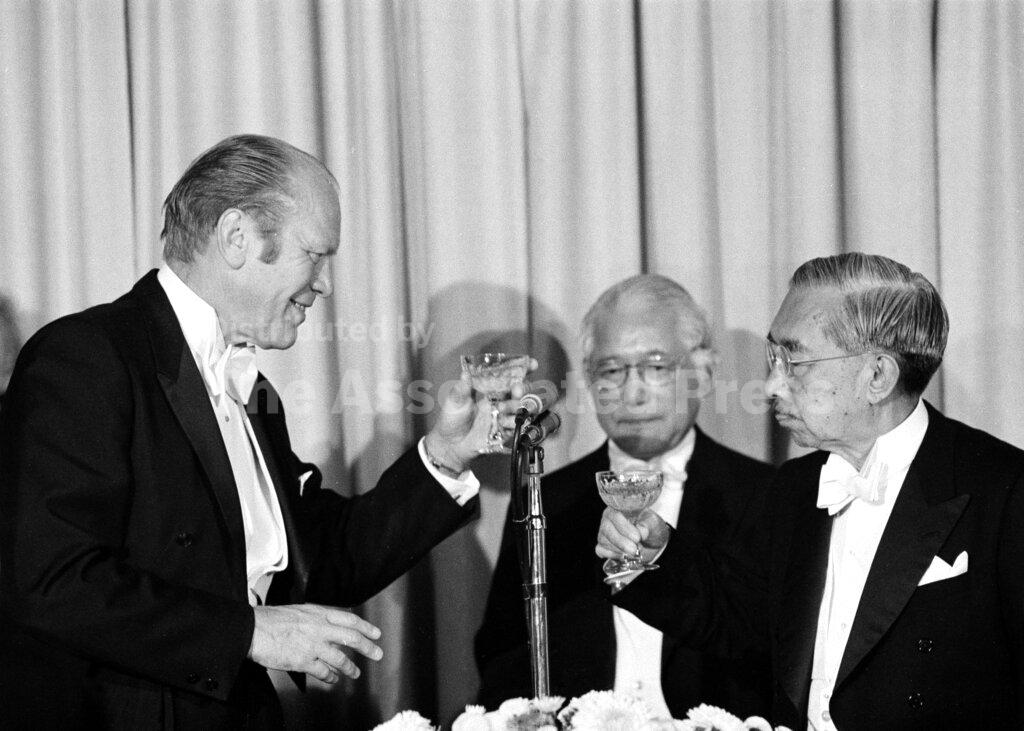
While a bugler sounded taps, Emperor Hirohito stood with his head bowed today before the Tomb of the Unknowns at Arlington National Cemetery. The Emperor visited the tomb, which contains the bodies of servicemen from both world wars and the Korean war, to lay a wreath of carnations in a ceremony that at once acknowledged Japan’s role in World War II and commemorated those who died in that war. Inscribed on the battle streamers that hung from a flag dipped in front of the Emperor were the names of dozens of islands in the Pacific where Japanese and American men met in savage combat a little over 30 years ago.
Daniel Patrick Moynihan, chief United States delegate to the United Nations, said in a speech in San Francisco that he agreed with a characterization of President Idi Amin of Uganda as a “racist murderer.” Speaking to a convention of leaders of organized labor, Mr. Moynihan praised Israel as a democracy that despots seek to destroy. Speaking of President Amin’s call at the United Nations Wednesday for the “extinction of Israel as a state,” Mr. Moynihan said of Uganda’s leader: “It is no accident, I fear, that this racist murderer, as one of our leading newspapers called him this morning, is head of the Organization of African Unity, for Israel is a democracy and it is simply fact that despotisms will seek whatever opportunities come to hand to destroy that which threatens them most, which is democracy.”
Accusing Congress of greatly expanding school lunch subsidies for “non-needy” children, President Ford vetoed a $2.7 billion extension of federal child nutrition programs. Congressional Democratic leaders seemed optimistic that they could enact the bill over Mr. Ford’s veto, his 39th, and tentatively scheduled an override vote Tuesday in the House. “If this bill provided food for children truly in need,” the President said, “I would give it my wholehearted support and approve it immediately.” The veto “will be overridden in less than a week,” predicted Senator George McGovern, the South Dakota Democrat who is chairman of the Senate Select Committee on Nutrition and Human Needs. He called Mr. Ford’s veto a “mindless exercise” by “a President who thinks the oil companies should have more and the hungry should have less.”
The nation’s job situation improved a bit last month. The Labor Department reported that the overall unemployment rate eased to 8.3 percent from 8.4 percent in August and that total employment rose a little. However, the job situation was substantially better than last May, when the jobless rate rose to a high of 9.2 percent.
Nonetheless, the depth of the recession was still reflected in the number of long-term unemployed. About 1.6 million remain dislocated and frustrated nearly a year after the economy took its longest plunge in four decades. For most, the struggle is not against starvation — jobless compensation rules protect them for up to 65 weeks — but a fight to preserve a hard-won middle-class lifestyle.
About 20 federal district judges from around the nation are to meet in Washington this weekend in closed sessions to discuss school desegregation cases and how to handle them. At least three judges scheduled to attend are among those now involved in desegregation litigation. The conference has been attacked by some lawyers who contend that such a meeting at a time when past orders by courts for busing as a means of ending segregation are under assault, is, as one lawyer said, “fraught with difficulties” if not improper.
The Central Intelligence Agency established an official group during the early nineteen-sixties to develop plans for removing foreign leaders by means that included assassination, two Senators and two former intelligence officials said today. Senator Frank Church, chairman of the Select Committee on Intelligence, confirmed the existence of the group, but he said that the plans it developed were never carried out. A member of the committee staff said that the group “petered out” in 1963. There was no evidence that President Kennedy, who was in office at the time, knew of or approved of the group. Mr. Church, an Idaho Democrat, refused to provide details about the unit, but he made it clear that the plans it developed were separate from the C.I.A.’s alleged plot to poison Premier Fidel Castro of Cuba in 1961 in connection with the Bay of Pigs invasion.
“This capability had no connection with the Castro business,” Senator Church said. “It was a separate mission.” He said that other details should not be made public until the committee releases its report on alleged C.I.A. assassination plots. The report is expected to be made public this month. A former high official of the intelligence agency, who declined to be identified, acknowledged in an interview the existence of an “executive action” group that probably included no more than three persons. He said that they developed methods for the removal of unfriendly foreign leaders. He said that in addition to assassination, the means could have included coups or shipping foreign leaders “off to the Riviera.” A second former C.I.A. official said the planning effort had begun in the wake of the alleged attempt to poison Premier Castro and was intended to maintain an “assassination capability” in case it was needed for use against other foreign leaders.
Terence Hallinan, a lawyer for Patricia Hearst, said that the story that she had been broken down by mistreatment by her kidnappers, recounted in an affidavit she signed, originated with an anonymous source and not with Miss Hearst. Hallinan said that another woman, whom he would not name, was the original source of the detailed account of how Miss Hearst was allegedly imprisoned in a closet, threatened, perhaps drugged with LSD and persuaded to join her abductors in a bank robbery. Mr. Hallinan’s version of events leading to the filing of the affidavit on September 23 was first reported in The San Francisco Examiner, of which Miss Hearst’s father, Randolph A. Hearst, is president. In a telephone interview, Mr. Hallinan confirmed The Examiner’s report, but added that he did not want to say any more.
The Washington Post recovered today from the sabotage of its pressroom and published a 24-page edition after missing publication only one day. The sabotage occurred early Wednesday as pressmen went on strike after their contract expired. Some violence involving pressmen and nonstriking Post employes was reported by the police last night. The 500,000 copies of the Friday edition were printed overnight at cooperating nonunion newspapers as far away as Charlottesville, Virginia, 115 miles to the southwest.
To combat fraud in the federally insured student loan program, which he called “one of the most gigantic ripoffs in the country,” Representative Robert H. Michel, Republican of Illinois, today introduced legislation that would invoke criminal penalties against profit-making schools and financial institutions cheating the Government or students. Mr. Michel, a senior member of the House Appropriations Committee and the minority whip, said that fraudulent use of the guaranteed student loans “could be as much as $500‐million.” Besides involving profit‐making schools, some of which are under investigation, or indictment now, the fraud reaches into “some of the nation’s largest corporations,” Mr. Michel said, as well as banks, savings and loan institutions and some credit unions. His bill would prohibit profitmaking “career” schools from eligibility as lenders under the program, which began a decade ago and has made some $18‐billion in loans.
The Boston Teachers Union, which struck the city’s public schools for six days last week, voted today by a 7‐to‐1 margin to ratify a new one‐year contract providing for a 6 percent pay rise. The union’s president, Henry Robinson, said the new contract also provided one‐year job security and required teachers to put in two and a half hours a month of free work on extracurricular projects. The teachers halted Boston’s school desegregation program last week when they walked off their jobs in a dispute that centered on overtime required to fulfill a desegregation plan ordered by Judge W. Arthur Garrity Jr. of Federal District Court.
The Teton Dam in Idaho began to fill as the Teton River was closed off. Eight months later, on June 5, 1976, the earthen dam would break, flooding the town of Wilford and killing eleven people.
Apple Records releases George Harrison’s sixth studio album, “Extra Texture” in UK.
Joe Frazier, a one-time major league pinch-hitter who spent 17 years playing baseball in the minor leagues and 10 more years managing teams there, vaulted into the front trenches yesterday when he was named manager of the New York Mets.
Dow Jones Industrial Average: 813.21 (+18.66, +2.35%)
Born:
India.Arie [Simpson], American Grammy Award-winning neo-soul singer (“Video”; Voyage to India), in Denver, Colorado.
Talib Kweli [Greene], American rapper, in Brooklyn, New York, New York.
Mike Johnson, Canadian MLB pitcher (Baltimore Orioles, Montreal Expos), in Edmonton, Alberta, Canada.
Scott Cassidy, MLB pitcher (Toronto Blue Jays, Boston Red Sox, San Diego Padres), in Syracuse, New York.
Died:
Guy Mollet, 69, former Prime Minister of France (1956–1957), of a heart attack.
 History Diaries