The U.S. Congress reversed its decision on an embargo against arms sales to Turkey. In a major victory for the Ford administration, the House voted to reverse itself and ease the eight-month arms embargo against Turkey. The bill, which passed by a vote of 237 to 176, now goes back to the Senate, which can either accept a change made in it by the House or send the measure to a Senate-House conference committee. The measure, which was approved after last-minute lobbying by the Administration, had been sought in an effort to repair severe strains in Turkish-American relations. The embargo was initially voted by Congress last year in retaliation for the use by Turkey of American‐supplied weapons during the August invasion of Cyprus. Turkey’s Action violated United States foreign aid laws that restrict the use of such arms to defensive purposes. A number of House members who had voted against the aid bill in July maintained that they were switching in support of the Administration tonight because the embargo’s aim of encouraging a Turkish‐Greek settlement of the Cyprus situation has been unsuccessful.
The United States has one of the worst energy conservation records among the world’s industrialized nations, according to a survey by the International Energy Agency. Only Belgium, Norway and Austria ranked lower, while Britain and Sweden topped the list. The report by the Paris-based agency said U.S. fuel taxes are too low to curb consumption effectively, contended there are not enough incentives to reduce auto travel and added that utility rates charged industry and other big users are too low.
Shouts of “Death to the Communists! No more clemency!” and of demands that the army seize power disrupted the funeral of three slain policemen in Madrid today. As the entire Spanish Cabinet looked on, irate plainclothes men and other mourners pushed forward to try to carry away the three coffins but were turned back by other policemen. Allowed to file by the coffins later, demonstrators bade farewell with arms out in Fascist salutes. “The Lord have mercy on us,” said the Rev. Jose Lepez Ortiz at the Roman Catholic funeral service. “Bring peace to our fatherland and make the miracle of softening our hearts.” But few of the 4,000 or more attending the service held at a police academy or agitating outside showed any signs of softening.
Charges and countercharges increased in Lisbon today in the wake of warnings by the Socialist party last night that the extreme left was about to stage a coup. The Socialists, who hold four of the 15 ministries of the Cabinet, said they would prove their charges after a Government investigation. Although an official spokesman said last night that the warnings were issued after “someone got overexcited,” the party paper A Luta and official spokesmen asserted today that the warnings had succeeded in heading off a coup. However, high‐ranking party officials, speaking privately today about the events of last night, were less assertive than they were skeptical and rueful. Communists, who hold one of the ministries, accused the Socialist party of using its warnings to prepare a “seditious uprising.” Communist‐dominated newspapers said that the Socialist alarms were aimed at trying to persuade the Premier, Vice Adm. José Pinheiro de Azevedo, to declare a state of emergency.
Three gunmen under siege in the basement storeroom of a London restaurant for five days released their six Italian hostages unharmed, Scotland Yard announced. The gunmen then surrendered. Their leader, a 28-year-old Nigerian ex-convict named Franklyn Davis, shot himself in the stomach after he let the hostages go. The other two gunmen were Jamaicans known only as Bonzo and Wesley. The three invaded the Spaghetti House in the fashionable Knightsbridge district last Sunday in a robbery attempt but were surprised by police.
Eleven people were killed and more than a dozen injured in a wave of shootings and bomb blasts across Northern Ireland in the worst day of bloodshed in the British province of Ulster in seven months. In Belfast alone five people — two of them sisters shot down in cold blood — were killed by the terrorists. The killings raised the known death toll from more than six years of sectarian warfare to at least 1,329.
Britain has decided to dispose of its dangerous nuclear wastes by turning them into solid glass, which can withstand earthquakes, fire and centuries of rain. This was disclosed in the annual report of the British Atomic Energy Authority that said a pilot plant was being commissioned to perfect the process, known as “glassification.” Using this process, nuclear waste would drip into a tank of molten glass and molecules of the two substances would mingle and solidify into thick glass cylinders.
Premier Alexei N. Kosygin told R. Sargent Shriver the Soviet Union is prepared to negotiate separate long-term arrangements with the United States on grain and oil. Shriver, a Democratic presidential contender, was in the Soviet Union on business. A U.S. delegation is in Moscow to wrap up a grain deal that is said to involve Soviet purchases of 5 million tons a year for five years.
The House International Relations Committee cleared the way for its formal approval tomorrow of the stationing of 200 American civilian technicians in the Sinai passes to help monitor the recent Egyptian-Israeli accord. In a three‐hour session, the committee agreed on the final draft of a joint resolution that permits the civilian volunteers to staff early‐warning stations in the Gidi and Mitla Passes between Egyptian and Israeli forces. The committee, headed by Representative Thomas E. Morgan, Democrat of Pennsylvania, delayed a final vote until tomorrow for technical reasons. The House is expected to vote by Thursday. Congress takes a 10‐day recess beginning next Friday, and the Administration, fearing that a delay may cause problems in carrying out the Sinai accord, is now seeking a vote on the resolution by that time. The resolution still faced slow going in the Senate.
Lebanon’s top politicians agreed that all armed men should withdraw from their positions in Beirut today, Premier Rashid Karami announced after a meeting of the special “national dialogue” committee formed to tackle the Lebanese political crisis. Eight days ago Karami announced that a new cease-fire had been reached but, despite the agreement, the factional violence between Left and Right has continued and at least 70 people have been killed. Under the newest agreement “internal security forces will be deployed to ensure security and stability” following the withdrawal today, Karami said.
The Occidental Petroleum Corporation said that the Libyan government was preventing 520 of its non-Libyan employees, including 230 Americans, from leaving Libya. The incident is the latest in a long dispute between the company and the Libyan government over petroleum policy and oil concession accords. The Libyans have also halted all oil shipments from Occidental’s Libyan terminal. Robert Funseth, a spokesman for the State Department, said yesterday, “We are looking into the matter urgently. We would view in the most serious light any such prohibition against American citizens.” The State Department added that “it would be completely contrary to international law and practice for any government to prohibit foreign nationals from leaving its country because of a business dispute with the citizen’s employer.”
India today solemnly celebrated the birthday of her national hero, Mohandas K. Gandhi. All across the land, the holiday was marked by sunrise prayer meetings, memorial services and sessions of “mass spinning,” in which people brought their spinning wheels together to produce strands of the plain white cotton thread that Gandhi made a symbol of India’s independence. Those are the traditional forms of homage to the ascetic philosopher who led the struggle against British rule. But this year the tone of the holiday was different—better for some Indians who see fresh hope for this poor country in the government’s new authoritarianism, and bitter for others. “If Gandhi were alive today, he’d be in jail,” muttered one opponent of the government, irritated at the frequency with which the memory of the nation’s founder was invoked by today’s political leaders, including Prime Minister Indira Gandhi, who is not related to Mohandas Gandhi. Indeed, the two most prominent surviving Gandhians, Morarji R. Desai and Jaya Prekash Narayan, are in jail, among the thousands of anti-government figures arrested in the crackdown that began when the state of emergency was declared on June 26.
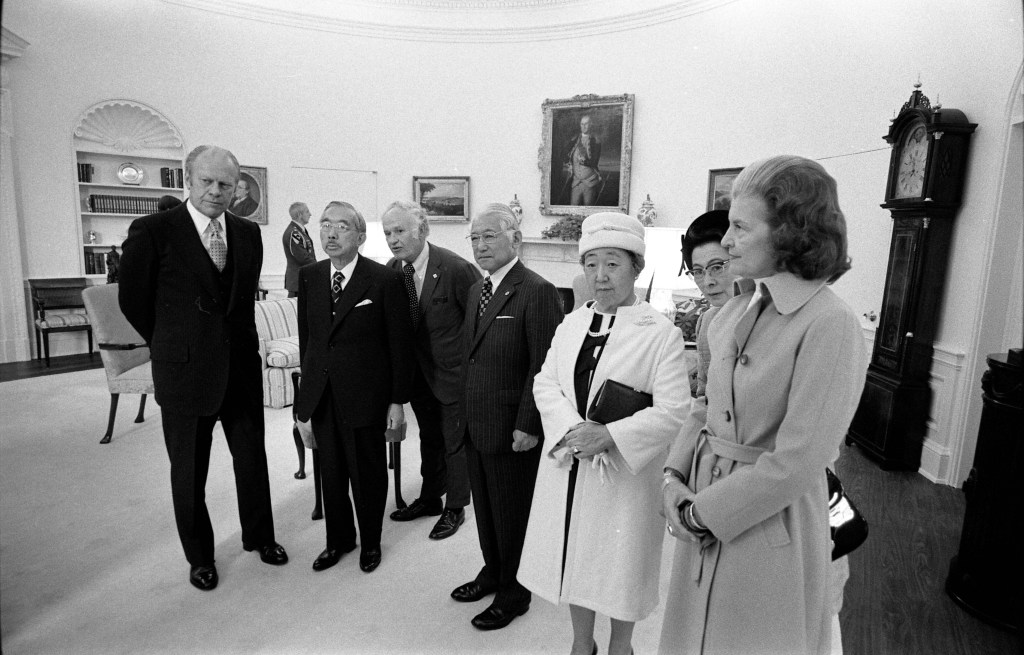
As President Ford welcomed Emperor Hirohito on the South Lawn of the White House, the Japanese leader indicated regret over Japan’s role in World War II and said he hoped his visit to this country would contribute to “everlasting friendship” between the people of their two nations. Replying to President Ford’s greeting as they stood side by side on the crowded South Lawn of the White House, the Emperor said, “Our peoples withstood the challenges of one tragic interlude when the Pacific Ocean, symbol of tranquillity, was instead a rough and stormy sea, and have built today unchanging ties of friendship and goodwill.” Later, in a toast at a state banquet in his honor at the White House, the Emperor expressed himself in even stronger terms. He wished to extend, he said, according to the official Japanese translation, “my gratitude to the people of the United States for the friendly hand of goodwill and assistance their great country accorded us for our postwar reconstruction, immediately following that most unfortunate war, which I deeply deplore.”
A Canadian firm manufacturing a new type of explosive shut down production in the wake of a blast that killed eight men and injured seven. The explosion, at the Canadian Industries Ltd. plant 15 miles east of Montreal, occurred in a building used for the manufacture of cap-sensitive slurries, “one of the new generation of explosives,” a company spokesman said.
Argentina’s interim president, Italo Luder, swore in Manuel Arauz Castex as new foreign minister amid continuing speculation that President Maria Estela Perón might not return from a rest as early as expected. The authoritative newspaper La Opinion said that most military sectors opposed her return to power. There was no formal response to the La Opinion report from the armed forces, which have had serious differences with the 44-year-old Mrs. Perón in the last three months of economic and political turmoil.
Roadblocks were set up on routes out of Addis Ababa following a bomb explosion at dawn that caused heavy damage to the telecommunications building in the center of the city. There were no injuries. A government statement blamed the blast on “criminals who seek to undermine the unity of the Ethiopian people and to plunge the country in chaos.” A government spokesman said no arrests had been made. International telex and telephone services were interrupted for several hours. About 1,000 local telephone lines were damaged.
United States officials boycotted a social function given by President Idi Amin of Uganda today in a gesture of displeasure over some of his remarks at the United Nations General Assembly yesterday. The chief American delegate, Daniel P. Moynihan, expressly endorsed critical comments made by a member of his delegation who sat through the Amin address. The delegate was Clarence M. Mitchell Jr., an official of the National Association of the Advancement of Colored People who is serving as an alternate representative at this Assembly session. Mr. Mitchell characterized the Uganda President’s call for the extinction of Israel as “ridiculous,” and rejected what he said was “unsolicited advice on how black Americans should conduct their affairs.” President Amin said in his assembly message that black Americans in part had to blame themselves for being barred from policy‐making in the United States Government “because there are so many reported divisions in their own community.”
A Senate hearing found evidence that the Central Intelligence Agency and the Federal Bureau of Investigation had used the Internal Revenue Service, apparently illegally, to harass groups they considered politically threatening. For example, it became known that the FBI had obtained a list of contributors from tax returns in a plan to disrupt the fundraising of the Rev. Dr. Martin Luther King Jr.’s Southern Christian Leadership Conference.
Two fragments of what appear to be a memoir manuscript written by William Harris, an activist in the self‐styled Symbionese Liberation Army, were found by agents of the Federal Bureau of Investigation in the apartment where he lived with his wife, Emily, sources familliar with the investigation said today. The fragments reportedly describe the kidnapping of Patricia Hearst and the “Army’s” bank robbery in San Francisco in which she is accused of taking part. The Harrises, together with Miss Hearst, who is alleged to have joined the radical group after her kidnapping, were indicted today in Los. Angeles in connection with events there. Eleven counts each of kidnapping, assault with a deadly weapon, robbery and other charges were included in the indictment, which supplants charges made last year in district attorney’s complaint.
A government spokesman this afternoon said he considered the newspaper Rolling Stone’s account of Miss Hearst’s travels with Jack Scott, the sports radical, to be “essentially correct.” Robert L. Stevenson, assistant director of public information of the Department of Justice, said in response to a question that he could not validate the newpaper’s account, “line by line.” The account said that Miss Hearst asked to be admitted to the Symbionese Liberation Army, that she refused an opportunity extended by Mr. Scott to be taken home to her parents in the summer of 1974, that within seven weeks of her kidnapping she joined the Symbionese group, and that she took part in the bank robbery for which she is charged as a means of proving her devotion to the organization. All these points contradict her affidavit filed in court on September 22 wherein she said she was never a willing follower of the group that kidnapped her.
Twelve New York State counties, including Queens, Westchester and Rockland, were named by President Ford as major disaster assistance areas. Thousands of victims of last week’s torrential rains can recover up to a total of $100 million in grants and loans for the losses they suffered.
Arthur Burns, chairman of the Federal Reserve Board, told the House Budget Committee that “if the (New York City) financial crisis is not resolved it could injure the recovery process that is now under way in our national economy.” Dr. Burns, who declined to elaborate on the statement, has previously made clear that the Federal Reserve would act to insulate the banking system from the shock of a financial default by the city but would take no steps to bail out the city or the state.
Attorney General Edward H. Levi next week will name Charles Ruff, Justice Department career official, to succeed resigning special Watergate prosecutor Henry S. Ruth Jr., a spokesman said. Ruff had worked in the office of the special prosecutor before he was named last July as acting chief inspector in the Drug Enforcement Administration. Sources said it was not clear when Ruff would take over from Ruth, who has announced he intends to quit in mid-October.
T. Sgt. Leonard P. Matlovich, who last month challenged the military ban on homosexuals, has been granted an honorable discharge by his base commander, an Air Force spokesman said. Matlovich said he would keep fighting to stay in the service. Colonel Alton J. Thorgersen, commanding officer of Langley Air Force Base, Virginia, rejected a September 19 recommendation made by a special three-man board that Matlovich, an admitted homosexual, be granted a general discharge. Matlovich, a 12year veteran with an unblemished record, has appealed. “The type of discharge is irrelevant because it is still a discharge for being a homosexual, a fact of my private life which has nothing to do with how I do my job in serving my country,” Matlovich said.
Top federal officials prodded the states to spend more money and manpower and permit more wiretapping in the fight against organized crime. FBI Director Clarence M. Kelley said fewer than half the states have passed laws allowing use of electronic surveillance against gambling, extortion, loan sharking and other crime syndicate operations. Also speaking in Washington to the National Conference on Organized Crime, Richard W. Velde, administrator of the Law Enforcement Assistance Administration, said the nation lost an estimated $50 billion a year to organized crime.
An executive of The Washington Post said this afternoon that, despite the newspaper’s inability for a second day to operate its damaged presses, 550,000 copies of an abbreviated Friday issue were being prepared using the facilities of six nonunion printing plants “outside the Washington area.” Mark J. Meagher, The Post’s executive vice president and general manager, declined at a brief news conference to identify the cooperating printing plants. “This is necessary,” he said, “to protect them from the same kind of sabotage destruction and violence which beset The Post yesterday.” All 72 printing press units of The Post, the nation’s seventh‐largest newspaper, were immobilized Wednesday in what The Post said was a rampage of vandalism by members of Local 6 of the Newspaper and Graphic Communications Union, who were beginning a strike on the expiration of their contract. According to The Post, the strikers did millions of dollars worth of damage to printing, equipment and assaulted and threatened the life of a pressroom foreman who witnessed the sabotage and presumably would be the Government’s Chief witness.
Two prisoners armed with weapons smuggled into a visiting room seized three hostages and bargained for 10 hours for their freedom before a Roman Catholic priest and an inmate counselor persuaded them to release the hostages and surrender. No one was hurt. Warden Tim M. Keohane of the Federal Correction Center for Youths in Englewood, Colorado, said Alfred S. Rollins Jr., 19, and Henry M. Cassidy, 20, were talked into giving up by chaplain Tim Ondahl and counselor Paul Ortiz. Officials said the incident began when Nancy Shoup, 19, Cassidy’s girlfriend, apparently smuggled in two guns.
The W.T. Grant Company, one of the country’s largest retail chains, filed a petition in voluntary bankruptcy, listing debts of more than $1 billion. The petition represented the second largest bankruptcy on record, exceeded only by that of the Penn Central Transportation Company, which listed liabilities of $3.3 billion when it collapsed in June, 1970. The last 359 stores would go out of business at the end of March 1976 as a result of court-ordered liquidation.
Officials close to an inquiry into alleged corruption in the grain export trade said two grain company executives had been partners in a private agency authorized by the Agriculture Department to inspect and grade the company’s grain. The agency, the Delta Weighing and Inspection Bureau, Inc., is one of several under investigation in New Orleans, along with companies whose grain they inspect.
The first Chevrolet Chevette, a two-door hatchback called the Chevette Scooter, went on sale. The first of the 1976 models had rolled off the Detroit assembly line on August 18 as “the first of hundreds of thousands of little three-door autos that are the smallest made in large volume in the United States since the Crosley.” and the car was unveiled on September 16, in Washington, DC. The Chevette had a 1.4 liter engine and got 40 mpg on the highway, but had little room, with a reviewer noting “If the Chevette is the car of the future, luggage space will soon be a thing of the past.”
A Russian moth that apparently entered the United States through Cleveland in 1964 may ultimately threaten wheat, rye, and wild grasses in the Midwest. Donald A. Davis, an entomologist with the Smithsonian Institution, said the moth has been riding the wind eastward but sooner or later will ride a truck or plane into the Midwest or Canada. It has no natural enemies, he said. Its larvae attack and destroy grain stems in the spring. “It more than likely will become a serious pest in some areas after it has become established,” he warned.
Air quality since January in New York City has been the best since measurement began seven years ago, the city’s commissioner of air resources reported. Measurements of five major air pollutants are used to establish categories of good, acceptable, unsatisfactory and unhealthy days. This year’s index for January to September showed 86 good days and 16 unhealthy ones. In the same period of 1974, there were 71 good days and 36 unhealthy ones, the Air Resources Department reported.
A research group reported a severe shortage of firewood in most poor countries of the world, where 90 percent of the people depend on wood as fuel for cooking and heating. A researcher warned that the shortage, imposing hardships on about 1.3 billion people, could lead to “the most profound ecological challenge” of our time.
Dow Jones Industrial Average: 794.55 (+10.39, +1.32%)
Died:
Kumaraswami Kamaraj, 72, Indian political leader, Chief Minister of Tamil Nadu.
Wade Crosby, 70, American actor (“Sign of Wolf”, “Tales of Robin Hood”).
 History Diaries