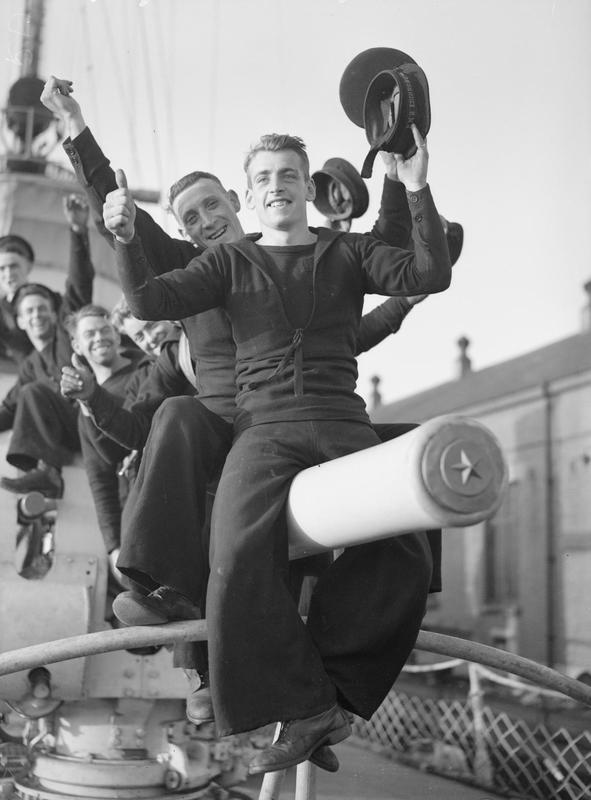
The first of the former U.S. Navy destroyers arrived in Britain.
Sumner Welles, U.S. Under-Secretary of State, in a statement said that the overwhelming majority of the American nation was determined to render all material support and assistance to the people of Britain “successfully defending their homes with a heroism which is worthy of the finest traditions of that proud people”.
All British clocks are adjusted back one hour for Daylight Savings Time.
Nearly half a million mothers and children began evacuating London, England, United Kingdom.
Radio Belgique, a broadcast transmitted from London to Nazi-occupied Belgium, was established. The Germans have been broadcasting all along every evening in the cultured tones of Lord Haw-Haw, so this is a counter-measure to provide the “real” news. Radio Belgique is produced with the support of the Belgian government in exile and forms part of the BBC’s European Service.
Radio Belgique broadcasts in French and Dutch (two separate services), and thus also provides news for people in France who choose to listen. Broadcasts at first are in a single segment from 21:00 to 21:15 each evening with the language switching on alternate days. Later, the broadcasts are expanded to include both languages daily at alternate times, with an expanded slate of both morning and evening timeslots.
Radio Belgique is a continuation of the pre-war BELGA agency and transmits throughout the war. The Germans are a bit slow on the uptake and only ban people from listening to the broadcasts in December, with harsh penalties imposed upon those who do listen. The Germans respond with collaborationist radio stations and attempt to jam the transmissions. It is estimated that more Belgians listen to this BBC station than to the German-run stations. These BBC propaganda broadcasts start small and take time to acquire a loyal following, but eventually accumulate a massive audience. They have a direct influence on the war, being used to transmit codes to resistance groups and provide a way for people who oppose the occupation to link together through this shared interest.
Today’s Daily Mail has an article quoting “a famous neutral air expert” deriding the Luftwaffe’s chances in the Battle of Britain. He makes the following points:
The Luftwaffe’s numerical advantage is not as big as believed;
Many of the Luftwaffe’s bombers are dive-bombers which are not effective in a strategic bombing campaign;
The Luftwaffe’s ability to expand is minimal, while the RAF’s ability to do so is “immense”;
The Luftwaffe has few aircrew reserves;
The Luftwaffe training system is completely inadequate.
The unnamed expert is likely an American with a dog in this fight, and these ideas are stated perhaps a bit bombastically. However, the basic points are all uncannily insightful — in hindsight.
At 1000 hours, over 120 German aircraft crossed the coast of Kent in southern England, United Kingdom in two waves; British fighters intercepted most of them, and only 6 bombers were able to reach London to release their bombs. At 1330 hours, 35 German bombers escorted by 125 fighters attacked targets in Kent; this group was turned back by 1410 hours. At 1415 hours, 60 German aircraft flew toward Portsmouth, southern England from Cherbourg, France; they were intercepted over the English Channel, released their bombs into the water, and returned to base. Although most German missions failed to reach their targets, the kill ratio of the day favored the Germans; 16 British fighters were shot down with 9 pilots killed, while the Germans only lost 6 fighters.
Weather is good on 28 September 1940, but the Luftwaffe is licking its wounds from the 27th. Once again, the Luftwaffe brass fine-tunes its strategy. Large formations of hundreds of bombers have been attracting massive responses from RAF Fighter Command to the Luftwaffe’s detriment because half the German forces are ponderous bombers which make easy targets. Why it has taken the Luftwaffe this long to figure out such basic tactics is a good question, perhaps simply a sign of immense (and wholly unjustified) overconfidence.
Thus, the new Luftwaffe strategy is to launch smaller, more focused formations which will force the RAF to pick and choose among them for attacks. Another tactic is to keep the escorting Bf 109s even higher than usual to retain the height advantage.
At 09:55 hours, British radar stations tracked a force of approximately 120 German aircraft approaching the Kent coast. The formation, composed of around 30 fast Ju 88 bombers escorted by a large number of fighters from JG 26 and JG 54, entered over Deal and divided into two waves. The first wave flew toward Biggin Hill, and approximately six bombers reached as far as Central London, where bombs were dropped in the Poplar, Deptford, and Woolwich districts. The second wave diverted toward Maidstone but did not penetrate further west. A total of 17 RAF squadrons were scrambled by No. 11 Group to intercept. The Luftwaffe fighters, operating from higher altitudes—some over 25,000 feet—had a tactical advantage, diving from above and out of the sun. Interception was made more difficult by slight haze. Nevertheless, skirmishes developed across Kent and into southeast London.
The second raid comes across right on schedule after lunchtime, at about 14:30. It heads for Portland, Beachy Head, Maidstone and nearby areas. RAF Nos. 10 and 11 Groups basically thwart this raid, but at some cost to themselves. Numerous Luftwaffe fighter pilots claim victories in this action, despite the lack of bombing success. No. 11 Group committed all available operational squadrons to intercept, with No. 12 Group dispatching five squadrons to patrol the vital airfields at Hornchurch and North Weald. Despite the coordinated defense, the engagement quickly escalated into widespread dogfights at high altitude. The Luftwaffe suffered several aircraft lost or damaged, but its experienced aces continued to inflict losses on RAF fighters. Major Werner Mölders of Stab/JG 51 claimed his forty-second victory, shooting down a Spitfire over Littlestone. Other successful German pilots included Hauptmann Helmut Wick (Stab I./JG 2, 32nd victory), Oberfeldwebel Werner Machold (9./JG 2, 23rd victory), Hauptmann Walter Oesau (Stab III./JG 51, 31st victory), Leutnant Gustav Sprick (8./JG 26, 20th victory), and Hauptmann Rolf Pingel (Stab I./JG 26, 16th victory). By 14:10 hours, the bulk of the German formations had turned back toward France.
A third attack wave crosses toward Kent about half an hour after the second. It heads from Cherbourg toward Portsmouth and Tangmere. Fighter Command is stretched by this raid, which dilutes the effort against the second wave. Most of the bombers turn back to base after dropping their bombs in the water.
The Luftwaffe mounts a couple of small convoy raids during the remainder of the afternoon, with limited success (described below).
After dark, London, as usual, is the main target. The bombers also attack airfields throughout England, including at Digby, the Midlands, Liverpool, Derby, Nottingham, Peterborough and around Bristol. A Liverpool raid causes heavy damage, with the bombers circling around over Wales to escape. A large force of 120 bombers attacks London shortly after 21:00, and the attacks last until after sunrise. London anti-aircraft fires all night long until the morning sun arrives.
The night’s attacks caused severe disruption across southern and eastern England. London remained the primary target, but several other areas sustained significant damage. At 22:34 hours, RAF Digby was hit by six incendiaries near the married quarters and Sergeants’ Mess, though no serious damage occurred.
Railway infrastructure was extensively damaged. Tracks were blocked or rendered unsafe between Twickenham and Strawberry Hill, Brentford and Chiswick, Mortlake and North Cheam, and elsewhere. A bridge at Acton Lane was damaged, and unexploded bombs closed lines near Guildford, Leatherhead, and Eastbourne. At least four rail lines were reported uprooted.
Factories were also struck. The Orion Works of Messrs W. Ottway & Co. Ltd in Ealing caught fire after an incendiary bomb hit at 00:08 hours. HE bombs fell near the Acton works of S. & G. Brown Ltd at 23:40 hours, causing severe damage to office buildings and the factory roof. At Weybridge, 200 incendiaries and 20 high explosive bombs fell opposite the Vickers Armstrong works, though the factory was not hit directly.
Several hospitals sustained bomb damage, including West Middlesex Hospital in Heston, Staines Emergency Hospital, St. Bernard’s Hospital in Uxbridge, and Barnes Isolation Hospital.
The score for the day is about even at 16 apiece. It is a good day for the Luftwaffe in terms of aerial victories, but the daylight bombing raids are proving more and more problematic. Daylight raids are not favored by everyone due to high losses, but they allow precision bombing of aircraft factories and other select targets that are extremely difficult to achieve at night.
British Losses:
Spitfire X4409, No. 41 Squadron
P/O H.H. Chalder. Died of injuries 10/11/40. Shot down during combat over Charing, Kent. Pilot baled out seriously wounded.
Spitfire X4426, No. 41 Squadron
F/O J.G. Boyle killed. Shot down in combat over Charing, Kent.
Hurricane N2400, No. 238 Squadron
Sgt. R. Little killed. Shot down into the sea by a Bf 110 east of the Isle of Wight.
Hurricane V6776, No. 238 Squadron
Sgt. E.S. Bann killed. Baled out over Brading Marshes, Isle of Wight but was killed when parachute failed to open.
Hurricane V6778, No. 238 Squadron
P/O D.S. Harrison. Listed as missing. Shot down by Bf 109s over the Solent.
Hurricane P3417, No. 501 Squadron
P/O F.C. Harrold killed. Shot down by Bf 109s.
Spitfire L1076, No. 603 Squadron
F/Lt. H.K. MacDonald killed. Shot down by Bf 109s over Gillingham. Pilot baled out too low.
Hurricane V6699, No. 605 Squadron
F/O P.G. Crofts killed. Shot down by Bf 109s over Ticehurst, Sussex. Pilot baled out but fell dead at Redpale Farm, near Dallington.
Hurricane P3108, No. 607 Squadron
F/Lt. W.E. Gore. Listed as missing. Shot down by Bf 109s in an action east of Selsey.
Hurricane R4189, No. 607 Squadron
F/Lt. M.M. Irving. Listed as missing. Shot down by Bf 109s east of Selsey.
Hans-Joachim Marseille shot down his 7th kill, a British Spitfire fighter, over the English Channel. His fighter received damage in the engagement, but he was able to crash land in France.
RAF Bomber Command dispatches 13 Blenheims across the Channel in daylight. 3 aircraft bombed barges at Ostend. No losses.
RAF Bomber Command dispatches 109 Blenheims, Hampdens, Wellingtons and Whitleys overnight to numerous targets in Germany and to the Channel ports. Whitley crews sent to attack the Fokker aircraft factory at Amsterdam could not identify their target and returned without bombing. 2 Wellingtons lost.
The South African Air Force attack Birikau, Italian East Africa (British Somaliland).
U-32, commanded by Oberleutnant zur See Hans Jenisch, badly damaged British steamer Empire Ocelot (5759grt) in 54-37N, 21-30W. Steamer Empire Ocelot sank in 54-55N, 22-06W. At 1609 hours the Empire Ocelot (Master Peter Bonar), dispersed from convoy OB.218, was torpedoed and damaged by gunfire by U-32 southwest of Rockall. The abandoned vessel sank later in 54°55N/22°06W. Two crew members were lost. The master and 31 crew members were picked up by the British destroyer HMS Havelock (H 88) (Capt E.B.K. Stevens DSC) and landed at Liverpool. The 5,759-ton Empire Ocelot was carrying ballast and was headed for Baltimore, Maryland.
Dispersed from Convoy OB.217, the damaged British steam merchant Corrientes was torpedoed and sunk by the U-37, commanded by Kapitänleutnant Victor Oehrn, approximately 600 miles west of Achill Head, Ireland in the northern Atlantic Ocean. At 2000 hours the abandoned Corrientes (damaged two days earlier) was struck underneath the bridge by one torpedo from U-37 and was finally sunk by gunfire at 21.40 hours. The master and 49 crew members were picked up by the Swedish motor merchant Kolsnaren and landed at Philadelphia. The 6,863-ton Corrientes was carrying general cargo and bricks and was headed for Montreal, Canada.
Battleship Bismarck departed Kiel for Gotenhafen and then into the Baltic Sea for her trials.
German destroyers Lody, Galster, Ihn, and Steinbrinck departed Brest escorted by destroyers Eckholdt and Riedel to lay mines in Falmouth Bay. These destroyers, which had been transferred to Brest earlier in September, laid the minefield without interference and returned to Brest on the 29th. Five ships for 2026grt were lost on this minefield. Armed yacht HMS Sappho (387grt, Cdr W. Ireland RNR) and minesweeping trawler HMS Comet (301grt, Second Hand R. G. Smith RNR) were lost on this minefield on the 30th off Falmouth, 50-04-30N, 04-57-30W. Ireland, Temporary Lt R. W. Bristow RNVR, Temporary Lt M. G. Cockshott RNVR, Temporary Lt W. A Pain RNVR, Temporary Lt (E) W. A Gow RNR, and twenty four ratings were lost on the yacht. Fifteen ratings were lost in the Comet. There were two survivors. Dutch tug Lauwerzee (262grt) was towing British cable ship Lady of the Isles (166grt) when both ships were lost on this minefield three miles east of St Anthony Point in 50-10N, 4-24W on 3 October. Twelve crewmen were lost on the tug and sixteen crewmen were lost on the cable ship. British steamer Jersey Queen (910grt) was lost on 6 October, one and a half miles 160° from St Anthony Point. Two crewmen were lost on the British steamer.
On a report of a German heavy cruiser escorting a convoy at 1400, possibly escorted by heavy cruiser Hipper off Norway in 62-00N, 3-30E, sixty miles off Stavanger, battlecruiser HMS Repulse (Flag Rear Admiral Destroyers Home Fleet), heavy cruisers HMS Berwick and HMS Norfolk, and destroyers HMS Matabele, HMS Punjabi, HMS Duncan, HMS Somali, and HMS Eskimo departed Scapa Flow at 2015 to intercept.
Battlecruiser HMS Hood, anti-aircraft cruiser HMS Naiad, and destroyers HMS Zulu, HMS Tartar, and HMS Electra departed Rosyth to intercept the German force.
No contact was made and the operation as cancelled at 0909 on the 29th.
Destroyer HMS Matabele was detached at 1130 to the area of Muckle Flugga on the 29th to transmit a message to heavy cruiser HMS Norfolk which had lost touch. Heavy cruiser Norfolk was ordered to return to Scapa Flow. Destroyer Matabele proceeded to Scapa Flow herself, arriving at 2120.
Battlecruiser HMS Hood with destroyers HMS Zulu, HMS Tartar, and HMS Electra arrived at Scapa Flow at 1920/29th.
Battlecruiser HMS Repulse, heavy cruiser HMS Berwick, and destroyers HMS Somali, HMS Punjabi, HMS Eskimo, and HMS Duncan arrived Scapa Flow at 2320/29th.
Anti-aircraft cruiser HMS Naiad proceeded to Rosyth.
Rear Admiral Destroyers transferred his flag from battlecruiser HMS Repulse to depot ship HMS Maidstone at 0045 on the 30th.
Battlecruiser HMS Repulse and destroyers HMS Duncan, HMS Zulu, and HMS Electra departed Scapa Flow at 0130/30th to return to Rosyth.
Destroyer HMS Duncan was detached to escort convoy OA.222 in Pentland Firth.
Destroyers HMS Zulu and HMS Electra were sent ahead of battlecruiser HMS Repulse at high speed from Gibra Island as an anti-acoustic mine precaution. Battlecruiser Repulse and destroyers Zulu and Electra arrived at 1300/30th.
Rear Admiral Destroyers rehoisted his flag on battlecruiser HMS Repulse at 1800.
Light cruiser HMS Nigeria (10th Cruiser Squadron Flag) arrived at Scapa Flow at 1015 to join the Home Fleet.
Destroyer HMS Vimy departed Scapa Flow and relieved destroyer HMS Versatile escorting troopship Empire Trooper in Pentland Firth at 2359. Destroyer Versatile returned to Invergordon. Destroyer VIMY and the troopship arrived at Liverpool at 1830/30th.
Anti-submarine trawler HMS Recoil (344grt) was lost in mining while on patrol off Portland Bill in the English Channel. Lt I. M. Wilson RNVR, Temporary S/Lt R. Phillips RNR, S/Lt A W. Proctor RCNVR, and twenty two ratings were lost in the trawler. Trawler Recoil was the German trawler Blankenburg captured in April off Norway.
German tanker Shell II (517grt) was sunk by British bombing in the Scheldt.
British steamer Dalveen (5193grt) in convoy HX.73A was sunk by German bombing in 58-10N, 02-19W. Thirty two crewmen were rescued from the British steamer.
British steamer Queen City (4814grt) in convoy HX.73 A was damaged by German bombing in 58-10N, 02-19W.
Anti-aircraft ship HMS Alynbank departed Scapa Flow at 0500 to support this convoy off Buchan Ness. After escorting this convoy, she screened convoy OA.221 from Buchanness before arriving back at Scapa Flow at 1230/29th.
The Mediterranean Fleet departed Alexandria on Malta convoy escort operation MB.5.
Battleships HMS Warspite and HMS Valiant, aircraft carrier HMS Illustrious, cruisers HMS York, HMS Orion, and HMAS Sydney departed Alexandria. The ships joined destroyers HMS Hyperion, HMS Hereward, HMS Hero, HMS Ilex, HMS Imperial, HMS Jervis, HMS Juno, HMS Janus, HMS Nubian, HMS Mohawk, and HMAS Stuart which departed Alexandria late on the 28th to sweep for submarines. Light cruisers HMS Liverpool and HMS Gloucester departed Alexandria on the 29th carrying 1200 troops for Malta. The cruisers joined the Main Force before daylight.
An Italian submarine reported the Mediterranean Fleet off Sidi Barrani escorting the Malta convoy. Italian submarines Scire and Gondar were at sea to launch SLC’s (piloted torpedoes) against the British Fleet at Gibraltar and Alexandria, respectively. They were both ordered to return to Spezia when it was learned both Fleets were at sea.
A Fulmar from aircraft carrier HMS Illustrious was forced landed on the 29th and its crew was picked up by destroyer HMAS Stuart. On 29 September, Australian destroyer Stuart suffered a broken steam main and was ordered to return to Alexandria alone. En route, destroyer Stuart encountered Italian submarine Gondar, which was returning to Spezia with three SLC’s intended for the Mediterranean Fleet. Destroyer Stuart damaged Gondar and summoned destroyer HMS Diamond from Alexandria to assist. Destroyer Stuart and an Alexandria based RAF No. 230 squadron Sunderland aircraft sank Italian submarine Gondar in 31-33N, 28-33E. Forty seven crewmen from Gondar were picked up by Stuart and anti-submarine trawler HMS Sindonis (440grt) which arrived on the scene. Destroyer Diamond arrived as Gondar was sinking.
That evening battleship HMS Warspite was straddled by bombing and three crewmen were wounded.
Two Fulmar aircraft failed to return to the aircraft carrier that evening. Destroyer HMAS Stuart rescued S/Lt I. L. F. Lowe and his naval airman from a Fulmar of 806 Squadron which had been shot down in the area.
Light cruisers HMS Gloucester and HMS Liverpool were detached to Malta at 1450/30th. Heavy cruiser HMS York and destroyer HMS Mohawk were stationed twenty miles 350° and forty miles 340° from the Main Fleet. Destroyer HMAS Voyager departed Malta at 0001 on 1 October and light cruisers Gloucester and Liverpool at 0230 to rejoin the Main Fleet. Destroyer Voyager joined the Main Fleet at 1245. Anti-aircraft ship HMS Calcutta, formerly supporting convoy AN.4, joined at 1545. The destroyers of AN.4, HMS Havock and HMS Hasty, were returning independently to Alexandria. light cruisers Liverpool and Gloucester rejoined at 1745.
Light cruisers HMS Orion and HMAS Sydney were detached at sunset on 1 October to carry out a sweep of the Gulf of Athens, Doro Channel, and towards Tenedos. They were also to conduct a night bombardment of port Maltezana, if possible.
In response to the Mediterranean Fleet being at sea, Italian battleships Littorio, Veneto, Cavour, Cesare, and Duilo, heavy cruisers Pola, Zara, Gorizia, Fiume, Trieste, Trento, and Bolzano, light cruisers Abruzzi, Garibaldi, Eugenio, and Aosta, and twenty three destroyers put to sea from Taranto and Messina. On 1 October, Italian reconnaissance sighted the Mediterranean Fleet returning to Alexandria and returned to port.
Light cruiser HMS Ajax and anti-aircraft ship HMS Coventry departed Port Said for Alexandria, arriving on the 30th.
Submarine HMS Pandora sank Italian steamer Famiglia (813grt) 33-00N, 21-38E north of Ras Aamer. Submarine Pandora was heavily counterattacked in return by Italian torpedo boat Cosenz.
Spanish steamer Monte Moncayo (4291grt) was sunk on a mine eight miles off Cagliari. Four crewmen were lost on the steamer.
Heavy cruiser HMS Cornwall departed Freetown for Manoka at 0600. The heavy cruiser arrived at Manora on 1 October. Heavy cruiser Cornwall departed Manora on 9 October for Pointe Noire. At 0635, light cruiser HMS Delhi departed Freetown to join the MENACE forces still at sea. At 1300, Australian heavy cruiser HMAS Australia arrived at Freetown. At 1400, aircraft carrier HMS Ark Royal arrived at Freetown.
Convoy OL.5 departed Liverpool escorted by destroyers HMS Vanquisher and HMS Arrow from 28 to 30 September. The convoy was dispersed on the 30th.
Convoy OA.221 departed Methil escorted by escort ship HMS Jason and corvette HMS Clematis from 28 September to 3 October. Anti-aircraft ship HMS Alynbank was with the convoy on 28 and 29 September.
Convoy FN.293 departed Southend, escorted by destroyers HMS Vega and HMS Watchman. The convoy arrived at Methil on the 30th.
With 408 combat planes roaring in intricate formations overhead, President Roosevelt declared today that this nation will “strive” with all its energies and skills to remain at peace, but pointed to the growing air power of the United States in an obvious warning to any potential attackers. Speaking only twenty-four hours after the announcement of the military treaty between Germany, Japan and Italy, the President twice reiterated this country’s desire to avoid war in a relatively short address at the cornerstone laying of the Administration Building at the new $12,500,000 Washington National Airport. But he declared that the planes were “symbolic of our determination to build up a defense on sea and on land and in the air that is capable of overcoming any attack against us.” The speech was broadcast nationally and several thousand spectators heard the President’s words directly.
The log-jam which has held the Excess Profits Tax and Amortization Bill in conference for seven days was believed to have been broken tonight when conferees reached an agreement on the controversial tax sections of the measure. A Senate-House committee voted to increase to 24 percent the normal income tax rate on all corporations with net income of more than $25,000 in reaching agreement tonight on the major provisions of an excess profits tax bill. The present rate is 20.9 percent. The committee decided to make no change in the tax on corporations with income of less than $25,000.
U.S. Under-Secretary of State Sumner Welles, who visited the European leaders during Spring 1940, notes in a written statement that the majority of U.S. citizens wanted to support Great Britain against Germany. He notes the “heroism” of “that proud people” in “defending their homes.”
If the Republican Party does not win the November election “this way of life will fall,” Wendell L. Willkie, G.O.P presidential candidate, told 55,000 cheering Republicans here tonight. Willkie asserted “the doctrines of the new deal must lead to the end of freedom,” and pledged himself to build “an effective, an expanding, an impregnable democracy.” Speaking to the New York state Republican convention, the Republican presidential nominee said that there “must be an end”, to doles, debts, and the emergency. He said that “the time has come when the government must cease giving to the people; the time has come for the people to give to the government.”
Henry A. Wallace, Democratic vice-presidential nominee, said tonight the labor record of Wendell L. Willkie and the Republican Party “reflect in a disturbing manner” their ability to pursue a progressive policy. Wallace spoke in Hollywood bowl, where the Republican presidential nominee made a speech 10 days ago, in defense of the new deal labor record which he said had brought a “new hope and new security” to American wage workers.
Major League Baseball:
At Fenway, A’s starter Chubby Dean goes all the way against the Red Sox despite giving up 19 hits. The Sox fatten their averages, winning 16–4. Boston will end the season with 5 wins and start the ‘41 season with another 5 wins, their longest streak over 2 seasons. Boston also wins game two, 8–1, behind Jack Wilson’s three-hitter.
The Yankees split a doubleheader with the Senators, losing the opener, 4–3, and then winning, 7–1, in eight innings behind Atley Donald before the game was called due to darkness. After the game, George Selkirk was diagnosed with appendicitis and flew back to New York.
Behind Ed Smith’s six-hit pitching, the White Sox defeated the Browns again today, 5–1, and assured themselves of finishing in the first division for the fourth time in five years. The triumph, helped by Bob Kennedy’s triple with the bases filled off Jack Kramer in the second inning, assured the Chicagoans of at least a tie with the Red Sox for fourth place.
Mel Harder of the Indians out-duels three Tigers’ pitchers and Cleveland wins, 2–1. Harder scatters seven hits, strikes out five, and walks only one.
The champion Reds punched out their ninety-ninth victory of the year today, a 6–5 job at the expense of the Pirates. For Jim Turner it was triumph No. 14, but he had to take cover at the end of a three-run eighth-inning rally by the Pirates.
The Chicago Cubs, getting ready for their inter-city series with the Chicago White Sox, used three pitchers against the Cardinals today. Larry French was effective, Claude Passeau yielded a run and Bill Lee finally lost in the twelfth inning, 4–3. Meanwhile, Southpaw Max Lanier went the route for the Cardinals and had only one bad inning, the second, when he surrendered all the Cubs’ runs.
The Giants crushed the Bees, 11–1, pounding out 16 hits at the Polo Grounds in New York. Hal Schumacher got the win with relief help from Jephat Lynn. Burgess Whitehead led the Giant offense with four singles.
The Dodgers bowed to the Phillies, 5–1. Ike Pearson (3–14) scattered six hits to handcuff Brooklyn. The Phillies scored two in the first to hang the loss on Ed Head (1–2).
Philadelphia Athletics 4, Boston Red Sox 16
Philadelphia Athletics 1, Boston Red Sox 8
St. Louis Browns 1, Chicago White Sox 5
Pittsburgh Pirates 5, Cincinnati Reds 6
Detroit Tigers 1, Cleveland Indians 2
Boston Bees 1, New York Giants 11
Brooklyn Dodgers 1, Philadelphia Phillies 5
Chicago Cubs 3, St. Louis Cardinals 4
New York Yankees 3, Washington Senators 4
New York Yankees 7, Washington Senators 1
The new move of the RomeBerlin-Tokyo Axis drew varied comment from the press today and sharp rebukes in Latin-American circles when it was suggested Spain might join the Axis and try to influence Latin-American opinion.
A declaration that Japan, Germany and Italy were “ready to display the power of their military alliance in case of necessity” was made tonight by Premier-Prince Fumimaro Konoye in an address to the nation. Japan, he said in a broadcast, is prepared “not only to settle the China incident, but also to participate in the formidable task of creating a new era in the entire world.” The premier added that the treaty had resulted from conflicts between the old and new orders in the world. Germany and Italy, he went on, were leading the attack upon the status quo in Europe as was Japan in Asia, and the alliance thus was the outgrowth of natural cooperation. “It is inevitable,” he continued, “that Japan toward East Asia and Germany and Italy toward Europe assume the leadership in forming these spheres with mutual prosperity. I believe attempts to hinder this inexorable force of nature were responsible for the outbreak of the second European war and the creation of what may be characterized as a state of quasi-war in East Asia.” Since Japan now has formally entered the alliance, he said, “All is now ready.” As to the Chinese-Japanese war, he remarked that Japan had “sacrificed many loyal and courageous officers and men and, moreover, has consumed huge amounts of money and economic resources.”
Thailand (Siam) renewed demands on French Indo-China today and a Siamese military plane machine-gunned native police 40 miles inside the Indo-Chinese frontier at the town of Moughthadeua. Local French officials said the demands were so sweeping that they could not be decided upon by colonial administrators, but had been referred to Vichy. Secrecy was maintained on the nature of the demands. The attack by a Siamese plane indicated that the Thailand authorities may be attempting to speed up a Vichy decision by tactics resembling Japanese methods of applying pressure.
Dow Jones Industrial Average: 132.32 (+0.56)
Born:
Alekandr Ivanchenkov, Soviet cosmonaut (Civilian Specialist Group 5; Soyuz 29/31, 1978; Soyuz T-6, 1982), in Ivanteyevka, Russian SFSR, Soviet Union.
George Greenstein, American baker (“Secrets of a Jewish Baker”) and owner of The Cheesecake King on Long Island, in New York City (d. 2012).
Joe Tom Easley, American lawyer and gay rights activist who advocated against “don’t ask, don’t tell”, in Robstown, Texas (d. 2022).
Died:
Chapman James Clare, 87, British-Australian sailor.
Naval Construction:
The Royal Canadian Navy Flower-class corvette HMCS Lunenburg (K 151) is laid down by George T. Davie & Sons Ltd. (Lauzon, Quebec, Canada).
The U.S. Navy submarine USS Mackerel (SS-204), lead boat of her class of 2, is launched by the Electric Boat Co. (Groton, Connecticut, U.S.A.).
The Royal Navy rescue tug HMS Assurance (W 59), lead ship of her class of 21, is commissioned.
The Royal Navy Bangor-class (Diesel-engined) minesweeper HMS Bridlington (J 65) is commissioned. Her first commanding officer is Lieutenant Charles Wickham Malins, RN.
The Kriegsmarine (German Navy) Type VIIC U-boat U-97 is commissioned. Her first commanding officer is Kapitänleutnant Udo Heilmann.
 History Diaries