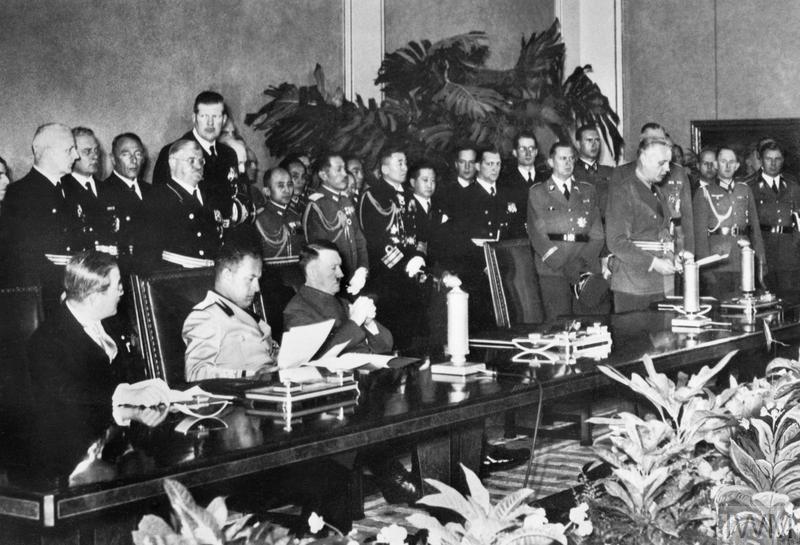
Germany, Italy and Japan signed the Tripartite Pact. The Tripartite Pact was signed in Berlin by representatives of Germany (Chancellor Adolf Hitler), Italy (Foreign Minister Count Galeazzo Ciano), and Japan (Ambassador Kurusu Saburo). In this defensive treaty each nation pledged mutual support in the event of attack by a power not presently involved in the European or Chinese-Japanese conflict. The intent was to keep the United States out of the war and taking a more active position in the Far East.
TEXT OF TRIPARTITE PACT
The Governments of Japan, Germany, and Italy consider it the prerequisite of a lasting peace that every nation in the world shall receive the space to which it is entitled. They have, therefore, decided to stand by and cooperate with one another in their efforts in the regions of Europe and Greater East Asia respectively. In doing this it is their prime purpose to establish and maintain a new order of things, calculated to promote the mutual prosperity and welfare of the peoples concerned. It is, furthermore, the desire of the three Governments to extend cooperation to nations in other spheres of the world that are inclined to direct their efforts along lines similar to their own for the purpose of realizing their ultimate object, world peace. Accordingly, the Governments of Japan, Germany and Italy have agreed as follows:
ARTICLE 1. Japan recognizes and respects the leadership of Germany and Italy in the establishment of a new order in Europe.
ARTICLE 2. Germany and Italy recognize and respect the leadership of Japan in the establishment of a new order in Greater East Asia.
ARTICLE 3. Japan, Germany, and Italy agree to cooperate in their efforts on aforesaid lines. They further undertake to assist one another with all political, economic and military means if one of the Contracting Powers is attacked by a Power at present not involved in the European War or in the Japanese-Chinese conflict.
ARTICLE 4. With a view to implementing the present pact, joint technical commissions, to be appointed by the respective Governments of Japan, Germany and Italy, will meet without delay.
ARTICLE 5. Japan, Germany and Italy affirm that the above agreement affects in no way the political status existing at present between each of the three Contracting Powers and Soviet Russia.
ARTICLE 6. The present pact shall become valid immediately upon signature and shall remain in force ten years from the date on which it becomes effective. In due time, before the expiration of said term, the High Contracting Parties shall, at the request of any one of them, enter into negotiations for its renewal.
At 0900 hours, 80 German bombers escorted by 100 fighters flew over Kent toward London, England, United Kingdom; most of the bombers were turned back near Maidstone and Tonbridge, but some got through and released their bombs over London. At 1120 hours, 25 bombers escorted by 45 Bf 110 fighters were intercepted before they reached their industrial targets in Bristol. Between 1200 and 1230 hours, 300 German aircraft, mostly fighters, conducted a sweep and engaged in dogfights near London; 20 bombers within this group were able to bomb London. By the end of the day, the Germans lost 21 bombers and 34 fighters while the British lost 27 fighters with 13 pilots killed.
Around 08:50 hours, a diversionary sweep by ten Bf 110s from V.(Z)./LG 1 crossed the coast as a feint to draw RAF fighters away from planned bomber formations. One aircraft had aborted at takeoff, leaving ten to proceed. The raid drew a swift response from RAF squadrons including No. 249, which intercepted near the Sussex coast. The German formation was decimated — only three aircraft returned to base. Among the losses was the Gruppe Kommandeur, Hauptmann Horst Liensberger, who was pursued for over forty miles at low altitude by Pilot Officer Burton of No. 249 Squadron, flying Hurricane V6883. After an extended chase, during which Burton’s guns ceased firing — likely due to ammunition exhaustion — the aircraft skimmed over rooftops near Hailsham. Burton manoeuvred above and behind the Bf 110 and made what appeared to be a ramming attack. Both aircraft lurched; debris separated mid-air. The tail unit of the Bf 110 dropped into a field, followed by the fuselage. The falling object was identified as the wingtip of Burton’s Hurricane, which then crashed into a large oak tree on New Barn Farm, killing him instantly. The Hurricane burned out in the field. This engagement cost both pilots their lives and marked the near-destruction of V.(Z)./LG 1, which by the end of the day retained only two veteran crews from its original strength in the French campaign.
At approximately 09:00 hours, a major Luftwaffe raid of around 180 aircraft crossed the Kent coast. The force included elements from Erprobungsgruppe 210, ZG 26, and bombers from KG 76 and KG 77. Escort cover was provided by Bf 109s of JG 3, JG 51, JG 54, and parts of JG 77. The intended targets included airfields and industrial facilities around London and Bristol, though the raid split en route. No. 11 Group scrambled thirteen squadrons to intercept, with engagements erupting over Maidstone, Tonbridge, and Sevenoaks. Despite RAF opposition, parts of the bomber stream reached central and western London.
Among the losses were Hptm. Martin Lutz, Gruppenkommandeur of Erpr.Gr. 210, and Oblt. Wilhelm Roßiger, Staffelkapitän of 2./Erpr.Gr. 210 — both of whom were posthumously awarded the Ritterkreuz. Hurricanes of No. 504 Squadron downed at least two Bf 110s from I./ZG 26 during the running battle.
At 11:20 hours, a separate German formation comprising approximately 25 bombers, escorted by around 45 Bf 110s and Bf 109s, crossed the coast near Swanage and proceeded westward toward Bristol. As the formation advanced inland, the Bf 109s disengaged near Frome, leaving the bombers and Bf 110s without adequate fighter cover. RAF fighters from No. 10 Group were swiftly scrambled in response. Although the Bristol Aeroplane Company’s main works escaped damage, Filton RAF Station was struck by bombs from an altitude of roughly 11,000 feet, resulting in only minor damage to facilities. In the ensuing air battle, a Bf 110 of 3./ZG 26 was intercepted and shot down in flames — likely by either Sgt. H.D.B. Jones of No. 504 Squadron or F/O T.H.T. Forshaw of No. 609 Squadron. The pilot, Leutnant Koepsell, bailed out and was taken prisoner, while his gunner, Unteroffizier Schmidt, was killed when his parachute failed to deploy.
Between 11:47 and 12:15 hours, six major German formations — totalling approximately 300 aircraft — crossed into England between Dover and Lympne at altitudes ranging from 12,000 to 29,000 feet. No. 11 Group responded with twenty squadrons, and heavy fighting soon erupted across Kent and East Sussex. The scale of the attack quickly overextended the Luftwaffe’s fighter escort, leaving many bomber formations exposed. KG 76 and KG 77 suffered particularly heavy losses; in one staffel of KG 77, only nine of eighteen Ju 88s returned to base. One Ju 88 from KG 77 was brought down at Folly Farm, South Holmwood — possibly shot down by P/O Mirosław Feric of No. 303 (Polish) Squadron.
At the same time, over Dorset and the southwest, a diversionary sweep by Bf 109s and Bf 110s aimed to divert RAF fighter strength away from the main attacks in the southeast. Nos. 56, 152, 504, and 609 Squadrons were scrambled in response. P/O Alfred Keith Ogilvie of No. 609 Squadron intercepted and destroyed a Bf 110 near Portland, describing both engines ablaze as the aircraft entered a vertical dive into the sea. Lacking consistent escort cover, many of the bomber formations failed to reach their intended targets and were forced to jettison their bomb loads over open countryside.
Later in the day, a Ju 88 of KGr 606, already damaged by anti-aircraft fire, was intercepted over Kent by fighters from Nos. 66 and 92 Squadrons. With one engine disabled, the bomber was forced to make an emergency landing on Graveney Marsh, near the Sportsman Inn. As troops from the 1st Battalion London Irish Rifles approached to secure the crash site and detain the crew, the Germans opened fire. A brief exchange followed, during which two of the Luftwaffe crew were wounded before the group was overpowered and taken prisoner. The Ju 88, remarkably intact, was later recovered and transported to Farnborough, where it provided valuable intelligence. The encounter — soon dubbed the “Battle of Graveney Marsh” — is often cited as the last armed engagement fought on English soil. Captain John Cantopher of the London Irish was awarded the George Medal for his leadership during the incident.
Between 15:00 and 15:26 hours, nine separate formations — totalling approximately 160 aircraft, roughly half of them bombers — crossed the English coast between Dover and Brighton at an altitude of around 22,000 feet. RAF squadrons, many of which had already been rearmed and refuelled following earlier sorties, were rapidly redeployed to intercept. Although the interceptions were largely successful, approximately twenty bombers penetrated the defensive screen and reached central London, where they released their payloads before turning back.
During the action, several high-scoring Luftwaffe pilots—including Hauptmann Helmut Wick (Stab I./JG 2), Oberleutnant Hans Philipp (4./JG 54), and Oberleutnant Herbert Ihlefeld (1.(J)/LG 2)—claimed multiple victories in the chaotic fighting. Nonetheless, German losses continued to rise at an unsustainable rate. In a candid post-combat assessment, Kommodore Adolf Galland reported to Göring:
“In spite of the heavy losses we are inflicting on the enemy fighters, no decisive decrease in their number or fighting efficiency was noticeable.”
The night of 27/28 September saw heavy bombing of London, Liverpool, Birmingham, Nottingham, and Edinburgh. The first wave began around 19:30 hours, with eighteen raids from Dieppe and Le Havre targeting London, while nine formations from Cherbourg struck the Bristol Channel and Merseyside. Edinburgh was hit by bombers from Denmark following reconnaissance flights along the east coast.
Between 21:00 and 01:00 hours, fifty-five raids were tracked, most converging on London. Others struck Cambridge, Newmarket, Duxford, and Mildenhall. A suspected minelaying operation occurred off North Foreland. Following a lull between 02:15 and 03:15 hours, new raids entered via Hastings and continued until just before dawn.
While bomb damage was lighter than previous nights, fires were reported across London, including at the Thames Ammunition Works. One KGr 606 Dornier intended for Liverpool accidentally dropped its load on Bristol.
The Parnall Aircraft Works in Bristol escaped significant damage, thanks to the successful interception of the midday raid. Filton airfield sustained some structural damage but remained fully operational. In London, renewed bombing caused disruption to transport infrastructure and communication lines. In Birmingham, bombs fell near the Dunlop Rubber Company, resulting in light damage. Nottingham and Liverpool also reported civilian casualties from scattered raids during the day and night.
It is a rough day for the Bf 110 Zerstörer pilots in particular. Gruppenkommandeur Hptm. Horst Liensberger of LG 1 is shot down and killed. Gruppenkommandeur Hptm. Martin Lutz of Epr.Gr 210 is shot down during the morning raid and killed. He and Staffelkapitän of 2 Staffel of Epr.Gr 210 Oblt. Wilhelm Rossiger is awarded the Ritterkreuz posthumously. Oblt. Werner Weymann replaces Lutz.
Friday, 27 September 1940 was one of the most intense and costly days of the Battle of Britain. The Luftwaffe launched a full-scale assault, deploying hundreds of aircraft in coordinated waves — but suffered devastating losses. RAF Fighter Command, though stretched to its limits, maintained air superiority. The destruction of V.(Z)./LG 1, high loss rates among bomber formations, and continued resilience of Fighter Command contributed to growing pessimism in Berlin. The Luftwaffe’s failure to neutralise British air defences marked another turning point. Fighter Command remained bloodied, but unbroken.
British Losses:
Hurricane P3647, No. 1 (RCAF) Squadron
F/O O.J. Peterson killed. Shot down in combat with Ju 88s and Bf 110s over North Kent.
Spitfire X4352, No. 19 Squadron
P/O E. Burgoyne killed. Shot down by Bf 109s in combat over Canterbury.
Spitfire X4032, No. 64 Squadron
Sgt. L.A. Dyke. Listed as missing. Failed to return from a sector patrol. Cause unknown.
Spitfire X4340, No. 72 Squadron
P/O E.E. Males killed. Shot down in combat with Bf 109s over Sevenoaks.
Spitfire N3068, No. 72 Squadron
F/O P.J. Davies-Cooke killed. Shot down by a Bf 109 over Sevenoaks. Pilot baled out but fell dead near Hayes Station.
Spitfire X4422, No. 92 Squadron
F/O J.A. Paterson killed. Shot down in flames by Bf 109s near Maidstone.
Spitfire R6767, No. 92 Squadron
Sgt. C. Sydney killed. Shot down in combat with enemy aircraft.
Spitfire R6622, No. 92 Squadron
Sgt. T.G. Oldfield killed. Aircraft crashed onto Hesketh Park in Dartford.
Hurricane N2401, No. 213 Squadron
F/Lt. L.H. Schwind killed. Shot down in combat with enemy fighters over Gatwick.
Spitfire P9364, No. 222 Squadron
Sgt. E. Scott. Listed as missing. Failed to return from an operational sortie in the afternoon.
Hurricane V6782, No. 229 Squadron
F/Lt. R.F. Rimmer killed. Shot down in combat with Bf 109s. Aircraft exploded over Franchise Manor Farm, Burwash.
Hurricane P2967, No. 242 Squadron
F/O M.G. Homer killed. Shot down in combat with Bf 109s.
Hurricane V6683, No. 249 Squadron
F/O P.R.F. Burton killed. Collided with Bf 110 during combat over Redhill area.
Hurricane P3834, No. 249 Squadron
P/O J.R.B. Meaker killed. Shot down by return fire from a Ju 88. Pilot baled out but fell dead at Warren Field, Brightling Park.
Hurricane L1696, No. 303 Squadron
F/O L.W. Paszkiewicz killed. Shot down in combat with enemy aircraft.
Hurricane V7246, No. 303 Squadron
Sgt. T. Andruszkow killed. Shot down over Horsham.
Hurricane V6645, No. 501 Squadron
P/O E.M. Gunter killed. Shot down while attacking Do 17s. Pilot baled out but was killed when parachute failed to open.
Spitfire N3244, No. 603 Squadron
P/O P.M. Cardell killed. Baled out over Channel but parachute failed to open.
Spitfire X4107, No. 609 Squadron
P/O R.F.G. Miller killed. Collided with a Bf 110 over Chesilbourne, near Kingscombe.
Spitfire R6702, No. 616 Squadron
F/O D.S. Smith. Died of injuries 28/09/40. Shot down by Bf 109s whilst acting as a weaver.
The 1st Battalion London Irish Rifles on 27 September 1940 is busy guarding Kent within their normal duty stations at the Sportsman Inn (pub) in Seasalter when they are informed that a German bomber has crash-landed down the road. It is a Junkers Ju 88 piloted by Uffz. Fritz Ruhlandt, shot down by RAF Nos. 66 and 92 Squadrons. The plane winds up at Graveney Marsh near the seawall and is in good condition.
Luftwaffe plane crews almost never try to escape capture — unlike scenes in some popular movies of the time — but this time is different. Rather than meekly surrender, the bomber crew opens fire with two machine guns and whatever other weapons they have on hand. What the crew thought could be accomplished under the circumstances is unclear — there were no other Wehrmacht ground troops within 20 miles — but they resist nonetheless.
Flabbergasted, the British soldiers deploy along the seawall and advance. The Germans wave a white flag, which the approaching soldiers take to mean surrender, but then the Germans open fire again. An exchange of gunfire takes place which injures one of the plane’s crew — shot in the foot — and the Germans finally decide to surrender.
The 1st Battalion men then celebrate the victory with their captives back at the pub, while the authorities come to take the plane — which turns out to be a recent model with a new bombsight which is of great interest — to Farnborough Airfield. Captain John Cantopher of the 1st Battalion later receives the George Medal for disarming a demolition charge in the plane.
This is believed to be the last military action to date in the British Isles. A commemorative plaque now hangs in the pub.
The Corpo Aereo Italiano (CAI) sends its bombers from San Damanio di Piacenza and Cameri di Novara airfields in Italy to their new bases on the English Channel front in Belgium. Due to inclement weather encountered while crossing the Alps, nine of them must land at German and Austrian airports.
Overnight, London, Liverpool, Edinburgh, Birmingham, and Nottingham were bombed.
Douglas Bader shot down a German Bf 109 aircraft.
James Lacey shot down a German Bf 109 fighter over Britain.
Kommodore Werner Mölders of JG 51, back from his medal ceremony in Berlin and the visit to Reichsmarschall Goering’s estate Carinhall, shoots down a Spitfire from RAF No. 222 Squadron for his 41st victory.
Hans-Joachim Marseille shot down his 6th kill, a British Hurricane fighter, over London, England, United Kingdom. In doing so, he abandoned his duty as wingman to flight leader Staffelkapitän Adolf Buhl, and Buhl would happen to be shot down in combat in this engagement.
RAF Bomber Command dispatches 15 Blenheims during the day. 9 aircraft bombed shipping on Channel coast. No losses.
RAF Bomber Command dispatches 86 Hampdens, Wellingtons and Whitleys overnight to Channel ports, Lorient U-boat base and railway targets in the Ruhr, 1 Wellington lost.
Two large formations of SM 79 bombers, about 9 bombers in all, escorted by at least a dozen CR 42 fighters, bomb Hal Far and Luqa airfields and surrounding vicinities starting around 17:00. Luqa takes the most damage, but operations are not curtailed. The bombs destroy a Hurricane on the ground and damage a Glen Martin. The defending Hurricane fighters scramble and reportedly down a fighter, with anti-aircraft fire damaging two bombers. One Hurricane sustains minor damage in battle.
RAF bombers attack Jarabub, Libya. It contains an important water supply station and is considered one of the most sensitive spots in Libya. Marshal Graziani is very fearful of the interdiction of his supplies at Sidi Barrani.
Italian planes try to raid Haifa but are intercepted and turned back.
The German government requires all Jews in occupied France to carry identity cards that reflect their religion. The Germans require that the Vichy police conduct a census of all Jewish residents.
British newspaper The Daily Herald, on its front page story, reported that six evacuee children from the liner City of Benares, which had been torpedoed by Kapitanleutnant Heinrich Bleichrodt on 17 September 1940, had been rescued from a lifeboat in the mid-Atlantic.
The Blitz has caused tremendous problems for the London rail service, but repairs are made as quickly as possible and lines put back into operation. Today, previously suspended services between Northfield and Hounslow resume at 08:52, and between Turnham Green and Richmond at 14:00. However, a 250kb bomb lands near the Chalk Farm Northern line station directly above a train tunnel, and service is temporarily suspended. When the damage is examined and found to be no present danger, service is resumed. The railway workers are among the unsung heroes of the Battle of Britain.
A record 172,000 Londoners take shelter in the underground tubes.
The Antonescu government in Rumania seizes all Jewish-owned land.
The London Times writes a feature about Malta which calls it a “fortress.” However, local soldiers realize their high degree of vulnerability.
U-31, commanded by Wilfried Prellberg, sank Norwegian steamer Vestvard (4319grt) three hundred miles west of Ireland. At 1113 hours the Vestvard (Master O.N. Bråstad), dispersed the day before from convoy OB.218, was hit on the port side near #3 hatch by one torpedo from U-31 about 300 miles west of Ireland and sank shortly after being struck at #4 hatch by a coup de grâce at 1123 hours. A first torpedo fired at 11.04 hours had passed underneath the ship. Between the two hits the crew had abandoned ship in two lifeboats, but one of them was hit and destroyed by debris from the second explosion. The seven occupants were later picked up by the other boat along with other men that were forced to jump overboard from the heavily listing ship but one crew member drowned in the suction of the sinking ship. On 1 October, the survivors made landfall near Slane Head Light, from where four men were admitted to a hospital in Galway. The 4,319 ton Vestvard was carrying ballast and was headed for Montreal, Canada.
U-37, commanded by Kapitänleutnant Victor Oehrn, sank Egyptian steamer Georges Mabro (2555grt) in 52-00N, 19-00W. At 2259 hours the unescorted Georges Mabro was hit underneath the bridge by one torpedo from U-37, broke in two and sank within 30 seconds. There were no survivors. The 2,555 ton Georges Mabro was headed for Glasgow, Scotland.
Light cruiser HMS Kenya was completed. Light cruiser Kenya arrived at Scapa Flow on the 29th for working up and assignment with the 10th Cruiser Squadron. Light cruiser Kenya was sent to Freetown for working up and departed Freetown on 27 October for Plymouth arriving on 5 November.
Anti-aircraft cruiser HMS Phoebe was completed. Light cruiser Phoebe departed the Clyde on 2 October to work up at Scapa Flow. She arrived at Scapa Flow on 4 October. She worked up at Scapa Flow and was assigned to the 15th Cruiser Squadron.
Anti-aircraft cruiser HMS Cairo departed Scapa Flow at 1600 to meet convoy WN.18 and escort the convoy through to Methil. Anti-aircraft cruiser Cairo then corrected defects at Rosyth.
Destroyer HMS Sikh was damaged by British tug Flamer, alongside at Rosyth. Destroyer Sikh’s temporary repairs were completed at 1200/29th.
Destroyer HMS Versatile departed Rosyth for the Tyne. At the Tyne, destroyer Versatile met troopship Empire Trooper and escorted her to Pentland Firth.
Submarine HMS Triumph, her repairs from the December mining completed, worked up in Holy Loch. Submarine Triumph departed Holy Loch on 6 November for the Mediterranean. The submarine arrived at Gibraltar on 16 November.
Minesweeper HMS Halcyon was mined in the mouth of the Tees in the North Sea and badly damaged. Temporary Lt J. D. Worthington DSC RNVR, Paymaster Lt W. A Kibble RNR, and several ratings were wounded. The minesweeper was repaired at Southbank, completed on 30 June 1941.
Norwegian steamer Diana (1155grt) was sunk on a mine between Lizard and Fowey.
Five hundred miles west of Saint-Nazaire, France, German U-boat U-46 dove suddenly due to mechanical failure, killing Oberbootsmaat Heinrich Schenk and Matrosenobergefreiter Wilhelm Reh; control was regained, and the commanding officer aborted the mission to return to Saint-Nazaire for repairs.
At 0530, light cruiser HMS Dragon with transports Kenya, Karanja, Sobieski, and Ettrick arrived at Freetown. At 0615, destroyer HMS Escapade arrived at Freetown. She sailed again at 1020 to rejoin the ships at sea. At 0900, transports Pennland and Westernland, escorted by sloops Savorgnan De Brazza, Commandant Domine, and Commandant Duboc arrived at Freetown. At 1430, light cruiser HMS Delhi arrived at Freetown. At 1700, heavy cruisers HMS Cornwall and HMS Cumberland arrived at Freetown. At 1815, French armed trawler President Houdace escorting Ocean Coast, Casamance, Anadyr, Nevada, and Fort Lamy arrived at Freetown.
Convoy OB.220 departed Liverpool escorted by destroyer HMS Skate, sloop HMS Wellington, corvette HMS Gladiolus, and anti-submarine trawlers HMS Lady Lillian and HMS Northern Gem. All but Wellington was detached on the 30th and the sloop was detached on 1 October.
Convoy FN.292 departed Southend, escorted by destroyers HMS Vanity and HMS Wolfhound. The convoy arrived at Methil on the 29th.
Convoy FS.293 departed Methil, escorted by destroyer HMS Winchester and sloop HMS Londonderry. The convoy arrived at Southend on the 29th.
Convoy SC.6 departed Sydney escorted by Canadian armed yacht HMCS Elk and ocean escort sloop HMS Enchantress. On 9 October, destroyers HMS Skate, HMS Vanquisher, and HMS Winchelsea, sloop HMS Hastings, and anti-submarine yacht HMS Philante joined the convoy. On 11 October, destroyer Winchelsea was detached. The remainder of the escort arrived with the convoy at Liverpool on 12 October.
Convoy SL.49 departed Freetown escorted by armed merchant cruiser HMS Moreton Bay to 14 October. On 12 October, convoy SL.49 rendezvoused with convoy SLS.49. On 13 October, destroyer HMS Antelope and sloop HMS Aberdeen joined the convoy. Corvette HMS Gloxinia and anti-submarine trawler HMS Northern Gem also escorted the convoy in Home Waters. The convoy arrived on 17 October.
Today in Washington the President undertook the direction of broad studies of the effect of the Berlin-Rome-Tokyo alliance. He devoted the regular Friday Cabinet meeting to a discussion of foreign affairs, conferred with his principal defense advisers, received an American delegation which urged all possible aid to Great Britain and talked with Lord Lothian, the British Ambassador.
The Senate ratified the Treaty of Havana, considered the consent calendar, heard Senator Norris attack Wendell L. Willkie and Senator Tobey charge that election registration books in New Jersey had been destroyed and recessed at 5:12 PM until noon Monday. The Military Affairs Committee reported favorably a bill authorizing the organization of Home Guard units.
The House was in recess. The Smith special committee heard further charges against the NLRB.
House and Senate conferees continued studying the excess profits tax bill.
U.S. Secretary of State Cordell Hull made the following statement regarding the Tripartite Pact: “The reported agreement of alliance does not, in the view of the Government of the United States, substantially alter a situation which has existed for several years. Announcement of the alliance merely makes clear to all a relationship which has long existed in effect and to which this Government has repeatedly called attention. That such an agreement has been in process of conclusion has been well known for some time, and that fact has been fully taken into account by the Government of the United States in the determining of this country’s policies.”
The Washington government made it more than plain today that it intends to follow its present foreign policies including that of assistance to Great Britain regardless of the thinly disguised warning to this country contained in the new German — Italian — Japanese military alliance. At almost exactly the same time as Hull’s statement, President Roosevelt was engaged in activities which scarcely could have escaped the attention of Berlin, Rome, and Tokyo. In quick succession he received Lord Lothian, the British ambassador, and a party of his colleagues; a group of Americans urging all possible help to England, and then entered upon a conference with officials in charge of the American defense program.
Strong moves were in progress in Washington yesterday to extend the embargo on scrap iron and steel exports to pig iron, raw steel and copper. In addition, efforts were made to have the October 16 deadline on scrap exports under existing licenses become effective immediately.
A meeting took place in the White House with A. Philip Randolph, Walter White (the head of the NAACP,) and T. Arnold Hill (an administrator for the Urban League) present. Speaking of the many injustices in the hiring practices of the burgeoning defense industry, these leaders specifically mentioned blacks being excluded from almost all skilled trade unions that limited their access to high-paying jobs. They talked with U.S. President Franklin D. Roosevelt about the discriminatory practices in the fighting forces. The president answered this complaint by telling the black leaders that progress was being made, since blacks were going to be put into combat services proportionately, and he added, “Which is something.” U.S. Secretary of the Navy William “Frank” Knox, present at the meeting, was asked about integrating the navy, and he responded that it would be almost impossible. “We have a factor in the Navy that is not so in the Army, and that is that these men live aboard ship. And in our history we don’t take Negroes into a ship’s company.”
Ambassador Joseph Kennedy, always pessimistic to date about England’s chances in the war, sends a message to that effect back to Washington.
A group of Americans who organized themselves into a “flying squadron” to urge President Roosevelt to rush every form of possible aid to Great Britain left the White House after a call today “enthusiastically encouraged” by the President’s attitude.
The Senate Military Affairs Committee approved today a bill to permit the States to organize home guard units to take the place of the National Guard organizations inducted into Federal service. It will be reported Monday.
A substantial majority of voters throughout the country believe that Franklin D. Roosevelt will be reelected President in November, according to a survey of the American Institute of Public Opinion, reported yesterday by Dr. George Gallup the director.
Wendell L. Willkie ended his 6,000-mile Western trip tonight with a speech in the Field House of the University of Wisconsin to about 15,000 persons. He was introduced by Dean Christian Christiansen of the College of Agriculture. Mr. Willkie criticized the President for trying to enlarge the Supreme Court on the ground that some of its members were too old. “And yet,” he continued, “the President recently appointed to a most important position, Secretary of War, a man older than the age he fixed as too old to render proper Judicial decisions.” The candidate also recalled that President Roosevelt had tried to “purge” members of Congress of his own party who did not agree with him, offering another instance in which the executive tried to infringe upon the powers of the other two departments of the federal government.
Henry Wallace, Democratic vice-presidential candidate, said today it was vital that, the United States cultivate the friendship of Latin America in order to promote solidarity and to preserve the last stronghold of democracy in the world. Here and at Albuquerque, N. M., where he addressed a convention of New Mexico Democrats, President Roosevelt’s third-term running-mate described New Mexico as “the bridge between the United States and Latin America” and urged a common understanding between the two languages.
Powerful dive-bombers described as “superior in performance to types playing such tremendous roles in Europe’s war” are now being delivered in quantities to the United States Navy, Douglas Aircraft Co. announced tonight. The Douglas Company said the bombers, designed as SBD type, are coming off production lines under the navy contracts. The SBD carries a crew of two and is capable of speed believed to be in excess of 300 miles an hour. “In recent acceptance tests, in California and in the east,” the Douglas concern said, “the dive-bombers are known to have established records considerably in excess of the figures generally attributed to the German Junkers “Stuka” bombers, as well as to planes of the general characteristics in the service of the British.” Douglas said additional quantities of dive-bombers are expected to be ordered by both the navy and the army.
The musical film “Strike Up the Band,” starring Mickey Rooney and Judy Garland, was released.
Major League Baseball:
The Detroit Tigers clinched the American League pennant with a 2–0 win over the Cleveland Indians. Besides Bobo Newsom (21–5), Schoolboy Rowe (16–3), and Tommy Bridges (12–9), the Tigers pitching staff combines for a losing record. Needing one victory to gain the title, manager Del Baker decides to withhold Newsom and Rowe and picks 30–year-old rookie Floyd Giebell. Giebell shuts out the Indians 2–0 to beat Bob Feller, who gives up just 3 hits, including a wind-blown two-run homer by Rudy York down the left field line. The ball would likely have been caught at League Park. Not eligible for the World Series, Giebell never wins another game in the majors. During the game, unruly Cleveland fans shower the field with fruit and vegetables delaying the game. Greenberg is hit by a tomato while in the field. At one point, a basket of green tomatoes is dropped onto Tigers catcher Birdie Tebbetts’ head while he sits in the bullpen, knocking him out for a few moments. When Birdie recovers, he finds the unruly fan, now in the hands of the police, and punches him.
The Red Sox pound the Senators, 24–4, at Fenway, scoring 10 runs in the 4th and 7 runs in the 8th. Boston bangs out 22 hits to make Fritz Ostermueller the winner. Dom DiMaggio scores 5 runs and Ted Williams drives in 4 as all 12 Sox batters collect a hit. Much of the damage comes against Joe Kraukaukas, who gives up 12 earned runs in 5 innings.
In New York, the Yankees, winners of 8 straight games, lose to the A’s Johnny Babich, 6–2. Babich is a former Yankee minor leaguer; he has won 14 this season for the A’s. New York is out of the World Series for the first time since 1935. Yankee catcher Arndt Jorgens, on the club’s active roster both last year and this, ends the season without an appearance, certainly a Major League record. Last season he scored a run as a pinch runner, but had no at bats.
A single by Luke Appling scored Joe Kuhel in the tenth inning to give the White Sox a 4–3 victory over the Browns today in the first game of the season’s final series. Bill Dietricht won his tenth game of the season.
In Pittsburgh’s 4–3 win at Cincinnati, Lonny Frey, Reds infielder, breaks his right foot in the dugout when the heavy metal cover of a water cooler falls and lands on it. Frey will be limited to two at bats in the world series. Arky Vaughn had two doubles including the one that drove in the winning run.
Hugh Mulcahy ends the last-place Phillies twelve-game losing streak and his personal 12–game loss streak with a 6–0 whitewash of the Giants. Despite the win, Mulcahy, a member of the 1940 All-Star team, still leads the National League in losses with 22. Carl Hubbell takes the loss for the Giants to finish the year at 11–12. It is the first time he has finished under .500.
The Cubs lost their last chance to finish fourth and share in the world series money by bowing meekly today to the Cardinals, 11 to 1, while Pittsburgh beat the Reds. Lon Warnecke held the Cubs to two hits. Johnny Mize hit his 43rd homer of the year for St. Louis.
Washington Senators 4, Boston Red Sox 24
St. Louis Browns 3, Chicago White Sox 4
Pittsburgh Pirates 4, Cincinnati Reds 3
Detroit Tigers 2, Cleveland Indians 0
Philadelphia Phillies 6, New York Giants 0
New York Yankees 2, Philadelphia Athletics 6
Chicago Cubs 1, St. Louis Cardinals 11
The United States Senate formally ratifies the Havana Convention (“Provisional Administration of European Colonies and Possessions in the Americas”) of 30 July 1940. However, the pact only takes effect upon ratification by two-thirds of the signatories, and that has not happened as of this date (and a handful never do). The Convention permits the signing parties to take control over European colonies whose mother states have been extinguished. In practice, the pact prevents Germany from taking over the colonies in the Americas of the countries that it conquers, such as France and Holland.
Japan cast her lot squarely with the Rome-Berlin axis today, but hastened to tell the world in general and the United States and Great Britain in particular that it did not mean she is going to enter the European war or pick a fight with anybody. Rather, Emperor Hirohito and Foreign Minister Yosuke Matsuoka insisted, it emphasized above all Japan’s determination to carry to completion her self-proclaimed mission of establishing a “greater East Asia” by peaceable means. “But there is no telling whether there might not arise occasions and circumstances calling for momentous decisions on Japan’s part,” Matsuoka told the nation in a broadcast. An imperial rescript, issued under the seal of the emperor, declared that in lining up with Germany and Italy, Japan was motivated by the “fervent hope that termination of disturbances and restoration of peace will be realized as swiftly as possible.” Echoing the words of the emperor and the foreign minister, Foreign Office Spokesman Yakichiro Suma declared: “We are not going to participate in the European war. We are not going to attack any country.” Suma asserted Japan had not abandoned hope of composing her differences with the United States, which preceded the signing of the new three-power pact by a day with an embargo on scrap iron, one of Japan’s most needed sinews of war. Announcement of the pact failed to stir nationwide excitement. Newspapers went on the streets with extras but the Japanese public read them in silence. The press did not share the peaceful views officially proclaimed. It declared the United States now has definitely allied herself with Britain and China and one newspaper, the influential Asahi, asserted a Japanese-American clash “now seems inevitable.”
The advance of Japanese forces into this French colony continued today, despite reported orders from Tokyo, as local authorities asked the Japanese government to send a plenipotentiary to halt the movement. Japanese troops who landed yesterday at Haiphong, port of Hanoi, today occupied the Doson shore batteries protecting the port after detaining two French officers and disarming their Annamite (native) soldiers.
Emperor Hirohito orders the cessation of all Japanese offensive actions in French Indochina, as the objectives have been achieved. The Japanese presence in the south, around Saigon, and in the Mekong Delta, remains sparse.
There are more problems for the French than the Japanese, however. The Japanese previously called for local communists to rise up against the French. These nationalistic uprisings accelerate in the mountains west of Lang Son, a city now occupied by the Japanese.
Developments both military and diplomatic of the last few days have brought the Philippines to reluctant acceptance of the possibility of a United States-Japanese war before their independence is attained in 1946, perhaps long before.
The forces driving Japan forward have finally decided to take all risks in pursuit of their Greater East Asia policy, formally allying Tokyo with Berlin and Rome. They gamble on Germany winning the war before the United States is ready. Any power not presently involved in the European War is menaced by their joint action if it attacks any of the contracting parties. Though no country is specified, the pact is an unmistakable warning to the United States. The point of the document lies in Article III, which in the Foreign Office translation reads: “Japan, Germany and Italy undertake to assist one another with all political, economic, and military means when one of the three contracting parties is attacked by a power not presently involved in the European War or the Sino-Japanese conflict.” Yakichiro Suma, Foreign office spokesman, declined to say whether United States assistance to Britain “short of war” would constitute an “attack” in the terms of the treaty.
Dow Jones Industrial Average: 131.76 (-1.74)
Born:
Mishal Al-Ahmad Al-Jaber Al-Sabah, Crown Prince of Kuwait, in Sheikhdom of Kuwait.
Benoni Beheyt, Belgian road cyclist (UCI World Championship gold Road Race 1963), in Zwijnaarde, Belgium.
Josephine Barstow, British opera soprano singer, in Sheffield, South Yorkshire, England, United Kingdom.
Femi Robinson, actor, in Abeokuta, Nigeria (d. 2015).
Died:
Julián Besteiro, 70, Spanish politician; Julius Wagner-Jauregg, 83, Austrian physician and Nobel laureate.
Naval Construction:
The Royal Navy “U”-class (Second Group) submarine HMS Unique (N 95) is commissioned. Her first commander is Lieutenant Anthony Foster Collett, RN.
The Royal Navy Fiji-class (Crown Colony-class) light cruiser HMS Kenya (14) is commissioned. Her first commander is Captain Michael Maynard Denny, RN.
 History Diaries