General Charles de Gaulle, leader of the “free French” forces, tonight accepted responsibility for abandonment of the siege of Dakar while members of parliament demanded punishment of those responsible for the “fiasco.” De Gaulle, in a statement from his headquarters, promised that despite the abortive assault his forces will continue their efforts to win France’s overseas possessions over to Britain’s side.
Vincent Auriol, Solomon Grumbach, Jules Moch and Marx Dormoy make up the latest list of politicians to be “administratively interned” by order of the Petain government. All belong to the Popular Front.
Erich Raeder met with Adolf Hitler, noting that the Italian territories in the Mediterranean Sea was in danger of being attacked by the British as he deduced from the importance the British had placed on the region historically. To prevent this, he recommended Hitler to make plans to seize Gibraltar, the Canary Islands, and the Suez Canal.
The British lodge a diplomatic protest at the Finnish government’s decision to grant the Wehrmacht transit rights.
Henry Willink, the Conservative Member of Parliament for Croydon, becomes Special Commissioner for the Homeless. Willink is to organize aid services for people made homeless through enemy air raids.
At Malta, Governor Dobbie continues to complain to the War Office about the lack of regular mail service. Otherwise, it is a quiet day on the island.
In the late evening, the German ambassador in the Soviet Union shared the news that Japan was about to join Germany and Italy in a military alliance. The Soviet Union immediately complained that, according to the Molotov-Ribbentrop Pact, the text of such an alliance should have been shared with the USSR prior to the pact being signed, including any secret clauses.
In one of the key meetings of the pre-war (for the Pacific) period, the Japanese Privy Council discusses the proposed alliance with Italy and Germany, The agreement is still not a done deal despite German Foreign Minister Ribbentrop’s assumption in Berlin that it is. The meeting, which includes the military and pretty much everyone else of influence, is told that the Emperor will issue an Imperial Rescript which endorses the pact, but also notes:
We earnestly wish that war be ended and peace be restored as quickly as possible.
This settles the matter of signing the treaty, but two issues remain under discussion:
- The American reaction;
- How this will affect Japanese oil supplies.
The two questions, of course, are interrelated. The Navy Minister, Oikawa, says that the military is sufficient in the short run to defeat the Americans, but must be upgraded in the long run. However, others point out that conflict with the United States might not be military, but rather economic in nature, as the US has been quick to impose harsh economic sanctions. Minister of War Tojo notes that oil supplies would be insufficient for a long war, but there was plenty of oil to the south ripe for the taking. Nothing firm is expressed on this point, but the implication is obvious.
The meeting reaches a somewhat convoluted conclusion: an alliance with Germany and Japan would prevent a war with the United States by demonstrating Japan’s resolve. Ambassador Kurusu in Berlin is instructed to sign the pact, which he does the next day, but Italian Foreign Minister Ciano notes that nobody in Berlin is very excited about the event. The same holds true in Tokyo.
It is important to recognize that the pact (which forms what comes to be known as the Axis, as opposed to the previous “Pact of Steel” between Germany and Italy) obligates the contracting parties to “assist one another with all political, economic and military means when one of the three Contracting Parties is attacked.” It does not obligate anything when one of the Contracting Parties attacks someone else. The Japanese demonstrate that they fully understand this key distinction by their inaction on 22 June 1941, the Germans – or at least Adolf Hitler – not so much about six months later.
At 1630 hours, 100 German aircraft attacked Southampton in England, United Kingdom, causing damage to the factory at Woolston producing Spitfire fighters. RAF fighters claimed 16 bombers and 16 fighters shot down, which was likely over-estimated, while losing 10 fighters and 3 pilots.
The Spitfire factory at Filton remains out of operation due to the big raids on the 25th. This is as much due to all the skilled workers last as from the damage to the facility itself. The government has recognized the danger to the large factories and begun to disperse valuable machine tools to other areas.
The renewed Luftwaffe priority on British aircraft factories continues today. Around 09:00, the Luftwaffe sends over a large formation of about 180 planes from the Calais area. Fighter Command mobilizes No. 11 and 12 Groups, and they blunt the attack. However, some bombers do get through to central and western London.
Around noontime, the Luftwaffe sends over an even bigger raid. This time, about 300 planes head toward the Chatham area. Fighter Command makes another maximum effort, sending up 20 squadrons. Another, smaller raid around the same time targets the Filton area again. RAF Filton takes the damage this time, with damage to the Operations Room but no serious problems caused.
King George visits RAF Northolt in the afternoon, and while he is there RAF No. 1 (Canadian) and 303 (Polish) Squadrons are scrambled. They head to intercept a raid approaching over the Isle of Wight region. This time, there are about 60 aircraft heading to the Southampton Supermarine Works. This attack is tremendously destructive, with three Spitfires destroyed on the production line. The Luftwaffe bombing is inaccurate, but that works to its benefit as some bombs strike the nearby Dawks gas works and docks. Over 100 people are killed in this attack and many more are wounded. Fighter Command mounts a moderate response, and much of the action involves anti-aircraft guns trying to bring down raiders. The bombers take moderate losses, losing a few over the area and having a couple of Heinkel He 11s barely make it back to base.
Overnight, London, England was bombed for the 26th consecutive night, while Liverpool and other towns and cities were also attacked. After dark, the usual raids begin against London, Liverpool, and other cities. The Luftwaffe also targets RAF Mildenhall and Duxford. The raids continue intermittently all night. They damage railway infrastructure throughout the London area, and a couple of bombs barely miss the Houses of Parliament. The underground Cabinet War Room is rattled when a bomb falls nearby. In Liverpool, incendiaries set fires in the dockyard areas.
The score for the day is even, with both sides losing about nine planes. The RAF engages in some wild overclaiming of the sort last seen in August by a factor of over 10, which of course the media picks up to trumpet British successes. It, in fact, is a very successful day for the Luftwaffe, though their actual bombing achievements are localized and not as significant as they might appear at first glance. However, a lot of civilian lives are lost today despite the low aircraft losses on both sides, and there is nothing insignificant about that.
British Losses:
Spitfire K9882, No. 152 Squadron
Sgt. J.M. Christie killed. Shot down by Bf 109s in combat over the Channel off Swanage.
Hurricane P3098, No. 238 Squadron
Sgt. V. Horsky killed. Shot down in combat with Bf 110s over the Solent.
Hurricane V7470, No. 253 Squadron
P/O W.M.C. Samolinski killed. Failed to return from combat over the Channel.
Hptm. Helmut Wick of Stab I./JG 2 notches his 30th victory claim. Numerous Luftwaffe pilots claim double victories, so there appears to be some overclaiming on that side, too. It is common on all sides in all wars.
RAF Bomber Command dispatches 12 Blenheims during the day. 3 aircraft bombed ports; 1 aircraft lost
RAF Bomber Command dispatches 77 Blenheims, Hampdens, Wellingtons and Whitleys overnight to Channel ports, Dortmund and Kiel, 1 Blenheim and 1 Hampden lost. Bomber Command raids the Channel ports as the Germans gradually disperse their invasion barges. Other targets include Kiel and airfields in northwest Europe. The RAF mounts a “special mission” by twelve Hampdens of No. 61 Squadron primarily against German battlecruiser Scharnhorst in Kiel Harbor, but no hits are achieved and one bomber is lost.
54 Vichy French bombers raided Gibraltar.
The RAF sends two different strikes against Italian forces at Sallum along the border. It is a potential choke point for Italian communications back to Fort Capuzzo and Tobruk, and Marshal Graziani is preoccupied with his supply lines.
Now that more U-boats are operating out of Norway and France, they are able to stalk convoys further out in the Atlantic. This area is not covered by air patrols at this stage of the war and escorts remain relatively rare. Attacking hundreds of miles out to sea is paying such handsome dividends that this period becomes known as the (first) “Happy Time” for U-boats.
For the crews of the convoys, though, every voyage is a lottery with death, as some ships get sunk with everyone surviving, and others with everyone perishing. It is not uncommon for merchant marine sailors to try to join the Royal Navy because sailing on freighters is so risky, while naval ships have better protection and aren’t such easy targets.
There are several large convoys at sea, and they take a beating today.
U-32, commanded by Oberleutnant zur See Hans Jenisch, torpedoed and badly damaged British steamer Corrientes (6863grt) from dispersed convoy OB.217 in 53-49N, 24-19W. At 0234 hours the unescorted Corrientes (Master Thomas Halliday Young Stewart), dispersed from convoy OB.217, was hit in the engine room by one torpedo from U-32 (Jenisch) about 600 miles west of Achill Head, Co. Mayo. The U-boat had chased the ship for six hours and left the vessel in a sinking condition after the crew abandoned ship, but she remained afloat. On 28 September, U-37 sank steamer Corrientes. The entire crew of the British steamer was rescued.
U-32 then sank Norwegian steamer Tancred (6094grt) from the dispersed convoy OB.217 in 53-32N, 24-35W. At 0811 hours the Tancred (Master Einar Hansen), dispersed the day before from convoy OB.217, was hit on the port side by one torpedo from U-32 about 600 miles west-northwest of Valencia, Ireland. The torpedo struck in the middle of #2 hatch and caused the ship to settle by the bow due to the flooding of the forward holds. No distress signals could be sent and within eight minutes the 36 crew members (the ship was armed with one 4in and a Lewis MG) abandoned ship in three lifeboats. The U-boat began shelling the ship with 48 rounds from the deck gun, scoring many hits and then left the area before the ship sank to chase another ship of the dispersed convoy. The vessel remained afloat and was re-boarded by the master and a few men to recover extra provisions, the ship´s log book and other valuable papers from a safe in the cabin of the master, but found no access to the cabin due to the damage. The lifeboats remained near the ship until it sank and then sailed eastward. All survivors were picked up the next morning by the Norwegian motor merchant Tricolor in 53°52N/23°07W and landed in New York about a week later. The 6,094-ton Tancred was carrying ballast and was headed for New York, New York.
U-32 later sank British steamer Darcoila (4084grt) from dispersed convoy OB.217 west of Ireland. At 1337 hours the unescorted Darcoila (Master William Anderson), dispersed the day before from convoy OB.217, was hit on port side amidships by one G7e torpedo fired from the stern torpedo tube of U-32 about 600 miles west of Ireland. The ship sank within 5 minutes by the stern after a boiler explosion. The master, 35 crew members and one gunner were lost. The 4,084-ton Darcoila was carrying ballast and was headed for Philadelphia, Pennsylvania.
U-46, commanded by Oberleutnant zur See Engelbert Endrass, sank British steamer Coast Wings (862grt) which was a straggler from convoy OG.43 in the North Atlantic, southwest of Ireland. At 0153 hours the Coast Wings (Master Evan Phelps Davies), a straggler from convoy OG.43, was hit in the bow by one torpedo from U-46 southwest of Ireland. The ship disintegrated and debris fell down near the U-boat. The 862-ton Coast Wings was carrying general cargo and was headed for Lisbon, Portugal.
U-46 later sank Norwegian steamer Siljan (3058grt) three hundred fifty miles southwest of Ireland. At 2120 hours the Siljan was hit in the bow by one torpedo from U-46 about 350 miles southwest of Ireland. The ship developed a list and the crew began to abandon ship when the U-boat went closer to read her name. They suddenly realized that the ship was still making headway at 6-8 knots and turned towards the U-boat, which had a hard time avoiding a collision and went onto a parallel course just beneath the vessel and came clear after a few minutes, but the diving planes were damaged and the U-boat was forced to abort the patrol. The ship sank after 25 minutes without being identified by the Germans. The 3,058-ton Siljan was carrying coal and was headed for Lisbon, Portugal.
In attacks on convoy OB.218, U-137, commanded by Oberleutnant zur See Herbert Wohlfarth, sank British steamer Manchester Brigade in 54-53N, 10-22W. At 0050 and 0051 hours U-137 fired torpedoes at the convoy OB.218 west of Malin Head, sank Manchester Brigade and damaged the Ashantian (Master Charles C. Taylor) in position 55°10N/11°W. The Manchester Brigade (Master Frederick L. Clough) was the ship of the convoy commodore (Vice-Admiral Humphrey Hugh Smith, DSO, RNR). The master, the commodore, six naval staff members, 47 crew members and one gunner were lost. Four crew members were picked up by the French hospital ship Canada and landed at Gibraltar. The 6,042-ton Manchester Brigade was carrying government and general cargo and was headed for Montreal, Canada.
U-137 damaged British steamer Ashantian (4917grt) in 55-10N, 11-00W. She had been en route from Liverpool to Freetown with 2000 tons of general cargo, including 112 mines and explosives. One torpedo struck on the port side in the engine room, disabling the ship and killing four crew members on watch below. As both port lifeboats had been destroyed, the 38 surviving crew members, two gunners (the ship was armed with two guns) and seven passengers immediately abandoned ship in the starboard boats, but one of them swamped in the heavy swell and they all had to board the same lifeboat. At daylight they reboarded the vessel, recovered the swamped lifeboat and sent distress signals to a circling aircraft, which alerted the nearby HMS Gloxinia (K 22) (LtCdr A.J.C. Pomeroy, RNVR). The commander of the corvette ordered the crew to leave again because a U-boat was reported in the nearby Dromore Bay, picked them up and left to investigate. In the meantime, HMS Wolves (FY 158) (Skipper B. Pile, RNR) arrived and four of her crew eventually boarded the vessel as she drifted towards the Irish coast and dropped the port anchor in 54°21N/09°46W. On 27 September, the corvette returned the master and eight crew members to their ship and then left to land the remaining survivors at Belfast. The master was shocked when he discovered that his ship had been looted by the boarding party of the armed trawler during their absence. The next day, the Ashantian was taken in tow by the rescue tug HMS Superman, which was joined by the tug HMS Seaman (W 44) off Innistrahull and together they towed the ship about 220 miles to Rothesay, where she was beached in Kames Bay on 30 September. In May 1941 the ship was refloated and towed to Glasgow where she was repaired and returned to service in September 1941. The 4,917-ton Ashantian was carrying general cargo, including mines and explosives and was bound for Freetown, Sierra Leone.
U-137 sank British tanker Stratford (4753grt) in 54-50N, 10-40W. At 0135 hours the surfaced U-137 fired a G7e torpedo at the Stratford (Master James Robertson Murray) in convoy OB.218 85 miles west-southwest of Bloody Foreland. The torpedo hit in the aft part of the tanker and caused such a heavy detonation that oil and debris fell near the U-boat. The stern was seen to caught fire and settle deep before the ship finally sank. Two crew members were lost. The master and 14 crew members were picked up by HMS Gloxinia (K 22) (LtCdr A.J.C. Pomeroy) and 17 crew members by HMS Wolves (FY 158) (Skipper B. Pile). The 4,753-ton Stratford was carrying ballast and was headed for Aruba.
U-137 also possibly sank Norwegian steamer Asgerd (1308grt) in 56-34N, 09-10W. Other sources credit a Focke-Wulf FW.200.
British submarine HMS Tribune fired four torpedoes at German U-boat U-138 off Lorient, France. All torpedoes missed.
Destroyer HMS Veteran, returning to Harwich after the aborted LUCID operation, was damaged by a mine exploding close aboard off Barrow Deep Light Vessel. The feet of the starboard turbine snapped and the steering engine was damaged. Destroyer Veteran was repaired at Chatham in eight days.
Destroyers HMS Bedouin and HMS Ashanti rescued three Norwegian airmen in an open boat in the North Sea.
S/Lt H. W. Richardson and Probationary Temporary Midshipman (A) D. S. T. Wells RNVR, were killed when their Miles Master of 759 Squadron crashed near Martock.
Anti-aircraft cruiser HMS Curacoa departed Scapa Flow at 1100/26th to support convoy OA.220. In German air attacks on convoy OA.220 at 2000, British steamer Port Denison (8043grt, Convoy Commodore) was damaged by German bombing six miles northeast of Peterhead. Steamer Port Denison sank on the 27th, seven miles 260° from Rattray Head. Sixteen crewmen, including a naval rating, were lost on the British steamer. Survivours from steamer Port Denison were rescued by anti-submarine trawler Pentland Firth (485grt).
British steamer Welsh Prince (5148grt) was damaged by a near miss of German bombing in 57-37N, 01-34W.
British steamer Suva (4873grt) was damaged by German bombing in 57-30N, 01-32W.
After escorting convoy OA.220, anti-aircraft cruiser HMS Curacoa arrived at Scapa Flow at 1200/27th.
In German air attacks on Liverpool, British steamers Diplomat (8240grt) and Peterton (5221grt) were damaged by German bombing at Brunswick Dock, Liverpool.
British steamer West Kedron (5621grt) and tug Wellington (285grt) were damaged by German bombing at Liverpool.
Australian destroyer HMAS Waterhen departed Alexandria to relieve destroyer HMS Ilex in convoy LW 17 from Haifa to Port Said. Destroyer Ilex arrived at Alexandria on the 27th.
Light cruiser HMS Enterprise arrived at Rio de Janiero.
Light cruiser HMS Neptune arrived at Durban.
Destroyer HMS Fury arrived at Freetown after MENACE operations and departed later that day to rejoin the MENACE force returning to Freetown.
German armed merchant cruiser Thor sank Norwegian tanker Kosmos (17,801grt) in the South Atlantic at 00-30S, 32-06W. Thor sank the Kosmos 400 miles northwest of Natal, Brazil with her deck gun after imprisoning the crew of 89; Captain Kahler of Thor would later be criticized for not transferring Kosmos’ valuable cargo of whale oil aboard before sinking the ship.
German steamer Weser (9179grt), which was to supply German armed merchant cruiser Orion, was captured as she departed Manzanillo, Peru, by Canadian armed merchant cruiser HMCS Prince Robert. Steamer Weser was renamed Vancouver Island for use by Canadian forces.
Convoy OA.220 departed Methil escorted by sloop HMS Rochester, corvette HMS Bluebell, and anti-submarine trawlers HMS Cape Argona, HMS Hornpipe, and HMS Pentland Firth from 26 to 28 September. Anti-aircraft cruiser HMS Curacoa provided support for the convoy on 26 and 27 September.
Convoy FN.291 departed Southend, escorted by destroyers HMS Vimiera and HMS Wolsey. The convoy arrived at Methil on the 28th.
Convoy FS.292 departed Methil, escorted by destroyers HMS Verdun and HMS Vivien. The convoy arrived at Southend on the 28th.
Convoy HX.76 departed Halifax at 1715 escorted by Canadian destroyer HMCS Saguenay, armed patrol boat HMCS French, and auxiliary patrol boats HMCS Husky and HMCS Reindeer in the Harbor. Patrol boat French returned to Harbor after dark. At 1930/27th, Canadian destroyer Saguenay departed the convoy leaving the ocean escort, armed merchant cruiser HMS Ausonia as the ocean escort.
Convoy BHX.76 departed Bermuda on the 24th escorted by ocean escort armed merchant cruiser HMS Alaunia. The convoy rendezvoused with convoy HX.76 on the 29th and the armed merchant cruiser was detached. Destroyer HMS Scmiitar, corvettes HMS Fleur De Lys, HMS Heartsease, and HMS Heliotrope, and anti-submarine trawlers HMS Huddersfield Town, HMS King Sol, and HMS St Zeno joined on 7 October. Trawler St Zeno was detached on 8 October and corvette Fleur De Lys and trawler King Sol were detached on 9 October. The convoy arrived at Liverpool on 10 October.
In Washington, President Roosevelt today put an embargo on exports of scrap steel and iron of all types except to the Western Hemisphere and Great Britain. He participated in ceremonies breaking ground for a new Recorder of Deeds Building.
The Senate passed the Ramspeck Civil Service Bill, listened to a charge by Senator Tobey that pressure had been exerted from “higher up” to drop the Jersey City padded election lists investigation, and heard Senator Clark of Missouri oppose the sale of flying fortresses to Britain. Its conferees reached complete agreement with those of the House on the amortization features of the Excess Profits Tax Bill. The Senate adjourned at 6:13 PM until noon tomorrow.
The House passed the $1,469,993,636 deficiency appropriation bill for the Army and Navy, and approved a $35,000 appropriation for the Dies committee. It adjourned. at 4:55 PM until noon Monday.
The U.S. government placed an embargo on the exportation of scrap iron and steel to any country outside the Western Hemisphere excluding Britain, effective October 16. Coincidental with the Japanese discussions today about US economic warfare, the Roosevelt administration today decides to impose a ban on US exports of scrap iron and steel beyond the Western Hemisphere (with the key exception of Great Britain). This ban is scheduled to take effect on 16 October 1940. Japan, which bought an estimated 91.01 percent of her scrap steel and scrap iron from the United States in 1939, is unable to obtain these products, vital for military production, in sufficient quantities elsewhere because wartime activities consume all available scrap in other leading producing countries. This was the second major move by the United States on the complicated Oriental checkerboard within twenty-four hours. Last night the Export-Import Bank announced it had agreed to lend another $25,000,000 to the Chinese Government.
Whether these two moves would checkmate Japan in her attempt to conquer Indo-China and China was regarded as uncertain in diplomatic circles, which conceded, nevertheless, that the blow to Japan was serious. In its direct effect toward crippling the Japanese war machine, the embargo was regarded as stronger than the abrogation of the United States commercial treaty with Japan last year, than the “moral” embargo on the shipment to Japan of airplane engines and parts, than the July 25 embargo upon the shipment of aviation gasoline and the introduction of a licensing system for scrap export. If for no other reason, this was deemed true because Japan cannot go into other markets to fulfill her needs.
Japan is not formally barred from buying finished steel in the United States, of course, but there are three difficulties in the way of doing this in quantity, any one of which, officials believe, would prevent it. In the first place, the gold reserves of the Tokyo government are listed at $120,000,000 at current exchange rates and finished steel is expensive. Secondly, it would be necessary to get exact sizes of finished products and, with the American steel plants busy on domestic and other orders, this would present a real difficulty. Third, if munitions were to be purchased, export licenses would be necessary here. These probably would not be forthcoming.
Extension of Pittman Act: The Roosevelt administration expanded the Pittman Act by authorizing the Export-Import Bank to lend American republics up to $500 million and to permit these countries to acquire munitions up to a total value of $400 million for their defenses. All of this is designed, per the act’s purpose, to strengthen the defenses of the Western Hemisphere.
Acting on another urgent appeal for speed from the National Defense Advisory Commission, House and Senate conferees reached agreement today on the amortization section of the Excess Profits Tax Bill, extending to corporations the privilege of accelerated depreciation allowances for new plant facilities constructed for the national defense.
The House passed by a voice vote today the third supplemental National Defense Appropriation Bill carrying $1,469,993,636 in cash and contractual authority, bringing to almost $13,000,000,000 the amount voted by the House this session for national preparedness.
A demand for an investigation of “propaganda agencies” favoring greater aid to Britain was voiced by Senator Clark of Missouri today simultaneously with the arrival in the capital of a “flying delegation” of prominent citizens from thirtyseven States to urge increased support for the British.
Vice President Garner returned to Washington today after a two-months’ absence, appearing hale and hearty, and after some handshaking and backslapping with his friends on Capitol Hill, started a one-man campaign to get Congress to adjourn.
Henry A. Wallace, Democratic vice-presidential nominee, tonight pictured the Democratic party as the “party of peace,” adding that “as the president knows, as all Washington knows and as all the nation should know, there is no difference between preparedness and peace.” He spoke to a courthouse square rally. “Not until we can command the respect of all nations, all belligerents, can we have -peace. It’s necessary in this day that we be prepared to adequately defend ourselves.”
Wendell L. Willkie coupled a proposal for a national economic conference tonight with an outline of his own farm program, which he said would include many existing federal activities and would “go to the roots’ of agricultural problems. Speaking before a yelling, cheering crowd in Ak-Sar-Ben coliseum in Omaha, Nebraska, the Republican nominee said if he were elected he would call a White House conference of farmers, factory and labor groups to tackle the problem of ending economic stagnation.
Former Governor Alfred E. Smith contended yesterday that the reelection of President Roosevelt for a third term would “destroy” the Democratic party.
The House Appropriations Committee recommended today funds for the Navy Department to start construction of the world’s largest graying dry dock in New York Harbor.
In a series of tumultous scenes, the American Legion today shouted a condemnation of “aggressor nations” and voted against a policy of strict United States neutrality before closing its convention with the election of Milo J. Warner of Toledo, Ohio, as its new national commander.
A “necking room” to offset the lure of cocktail bars. It’s being done, a district convention of the California Federation of Women’s clubs heard. Said Mrs. Thomas H. Richards, president: “There are entirely too many young women in cocktail bars. We must establish recreation halls for the young people. One club, which has done great work along these lines, even has a sitting room where the young people can neck.”
Major League Baseball:
The Yankees stay in contention by sweeping a pair from the A’s, 5–4 and 2–0. New York, winners of 8 straight, are now 2 ½ games behind Detroit and a half game behind Cleveland. Red Ruffing wins the openers with home run support from Joe Gordon and Bill Dickey. For Gordon, it is his 30th homer of the year. Ernie Bonham allows 4 hits in the nitecap.
The fading Red Sox lose to the Senators, 6–5, as the Nats have 3 straight hits in the 9th, including Cecil Travis’s game-winning hit, to emerge victorious. Losing hurler Jim Bagby, Jr, sets a Major League record for pitchers when he makes all 3 putouts in the 4th inning. It won’t be matched until 1963.
The Reds recorded their ninety-eighth victory of the season today, putting them one game ahead of the total by which they gained the 1939 pennant. After taking the first game of a doubleheader from the Cardinals, 4–3, the Reds dropped the second contest, 5–1. In their final series with Pittsburgh, the champions have a chance to reach 100. victories, a mark attained last by the Cubs in 1935. In the forty years from 1900 to 1939, only eleven National League pennant winners have won 100 or more games. Johnny Vander Meer, looking more like the double no-hitter of two seasons ago, had excellent control as he walked only three men in beating the Cardinals. He allowed six hits.
Behind Harry Gumbert and Bob Carpenter, the Giants beat the Phils, 3–1 and 2–1. Both Phillie tallies come in the 9th. Giants’ centerfielder John Rucker, the Crabapple Comet, records his first homer in game one, an inside-the-park homer.
Boston sweeps a pair from Brooklyn behind unlikely Bees’ rookie pitchers, George Barnicle and Hank LaManna, who both win their only decision of the year. Barnicle takes the opener, 5–2, when Don Manno clouts his only Major League homer, a 6th inning grand slam off Wes Flowers. Manno debuted four days earlier. LaManna wins the nightcap, 5–4, as Boston scores 4 runs in the top of the 9th.
Pittsburgh’s Pirates, fighting to hold fourth place in the National League, beat the Cubs today, 7–6. They are now two full games ahead of Chicago. The losers used five pitchers in the series windup and the season’s finale here. A three-run blast in the seventh inning off Clay Bryant clinched the decision.
Washington Senators 6, Boston Red Sox 5
Boston Bees 5, Brooklyn Dodgers 2
Boston Bees 5, Brooklyn Dodgers 4
Pittsburgh Pirates 7, Chicago Cubs 6
Philadelphia Phillies 1, New York Giants 3
Philadelphia Phillies 1, New York Giants 2
New York Yankees 5, Philadelphia Athletics 4
New York Yankees 2, Philadelphia Athletics 0
Cincinnati Reds 4, St. Louis Cardinals 3
Cincinnati Reds 1, St. Louis Cardinals 5
The United States Government agreed today to lend Brazil $20,000,000 to set up her own steel industry for the smelting of the 15,000,000,000 tons of high-grade ore that so long have gone unused in the State of Minas Gerais.
The United States declared an embargo on all exports of scrap iron and steel, except to Britain and nations of the Western Hemisphere. This action was directed at Japan. The United States countered Japan’s drive into Indo-China by placing an embargo on all iron and steel scrap exports after October 15, except to western hemisphere countries and Great Britain. The action, it was generally believed, might prove damaging to Japan’s war economy, inasmuch as an estimated 90 per cent of all Japan’s ‘ imports of scrap iron, which is vital to the armament industry, have been acquired in the United States. Opposition to Japan’s attempt to create “a new order in east Asia,” and particularly to her military moves in Indo-China was further evidenced by Secretary of State Hull in an emphatic restatement of principles governing American relations with other countries. Recalling a statement he made in July, 1937, he asserted that these principles included preservation of peace, self-restraint on the part of nations, observance of international agreements, modification of treaties by orderly processes, and respect by each nation for the rights of others. After citing these at his press conference, Hull asserted that he wished they could be engraved on the capitol of every nation in the world. He added that any countries opposing or seeking to destroy them did so on their own responsibility.
The Japanese press chorused indignation today over the new United States embargo on scrap iron and steel and the influential newspaper Asahl went so far as to say “a clash between Japan and America… now seems inevitable.”
Posters asserting “Japan won’t permit Britain or the United States to interfere in east Asia” were pasted up today near the United States embassy in Tokyo. Japan, convinced finally that the United States stands unalterably opposed to her “legitimate” expansion in the Orient, can be expected to give Germany active support if America enters the European war, a highly qualified Japanese informant said today. The United States, he said, has followed a strong policy of opposition to Japan even at times when Britain offered conciliation and Japanese hopes for an agreement with America seem futile.
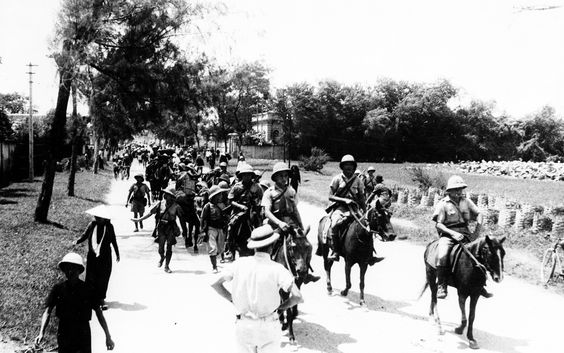
Japan conducted an amphibious landing at Dong Tac (Đông Tác), Indo-China; later that day, Japanese troops captured the Gia Lam (Gia Lâm) airfield and several rail yards near Hanoi (Hà Nội). In addition, the Japanese occupy the railway yards at Phu Lang Thuong (Phủ Lạng Thương) and Lao Cai (Lào Cai). The Japanese station 600 troops in Hanoi. In the evening, Emperor Showa (Hirohito) ordered fighting to stop in Indochina since the French had already surrendered on the previous day.
Two thousand Japanese troops landed in Indo-China under the powerful but silent French guns commanding the entrance to the Red River and marched across the hot countryside into Haiphong (Hải Phòng), the rail, highway and river gateway to the northern province of Tonkin and to southwest China beyond. Japanese planes heralded the approach of these land forces by dropping bombs on a railroad crossing, damaging several buildings and killing 15 and wounding 18 civilians, while the frightened population ran for shelter. The Japanese commander said the bombing was a mistake. Last night, the French authorities announced that a strong protest of the incident had been lodged with Tokyo. En route to the barracks provided for them by the French, the Japanese regiments marching behind a squadron of their light tanks exchanged with the French nothing more hostile than curt salutes. The crack battalions of French colonial infantry moved out, their fine artillery and machine-guns muzzled, another undefeated army on the road back without ever having come to grips with the advancing force.
The Vichy government essentially has capitulated by this point, and the Japanese invasion is complete except for some loose ends. The French agree that the Japanese can garrison 40,000 troops in southern Indochina (the Saigon/Mekong Delta region), but the Japanese remain primarily in the north. At this point, the Japanese are not really worried about the French, but they tread lightly for fear of antagonizing the British who maintain strong presences at Hong Kong and Singapore, the Dutch who also have powerful naval forces to the south in Indonesia, and, worst of all, the United States.
Strikes and violence spread in the International Settlement of Shanghai today and Occidental authorities feared a crisis which might culminate in a Japanese move to seize control of the French concession and most of the International Settlement. Police investigating the strikes charged they were fomented by Japanese agents, perhaps to enable the Japanese to seize control under the pretense of “restoring order.” Bus and streetcar employees have been out several days. The strike was extended to municipal garbage collection employees today, presenting the city with a disease threat. Utilities company directors, insisting on remaining anonymous for fear of retaliation, said agitators were threatening the families of workers unless the employees of gas, electric power and waterworks plants struck this weekend.
With many Australian servicemen either in the Middle East already or on the way, the media takes a keen interest in the Battle of the Mediterranean. The Sydney Morning Herald publishes an editorial that notes that the Axis has experienced a “loss of initiative” there, and Malta, in particular, is a sign of Axis defeat.
The Marquess of Lothian, British Ambassador to the United States, firmly answered reports of a threatened Japanese alliance with Germany and fears for the security of Singapore and the Netherlands Indies by asserting that any challenge to the security of these important Pacific possessions would encounter “most formidable resistance from the ever-growing organized strength of Australia and New Zealand.”
Dow Jones Industrial Average: 133.5 (-0.65)
Born:
Bob Duffy, NBA point guard (St. Louis Hawks, New York Knicks, Detroit Pistons), in Cold Spring, New York.
Frank Maloney, American football coach (Syracuse University 1974-1980), in Chicago, Illinois (d. 2020).
Gary Bartz, American jazz, jazz-fusion, and funk saxophonist, in Baltimore, Maryland.
Died:
Walter Benjamin, 48, German Jewish philosopher and social critic (suicide).
Naval Construction:
The Royal Australian Navy Bar-class boom defense vessel HMAS Kangaroo (Z 80) is commissioned.
The Royal Navy British Power Boat 70 foot-class (ex-French) motor anti-submarine boat HMS MA/SB 59 is commissioned.
The Royal Navy ocean boarding vessel HMS Camito (F 77) is commissioned. Her first commanding officer is Lieutenant Commander Avon Alexander Barnet, RNR.
The Nihon Kaigun (Imperial Japanese Navy) Type C-1 submarine HIJMS I-20 is commissioned. Her first commanding officer is Commander Yamada Takashi.
The Royal Navy Flower-class corvette HMS Nasturtium (K 107) is commissioned. Her first commanding officer is Lieutenant Commander John Frederick Castle Bartley, DSC, RNR.
 History Diaries