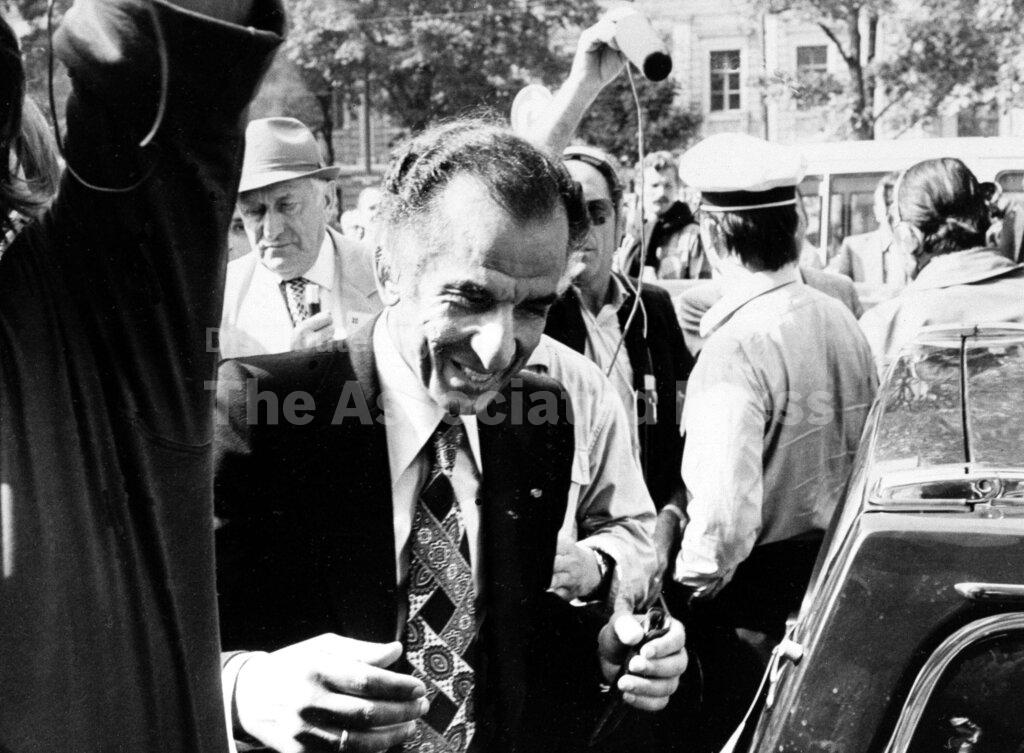
Defense Secretary James R. Schlesinger warned the North Atlantic Treaty Organization allies today that further cuts in their defense budgets could tip the military balance in Europe in favor of the Soviet Union. The Western allies, he said, are in danger of “falling into the pit pf postwar folly,” because of a “feeling that security falls like manna from heaven” rather than from collective efforts and sacrifices. Mr. Schlesinger chose the 21st annual meeting of the North Atlantic Assembly attended by 172 parliamentarians from 15 NATO countries to expound on his theme that the NATO allies must increase their defense budgets if they are to maintain a military equilibrium with the Warsaw Pact nations. In effect, Mr. Schlesinger is trying on an international scale to spread the message that he has been trying to convey to Congress for the last two years, with qualified success since Congress has been cutting the American defense budget more than he would like. Within the last several weeks Mr. Schlesinger has been to North Korea, Japan and Canada, pressing for greating defense efforts. This week he is making a tour of Britain, West Germany and France — with a side trip to Copenhagen for the parliamentary meeting — to spread the message to Europe.
The North Atlantic Treaty Organization and the Warsaw Pact are months, and perhaps years, from agreement on any reductions of the 1.7 million ground troops massed in Central Europe, according to a score of officials on both sides. Negotiators from 19 countries resumed troop reduction talks here today in the 19th‐century splendor of the Hofburg Palace, opening the seventh round in two years of negotiations. After a perfunctory session, the spokesman for the Warsaw Pact, Ambassador Ingo Oeser of East Germany, said, “We are awaiting new proposals from the West.” But the West made no new ones. The United States is trying to get its allies to agree on a new proposal that would bring American tactical nuclear weapons in Europe into the discussion, but so far they have not agreed.
Generalissimo Francisco Franco of Spain refused to commute the death sentences of five terrorists convicted of killing policemen but he spared the lives of six others. The decision to commute some of the sentences appear to be a response both to international protests and strong internal pressures from aroused policemen and Civil Guards and rightist elements backing them. Two of the five condemned terrorists are members of E.T.A., the Basque separatist organization. Violent reactions to any executions were expected in the four Basque provinces of northern Spain. The six others, four men and two women were spared by General Franco, the chief of state, “in agreement with the government.” the Minister of Information, Leon Herrera Esfahan, announced.
The French Foreign Minister, Jean Sauvagnargues, told the General Assembly today that “France, and I think, Europe” were prepared to take an active part in over-all guarantees to strengthen a future peace settlement in the Middle East. Elaborating on his statement in an interview, Mr. Sauvagnargues explained that any general arrangement on peace between Israel and the Arabs would require safeguards “that aren’t lust on paper.” He said that France was ready to participate in an effective military peace‐keeping force. The Foreign Minister also said that “a certain Palestinian organization” had attempted to put pressure on West European governments, and he warned the Palestine Liberation Organization that it must recognize the existence of Israel and formally renounce terrorism if it wanted to be accepted as a partner in international negotiations.
The General Secretary of the Socialist International dented today that Western European Socialist parties were passing on money to the Portuguese Socialist party that was provided by the American Central Intelligence Agency. “There has been no such involvement whatsoever,” the General Secretary, Hans Janitschek, said. A Washington dispatch in The New York Times yesterday telling of such an involvement, he said, “does great damage to the cause of socialism in Portugal and also in other Western European countries.”
A U.S. State Department official said today that the Central Intelligence Agency had been sending $2‐million to $10‐million a month to the Portuguese Socialists, but offered no overall total for aid thus far. The official’s comment came as sources in the State Depart ment and the intelligence community confirmed that the aid was going to Portugal’s Socialist-Communist labor unions. The sources said aid was sent through a roundabout network involving C.I.A. contacts within Western European countries, such as West Germany’s Social Democratic party.
Portugal’s military leaders announced today the formation of an elite force to back the newly formed coalition Cabinet because of the gravity of the current political-military situation.” Called the military intervention force,” it is to be drawn from existing army, navy and air force units, a communiqué said. It was put directly under the command of the President, General Francisco da Costa Gomez, who is also commander in chief of the armed forces. The formation of the new force was announced after an eight‐hour session of the High Council of the Revolution, the country’s supreme authority.
The oil exporters’ cartel failed again to reach agreement but appeared to be nearing a compromise on what qualified sources said would probably be a 10 percent price increase followed by a price freeze. Ministers of the 13-nation Organization of Petroleum Exporting Countries have been struggling for three days in Vienna to adopt a new price structure that would take effect October 1. Bitter argument — chiefly between Iran, which wanted a relatively large increase, and Saudi Arabia, which wanted a small increase or none at all — has dragged the conference here beyond its two scheduled days. The ministers met for three ‘hours this afternoon and for four hours tonight, then adjourned until tomorrow at 10 AM. Venezuela’s Oil Minister, Valentin Hernandez‐Acosta, told newsmen that on the basis of a new compromise proposal from Kuwait, supported by his country, he was optimistic that an agreement would be reached tomorrow.
A majority of Israelis are satisfied with the new interim peace agreement with Egypt, according to a public opinion poll. The poll, carried out for the newspaper Yediot Ahazonot, showed that 57.7 percent of those interviewed were satisfied, and that 25.8 percent were opposed to the accord. It showed that 47.4 percent were against the opening of any talks for a similar agreement with Syria on the Golan Heights, with 38.5 percent in favor. A majority of 68.2 percent were opposed to the abandoning of any Jewish settlements on the Golan Heights.
The White House said today that the United States would consider Egypt’s request for American military equipment to help President Anwar Sadat end his reliance on Soviet arms. The announcement, and remarks by President Ford in Los Angeles the other day indicated that the administration was giving serious thought to ending the long-standing arms embargo against Egypt. The new attitude toward arms sales to Egypt has arisen from the just‐concluded Egyptian‐Israeli agreement on Sinai. Mr. Sadat has been lauded by Secretary of State Kissinger and other key officials as a “moderate” who was “courageous” in making another accord with Israel despite opposition from Syria and the Palestinians.
Since Mr. Sadat has been involved in sharp polemics with Moscow and has had difficulty receiving arms supplies from the Soviet Union, many top officials here believe that the United States must help out Egypt in some way to get the arms Mr. Sadat needs to keep his army satisfied. But any sale of military equipment worth more than $25‐million must be submitted to Congress, and would be sure to run, into opposition if the equipment was regarded as dangerous to Israel’s interests. The recent dispute over Hawk antiaircraft missiles to Jordan was an example of the problem.
This has been Beirut’s longest siege. It has also been the most bewildering and enervating, since the connection between political issues and the street fighting has seemed so tenuous. Last summer, when the city exploded, there was a clear‐cut political issue—the formation of a new government. This time the killings seem to have gained a momentum of their own. Now a 20‐man committee has been put together, and the words “love” and “patriotism” are in the air. A hollow truce between exhausted forces is taking hold. “In Lebanon” observed a columnist, “debates move easily from the table to the barricades, but just as easily in the other direction.” Some people express a sense of being manipulated by outsiders. For Christians, it is radical Arab meddlers for the left, the “imperialist” schemers. Off the Rue Clemenceau machinegun rattles. A sleepy, unshaven gendarme, idly twirling his M‐16. barely takes notice. It’s around the corner, not on his block.
“As long as there are armed men in any part of Beirut, we would not advise the public to go back to their work,” the radio cautioned. This morning, people in downtown Beirut disobeyed and set off to have a peek at their stores and shops, closed for more than a week. It was a mistake. About 11:15 AM, a sniper opened up on Commodore Street just above the fashionable shop district of Hamra Street. To the east, gunmen opened fire and shots echoed through the streets. On Hamra Street a patrol of gendarmes warned people off the streets. The Cafe de Paris was emptied of customers. Shops hurriedly closed, cars squealed the wrong way down one‐way streets. Within minutes, a graveyard silence returned to the city. In an apartment building a woman sobbed uncontrollably, her nerves apparently frayed. At the Muslim cemetery near Horsh, bodies are placed quickly into mass graves to avert an outbreak of disease. The gravediggers wear masks over their mouths and noses. Every night, corpses are dumped in the areas between warring neighborhoods.
The Seoul district court today postponed the sentencing of Kim Dae Jung, the Opposition presidential candidate of 1971 who is accused of violating election law and of activity against the Seoul Government while he was in exile. Hwang Sok Yon, the senior judge, said the court would consider Mr. Kim’s motion for a new trial. The motion challenged the fairness of the three‐man court. The government prosecutor has asked for a five‐year prison term for the Opposition leader.
Heavily armed Filipino bandits hijacked a Japanese freighter with 27 persons aboard today and demanded a ransom of $133,000. The bandits, saying they were members of the same band that abducted a Japanese woman tourist last month, warned authorities against any military intervention “for the safety of the ship and the personnel aboard.” A spokesman for the Japanese Embassy said the bandits had set a two‐day deadline for the ransom and that representatives of the ship’s owners had agreed to pay. Two company officials were sent to Manila to gather the money and negotiate the release he said. The spokesman said he understood the Philippine armed forces had assembled a task force of three ships and three smaller craft to try to rescue the crew as soon as orders came through. There was no confirmation from military officials.
Seven persons died and 19 were wounded when Ethiopian security forces fired on a crowd at the airport at Addis Ababa after coming under pistol fire, the government said today. The government said the shooting occurred yesterday when security forces tried to arrest an Ethiopian Airlines employee caught distributing illegal pamphlets. Several hundred people tried to prevent the arrest and security forces used tear gas to disperse‐them, the government statement said.
A French envoy returned from the desert of northern Chad today after handing over part of a ransom demand to rebels but without achieving the release of a captive archeologist, Francoise Claustre. The government representative, Louis Morel, flew back after opening direct talks in Chad’s Tibesti desert with the rebels’ chief, Hissere Habre. who has held the 38‐year‐old woman captive for 17 months. France has agreed to pay a $2.4‐million ransom, $800,000 in cash and the rest in equipment for Mrs. Claustre, who was spared threatened execution on Tuesday. Her husband is also held but not under the threat of death. A presidential spokesman said, that Mr. Morel had paid the cash and Mrs. Claustre’s release now depended on when the equipment, jeeps, trucks and other non-military supplies could be delivered.
Prime Minister Ian D. Smith said today that Rhodesia was in a worse situation than when his Government began efforts to settle with black nationalists. He told the Congress of his governing party, the Rhodesian Front, that the most serious damage was caused by the fact that the black nationalists believed that South African pressure was causing Rhodesia to back down.
The U.S. Congress, in agreement with President Ford, voted to restore price controls on oil and gasoline for another 50 days, to last until November 15. The price freeze had expired on September 1, and the controls were extended retroactively by a vote of 75–3 in the Senate and 342–16 in the House. A day after it was agreed on by President Ford and congressional leaders, legislation that would temporarily reinstate oil price controls that expired September 1 was quickly approved by wide margins in Congress and sent to the White House. President Ford’s approval is certain. The bill would extend controls to November 15. Its basic purpose is to give Mr. Ford and Congress time to set a long-range energy policy.
President Ford, seeking to avert a threatened citation for contempt of Congress, met with House leaders to try to resolve a dispute over congressional access to intelligence information. But the chairman of the House Select Committee on Intelligence, Representative Otis Pike, Democrat of Suffolk, said Mr. Ford and congressional leaders were “a long way from an agreement.” Nevertheless, Mr. Ford and Representative Robert McClory of Illinois. the committee’s ranking Republican, made statements that were more optimistic.
The Senate approved today a $36.2-billion spending bill containing two riders barring the Department of Health, Education and Welfare, but not the courts, from ordering the busing of public school students to achieve desegregation. The bill, which passed by a vote of 60 to 18 after more than a week of sometimes heated debate, now goes to a Senate‐House conference, which could alter the antibusing provisions. The House version of the measure did not contain similar antibusing language. Some Senators have said that the bill, which appropriates funds to operate the Departments of Labor and H.E.W., could face a possible veto by President Ford because it provides about $1‐billion more than he requested. However, other Senators speculated that Mr. Ford might be more inclined to sign the bill if the final version retained the antibusing restrictions.
Representative Robert N. Giaimo, a member of both the House Defense Appropriations Subcommittee and the Select Committe on Intelligence, will attempt again next week to make the budget of the Central Intelligence Agency public for the first time since 1947.
In a report to the Securities and Exchange Commission, the Phillips Petroleum Company said it had illegally contributed corporate funds to the campaigns of dozens of congressional candidates, including those of Gerald Ford in 1970 and 1972 and to the presidential campaigns of Richard Nixon and Lyndon Johnson. The company said it had illegally made two contributions of $1,000 each to Mr. Ford’s campaigns of 1970 and 1972. Mr. Ford was then serving as a Representative from Michigan. The White House said that Mr. Ford “had no idea” that the contribution consisted of company funds. Phillips already has been convicted of making an illegal gift of $100,000 to President Nixon’s 1972 re-election campaign.
Law enforcement officials in Washington said that the Secret Service decided that Sara Jane Moore did not represent a serious threat to President Ford’s life largely because the San Francisco police department had told it that she had served the department and two federal agencies as an informer over the last 18 months. The decision by the secret Service not to keep Miss Moore in custody or place her under surveillance during the President’s visit to San Francisco last Monday was made less than 24 hours before the woman allegedly fired a shot at Mr. Ford as he emerged from the St. Francis Hotel in downtown San Francisco, and after she reportedly made a statement to the local authorities that could be interpreted as a threat to Mr. Ford. The basis for what the Secret Service has described as an “assessment” that Miss Moore “was not of sufficient protective interest to warrant surveillance” was explained to a conference of Secret Service executives here earlier this week, and has been confirmed in substance by well‐placed Government officials.
Patricia Swinton was acquitted in Federal District Court of being part of a conspiracy to bomb several large buildings in Manhattan in 1969. “It’s our gift to the Bicentennial,” one of the jurors said, as the rest of the jury nodded in agreement. Another juror. Norman Alberts of Manhattan, a computer programmer, said the Government’s case had been poor. A third juror, who declined to give his name, said, “The American system of justice works.” Kathleen Marazan, a school aide in the Bronx, who was foreman of the jury, said, “We found there wasn’t any evidence.” Mrs. Swinton, interviewed on the courthouse steps in the rain, said she was “grateful to the 12 people,” but asserted that “the United States system of justice is not a fair system—it still requires a lot of money.”
A Federal court jury tonight acquitted Nelson Bunker Hunt and W. Herbert Hunt, two of the nation’s weathiest men, of wiretapping charges. The two men, whose fortunes are estimated to be $400‐million each, had been accused of hiring private detectives six years ago to tap the telephone of six employees of their late father, H. L. Hunt, the eccentric Dallas billionaire, to check on thefts from the company. The jury, ten of whose members have direct ties to agriculture, reached a verdict of acquittal in less than three hours. There were gasps of relief from the relatives of the two accused oil men when Federal District Judge H. O. Woodward read the verdict.
The authorities will attempt to match at least 15 unexpended 9-mm. cartridges dropped by fleeing bandits after a bank robbery with similar ammunition found in two apartments occupied by Patricia Hearst and other members of the self-styled Symbionese Liberation Army, official sources said today. A spokesman for the Sacramento County Sheriff’s Department also said that Miss Hearst roommate, Wendy Yoshimura, and William and Emily Harris, all of whom were arrested in San Francisco on September 18, were considered suspects in the robbery, in which a woman customer was shot to death. The spokesman added that Stephen Soliah a 27‐year‐old house painter who rented the apartment in which Miss Hearst and Miss Yoshimura lived, was also considered a suspect, along with James Kilgore, his former business partner, and his sister, Kathleen Soliah.
The California Agricultural Labor Relations Board, acting on a complaint by the United Farm Workers, says that an important grower threatened to kill workers who supported the U.F.W. at secret ballot representation elections.
“The Rocky Horror Picture Show,” which would become a cult film classic, after being adapted from a British stage play, was first shown, debuting in Westwood, Los Angeles. The film was a flop until April 1, 1976, when midnight screenings at the Waverly Theater in New York City were accompanied by audience participation, which became a fad in the late 1970s.
Congress will begin hearings Monday on the National Football League labor controversy in an effort to see if an agreement on a new contract can be reached between the 26 owners and some 1,200 players.
Major League Baseball:
Getting shutout pitching from Luis Tiant (18–14) and Reggie Cleveland (13–9), the Red Sox took giant strides toward clinching the East Division title by posting a pair of 4–0 victories over the Indians in a twi-night doubleheader. The sweep reduced the Red Sox’ magic number to two for eliminating the Orioles, who were rained out in New York. In the opener, the Red Sox scored twice in the first inning. Bernie Carbo and Denny Doyle walked. Carl Yastrzemski flied to right field and Carbo raced to third after the catch in position to score on a sacrifice fly by Fred Lynn. Carlton Fisk then doubled to drive in Doyle. Cecil Cooper homered in the fourth and the final run followed in the eighth on a double by Fisk and single by Cooper. In the nightcap, the Red Sox counted their initial run in the fourth on a sacrifice fly by Bob Montgomery after loading the bases with a single by Fisk, pass to Deron Johnson and single by Rico Petrocelli. Removing any doubt about the outcome, the Red Sox exploded for three runs in the seventh on consecutive doubles by Doyle and Juan Beniquez and a homer by Dwight Evans.
George Scott drove in the Brewers’ runs with his 35th and 36th homers and Pete Broberg (14–16) pitched a six-hitter to shut out the Tigers, 3–0. Scott hit for the circuit in the third inning and followed with another drive after a single by Robin Yount in the seventh to boost his RBI total to 107.
A double by Steve Brye and single by Larry Hisle in the sixth inning enabled the Twins to defeat the White Sox, 2–1. The White Sox’ run counted in the fourth on a single by Bill Stein, double by Lamar Johnson and grounder by Brian Downing. Jerry Terrell tied the score with his first homer of the season in the Twins’ half.
Two runs in the ninth inning on an error and a pass with the bases loaded enabled the Royals to defeat the Rangers, 8–6. Jamie Quirk drove in three of the Royals’ six earlier runs with a pair of singles. A two-run double by Mike Hargrove and homer by Toby Harrah with a man on base helped the Rangers narrow their deficit to one run at 6–5 before the Royals began the ninth by loading the bases with singles by Frank White and Vada Pinson and a walk to John Mayberry. Harmon Killebrew then grounded to Harrah and was safe on the shortstop’s error as White scored. Amos Otis came up next and walked to force in an extra tally.
Although collecting only five hits of Ed Figueroa, the Athletics made them count in gaining a 4–2 victory over the Angels. Two walks and a single by Billy Williams produced the initial run in the first inning. After the Angels went ahead, 2–1, in the fourth, the A’s came back with a pair in their half on a double by Williams, a walk and singles by Joe Rudi and Bert Campaneris. Tommy Harper wrapped up the scoring with a homer in the eighth. The Angels stole four bases to bring their club total to 219.
The game between the Baltimore Orioles and New York Yankees at Shea Stadium is postponed due to rain. It will be made up on September 28.
Gary Nolan (15–9) , who achieved a sensational comeback after two winless years with shoulder trouble, gained his 15th victory of the season when the Reds defeated the Braves, 12–5. The Braves jumped off to a 4–0 lead, but Nolan started himself on the road to victory by hitting a single to drive in two of the Reds’ three runs in the second inning. The Reds then took command of the game by counting three more times in the fourth on a bases-loaded double by Tony Perez, who boosted his season’s RBI total to 109.
Burt Hooton (18–9) gained his 12th straight victory, setting a Los Angeles club record, when Steve Garvey smashed a two-run homer in the ninth inning to carry the Dodgers past the Astros, 3–2. The Dodgers scored their initial run in the eighth on two walks, a bunt and sacrifice fly by Leron Lee, but the Astros went ahead in the top of the ninth when Cliff Johnson homered with a man on base. In the Dodgers’ half, Willie Crawford walked and Garvey ended the game in Hooton’s favor with his circuit clout.
At Veteran’s Stadium, the Phillies clinched second place in the East Division by winning the first game of a twi-night doubleheader, 4–3, in 12 innings before the Mets came back to take the second game, 3–2, also in 12 innings. Larry Bowa, who had hit a two-run triple in the second inning of the opener, tripled again with one out in the 12th. After the Mets walked Mike Schmidt and Greg Luzinski intentionally, Tony Taylor struck out but Garry Maddox singled to drive in the Phillies’ winning run. Dave Kingman hit his 36th homer of the season for the Mets. The Mets won the nightcap with two unearned runs in the 12th. Jesus Alou reached base on an error by Alan Bannister. After a forceout, Bob Gallagher scored on a double by Felix Millan, who also crossed the plate on a wild throw by Mike Anderson. In the Phillies’ half, Johnny Oates singled and Tim McCarver walked. Mike Rogodzinski doubled, driving in Oates, but McCarver was thrown out at the plate to end the game.
Bob Forsch (15–10) yielded only three hits and pitched the Cardinals to a 1–0 victory over the Pirates. The speed of Lou Brock enabled the Cards to score the game’s only run off Jim Rooker in the first inning. Brock singled and, on a hit-and-run play, raced home from first base on a single by Ted Simmons.
After hitting a two-run homer to tie the score in the eighth inning, Mike Jorgensen drove in another run with a single in the 12th to bat the Expos to a 3–2 victory over the Cubs. Manny Trillo accounted for the Cubs’ pair with a single in the fourth. Jorgensen’s homer in the eighth followed a pass to Jim Dwyer. Pepe Mangual drew a walk in the 12th, stopped at second on a single by Tim Foli, stole third and crossed the plate on Jorgensen’s single. Dale Murray, who pitched five innings of three-hit relief, picked up his 15th victory — all in relief — and third over the Cubs in six days.
The biggest rookie winner in the National League this season, John Montefusco brought his record to 15–9 by pitching the Giants to a 5–0 victory over the Padres. The shutout was the young righthander’s fourth of the year. Montefusco struck out only four, but his total of 215 was the highest for any yearling in the National League since Grover Cleveland Alexander fanned 227 in 1911. The Giants jumped off to a 2–0 lead in the fourth inning on singles by Derrel Thomas, Bobby Murcer, Willie Montanez and Bruce Miller. Their other runs followed in the eighth on an error and singles by Thomas, Murcer, Gary Matthews and Gary Thomasson.
Cleveland Indians 0, Boston Red Sox 4
Cleveland Indians 0, Boston Red Sox 4
Montreal Expos 3, Chicago Cubs 2
Atlanta Braves 5, Cincinnati Reds 12
Houston Astros 2, Los Angeles Dodgers 3
Detroit Tigers 0, Milwaukee Brewers 3
Chicago White Sox 1, Minnesota Twins 2
California Angels 2, Oakland Athletics 4
New York Mets 3, Philadelphia Phillies 4
New York Mets 3, Philadelphia Phillies 2
San Francisco Giants 5, San Diego Padres 0
Pittsburgh Pirates 0, St. Louis Cardinals 1
Kansas City Royals 8, Texas Rangers 6
Dow Jones Industrial Average: 818.60 (-1.64, -0.20%)
Born:
Jake Paltrow, American film director and brother of Gwyneth Paltrow, in Los Angeles, California.
Ron Warner, NFL defensive end (New Orleans Saints, Tampa Bay Buccaneers, Washington Redskins), in Independence, Kansas.
 History Diaries