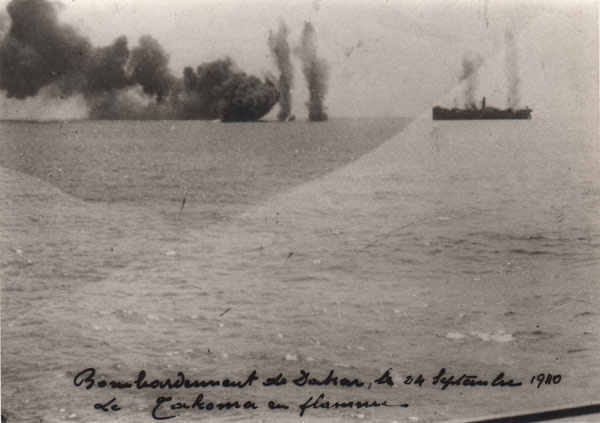
Operation MENACE: Overnight, Governor of French West Africa, Pierre Boisson, rejected Free French demand for the surrender of Dakar. At 0700 hours, British destroyer HMS Fortune detected Vichy French submarine Ajax, which was forced to surface by depth charges and then sunk with gunfire after the crew of 61 was captured. British battleship HMS Barham shelled French battleship Richelieu in Dakar harbor; Richelieu was damaged with two shells and a misfire of her own. French coastal batteries was able to force back the British fleet at 1000 hours. In the afternoon, the British fleet returned. French coastal artillery opened fire again, hitting Barham with four shells, and forced back the British fleet once again. Far to the north, 64 Vichy French bombers from Algeria and Morocco bombed Gibraltar in retaliation, damaging one ship.
The Allies on 24 September 1940 remain offshore of Dakar during Operation Menace, with the Vichy French sitting tight. Both sides are lobbing shots at each other, but the basic situation remains unchanged. During the day, the British battleship HMS Barham, sitting 13,500 yards (about 8 miles) offshore, lobs in some 15-inch shells that strike the French battleship Richelieu sitting in port. The Richelieu, unfinished, also has issues with its guns, with 380mm guns 7/8 in Turret 2 going out of service today when a shell explodes. However, the port defense guns aren’t fully manned, so some Richelieu crew just switch to coastal guns, where they have success. The biggest problem for the Vichy French is ammunition, as they are using an old powder which causes problems.
The Vichy French have submarines in the area, and shortly after sunrise the British force their submarine Ajax to surface. This is a joint exercise between Swordfish operating from the Ark Royal and patrolling destroyers. The Swordfish bomb the submarine and force it to surface. The Vichy French crew then scuttles the badly damaged sub. Destroyer HMS Fortune rescues the 61-man crew. There are different versions of this action in which the destroyer, and not the planes, cause the sub to surface and scuttle, and likely it was some combination of forces.
The British fleet approaches the port in the morning but retreats under fire around 10:00. It then approaches in the afternoon again, then retreats again. British battleship HMS Resolution, for its part, takes damage which eventually requires it to be put under tow down to Cape Town, South Africa. Barham and two British cruisers are damaged by coastal defense guns manned by the Richelieu crew.
The Vichy French retaliate for the attack by sending 64 aircraft based in Morocco and Algeria over Gibraltar. They drop 150 bombs on the British base and cause damage to the dock area, especially the South Mole area. This attack is somewhat unusual because heretofore the Armée de l’Air de Vichy bombers have made perfunctory runs and dropped many of their bombs out at sea. Somewhat perversely, this is the largest air raid of the war to date by the French Air Force, including the Battle of France.
At 0830 and then again at 1115 hours, 200 German bombers, escorted by 400 fighters, were launched to attack targets in Kent in southern England, United Kingdom; Portsmouth, Southampton, and the nearby Spitfire fighter factory at Woolston were among the targets.
Weather over Great Britain: Mist and fog patches were to be widespread in most areas especially over the French and British coastlines during the morning. Mist or haze was expected to be prevalent for most of the day, with high cloud expected to clear by late afternoon.
Most of the fighter stations in the south woke up to a rather foggy morning and many experienced an eerie feeling as those that were up while it was still dark inspecting their aircraft before settling down to breakfast, groped around in the shallow visibility with the thought that they would be confined to base under the circumstances. Reports that had come through from the coastal radar stations also indicated that most of the Channel coast was also under the influence of reduced visibility. However, by 0630 hrs, the visibility increased as the fog began to lift. Two aircraft managed to take off from Manston and Tangmere on weather reconnaissance and reported that the fog was prevalent over the Channel, but along the coast and inland, the fog had reduced to low lying mist patches. Above the fog, visibility was good and the cloud base was about 18,000 feet.
0810 Hours: Radar stations at Foreness, Dover and Rye picked up a large formation coming across the Channel from Calais. It turned out to be a formation of about 200 plus that consisted of bombers with fighter escort. The formation was broken up into a number of smaller formations that were to cross the Kent coast on a wide front.
Keith Park decided that he would send up eleven squadrons. 72 Squadron Biggin Hill (Spitfires) were scrambled early to meet an advance formation of Bf 109s. It appears that the bomber formation continues its route in a northerly direction heading towards the Thames Estuary and it was in this area that they were met by 17 Squadron Debden (Hurricanes) and 92 Squadron Biggin Hill (Spitfires). The area over the Thames Estuary was misty with fog areas over the resort towns, but above this, the two fighter squadrons engaged in combat with the bombers.
The first casualty of the morning was from 72 Squadron that engaged the advance party of Bf 109s. At 0820 hours a Spitfire flown by Sgt J.Steere sustained damage while in combat over Dartford, but not enough for him to abandon his aircraft and he managed to return to base. In return, 72 Squadron managed to shoot down one Bf 109 before the enemy gained height and redirected themselves east to meet up with the main bomber formation. Over the Thames Estuary, 72 Squadron was to claim another two possibly damaged, and one definitely damaged. 92 Squadron Biggin Hill (Spitfires) were also in attendance over the Estuary where they claimed six enemy aircraft damaged, with two of them possibles. One of them, a He 111 was seen returning back out towards the North Sea badly smoking from both engines. One of the 92 Squadron Spitfires was hit by gunfire from one of the Bf 109s and was seen to crash near North Weald and bursting into flames on impact. The pilot did not bail out and went down with the aircraft.
17 Squadron Debden (Hurricanes) also claimed one damaged and another possibly damaged, but unfortunately lost one Hurricane after it crashed into the sea off Chatham after being hit by gunfire from a Bf 109. The pilot P/O H.A.C.Bird-Wilson managed to bail out of his burning aircraft with burns to his hands and body, but was rescued from the sea by a boat. According to German records, a number of the bombers did sustain damage in this action, and although they managed to return to their bases many of them crashed upon landing due to combat damage, but the times are sketchy and in many cases are not available.
Of the squadrons that were also dispatched, but did not make contact, often left the pilots in a discerning mood as to them they could have stayed on the ground back at their bases and finished their breakfasts in peace and quiet. P/O George Barclay of 249 Squadron said once, that after being vectored into one location, it almost seemed a waste of his time, and a waste of precious fuel to fly around an empty sky in search of something that wasn’t there. But on reflection, we must have been there for a reason.
“Our two Spitfires hummed easily along the air paths……..The world of last night seemed a long way off, and I wondered how, by contrast to this ecstatic feeling I had now. I could ever have descended to the general debauchery which characterized last night’s behavior. I wondered what the alternatives were. Were we to sit in our rooms to read a book, or sit in the mess and do a crossword puzzle or read all about the war, or write letters to our loved ones in case we got no further opportunity, or should we go to the cinema? I didn’t think any of these activities would really be adequate as a sequel to the day. It would be physically possible to sit down by oneself in one’s room and read a book after fighting Germans at a great height and at great speed at intervals during the day — but it would be unnatural. It was no longer a mystery to me why fighter pilots had earned such a reputation for being somewhat eccentric when they were on the ground. I knew why it was, and I knew that if I were alive this evening I should get drunk with the others and go wherever they went.”
- P/O R.M.D.Hall 152 Squadron September 1940
The morning had been a busy one for Fighter Command although we cannot say that they were pushed anywhere near the limit. Almost as if on cue, everything seemed to be quiet while everybody went home for lunch!!
1330 Hours: 41 Squadron (Spitfires) Hornchurch was out on patrol over the Channel near Hell Corner when they were bounced on by a flight of Bf 109s. The squadron was forced to take defensive action and failed to turn the action into one of attack. two aircraft were lost, one crashed into the sea and the pilot rescued, while the other sustained serious damage and once over the Kent coast was forced to crash land somewhere outside Dover. The pilot was unhurt.
1350 Hours: A small to medium formation of Bf 110 aircraft from I/Erprobungs Gruppe 210, 4ZG/76 and IIIZG/76 made a surprise attack on the docks and naval ports of Southampton and Portsmouth. Wood and Dempster in “The Narrow Margin” incorrectly state that these were bomb carrying Bf 109 fighter bombers. It cannot be ascertained as to whether they flew across the Channel at very low level remaining undetected by ventnor radar until observed by the Observer Corps, or whether Fighter Command was too late scrambling squadrons in time to intercept.
The Bf 110s managed to fly past the Isle of Wight and up the Solent with not one Hurricane or Spitfire in sight and headed towards the Spitfire factory at Woolston where a number of direct hits caused considerable damage to a number of buildings and an air raid shelter where it is estimated that 100 factory workers were killed. The main factory and assembly plant was not hit and production was unaffected.
The only defense that could be offered by the British was by the anti-aircraft units who excelled with accurate gunfire with one Bf 110 crashing into the sea, two Bf 110s of III/ZG76 also sustaining hits and crashing into the Channel while a Bf 110 of 4ZG76 sustained damage and managed to get back to base.
After the raid on Southampton, the attackers then turned on Portsmouth where they dropped their bomb-loads on mostly residential and commercial areas of the city with the naval dockyard and factories remaining undamaged.
Soon after darkness fell, they usual formations of bomb laden Heinkels, Dorniers and Junkers arrived over the coastline of Kent, Sussex and Hampshire for the continuation of the night bombing raids that had been so prevalent over the last couple of weeks. The bombing was very widespread with heavy forces again targeting London, Portsmouth and Plymouth. Other areas targeted by the Luftwaffe bomber formations were Hull and Humberside, Newcastle and Middlesbrough, Liverpool and Manchester and a number of areas in the west and in South Wales. It was by far one of the most widespread of bombing attacks so far and it continued until about 0600 hours the next morning.
RAF Casualties:
0900hrs: Nth Epping Forest. Spitfire X4037. 92 squadron Biggin Hill
P/O J.S. Bryson Killed. Shot down by Bf 109s over Essex and crashed in flames near North Weald
1630hrs: Over Channel. Hurricane P3832 605 Squadron Croydon
P/O W.J. Glowacki Killed. In combat with Bf 109 over French coast and shot down
Again the above casualty list does really not reflect on the severity of the combat action that took place during the morning. Six Hurricanes and Spitfires were destroyed, three pilots bailed out, four damaged aircraft crashed on landing while eight other aircraft, although damaged by enemy gunfire were repairable.
The arrival of German bombers on this night marked the 18th consecutive night in which London had been bombed; Liverpool, Dundee, and other cities and towns were also bombed.
The Luftwaffe bombs and sinks classic 1815 ship of the line HMS Wellesley at its dock on the Thames. The ship sinks in shallow water and can be salvaged, but it is damaged beyond repair. HMS Wellesley has the distinction of being the last ship of the line to be lost in enemy action and the only one lost by air attack. Its figurehead now graces the entrance to Chatham Dockyard.
RAF Bomber Command dispatches 18 Blenheims on daylight sea sweeps. One formation of 12 aircraft attacked some German patrol boats in the Channel, scoring near misses. There were combats with German fighters in which 1 Me 109 was shot down and 1 Blenheim was lost.
RAF Bomber Command dispatches 122 aircraft of all types overnight, 100 to the Channel ports, 20 to a power-station in Berlin and 2 to Hamm railway yards, 1 Blenheim and 1 Whitley lost.
RAF Coastal Command attacks the ports of Zeebrugge and Brest, while Bomber Command attacks Berlin with 20 bombers, Frankfurt, the German coastal guns at Cap Gris Nez, and the usual ports and airfields in northwest Europe. By far the greatest effort is made against the invasion ports, where the barges are gradually dispersing.
In retaliation for the events at Dakar, Vichy French air forces attacked Gibraltar but did little damage.
The government information bureau announced tonight that Finland is permitting transport of German troops and supplies in northern Norway via northern Finland. The Finnish communique said: “Transit of German troops on leave and of German supplies is taking place between northern Norway and northern Finland subject to certain conditions and control measures.” A spokesman said the arrangement was modeled after that between Sweden and Germany, which became effective in July. No explanation beyond the communique was given. It was learned reliably, however, that some transport ships were in use. Whether troops arriving in northern Finland by sea were routed southward into Sweden and thence into Norway was not made clear.
In Britain, gasoline price rose to 2 shillings and 2 pence per gallon.
King George VI of the United Kingdom instituted the George Cross medal to award those who displayed courage not in the face of the enemy.
Douglas Bader was promoted to the war time rank of flight lieutenant.
Meanwhile, as the British government announced plans to expand evacuation, 444,000 children had already been evacuated from the London area.
At Malta, it is a quiet day with no air raids. The island receives word that three warships are on the way (arrival date unknown) carrying supplies, so unloading parties are put on standby throughout the day. Arriving ships must be docked and unloaded immediately so they can depart again to avoid air/naval attack.
Rear Admiral (Destroyers) Home Fleet transferred from battlecruiser HMS Repulse to depot ship HMS Maidstone at 1500.
Light cruiser HMS Glasgow departed Scapa Flow at 2030 for the Humber to join the Nore Command.
Destroyers HMS Duncan and HMS Isis departed Scapa Flow at 1200 for Skolpenfjord, Faroes, to meet British troopship Ulster Monarch (3791grt) and escort her to Invergordon. The ships arrived at Invergordon at 0815 on the 26th. The destroyers proceeded to Scapa Flow.
Destroyers HMS Ashanti and HMS Bedouin departed Rosyth at 2300 to search Dogger Bank for a downed Blenheim air crew in 55-00N, 10-30E. The RAF dinghy was not located, but three Norwegian aviators in an open boat were rescued on the 26th. The destroyers later located the dinghy and rescued one alive and one dead airman in 54-12N, 1-58E. The survivors were landed at Newcastle and the destroyers then proceeded to Rosyth. Both destroyers arrived back at Rosyth at 0800/28th.
Anti-submarine trawler HMS Loch Monteith was damaged by German bombing in the English Channel. Six ratings were killed and another died of wounds.
Due to floating mines west of the Orkneys, it was no longer practical to conduct anti-submarine exercises in the usual area. Restructured exercises were conducted inside the Flow.
German steamer Ostmark (1280grt) was sunk by Submarine HMS Tuna in 47-01N, 03-02W, off Belle Ile.
Submarine HMS Cachalot attacked a German submarine in 46-58N, 5-56W without success.
British steamer Continental Coaster (555grt) was sunk by a German motor torpedo boat S.30 in 52-59N, 02-10E. Four crewmen were lost on the British steamer.
Motor torpedo boats MTB.14, MTB.15, MTB.16, and MTB.17 were returning from a raid against German shipping between Ostend and Dunkirk. Motor torpedo boat MTB.15 (Lt L. J. Gamble) was sunk by a mine thirty miles northeast of North Foreland.
Armed patrol trawler HMS Loch Inver (356grt, Probationary Temporary Skipper T. Hardcastle RNR) was sunk by a mine in the Harwich area. Hardcastle and fourteen ratings were lost in the trawler.
British trawler Bass Rock (169grt) was sunk by German bombing 23 miles S by W of Old Head of Kinsale. Four crewmen were lost on the British trawler.
German heavy cruiser Admiral Hipper departed Kiel to raid in the Atlantic, but returned on the 30th with engine problems developed on the 27th.
In MENACE operations:
At 0700, Vichy French submarine Ajax was bombed at periscope depth by HMS Ark Royal aircraft and badly damaged. She surfaced before sinking and her crew, five officers and fifty six ratings, were taken aboard Destroyer HMS Fortune, later transferred to battleship HMS Barham.
Battleships HMS Barham and HMS Resolution engaged French battleship Richelieu at 13,500 yards.
Shortly later, Heavy cruisers HMS Devonshire and HMAS Australia engaged a cruiser and a destroyer, damaging the destroyer.
Australian heavy cruiser HMAS Australia, heavy cruiser HMS Devonshire, and destroyers HMS Forester, HMS Inglefield, and HMS Foresight bombarded Vichy positions in Goree Bay.
French battleship Richelieu was damaged by a hit of a 15 inch shell and the near misses of two air bombs.
Battleship HMS Barham received medium damage from four shell hits.
In British air attacks during the day, three Swordfish and three Skuas aircraft from aircraft carrier HMS Ark Royal were lost to French fighters and two aircraft to French anti-aircraft fire. Lt Cdr A Yeoman, leading a strike of nine Swordfish of 810 and 820 Squadrons, escorted by three Skuas, forced landed his Swordfish en route due to engine failure and was picked up by destroyer HMS Escapade. On the return, Acting Lt R. S. Hankey of 810 Squadron was able to land his anti-aircraft damaged Swordfish in the water and was picked up by destroyer HMS Echo. Lt N. R. Corbet-Milward and LtB J. Prendergast of 810 Squadron landed in the water and were picked up by destroyer Escapade. One Skua crew of 800 Squadron was picked up by destroyer Echo and another from 803 Squadron by destroyer HMS Forester. In Swordfish of 810 Squadron, Acting S/Lt (A) I. H.B England and Naval Airman F. C. Moore of one Swordfish, S/Lt (A) A L. Cross and S/Lt (A) G. M. M. C. Wheeler of another were lost. Naval Airman G. P. Dawson of the Wheeler Swordfish and and Acting S/Lt (A) D. G. Richardson of the England Swordfish were taken prisoner. Lt J. S. L. Crabb, Lt (A) H. H. Jackson, and Naval Airman N. Jarvis of aircraft carrier HMS Hermes’s 814 Squadron were shot down and taken prisoner.
Australian light cruiser HMAS Sydney departed Alexandria to patrol off Cyprus. Light cruiser Sydney covered British netlayer HMS Protector on patrol near Beirut from 24 to 26 September searching for French steamer Theophile Gautier, which was depart Beirut for Marseilles. The Australian light cruiser arrived back at Alexandria on the 26th after it was learned that the French ship was delayed in sailing.
Heavy cruiser HMS York arrived at Suez and departed for Alexandria on the 25th. The cruiser departed Port Said on the 26th and arrived at Alexandria on the 27th.
Destroyers HMS Hasty and HMS Havock departed Alexandria for Port Said to escort convoy AN.4 of four steamers, which departed on the 27th. Anti-aircraft ship HMS Calcutta departed Alexandria on 28 September to join this convoy. The convoy arrived on 2 October.
In French air attacks on Gibraltar from 1250 to 1439, battlecruiser HMS Renown was near missed by two bombs, but was not damaged. Battlecruiser Renown with destroyers HMS Hotspur, HMS Firedrake, HMS Griffin, and HMS Encounter sortied from Gibraltar at 1550 to avoid further air attack. French Vichy destroyers Epee, Fleuret, Fougueux, and Frondeur departed Casablanca on the 24th to demonstrate off Gibraltar for MENACE. Following a contact report by armed boarding vessel HMS Charles Mciver (428grt), destroyer HMS Wrestler contacted the French destroyers at 0500/25th. Destroyer Epee opened fire at 0518 on the 25th on Destroyer Wrestler off Gibraltar. Destroyer Epee fired fourteen rounds, destroyer Fleuret was able to fire due to fire control equipment defects, and destroyers Fougueux and Frondeur fired six rounds between them. The Destroyer sustained no damage. Destroyers HMS Wrestler and HMS Wishart pursued the withdrawing French destroyers.
Battlecruiser HMS Renown with her destroyers proceeded in support, but made no contact. Destroyers HMS Firedrake and HMS Wishart joined on the 27th, relieving destroyers HMS Hotspur and HMS Gallant which returned for refueling. Destroyer Wishart was detached on the 28th to investigate a submarine contact near battlecruiser Renown. The Renown force arrived back at Gibraltar at 1745 on the 28th. Destroyer HMS Griffin was detached and returned to assist destroyer Wishart. All four French destroyers returned to Casablanca on the 25th.
The Italian Submarine Sciré, commanded by Junio Valerio Borghese, left La Spezia for Gibraltar carrying three manned torpedoes and eight crewmen. The attack was called off and the submarine ordered back to La Maddalena because the British fleet had left Gibraltar before the Sciré could get into position.
Convoy OA.219 departed Methil escorted by sloop HMS Aberdeen from 24 to 28 September and destroyer HMS Scimitar from 25 to 28 September.
Convoy OB.218 departed Liverpool escorted by destroyer HMS Sabre, corvettes HMS Erica, HMS Gloxinia, and HMS Picotee, and anti-submarine trawlers HMS Fandango and HMS Wolves. Corvette HMS Erica was detached on the 24th and corvette HMS Gloxinia on the 26th. Destroyer Sabre left the convoy on the 27th and corvette Picotee and the two trawlers were detached on the 28th.
Convoy FN.290 departed Southend, escorted by destroyers HMS Valorous and HMS Westminster. The convoy arrived at Methil on the 26th.
Convoy FS.289 departed the Tyne, escorted by destroyer HMS Vimiera and sloop HMS Puffin. The convoy arrived at Southend on the 25th.
Convoy OL.4 departed Liverpool escorted by destroyers HMS Havelock and HMS Sabre from 24 to 27 September. The convoy was dispersed on the 27th.
Convoy BS.5, escorted by New Zealand Division light cruiser HMS Leander and Australian sloop HMAS Parramatta, was attacked by Italian aircraft in the Red Sea.
US Destroyer Division 69 and the first section of Division 73 were transferred to the Canadian Navy at Halifax under Lend Lease.
United States Navy name — Royal Canadian Navy name — Commanding Officer
USS Williams (DD-108) — HMCS St Clair — Lt Cdr D.C Wallace RCNR
USS Thatcher (DD-162) — HMCS Niagara — A/Cdr E. L. Armstrong Rtd
USS Mackenzie (DD-175) — HMCS Annapolis — A/Cdr H Kingsley RCN from 24 September to 10 October, and Cdr C. D. Donald from 11 October.
USS Haraden (DD-183) — HMCS Columbia — Lt Cdr S W Davis Rtd
USS McCook (DD-252) — HMCS St Croix — Lt M A Medland RCN from 25 September to 10 October, Cdr H Kingsley RCN from 11 October.
USS Bancroft (DD-256) — HMCS St Francis — A/Cdr H F Pullen RCN
On 30 November, HMCS St Clair, HMCS St Croix, and HMCS Niagara departed St Johns for England.
Destroyer HMCS St Croix broke down en route when she had insufficient suction on her fuel lines and had to return to St Johns. She was taken under repair at Halifax and did not enter service until March 1941. Destroyer St Croix remained in Canadian waters for her service.
Destroyers HMCS St Clair and HMCS Niagara arrived the Clyde on 11 December and were assigned to the 4th Escort Group.
In late October, HMCS Annapolis burnt out a boiler and was under repair at Halifax until February 1941.
Note: Between 9 September 1940 and 5 December 1940, the USN transferred three Shaw-class, 23 Wickes-class, and 18 Clemson-class destroyers to the RN, plus four Wickes-class and two Clemson-class destroyers to the RCN. The destroyers in British service were known as the Town-class and were broken into the “Belmont,” “Lewes,” “Campbeltown,” and “Bath” groups. The ships transferred to the RCN were given the names of Canadian rivers but were also known as Town-class ships to distinguish them from the A- and C-class British destroyers in Canadian service and already know as the Canadian River-class destroyers (not to be confused with the impending River-class frigates).
On September 24, 1941, ten 250-foot Lake-class U.S. Coast Guard cutters were also transferred to Britain. The former cutters were known as the Banff-class (names after British lifesaving stations) and were designated as escort sloops because of their substantially greater endurance. The Wickes-class destroyers normally carried only 225 tons of fuel and were considered very ‘short-legged’. By using all ’emergency’ fuel storage spaces, their bunker capacity could be increased to 290 tons, producing an endurance of between 3,200 and 3,500 miles at 12 knots; barely enough to get across the Atlantic Ocean. Their endurance was inferior even to the Flower-class corvette (230 tons, 3450 mile at 12 knots), that was known to be seriously fuel-limited. Because of the recognized endurance deficiency of the Wickes-class, the Clemson-class was designed to carry 35 percent more fuel than the Wickes-class through the use of cylindrical ‘wing tanks’ in the boiler rooms. Normally, they carried 305 tons of fuel but, like the Wickes-class, through the use of their ballast tank, could increase this to 395 tons, resulting in an endurance of about 3,900 miles at 12 knots. This made them marginally more useful but they were still practically unsuited to mid-ocean or transoceanic escort work in the Atlantic. An effort to increase the bunkerage of the Wickes-class by eliminating the aftermost of four boiler rooms and replacing it with fuel tanks and mess decks raised their fuel capacity to 385 tons and gave them an endurance of between 4,300 and 4,500 miles at 12 knots. Some of the Clemson-class destroyers underwent a similar conversion but, because they already had a heavier fuel load, gained relatively less through the process — their bunkerage was increased to 457 tons and their endurance climbed to between 4,400 and 4,600 miles at 12 knots. By comparison, most of the River-class destroyers carried 380 tons of fuel and had an endurance of 4,800 miles at 15 knots, which also proved to be too low for mid-ocean escort work. The fuel inefficiency of the Clemson-class is very evident. The Lake-class cutter had an endurance of 8,000 miles at 10 knots on 355 tons of fuel. Their extraordinary fuel economy was due to an innovative turbo-electric propulsion system that was both simple and efficient. Only when the River-class frigates arrived did an escort vessel with adequate endurance enter into RCN service (440 tons, 7,200 miles at 12 knots). In addition to the fuel improvements, the USN’s own ‘four-stackers’ went through other upgrades to improve their value as escorts
All of the Wickes and most of the Clemsons had their old single-purpose 4-inch guns replaced by dual-purpose 3-inch guns. They had two of their four sets of torpedo tubes landed and replaced by one ‘Y-gun’ depth charge launcher with ten charges. The number of 300-lb depth charges in the stern racks was increased from 14 to 24. Finally, the number of.50-calibre machine guns was increased from two to four. The USN conversion program was halted in Nov 43. By that time virtually all of the Wickes and most of the Clemsons had been converted. All of the ships transferred to the RN and RCN were in their original condition. Gilbert Tucker recorded that the Towns were literally forced on the RCN by the Admiralty against the better judgement of the Naval Staff.
Moreover, all of the American destroyers (except Columbia) transferred to Britain and Canada were built by the Bethlehem Steel Corporation, which had a reputation for building notoriously inefficient ‘fuel hogs.’ This was due to defects in their boiler and turbine construction. The USN did not retain the Bethlehem-built ships for their own use, either scrapping them or putting them into reserve status.
The ships transferred to the RN and RCN have been described as “The Fifty Ships That Saved the World” in the title of a book by Philip Goodhart, (London, UK — Heinemann, 1965). In fact, the ships were virtually worthless as escorts in their original condition and only marginal as modified by the USN. They proved to be a serious drain on precious manpower and dockyard resources in the UK and in Canada. One Admiralty source called them, “Wretched Little Ships.” The Banff-class cutters, on the other hand, proved to be outstanding escort vessels and were judged by the Admiralty to be “worth their weight in gold.” Interestingly, the 50 destroyers are far more remembered than the later and more useful cutters. The destroyers did have a symbolic importance that far outweighed their combat usefulness, in cementing the burgeoning “Special Relationship” between the Western Allies in the waning months of 1940.
President Roosevelt today appointed a board to coordinate communications with the national defense program and received a committee headed by Senator Norris and Mayor La Guardia which will launch an independent movement for his re-election. He also heard the report of the Birthday Ball Committee of the “Fight Infantile Paralysis” campaign.
The Senate defeated a motion to take up the Logan-Walter bill; considered the Ramspeck Civil Service Bill and debated Wendell Willkie’s power policy. Its Interstate Commerce Committee reported the Wheeler resolution for the investigation of foreign tie-ups in national defense industries and approved a resolution for inquiry into the Lovettsville airplane disaster. It recessed at 6:01 PM until noon tomorrow.
The House passed a bill penalizing peacetime sabotage of preparations for national defense and a bill providing for assignment of claims against the government as security for bank loans. It received the Cox resolution for Congressional approval of the trade of destroyers against base leases and the Hoffman resolution for investigation of complaints of discrimination in defense contracts against non-union workers. It adjourned at 3:10 PM until noon tomorrow.
Congressional leaders, after testing the temper of the members, virtually abandoned hope today of a sine die adjournment of Congress and prepared for a possible five-week recess to end soon after the November elections. Senator Barkley, majority leader, who is faced with the threat of a filibuster because he will not consent to the immediate consideration of the Logan-Walter bill, told the Senate late today that after a conference with Speaker Rayburn, it appeared that Congress would consent to nothing more than a relatively long recess, or possibly recesses of only a few days at a time.
One member said privately that he and many colleagues felt that Congress, as a branch of the government, had its own responsibility for the conduct of affairs, and that it would not surrender it even though political exigencies might seem to demand it. Members might be concerned about their own political affairs, he said, but they felt it was politically suicidal to quit and face a constituency which might accuse them of abandoning their jobs in an emergency. This change in sentiment was echoed to some degree in the Senate by those who insist on consideration of the Logan-Walter bill, which provides for judicial review of rules and regulations of quasi-judicial government agencies.
An independent movement for the reelection of President Roosevelt, in which Senator Norris and Mayor La Guardia are the leading figures, was started today at White House ceremonies during which President Roosevelt told the committee that this country must remain progressive if democracy was to survive. President Roosevelt told a newly formed National Committee of Independent Voters today that he was “very, very happy” to receive its support for a third term because, he said, democracy has a better chance to survive if it “remains progressive and liberal.” The men and women designated by Mr. Roosevelt as “progressives” had just notified him of their intention to work for his reelection and of the formation of the new organization. Mayor Fiorello H. La Guardia of New York City is chairman and Senator George Norris, Nebraska Independent, is honorary chairman.
Vice-President Garner was on his way back to Washington tonight to resume his duties as presiding- officer of the senate after more than two months spent at his home in Uvalde, Texas, tending his bantam chickens and supervising the enlargement of a housing project he maintains. The vice-president, who left Washington shortly after his bid for the Democratic presidential nomination failed at the Chicago convention in July, slipped out of Uvalde so quietly that few of the townsfolk knew that he had gone. Mrs. Garner remained behind. Few of Garner’s friends here expressed surprise at his decision to return, although it had been the general understanding in Texas that he was home to stay, at least until January, when he could turn his office over to his successor. Several senators, however, were known to have written Garner urging him to wind up his 40-year political career in the harness.
Recognizing national defense as “the paramount issue of today,” Alfred P. Sloan Jr., chairman of General Motors, said in a speech tonight that along with defense must come reconstruction of the nation’s economic policy, for both were vitally “essential to the cause of American liberty and enterprise.”
Speaking in Montana, a state that voted for President Roosevelt in 1932 and 1936, Wendell L. Willkie declared in Butte tonight that the drift toward centralization of power in Washington was dangerous to the ordinary citizen and pointed to the reduction of the wages of workers in the copper mines and smelters here to illustrate his point.
National Guardsmen and trainees who are obtained through the selective-service program will not be inducted into military service until adequate living quarters have been provided, the War Department made known today.
The Defense Communication Board was established. Membership included the Director of Naval Communications Rear Admiral Leigh Noyes. President Roosevelt set up today by executive order a Defense Communications Board, charged with coordinating all branches of communication with the national defense and preparing plans for operation “during any national emergency.”
Major League Baseball:
The Dodgers beat the New York Giants, 5–4, and clinched second place in the National League pennant race. John Whitlow Wyatt won his fifteenth game this year for Brooklyn; Bill Lohrman took his fifteenth loss.
George Caster of the Philadelphia Athletics allows 6 home runs against the Boston Red Sox, four of them coming in the 6th inning when the Sox total 25 bases and an American League record (since tied) 7 extra bases on long hits. Ted Williams, Jimmie Foxx, and Joe Cronin connect successively, with Foxx’s home run his 500th career homer. Bobby Doerr hits a triple (he is held up by the third base coach and some observers felt he might’ve scored) and Jim Tabor adds another home run in the 6th as Boston barely wins, 10–9, in 10 innings, clouting 5 doubles, 3 triples, and 6 homers. Boston then wins the 2nd game, 3–2. It is the 3rd time that Foxx has been part of a three consecutive-homer barrage. Jimmie Foxx of the Boston Red Sox became the second member of the 500 home run club, hitting the historic round-tripper off George Caster in the sixth inning of a game against the Philadelphia Athletics. Foxx was only 32 years old and many observers expected him to surpass Babe Ruth’s record of 714, but he would hit just 34 more in his career.
With all their September games now at Municipal Stadium, the Indians drop a 7–2 game to the lowly Browns. Red Sox and Tiger castoff Eldon Auker out-pitches Mel Harder for his 15th win. With the Tigers rained out, the Indians are 1 ½ back.
The Yankees sweep a pair from the Senators with fireman Johnny Murphy winning both games. Murphy pitches the 10th inning of the opening 6–5 win, then tosses 2 ⅔ innings of the nitecap, a 9–4 win stopped after 6 ½ innings because of darkness. The Murphy wins puts the Yankees at 2 ½ games back.
New York Giants 4, Brooklyn Dodgers 5
St. Louis Browns 7, Cleveland Indians 2
Washington Senators 5, New York Yankees 6
Washington Senators 4, New York Yankees 9
Boston Red Sox 16, Philadelphia Athletics 8
Boston Red Sox 4, Philadelphia Athletics 3
The Mexican Ministry of National Defense today reported progress in the military operations against small bands of insurgents in six States, Chihuahua, Tamaulipas, Puebla, Michoacan, Guerrero and Guanajuato.
The U.S. Senate Foreign Relations Committee, told by Secretary Hull that European possessions in the Western Hemisphere must not become a battleground of the present war, unanimously recommended today that the Senate ratify the Treaty of Havana.
Uruguay’s highest ranking general, accompanied by the chief of military aviation, left here today for Washington in response to an invitation to Latin-American republics to send two officers each to tour military establishments of the United States.
Convoy BN.5B with troopships Empress of Japan (26, 032grt) and Orion (23,371grt) departed Bombay on the 19th with convoy US 4 troops. The convoy was escorted by light cruiser Colombo and armed merchant cruiser HMS Kanimbla. Troopship Ormonde (14,982grt) departed Bombay on the 20th escorted by armed merchant cruiser HMS Antenor and overtook the convoy. The convoy arrived at Aden on the 24th. The troopships departed Aden at 1000/25th and was given anti-aircraft support in the Red Sea by anti-aircraft cruiser HMS Coventry which was detached from the Mediterranean Fleet. The convoy was covered by light cruiser HMS Ajax, which was en route to the Mediterranean Fleet, and destroyer HMS Kandahar. The Red Sea anti-aircraft cruiser HMS Carlisle was refitting at Colombo. New Zealand Division light cruiser HMS Leander was unsuccessfully attacked by Italian bombers in the Red Sea on the 24th. Anti-aircraft cruiser Coventry was detached on the 27th to Port Tewfik. Cruiser Coventry and British gunboat HMS Gnat passed through the Suez Canal and arrived at Alexandria on the 30th. The convoy and light cruiser Ajax safely arrived at Suez on the 29th.
With the approach of the fourth Winter of the wartime conditions of the military occupation of North China, all indications point to millions facing a severe food shortage and also to the skyrocketing of prices of foodstuffs and other commodities necessary in daily life. Already the poorer people are obliged to curtail their expenses by purchasing less of the cheaper grains and foodstuffs. Although it has been announced that the authorities have decreed anti-hoarding regulations, speculation, price-raising and withholding of commodities from the market for future profits, coupled with official “squeeze,” have not been eliminated.
Japanese troops occupied Lang Son (Lạng Sơn), Indochina. The Japanese army resumed its thrust into French Indo-China late today at Lang Son, 12 miles within the northern border, French officials reported tonight. Extent of the new fighting was not clear, but the French said the situation was one of “extreme gravity,” following a 12-hour period of comparative inactivity. French troops, they said, were under orders not to fire unless fired upon, in the hope of a settlement without further bloodshed. Nevertheless, the colony was fully mobilized and reinforcements were reported sent to the north. Battles already have occurred at Dongdang (Đồng Đăng) and Lang Son despite a negotiated agreement giving the Japanese certain restricted military privileges in Indo-China.
The Central Chinese News Agency reported tonight that Yunnan provincial authorities were dispersing the population and tightening air raid precautions for fear of new onslaughts from Japanese air bases obtained in French Indo-China. Personnel and property of schools and other institutions are being moved to the country, the report said, and large numbers of Chinese who have been living in Indo-China are fleeing into Yunnan. Chinese military observers, however, declared the Japanese drive into Indo-China could have no decisive effect on the Chinese-Japanese war.
General Gordon Bennett now commands the Australian 8th Infantry Division.
Otojiro Okuda, Japanese acting consul-general in Honolulu, said today he believed Kiichi Gunji, former consul here, was referring only to Japanese aliens when he was quoted in Tokyo yesterday as saying “Japanese in Hawaii all are determined to undergo great sacrifices for Japan during the present uneasy relations” between United States and Japan. Referring to the quoted matter in the Tokyo newspaper, Tomiuri, Okuda said he believed Gunji did not intend to include Americans of Japanese ancestry. “I do not think Gunji meant to include Hawaii-born Japanese when he said Japanese,” Okuda said
Dow Jones Industrial Average: 134.44 (-0.66)
Born:
Barbara “Bibs” Allbut, American rock vocalist (Angels — “My Boyfriend’s Back”), in Orange, New Jersey (d. 2021).
Curt Motton, MLB pinch hitter and outfieder (Baltimore Orioles, Milwaukee Brewers, California Angels), in Darnell, Louisiana (d. 2010).
Naval Construction:
The Royal Navy LCT (Mk 1) class landing craft, tank HMS LCT 13 is laid down by the John Brown Shipbuilding & Engineering Company Ltd. (Clydebank, Scotland).
The U.S. Navy prototype (110-foot wooden hull) submarine chaser USS SC-453 is laid down by the Fisher Boat Works (Detroit, Michigan, U.S.A.).
The Kriegsmarine (German Navy) Type IXC U-boat U-508 is laid down by Deutsche Werft AG, Hamburg (werk 304).
The Royal Navy “Q”-class destroyer HMS Quadrant (G 11) is laid down by Hawthorn Leslie & Co. (Hebburn-on-Tyne, U.K.).
The Kriegsmarine (German Navy) Type IXB U-boat U-106 is commissioned. Her first commander is Oberleutnant zur See Jürgen Oesten.
The Royal Canadian Navy (ex-U.S. Navy) Town-class destroyers HMCS Annapolis (I 04), HMCS Columbia (I 49), HMCS Niagara (I 57), HMCS St. Clair (I 65), HMCS St. Croix (I 81), and HMCS St. Francis (I 93) are commissioned.
 History Diaries