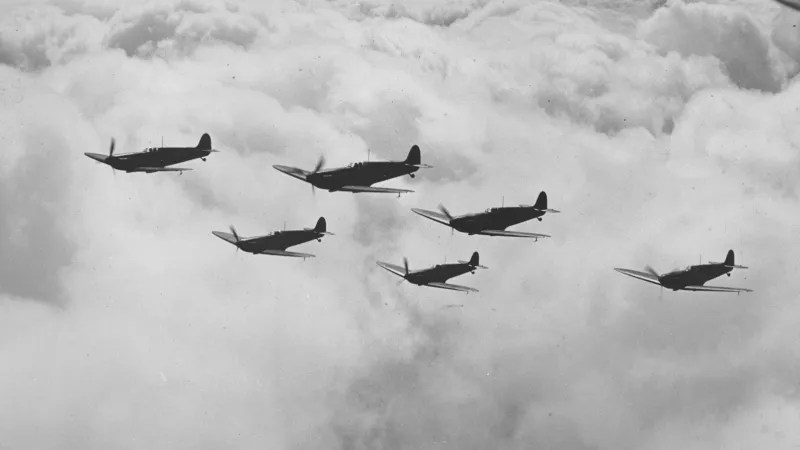
The Battle of Dakar began off the port of Dakar in French West Africa. The British fleet, which includes three battleships including HMS Barham and aircraft carrier HMS Ark Royal, stands offshore with transports full of Free French soldiers. Early in the morning, the Fleet Air Arm drops propaganda leaflets over the city delivering an ultimatum to surrender (one Skua lost at sea, pilot saved). Vichy French Governor of West Africa, Pierre Boisson, is not interested in talking things over, so the game is on.
Things get rolling around first daylight when the Ark Royal launches aircraft manned by Free French. In an overly optimistic miscalculation, they land at Dakar airport to be greeted as liberators but are immediately taken prisoner. In addition, a launch representing the Free French enters the port expecting to be greeted warmly, but turns back when fired upon.
The Vichy French lose two submarines. British destroyer HMS Fortune detects a Vichy French submarine, the Ajax (Q148), which it forces to surface and then sinks. All 61 on board survive. HMS Dragon, Foresight and Inglefield spot French submarine Persée (Q154) attempting to attack cruiser HMS Dragon and shell it, sinking it. Some reports state that torpedo planes sank the submarines, and with all the Royal Navy ships in the vicinity it well may have been a joint effort.
Around 10:00, Vichy French ships in the port sally. Cruiser HMAS Australia fires upon them and forces them back. This leads shore batteries to open fire on the Australia, which, along with the rest of the Royal Navy ships, returns fire. The Australia hits the Vichy French destroyer L’Audacieux, which turns it into a flaming inferno that has to be beached. There are 81 deaths and 186 survivors.
Royal Navy battleships Barham and Resolution exchange fire with anchored French battleship Richelieu and damage it, though it remains able to fire its main guns. HMS Dragon is damaged by shell splinters, wounding a crewman, while HMS Cumberland is hit in the engine room and retreats to Bathurst for repairs. Vichy French freighters Porthos Korsholm and Tamara are damaged.
The Royal Navy then moves further offshore after also damaging freighter Tacoma in the harbor, causing six crew deaths. The Tacoma has to be beached.
The British make the next move. They send three sloops full of Free French soldiers to Rufisque, southeast of Dakar. The Vichy French open fire, completely defeating the landing attempt (a very rare event during World War II) and damaging the Commandant Duboc. General de Gaulle, who is present, gives the order to retreat personally as he does not want to “shed the blood of Frenchmen for Frenchmen.”
During the afternoon, the Royal Navy ships approach the port again. This time, the French coastal batteries score some hits on the Barham. The Vichy French then launch an air raid on Gibraltar with 64 bombers based in Morocco and Algeria which causes minor damage.
As the day ends, little has changed, with the British standing offshore and the Vichy French holding tight to the port. That, in essence, is a victory for the Vichy French, but the British continue to lurk.
Lieutenant-Colonel Hans Speidel, Chief of Staff of the military commander in France, submits a detailed report to OKW and Hitler on the course of the aerial campaign against Great Britain. He notes that the battle opened well for the Luftwaffe, but fierce opposition caused the opening of attacks on London to begin too late, and poor weather made them ineffective. The delays enabled the RAF to recover by speeding up pilot training and plane production, with planes rolling straight from the factories into combat. Speidel observes that the new pilots were incompetent and had resorted to ramming Luftwaffe bombers. While crude, the tactics frustrated the Luftwaffe attacks on London and necessitated the third (current) phase of the battle, attacks on London by night and fighter raids by day. He concludes that the RAF Fighter Command is down to 300 fighters, with a production rate of 250 per month and notes:
“Our own forces still feel themselves to have the upper hand over the enemy, and are completely confident that the air war can be prosecuted successfully.”
In essence, Speidel places the blame for the Luftwaffe’s failures on fanatical and self-sacrificing RAF pilots and the weather. It is a classic evasion-of-blame report which reveals the continued myopia of the Luftwaffe intelligence section. In point of fact, the RAF still has about 700 fighters in good condition, roughly the same level it has had throughout the battle, and the quality of fighter is increasing as older models get shot down and replaced by newer ones. At this point, everyone knows that the Luftwaffe has not met Hitler’s objectives, so Speidel simply paints a happy face on the picture and ends with standard hopes for ultimate success.
Two German raids approached London, England, United Kingdom at 0930 hours and 1730 hours, but few aircraft reached London, turned back by RAF fighters; the Germans lost 10 Bf 109 and 1 Bf 110 fighters, while the British lost 11 fighters.
Weather over Great Britain: Mist and fog patches were to be expected in most areas but this would give way to a mainly fine day. Some patchy cloud could be expected, but generally mainly fine weather should prevail over most areas.
The rather peaceful periods that the aircrews had experienced over the last few days was about to end, much like the cloud and rain periods as the bright ball of the sun could be seen above the low lying mist and fog layers. Some aircrews may have been thrown into a false sense of security as the month’s combat actions had melted down to almost nothing.
But by 0840 hours radar stations from Foreness to Rye had detected four separate formations close together coming in from the Channel towards Dover. As they approached the Kent coastline they appeared to fan out with the outer formations coming in from Ramsgate and Brighton while the center ones came in over Deal and Folkestone. Again, as in the previous few days, they were Geschwaders of Bf 109s and the Observer Corps estimated their numbers as two hundred plus. Fighter Command is said to have released twenty-four squadrons, although later authorities have revised this to fourteen. Again the problem of The British fighters not being able to get to the desired height and position because of the time taken to gain height in a Bf 109 attack as they approached at a much faster rate than the bombers.
The formations of Bf 109s crossed the coast at about 0915 hours and eight of 11 Group squadrons managed to make an interception of the enemy when they were over North Kent. 257 Squadron (Hurricanes) Debden and 92 Squadron (Spitfires) Biggin Hill were among the first to intercept and a fierce dogfight took place off the coast near Herne Bay and Margate. One of the other formations were intercepted by 73 Squadron (Hurricanes) Church Fenton, 229 Squadron (Hurricanes( Northolt and 303 Squadron (Hurricanes) Northolt.
1000 Hours: An area from Dartford to Margate became a mass of twisting, whirling white vapour trails as the fighters from both sides weaved and spiraled against the backdrop of now bright blue sky. A spitfire of 92 Squadron Biggin Hill piloted by P/O A.J.S.Patterson, engaged in aerial combat over Gravesend was hit, forcing the pilot to break away from the action. He tried to make for the aerodrome at West Malling, but in an attempted forced landing the Spitfire crashed into the ground wounding P/O Patterson in the upper leg. Sgt D.J.Aslin of 257 Squadron Debden suffered burns when his Hurricane sustained a hit from one of the Bf 109s and caught fire over the Thames Estuary. He managed to bail out with his aircraft crashing near Eastchurch.
1100 Hours: The action continued as other British pilots come to grief. were four Hurricane’s from 73 Squadron (Church Fenton) had engaged combat over the Thames between Sheppy and Southend being jumped on by Bf 109s of IIJG/26 which were shot down in flames over the Isle of Sheppy and Thames Estuary, a Spitfire of 72 Squadron which crashed at Sittingbourne, a Spitfire II of 74 Squadron Coltishall which was shot down while in single combat with a Bf 109 and a Spitfire flown by P/O W.Beaumont of 152 Squadron but it is not known if he was engaged in combat over north Kent.
“Over London my Schwarm met a formation of Englishmen, around sixty fighters. I made a head-on attack on a Spitfire. The enemy tracer flew past my canopy, but the Englishman went spinning down in flames. Perhaps he had lost his nerve. Now a wild dogfight began. It was best to break away. Now I had four Spitfires on my tail. I was 18,000 meters, and I pushed the stick forward and dived away at full speed, pulling out at ground level with my wings fluttering. No British fighter could have followed my wild dive. I looked behind me. Damn! There were two Spits on my tail again. There was no time to draw breath. My only chance of escape lay in my flying ability at low level, hedgehopping to the Channel over houses and around trees. It was no use, one of them was always there and I couldn’t shake him off. He hung a hundred meters behind me. Then we were over Dover. I thought: He can’t keep this up as I fled out over the wavetops but the Spitfire stayed behind. I jinked to right and left as the pilot opened fire and the bullets splashed into the water in front of me. I blinked the sweat out of my eyes. The French coast was now in sight. My fuel was getting low. I kept squinting behind so as not to miss the moment when he broke away. Wait, my friend, I thought. ‘You must return soon, and then I will be the hunter. Cap Gris Nez loomed up in front, and I skimmed over it one meter above. Suddenly the Tommy climbed steeply and slowed down. At once I turned my Me 109 and zoomed up in a tight bank, engine howling, straight at him. I fired one burst from close range I nearly rammed him and the Spitfire went straight into the sea. He flew fantastically.”
- Wilhelm Balthasar,III/JG3, 23 September 1940
But it was not just the fighters of Fighter Command that were having a bad day. The Luftwaffe suffered just as bad. F/Lt Brian Kingcombe of 92 Squadron Biggin Hill managed to score a direct hit on a Bf 109 near Maidstone. The pilot Bailed out and was captured. Another of the 92 Squadron Spitfires being flown by P/O J.F.Drummond damaged the cooling system of a Bf 109 north of Maidstone and it was forced down finally finishing up in a pond where the pilot also was taken prisoner. 72 Squadron also claimed credit for destroying a Bf 109 that was to dive into the Channel off Folkestone. The Poles of 303 Squadron also increased their tally by another two when they claimed two Bf 109s over the Thames Estuary while 257 Squadron and 605 destroyed one each. In all, ten Bf 109s either crashed on English soil, or crashed on landing due to battle damage and were all destroyed while four managed to return back to their French bases with sustained battle damage.
A lone Ju 88 on a photo or weather reconnaissance mission was detected over the Channel south of the Isle of Wight and 234 Squadron from Middle Wallop sent one flight to intercept. The Junkers was shot down and made a belly landing in the sea. All the crew managed to get out of the sinking aircraft and was captured by British authorities.
Another small number of enemy aircraft got through and according to the station records book at Fowlmere, they came under attack at 1530hrs. One Spitfire was destroyed and a number were damaged. There was no damage to any buildings or to the airfield. There is a possibility that the attack on Fowlmere, was by the Bf 109s that were detected earlier over London, but this cannot be said for any certainty.
The afternoon was again peaceful after a busy morning, much to the delight of the aircrews, although one station commander stated to one of his squadron leaders “….that if things remain this quiet, you sure you won’t get bored?” But during the evening, as usual, things started to change. Wave upon wave of Heinkels, Junkers and Dorniers threw everything at London. The city had many heavy nights of bombing, but this was by far the heaviest. By midnight, it looked as if there was a sunset over London, the night sky was that red.
Fighter Command sent up a number of Defiant and Blenheim night fighters, but with Britain night fighting ability still in its infancy, and about a dozen ‘nighties’ up against an estimated 125 bombers, their task was almost an impossibility. After forty five minutes they returned to their bases.
But the night time attacks on the British capital and other major centers around Britain, the intensity of the night attacks remained heavy. The British War Cabinet decided to retaliate and ordered indiscriminate attack on Berlin with parachute mines. But, the Air Staff issued the directive that only targets that comprised any military value should only be attacked and that areas of civilian and residential areas should not be targeted.
RAF Casualties:
1100hrs: Over Channel. Spitfire R6896. 234 Squadron St Eval
P/O T.M. Kane Confirmed P.O.W. (Was flying routine patrol but believed crashed in Channel off French Coast)
1130hrs: Over Channel. Spitfire P9371 74 Squadron Coltishall
Sgt D.H. Ayers Listed as missing. (Chased Bf 109 to French coast but was shot down and crashed into sea)
Unknown Time: Spitfire R7016. 152 Squadron Warmwell
P/O W. Beaumont Listed as missing. (Failed to return from operational sortie. Last seen over the Channel)
The above casualty list does really not reflect on the combat action of the day. In total, eleven Hurricanes and Spitfires were lost due to combat action. Four pilots managed to bail out of their damaged aircraft, while four crash landed. Of the eight, six pilots received burns or severe wounds.
King George VI of the United Kingdom instituted the George Cross award as the equivalent of the Victoria Cross for civilians.
Werner Mölders was awarded the 2nd Knight’s Cross of the Iron Cross with Oak Leaves (Ritterkreuz des Eisernen Kreuzes mit Eichenlaub) on 21 September 1940 for becoming the first pilot to get credit for 40 victories. Adolf Hitler personally pins it on him today in the new Reichskanzlei in Berlin. Afterward, his boss Hermann Göring invites Mölders to his hunting lodge in the Rominter Heide.
Hans-Joachim Marseille has to bail out over the Channel after his plane takes damage about 10 miles off Cap Gris Nez. He is shaken up and spends hours in the water. Fortunately, a Heinkel He 59 spots him and returns him to a field hospital. As usual, there is disputed credit for his shoot-down, but the best case seems to lie with Robert Stanford Tuck. Marseille, developing into a very talented pilot, also is developing a reputation as an uncontrollable pilot who does not follow orders, in other words, a bit of a prima donna.
Overnight, German bombers attacked London and Liverpool. London is attacked all night long until shortly before sunrise. Particularly hard hit are the Clarnico factory, West Ham (numerous fires), Stevenage Wharf, Bexhill, Hastings, and Seaford.
RAF Bomber Command dispatches 12 Blenheims on uneventful daylight sea and coastal sweeps.
In a unique raid for this period of the war, RAF Bomber Command decided to concentrate its main strength of bombers for an attack on targets in just one German city: Berlin. 129 Hampdens, Wellingtons and Whitleys were dispatched overnight to 18 separate targets in Berlin. These targets were: 7 railway yards, 6 electrical power-stations, 3 gasworks and 2 factories making aero engines or aircraft components. 112 aircraft reported having bombed in a 3-hour period and from heights between 4,500 and 16,000 ft. Many searchlights and a ground mist made identification of targets very difficult 3 aircraft, 1 of each type, were lost. Unfortunately the relevant pages for this raid are missing from Berlin’s air-raid records, possibly being removed immediately after the raid so that a record of it should not remain available to any civilian official. It is believed that most bombs fell in the Moabit area of the city where a power-station was one of the selected targets. The famous Schloss Charlottenburg was slightly damaged. No other details are available.
A subsequent press release from the British Air Ministry describes it:
“Throughout last night [Monday] strong bomber forces of the R.A.F. delivered a heavy attack on military objectives in and around Berlin. This attack was on a much larger scale than any yet carried out, and preliminary reports show that extensive damage was done. Among the targets selected by our aircraft and heavily bombed were Rangsdorf railway station and several goods yards, including that at Grünewald; the west tower of Wilmersdorf electric power station; gasworks at Dantzigerstrasse and Neukölln; factories at Charlottenburg and Spandau, including Brandenburg motor works, and other objectives.”
Also, 71 aircraft — 46 Blenheims and 12 Battles, with 8 Wellingtons and 5 Whitleys probably manned by new, ‘freshman’ crews — attacked Boulogne, Calais and Flushing, and 9 O.T.U. crews operated over France and the Channel Islands, all without loss. The total number of aircraft dispatched on this night — 209 — was another new record and it was the first time that the 200 figure was exceeded.
The RAF attacks the Italian fortress of Tobruk and the airfield at El-Menastir, Libya. Royal Navy gunboat HMS Ladybird bombards Sidi Barrani.
King George VI gave a radio address from an underground air-raid shelter at Buckingham Palace. The King declared that Britain would be victorious with the aid of “our friends in the Americas.” He also announced the creation of the George Cross and George Medal, new civilian awards for heroism. These awards typically go to people who perform heroically during the Blitz, such as rescuing people at the peril of their own lives. Many are awarded posthumously. The George Cross is intended as the civilian equivalent of the Victoria Cross, but in practice is awarded to primarily military personnel.
Strong Nazi warnings to Egypt and Greece to renounce their ties with Great Britain were issued tonight as Foreign Minister Joachim von Ribbentrop returned from his Rome talks and went into immediate consultation with Chancellor Hitler.
Dutch Nazi collaborator Mussert’s first meeting with Adolf Hitler.
Dutch artist Piet Mondrian leaves Europe for New York, where he lives for the rest of his life.
Vichy France and Poland broke off diplomatic relations.
Prime Minister Churchill has worries about Malta. He agrees with a note from Malta Governor Dobbie that there are insufficient ground troops there. In a note to the Chief of the Imperial General Staff, he notes:
“The telegram (from Malta Cmd) confirms my apprehensions about Malta. Beaches defended on an average front of 15 miles, and no reserves for counter-attack worth speaking of, leave the Island at the mercy of a landing force. You must remember that we do not possess the command of the sea around Malta. The danger therefore appears to be extreme. I should have thought four battalions were needed…”
He also sends another note to the Secretary of State for War warning that Malta could be attacked “at any time.”
On Malta itself, three Wellingtons arrive at Lupa Airfield during the morning, but one crashes upon landing and is out of action for the foreseeable future. Two Sunderland Short flying boats arrive at Kalafrana with some workers for the dockyards.
Light cruiser HMS Nigeria was completed. She arrived at Scapa Flow on the 29th for working up and duty with the 10th Squadron.
Anti-aircraft ship HMS Alynbank arrived at Scapa Flow from the Clyde to operate with the Home Fleet to provide anti-aircraft protection to convoys between Pentland Firth and Methil.
Destroyers HMS Broke, HMS Vansittart, and HMS Whitehall and Polish destroyers ORP Blyskawica, ORP Garland, and ORP Burza departed the Lizard at 2030/23rd on operation GL. They swept north off the French coast north from Ushant. Destroyer Blyskawica sank a French cutter.
During the night of 23/24 September, destroyers HMS Wolverine, HMS Viscount, HMS Witherington, and HMS Brilliant attempted to intercept a German merchant ship going down Channel. The destroyers did not contact the merchant ship.
German steamer Heimdal (2186grt) was sunk seven miles northwest of Terschelling by Submarine H.49 (Lt M. A Langley).
Submarine HMS Cachalot laid minefield FD.27. This minefield was 50 mines in a one and a half mile line from 47-48N, 4-33W extending the 19/20 August FD.24 minefield. Due to demands for submarines for patrol duties, the minelaying submarines were returned to patrol duties on the 26th.
British steamer Corinia (870grt) was damaged by German bombing at Gravesend Reach.
British steamer Pacific Grove (7117grt) was damaged by German bombing five miles northwest of Tory Island.
In naval grid BF 17 U-48 and U-99 search for a crashed German He 111 aircraft
The store ships and British tanker Ocean Coast departed Freetown for MENACE operations on the 18th. On 21 September, British Force M.and the troopships for MENACE departed Freetown. Aircraft carrier HMS Ark Royal, battleships HMS Barham and HMS Resolution, heavy cruisers HMS Cumberland, HMAS Australia, and HMS Devonshire, light cruiser HMS Dragon (Dragon was a replacement for destroyer HMS Eclipse which developed engine problems), destroyers HMS Greyhound, HMS Inglefield, HMS Foresight, HMS Forester, HMS Fortune, HMS Faulknor, HMS Fury, HMS Escapade, HMS Echo, and HMS Eclipse, French sloops Savorgnan De Brazza, Commandant Duboc, and Commandant Domine, armed trawlers HMS Vaillant (943grt) and HMS Vikings (1150grt), Dutch liners Pennland (16,082grt) and Westernland (16,479grt), transports Kenya, Sobieski, Karanja, and Ettrick, cargo ships carrying tanks, crated aircraft, guns, et al, Anadyr (5278grt), Casamance (5817grt), Fort Lamy (5234grt), and Nevada (5693grt), and British tanker Ocean Coast (1173grt) comprised the allied ships for MENACE.
At Dakar opposing the Anglo French force were battleship Richelieu, light cruisers Montcalm and Georges Leygues, large destroyers Audacieux, Fantasque, and Malin, destroyer Le Hardi, sloops Gazelle, Surprise, Annamite, D’Iberville, and Commandant Riviere, and submarines Persee and Ajax with submarine Beveziers in dock.
The French light cruisers attempted to leave Dakar when the allied attack began. The Free French sloops Savorgnan De Brazza, Commandant Duboc, and Commandant Domine attempted to land troops without success and Commandant Duboc was damaged. Vichy French submarine Persee attempted to torpedo Light cruiser HMS Dragon, but was sunk by Dragon and destroyers HMS Foresight and HMS Inglefield. Vichy French large destroyer Audacieux was hit by gunfire from Heavy cruiser HMAS Australia and destroyers HMS Greyhound and HMS Fury and set afire. Eighty one crewmen were killed or missing. One hundred and eighty six survivors from Audacieux were rescued by Vichy sloop Surprise. After emergency repairs, destroyer Audacieux departed Dakar on 7 August 1941 and arrived at Casablanca on 11 August. She departed on 17 August and arrived at Oran on 18 August. Departing on 20 August, she arrived at Bizerte on 22 August.
Heavy cruiser HMS Cumberland was hit in the engine room by a 9.4-inch shell. The shell severed a steam pipe which temporarily cut off all electrical power to the ship. Commissioned Electrician J. W. Dowthwaite was killed. Cumberland was forced to retire at 10 knots to Bathurst for repairs, arriving on the 24th. She left Bathurst on the 26th and arrived at Freetown on the 27th. Light cruiser HMS Dragon was damaged by splinters from French gunfire. Commissioned Schoolmaster H. G. Middleton was wounded.
While pursuing French submarines Ajax and Persee, destroyers HMS Inglefield and HMS Foresight were hit by shore gunfire, but neither required immediate repair. Temporary Surgeon Lt M. R. J. Behrendt RNVR, and six ratings were wounded on destroyer Inglefield. Three ratings were killed in destroyer Foresight. Destroyer Inglefield departed Gibraltar on 31 October for London where she was under refit and repair until 20 January 1941. Destroyer Foresight departed Gibraltar on 31 October for Liverpool where she was under refit and repair until 30 December.
S/Lt (A) G. W. Brokensha of 803 Squadron, returning to aircraft carrier HMS Ark Royal, crashed landed his Skua at sea and was rescued by destroyer HMS Greyhound.
Danish steamer Tacoma (5905grt), which had been captured by Vichy forces in July, was sunk at Dakar. French steamer Porthos (12,692grt) and Swedish steamers Korsholm (2647grt) and Tamara (6390grt) were damaged.
While examining an Italian torpedo found ashore six miles west of Agami, the Torpedo Officer Lt Cdr J. G. S. Cunningham, Gunner (T) E. G. Lee, and two ratings of depot ship HMS Medway were killed when the torpedo exploded.
Australian light cruiser HMAS Sydney completed a refit at Alexandria begun earlier in the month.
British gunboat HMS Ladybird, which had departed Alexandria for Mersa Matruh on the 20th, bombarded Sidi Barrani.
The Norwegian freighter Tirranna, captured by the German commerce raider Atlantis on June 6, was sunk off the coast of France near Bordeaux by the submarine HMS Tuna. The Tirranna was carrying 274 prisoners and a nineteen-man prize crew. 86 of the captured prisoners and one of the prize crew were killed.
Convoy FN.289 departed Southend, escorted by destroyer HMS Winchester and sloop HMS Egret. The convoy arrived at Methil on the 25th.
Convoy OB.216 was dispersed at 17W. Sloop HMS Scarborough and other escorts joined other convoys.
US destroyers of Destroyer Divisions 76 and 79 were transferred under Lend Lease to the Royal Navy at Halifax.
US Name — British Name — Commanding Officer
USS Thomas (DD-182) — HMS St Albans — Cdr F E Wilmot-Sitwell Rtd
USS Cowell (DD-167) — HMS Brighton — Cdr C W V T S Lepper Rtd
USS Maddox (DD-168) — HMS Georgetown — Lt Cdr A G Poe
USS Foote (DD-169) — HMS Roxborough — Lt V A Wight-Boycott OBE
USS Kalk (DD-170) — HMS Hamilton — Cdr L M Shadwell
USS Hopewell (DD-181) — HMS Bath — Cdr A V Hemming Rtd
USS Abbott (DD-184) — HMS Charleston — Lt Cdr T Johnston
USS Doran (ex-Bagle, DD-185) — HMS St Marys — Lt K H J L Phibbs
Later, on the 29th when HMS Roxborough, HMS Brighton, HMS Bath, HMS St Albans, HMS St Marys, and HMS Charleston departed St Johns, all but Roxborough which had to turn about with excess fuel consumption, reached Belfast on 8 October and Devonport on 12 October.
Destroyers HMS St Albans, HMS St Marys, HMS Bath, and HMS Charleston were permanently assigned to the 1st Minelaying Squadron.
Destroyer HMS Roxborough departed Halifax on 7 December for Belfast.
The other two destroyers of this group HMS Georgetown and HMS Hamilton damaged their propellers in a collision on 1 October while preparing to fuel at St Johns. Destroyer Georgetown arrived at Devonport on 13 November. Destroyer Hamilton undocking from repairs at St Johns ran aground and broke her back on 26 October. Destroyer Hamilton was transferred to the Canadian Navy in late October and was under repairs under June 1941. She was formally commissioned HMCS Hamilton on 6 July 1941.
Today in Washington, the Senate debated whether to consider the Ramspeck Civil Service Bill or the Logan-Walter measure to check the activities of administrative agencies; heard Senator Hatch declare trainees and National Guardsmen would come under the provisions of the Hatch act, and recessed at 5:06 PM until noon tomorrow. A Judiciary subcommittee heard further support of anti-third-term resolutions and the Foreign Relations Committee voted to ask State Department representatives to testify tomorrow on the Havana convention.
The House passed by a vocal vote the $267,733,728 Civil Functions Deficiency Bill; heard Representative Andresen say that President Roosevelt, if re-elected, might turn over his office to Henry Wallace; tabled the Rogers resolution requesting Secretary Hull to furnish information on further military aid to Great Britain, and adjourned at 5:07 PM until noon tomorrow.
President Roosevelt asked today, in an identical letter to each of them, the cooperation of the forty-eight governors in setting up localized and civilian control of the registration October 16 of 16,500,000 young men for possible military training of a year, under the Selective Service Act. Preliminary details of registration machinery were set forth in an Executive order of two volumes, totaling sixty-one pages. More volumes of rules will follow. From among the eligibles registering 400,000 will be called for immediate training. A second contingent of 400,000 will be called in the next year. Many exemptions are included in the law and in today’s order, as well as alternative methods of registration. President Roosevelt made public a copy of the long letter sent to each governor asking him to “set up and supervise the selective service system.” He asked the cooperation of State and local election boards in conducting the registration and requested that the governors nominate promptly the members of draft boards in order that the President might ratify their appointments, as required by the law.
President Roosevelt called upon the members of the American Legion today “to play their full part in keeping the war away from our shores and in preventing it from imperiling our freedom, our institutions, our America.”
The House passed by a voice vote and sent to the Senate today the $267,733,728 Civil Functions Deficiency Bill. One of the important provisions was an $80,000,000 appropriation toward a projected $500,000,000 program for enlargement and improvement of civil airports in the nation. The measure is presumably next to the last of the appropriations bills which Congress will consider this session, under plans of leaders. The next House bill, which probably will be ready by midweek, is the last deficiency bill. It will contain funds to pay trainees under the Burke-Wadsworth Compulsory Military Training Act.
Final action this week on the $400,000,000 excess-profits tax and amortization bill was forecast today after Senate and House conferees, at two meetings, laid the groundwork for composing the differences in the texts of the two houses.
Two persons were killed and 11 slightly injured today in an explosion at the United States army’s Picatinny arsenal. It was the second fatal munitions blast in the Dover area within a fortnight, the explosion of a smokeless powder line at the Kenvil plant of the Hercules Powder Co., September 12 having taken 50 lives.
The sinking of a British refugee liner by a submarine was condemned today by Secretary of State Cordell Hull as “a most dastardly act.” The Secretary chose the occasion of his press conference to express this government’s feelings upon the tragedy, which resulted in the loss of eighty-three of ninety British children seeking sanctuary in Canada and of 293 persons in all. Mr. Hull said he was “sure there will be no division of opinion in this country that it was a most dastardly act.” The liner was torpedoed without warning last Tuesday by a submarine about 600 miles off the coast of Great Britain. Only 113 of the 406 persons aboard were reportedly rescued.
The U.S. Army has contacted 135 companies with its request for a new small transport vehicle. American Bantam Car Company today submits its hand-built prototype “Pilot” aka “Blitz Buggy” aka “Bantam Reconnaissance Car” to the Army at Camp Holabird, Maryland. The Army likes the Karl Probst design, but Bantam is bankrupt and too small to fill the order. The Army turns the design over to Willys-Overland and Ford for further refinement and development. The prototype delivered today ultimately leads to the ubiquitous Jeep.
The results of a Gallup poll were published asking Americans, “Which of these two things do you think is the most important for the United States to try to do — to keep out of war ourselves or to help England win, even at the risk of getting into the war?” 52% said help England, 48% said keep out.
Charles Coughlin is a well-known opponent of the war known as the “Radio Priest.” A Detroit priest who is known as “Father Coughlin,” he has had a popular radio show for many years that is widely considered to be anti-Semitic, anti-Roosevelt and anti-war. While his radio audience is immense, reaching up to 30 million per week, he is a very controversial figure not just in the public, but within the Church, where Bishop Michael Gallagher of Detroit allowed him to remain on the air (until his passing in 1937) despite pressure from everyone above.
Today, Coughlin announces in his popular publication Social Justice that he had been forced from the air “by those who control circumstances beyond my reach.” This is almost certainly a result of the adoption of new rules which curb the sale of radio time to “spokesmen of controversial public issues” in October 1939, which require that such spokesmen submit copies of their speeches in advance and threaten stations with loss of their licenses.
Lieutenant William T. Hulson, 27, of Colchester, Illinois, was killed today after his naval fighting plane plunged into the Pacific Ocean four miles offshore near San Clemente, California, during a routine gunnery flight. Naval authorities said Hulson, who was alone in the craft, bailed out, but apparently was flying too low for the parachute to properly function. He was killed in the impact with the water. The accident occurred 12 miles southwest of Dana Point. The plane was attached to fighting squadron 3, USS Saratoga.
The light cruiser USS St. Louis arrived at Boston, Massachusetts but set sail for Norfolk, Virginia the same day. Embarked was the Greenslade Board. The Greenslade Board was a committee formed “to make a comprehensive study of the shore establishment (naval and commercial) necessary to support the Fleet in peace and war.” With the strategic requirements of the fleet in mind, the board was instructed to make recommendations for additional facilities in new locations and as to the expansion, limitation, contraction, abandonment, or conversion of existing shore facilities. The board was known by its senior member, Rear Admiral John W. Greenslade. The board, headed by Rear Admiral John F. Greenslade, which would evaluate base sites acquired from the British on September 5 in the destroyers-for-bases agreement.
Major League Baseball:
Despite stranding 11 runners in the first 7 innings, Brooklyn beats the visiting Giants, 3–2, scoring 2 in the 8th and 1 in the 9th. Dolph Camilli homers into the centerfield bleachers with 2 out in the 9th. Winning pitcher Tex Carleton relieves in the 9th with runners on second and third and one out. He intentionally walks pinch hitter Joe Moore to load the bases. He sprawls snagging Johnny McCarthy’s popped bunt attempt for one out and then scrambles to first base to complete the unassisted double play. The Dodgers score in the 9th and Tex picks up his 100th win in his final Major League appearance.
Ben Warren gave the Phillies an even split in a double-header with the Bees today when he reached Manuel Salvo for a pair of home runs in the opener, which Philadelphia won, 6-2, behind Johnny Podgajny’s six-hit pitching.
Before a Wrigley crowd of 1,843, Claude Passeau notches his 20th win as he scatters four Cardinal hits. Passeau, in recording his fourth shutout of the season, hurled hitless ball for five innings. No runner reached third base. Passeau helps his cause with a home run in the 10–0 romp.
The Pirates stopped Joe Beggs’s ninegame relief winning streak today and took a series with the champion Reds for the first time this year by winning the odd game, 12–9. The contest was the last of the season at Forbes Field.
New York Giants 2, Brooklyn Dodgers 3
Philadelphia Phillies 6, Boston Bees 2
Philadelphia Phillies 0, Boston Bees 8
St. Louis Cardinals 0, Chicago Cubs 10
Cincinnati Reds 9, Pittsburgh Pirates 12
The trial of eight Nazi leaders charged with conspiracy to seize Uruguay as a German colony began today, within twenty-four hours after the indictment against them had been issued and the bringing of the last three defendants from interior points to Montevideo yesterday.
Convoy BN.6 departed Bombay, escorted by armed merchant cruiser HMS Hector. The convoy was joined on the 25th by armed merchant cruiser HMS Antenor. Both were detached on 1 October when light cruiser HMAS Hobart joined the convoy. Sloops HMIS Hindustan and HMAS Parramatta joined on 3 October and destroyer HMS Kingston and sloop HMS Auckland on 4 October. Light cruiser Hobart was detached on 4 October and sloop Hindustan was detached on 8 October. The remainder of the escort was detached on 9 October when sloops HMS Clive and HMS Grimsby joined. The convoy arrived at Suez on 11 October.
Light cruiser HMS Durban arrived at Hong Kong.
The U.S. State Department issued a statement expressing its disapproval of the developments the previous day where the Vichy French gave into Japanese demands in French Indochina. Secretary of State Cordell Hull attends a press conference today at which he states:
“Events are transpiring so rapidly in the Indochina situation that it is impossible to get a clear picture of the minute-to-minute developments. It seems obvious, however, that the status quo is being upset and that this is being achieved under duress. The position of the United States in disapproval and in deprecation of such procedures has repeatedly been stated. his government has not at any time or in any way approved the French concessions to Japan. The attitude of this government toward developments in French Indochina is as expressed by the Secretary of State this morning and in previous public statements.”
Japanese troops invaded Indochina despite French agreement to Japanese demands during negotiations on the previous day. Domei, Japanese news agency, reported today from French Indo-China, that 131 Indo-Chinese had been killed in fighting with Japanese at an undisclosed point as the Japanese pushed forward into the French colony under Sunday’s accord. It said the Japanese captured 240 prisoners, including several French officers, and a quantity of arms and ammunition. Japan drove ahead for “all such facilities as are required” in France’s Indo-China colony, contemptuous of censure abroad and the resistance of Indo-Chinese forces still fighting near the frontier. The Japanese press lauded the army’s action. The Japanese government will reject unhesitatingly any third country’s protest, the newspaper Yomiuri said. Nichi Nichi declared that “if there are any foreign powers who dare interfere with this sacred mission, Japan should exterminate them.”
With Japanese troops pouring across the border, a Vichy French garrison at Da Nang, a coastal city about midway down the shoreline, defends the city. The Japanese quickly take control of Tonkin Province and today bomb the French airfield at Lang Son. French negotiators in Japan request a cease-fire.
The air bases that Japan is obtaining in French Indo-China will bring the Burma Road within 200 miles of flying distance.
Anticipating charges that the FrancoJapanese accord in French Indochina was reached under the stress of German pressure, Foreign Minister Paul Baudoin in a statement to the foreign press tonight denied that there had been any intervention at all.
Dow Jones Industrial Average: 135.1 (+2.65)
Born:
Michel Temer, Brazilian lawyer and 37th President of Brazil (2016-18), born in Tietê, Brazil.
Leonard Lopate, American radio host (WNYC, 1985-2017), in Queens, New York, New York (d. 2025).
Tim Rose, American singer-songwriter, in Washington D. C. (d. 2002).
Mohammad-Reza Shajarian, classical singer and composer, in Mashhad, Iran (d. 2020).
Died:
Hale Holden, 71, American railroad executive.
Naval Construction:
The Royal Fleet Auxiliary Ranger-class fleet support tanker RFA Green Ranger (X 42; later A 152) is laid down by the Caledon Shipbuilding & Engineering Company (Dundee, Scotland).
The Royal Australian Navy Bathurst-class minesweeper-corvette HMAS Mildura (J 207) is laid down by the Morts Dock & Enginering Co. Ltd. (Sydney, New South Wales, Australia).
The U.S. Navy submarine USS R-1 (SS-78) is recommissioned into service. Her commanding officer on recommissioning is Lieutenant Commander James Donald Livingston Grant, USN.
The Royal Navy (former U.S. Navy) Town-class destroyers HMS Bath (I 17), HMS Brighton (I 08), HMS Charlestown (I 21), HMS Georgetown (I 40), HMS Hamilton (I 24), HMS Roxborough ( I 07), HMS St Albans (I 15), and HMS St Marys (I 12) are commissioned.
The Royal Navy Fiji-class (Crown Colony-class) light cruiser HMS Nigeria (60) is completed. Her first commanding officer is Captain John George Lawrence Dundas, RN.
 History Diaries