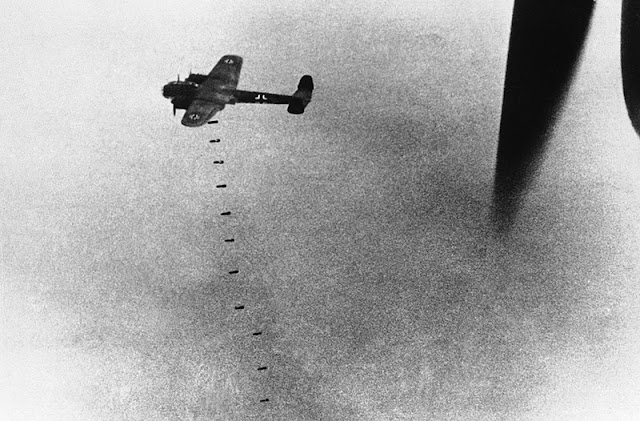
Today, like most mornings the pilots on all the forward sector and forward aerodromes woke up wondering just what the day would bring. The day previous was exceptionally quiet, but this did not place anybody into a sense of false security. Yesterday, operations were relatively easy, spasmodic attacks by lone aircraft during the day while more concentrated attacks occurred after dark as would be expected. But even though the Luftwaffe only lost some six or seven aircraft, Fighter Command did not lose a single aircraft or pilot which shows the inactivity of the day.
Weather over Great Britain: The morning would be reasonably fair with scattered cloud with showers expected by midday and these would continue throughout the day.
It was another of those mornings where there was an abundance of blue sky and scattered cloud, but the radar screens at the south coast radar stations were totally clear. Pilots at most of the airfields had checked out their aircraft and waited patiently lazing around. Some flights from individual squadrons made routine patrols of the south coast………but nothing. But it is in these quieter moments that many of the newer pilots are given further training by the more experienced pilots. Fighter Command had taken the opportunity in reinforcing many of the squadrons with fresh aircraft and an influx of new pilots. New pilots maybe, but with very little experience.
“Two further pilots have come to us straight from a Lysander squadron with no experience on fighter aircraft. Apparently demand has now outstripped supply and there are no trained pilots available in the Training Units, which means that we will just have to train them ourselves. However it remains to be seen whether we can spare the hours, as we are already short of aircraft for our own operational needs. It seems a very funny way to run a war.”
- Sandy Johnstone 602 Squadron — a comment made during early September.
1050 Hours: The quiet of the early morning was broken at 1030 hours when radar had picked up a German formation that was coming across the Channel from the direction of Calais and by 1100 hours a formation of 20 plus Bf 109s at 15,000 feet crossed the coast at Dungeness, with other formations of 50 plus Bf 109 aircraft crossing the coast in the region of Dover. The radar at Foreness picked up another formation that had stayed out to sea and came in through the Thames Estuary. This was another change of tactic by the Luftwaffe, although it was not the first time that they had sent in Bf 109s en masse on daytime attacking raids.
Fighter Command released fifteen squadrons including 72 Squadron Biggin Hill (Spitfires), 92 Squadron Biggin Hill (Spitfires), 222 Squadron Hornchurch (Spitfires), 253 Squadron Kenley (Hurricanes) and 605 Squadron Croydon (Hurricanes). The Luftwaffe in this attack had the upper hand by sheer weight of numbers.
“It was always exciting watching the dogfights over the Kentish fields and the English Channel, I suppose little did we realize then that men were up there fighting for their lives and many of them were being killed or seriously wounded. The long twisting white vapor trails left a messy woven pattern in the skies, while most of those that were going to crash trailed columns of black smoke although there were times when you saw just a single dot slowly get bigger and bigger going straight down to crash into the sea with a giant plume of white spray.
“I remember on this occasion the melee commenced just as the planes of both sides came over the cliffs, they were high and the vapor trails started to get more and more intense. One plane dived straight down going round and round with little puffs of smoke that appeared to be coming from the back of the plane, then it crashed into the ground with an almighty bang. Then a German plane came down from a great height and levelled out just above the ground. He was closely followed by a Spitfire, a plane that we all got to know. The German plane weaved left and right but the Spitfire seemed to stick to him like glue, and we had to duck as we felt that they were so low that they would have taken our heads off. Then they turned and flew out to sea, we waited to see if the German was going to crash but they disappeared.”
- Pamela Watson — Reading. Talking of childhood memories.
Is was a possibility that both waves of German fighters were targeting London, but over the Kentish countryside, what the RAF fighter pilots lacked in numbers they made up for in skill even if they did sustain many casualties. The combat action was sustained over the fields of Kent and at the mouth of the Thames near Southend and Sheppy with neither formation making much progress towards their objective.
One of the first aircraft of Fighter Command to go down was the Spitfire of P/O H.L.Whitbread of 222 Squadron Hornchurch at 1115hrs. A Bf 109 came from above and took him by surprise and the Spitfire crashed at Higham near Rochester killing the pilot. At about 1130hrs, 253 Squadron Kenley had three Hurricanes shot down between Ashford and Maidstone. All three pilots, P/O A.R.H.Barton, Sgt A.R.Innes and an unnamed pilot all escaped serious injury. P/O W.J.Glowacki was unhurt as his Hurricane of 605 Squadron Croydon was hit by gunfire from a Bf 109 but was one of the lucky ones in being able to return to base. By 1135hrs, 92 Squadron Biggin Hill lost two pilots when they became seriously involved in combat in the Dover/Dungeness area. One Spitfire crashed at West Hougham and another crashed in the Channel, both the victims of Major Mölders.
It should be noted here that although mass daylight attacks had occurred with the use of Bf 109 fighters only, they were causing more than a headache for Fighter Command. The sheer weight of numbers were causing all sorts of headaches for both Hurricane and Spitfire squadrons. The techniques involved when fighter was against fighter and were quite different to those when the German Bf 109s were involved with providing escort.
“We in JG52 were very inexperienced. In two months our strength fell from thirty-six pilots to just four. We really wasted our fighters. We didn’t have enough to begin with, and we used them in the wrong way, for direct close escort. We were tied to the bombers, flying slowly — sometimes with flaps down — over England. We couldn’t use our altitude advantage nor our superiority in a dive. of course, the Spitfire had a marvelous rate of turn, and when we were tied to the bombers and had to dogfight them, that turn was very important.”
- Gunther Ball 8/JG52
Reichsmarschall Herman Göring, still keeping a close eye on developments, is excited at the day’s successes. He immediately orders that each fighter group convert a full third of its fighters to carry bombs. This results in 200-250 fighter-bombers entering service over the next two weeks but seriously weakens the fighter force. The fighter pilots such as Galland are violently opposed to this change, but the OKL (Luftwaffe High Command) is living in a fantasy world where the RAF is virtually beaten and bombing cities is the path to victory. This is Luftwaffe military intelligence at its lowest ebb — well, maybe it does get lower, but this is pretty low.
The mornings attack was the only main combat of the day. But is had been a terrible blow to Fighter Command. of the five pilots killed in the attack, four of them at least were experienced seasoned pilots, pilots that were still badly needed. The Bf 109 pilots, whether experienced or not had this day gained a slight advantage by downing more British fighters than they had lost themselves. Maybe the Luftwaffe would learn by this result, and that in the days to follow, more Geschwaders of Bf 109s would make the daylight attacks and try to make up for the disastrous losses that they had so far they experienced. We will have to wait and see.
RAF Casualties:
1020 Hours: Canterbury. Spitfire X4410. 72 Squadron Biggin Hill
P/O D.F. Holland Killed. (Bailed out after being shot down by Bf 109s. Died on admission to hospital)
1115 Hours: Rochester. Spitfire N3203. 222 Squadron Hornchurch
P/O H.L. Whitbread killed. (Shot down by Bf 109s and crashed at Pond Cottage. Thrown clear but dead)
1130 Hours: Amesbury. Hurricane L1595. 56 Squadron Boscombe Down
Sgt C.V. Meeson killed. (Crashed during formation flying practice)
1134 Hours: West Hougham. Spitfire X4417. 92 Squadron Biggin Hill
P/O H.P. Hill. Killed. (Shot down by Major Moelders in Bf 109 and burst into flames on crashing)
1134 Hours: Dungeness. Spitfire N3248. 92 Squadron Biggin Hill
Sgt P.R. Eyles Posted as missing. (Crashed into the Channel after being shot down by Major Moelders)
Werner Mölders shot down two Spitfire fighters of No. 92 Squadron RAF near Dungeness, England, United Kingdom, which were the 39th and 40th victories.
Overnight, London was again attacked by German bombers.
RAF Bomber Command dispatches 6 Blenheims on an uneventful daylight North Sea sweep.
RAF Bomber Command dispatches 172 aircraft of all types overnight. Most of the effort was to Channel ports but small raids on German railways and canals, French airfields and minelaying at St-Nazaire. 1 Wellington lost.
The RAF bombs Italian airfields supporting the invasion troops at El-Menastir, Libya and the motor pool at Sidi Barrani. The RAF also operates further south, hitting Dire Dawa in Abyssinia, Berbera in British Somaliland and the Gura airfield in Eritrea.
General von Bock opens Army Group B headquarters in Berlin to prepare for Operation BARBAROSSA.
Appealing to the French population to accept their ordeal with courage, discipline and dignity, the Agriculture Minister, Pierre Caziot, today announced severe rationing measures, effective Monday, for bread, meat and derived products, milk, fats, and oils and coffee in free and occupied districts.
The British Government was reconsidering tonight its policy of closing London subways to people seeking shelter during the all-night air raids. Faced with making a decision to force thousands of people, many of them homeless, out of the subways or to reverse its policy and allow the subways to be used, the government, it appears, will concentrate on controlling the flow of people into the stations.
At Malta, no air raid sirens sound, but a serious morale problem is growing worse because of a lack of mail. The start of the Blitz back home in England has magnified the worries of island troops and workers about the condition of family in London, Liverpool and elsewhere. Governor Dobbie writes to the War Office today noting that there have only been 2 letters per man delivered in the past two months and demanding the forwarding of backlogged mail in a timely fashion and regular mail service maintained thereafter.
Convoy HX.72, bound from Halifax to Liverpool with 43 ships, has been sailing uneventfully since 9 September. However, the closer it gets to Great Britain, the greater its danger. The Royal Navy, however, is pressed for ships, and detaches its ocean escort today, leaving the cargo ships unprotected until due to be met by local escorts late on the 21st.
Kapitänleutnant Günther Prien is out of torpedoes after a successful attack on Convoy SC.2, so his U-47 is acting as a “weather ship,” spotting ships for other U-boats. He observes Convoy HX.72 and immediately reports the easy pickings to U-boat Control (BdU). It begins summoning every U-boat in the vicinity. BdU gathers U-99 (Kapitänleutnant Otto Kretschmer) and U-65 (K.Kapt. Hans-Gerrit von Stockhausen) first, and four others (U-32 (Oblt.z.S. Hans Jenisch), U-43 (Kptlt. Wilhelm Ambrosius), U-38, and U-100 (Kptlt. Joachim Schepke)) are on the way. This is like an assembly of all-time legendary U-boat commanders, the Woodstock of the Kriegsmarine. HX.72 is in big trouble, but it has no idea yet.
U-138 in attacks on convoy OB.216 sank British tanker New Sevilla (13,801grt) in 55-48N, 07-22W, and Panamanian steamer Boka (5560grt) in 55-54N, 07-24W, and City of Simla in 55°59N/08°16W. Between 2120 and 2126 hours on U-138, commanded by Oberleutnant zur See Wolfgang Lüth, fired three torpedoes at the convoy OB.216, 52 miles northwest of Rathlin Island and reported three ships totaling 20,000 tons sunk. The three ships sunk were the New Sevilla, Boka and City of Simla.
Eight crew members from Boka were lost. The survivors were picked up by HMS Arabis (K 73) (LtCdr B. Blewitt, RNR) and landed at Londonderry. The 5,560-ton Boka was carrying coal and was headed for Takoradi, Ghana.
The City of Simla (Master Herbert Percival) remained afloat for a short time and sank later in 55°59N/08°16W. One crew member and two passengers were lost. 165 crew members and 153 passengers were rescued by the British steam merchant Guinean, transferred to HMS Vanquisher (D 54) (Lt A.P. Northey, RN) and landed at Londonderry two days later. 17 crew members and 12 passengers were picked up by the Belgian trawler Van Dyke and landed at Liverpool. The 10,138-ton City of Simla was carrying passengers and general cargo and was headed for Bombay, India.
The whale factory ship New Sevilla (Master Richard Black Chisholm) was taken in tow, but sank the next day 9 miles from the Mull of Kintyre in 55°48N/07°22W. Two crew members were lost. The master and 22 crew members were picked up by HMS Arabis (K 73) (LtCdr B. Blewitt, RNR) and landed at Liverpool. 44 crew members were picked up by the Icelandic trawler Belgaum and later transferred to the Industria, which had already picked up 215 crew members and landed at Belfast. The 13,801-ton New Sevilla was carrying whaling stores and ballast and was headed for South Georgia Island.
U-58, leaving Lorient, was attacked by a submarine.
In Operation DT, aircraft carrier HMS Furious, heavy cruisers HMS Berwick and HMS Norfolk, and destroyers HMS Somali, HMS Matabele, and HMS Eskimo departed Scapa Flow at 1230. At 0300/22nd in 64-30N, 07-50E, aircraft carrier Furious flew off eleven Swordfish of 816 and 825 Squadrons and six Skuas of 801 Squadron to attack Trondheim. Bad weather spoiled the operation and no results were observed. Five Swordfish and one Skua were lost; of these, one Swordfish and one Skua landed in Sweden. Lt (A) M. A J. J. Hanrahan, Midshipman (A) A O. Atkins, and Naval Airman A R. Purchase of one Swordfish of 816 Squadron, Acting S/Lt (A) H. A Cheetham and S/Lt (A) H. N. C. Hearn, air gunner Naval Airman C. D. Jago in a Swordfish of 825 Squadron, and Temporary Lt (A) H. Detering RNVR, Acting S/Lt (A) D. A Poynter, and Naval Airman H. W. Brown of another Swordfish of 825 Squadron were captured. Temporary S/Lt (A) R. L. R. Morgan RNVR, Acting S/Lt (A) I. M. MacLeod Rees, and Leading Airman B R. Laing of one Swordfish of 825 Squadron and Probationary S/Lt (A)B F. Wigginton RNVR, and Naval Airman K. R. King of 801 Squadron were interned. Lt (A) J. Read, Probationary Temporary S/Lt (A) G. A Busby RNVR, and Leading Airman L. A Webber of 816 Squadron were lost when their Swordfish crashed into the sea after failing to locate the aircraft carrier. The ships arrived back at Scapa Flow at 1100/23rd, except heavy cruiser HMS Norfolk which arrived at 1300/23rd.
Anti-aircraft cruiser HMS Cairo covered convoy OA.217 to Pentland Firth where she joined convoy HX.71A. Anti-aircraft cruiser Cairo remained with convoy HX71 A until dark when she returned to Scapa Flow.
Destroyer HMS Isis departed Devonport at 1100. After carrying out a full caliber shoot, she then proceeded to Scapa Flow to work up.
Destroyer HMS Vimy departed Scapa Flow for Lerwick arriving at 2330. From Lerwick, destroyer Vimy escorted British steamer Lady of Mann to Aberdeen. Destroyer Vimy arrived back at Scapa Flow at 1900/21st.
Dutch steamer Trito (1057grt) was sunk by German bombing in 50-23N, 02-43W. Three crewmen were rescued from the Dutch steamer. Two British naval ratings were lost with the crew. British drifter Innisdhu (96grt) was sunk by German bombing one hundred yards west of Westward mine marking buoy, itself S 16° W from Hole Haven Signal Tower. The crew of four was lost.
Anti-aircraft cruiser HMS Coventry departed Aden with a northbound convoy. She was detached at Bab el Mandeb for patrol between Perim and Massawa. The cruiser arrived back at Aden on the 22nd.
Submarine HMS Tetrarch departed Gibraltar for patrol off Gibraltar.
Destroyer HMS Wishart departed Gibraltar to land French officers four miles outh of Agadir.
Battleship HMS Barham and destroyers HMS Fortune and HMS Fury arrived at Freetown at 0600. Heavy cruiser HMS Devonshire and destroyers HMS Inglefield, HMS Greyhound, and HMS Escapade arrived at Freetown at 0800.
Light cruiser HMS Dragon arrived at Freetown.
British steamer Bhima (5280grt) was damaged near misses from Italian bombing at 13-57N, 42-53E and grounded to prevent sinking. She was later taken in tow by British steamer Ashbury (3901grt) and taken to Aden and beached. Steamer Bhima was in Convoy BN.5 being sought after by the Italian forces in the Red Sea. Light cruiser HMS Leander escorting the convoy was unsuccessfully attacked by Italian bombers.
Convoy FN.286 departed Southend. The convoy arrived at Methil on the 22nd.
Convoy MT.175 departed the Methil. The convoy arrived in the Tyne the next day.
Convoy FS.286 departed the Tyne, escorted by destroyers HMS Vivacious and HMS Woolston. The convoy arrived at Southend on the 21st.
Convoy FS.287 departed Methil, escorted by destroyer HMS Winchester and sloop HMS Egret. The convoy arrived at Southend on the 22nd.
Convoy OG.43 of forty six ships departed Liverpool. The convoy was given escort in the Liverpool approaches by anti-submarine trawlers Drangey (434grt) and Southern Pride (582grt). Sloop HMS Fowey and corvettes HMS Anenome, HMS Mallow, and HMS Peony escorted the convoy from 20 to 24 September. Destroyers HMS Highlander and HMS Harvester escorted the convoy from 20 to 25 September. Destroyer HMS Hurricane joined the escort on the 21st and departed on the 25th. Escort vessel HMS Gleaner joined the convoy from OA.216 and escorted the convoy from 24 September to 3 October. Destroyer HMS Vidette joined the convoy on the 30th and remained with it until its arrival at Gibraltar on 3 October. On arrival, destroyer Vidette escorted three ships of the convoy to Melilla.
Convoy BS.5 departed Suez, escorted by sloops HMS Clive and HMS Grimsby. These sloops were relieved on the 23rd by light cruiser HMS Leander and sloops HMS Auckland, HMAS Parramatta, and HMS Shoreham. The convoy was dispersed off Aden on the 28th.
Plans for adjournment of Congress by September 28 hit a snag today in the demand of a Senate group for consideration before the session ends of the controversial Walter-Logan bill to provide judicial review for rulings of administrative agencies. The demand carried with it an open threat of filibuster. Senator Burke of Nebraska, heading the proponents of the measure, told the Senate that he proposed to object to the consideration of any other legislation, and, if necessary, to speak at length, if the leadership did not agree to its consideration. The bill has passed the House and was once adopted by unanimous consent by the Senate, only to be reconsidered at the demand of Administration forces. The Administration is understood to be unalterably opposed to the bill and leaders have no doubt that President Roosevelt would veto it if it were sent to him by Congress. The Senate rushed to completion today several measures on the “must” agenda for the session.
Amid reports that the British government wanted to purchase additional ships in the United States, the maritime commission offered today for sale 25 cargo vessels from its laid-up fleet. The vessels, which are laid up in the James River in Virginia and at New Orleans, were offered on an “as is, where is” basis, and without restriction as to purchaser, bids will be opened Oct. 8. About the same time, Senator Lodge, Massachusetts Republican, proposed in the senate a resolution which would request President Roosevelt to inform congress whether the acquisition of British air and naval bases in the western hemisphere involved supplying England with any military or naval equipment besides the 50 destroyers already announced as consideration.
President Roosevelt, honored today by the University of Pennsylvania with the degree of Doctor of Law, told a capacity bicentennial celebration crowd of 15,000 in Convention Hall that under present world conditions no man could withdraw “into some ivory tower and proclaim the right to hold himself aloof from the problems, yes, and the agonies of his society.” Devoting a large part of his address to an attack on the Hamiltonian theory of government by the few, and supporting Jefferson’s philosophy of unlimited suffrage, the President said: “No dictator in history has ever dared run the gauntlet of a really free election.”
“I am very greatly honored to have the privilege of wearing this hood,” he began. “I cannot say that I am wholly happy that the founders of the university chose the year 1740. If they had had that great attribute, which I have so long sought, of looking ahead and planning, they would have founded the university in 1739, lest the two hundredth anniversary should fall in an election year. Thereby I, at least, would have been saved much embarrassment. And yet what I want to say to you today very simply, I might as readily and easily have written in the Autumn of ’39, for even then we were in the midst of a strange period of relapse in the history of the civilization of the world.”
Army officials made it plain today that married men will not be exempted from the draft simply and automatically because they are married. In each individual case, that point is to be decided by the local draft board on its own merits and, if necessary, after an inquiry as to whether the wife or other dependent is actually dependent upon the draftee’s earnings for a livelihood. Thus, private means of income and such questions as whether the wife has a job apparently are to be taken into consideration. Officials of the selective service system reversed a previous opinion to set this forth today.
A three-year-old child of wealth, the brown-haired son of the Count and Countess Marc de Tristan, was kidnaped near his home in Hillsborough, California today and several hours later the family said it was willing to pay a requested $100,000 ransom. Law enforcement authorities, simultaneously, said that at the family’s request they were withdrawing from the case temporarily to permit contact with the kidnaper.
The third group of U.S. ships involved in the destroyers-for-bases transfer to Great Britain arrived at Halifax, Nova Scotia. This group included the USS Mackenzie, USS Haraden, USS Williams, USS Thatcher, USS McCook and the USS Bancroft.
The United States was reported tonight to be considering an informal British offer to permit United States naval vessels to use the British naval base at Singapore. Officials were believed to be canvassing the question whether acceptance of the offer would be a stabilizing factor in the tense far eastern situation. Secretary Hull, in describing today the broad scope of recent conversations with Lord Lothian, the British ambassador, and Richard G. Casey, Australian minister, would say only that Singapore may have been mentioned. But he asserted that no negotiations were involved or envisaged in these talks.
A benefit for British War Relief was held at Treasure Island in San Francisco, California.
The Universal Horror film “The Mummy’s Hand” was released.
Major League Baseball:
At Detroit, the Tigers, down 4–1, jump on Bob Feller, in relief of Mel Harder, and Joe Dobson for 5 runs, and win 6–5. For the first time in 18 games the Tigers fail to hit a home run. The Tigers now lead the American League by a game over the Tribe. The Plain Dealer’s Gordon Cobbledick laments, “if the Indians fail to win the pennant, it will be because Feller has been worn to a frazzle by working in and out of turn.”
In St. Louis, Harlond Clift hits a first-inning grand slam and the Browns hold on for a 7–6 win over the White Sox.
Cleveland Indians 5, Detroit Tigers 6
Chicago White Sox 6, St. Louis Browns 7
The War Technical and Scientific Development Committee, after much consideration, approves Frederick Banting’s request to begin bacterial warfare research in Canada.
More US destroyers arrive at Halifax for the Royal Navy pursuant to the destroyers-for-bases deal. This is the third group so far and includes USS Mackenzie, Haraden, Williams, Thatcher, McCook and Bancroft — all soon to be renamed and taken over by Royal Navy crews.
The cargo passenger ship Commissaire Ramel was torpedoed and sunk in the Indian Ocean by the German auxiliary cruiser Atlantis. German armed merchant cruiser Atlantis, disguised as the Dutch freighter MV Tarifa, sank the French liner, under British control, Commissaire Ramel (10,061grt) in the Indian Ocean in 28-25S, 74-27E. Three crewmen from the French liner were lost. Sixty three crewmen were interned in Italian Somaliland. A British hunter group was formed to locate the German armed merchant cruiser Atlantis. The group was composed of Australian heavy cruiser HMAS Canberra, light cruisers HMS Capetown and HMS Durban, and armed merchant cruiser HMS Westralia. The Commissaire Ramel was carrying steel, wheat, soap, leather and fruit.
Following repairs at Singapore, submarine HMS Rover departed Singapore on 22 August and arrived at Aden on the 7th. Submarine Rover departed Aden on the 9th and departed Port Said on the 18th arriving at Alexandria on the 20th for duty with the Mediterranean Fleet.
The British-owned newspaper China Mail reported today that “since yesterday morning” Japanese warships have moved into Tonkin bay “as a persuasive measure” to back up Japanese negotiations for military rights in French Indochina. Jean Decoux allowed Japanese forces to enter Haiphong harbor, French Indochina.
The Japanese dispense with negotiating with the Vichy French in charge of French Indochina. They simply demand transit rights to China, the use of Haiphong Harbor and air bases there. Admiral Jean Decoux, Governor-General, with little choice, capitulates and signs a treaty giving the Japanese what they want. Decoux, a controversial figure, stays busy building support amongst the local Vietnamese, giving them a prominent role in the government.
The apparently imminent Japanese invasion of Indo-China is regarded at the U.S. State Department as probably the thorniest immediate problem in the foreign relations of the United States. Secretary of State Cordell Hull declined to discuss it at his press conference today.
Dow Jones Industrial Average: 131.61 (+0.27)
Born:
Tarō Asō, 59th Prime Minister of Japan, in Iizuka, Fukuoka, Japan.
Joe DioGuardi, American accountant and politician (Rep-R-NY, 1985-1989), born in New York, New York.
Terry McDermott, American speed skater (Olympic gold medal, 500m, 1964, silver, 1968), in Essexville, Michigan (d. 2023).
Naval Construction:
The Royal Navy Isles-class minesweeping trawler HMS Hoxa (T 16) is laid down by Cook, Welton & Gemmill (Beverley, U.K.); completed by Amos & Smith
The Royal Navy Flower-class corvette HMS Gentian (K 90) is commissioned. Her first commanding officer is Lieutenant Commander Roy Oswald Yeomans, RNR.
The Royal Navy Flower-class corvette HMS Salvia (K 97) is commissioned. Her first commanding officer is Lieutenant Commander John Isdale Miller, RNR.
 History Diaries