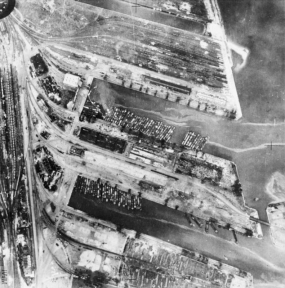
The Royal Air Force bombed German invasion barges in ports along the French coast. After the attack, Adolf Hitler ordered the barges dispersed. Hitler on 19 September 1940 continues his gradual retreat from Operation SEA LION (a process that takes almost two years). He reviews the large overnight attack by RAF Bomber Command and makes a decision. With 214 of the 1918 barges assembled having been destroyed, and 21 of 170 troop transport vessels sunk, he orders them dispersed because “under the present circumstances” he cannot “contemplate” an invasion. Much of the German economy relies on barges, so their loss is no small matter. Operation SEA LION remains on the docket, but will never again come under serious consideration.
It is extremely unlikely that the Wehrmacht can expect the British not to notice these changes, somewhat diminishing the value of the Ultra decrypts of the 17th. This, of course, will release the British bombers to resume strategic attacks on Germany, Italy, and the occupied countries.
The troops assembled for SEA LION are dispersed as well except for those necessary to dismantle the invasion preparations. Some head to the East in preparation for Operation BARBAROSSA. For the vast majority of them, this will be the last quiet winter of their lives.
Dawn: As the first light of day takes over from the dark of the early morning, members of the Civil Defence, the fire services and many civilians count the cost the nights bombing. About 2200 hours the previous night, German bombers attacked a number of installations in Northumberland and County Durham causing considerable damage. But it was again on London that the bombing was most severe. Just before midnight, heavy bombing occurred along the Thames and as the night wore on this was extended closer to the city center. By daylight, the extent of the damage was clearly seen. The once high class shopping areas of Regent Street, Bond Street and along Piccadilly, was a scene of devastation. Many shop fronts had been blown in, many of the once beautiful facades that had formed a part of London’s history for many years now lay in a crumpled mass of bricks and mortar in the streets.
Weather over Great Britain: Heavy cloud was expected to continue throughout the day and rain periods, heavy at times was expected over most of Britain. The Channel areas could expect a very low cloud base with early morning fog and mist patches in coastal districts.
Waking up to a rather dismal and damp morning, it was obvious to many of the British pilots that it was certainly not going to be a day that one should be up there in that dull grey murk and they hoped that the Luftwaffe would see it in the same way. They were not going to be disappointed. Radar stations along the Channel coast were idle, the CRT screens blank.
“On mornings where there is absolutely no activity, it is like a gift from God. We are able to take things that little bit easier, have breakfast in comfort and generally most of us are in a very relaxed frame of mind, but there was always someone to keep an eye on that screen… just in case.”
- Margaret Farmer. Radar Operations.
0950 Hours: Ironically, it was not on the south coast that the first attacks of the day occurred. A small formation made a surprise attack on Liverpool. No serious damage was done as most of the enemy aircraft were flying in singly or in pairs. Later in the morning, a number of Ju 88s were detected heading towards London. These were met by 249 Squadron North Weald (Hurricanes) and 302 Squadron Duxford (Hurricanes) over north Kent. The Ju 88s were scattered and were turned back with one of the bombers being shot down by F/O J.Kowalski of 302 Squadron at 1130 hours and it crashed near Bury St Edmunds. Another was to sustain engine damage and crash landed near Cambridge.
1050 Hours: During the rest of the day, the Luftwaffe make a number of reconnaissance flights over the Channel and off the English east coast over the North Sea. Other aircraft are assumed to mine laying duties and Fighter Command decides to leave them alone as they are posing no threat. One of the aircraft, a Ju 88 was spotted crossing the coast near Harwich at 1045 hours and was soon intercepted by British fighters and it crashed on the coast near Orfordness.
1600 Hours: Everything is rather quiet up until now when radar picks up small blips off the coast near Swanage.
Green section of 152 Squadron consisting of two Spitfires, is scrambled from Warmwell. The pilots are P/O Williams and P/O “Duchy” Holland (Sgt. K.C.Holland). Just after takeoff it is realized that Williams’ radio is not functioning so the Australian assumes the leaders position. Not long afterwards a bandit is sighted over the Channel and Holland signals Williams to go below the cloud base while he remains above it. The German plane, a Ju 88, disappears into the murk but moments later it reappears about two miles (3 km) in front.
“The Australian closes in, making alternate quarter attacks from left and right. Aiming first at the gunners positions and then at each engine, Holland opens fire. There seems to be a free cannon firing at his Spitfire from the port side of the cockpit but this stops after Holland’s first burst. There are also machine guns firing from each side of the cockpit as he sweeps in from each direction. Altogether he makes six attacks until he runs out of ammunition. The Ju 88 is badly battered and Holland watches as it dives into the sea.”
- Dennis Newton A Few of the Few Australian War Memorial 1990 p187
*This downed Ju 88 is probably one from 1/KG51 that was recorded as being shot down by British fighters of Britain’s south coast, although the cause of crash is stated to be “Cause Unknown”. Those killed were Oberfw. Luckard and Unffz. Henker while Fw. Walter and Gefr. Roeder were listed as missing. The time and location seem to confirm that this was the aircraft shot down by Holland and Williams of 152 Squadron.
Across the Channel, the Germans were busy during the day cleaning up the Channel ports from Calais to Antwerp after Wellington’s, Hampdens and Whitleys unleashed another successful night attack on the barges during the night of the 18th/19th September. It was the biggest operation yet by Bomber Command on the barge installations when 194 bombers were involved. of these, 187 crews reported that their mission was successful. of this number, only one Hampden was lost while another was lost on a separate mine laying mission.
With the events of September 15th still fresh when the Luftwaffe suffered tremendous losses, and the weather that was by now deteriorating and the prospect that no further improvement could be seen in the foreseeable future, Hitler formally announces that ‘under the present circumstances it is not possible to contemplate any invasion plans against England.’ The invasion was now postponed indefinitely and there would be no further discussion on the matter until the spring when the weather conditions would more suited to any implementation of an invasion. of course, this is not known in England although as to whether any message was intercepted by British Intelligence or Fighter Command has never been mentioned or recorded.
Plans were put into place where the majority of German troops, who had been placed in readiness for an invasion of Britain, were now given fresh orders and were posted to alternative fronts. Most of them were to go towards the east in preparation for “Operation Barbarossa” that was to take place the following year, some had been sent to Crete while the remaining troops dismantled all the barges at the various ports along the Channel coast.
But although all plans now had been postponed, that was not say that hostilities against Britain were to cease. Air attacks were to continue, especially at night. The regular daylight sortie was still to occur which kept Fighter Command busy, but the continuous bombing of British cities and towns was to achieve nothing, except that Hitler hoped that it would demoralize the people. But in actual effect it had the opposite. The Luftwaffe bombed Britain, the stronger the people became. They were true to their word, “…..they can bomb us as much as they like, they can come over night after night but the will never, never break our spirit.”
Inclement weather conditions in the evening curtailed many German operations, although scattered attacks did occur. Minelaying continued along the coastline, Northumberland and County Durham were bombed although no serious damage was reported. Liverpool prepared for night raids and many sirens sounded, but it appears that enemy aircraft kept well out into the Irish Sea as no attack was made on the city. A formation of German bombers was detected off the Welsh coast at 1950 hours and appeared to be heading for the port of Liverpool, but they were lost and there was no record of them reaching Liverpool. The London area came under warning signals at 1955 hours and a number of separate raids on the capital commenced at 2100hrs, and damage was done at Heston aerodrome in Middlesex when bombs destroyed a hangar and a number of buildings. Thirteen aircraft were damaged, some seriously. These included Spitfires of the Photographic Reconnaissance Unit, a Wellington bomber that was ‘just visiting’ and the famous Lockheed 12A that was used by the famous war photographer Sidney Cotton. In London, a bomb exploded at the entrance to a large air raid shelter in the borough of Tottenham and estimates put the casualty count at about 70. Bombs fell at Edmonton, Golders Green and Willesden, but damage was not serious.
By 2100 Hours, much of the heavy cloud cover either thinned out or cleared, especially in the North Wales and Northwest coast of England and a number of enemy aircraft were spotted. Most came under AA gunfire, but there were no reports of any of the bombers being brought down.
The weather seriously hampered Bomber Commands operations. Only a handful of Blenheims left for a raid on Dunkirk Harbor bombing German shipping and buildings.
In general, it was a day of spasmodic and scattered raids, quite often only consisting of a single German bomber. The weather conditions must have contributed to the fact that no major operation was conducted by the Luftwaffe. Compared to the heavy activity of previous days, Fighter Command took the advantage of moving some of those squadrons that had been under intense pressure over the last few weeks to quieter pastures.
234 Squadron that had been in the thick of things while at Middle Wallop and had earlier been moved to Warmwell, now were relaxed to St Eval who were exchanged for 238 Squadron who were sent to Middle Wallop. 610 Squadron were moved from Croydon to Acklington.
RAF Casualties:
It was just the second time during the battle that Fighter Command did not suffer any casualties. True that Britain did not have any with the exception that one aircraft of 257 Squadron Debden suffered engine failure while on convoy patrol but landed safely. But the Luftwaffe did sustain a number of casualties.
Excluding about six Luftwaffe bombers that crashed on landing on internal flights or crashed on takeoff, there were a number of them that crashed after being involved in operations against the RAF. One Ju 88 of 4(F)/121 had to make a forced landing at Oakington aerodrome due to engine failure while on a photo-reconnaissance flight and was involved with British fighters and its crew captured. Another Ju 88 of 5(F)/122 was involved in a British fighter attack and had to return to base carrying one dead and one seriously injured crewmember. A Do 17 of 7/KG2 was attacked by Spitfires over southern England and although it managed to return to France it crashed. Another Do 17 of 2/KG3 was believed to have suffered damage from AA gunfire and crashed on landing causing minor damage to the aircraft. A Ju 88 was shot down by fighters over London with all the crew either killed or missing. A He 111 of 4/KG4 was pursued by Hurricanes over the Thames Estuary and was last seen heading out towards the North Sea and is presumed to have crashed into the sea. The crew of a He 111 were captured after their aircraft was brought down by AA gunfire near Bishops Stortford in Hertfordshire. All these claims have been checked ands many of them are also recorded in Winston Ramsey’s Battle of Britain — Then and Now Vol 5.
RAF No. 71 Squadron forms at RAF Church Fenton. It is composed of Brewster Buffaloes, which the British Purchasing Committee ordered during the darkest days of the summer. The pilots immediately notice that they are inferior to Spitfires and Hurricanes.
Overnight, London, England, United Kingdom was bombed several times between 2000 hours and midnight.
RAF Bomber Command dispatches 18 Blenheims on daylight operations but only 1 aircraft bombed, attacking shipping in Dunkirk harbor.
RAF Bomber Command dispatches 53 Hampdens and Whitleys overnight to ports and railway targets and laying mines (8 aircraft) in the River Gironde. No losses. Wellington, Hampden, and Whitley bombers of the British RAF attacked German invasion barges in ports along the French coast. After the attack, Adolf Hitler ordered the barges to disperse to minimize further losses. Thus far, 214 of the 1,918 barges assembled for the planned invasion had been destroyed by British aerial attacks.
In Germany, Hitler formally ordered the assembly of the invasion fleet to be stopped, and the shipping in the Channel ports to be dispersed ‘so that the loss of shipping space caused by enemy air attacks may be reduced to a minimum’.
Of course this news does not reach Britain. They remained unaware of the German situation. But what was making news in Germany, was the headlines in most of the German newspapers. They accused RAF Bomber Command of murdering 21 deficient children at Bethel and stated that this bloody act is cause for revenge. Yet these same newspapers drowned in their own glee in reporting that German bombers had attacked London with devastating results killing thousands of civillians which included hundreds of children. Another newspaper, The Diplo stated that Germany is waging war with clean weapons and in a chivalrous manner. It must be pointed out that these are written by the newspapers and edited by the German Foreign Office and are NOT of public opinion.
German Foreign Minister Ribbentrop meets with Mussolini and his counterpart, Count Ciano, in Rome. His message from Hitler: leave Greece and Yugoslavia alone. Mussolini, of course, is casting a covetous eye on ancient enemy Greece. He vows to finish off Egypt first (which, in retrospect, would have been much wiser). Obviously, Mussolini is lying through his teeth to his ally.
A Nazi decree forbids gentile woman to work in Jewish homes.
The existence of the cavity magnetron is first revealed to the Americans by the British at a party at Washington’s Wardman Park Hotel, hosted by the millionaire and amateur scientist Alfred Loomis.
Waterloo Station is reopened after being repaired from the attack on 7 September.
British Minister of Labour Ernest Bevin announced that, as of the end of August 1940, there were 51,261 registered conscientious objectors in Britain.
The Rumanian Government tonight officially accused Hungarian soldiers and civilians of “massacring” Rumanian peasants, burning villages and committing thirteen specific “horrors” in Northern Transylvania since the occupation of that recently ceded area.
Witold Pilecki is voluntarily captured and sent to Auschwitz in order to smuggle out information and start a resistance.
With Malta increasingly isolated due to the Italian advance into Egypt, the British send a Short Sunderland flying boat from Alexandria with replacement parts for a damaged Sunderland. Governor Dobbie telegrams the War Office to complain that the military presence on the island would be insufficient to repel an invasion. There are five infantry battalions guarding the beaches and eight companies on guard at the airfields. Dobbie requests two additional battalions from England, noting that the locals cannot provide the necessary soldiers.
Orde Wingate departs from England for Khartoum, taking a long way around via Cape Town and Cairo. Middle East commander General Wavell, an old friend, has invited him to stir up opposition to the Italians in Ethiopia. Wingate will create the Gideon Force, a guerrilla force composed of British, Sudanese and Ethiopian soldiers.
Major General Richard O’Connor, Commander of the Western Desert Force, gets a new chief of staff, Eric Dorman-Smith. Their goal is to push the Italians out of Egypt.
At Dakar, the Vichy French land some troops. They apparently have gotten wind of Free French plans to invade the port with the British in Operation MENACE. British Convoy MS, composed of 5 transport ships, departs from Freetown with escorts as part of the operation.
Italian submarine Marconi sank Spanish trawler Almirante Jose de Carranza (330grt) sixteen miles northwest of Cape Villano. There was only one survivor from the Spanish trawler. The Marconi is en route to Bordeaux, its new BETASOM base.
Another Italian submarine, Comandante Faa Di Bruno, is operating about 700 miles west of Gibraltar and spots another Allied ship, but misses.
Destroyers HMS Tartar and HMS Maori, which departed Rosyth on the 18th, escorted the new light cruiser HMS Nigeria from the Tyne for trials. After the trials, they proceeded to Rosyth.
Destroyer HMS Somali sank four British mines in area “C”.
Anti-aircraft cruiser HMS Cairo departed Scapa Flow at 2100 to act as anti-aircraft protection for convoy WN.16.
Minelayer HMS Teviotbank laid minefield ZMD (B) in channels in the Faroes Islands. This minefield was an extension of ZMD (A) laid on the 14th.
British tanker Shelbrit I (1025grt) was sunk on a mine in 57-39N, 03-56W. The entire crew, including a naval rating, of the tanker was lost.
British steamer West Kedron (5621grt) was damaged by German bombing in North Channel.
German destroyers Lody, Eckholdt, Galster, Riedel, and Ihn departed Cherbourg for a strike for the area between the Lizard and Start Point. The sweep was cancelled due to poor weather.
German torpedo boat T.3 was sunk by British bombing at Le Havre, with nine men killed and twelve wounded. Torpedo boat T.3 was later salved and returned to service on 12 December 1943.
The Mediterranean Fleet arrived back at Alexandria.
Italian submarine Serpente in error launched a torpedo against Italian submarine Colonna fifty nine miles south of M. di Leuca. Fortunately, the torpedo did not strike Colonna.
Italian destroyers Leone, Pantera, Battisti, and Manin departed Massawa to operate in the Red Sea searching for convoy BN.5 of twenty three ships escorted by New Zealand Division light cruiser HMS Leander, sloop HMS Auckland, and Australian sloops HMAS Yarra and HMAS Parramatta. Italian submarines Archimede and Guglielmotti also searched without success for this convoy. The destroyers arrived back at Massawa on the 21st.
Convoy OL.3 departed Liverpool escorted by destroyers HMS Skate, HMS Scimitar, HMS Keppel, and HMS Active from 19 to 21 September. Destroyers Skate and Scimitar were detached to convoy HX.72. Destroyers Keppel and Active to convoy SC.4.
Convoy OA.217 departed Methil escorted by sloop HMS Fowey and corvette HMS Peony from 19 to 24 September.
Convoy OB.216 departed Liverpool escorted by destroyer HMS Vanquisher, sloop HMS Scarborough, and corvette HMS Arabis. The convoy was joined on the 21st by escorted ship HMS Gleaner and corvettes HMS Camellia and HMS Fleur De Lys. The escort was detached on the 23rd.
Convoy FN.285 departed Southend, escorted by destroyer HMS Vivien and sloop HMS Londonderry. The convoy arrived at Methil on the 21st.
Convoy MT.174 departed Methil. The convoy arrived in the Tyne later that day.
Convoy HG.44 of twenty eight ships departed Gibraltar escorted by destroyer HMS Velox from 19 to 23 September. Sloop HMS Leith escorted the convoy from 19 September to 4 October. Destroyer HMS Skate, corvette HMS Gladiolus, and anti-submarine trawler HMS Lady Lillian (581grt) escorted the convoy after being detached from convoy OB.220 from 1 from 4 October. The convoy arrived at Liverpool on 4 October.
Convoy SC.5 departed Sydney at 0530 escorted locally by Canadian armed yacht HMCS Lynx and Sloop HMS Folkestone. The convoy was joined on the 30th by destroyers HMS Arrow and HMS Vanquisher. On 1 October, destroyer HMS Keppel, sloop HMS Rochester, corvette HMS Bluebell, and anti-submarine trawlers HMS Ellesmere and HMS Ullswater joined. The sloop and the corvette were detached on 2 October. The rest of the escorts arrived with the convoy at Liverpool on 4 October.
Convoy SL.48 departed Freetown escorted by armed merchant cruiser HMS Maloja to 8 October. On 5 October, destroyers HMS Walker and HMS Sabre, sloop HMS Fleetwood, corvette HMS Mallow, and anti-submarine trawlers HMS Sphene and HMS St Apollo joined the convoy. The trawlers were detached that night, destroyer HMS Sabre on 7 October, and destroyer HMS Walker on 9 October. On 8 October, corvette HMS Coreopsis joined the convoy. The convoy arrived at Liverpool on 9 October.
British MENACE convoy MS of five mechanical transports Ocean Coast, Nevade, Casanance, Fort Lamy, and Anadyr departed Freetown escorted by sloop HMS Bridgewater, boom defence vessel HMS Quannet, and French patrol ship President Houdace.
Convoy BN.5A departed Bombay, escorted by light cruiser HMS Colombo and armed merchant cruiser HMS Kanimbla. Armed merchant cruiser HMS Antenor was with the convoy on the 20th only. On 25 September, the escort was detached when met by light cruiser HMS Ajax, anti-aircraft cruiser HMS Coventy, and destroyer HMS Kandahar. The escort was detached on the 28th. The convoy arrived at Suez on the 29th.
Today in Washington, President Roosevelt appointed a medical committee within the National Defense Commission, and prepared to leave for Philadelphia to speak tomorrow at ceremonies celebrating the 200th anniversary of the founding of the University of Pennsylvania.
The Senate, by a vote of 46 to 22, passed the excess profits tax amortization bill, received a resolution from Senator Thomas of Oklahoma to establish air raid shelters along the international borders, and recessed at 5:37 PM until noon tomorrow.
The House sent the excess profits tax bill to conference, passed a resolution authorizing $338,000,000 for housing military service trainees, received a bill by Representative Marcantonio to repeal the Selective Service Bill, and adjourned at 2:57 PM until noon tomorrow.
Tentative plans for calling 37,000 more national guardsmen to active duty in November were announced today by Secretary Stimson, while airmail planes rushed master copies of civilian draft registration forms to central points in each state. The new militia orders would bring the total of guardsmen mustered into active service to 133,000, and would principally affect the 56th cavalry brigade (Texas), the 31st division (Florida, Alabama, Mississippi and Louisiana), the 35th division (Nebraska, Kansas and Missouri) and the 36th division (Texas.) The plan calls for mobilizing 1,377 officers and men from the 56th cavalry on November 18, at Fort Bliss, Texas, and the remainder on November 25, at Camp Blanding, Florida, Camp Robinson, Arkansas, and Brownwood, Texas.
The House of Representatives, in a three-hour session today, gave attention to some important national defense matters. Its chief accomplishment was to pass and send to the Senate an appropriation of $338,000,000 to cover housing costs for the trainees who are to be called up the coming year. Representative Woodrum, chairman of the deficiency subcommittee, asked for immediate passage of the measure so that plans could be expedited for housing men selected from the 16,500,000 who are expected to register on October 16. He said that “every day counts,” in view of the speed with which the Army hopes to put the young men. into training. The approved measure carries $329,519,920 for the construction of buildings, utilities, flying fields and other facilities, and $8,000,000 for the purchase of land. The $338,000,000 would supplement $128,000,000 provided in the recently approved defense appropriation bill for the housing of the National Guard during its year’s Federal service.
1924 Democratic presidential candidate John W. Davis delivered a speech to a U.S. Senate sub-committee proposing an amendment to the Constitution that would limit the President to serving one term lasting six years with no possibility of re-election. “We think we do better if we employ our servants in the executive branch for fixed and certain terms,” Davis explained. “We want them to realize that what they do they must do within the allotted span of their official lives … Six years is long enough in which to do all the good one man is likely to accomplish, if he thinks first of his country and not of himself.”
Wendell L. Willkie told a crowd of 75,000 to 80,000 in the Los Angeles Memorial Coliseum tonight that he proposed to rescue America from an administration which has proved itself incompetent and not to be trusted with the enormous powers that it has acquired. Speaking before an audience in the Los Angeles Memorial Coliseum, Wendell Willkie contended that the Roosevelt administration had set up a tax structure that is “unscientific, repressive, and loaded with punitive measures.” Floodlights played from all parts of the coliseum on the speakers’ platform. In various sections of the stands spectators carried signs reading “Willkie for President,” while back of the platform was spelled in electric lights “on Nov. 5 Willkie and McNary.”
Reporting rapid progress on several phases of the nation’s defense program, Secretary Stimson said today that contracts had been let for almost half of the 18,641 Army planes for which Congress appropriated funds at this session.
Donald M. Nelson, Coordinator of Defense Purchases, reported tonight that the Defense Commission had cleared contracts totaling more than $6,000,000,000.
The U.S. Navy battleship USS Oklahoma collided with the tug Goliath in Puget Sound, Washington.
Major League Baseball:
The Yankees crushed the White Sox, 10–1 to move four games behind the league leaders. With only ten games left, the Yankees are at best a longshot. Charlie Ruffing (14–12) got today’s win. George Selkirk homered for New York.
The American League race is a tie when the Tigers sweep the A’s, 13–2 and 10–1. Floyd Giebell, 30, just up from Buffalo where he went 15–16, wins the opener and Dizzy Trout takes the nitecap. The Indians win and with 8 games left, the Tigers and Indians are knotted at 85–61.
The hit-hungry Indians drove to a 3–1 triumph over the hapless Senators today to carry a first-place tie with the Tigers into their all-important pennant series opening tomorrow in Detroit. Al Smith out-dueled Dutch Leonard.
With Manager Joe Cronin on the bench because of a spiked hand, and a makeshift line-up playing, the Red Sox lost their season finale with the Browns today, 2–1. Dropping the two-game series to St. Louis ended Boston’s mathematical chance to win the American League pennant.
The Reds’ ace Paul Derringer notches his 20th win, his third in three years, as he guns down the Phillies, 4–1. Derringer held the Phillies to seven hits. Ben Warren’s ninth-inning homer ruined his shutout bid.
Chicago’s Claude Passeau tops the Giants 8–2 to hand New York its 11th straight loss. Stan Hack homered in the ninth to conclude the scoring after the Giants managed two runs in the eighth.
The hopes of Frankie Frisch and the Pirates to oust St. Louis from third place in the National League faded quickly today as the rampaging Cards set them back twice, 2–1 and 8–2. William Henry McGee won the opener with a five-hitter.
New York Yankees 10, Chicago White Sox 1
Washington Senators 1, Cleveland Indians 3
Philadelphia Athletics 2, Detroit Tigers 13
Philadelphia Athletics 1, Detroit Tigers 10
Chicago Cubs 8, New York Giants 2
Cincinnati Reds 4, Philadelphia Phillies 1
St. Louis Cardinals 2, Pittsburgh Pirates 1
St. Louis Cardinals 8, Pittsburgh Pirates 2
Boston Red Sox 1, St. Louis Browns 2
Spurred by demands for power engendered by wartime industrial expansion, Canada and the United States are reported to be moving close to agreement on the joint power development phase of the Great Lakes-St. Lawrence seaways project.
A Norwegian Air Corps, whose nucleus consists of naval and army pilots who eluded the vigilance of the Gestapo and escaped from Norway, is training at the Toronto Island Airport in Canada under the supervision of Bernt Balchen.
Argentina has put an embargo on all future imports from the United States, although today’s newspapers carried a formal denial by Finance Minister Federico Pinedo that the government has taken any restrictive measures against United States trade.
A Chinese Army spokesman said today that Chinese forces in North China had inflicted several hundred casualties and cut five railways and two highways in attacks in the last week on Japanese garrisons. Chinese guerrilla units operate in several North China areas nominally under Japanese Army occupation.
An imperial conference was held in the presence of Emperor Hirohito yesterday, with the Premier Prince. Fumimaro Konoye; the Ministers. of Foreign Affairs, War, Navy and Finance; the chiefs and vice chiefs of the Army and Navy General Staffs, the president of the Privy Council and the president of the Planning Board attending. Earlier in the day the Emperor received the Minister of the Navy.. Admiral Zengo Yoshida, and the Vice Minister of War, to whom he addressed various questions. Kenji Tomila, the chief secretary of the Cabinet, said the imperial conference had deliberated on “important national affairs.” Such conferences usually are held only when the gravest questions are involved. As yesterday’s conference sat three hours, presumably it did not meet merely to register a decision already agreed upon.
The Foreign Office did not add anything to the Cabinet’s bald communiqué, but officials remarked that important domestic matters, as well as international questions, were receiving the government’s attention and that it had been decided several weeks ago to hold imperial conferences more frequently. This statement leaves room for the possibility the conference may have been concerned with constitutional questions connected with Prince Konoye’s new national structure. The meeting has revealed how complete is the Konoye Government’s control over the press. Formerly it would have been impossible to keep such an important conference entirely secret. The press would have been allowed to indicate the nature of the business. before the throne. Today, for almost the first time in its history, the Japanese press records this item of first-class political news in the uninformative words of the official communiqué, without a single effort at comment or explanation.
During the Imperial Conference, Prince Hiroyasu of Fushimi expressed concerns regarding the alliance between Japan and Germany.
Dropping the pretense of negotiations, Japan formally notifies the authorities in French Indochina that more troops are going to cross the border from China. New and unexplained demands threatened tonight to upset the negotiations between the government of French Indo-China and the Japanese, who have sought the right to move troops and supplies through the colony to facilitate their war against China.
France in her weakened position cannot alone resist Japanese demands for a military base in Indo-China for operations against the Chinese, Foreign Minister Paul Baudoin said here today.
Official foreign quarters said to day they had received information that Japan had given French Indochina until Sunday to comply with new Japanese demands, but that the French were unyielding. Upon receipt of the 72-hour ultimatum, the French virtually told the Japanese to “go ahead,” these quarters said. They expressed the opinion, however, this new development did not necessarily mean the Japanese would resort immediately to military action but that instead they might seek to reach a face-saving agreement at the last minute.
Dow Jones Industrial Average: 131.34 (+0.06)
Born:
William Thomas Medley, American rock singer (The Righteous Brothers, “You’ve Lost That Lovin’ Feelin’”, “Unchained Melody”), in Santa Ana, California.
Paul Williams, American singer, composer (“Rainy Days and Mondays”; “Evergreen”; songs from Ishtar; “Rainbow Connection”), and actor (“Battle for the Planet of the Apes”; “Smokey and the Bandit”), in Omaha, Nebraska.
Sylvia Tyson (née Fricker), Canadian singer-songwriter (“You Were On My Mind”), in Chatham, Ontario, Canada.
Ed Westfall, Canadian NHL defenseman and right wing (NHL Champions, Stanley Cup–Bruins, 1970, 1972; NHL All-Star, 1971, 1973-1975; Boston Bruins, New York Islanders), in Belleville, Ontario, Canada.
Naval Construction:
The Royal Navy Bar-class boom defense vessel HMS Barbour (Z 169) is laid down by the Blyth Shipbuilding & Drydock Co. Ltd. (Blyth, U.K.).
The Royal Navy Flower-class corvette HMS Coriander (K 183) is laid down by Hall, Russell & Co. Ltd. (Aberdeen, Scotland). She is transferred to the free French Navy upon completion and commissions as the Forces Navales Françaises Libres (Free French Naval Forces) corvette Commandant Detroyat (K 183).
The Royal Canadian Navy Tribal-class destroyer HMCS Iroquois (G 89) is laid down by Vickers Armstrong (Newcastle-on-Tyne, U.K.); completed by Parsons.
The Japanese NYK Lines passenger-cargo liner Kasuga Maru (春日丸) is launched by Mitsubishi Shipbuilding & Engineering, Nagasaki. The ship was requisitioned by the Imperial Japanese Navy (IJN) in early 1941 and converted to the escort carrier HIJMS Taiyō (大鷹; “Big Eagle”).
The Kriegsmarine (German Navy) Type VIIC U-boat U-69 is launched by F. Krupp Germaniawerft AG, Kiel (werk 603).
The Royal Navy Flower-class corvette HMS Petunia (K 79) is launched by Henry Robb Ltd. (Leith, U.K.); completed by Kincaid.
The Royal Navy Fairmile B-class motor launch HMS ML 126 is commissioned.
 History Diaries