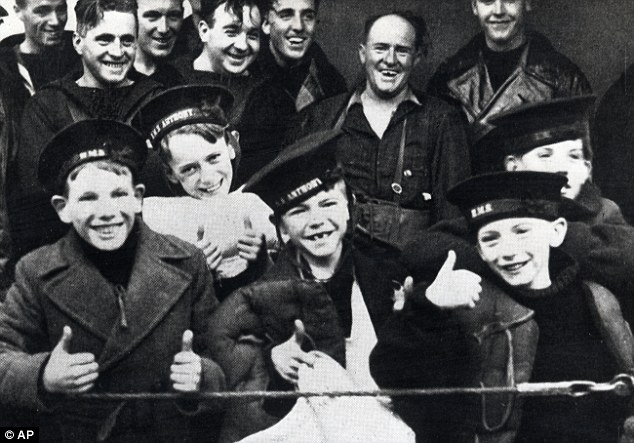
The British passenger ship City of Benares was torpedoed and sunk in the Atlantic Ocean by German submarine U-48. Over 150 people were killed, including 77 children being evacuated from Great Britain.
U-48 has been trailing the zigzagging City of Benares, a liner with guns at either end, for ten hours as the 17th of September ends. Just before midnight on the 17th, he fires two torpedoes and misses (most accounts thus place this incident on the 17th, but in fact, the sinking occurs on the 18th). Still in firing position, just seconds after midnight, Bleichrodt fires a third torpedo. It hits the 11,081-ton British liner in the stern. The ship sinks within 30 minutes. Bleichrodt steps back from the periscope and quietly mutters his verdict:
“A success.”
Bleichrodt surfaces and plays a searchlight over the scene, giving hope to survivors. It is chaotic, with people in the sea and lifeboats everywhere. The ship is obviously kaputt. Satisfied, he leaves the scene and heads east, where he spots another ship from the convoy and sinks it, too.
The crew of the stricken ship acts incredibly quickly and gets as many lifeboats in the water as possible before the ship sinks. There are 260 deaths, while 147 people survive (sources vary on all the numbers). Among the passengers are 90 British children being sent to Canada as refugees; 77-83 of them perish before seeing land again. HMS Hurricane, 300 miles away, receives a message about the sinking and immediately heels over to race to the scene. When it arrives a day later, there is massive confusion because another ship in the convoy, the Marina, also has been torpedoed around the same time. This causes one of the lifeboats from the City of Benares to be overlooked, and the passengers spend eight days drifting before finally being spotted and picked up by HMS Anthony.
This incident spells the end for the Children’s Overseas Reception Board (CORB), which has been relocating children to Canada. However, private evacuations of the sort continued for another year.
As a reward, Captain Bleichrodt in mentioned in the daily Wehrmachtsbericht, an incredible honor, a few days later on 21 September 1940 for his successful patrol (8 ships sunk as of that date). A top U-boat ace, he suffers some kind of mental breakdown a couple of years later and is given shore duty — but even so, he is considered the war’s tenth-most-successful U-boat ace.
Bleichrodt is tried after the war for the sinking. One of U-48’s crew, a Corporal Solm, had described the sinking after his capture, ““We knew there were kiddies on board before the tin fish were fired. We bagged a kiddie ship! Six thousand tons. We heard on the radio what was on board. No one survived.” However, Bleichrodt himself denies any knowledge of the presence of children in the City of Benares when he fired the torpedo and refuses to show remorse. The court agrees with the captain after some helpful testimony from the British Admiralty, Bleichrodt is cleared, and he retires to Munich. Bleichrodt passes away in 1977. Very clearly, if he had been found to have known there were children aboard, Bleichrodt would have been found guilty. Very, very close call.
Adolf Hitler insists on continuing the bombing of London, against the inclinations of Reichsmarschall Göring and others in the Luftwaffe. Hitler typically imbues a political perspective to his military decisions, a tendency that becomes more pronounced as the war lengthens. In this case, he perhaps feels that the damage to British morale and industry is more important than resuming an all-out offensive against the RAF and actually defeating it.
It now appeared that the Royal Air Force were starting to gain the upper hand, but even though London suffered serious damage and hundreds of casualties from September 7th onwards, the battle was far from being over, although the turning point, it could be said, happened on September 15th. Adolf Hitler may have postponed the invasion once again, but the intensity of day and especially night raids were about to increase.
Göring was under instructions to continue bombing attacks on the British capital although personally, he would have like to revert back to destroying the fighters, the airfields and ground support installations of the RAF, but unlike the British chain of command, he was under instructions from Hitler personally. Daytime attacks would still continue, and by increasing Bf 109 and Bf 110 escort duties to the bombers, he could hopefully destroy at least some of Fighter Command by forcing them to send fighters into the air, but with instructions to concentrate on the industrial areas of London’s East End and bombing London itself, it was going to be a big ask if the targets were not the fighter aerodromes themselves. Night time bombing would continue, and this was to become more widespread with greater intensity and with more high explosive bombs followed by thousands of incendiary bombs.
Keith Park was now under pressure to pursue the tactics of flying his squadrons in pairs. The instruction was given by the Air Ministry, mainly under pressure by those in favor of the “Big Wing” theory and as it had turned out, that the British tactical position had improved greatly.
The flying of squadrons in pairs was more of a compromise on the part of Park who refused to send up the number of squadrons as Douglas Bader and Leigh-Mallory had wanted, although it must be admitted that Bader’s “Big Wing” was destroying large numbers of enemy aircraft when given the opportunity. The combination of the “Big Wing” and other squadrons flying in pairs proved how successful the method was during the British victory on September 15th. We were not to see the last of paired squadrons yet.
During the early hours of the morning, Bomber Command flew a number of sorties which comprised of some 194 aircraft. Seventy-five per cent of the bombers were attacking the Channel ports as they had done throughout September, with special emphasis on Antwerp targeting the barges that would be used in any impending invasion. 187 of the bombers dispatched reported successful missions with only two Hampdens being lost during the night operations.
Weather over Great Britain: Conditions were expected to be a continuation of the previous day except that the low to medium cloud that brought the rain periods would disappear. The day was expected to be bright and clear although the squally winds would continue.
0900 Hours: Radar stations from Pevensey to Foreness detect a formation building up just off the Channel coast at Calais. The information is passed on to FCHQ immediately.
0920 Hours: Keith Park was ready to issue orders to his station commanders after a meeting with Hugh Dowding the previous day. But the news of another detection allowed him to delay the new instructions. The Observer Corps reported tiny specks at high altitude which indicated that it was a formation of fighters flying at heights in the region of 20,000 feet between Folkestone and North Foreland.
At varying intervals, a total of fifteen squadrons of Fighter Command were scrambled to intercept.
0940 Hours: The enemy fighters reach Maidstone and decide to break up into two separate formations. One headed towards Sheerness while the other veered north towards the open waters of the Thames Estuary. Only six of the fifteen Fighter Command squadrons make contact between Maidstone and Chatham. These were 17 Squadron Debden (Hurricanes), 46 Squadron Stapleford (Hurricanes), 73 Squadron Debden (Hurricanes), 257 Squadron Debden (Hurricanes), 501 Squadron Kenley (Hurricanes) and 603 Squadron Hornchurch (Spitfires). Most of these squadrons, once they observed that the enemy was all Bf 109 fighters, made their presence felt but broke off any form of attack in accordance with Parks instructions not to be drawn into combat with German fighters unless they were escorting their bombers.
A couple of flights from both 501 Squadron and 603 Squadron did become involved in combat after being jumped by Bf 109s. One pilot Bailed out of his Hurricane over Staplehurst while Spitfire pilot of 603 Squadron was killed after his aircraft was shot up and crashed near Ashford.
There’s nothing worse than having to leave a half cooked breakfast, scramble and push hard to a vectored height and position, look left, right, above and behind and see nothing but clear blue sky. Not a telltale sign of AA gunfire and you are then ordered back to base reporting nothing seen and that you didn’t partake in any combat, only to find that your breakfast is stone cold.
Pilot Officer George Barclay 249 Squadron Fighter Command
1000 Hours: No sooner had a number of the squadrons landed that others were scrambled and vectored to intercept enemy formations detected over Dover and over the Thames Estuary. Some of the squadrons that were scrambled earlier were vectored to new locations while more squadrons were released.
Keith Park back at Uxbridge, watched his large map table below as squadrons moved into position. These had been carefully dispatched from various airfields to be vectored to intercepting positions. He takes the opportunity in contacting his station commanders with instructions regarding any invasion attempt of Britain. His own fighters were to give protection to naval forces and their bases and also to provide cover for Bomber and Coastal Command operations. They are to distract enemy dive bombers from attack on ships that are engaging enemy vessels and destroy enemy aircraft carrying troops or tanks. They would attack the barges and landing craft and protect British troops from dive bombers. RAF personnel would combine with the Army and jointly defend forward aerodromes. Demolition of installations and withdrawal would take place only as a last resort, pending the arrival of Army mobile forces. Other instructions were; inland aerodromes must not be evacuated and were to be held at all costs, Group control would be maintained as long as sector operation rooms were still intact and telephone links to and from them was still possible. In the event that group control became impossible, then the sector commanders would take charge, and if the sector control failed, then it would be up to senior officers to act on their own initiative. He emphasized that an invasion would be defeated in seventy two hours at the most, and that both pilots and ground crews would expect a ‘hard time’.
A number of the squadrons engage the enemy over the Estuary and a number of individual combat actions take place at various locations at the mouth of the River Thames. 1(RCAF) Squadron Northolt (Hurricanes) becomes involved and has one of its fighters shot down, but P/O E.W.B.Beardmore bails out and receives slight injuries. 66 Squadron Gravesend (Spitfires) engage Bf 109s over North Kent and one of the Spitfires is hit and the pilot, Sgt D.F.Corfe sustains injuries after he managed to crash land the aircraft at Perham. 72 Squadron Biggin Hill (Spitfires) manage to turn a formation of Bf 109s around while over Sheerness and continue the chase as the enemy fighters head towards Dover and the Channel. Three Spitfires are damaged with two of their pilots receiving injuries while the third in unhurt.
1200 Hours: The first German bombing raid is detected coming in north of Dover. It consists of about 70 Junkers Ju 88s escorted by 100 Bf 109 fighters. Fighter Command dispatches another twelve squadrons who engage, but not before many bombs fall on the dockyards and surrounding areas of Chatham. Many of the bombers scatter going in all different directions, but it is estimated that 60 manage to get though and head towards London. Most bombs fall on the central area of the city, but within forty minutes most of the bombers are heading back towards the coast.
1530 Hours: More contacts were made by the south coast radar stations. Again the German forming up position was again over Calais, where two separate formations were detected. Early sightings indicated that there were between one hundred and one hundred and fifty aircraft heading towards the English coast and the Observer Corps reported that they were crossing the coastline between Dungeness and Folkestone and towards Ashford and Chatham. This time, it was reported that there were no sign of fighter escorts, and that the formation was made up of mainly Do 17 and Ju 88 bombers.
Fighter Command put up at least ten squadrons where most of the action taking place over Maidstone and Chatham.
1630 Hours: By now, a number of squadrons had engaged the enemy over the north Kent coast with many squadrons that had left aerodromes in the protective area around London. Park again called on 12 Group and in response Woodhall scrambled the ‘Duxford Wing’ to patrol the area from London to Gravesend. Bader decided that it would be best to keep below the cloud layer of 24,000 feet and stepped his squadrons at altitudes between 18,000 and 20,000 feet.
Although no indication was given over the R/T Bader saw the telltale puffs of AA Gunfire just south of the Thames in the vicinity of Maidstone. The wing found two formations south of the river below Gravesend and Northfleet and ordered his squadrons to attack. Immediately they broke up the formations with Bader’s 242 Squadron diving into the centre with all guns:
He fired in the dive. It was a quarter attack turning astern at the leading three enemy aircraft — Junkers 88s. His bullets scored on the left hand one of the leading section, and as Bader arrived right in amongst them, this Junkers swung away in a leftish dive, its port engine hit. It zoomed down and out of the fight towards the north bank of the Estuary, somewhere west of Thameshaven. Sergeant Brimble as Yellow 3 confirmed the crash.
Bader’s initial dive broke up the front of the formation and he found himself shortly afterwards among another hostile group. He gave a couple of quick squirts and then got out of this collection. He nearly collided with two of the enemy before extricating himself — and also nearly collided with at least one Hurricane. He spun off someone’s slipstream and lost about 3,000 feet in altitude in next to no time. Regaining control, he set for the south-east. Bader discovered a Dornier 17 rather detached, so he closed to the shortest range and fired. The immediate result startled him. He got no return fire but the rear gunner at once Bailed out and in doing so wrapped his parachute around the tailplane of the bomber. The Dornier started doing aerobatics in the shape of steep dives followed by zooms onto its back. Bader watched.
“After the second or third performance like this, two members of the crew Bailed out from in front and the Dornier was left doing its aerobatics alone with the rear gunner. Bader tried to kill him to put him out of his misery, but he was unsuccessful.”
- John Frayn Turner Battle of Britain Airlife 1998 p151
The ‘Big Wing’ continued its success in the combat. Against the white of the cloud base the enemy bombers stood out almost beckoning to be picked out one by one. The sky was a kaleidoscope of frantically weaving bombers and marauding fighters leaving trails in the air of crisscrossing vapour trails. One by one the bombers went down in flames and by 1730 hours the action was still continuing to the south of London.
Evening: By 1800 hours many civilians were making the most of the period that was the noted evening meal time in London and other main cities in Britain, before the now routine trek down to their Anderson shelters for evening protection. Others close to larger shelters and Underground stations also made the nightly haul to places where they believed would render them safe.
By 1930hrs, the first of the bombers came over and the first of the raids began. London was again hit bad and many buildings which had just their fires extinguished where hit again and it started all over. As one formation arrived, dropped its bombload, another formation was approaching lining up in the queue to add further destruction as the other formation left. Other targets were Liverpool and Manchester where the Merseyside docks received some heavy attacks. Although other bombs were dropped in various areas of Kent, Surrey, Hertfordshire and Middlesex, it is believed that they were bombs from aircraft dropped at random to lighten the load for the return journey.
“The night was cloudless and starry, with the moon rising over Westminster. Nothing could have been more beautiful and the searchlights interlaced at certain points on the horizon, the star like flashes in the sky where shells were bursting, the light of distant fires, all added to the scene. It was magnificent and terrible: the spasmodic drone of enemy aircraft overhead, the thunder of gunfire, sometimes close, sometimes in the distance, the illumination, like that of electric trains in peacetime, as the guns fired, and the myriad of stars, real and artificial in the firmament. Never was there such a contrast of natural splendor and human vileness.”
- Jock Coleville on two sides of the bombing (Finest Hour Tim Clayton & Phil Craig Hodder & Staughton pp323-4)
RAF Casualties:
0950 Hours: Ashford. Spitfire X4323 603 Squadron Hornchurch
P/O P. Howes killed. (Shot down in combat with Bf 109s. Pilot did not bail out)
1230 Hours: Chatham. Hurricane V7442. 46 Squadron Stapleford
Sgt G.W. Jeffries killed. (Shot down by enemy aircraft, Bailed out but parachute failed to open)
1325 Hours: Gravesend. Hurricane V6600. 249 Squadron North Weald
Fl/Lt D.G. Parnell killed. (Crashed and burnt out after combat with enemy aircraft)
Douglas Bader shot down a German Do 17 aircraft and a Ju 88 aircraft.
Hans-Joachim Marseille scored his fifth kill, a British Spitfire fighter, over Dover, England, United Kingdom.
Overnight, London was bombed by several waves of bombers; Liverpool, Manchester, Bristol, and other cities were also attacked.
RAF Bomber Command dispatches 6 Blenheims on an uneventful daylight sea sweep.
RAF Bomber Command dispatches 174 aircraft overnight. The majority of the effort was to the Channel ports; most of the remainder was to German railway targets. 8 aircraft — 3 Whitleys, 2 Blenheims, 2 Wellingtons, 1 Hampden — lost. Bomber Command takes no chances with a possible invasion despite having learned on the 17th — via the Ultra decrypts — that the invasion is off. It targets the invasion ports all along the coast, and also main supply points such as Brussels, Osnabruck, Ehrang, Hamm, and Mannheim. Coastal Command chips in with raids on Cherbourg, a convoy near Borkum, and De Kooy Airfield 5 km south of Den Helder in Holland (just south of Texel).
Soviet Minister of Defence Marshal S.K. Timoshenko and Chief of General Staff K.A. Meretskov submit to the Politburo their plan for the invasion of Germany. It proposes an advance north of the Pripet Marshes — very similar to the opening stages of World War I. Those who prefer to see Operation Barbarossa as the most epic military mistake of all time tend to overlook the fact that the Soviets are considering something similar. In fact, this plan has a great resemblance to some of the initial planning for Barbarossa — in reverse.
In the fitful moonlight outside one of London’s subway stations, closed during air raids, a young woman in the neatly tailored blue uniform of the London Transport Organization stands nightly calmly directing would-be passengers to the nearest raid shelter. “Please don’t stand about here. There is seating in the shelter 100 yards to the left with every comfort and convenience,” she advises. There is no resisting request of that girl doing a policeman’s job on a spot that might be described as one of the bullseyes for Reich Marshal Hermann Göring’s bombers: yet her job of “outside marshal” in air raids is only one of the nerve-testing tasks for which London women — and not all of them are young women — are volunteering by the thousands to replace men called to take their stand behind the barbed wire of Great Britain’s coastal defenses.
The public prosecutor especially assigned to the French Supreme Court at Riom has requested the indictment of former Premier Edouard Daladier and General Maurice Gustave Gamelin, the former Commander in Chief. This brief announcement, issued tonight by the Ministry of Justice, marks an important step in the eventual trial of those political and military leaders and their subordinates who may be considered responsible for the war and France’s defeat. The prosecutor already has requested the indictment in absentia of former Air Ministers Pierre Cot and Guy La Chambre. The court has not yet taken a decision in the matter. M. Cot is in the United States and M. La Chambre left that country by clipper plane last Monday, returning to France so that the warrant for his arrest, recently issued, may be executed.
In an endeavor to direct the resumption of industry and farm production in France toward reorganization in keeping with post-war possibilities the French Government has issued a series of new rulings affecting industry and labor.
The loss of Sidi Barrani to the Italians is having subtle but growing adverse effects on the British hold on the Mediterranean. The RAF airbase there had been extremely useful for launching raids against Italian-held Libya and for shuttling planes to Malta. The next-nearest airfield is at Benghazi, and fighters cannot make it from there to Malta even with extra fuel tanks. Even Blenheim bombers can barely make it, with little room for error. Thus, losing Sidi Barrani makes reinforcement of Malta much more difficult, and curtails transits between there and the main base at Alexandria. Loss of Sidi Barrani also deprives Royal Navy ships from Alexandria of fighter cover over the Italian positions further west such as Bardia. And, of course, the reverse situation applies, with the Regia Aeronautica now in a position to bomb RAF airfields further east and give more cover to its ships at Tobruk and other eastern Libyan ports. All in all, the tepid Italian advance has had far more effect on the British military posture than its small gains might suggest.
The American Library in Paris, France reopened. The United States continues to recognize Vichy France, and today the American Library in the occupied zone of France reopens in Paris.
U-48, commanded by Kapitänleutnant Heinrich Bleichrodt, sank British steamers City of Benares (11,081grt, Convoy Commodore Rear Admiral E. J. G. MacKinnion DSO Rtd in 56-43N, 21-15W and Marina (5088grt) in 56-46N, 21-15W from convoy OB.213. Convoy OB.213 had departed Liverpool on the 13th escorted by destroyer HMS Winchelsea (Senior Officer) and two sloops. The escort was detached and joined convoy HX.71 on the 17th.
At 0001 hours the City of Benares (Master Landles Nicoll) in convoy OB.213 was hit in the stern by one torpedo from U-48 and sank after 30 minutes 253 miles west-southwest of Rockall. The ship had been missed by two torpedoes at 2345 hours on 17 September. She was the ship of the convoy commodore (Rear Admiral E.J.G. Mackinnon, DSO, RN) and the first ship in the center column. 15 minutes after the hit, the vessel was abandoned, encountering difficulties with lowering the boats on the weather side of the ship. HMS Hurricane (H 06) (LtCdr H.C. Simms, RN) picked up 105 survivors and landed them at Greenock. 42 survivors were adrift for eight days, then picked up by the HMS Anthony (H 40) (LtCdr N.J.V. Thew, RN) and landed at Greenock. The 11,081-ton City of Benares was headed for Montreal, Canada. The City of Benares had on board a crew of 207, two naval gunners, which were both lost, and 191 passengers, including 90 children being evacuated to Canada. One hundred and nineteen crew and 134 passengers, including 77 of these children, were lost. After this incident, no more children were sent overseas.
At 0007 hours the Marina (Master Richard Townshend Payne) in convoy OB.213 was hit by one torpedo from U-48 and sank within 20 minutes 253 miles west-southwest of Rockall. Two crew members were lost. 17 crew members and three gunners were picked up by HMS Hurricane (H 06) (LtCdr H.C. Simms) and landed at Gourock. The master and 16 crew members were picked up after eight days by the British merchant Carlingford and landed at Londonderry. The master, Richard Townshend Payne, was awared the George Medal and the Lloyds War Medal for bravery at sea. The 5,088-ton Marina was carrying general cargo, including coal and was headed for River Plate, Argentina.
U-48 sank British steamer Magdalena (3118grt) in 57-20N, 20-16W. At 1849 hours the Magdalena (Master Frederick Allen), a straggler from convoy SC.3, was hit by one torpedo from U-48 south of Iceland and sank within ten minutes. The master, 29 crew members and one gunner were lost. The 3,118-ton Magdalena was carrying iron ore and was headed for Liverpool, England.
Anti-aircraft cruiser HMS Cairo and destroyers HMS Eclipse and HMS Firedrake departed the Clyde for Scapa Flow.
Hunt-class destroyer HMS Cleveland was completed. She departed the Clyde on the 29th for working up in the 23rd Destroyer Division. Destroyer Cleveland arrived at Scapa Flow on 3 October to work up. Destroyer Cleveland was later attached to the Portsmouth Command for duty in the 1st Destroyer Flotilla.
British steamer Lady of Mann, on passage to Lerwick, sustained weather damage to her forecastle. Escorting destroyer HMS Versatile had damage to her D. G. gear. Both ships returned to Aberdeen. The ships departed Aberdeen at 1800/19th. After delivering the steamer, destroyer Versatile proceeded to Scapa Flow.
S/Lt P. O. Williams, in a Whitley of RAF 77 Squadron from Linton on Ouse, was killed when the aircraft was shot down near Achter-Ziluwent.
German steamer Johann Blumenthal (1626grt) was sunk by British bombing at Cherbourg. German destroyer Lody rescued the survivors. German torpedo boat T.11, also at Cherbourg, was splinter damaged by near misses. Torpedo boat T.11 received temporary repairs at Cherbourg until 11 October. She proceeded to Wesermunde, arriving on 16 October, and was under repair until 6 June 1941. Minelayer Schiff 23 was damaged by near misses.
British steamer Rudmore (969grt) was damaged by German bombing at Gravesend Reach.
British steam barge Ling (164grt) was damaged by German bombing at North Morpeth Docks, Liverpool.
Swedish steamer Frisia (1059grt) was seized by German forces at Bordeaux.
Italian submarine Bagnolini sank Spanish steamer Cabo Tortosa (3302grt) near Oporto. Spanish steamer Monte Ayala (2955grt) rescued the entire crew of the Spanish steamer.
In the Gulf of Guinea, at 0841 on the 18th, Heavy cruiser HMS Cornwall reported French light cruiser Primauguet and tanker Tarn in 5-16N, 7-16W. The French ships were en route torefuel French Force Y, returning to Dakar from the Cameroons. The heavy cruiser was ordered to shadow the French ships only on the 18th. Light cruiser HMS Delhi joined heavy cruiser Cornwall on the 19th. The French light cruiser and tanker were stopped by heavy cruiser Cornwall at 1229 on the 19th. The French ships were escorted towards Casablanca by the British ships. On 22 September, near Freetown, light cruiser Delhi was detached for refueling. Heavy cruiser Cornwall escorted the French ships until 26 September when they were allowed to continue on their own. Light cruiser Primageut and tanker Tarn arrived at Casablanca on 1 October.
French light cruisers Georges Leygues, Montcalm, and Gloire departed Dakar for Libreville. Early on the 19th, Australian heavy cruiser HMAS Australia, which had departed Freetown on the 18th to relieve Heavy cruiser HMS Cumberland on patrol south of Dakar, sighted the French cruisers. The French cruisers were shadowed by Australian heavy cruiser Australia which was joined by heavy cruiser Cumberland at 1152. Heavy cruiser HMS Devonshire and destroyers HMS Inglefield, HMS Greyhound, and HMS Escapade departed Freetown at 1400 to join the two heavy cruisers. Battleship HMS Barham and destroyers HMS Fortune and HMS Fury followed Devonshire from Freetown. Aircraft carrier HMS Ark Royal was delayed by engine room defects, but was able to sail at 0500/20th. At 2100/19th, an engine breakdown on light cruiser Gloire reduced her speed to fifteen knots, and later four knots, and she was intercepted by heavy cruiser Australia. The heavy cruiser escorted the French ship until 21 September towards to Casablanca, where she arrived on the 24th. Heavy cruiser Cumberland, joined by heavy cruiser Devonshire and destroyer Inglefield, lost touch with the other two French ships in a rain storm and Montcalm and Georges Leygues returned to Dakar.
Heavy cruiser HMS Dorsetshire departed Durban for Simonstown.
Convoy OA.216 departed Methil escorted by corvettes HMS Camellia and HMS Fleur De Lys, escort ship HMS Gleaner, and anti-submarine trawlers HMS Indian Star and HMS Ullswater from 18 to 21 September. The convoy rendezvoused at sea with OB.216.
Convoy FN.284 departed Southend, escorted by destroyers HMS Wallace and HMS Wolfhound. The convoy arrived at Methil on the 20th.
Convoy MT.178 departed Methil. The convoy arrived in the Tyne the next day.
Convoy FS.285 departed the Tyne, escorted by destroyers HMS Vega and HMS Vortigern. The convoy arrived at Southend on the 21st.
President Roosevelt returned after attending Speaker Bankhead’s funeral at Jasper, Alabama, signed the Wheeler-Lea Transportation Bill to unite control of all common carriers, except airplanes, under the Interstate Commerce Commission, proclaimed October 11 as General Pulaski’s Memorial Day, and the week beginning October 6 as Fire Prevention Week.
The Senate approved and sent to the House legislation to insure social security benefits to drafted men, as well as fourteen amendments to the Agricultural Adjustment Act, debated the Excess Profits Tax Bill, and recessed at 4:59 PM until 11 AM tomorrow.
The House was in recess.
Seeking to ease the financial burdens of men drafted for military training, the Senate wrote into the excess tax bill today broad, authority for the president to establish allowances for dependents. He also would be empowered to establish an insurance system for the men and make modifications in the present social security regulations for their benefit. It acted while the war department, waiting for President Roosevelt to sign executive orders establishing the machinery, rules and regulations for conscription, reported that numerous states were announcing progress on preparations for their part in the draft.
Sentiment for deferring the election of a new House Democratic leader until the new Congress convenes in January seemed to be growing tonight despite the contest now under way to get votes for several candidates. The urge to wait came from adherents of Representatives John W. McCormack of Massachusetts and Clifton A. Woodrum of Virginia. With signs growing that the fight between these two, possibly involving other aspirants, may develop an intensity paralleling the leadership contest of four years ago, several members proposed that the election go over in order to prevent any cleavage in the party ranks before the election. Speaker Rayburn, who returned to Washington with some forty other Democratic members of the House from the funeral of Speaker Bankhead, indicated that he would take no part in the forthcoming contest.
The Federal debt passed $44,000,000,000 today before the Treasury Department had begun big borrowings for national defense. The Treasury revealed that out of its $45,000,000,000 limit on borrowing for general purposes, it had exhausted $44,061,821,728. Several additional millions of the borrowing power also were reserved to cover the automatically increasing value of “baby” bonds. This indicated that most of the Treasury’s borrowing in coming months would be confined to the special $4,000,000,000 borrowing authority given it by Congress for national defense purposes.
There is a new Secretary of Commerce, Jesse H. Jones, replacing Roosevelt crony Harry Hopkins. Roosevelt has other plans for Hopkins, who he sees as more of a “special projects” guy.
To the cheers of a crowd of 10,000 that filled San Diego’s baseball park, Wendell Willkie declared tonight that what this country needs is faith in its industries and faith in its people and that he has that faith. “I am not the indispensable man,” said the Republican presidential nominee from his open automobile under floodlights near the baseball diamond’s home plate. “No man could but be humble after such a tribute and such an outpouring of people to hear what he had to say.” He referred to shouts of “We want Willkie” that arose from the bleacher crowd as his car pulled into the infield.
The New York Times tonight announced its support of Wendell L. Willkie for the presidency, the first time it has backed a Republican presidential candidate since 1908. In a three-column editorial, the Times, which describes itself as Independent-Democrat, said: “We give our own support to Mr. Willkie primarily for these reasons: Because we believe that he is better equipped than Mr. Roosevelt to provide this country with an adequate defense; because we believe he is a practical liberal who understands the need of increased production; because we believe that the fiscal policies of Mr. Roosevelt have failed disastrously; because we believe that at a time when the traditional safeguards of democracy are falling everywhere it is particularly important to honor and preserve the American tradition against vesting the enormous powers of the presidency in the hands of any man for three consecutive terms of office.”
All hope of maintaining a free economy in the world would be gone for a generation if this country entered the war, Herbert Hoover asserted tonight in an address at the University of Pennsylvania bicentennial conference. Totalitarian dictatorship would then be “inevitbale.”
University of California students in Berkeley bombarded a Communist anti-conscription speaker with overripe tomatoes today during a noon-day meeting outside Sather gate entrance to the campus. Stopped by police from continuing their tomato barrage, the students punctuated the balance of the speech with blasts of automobile horns. The speaker was Henry Winston, national administration secretary of the Young Communists league of America.
The second group of U.S. ships involved in the in the destroyers-for-bases transfer to Great Britain arrived at Halifax, Nova Scotia. This group included the USS Kalk, USS Maddox, USS Cowell, USS Foote, USS Hopewell, USS Abbot, USS Thomas, and the USS Doran.
The light cruiser USS St. Louis shifted from St. John’s, Newfoundland, to Argentia with the Greenslade Board aboard. The Greenslade Board was a committee formed “to make a comprehensive study of the shore establishment (naval and commercial) necessary to support the Fleet in peace and war.” With the strategic requirements of the fleet in mind, the board was instructed to make recommendations for additional facilities in new locations and as to the expansion, limitation, contraction, abandonment, or conversion of existing shore facilities. The board was known by its senior member, Rear Admiral John W. Greenslade. The board, headed by Rear Admiral John F. Greenslade, which would evaluate base sites acquired from the British on September 5 in the destroyers-for-bases agreement.
Elmer Harris’ “Johnny Belinda” premieres in NYC.
Major League Baseball:
The Cincinnati Reds clinched their second straight National League pennant with a 4–3 win over the Philadelphia Phillies in 13 innings. The Reds clinch the National League flag, outdistancing the Dodgers and the late-rushing Cardinals. Johnny Vander Meer got the win with relief help from Joe Beggs.
In a football score at Ebbets Field, the Cardinals top the Dodgers, 14–7. Johnny Mize has 4 hits and drives in six runs for the Birds, while Babe Phelps hits a first-inning grand slam for Brooklyn.
The Giants took another fall yesterday at the Polo Grounds when the Cubs beat them with two runs in the ninth for the tenth straight setback to the staggering New Yorkers. The score was 6–4. Stan Hack hit two homers for the Cubs, including the ninth-inning blow.
Jim Tobin pitched his first game against the Pirates, his former mates, today and allowed only five hits as the Bees won, 4–1. The Bees rapped out nine hits off Joe Bowman. Chet Ross hit his seventeenth home run in the fourth inning with Max West on base.
The A’s are mired deep in the cellar, but Connie Mack hits all the right buttons today. He sends 4 pinch batters to the plate in the 9th inning versus Detroit, and all 4 deliver hits, a record, with an Major League-record tying 3 scoring. Hank Greenberg matches that for Detroit with a grand slam as the two teams split a doubleheader. Detroit wins the opener, 14–0, and the A’s take the second game, 13–6, as they plate 9 runs in the 9th.
Cleveland tops the Senators, 3–1, in game 1, as Johnny Allen picks up the victory Pitching on two days rest, Bob Feller wins his 26th in game 2, beating the Senators, 2–1. Sid Hudson takes the loss. The sweep moves Cleveland to a half-game ahead of Detroit.
The Yankees bow to Thornton Lee and the White Sox, 6–3, in the opener of a doubleheader, then come back to take the nightcap, 9–8, as the Yankees score five runs in the last two innings, before the game is called due to darkness after eight.
The Browns established themselves more firmly in sixth place today by walloping the Red Sox, 11–2, while Washington was losing twice to the Indians. Getting two triples and six doubles among their fourteen hits, the Browns had an easy time downing Boston. Bob Harris limited the Sox to nine hits, Roger Cramer’s single driving in their only runs.
St. Louis Cardinals 14, Brooklyn Dodgers 7
Pittsburgh Pirates 1, Boston Bees 4
New York Yankees 3, Chicago White Sox 6
New York Yankees 9, Chicago White Sox 8
Washington Senators 1, Cleveland Indians 3
Washington Senators 1, Cleveland Indians 2
Philadelphia Athletics 0, Detroit Tigers 14
Philadelphia Athletics 13, Detroit Tigers 6
Chicago Cubs 6, New York Giants 4
Cincinnati Reds 4, Philadelphia Phillies 3
Boston Red Sox 2, St. Louis Browns 11
Emperor Kangde presided over the dedication ceremony of the National Martyr Shrine of Manchukuo in Xinjing, the capital of the puppet state.
Chongqing University of Technology was established in China.
Believing that other powers are preoccupied with much larger issues, Japan continues to delay her promised reopening of the Yangtze River to third-power trade and navigation, while Japanese steamship lines and Japanese traders entrench themselves ever more monopolistically.
A speedy end to negotiations over Japan’s demand for military concessions in French Indo-China was predicted today by Roruku Suzuki, Japanese Consul General in Hanoi. He said an agreement between French Governor General Jean Decoux and the Japanese negotiators probably would be ready for signature tonight or tomorrow. Mr. Suzuki intimated that controversies over the demands, which reportedly include the landing of Japanese troops and establishment of air and naval bases in Indo-China, had been settled.
Philippine President Quezon called in the press today and roundly endorsed all that Finance Minister Manuel Roxas said in his transpacific broadcast of yesterday asking for a ten-year extension of trade privileges and military assistance to the commonwealth from the United States as a result of the troubled world situation. He stubbornly refused, however, to make a direct admission that the Filipinos might consent to a postponement of independence, scheduled for 1946.
Dow Jones Industrial Average: 131.28 (+0.85)
Born:
Frankie Avalon [Francis Avallone], actor (“Beach Party”; “Grease”) and singer (“Venus”), in Philadelphia, Pennsylvania (some sources give year of birth as 1939).
Allen Johnson, American doo-wop baritone vocalist (The Marcels — “Blue Moon”), in Pittsburgh, Pennsylvania (d. 1995).
Donnie Davis, NFL and CFL wide receiver and tight end (Dallas Cowboys, Houston Oilers; CFL: Montreal Alouettes), in Opelousas, Louisiana (d. 2004, of cancer).
Died:
James Baldwin-Webb, 45 or 46, British Army officer and politician (killed in the City of Benares sinking).
Naval Construction:
The U.S. Navy Cimarron-class oiler USS Salamonie (AO-26) is launched by the Newport News Shipbuilding and Dry Dock Co. (Newport News, Virginia, U.S.A.).
The Royal Navy Flower-class corvette HMS Begonia (K 66) is launched by Cook, Welton & Gemmill (Beverley, U.K.). She will be transferred to the U.S. Navy in March 1942 under Reverse Lend Lease and become the USS Impulse (PG-68).
The Royal Navy Dido-class light cruiser HMS Sirius (82) is launched by Portsmouth D.Y. (Portsmouth, U.K.); completed by Scotts Shipbuilding & Engineering Co. (Greenock, Scotland).
The Royal Navy Fairmile B class motor launch HMS ML 115 is commissioned.
The Kriegsmarine (German Navy) Type IID submarine U-143 is commissioned. Her first commanding officer is Oberleutnant zur See Ernst Mengersen.
The U.S. Navy “S”-boat submarine USS S-31 (SS-136) was recommissioned. Her commanding officer on recommissioning is Lieutenant Commander Mannert Lincoln Abele, USN.
The Royal Navy Hunt-class (Type I) escort destroyer HMS Cleveland (L 46) is commissioned. Her first commanding officer is Lieutenant Commander William Stratford Clouston, RN.
The U.S. Navy Benson-class destroyer USS Mayo (DD-422) is commissioned. Her first commanding officer is Lieutenant Commander Campbell Dallas Emory, USN.
 History Diaries