German Chancellor Adolf Hitler postponed Operation SEELÖWE (SEA LION) indefinitely. The invasion fleet is to be dispersed to reduce its vulnerability to air attack. Hitler postponed Operation SEA LION via order Nr. 00 761/40 g. Kdos., ordering that no new barges would arrive, but those that were already there (1700 barges and 200 ships, capable of carrying 500,000 men) would remain. British intelligence would continue to think that a German invasion was still probable; as a result, Churchill announced to the Parliament on this date that the next few weeks would be “grave and anxious”.
Hitler meets with Reichsmarschall Hermann Göring and Generalfeldmarschall Gerd von Rundstedt, his two closest military advisors, to discuss the prospects for Operation SEA LION. He concludes that there are three insuperable obstacles to the invasion:
- The Luftwaffe has not established aerial supremacy over England;
- Such supremacy is not likely to be achievable before winter;
- The three service branches cannot adequately coordinate their activities to overcome these other obstacles.
After mulling it over, Hitler issues five copies of the lapidary order “Nr. 00 761/40 g. Kdos” to the heads of the three military services. It provides that his previous 3 September 1940 order “Nr. 33 255/40 g. Kdos. Chefs.” establishing S-Day as 21 September 1940 is canceled, with no new date established.
Operation SEA LION effectively has been canceled. The order also provides that no new barges are to be moved to the invasion ports, although the shipping already collected in them (1700 barges and 200 ships) are to remain there. Hermann Göring is ordered to continue attacks on England, but the sense of urgency is lost. The plan is to continue the illusion of a threatened invasion of Great Britain.
Later in the day, the OKW sends a radio message telling the German authorities in Holland to dismantle the special equipment required to load transport aircraft for the invasion. This signifies to everyone there that the invasion is off for good, though of course, the official order from Hitler does not actually say that.
The question arises whether this was a good decision. At best from the German perspective, it is a good decision that flows from a series of really terrible decisions that made Operation SEA LION’s success impossible. War Games held at the Sandhurst Military Academy in 1974 concluded that Operation SEA LION could not have succeeded at this point in time. A series of absolutely horrible military decisions followed by an undeniably good one that prevents outright catastrophe is a hallmark of the German World War II strategy.
Hitler most likely figures that, like a year previously while contemplating the invasion of France, he can simply suspend operations for the winter and just pick them up again in the spring where he left off. In the meantime, Hitler’s bombers and U-boats can weaken Great Britain as he plans for a really important project in the East. However, this is a much different situation than the invasion of France, and Hitler is under extreme time pressure to finish off England quickly for a variety of reasons that he does not appreciate, some of his own making (such as the contemplated Operation BARBAROSSA).
Separately, and in an indication of where the real priority in the German High Command now lies, the deputy chief of the German General Staff (Oberquartiermeister I), Lieutenant General Friedrich Paulus, presents a revised plan for Operation BARBAROSSA. This new plan expands the operation from focusing just on the northern sector to three separate thrusts in the north (Leningrad), center (Moscow) and south (Kiev).
The Enigma decoding operation at Bletchley Park (Ultra) intercepts Hitler’s order postponing Operation SEA LION, and also the second, seemingly less important, order about the Luftwaffe equipment in Holland. The Air Ministry will conclude from the latter order that the invasion really is off for real and that the invasion cannot take place in 1940.
Since first light on August 15th until the last squadron of Fighter Command landed on September 15th, the intensity of the air combat was at its peak. 201 Fighter Command aircrew had been killed during this period and 495 aircraft had been destroyed. This was an average of 6.29 pilots killed each day and 15.47 valuable aircraft lost or destroyed on a daily basis. If we take a look at the Luftwaffe figures, one can understand as to why Göring was not impressed. The Luftwaffe lost 1,132 aircrew and 862 aircraft. This averaged out at 35.37 aircrew lost each day and 26.93 aircraft lost or destroyed every day for the last 32 day period.
It was also during this 32 day period that things were at their most difficult and daunting for the Germans. First of all, they made the fundamental alteration regarding strategy, which did not benefit themselves but played into the hands of Fighter Command where it appears that it gave them a new lease of life. It was prompted by the overall success of Keith Park’s policy of refusing battle, as far as possible, with German fighters and concentrating against their bomber force.
We must also appreciate the fact that Germany was not producing the amount of new aircraft at the same rate as they were in Britain, a feat that all accolades must go to the Minister for Aircraft Production Lord Beaverbrook. If the battle were to continue for the next 32 days with the same amount of attrition, then the Luftwaffe would surely be a spent force. Aircraft production in Britain, despite the number of attacks on the aircraft factories, still managed on many occasions to produce more aircraft on a daily basis than were being shot down.
When Beaverbrook became Minister of Aircraft Production on 14 May, the planned production of fighters for that month was 261 machines. The actual output for the month was 325. For June the planned program was 292; the actual output was 446. In July and August the improvement still continued: the total planned production was 611 but the total actual output was 972. Already by early July the supply of fighters had become so satisfactory that it was decided to allocate an additional four aircraft to each of thirty Hurricane and six Spitfire squadrons — though, unfortunately, there were not the pilots to go with them.
- Hough & Richard’sThe Battle of Britain: — A Jubilee History Hodder & Stoughton 1989 p102
Then, if we look at total fighter production between week ending August 17th and week ending September 14th we will see that 43 Defiants were produced, 271 Hurricanes, 186 Spitfires, 26 Buffalo’s and 3 Westland Whirlwinds giving Fighter Command a total of 1154 serviceable fighter aircraft. This is an average daily total output of 36.06, meaning that Beaverbrook’s factories were producing a little over twice as many fighter aircraft that were being shot down.
Even though these figures appear to be excellent, we have to appreciate the fact that Fighter Command did lose a considerable number of aircraft from mid-August to mid-September, coupled with the fact that hundreds more had been damaged and were undergoing repairs. We are fortunate in having these figures available to us, but at the time, such accurate figures were not available and unless German intelligence was on the ‘mark’ they would have had no idea of the situation, except for the fact that there were four or five times more British aircraft to meet the German armada of bombers than they had anticipated.
During the morning, just as the Luftflotten commanders were giving instruction of the impending days raids, and the crews were being briefed, a communiqué came through stating that “Operation SEELÖWE” had yet again been postponed. It was due to the present circumstances, and the message was obviously under the direction of Hitler, he being the only one who could announce such a decision. Later, the German General Staff sent a message by radio to the commanding officer handling the loading and supply of troop-carrying aircraft in Holland. It gave the commanding officer the authorization to dismantle all of the air-loading equipment at all the Dutch airfields. Without this vital equipment, there could be no such invasion, and by the withdrawal of the air-loading equipment and possibly the barges at Antwerp, it appeared that this postponement was more like an abandonment.
In the deciphering rooms at Bletchley Park, the message was intercepted by Ultra loud and clear. Marshal of the Royal Air Force Sir Cyril Newhall stated to his ministry that with this great news of the air-loading equipment being ordered to disband, and with the unreliable weather conditions that could be expected for the remainder of the year, any planned invasion would now not take place, not in 1940 anyway. Again the Air Ministry put this down to their success of September 15th. In Germany, Hitler’s new directive stated that Operation SEELÖWE could still be expected, even as late as October, but only if the air and weather conditions permitted, otherwise such an invasion could not now take place until 1941.
Weather over Great Britain: Cold with squally winds especially in the Channel areas. Rain periods were to be expected in the south with the chance of a thunderstorm. The possibility of bright intervals expected during the afternoon.
There was very little activity during the morning period. Radar had picked up several small blips over the Channel, but these being either enemy aircraft flying singularly or in pairs were ignored by Fighter Command as they were probably just weather or photo-reconnaissance aircraft and caused no threat. One enemy bomber came very close over the town of Dover and the air raid warning sounded but the bomber flew along the coastline for a while before turning back out over the Channel towards its base.
1400 Hours: A formation of Ju 88s were detected heading in a northerly direction over Bristol. There target was believed to be the factory areas of north of Bristol. 152 Squadron Warmwell (Spitfires) were scrambled to intercept. One of the Ju 88s was hit and it was further harassed by the Spitfires until it crashed near Warminster south-east of Bath. The pilot was killed while three others were captured, one of them being a Gruppe Commander.
1500 Hours: With the brightening of the weather allowing better visibility, a large formation was detected crossing the Channel from Calais. As they crossed the coastline between Dover and Dungeness, the Observer Corps had trouble identifying them reporting that it was a large formation at great height. They could very well be forgiven, because the enemy formation was only flying at 15,000 feet, but they were a large contingent of Bf 109s heading across the Kent coast.
11 Group dispatched at varying times a number of squadrons, most of them Hurricanes. 1RCAF Squadron Northolt (Hurricanes), 17 Squadron Debden (Hurricanes), 19 Squadron Duxford (Spitfires), 41 Squadron Hornchurch Spitfires), 73 Squadron Debden (Hurricanes), 213 Squadron Tangmere (Hurricanes), 257 Squadron Debden (Hurricanes), 303 Squadron Northolt (Hurricanes), 501 Squadron Kenley (Hurricanes), 603 Squadron Hornchurch (Spitfires) and 607 Squadron Tangmere (Hurricanes) some sources state that up to twenty squadrons were dispatched, but records were not available.
While it is not actually known where the target area was to be, the formation of Bf 109s, accompanied by a small number of Ju 88 bombers were heading in the general direction of Sheerness and Tilbury, and over the Kent countryside, quite a number of bombs were dropped indiscriminately indicating that a number of these Bf 109s had taken to a new role of carrying bombs. But over various areas of mid Kent, heavy air combat actions began to take place.
17 Squadron, 73 Squadron and 253 Squadron, the all Hurricane squadrons from Debden were vectored to the Hendon and Northolt area. Orders were to patrol Hendon at 20,000 feet. Apparently no contact was made with the enemy, and only 73 Squadron reported that a visual sighting was made, but the enemy was flying at approximately 33.000 feet and did not appear to be escorting any bombers. The Debden controller instructed 73 Squadron not to increase height and stay at 20,000 in the patrol area. On arrival at base later, all squadrons reported that no contact was made with the enemy.
1530 Hours: One of the combat areas was in the Dover area. Heavily involved was 41 Squadron Hornchurch who took on a large formation of Bf 109s. Two of the 109s became sandwiched between 41 Squadron Spitfires and trailing smoke dived down to low levels in a bid to make good their escape. Both of these managed to return to Wissant without any further attack being made on them.
Over “Hells Corner” another Bf 109 was to break away and attempted to return to its base after receiving damage, but the damage was too severe and it had to make a forced landing, but three other 109s were not so lucky. Two were shot down and crashed into the Channel, another was destroyed when it crashed near Deal, but not after the squadron sustained some bruising from the German fighters. At 1535hrs, F/O J.G.Boyle’s Spitfire was hit by gunfire from a 109 over Manston, and had to return to Hornchurch. At 1540hrs, P/O J.N.Mackenzie’s Spitfire was severely damaged and while the pilot was unhurt, it is believed that his aircraft was beyond repair after it crash landed. P/O H.H.Chalder was another who had to return to base while P/O H.C.Baker had to make a forced landing at Stelling Minnis after he took a hit while in combat over Manston.
1540 Hours: The action here was with 501 Squadron Kenley who took on some Bf 109s over Ashford. They were not as lucky as 41 Squadron as P/O Bennions describes their only success of the day:
After the commencement of the engagement, I found myself about 2,000 feet below a section of 5 Me109s. Two of the Me109s dived down onto me and I evaded by turning sharply right; then one dived away and as I turned to follow three more came down on me. After turning and twisting violently, I spun out and, on pulling out I found that one only had followed me down. I turned to engage and he disappeared into the clouds. I climbed back to 15,000 feet and sighted a loose formation of four Me109s circling. I attacked the rear one from the inside of a left hand turn and, after a short burst, I saw pieces fly off the aircraft, which then rolled over and spun inverted for about 8,000 feet and then dive straight into the ground midway between Canterbury and Herne Bay, near a very large wood.
Combat Report of P/O G.H.Bennions 501 Squadron for September 17th 1940
501 Squadron was to lose two Hurricanes in this engagement. One of them was Sgt J.H.Lacey who managed to bail out of his stricken aircraft, while the other was Sgt E.J.Egan who went down with his Hurricane that had burst into flames. Both incidents occurred over Ashford.
19 Squadron also got into the action and over north Kent was credited with two destroyed Messerschmitts. As it turned out, both were shot down by Sub Lt “Tony” Blake, who as it happens turned out to be the Navy’s highest scoring fighter pilot.
Evening: The usual raids began to commence at about 2000hrs. The first raids were on London where continuous waves of bombers pounded the city.
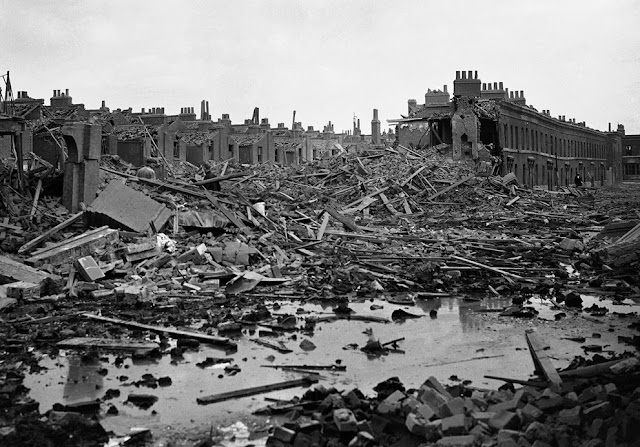
“For nearly two weeks, London had taken a beating. Each night was now becoming a sort of ritual having to go down to the shelter in the back garden each time the air raid siren went off. Sometimes you could hear the steady drone of bombers as they came over and the dull short thud of explosions. Sometime you wouldn’t hear any engines at all, only thud, thud, thud of the AA guns, then just as you thought that you heard what could have been a steady drone of engines, you would hear a dull whistle getting louder and louder then the ground shook as a bomb exploded, maybe a few houses away or maybe a few streets away. Sometimes you heard nothing, the raid was not over your part of London, but one could see the waving tall shafts of light as searchlights tried to locate the bombers, and the sound of exploding bombs could be heard miles away.”
- Pauline Harper (nee Davison) remembers the ‘Blitz’
Later in the evening, Junkers Ju 88s went on a bombing spree over Merseyside. Again, the bombing was either not accurate or the Germans just dropped their bombs anywhere as long as they were over the city. There were plenty of industrial and dock areas that could be bombed, but the residential areas were also taking a beating and again, many lives were lost. The cities of Newcastle and Durham were also hit, but many houses were damaged and destroyed. Reports of bombs landing in open country were again reported well away from towns and cities.
Victory came at 2345 hours to one of the Defiants of 141 Squadron converted to night fighter operations and based at Biggin Hill. A number of Junkers Ju 88s were detected crossing the coast near Dover and 11 Group dispatched a flight from 141 Squadron. Interception was made north of Ashford and Sgt Lawrence and Sgt Chard began their attack on B3+OL. The badly damaged bomber finally crashed in a residential street in Maidstone killing all the aircrew.
RAF Casualties:
1540 Hours: Ashford. Hurricane P3820. 501 Squadron Kenley
Sgt E.J. Egan killed. (Shot down in sudden attack by Bf 109. Aircraft burst into flames. Pilot did not bail out)
1540 Hours: Beltring. Hurricane P3933. 607 Squadron Tangmere
Sgt J. Lansdell killed. (Shot down during combat with Bf 109. Failed to bail out)
1600 Hours: Faversham. Hurricane V7529. 504 Squadron Hendon
Sgt D.A. Helcke killed. (Lost control during attacking practice and failed to bail out)
No. 29 Squadron RAF became fully operational with the Beaufighter IF fighters. Meanwhile two more Squadrons (Nos. 600 and 640) were working up with the type.
James Lacey was shot down over Ashford, England, United Kingdom by Bf 109 fighters.
Hans-Joachim Marseille was awarded the Iron Cross 1st Class.
Overnight, more than 350 tons of bombs were dropped on London, South Wales, and Liverpool.
RAF Bomber Command dispatches 15 Blenheims during the day to the Channel ports. 9 aircraft bombed. No losses.
RAF Bomber Command dispatches After a night’s rest, Bomber Command dispatched 194 aircraft overnight, its greatest number of the war to date. Approximately two thirds of the effort was devoted to bombing barges in the Channel ports; minor raids were made on many targets in Germany. 187 aircraft, 96 percent of those dispatched, reported carrying out their tasks. 2 Hampdens were lost, 1 attacking the Channel ports and 1 on a minelaying sortie.
At Malta, a pilot of a downed Stuka Ju 87 is fished out of the sea and gives the British valuable intelligence. He reveals that the Stukas are operating out of the fortified island of Pantelleria and are Italian.
There are two air raids during the day, one at 10:40 and the other at 16:00. The attackers lose two Stukas and an Italian CR 42 fighter in the morning raid, the afternoon one turns out to be only Italian reconnaissance. Three are 15 unexploded bombs at Luga which require a big area to be fenced off for a week to see if they have time fuzes.
Heinrich Himmler ruled that all Polish workers must wear a yellow badge marked with the letter “P” to distinguish themselves from Germans.
General Paulus, Deputy Chief of the Army General Staff, presents a plan for a massive attack on the Soviet Union.
Spanish Interior Minister Serrano Suner continues his meetings in Berlin, meeting with Hitler. Minister Suner responds to German requests for bases in Spanish possessions with a laundry list of items that Spain wants in return.
The urgent question of food supplies for unoccupied France again was studied by the Cabinet today. Dispatches from Paris said strict rationing of all principal foodstuffs would be begun in the Nazi-held zone next Monday.
In London, Winston Churchill announced that 2,000 civilians were killed and 8,000 were wounded during the Blitz thus far.
In the murky world of “black propaganda,” the British are second to none. Black propaganda is the circulation of false rumors by the government for covert purposes. In this case, the British conduct a “whisper campaign” claiming that the Germans had attempted an unsuccessful invasion with heavy losses on 7 September 1940. The cause of this supposed German defeat is ascribed to using flaming oil on the seas near the beaches, a particularly vivid image. The rumors are complete rubbish that both the German and British governments officially deny. However, they gain currency (as intended) among the Americans, who see in the fictional victory a resolute England fighting off the dreaded German hordes and likely to survive.
General Ion Antonescu, Rumania’s military dictator, has asked Germany to send a military mission to reorganize the Rumanian Army in accordance with new war methods.
The officially controlled Bulgarian press today opened its long-anticipated attack on Greece, which is regarded as a normal preliminary revisionist campaign.
Rumors of unrest prevailing throughout the whole French zone in Morocco are circulating. According to recent arrivals in Tangier, Spaniards have been concentrating troops along all frontiers of Morocco as a precautionary measure.
At Dakar, Vichy French Force Y (two cruisers) joins with other Vichy units based at Dakar departs for stressed Vichy possessions to the south (Douala, Cameroon, Libreville, Gabon, and Pointe Noire, Congo) in a “Show the Flag” mission. The Royal Navy fleet assembling for Operation Menace, the attack on Dakar, is docked in Freetown, Sierra Leone.
A wolfpack composed of U-65 (K.Kapt. Hans-Gerrit von Stockhausen) and U-99 ( Kptl. Otto Kretschmer) is stalking Convoy HX.71. Both U-boats notch successes.
U-65, commanded by Kapitänleutnant Hans-Gerrit von Stockhausen, in attack on convoy HX.71 sank British steamer Tregenna (5242grt) in 58-22N, 15-42W. At 1626 hours the Tregenna (Master Willam Thomas Care) in convoy HX.71 was hit by one torpedo from U-65 and sank immediately 78 miles northwest of Rockall. The master and 32 crew members were lost. Four crew members were picked up by Filleigh and landed at Avonmouth. The 5,242 ton Tregenna was carrying steel and was headed for Newport, England.
U-99, commanded by Kapitänleutnant Otto Kretschmer, sank British steamer Crown Arun (2372grt), a straggler from convoy HX.71, in 58-02N, 14-18W. At 0832 hours the Crown Arun (Master Hugh Laurence Leaske), a straggler from convoy HX.71, was torpedoed and sunk by gunfire by U-99 north of Rockall. The master and 24 crew members were picked up by HMS Winchelsea (D 46) (LtCdr W.A. Hawkins, DSC) and landed at Liverpool. The 2,372 ton Crown Arun was carrying pit props and was headed for Hull, England.
German U-boat U-48 attacked British passenger liner City of Benares 400 miles west of Scotland, United Kingdom; City of Benares was evacuating 90 British children and their families to Canada but this fact was unknown to the German captain; both torpedoes missed and U-48 would continue to stalk her prey.
The Italians chip in success in the Atlantic, too. While their success rate is far below that of the U-boats, the Italian submarines do get their share of ships. Operating to the south, they tend to get more Spanish and Portuguese ships than do the U-boats, which feast on British shipping.
Italian submarine Alpino Bagnolini (Lieutenant Commander Tosoni Pittoni) torpedoes and sinks 3812-ton Spanish freighter Cabo Tortosa in the Atlantic off Oporto, Portugal. The ship takes 90 minutes to survive, and everybody aboard survives. The Alpino Bagnolini has just arrived from its base at Trapani, Sicily to take up station in the Atlantic, and will be based at Bordeaux. Commander Pittoni tries to signal the ship to see if it was carrying war material, but smoke on the horizon compels him to attack before the Spanish ship can tell him that it is simply a local freighter not going to the UK.
Battleship Bismarck exited the Kiel Canal at 1448 hours, then arrived at Scheerhafen, Kiel.
Destroyer HMS Douglas arrived at 0700 at Greenock escorting steamer Kyle Fisher. Destroyer Douglas proceeded up river for boiler repairs at Govan. The destroyer ran aground on entering the Harbor. Destroyer Douglas was repaired through the end of September.
Destroyer HMS Versatile undocked from the AFD.12 Floating Dock at Scapa Flow after repairs to her stern gland. Destroyer Versatile departed Scapa Flow at 2200 for Aberdeen to escort British steamer Lady of Mann (3104grt) to Lerwick.
Destroyer HMS Chelsea, en route to Belfast from Halifax, made an unsuccessful attack on a German submarine.
Heavy cruiser HMS Sussex arrived at Glasgow on the 2nd for a six week turbine repair. On 17 September she was damaged in German air attacks on Glasgow when a two hundred and fifty pound bomb penetrated the deck. She was set afire by splinter damage and when the dock was flooded to extinguish the fire, Sussex heeled over in dock. Midshipman J. R. L. Cook was wounded and two ratings were killed. The cruiser was badly damaged. She was refloated in October and taken to Stephen’s Dry Dock at Linthouse, Greenock. The cruiser had to be rebuilt. Heavy cruiser Sussex was repairing from November to 9 August 1942 at the Clyde. The cruiser arrived at Scapa Flow on the 4th 1942 for operations.
Canadian destroyer HMCS Margaree (recommissioned on the 6th from Destroyer HMS Diana) was damaged by splinters in German bombing in the London Docks.
French torpedo boat Bouclier was damaged in a collision. The torpedo boat was repaired at Devonport from 17 September to 30 September.
Greek steamer Kalliopi S.(5152grt) was sunk by German bombing eleven miles south west of Tory Island. The steamer was abandoned and went onto the rocks at Sheephaven Bay, ten miles east of Tory Island.
Operation MBD 1 was an attack on Benghazi launched from aircraft carrier HMS Illustrious.
Heavy cruiser HMS Kent, light cruisers HMS Liverpool and HMS Gloucester, and destroyers HMS Jervis and HMS Hereward departed Alexandria on the 13th.
Aircraft carrier HMS Illustrious, battleship HMS Valiant, light cruiser HMS Orion, and destroyers HMS Hyperion, HMS Hero, HMS Hasty, HMS Mohawk, HMS Nubian, HMS Dainty, and HMS Decoy departed Alexandria on the 15th.
On 16 September off the west coast of Crete, the two forces rendezvoused with anti-aircraft cruiser HMS Calcutta and destroyers HMS Janus and HMS Juno.
Anti-aircraft cruiser HMS Calcutta and destroyers HMS Janus and HMS Juno were detached and arrived at Alexandria that night.
For the attack, the British ships were divided into three Forces.
Force A was light cruiser HMS Orion, aircraft carrier HMS Illustrious, and destroyers HMS Nubian, HMS Mohawk, HMS Hero, and HMS Hasty.
Force B was battleship HMS Valiant and destroyers HMS Hyperion, HMS Decoy, and HMAS Waterhen.
Force C was heavy cruiser HMS Kent, light cruisers HMS Liverpool and HMS Gloucester, and destroyers HMS Jervis and HMS Hereward.
Destroyer HMS Hasty reported a torpedo track and attacked a submarine contact at 1940/17th.
On 17 September, aircraft carrier HMS Illustrious launched an air attack on Benghazi. Nine aircraft from the 815 Squadron attacked shipping in the Harbor. Six aircraft from the 819 Squadron laid mines off the Harbor.
Italian destroyer Borea was sunk in torpedo plane attack.
Destroyer Aquilone was sunk on a mine dropped by Illustrious aircraft. Italian steamers Gloria Stella (5490grt) and Maria Eugenia (4702grt) were sunk and Italian torpedo boats Cigno and Cosenz and three merchant ships were badly damaged.
At 1130 hours, British gunboat HMS Ladybird bombarded the coastal highway near Sollum, Egypt.
Heavy cruiser HMS Kent and destroyers HMS Mohawk and HMS Nubian were to have bombarded Bardia early on the 18th. However, at 2355 before the bombardment, an Italian torpedo plane torpedoed Kent and badly damaged her. Cdr C. E. F. Hall, Temporary Paymaster S/Lt G. Yealland RNVR, and thirty one ratings were killed on the cruiser. Anti-aircraft cruiser Calcutta departed Alexandria to support Kent’s retirement. Destroyer HMS Vendetta was sent from Alexandria to join Kent. Netlayer HMS Protector and tug HMS St Issey departed Alexandria on the 18th. Heavy cruiser Kent was towed to Alexandria by destroyer Nubian and screened by light cruiser HMS Orion, anti-aircraft ship HMS Calcutta, and destroyers HMS Jervis, HMS Janus, HMS Juno, HMS Mohawk, and HMS Vendetta. The cruiser safely arrived early on the 19th. The dead were buried at sea from netlayer Protector during the evening of 19 September.
Aircraft carrier HMS Illustrious, battleship HMS Valiant, light cruisers HMS Liverpool and HMS Gloucester, and destroyers HMS Hasty, HMS Hero, HMS Hyperion, HMS Decoy, and HMS Hereward were detached to Alexandria late on the 18th and arrived on the 19th.
After emergency repairs, HMS Kent was sailed on 26 October to Port Said arriving on 27 October. She departed Suez on 28 October in convoy SW 20, Aden on 2 November, and was at Mombasa from 7 to 11 November. She departed Mombasa on 11 November and arrived at Simonstown on 18 November remaining until 25 November. Kent arrived at Freetown on 4 December and departed on 7 December with convoy SL.58. Heavy cruiser Kent arrived at Plymouth on 27 December for repairs began on 1 January 1941. Repairs were completed on the 20th September 1941.
Destroyers HMS Janus and HMS Juno departed Alexandria on the 17th for Mersa Matruh. They bombarded Sidi Barrani for twenty five minutes beginning at 2300. British gunboat HMS Ladybird, which departed Alexandria for Mersa Matruh on the 16th, escorted by destroyer Juno bombarded Sollum at 2330.
Battlecruiser HMS Renown and destroyers HMS Griffin, HMS Encounter, HMS Wrestler, and HMS Vidette departed Gibraltar for patrol in the vicinity of the Canary Islands. On 18 September, destroyers HMS Gallant and HMS Firedrake joined Renown and relieved destroyers Wrestler and Vidette which returned to Gibraltar. The ships arrived back on the 20th.
Heavy cruiser HMS Devonshire, Australian heavy cruiser HMAS Australia, and destroyers HMS Fury and HMS Echo arrived at Freetown.
Light cruiser HMS Dragon departed Lagos on patrol.
Convoy OB.215 departed Liverpool escorted by destroyer HMS Shikari, sloop HMS Lowestoft, and corvettes HMS Calendula, HMS Heartsease, and HMS La Malouine. The escort was detached on the 21st.
Convoy FN.283 departed Southend, escorted by destroyers HMS Vanity, HMS Vimiera, and HMS Woolston. The convoy arrived at Methil on the 19th.
Convoy FS.284 departed the Tyne, escorted by destroyer HMS Verdun, sloop HMS Black Swan, and anti-submarine trawlers HMS Basset and HMS Tourmaline. The convoy arrived at Southend on the 19th.
Convoy HX.74 departed Halifax at 1230 escorted by Canadian destroyer HMCS Assiniboine and armed yacht HMCS Elk, and auxiliary patrol boats HMCS Husky and HMCS Laurier. However, at sea, ELK was ordered to return due to heavy weather. The merchant ships which would have departed Bermuda in convoy BHX.74 were diverted before arrival to Halifax due to a forecast hurricane. Convoy BHX.74 was cancelled. At 1930/18th, destroyer Assiniboine returned to Halifax leaving the convoy to ocean escort, armed merchant cruiser HMS Montclare, which was detached on the 29th. On 28 September, anti-aircraft ship HMS Alynbank joined the convoy and was detached the next day. Destroyers HMS Scimitar and HMS Winchelsea, sloop HMS Aberdeen, and corvettes HMS Geranium, HMS Hibiscus, and HMS Periwinkle joined on the 29th. The convoy arrived at Liverpool on 2 October.
Selective service officials outlined today a “fishbowl” publicity policy by which, they said, they would keep every man of draft age, his family and friends fully informed of each step taken in selecting men for compulsory military service. President Roosevelt is expected, soon after his return tomorrow afternoon from Speaker Bankhead’s funeral in Alabama, to sign an executive order creating a national organization to administer the conscription act and prescribing general rules for it. Mr. Roosevelt yesterday fixed Oct. 16 as the draft registration date.
Alabama’s distinguished son, William B. Bankhead, was honored in death today as President Roosevelt, Cabinet officials and members of Congress joined with thousands at an impressive funeral for the late Speaker of the House. The Speaker was buried beside his father and mother in Oak Hill Cemetery after a brief ceremony witnessed by only a few hundred of the crowd estimated at 65,000 persons, which jammed into Jasper, town of 5,000 population. The funeral took place in the Speaker’s own church, the First Methodist Church, with the pastor, the Rev. Dr. Thomas L. McDonald, and the chaplain of the House, the Rev. Dr. James Shera Montgomery of Washington, conducting. Attending the rites at the church were the President of the United States, Secretary Morgenthau, Attorney General Jackson, Secretary Ickes, Secretary Jones, Secretary Wickard, Secretary Perkins, Sumner Welles, Under-Secretary of State; Justice Black of the Supreme Court and John M. Carmody, Federal Works Administrator.
Speaking in Amarillo, in the Texas Panhandle on the edge of the dust bowl, Wendell L. Willkie declared he had come here today to tell the Democrats of the South that they must make a choice at the coming Presidential election between two great traditions, the tradition of voting Democratic and the 160-year-old American tradition that no President should serve more than two terms. The Republican nominee for President asserted the anti-third-term tradition was the very essence of democracy, the preservation of which was of paramount importance in this time of world crisis. Although the reception of Mr. Willkie was friendly, there was only a small crowd, not more than 3,000.
Wendell L. Willkie said tonight that in the last seven and a half years, the Democratic administration “has been on the most drunken orgy of spending that ever occurred in the history of the world. Speaking in the baseball park at Albuquerque, New Mexico before a crowd estimated at 21,000, the Republican presidential nominee added: “What a piker was Louis XIV. Louis XIV, and the rajahs of Persia with their diamonds, didn’t spend pennies compared to these boys.”
The National Defense Advisory Commission has informed Attorney General Jackson that the anti-trust suit proposed by Assistant Attorney General Arnold to split apart the diversified activities of twenty-two major oil companies, with nearly 300 subsidiaries, would endanger the national defense program, it was reported in Administration circles today. Details of the commission’s report to the Attorney General were lacking because it was sent to him in Alabama, where he is attending the funeral of Speaker Bankhead. Mr. Arnold, in charge of the anti-trust program, is said not to have seen the document.
Preparations were under way today for a full-dress debate when the Senate reconvenes tomorrow over a proposal barring the reissuance in the future of tax-exempt securities by the Federal, State, municipal, county or other subordinate governments.
Special Service Squadron (Rear Admiral H. Kent Hewitt), consisting of gunboats Erie (PG-50) and Charleston (PG-51) and destroyers J. Fred Talbott (DD-156) and Tattnall (DD-125), is disbanded .
Major League Baseball:
The Cardinals shut out the Dodgers, 5–0. Max Lanier stops Brooklyn on just five hits, fanning four. Lee Grissom kept the Dodgers close, trailing by just one run, until two walks, a wild pitch, a hit and an error ended up producing four St. Louis runs.
The Reds Whitey Moore stops the Phils on 5 hits and stops Danny Litwhiler’s 21–game hit streak, the longest of the year. The Reds are a game away from clinching. Kirby Higbe takes the tough loss.
The Bees halted the Pittsburgh surge today by belting four Pirate pitchers for fourteen hits and a 10–5 victory. The Bees teed off on starter Dick Lanahan and chased him before he could get a man out in the first inning, which ended with Boston leading 4–0.
The New York Giants had a three-run lead, then a four-run edge and finally a five-run margin. But when faced with the danger of winning the ball game from the fifth-place Cubs, they let this advantage slip through their fingers and then lost, 9–8. It was their ninth loss in a row. Hank Leiber homered for the Cubs.
The Tigers regain first place defeating the Senators, 6–3, behind the pitching of Schoolboy Rowe (15–3). But Rowe has to leave in the sixth with shoulder pain. Rudy York hits his 29th homer.
The cellar-dwelling Athletics jerked the Indians out of first place today with a 4–3 triumph — Philadelphia’s second straight one-run decision over the Tribe. Bil Beckman out-dueled Al Milnar for the win.
Atlee Donald of the New York Yankees shuts out the St. Louis Browns on six hits, winning 9–0, to snap a three-game losing streak that has badly hurt the Yankees’ pennant hopes.
St. Louis Cardinals 5, Brooklyn Dodgers 0
Pittsburgh Pirates 5, Boston Bees 10
Philadelphia Athletics 4, Cleveland Indians 3
Washington Senators 3, Detroit Tigers 6
Chicago Cubs 9, New York Giants 8
Cincinnati Reds 2, Philadelphia Phillies 1
New York Yankees 9, St. Louis Browns 0
Franco-Japanese negotiations for Indochina were re-opened; the Japanese increased their demands and openly threatened France with military action. The crisis between Japan and French Indo-China headed swiftly toward a possible showdown tonight. Ships are en route, supposedly to take out Japanese nationals if necessary.
Plans for giving Japan a new national structure with a certain resemblance to Italian Fascism were formally presented to Premier Prince Fumimaro Konoe today by the committee named for that purpose.
In what is plainly a feeler for breaking down Independence Law restrictions and inducing the United States to arm the islands against aggression, Manuel Roxas, Finance Secretary, pleaded yesterday for a ten-year extension of trade privileges after 1946. He spoke on a transpacific broadcast which many Americans must have heard. Mr. Roxas consulted both President Quezon and General Douglas MacArthur, military adviser to the Philippines, before appealing for “more arms and ammunition, more airplanes and other equipment essential to warfare which are not produced in these islands.”
Not stopping there, he pleaded for outright protection by the United States Navy and admitted freely that “we now find our task of economic readjustment not only extremely difficult, but practically impossible during the period granted to us,” meaning six more years during which “difficulties will be aggravated by the imposition of export taxes and limitations on our exports to the United States beginning next January.”
Dow Jones Industrial Average: 130.43 (+0.99)
Born:
Jan Eliasson, Swedish diplomat (4th Deputy Secretary-General of the United Nations), in Gothenburg, Sweden.
Sotiris Moustakas, Greek actor (“Zorba the Greek”), in Limassol, Cyprus (d. 2007).
Cisco Carlos, MLB pitcher (Chicago White Sox, Washington Senators), in Monrovia, California.
Jim Price, AFL linebacker (New York Jets, Denver Broncos), in Nettleton, Mississippi (d. 2012).
Naval Construction:
The Royal Navy Flower-class corvette HMS Bellwort K 114) is laid down by George Brown & Co. (Greenock, Scotland), completed by Kincaid.
The Royal Navy Flower-class corvettes HMS Anchusa (K 186) and HMS Armeria (K 187) are laid down by Harland & Wolff Ltd. (Belfast, Northern Ireland).
The Royal Canadian Navy Flower-class corvette HMCS Camrose (K 154) is laid down by Marine Industries Ltd. (Sorel, Quebec, Canada).
The Royal Navy Flower-class corvette HMS Heather (K 69) is launched by Harland & Wolff Ltd. (Belfast, Northern Ireland).
The Royal Navy Dido-class light cruiser HMS Charybdis (88) is launched by the Cammell Laird Shipyard (Birkenhead, U.K.).
The U.S. Navy Benson-class destroyer USS Lansdale (DD-426) is commissioned. Her first commanding officer is Lieutenant Commander John Connor, USN.
 History Diaries