By the time that most people had either emerged from their Anderson Shelters or had risen after another rather uncomfortable night’s sleep, the daily newspapers were busy informing them of the events of the previous day. The ‘Daily Telegraph’ stated that “Of the 350 to 400 enemy planes launched in two waves against the capital and south-east England, 175, or nearly 50 per cent were shot down according to returns… The Germans loss yesterday was their highest since August 15, when 180 were shot down. On Aug 18 they lost 153. In personnel their loss yesterday was over 500 airmen against 20 RAF pilots.’ The ‘Daily Herald’ told a similar story, but added that AA gunfire had brought down four of the 175 German planes. On the subject of the RAF victory, they went on to say that in both of the raids, the gallant pilots and squadrons of the RAF harassed the bombers so much that those that were not shot down, were harried and chased right back to the Channel. The Germans had encountered their most grueling reception so far.
Of course, the figures had done wonders for British morale, newspapers and radio had a field day, but just like their German counterparts, all the figures had been completely blown out of all proportion. We have now learned that the true figure was that 56 German aircraft had been shot down and the Royal Air Force lost 27 Hurricanes and Spitfires. But if the British public really wanted proof that day, they only had to go down to the open fields of Kent and Sussex to see the scattered remains of bent and broken aircraft, and most of them were German.
But at the meetings held this morning, on both sides of the Channel, two completely different attitudes were emerging over the analysis of the previous days combat actions.
Keith Park, the AOC of 11 Group, even though the success of the previous day’s events had exhilarated him, he still felt that improvements could be made, he was not going to rest on his laurels as there was always the chance that Goring would send his Luftwaffe over again with an if not stronger force. He was concerned that individual squadrons were failing to rendezvous at the right times at given vectored positions. That paired squadrons were meeting up with each other far too early and too low for that matter. And he also showed concern that paired squadrons were not committing themselves to the task that paired squadrons were supposed to do. ‘In paired squadrons’ he said, ‘ Hurricanes are to go after the bombers and the Spitfires must attack the fighter top cover.’ Reports had got back to the 11 Group commander many Spitfires had been seen attacking the bombers while in other instances Hurricanes had been struggling with Bf 109s. But this was not always possible:
The philosophy of taking on German bombers and fighters was based on the fact that the Hurricanes should attack the bomber formations and the Spitfires the fighter cover. of course it never worked out like that. Either you weren’t together with the Spitfires when the raid happened or, by the time the first flight went in to attack the bombers, the fighters were already coming down — so one of you had to play rear guard action and take on the fighters. This usually fell to my lot, although I did get mixed up with bombers on occasions.
“If you had the time and the height, you got into a favorable position up-sun — but again that didn’t usually work out, because one was always scrambled on the late side. This was because, until the controllers were certain that it was a raid and not a spoof to draw you into the air, there was no point in launching you. If it was a spoof, by the time you were refueling, the main raid would come — and this was what the controllers were trying to avoid.”
- Flight Lieutenant P.M.Brothers 32 Squadron Fighter Command
The new instruction sent to squadrons was that Spitfire squadrons, especially those at Biggin Hill and Hornchurch should rendezvous in pairs, at height if the weather was clear and below the cloud base if the weather was overcast, then increase altitude to meet and attack the enemy high fighter screen. He wanted several pairs of these Spitfire squadrons to be put up, while there should be ample Hurricane squadrons to be assembled in pairs close to the sector airfields. Further to this, the Northolt and Tangmere squadrons should be dispatched as three squadron wings to intercept the second and third waves of the attacking bombers. With instructions like this, do we see a hint of a smaller version of the ‘Big Wing’ to which Park and Dowding were so very much opposed.
In Germany, if Göring was disappointed, Hitler was furious. London, on the 15th, was supposed to have been decimated, the capital was supposed to have been flattened and in flames and the people were supposed to have been bombed almost into submission. The fighters of the Royal Air Force were to have been knocked out of the sky, after all, the Luftwaffe had send more than enough aircraft to put an end to Fighter Command once and for all. In actual fact, London did not receive the full scale bombing that was intended, but, compared with the number of German aircraft that had orders to bomb London, damage was only slight. The German fighters had no chance of destroying Fighter Command because they were met with far more fighters than they anticipated, and pilots that, after the lull of the previous week fought with renewed vigor and enthusiasm. Couple this with the attack on the night of the 15th and 16th by Bomber Command who repeated their raids of the previous night and sent 155 bombers to attack all the Channel ports along the French, Belgian and Dutch coasts including a large attack on the docks at Antwerp where the hundreds of barges were docked in preparation for the planned invasion of England.
Göring called a meeting of his Luftflotten commanders on this day. “The British air force is far from finished, their fighters proved that yesterday. Their bombers are continually attacking our barge installations and although we must admit they have achieved some form of success, but I will only say and repeat what I have said before, and that is our orders to attempt full scale attacks on London, instead of the destruction of their air force will not achieve the success we need, it will only act as our demise.” A thought that was indeed shared by one of Germany’s best fighter pilots:
“Our greatest mistake was not keeping the pressure up on the airfields of southern England. Göring thought that he was master when he said that he was now in charge of the battle. He thought he was losing too many aircraft in attacking the RAF airfields, they were always there, not in great numbers, but they were always there. He thought that by trying to bomb London by night, he knew that Britain had no night fighter squadrons, he could devastate London and the people of Britain would be crying for mercy. This was his greatest mistake. He himself gave the RAF room to breathe, time to reorganize, time to rebuild. The result was, we were losing the Battle of Britain.”
- Major Adolf Galland III JG/26 referring to the battle on September 15th 1940
But it was always the fact that ‘someone else was at fault.’ Adolf Hitler placed the blame on Göring for the way that the attacks had been implemented. Göring in turn gave criticism to his fighter pilots because they did not give adequate protection to the bomber force, and in turn both fighter and bomber forces of the Luftwaffe initiated bitter arguments between each other. The bomber forces argued that much of the time forming up over the French coast was because the fighter escort failed to rendezvous at the correct time, while the fighter units claimed that it was the time that the bomber units took to form up over the airfields and that they had wasted precious time and most importantly precious fuel which shortened the amount of time that they could spend over England.
Göring decided that further daylight attacks on the British capital (and other British cities and towns) was right out of the question. His conversation with the Führer that morning was one where Hitler displayed his disappointment of the events of the previous day; there was no mention of future plans. His decision now, was to continue where he had left off prior to Hitler’s intervention with his directive No.16, only his task was now made even harder because Fighter Command was now stronger than ever before, and the success of September 15th had given the leaders and the pilots of 11 Group renewed confidence. He would continue with daylight bombing of RAF fighter aerodromes and fighter production factories, this way, as before he could hope to destroy Fighter Command on the ground as well as in the air, just as he had planned in early July. To keep Hitler happy, he would mount a campaign of night attacks on London for as long as possible, knowing full well that the British fighters had no answer to night fighting. (London was continued to be bombed for a further fifty-seven consecutive nights).
Weather over Great Britain: Much cooler conditions coming in from the North Sea. Most areas can expect heavy cloud cover and rain in all districts that was expected to be heavy at times. The forecast was general for all areas.
The thought of any major raid on Britain was obviously out of the question. Conditions were in fact disastrous and only a few small feints were intercepted and the odd reconnaissance aircraft. The largest was an impending raid towards North Kent targets, but nothing really developed.
0730 Hours: Radar picked up a medium plot coming in from the Channel and spread out along the Kent coastline. This was confirmed as 100 plus, but turned out to be Bf 109s, probably looking for targets of opportunity rather than any pre-planned raid.
0745 Hours: Hurricanes of 605 Squadron Croydon are scrambled to intercept, but most of the enemy fighters had turned back and the squadron engaged in combat with the last remaining Bf 109s. 605 Squadron appear to damage two of the German fighters, but Major Werner Molders attacked the Hurricane of P/O E.J.Watson and causes enough damage for it to make an emergency landing at Detling.
1020 Hours: A few German aircraft had been detected off the Suffolk coast, but made no attempt to cross. One of these was a Junkers Ju 88 that had been chased by a Spitfire of 616 Squadron Kirton-in-Lindsay, who after damaging the enemy bomber by gunfire, aborted the chase because of a critical fuel situation. The Spitfire ran out of fuel about 20 miles north of Cromer and Sgt T.C.Iveson was forced to abandon the aircraft. While the Spitfire sank in the North Sea, the pilot was picked up by a Navy motor torpedo boat and brought ashore at Great Yarmouth.
73 Squadron Debden (Hurricanes), 257 Squadron Debden (Hurricanes) and 504 Squadron Hendon (Hurricanes) were ordered to patrol the north Kent coast in the vicinity of Gravesend. They returned after about one hour and the official record book of 257 Squadron stated that there was no contact made with the enemy.
It is hard to ascertain as to who shot who down on this day. Besides a few squadrons on training flights, only two RAF squadrons were reported to have flown on operational duty. Yet statistics indicate that nine German aircraft were shot down. John Foreman’s “Fighter Command War Diaries” claims that a 616 Squadron Spitfire damaged a Ju 88 and that the pilot was F/L Colin MacFie and his Spitfire was a write off. In Winston Ramsay’s “Battle of Britain — Then & Now Vol 5” the incident is the same, but the pilots names differ. John Foreman also bears out the fact that only two squadrons were on operational duty. Both pilots incidentally did serve with 616 Squadron.
Ten German aircraft did crash while on operation sorties, but who takes the credit for their destruction?
Heinkel He 111H ?: Crash landed at Dreux airfield after combat operations over the Channel.
Heinkel He115 8L+GH: Believed to have lost bearings after operational sortie, Crashed at Aberdour.
Heinkel He115C S4+CL: Ditched in North Sea after suffering engine failure during operational sortie.
Junkers Ju 88 F6+HM: Failed to return after operational sortie over English coast.
Junkers Ju 88A 9K+AH: Shot down by ground defences over southern England during night operation.
Junkers Ju 88A B3+HH: Crashed in flames near Coventry after hitting balloon cable.
Junkers Ju 88A ?: Crashed and burst into flames at Evreux after combat operation.
Junkers Ju 88A ? Crashed with severe damage after night operation at Melun-Villaroche.
Junkers Ju 88A F1+BM: Crew Bailed out of aircraft over Arlon that was damaged during combat operations.
Junkers Ju 88C R4+AH: Failed to return after night sortie over eastern England.
1940 hours to 0430 hours on Tuesday: A number of night bombing raids took place starting a little earlier than normal. Wave after wave approached the city of London with very little respite. In all, 170 German aircraft dropped over 200 tons of high explosive. The targets followed a pattern very similar to that of the early bombing raids, and that was the London dock area, the residential districts of West Ham, East Ham, Hackney, Bethnal Green and Shoreditch. Others dropped their loads on the southern boroughs of Southwark, Bermondsey and Brixton, and in the west at Finchley, Willesden and Stanmore.
More formations of German bombers made their way to Liverpool and Manchester, while others targeted Coventry, Birmingham and Bristol. The people of Britain were now to take the night bombing in their stride, from now on, the evening movement down to the shelter was to become a part of the daily ritual, for it was in these often cold and damp places, often cramped that people were to spend as much time down in their ‘Anderson’ as they did in their home. In London itself, the deep underground stations of the ‘tube’ became the nighttime mecca for thousands. Beds and bunks lined the station platforms, and this too became so much a ritual for thousands, many of the voluntary services brought down pots of tea and plates of food, and as time went on entertainers and bands joined in and many an enjoyable concert was held deep down below the surface of London. In other towns and cities, the story was very much the same. The lifestyle of the people was now beginning to change, but the thing was now, for how long could the people last. The period of the “Blitz” was just beginning.
RAF Casualties:
There were no British deaths recorded on this day.
The coastal guns at “Hellfire Corner” exchange salvoes in the morning without causing much damage.
Overnight, German bombers attacked London, Liverpool, Manchester, Coventry, Birmingham, and Bristol.
RAF Bomber Command dispatches 21 Blenheims on daylight sea and coastal sweeps. 10 aircraft bombed shipping and barges in ports. British bombers attacked German invasion barges in French ports along the English Channel, interrupting an amphibious training exercise and causing many casualties. No RAF losses.
The Italian invasion of Egypt came to a halt when approximately five Italian divisions set up defensively in a series of armed camps after advancing about 60 miles to Sidi Barrani. Italian troops of the 1st Blackshirt Division “23 Marzo” captured Sidi Barrani, Egypt and stopped the advance due to supply problems. This would prove to be the farthest the Italians would go.
The Italians complete their offensive. They send 50 tanks and supporting artillery toward Alam el Dab, near Sidi Barrani, in an attempt to outflank the British. The British continue withdrawing, this time from Alam Hamid to Alam el Dab. They engage in scorched earth demolitions as they go, suggesting they don’t expect to be returning any time soon. The Italians (1st Blackshirt “23 Marzo” Division) occupy Sidi Barrani by sunset. The coast road in this area has an alternate route on cliffs overlooking the road, and the Italians advance on the road while the British retreat on the cliffs.
The Italians make various threats over Italian radio to continue their advance toward the railroad station at Mersa Matruh, 70 miles further down the coast road. In fact, they stop at Sidi Barrani and dig in. Eventually, they form a chain of fortified encampments in an arc reaching into the desert. They also occupy all the points they bypassed, such as Buq Buq and Sidi Omar, and repair the road and lay a water pipe (the Italians are awesome road-builders in the desert). The British set up a defensive line in front of Mersa Matruh and leave the 11th Hussars forward as a screening force.
While the media at the time claims that the Italians suffered thousands of casualties a day, in fact, their total casualties are about 550 men. The British, in turn, suffer very few casualties, retreating in good order to their railhead, and this time Churchill is more appreciative of an efficient withdrawal than he was in British Somaliland. Both sides engage in fighter sweeps on their enemy’s advanced positions, to little effect.
The entire Italian offensive accomplishes little beyond occupying the worthless ground, but it fulfills Mussolini’s desire to look like Hitler’s partner. He has other projects in mind anyway, in Albania. However, Mussolini chafes at his army’s inactivity and continually prods Marshal Graziani to resume the offensive toward Matruh, which is planned for December. As Mussolini tells Graziani, he just wants the army to attack, not occupy places:
“Once again I repeat that there are no territorial objectives. It is not a question of aiming for Alexandria nor even Sallum. I am only asking that you attack the British forces facing you.”
Graziani, however, is a cautious commander, is worried about his supply line and the size of the British forces opposing him, and goes no further.
RAF planes from the carrier HMS Illustrious attacked Benghazi and sank four Italian ships.
At Malta, Governor Dobbie warns that the island is running out of food stores. The island does, however, have ample fuel stocks with strict rationing. Everything is vulnerable to bomber attack, so the government is building underground storage tanks.
The presence of German troops in Finland, despite the fact that they were ultimately destined for Norway, alarmed the Soviet Union. The Soviets take notice of the Wehrmacht troops using their new transit rights in Finland (they are en route to Narvik) and are concerned. Of course, they would be a lot more concerned if they knew what was being planned in the Führer Headquarters.
Spanish Minister Serrano Suñer visits Berlin to discuss Germany’s request for bases in the Canary Islands and elsewhere. He indicates that Spain would require a lot in return and, in effect, denies the request.
The SS actively recruits for the new Dutch SS formation.
General Georges Albert Julien Catroux, recent commander of French Indochina, arrives in London. He joins the Free French movement, having met General Charles de Gaulle during World War I. Catroux is the most senior officer of the French Army to transfer allegiance (including de Gaulle) and becomes the commander-in-chief of the Free French forces (under de Gaulle).
New Caledonia pledges its allegiance to the Free French upon the appointment of Governor Henri Sautot of New Hebrides to replace Governor Pélicier.
Railway traffic in Hungary will be sharply curtailed from midnight tonight. The Hungarian Railway Administration has issued a request to the public not to travel except in the most urgent cases.
Rising prices resulting from the increasing scarcity of food led the Yugoslavian Government today to tighten control over marketing and take firm measures against food hoarding and speculation.
U-99, commanded by Kapitänleutnant Otto Kretschmer, sank Norwegian steamer Lotos 15 miles NE of Rockall. At 0241 hours the Lotos (Master Karl Hjellestad) was hit by one torpedo from U-99 on the starboard side abaft of the #2 hatch and sank 15 miles northwest of Rockall. The ship had been in convoy SC.3, but could not keep up with the speed and lost the convoy shortly after they left Sydney. One lifeboat with nine men reached shore after three days, the second lifeboat containing eight survivors including the master made landfall at Castlebay, Hebrides after 5 days. The 1,327-ton Lotos was carrying timber and was headed for River Tyne, England.
Battleship Bismarck entered the Kiel Canal.
Destroyer HMS Duncan, returning with aircraft carrier HMS Furious from a practice shoot west of the Orkneys, exploded a British mine.
Destroyers HMS Worcester and HMS Wild Swan were involved in a minor collision in Harwich Harbor. There was no damage to Worcester, but Wild Swan was repaired at Harwich on the 16th and 17th.
Submarine HMS H.49 attacked a convoy of eight supply ships in 53-16N, 4-42E.
In the North Sea, destroyer HMS Holderness received damage to her turbine feet from a mine exploding close aboard. She was repaired at Sheerness in six days.
Vichy French steamer Touareg (5135grt) was captured by light cruiser HMS Dragon off the Congo River.
German armed merchant cruiser Pinguin captured Norwegian steamer Nordvard (4111grt) in the Indian Ocean in 30-31S, 69-09E. Nordvard arrived at Bordeaux on 3 December and twenty eight of her crewmen were repatriated to Norway.
Steamer Aska (8323grt), carrying 183 crew, one naval gunner, two naval signalmen, and 358 troops, was sunk by German bombing in 55-15N, 05-55W. Eleven crew and nineteen troops were lost, and the survivors rescued by escort vessel HMS Jason. The steamer went ashore off Cara House. Jason was then damaged in collision with tug Scheldt, and repaired at Rosyth, completing on the 23rd.
Steamer City of Mobile (6614grt) was sunk by German bombing in 54-18N, 05-16W, but the entire crew was rescued.
Heavy cruiser HMS Cornwall departed Freetown to join light cruisers HMS Delhi and HMS Dragon and intercept French ships attempting to proceed to the Cameroons.
Vichy French steamer Poitiers (4185grt), en route from Libreville to Dakar, was intercepted by heavy cruiser HMS Cumberland. She was scuttled rather than be captured, and the wreck dispatched by gunfire from Cumberland, which rescued the entire crew.
Light cruiser HMS Delhi intercepted French steamer Touareg and escorted her into Takoradi.
Aircraft carrier HMS Ark Royal and destroyers HMS Inglefield, HMS Escapade, and HMS Fortune arrived at Freetown.
Light cruiser HMS Dragon arrived at Lagos.
Convoy OA.215 departed Methil.
Convoy FN.282 departed Southend, escorted by destroyer HMS Winchester and sloop HMS Egret, and arrived in the Tyne on the 18th.
Convoy MT.171 departed the Tyne. The convoy arrived in the Tyne on the 17th.
Convoy FS.283 departed the Tyne, escorted by destroyer HMS Vivien and sloop HMS Londonderry, and arrived at Southend on the 19th.
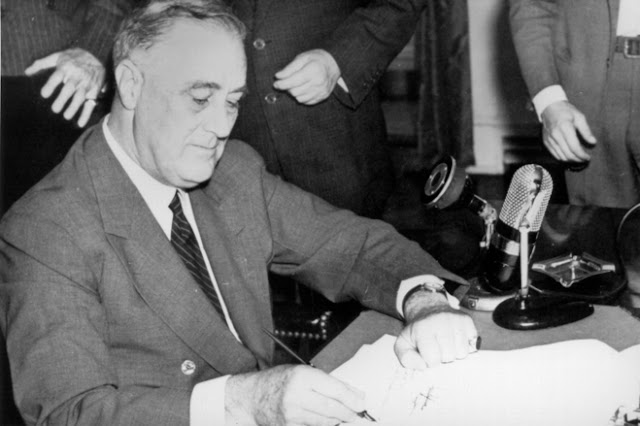
Today in Washington, President Roosevelt signed the Selective Service Act today and proclaimed October 16 as registration day for all males from 21 to 35. years old.
The President and many other dignitaries attended the funeral for Speaker Bankhead in the House and prepared to leave tomorrow for burial in Alabama.
The Senate adopted a resolution of regret over the death of Mr. Bankhead, attended the funeral in the House and recessed at 1:10 PM until noon on Wednesday. The House elected Representative Sam Rayburn of Texas Speaker, and, following the funeral, adjourned at 1:07 PM until noon on Thursday.
The War Department awarded contracts worth $196,156,126 for airplanes, construction work and supplies, to nearly 100 concerns.
The Selective Training and Service Act of 1940 was enacted in the United States, the first peacetime conscription in American history. The Selective Training and Service Act of 1940, also known as the Burk-Wadsworth Act, became law when it was signed by U.S. President Franklin D. Roosevelt. The act required men between the ages of 21 and 35 register with local draft boards and introduced the first peacetime conscription in United States history. Present plans of the war department are to call for service only about 400,000 men between the registration day and the first of, the year, which would be approximately one man in every 40 of the 16,500,000 expected to be registered throughout the United States. During the first year of the five-year training program, 900,000 are expected to be called, amounting to one in 18. Local boards will be allocated on the basis of one board for every 30,000 persons. Thirty advisors will be assigned to each board to assist registrants in filling out the lengthy questionnaires. In addition, each board will have one examining physician and one appeal agent.
The highest ranking officers of the federal government and of the diplomatic corps joined today in paying final tribute to Speaker William B. Bankhead at a state funeral in the chamber of the House.
Samuel Rayburn of Texas is elected speaker of the U.S. House of Representatives. With the body of their late Speaker, Representative William B. Bankhead of Alabama, lying in state before them, members of the House today chose as his successor Representative Sam Rayburn of Texas, who for three years had been majority leader. Mr. Rayburn and Mr. Bankhead were the only two Speakers in the history of the House to be elected without a contest.
Wendell L. Willkie charged late today that President Roosevelt “has weakened democracy throughout the world,” and declared that a totalitarian government would result from a third term for the chief executive. Making his first major campaign address in this city of Coffeyville, Kansas, where he taught school 27 years ago, the Republican presidential nominee started his talk with no trace of the hoarseness which had curtailed his week-end engagements, but his voice became husky before he had read two pages of his speech. An estimated 67,000 persons were at the park and 85,000 were in town during the day.
Two isolationist Senators said today that the Administration was seeking to deliver about half of this country’s bombing planes, known as Flying Fortresses, to Great Britain. They were Senators Clark of Missouri and Holt of West Virginia.
California’s troublesome migrant problem may be alleviated to some extent by defense preparations, but Farm Security Administrator C. B. Baldwin does not believe it will be ended. The continued trend toward larger farms, in the opinion of Baldwin, will tend to put more families into the migrant camps. He estimated that 40,000 “dust bowl” refugee families had migrated to California in the past 10 years and that 28,000 of these families still were living in the state. These families average about five persons. Baldwin said the flow during the past six months had been smaller, but the problem continued to be a serious one.
Colonel Frank Knox, secretary of the navy, said that the first contingent of the U.S. fleet left Hawaii today for the Pacific coast. Two other contingents of the fleet numbering approximately 30 vessels each also will return to the mainland, Knox said. Each contingent will remain two weeks for overhaul of the ships and to provide the navy personnel with shore leave. The secretary said he believed there were about 100 navy vessels which would return from Hawaii and that “30 or so” would constitute each of the three contingents. The second will leave Honolulu after the first returns from the mainland, and the third departs for the Pacific coast upon the return to the islands of the second group of ships.
The light cruiser USS St. Louis, arrived at St. John’s, Newfoundland with the Greenslade Board aboard. The Greenslade Board was a committee formed “to make a comprehensive study of the shore establishment (naval and commercial) necessary to support the Fleet in peace and war.” With the strategic requirements of the fleet in mind, the board was instructed to make recommendations for additional facilities in new locations and as to the expansion, limitation, contraction, abandonment, or conversion of existing shore facilities. The board was known by its senior member, Rear Admiral John W. Greenslade. The board, headed by Rear Admiral John F. Greenslade, which would evaluate base sites acquired from the British on September 5 in the destroyers-for-bases agreement.
Dedicated to “the preservation of peace in our hemisphere,” the 45,000-ton battleship USS New Jersey began to take shape today at the Philadelphia Navy Yard with the welding of two sections of its massive keel by Charles Edison, former Secretary of the Navy.
Major League Baseball:
After the Dodgers lose to the Reds, 4–3 in ten innings, a rhubarb at Ebbets Field results in a suspension and fine for Leo Durocher for “inciting a riot.” Perhaps better known from the game is the photo showing an obese Brooklyn fan astride George Magerkurth, pummeling the veteran umpire.
Called up from the Eastern League in August, Phillies rookie Danny Litwhiler singles in both games of 7–1 and 3–2 losses to St. Louis, extending his hitting streak to 21 straight games. He will be stopped tomorrow by Whitey Moore at Cincinnati, but will hit .345 in 36 games.
Sinking to an all-around new low, the sixth-place Giants dropped their eighth straight game yesterday, bowing to the Pirates, 7—6. The crowd, 1,262, was the smallest of the year at the Polo Grounds and no one seemed to care much. Mel Ott hit two home runs for New York in the losing effort; while Vince DiMaggio had a three-run shot for the Pirates.
Rookie Johnny Lucadello of the St. Louis Browns hits home runs from each side of the plate versus the New York Yankees in a 16–4 Browns win. Only Wally Schang, in 1916, had accomplished the same in the American League. Mickey Mantle in 1955 will be the next American League player to do it. Today’s clouts are the only home runs Lucadello will hit all year. The Browns drop the Yankees to 4 games back of the Indians.
The Indians, with Mel Harder retiring the first twenty batters in order, beat Philadelphia in the opener, 8–3. Johnny Babich’s six-hit twirling was too much for the Indians in the nightcap and the Athletics squeezed out a 3–2 triumph. The Split cost Cleveland half of its one-game advantage over Detroit.
The Tigers move to a ½ game back by beating the Senators, 9–2. Bobo Newsom cops his 19th win against four losses, spinning a five-hitter. Barney McCosky had two triples and Hank Greenberg hit his 35th homer of the season.
The Red Sox gave the faint pennant hopes of the White Sox a rude jolt today, defeating Chicago, 6–2, behind the sterling five-hit pitching of Jack Wilson. The loss snapped an eight-game White Sox winning streak.
Cincinnati Reds 4, Brooklyn Dodgers 3
Boston Red Sox 6, Chicago White Sox 2
Philadelphia Athletics 3, Cleveland Indians 8
Philadelphia Athletics 3, Cleveland Indians 2
Washington Senators 2, Detroit Tigers 9
Pittsburgh Pirates 7, New York Giants 6
St. Louis Cardinals 2, Philadelphia Phillies 3
St. Louis Cardinals 7, Philadelphia Phillies 1
New York Yankees 4, St. Louis Browns 16
A hurricane with an estimated wind velocity of seventy miles an hour struck parts of Canada’s maritime provinces of Nova Scotia, New Brunswick and Prince Edward Island tonight and much of the stricken territory, including the vital port of Halifax, was cut off from the outside world.
Five persons were killed and seventytwo injured, the police reported today, in a series of disturbances in the city last night during Mexico’s independence celebrations.
Communist Chinese New 4th Army captured Jiangyan (now a district of Taizhou), Jiangsu Province, China.
France was believed in well-informed quarters tonight to be in imminent peril of losing French Indo-China to Japan. French officials admit privately that negotiations already approved in principle by Vichy and Tokyo-are likely to result within a few days in an agreement permitting Japan to establish perhaps 25,000 troops on Indo-Chinese soil. Authoritative French, Japanese and foreign sources say this may prompt China to send her own soldiers across the colonial frontier and precipitate a conflict which might mean the beginning of the end of France’s 60-year rule of this east Asian territory of 230,000 square miles.
Dutch light cruiser HNMS Sumatra departed Capetown for Mauritius.
Dow Jones Industrial Average: 129.44 (+1.06)
Born:
Lisle Atkinson, American jazz double-bassist (Nina Simone; Betty Carter; Neo-Bass Ensemble), in New York, New York (d. 2019).
Neal Petties, NFL offensive end (Baltimore Colts), in San Diego, California.
Ed Bettridge, NFL linebacker (NFL Champions-Browns, 1964; Cleveland Browns), in Sandusky, Ohio.
Naval Construction:
The Kriegsmarine (German Navy) Type VIIC U-boat U-135 is laid down by Bremer Vulkan-Vegesacker Werft, Bremen-Vegesack (werk 14).
The Royal Navy Flower-class corvette HMS Campion (K 108) is laid down by John Crown & Sons Ltd. (Sunderland, U.K); completed by Clark.
The U.S. Navy Iowa-class battleship USS New Jersey (BB-62) is laid down by the Philadelphia Navy Yard (Philadelphia, Pennsylvania, U.S.A.) .
The Royal Navy Bar-class boom defense vessel HMS Barlake (Z 39) is launched by the Blyth Shipbuilding & Drydock Co. Ltd. (Blyth, U.K.).
 History Diaries