Battle of Britain Day
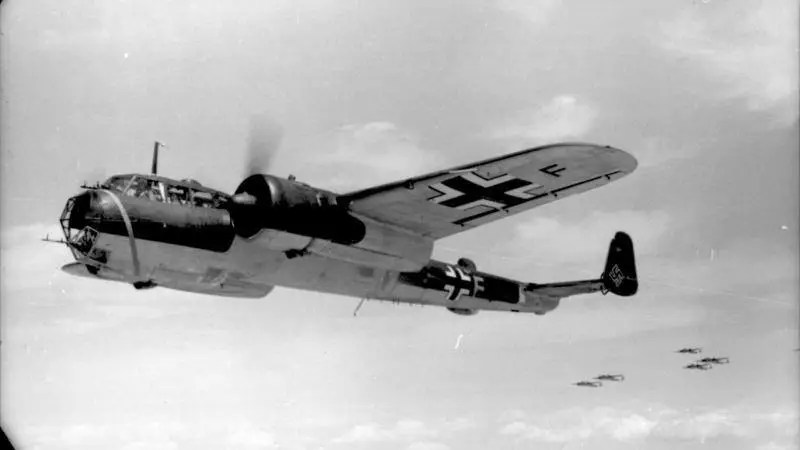
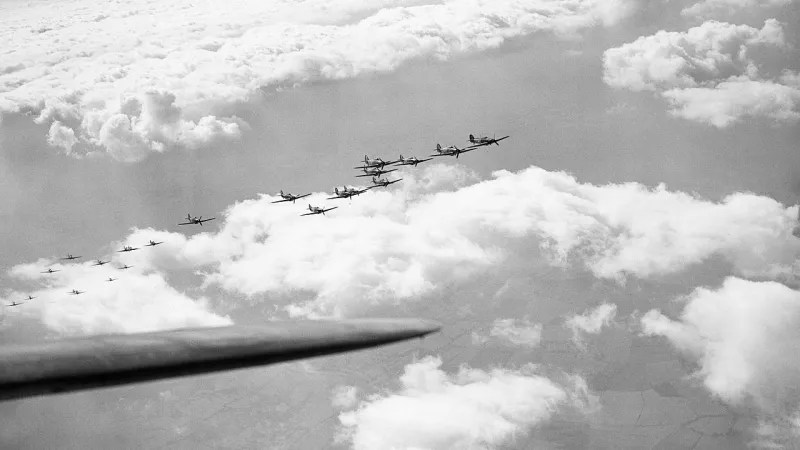
The large-scale air battle known as Battle of Britain Day was fought. Believing the RAF was near its breaking point, the Luftwaffe mounted an all-out offensive, sending two huge waves of about 250 bombers each to bomb London and surrounding areas. The RAF managed to scatter many of the German bomber formations and shoot down 61 planes while losing 31 in return, inflicting a clear and decisive defeat on the Germans. Prime Minister Winston Churchill visits the Royal Air Force 11th Fighter Group at Uxbridge on what would be the fiercest day of the Battle of Britain.
Today comes and goes with no invasion. History shows that the Luftwaffe came as close as it ever could to achieving aerial supremacy over the British Isles on 6 September, after weeks of focused, effective and hard-fought attacks on the RAF and its infrastructure. On the 7th, however, the Germans radically changed strategy to focus instead on British cities. While that change radically ramped up the miseries of the war for everyone (including, incidentally, Hitler’s own people in Berlin and other cities eventually), the Germans making this decision — primarily Adolf Hitler and Reichsmarschall Hermann Goering — thereby sabotaged their own effort. The RAF has recovered and lies in wait, lurking and intact, although cannily not showing all the cards in its hand.
There are many possible psychological layers to this — in fact, it is all psychological analysis in hindsight — and Hitler may in fact already have known by early September that an invasion was not possible. Thus, the change in strategy to bomb cities may not have been as significant as we would like to think — it just flowed from the cold, hard realization that the Luftwaffe already had lost the battle, or at least could never win it. That, incidentally, is the verdict of historians, too, and it is fairly obvious to this one that the Luftwaffe was not “clearing the skies” of the RAF in any kind of timely fashion that would support an invasion.
It is very dangerous to assume that World War II leaders simply made stupid decisions. There usually was a very good reason for them that simply hasn’t been explicated by historians for a variety of reasons. World War II leaders such as Hitler were extremely devious and engaged in a lot of misdirection and feints with even their closest subordinates. Though, of course, that doesn’t mean that the decisions were always good ones, just that there was an underlying rationale that may not be obvious at hindsight’s first glance.
The invasion technically remains an open question. Hitler has promised a final decision soon, though his next “final” decision likely will just be another postponement. Any student of his decisionmaking process knows that Hitler habitually sets seemingly hard dates, then postpones them time after time until he feels the time is right. However, it also is true that Hitler usually eventually carries through, though not always at the most propitious time.
Thus, faced with potentially one of the most important issues of the 20th Century, Hitler temporizes and keeps his own counsel. We can make some guesses, though, on what is really going on. There are many indications from his actions that Hitler is not very serious about the idea of an invasion at any point in September 1940. This includes a very relaxed attitude observed by his closest associates when normally he is extremely nervous before major operations. Hitler always exhibits a decided aversion to major Kriegsmarine operations, even though occasionally he does authorize them anyway with great trepidation (he went through major trauma about Operation WESERÜBUNG, for instance, a much less significant event), so his easy-going attitude on the supposed eve of the biggest of them all is a tell on his real thinking. If he was truly serious, Hitler would be in a near-catatonic state of worry.
In addition, Hitler does something else today that shows his mind is elsewhere. He instructs that “No hint of Operation BARBAROSSA must be given to the Japanese.” If Hitler were focusing on Operation SEALION, it is unlikely that he would be giving many thoughts to Operation BARBAROSSA at this critical juncture. This, incidentally, is a very wise admonition considering later intelligence breaches in Japan. The submission today of the Lossberg Report (see below) further reveals where the real action is in the Führer’s mind.
Hitler knows that there are other possible ways to defeat the British — a peripheral strategy in the Mediterranean already advocated by Admiral Reader having a lot more promise than a frontal invasion — and a failed invasion would be a traumatic loss of face for Germany which might even lead to uprisings in territories already conquered. This hugely risky gamble just isn’t necessary, especially with his naval counsel — the one who first brought the Operation SEALION idea up and planned the successful WESERÜBUNG — telling him it isn’t the right time. Finally, Hitler never expected to completely defeat France in 1940 — if at all — so what’s the rush?
The view that Hitler is not serious about an invasion is shared by many in the Wehrmacht. They see more of a show being put on by assembling invasion barges (which has the incidental benefit of diverting bombing raids from German cities, which may be part of Hitler’s thinking because he often mentions that in similar situations) than any sign that actual troops and tanks are ready to board them. Adolf Galland comments on this directly in his memoirs, noting that never at any point in the battle is there a sense of purpose. If it is just a show, it is a good one, but a show alone is not going to win the war.
The Luftwaffe again mounts a heavy attack, but loses 60 aircraft. The 31 fighter squadrons committed lose 26 aircraft and 13 pilots.
The “hour of destiny” was September 15th, a date thereafter commemorated as “Battle of Britain Day”. The title has been disputed; Alfred Price, for one, says that September 15th “has singularly little to commend it…..the day when the British victory claim was furthest from the truth…..” Yet, forgetting the “numbers game”, it is hard to dispute Churchill’s verdict that it was, in fact, “the crux of the Battle of Britain”. He made that judgment in the light of his knowledge of what happened to Operation SEA LION — which was, of course, from beginning to end, what the Battle of Britain was really about. The Official History sums up with clarity:
“If 15th August showed the German High Command that air supremacy was not to be won within a brief space, 15th September went far to convince them that it would not be won at all.”
- John Terraine The Right of the Line Hodder & Stoughton 1985 pp210-211
Sunday, September 15th 1940, was not only the turning point of the Battle of Britain, it was the turning point of the whole war. Every Fighter Command aerodrome in 11 Group was in some way involved, every squadron within 11 Group participated as well as the Duxford Wing from 12 Group and a number of squadrons in 10 Group were called upon to protect areas in the south west. Ground crews at all 11 Group airfields had to make efficiency a top priority in getting aircraft refueled and rearmed in between sorties, while at 11 Group Headquarters Air Vice Marshal Keith Park busily controlled the situation drawing on all his experience and expertise under the watchful eye of visiting Winston Churchill who saw firsthand the development of activities on this important day. Air Chief Marshal Hugh Dowding remained at Fighter Command Headquarters keeping silent vigil over the large map below indicating to him the events and the unfolding battle that was taking place over the south-east of England.
For Adolf Hitler and the German commanders, time was now running out. If an invasion was to take place on September 17th as planned, the lead-up would have to commence no later than today…..September 15th. The weather had shown, just how quickly it can turn at this time of year, and with winter not too far away, the German forces would have to take advantage of the better conditions that now seemed to prevail. Göring had sent out the instructions the day previous to all bomber and fighter bases that preparations for an all-out assault on England was to be made on this day September 15th, bomber units were given times and flight paths of their attack. Over the last few weeks, the Luftwaffe had experimented with different flying formations, needless to say, none had really been successful, losses had still been high, but they had discovered that on the occasions that they had kept at high altitudes, they had on a number of occasions surprised Fighter Command.
This was mainly due to the fact that the British radar was ineffective above 20,000 feet, and by flying at a height above this level they could cross the Channel undetected, but, the Germans did not know this. All that they were aware of, was the fact that those formations that flew at higher altitudes were not intercepted until they were usually well over the English coast. The most logical reason for this, thought the Germans was due to the fact that it took the British fighters much longer to gain the required height to intercept.
The sending of advance Ju 87 and Bf 110 units to bomb the radar stations along the southern coastline was, in the opinion of the Luftwaffe, a waste of time. As fast as they seemed to be destroyed, they were back in operational use again, and mobile units too were brought in to replace any radar station damaged. Over the last few days, the Germans had practiced at electronic jamming, this, they believed was successful and plans were made to intensify the jamming procedure in an effort to further reduce detection.
The spirit of the German aircrew, was still far from high. Time and time again, they had been told that the ‘Glorious Luftwaffe’ is ready to strike the final blow. But they had been told that in July, and again in August when Adlerangriff had been announced, and it was to be repeated yet again this September 15th. Early in the Battle of Britain, the Luftwaffe aircrews were told that the Royal Air Force would be wiped out in two or three weeks, now, whenever they fly over the British countryside they are still met with masses of British fighters in the hands of pilots that were gaining in skill and techniques. Many firmly believed that they were no nearer victory than they were two months before.
“Failure to achieve any notable success, constantly changing orders betraying lack of purpose and obvious misjudgment of the situation by the Command, and unjustified accusation had a most demoralizing effect on us fighter pilots, who were already overtaxed by physical and mental strain.”
- Adolph Galland, Commander
In Britain, things were slightly different. Most of the pilots were relatively fresh unlike their German counterparts. Combat action had been very infrequent, with only one really heavy day. As mentioned previously, Fighter Command was now stronger than it had been for weeks, aerodromes repaired, planes and personnel had replaced many that had been shot down and the radar stations were all functioning at 100%.
Park meanwhile, was prepared. He had learnt just a few days previous that there was to be a large scale attack prior to the impending invasion, only that he was unsure as to the exact date or time. Whatever attack that the Germans planned, he was sure, that 11 Group was ready even though the Luftwaffe commanders could not agree as to the actual strength of Fighter Command at the time.
“I think one of the problems with German intelligence was, was that it simply did not help the Germans to fight the battle, partly because of the problems we’ve mentioned with their inability to tell the truth even when they knew it, but the results of this can be seen only in September when there is a conference for senior German commanders attended by Göring himself, and Bepo Schmidt. And you have the commander of one Luftwaffe unit giving his opinion that there are at least one thousand RAF fighters left in Fighter Command, and the commander of another Luftwaffe unit giving his opinion that Fighter Command is beaten.
“So the degree of confusion in the German High Command as to what was actually happening is quite obvious whereas the British, at least they knew what they were trying to achieve. The British had a slightly simpler problem. Their main objective was survival. Both intelligence organizations seriously overestimated the number of enemy aircraft they shot down, the Germans by a factor of between three and four. The British right towards the end of the battle did get slightly puzzled by the fact that they could only find the wreckage of some eight hundred aircraft whereas the numbers claimed were far in excess of that. Instead of drawing the correct conclusion which was that the fighter pilots for quite understandable reasons were over claiming the number of enemy aircraft lost.
“They tried to work out where the missing, in inverted commas, aircraft might be, and that is to why did they crash in France or in the English channel or wherever. They didn’t correctly identify the problem which was that a German aircraft shot down was often claimed by more than one pilot in the confusion of the air fighting.”
- Sebastian Cox, Air Historical Branch, regarding the Battle of Britain
To survive any intense attack that may be instigated by the Luftwaffe, Keith Park had, in the last few days rearranged some of his squadrons, carefully placing them in the best strategic position to provide the best defense of London that he possibly could. of course, we must remember, that the pilots of Fighter Command had no idea of any large scale attack being made by the Luftwaffe. This information was only known by a selected few in radio interception (the “Y” Force) and the Air Ministry and of course, Dowding and Park himself. To the pilots, any change they thought was the usual relieving of tired squadrons.
It was not long after breakfast that Keith Park new that today was to different from all others, for the first time in a week, he had been notified that there was a buildup of German formations along the enemy coast. ‘This, I think is what we have been waiting for’ he said, ‘ I think that it is about to happen.’
Weather over Great Britain: Heavy cloud and rain periods overnight was expected to clear and the forecast for the day was fine in most areas with patchy cloud. No rain was forecast but some areas could expect an odd shower to develop. The cloud was expected to clear during the afternoon giving way to a fine and clear evening.
0900 Hours: Unaware of what was about to unfold within Fighter Command, the British Prime Minister Winston Churchill and his wife decided that he would call upon Air Vice Marshal Keith Park at 11 Group Headquarters at Uxbridge.
During the morning of 15 September Park received a visit from Churchill, accompanied by his wife and one of his private secretaries. He had no wish to disturb anyone, he said, but as he happened to be passing, he thought he would call in to see if anything was up. If not, ‘I’ll just sit in the car and do my homework.’ Naturally, Park welcomed the Prime Minister and his companions and escorted them down to the bomb-proof operations room, fifty feet below ground level. Churchill sensed that something important might happen that day. (Park’s wife had the same sense: when he apologized at breakfast for forgetting that 15 September was her birthday, she replied that a good bag of German aircraft would be an excellent present.)
Once they were in the operations room, Park tactfully explained to Churchill — not for the first time — that the air conditioning could not cope with cigar smoke. As the day’s dramatic events unfolded, the Prime Minister was therefore obliged to observe them with no better consolation than a dead cigar between his teeth. He had met Park several times and regarded him highly, recognizing (as he wrote after the war) that his was the group “on which our fate largely depended. From the beginning of Dunkirk all the daylight actions in the South of England had already been conducted by him, and all his arrangements and apparatus had been brought to the highest perfection.”
Keith Park took his visitors to the operations room, and as he began to explain some of the complexities of the operations, a radar report had come through that a number of enemy aircraft had been detected building up in the vicinity of Dieppe, another smaller formation had been detected over the the Channel off the coast near Dover. Park told the Prime Minister that he was lucky because it looked like that he could witness the activities of operations because a couple of German formations had been spotted. Winston Churchill replied that he would let the C-in-C carry on with his job and that he would just sit and watch.
The C-in-C called up some of his station commanders, mainly at Biggin Hill, Kenley and Hornchurch and ordered that they each place a couple of squadrons on ‘Stand By’ *. All eyes were concentrated on the large map table below. The smaller formation seemed content on staying out of reach in the center of the Channel and made no move towards the English coastline. “Feelers,” said Keith Park, “no doubt trying to entice our squadrons into the air.” He knew that there was something strange about this morning. A small formation, possibly Bf 109s flying parallel to the coast while a larger formation was gathering behind them. These tactics had not been employed since they used to make attacks on his airfields.
The markers indicating the position of the enemy force near Dieppe on the map table were now pushed into a position near the center of the Channel, their strength was forty plus, and he now noticed that another marker had been placed slightly behind and to the left of the first marker. This also read forty plus but for both markers, there was no height reading. Another call to his station commanders, and more squadrons were to be placed on ‘Stand By’ * while others were placed at ‘Readiness’ ** Should the detected formation decide to abort or pose no further threat the order of “Stand Down” *** would be given to any, or all squadrons.
- “Standby” (pilots strapped into their aircraft with all connections intact ready for immediate take off.)
** “Readiness” (pilots should be prepared to take off with five minutes.)
*** “Stand Down” (pilots to ignore previous order and await further orders)
0930 Hours: The two formations had spread themselves out and were detected near the coasts off Dover, Harwich and in the Thames Estuary. Squadrons were dispatched from Hornchurch, Gravesend and Croydon. But most of the German formations were ordered to turn back. The Fighter Command squadrons were recalled. The only other activity was just off the Devon coast were a lone reconnaissance aircraft was detected and a flight from 87 Squadron Exeter (Hurricanes) was “Scrambled”. It turned out to be a He 111 on weather reconnaissance and was shot down by P/O D.T.Jay.
1030 Hours: New formations were detected positioned between the towns of Calais and Boulogne. The markers on the map table at 11 Group HQ indicated that the enemy strength was 100 plus, but within moments, another marker was placed just behind the first and indicated 150 plus. It appeared that the German formations were in no great hurry and were forming up very slowly, this worked to the advantage of Keith Park as it gave him the chance to organize his defense forces. “This, Mr. Prime Minister looks like the big one.” said Park, eyes glued to the map. The C-in-C gave a few orders then asked for someone to get Observer Corps HQ on the telephone, then he ordered his assistants with him to get the various sector station controllers “on the blower” with the order for all squadrons to, “Stand By”. During a lull in Parks orders, Winston Churchill, standing beside him said quietly, “There appear to be many aircraft coming in.” Keith Park answered in the same low tone “And we are ready for them…….there’ll be someone there to meet them.”
1100 Hours: The picture now of this morning attack was clearer. There was at least 200 plus bombers and an unknown number of Bf 109 and Bf 110 escorts just off the coast near Calais. They were flying in a nor’ nor’ west direction and in a straight line this would allow them to cross the English coast in the vicinity of Dungeness. The expected time over the English coast would be between 1145 and 1200 hours if they were carrying heavy bomb loads, which it was expected they were.
Park was expecting a heavy engagement, but the map showed no other detection of enemy aircraft, just this one coming towards Dungeness, and this was big enough. He asked his assistants to get the sector controllers on the phone again and in the next thirty minutes, the following squadrons were scrambled:
1105 Hours: — 72 Squadron — Biggin Hill — Spitfires
1105 Hours: — 92 Squadron — Biggin Hill — Spitfires
1115 Hours: — 229 Squadron — Northolt — Hurricanes
1115 Hours: — 303 Squadron — Northolt — Hurricanes
1115 Hours: — 253 Squadron — Kenley — Hurricanes
1115 Hours: — 501 Squadron — Kenley — Hurricanes
1115 Hours: — 17 Squadron — Debden — Hurricanes
1115 Hours: — 73 Squadron — Debden — Hurricanes
1120 Hours: — 504 Squadron — Hendon — Hurricanes
1120 Hours: — 257 Squadron — Martlesham — Hurricanes
1120 Hours: — 603 Squadron — Hornchurch — Spitfires
1120 Hours: — 609 Squadron — Warmwell — Spitfires
1130 Hours: Just as the first Fighter Command squadrons approached the southern coast of Kent, the leaders of the German formation still had a few miles to go before they crossed the tall cliffs of the British coastline. The enemy bombers consisted of practically the whole of 1/KG76 flying Dornier Do 17s, these had met up with the Do 17s of 111/KG76 and KG3 behind Calais and now the combined force, escorted by Bf 109 escorts formed a vast armada almost two miles wide crossing the coast. All the enemy aircraft were thought to have departed from bases in the Brussels and Antwerp areas. The heights of the enemy formations were between 15,000 and 26,000 feet and the Observer Corps reported that they were crossing the coast just north of Dungeness, to the south of Dover and at Ramsgate.
The bombers came across the coastline in a number of vic formations, some of these consisted of three aircraft, some in five while others were in vics of seven, but as they crossed the tall cliffs they looked something like a giant herringbone. The bombers, which consisted of Dorniers, Heinkels and Junkers were escorted by Bf 110 aircraft flying in close support while the Bf 109s flew top cover high above the bombers.
Keith Park reckoned that the advance squadrons should make the initial interception and slow the advancing formation down. He knew that it would be asking too much to turn such a large force around and it would be obvious that these squadrons would have to be replaced as fuel and ammunition became low. The relieving squadrons then would leave London defenseless so Park decided to bring in the ‘Duxford Wing’ from 12 Group and wanted to vector them to be over London just prior to the estimated ETA of the enemy formation should they manage to get through.
In the next fifteen minutes, the following squadrons were scrambled:
1140 Hours: — 41 Squadron — Hornchurch — Spitfires
1135 Hours: — 242 Squadron — Duxford — Hurricanes
1135 Hours: — 302 Squadron — Duxford — Hurricanes
1135 Hours: — 310 Squadron — Duxford — Hurricanes
1135 Hours: — 19 Squadron — Duxford — Spitfires
1135 Hours: — 611 Squadron — Digby — Spitfires
1135 Hours: — 249 Squadron — North Weald — Hurricanes
1135 Hours: — 46 Squadron — Stapleford — Hurricanes
1140 Hours: — 1(RCAF) Squadron — Northolt — Hurricanes
1140 Hours: — 605 Squadron — Croydon — Hurricanes
1142 Hours: — 66 Squadron — Gravesend — Spitfires
As the full weight of the German bomber stream approached London, and squadrons from across No. 11 Group were already airborne or engaged, Prime Minister Churchill stood silently beside Air Vice-Marshal Park at the edge of the operations room plotting table at Uxbridge. Watching as every available squadron tag was pushed forward into the fight, Churchill turned to Park and asked quietly:
“What other reserves have we?”
To which Park, without hesitation, replied:
“There are none.”
It was a moment of stark finality — the climax of weeks of attritional combat. The fate of the capital now rested entirely on the squadrons already in the air.
1200 Hours: The German formation was making slow progress and 72 Squadron Biggin Hill (Spitfires) and 92 Squadron Biggin Hill (Spitfires) were vectored to intercept the enemy between Maidstone and Ashford. Some of the other squadrons that had been vectored further south were now re-vectored. These included the Hurricanes of 253 Squadron Kenley and 501 Squadron Kenley, with the Spitfires of 66 Squadron Gravesend, 603 Squadron Hornchurch and 609 Squadron Warmwell and within minutes reinforced 72 and 92 Squadrons. Soon after the initial interception, 229 Squadron Northolt (Hurricanes) and 303 Squadron Northolt (Hurricanes) met the raiders between Rochester and South London while 17 Squadron Debden and 73 Squadron Debden (Hurricanes) met the bombers over Maidstone. Fighter Command had eleven squadrons engaging the German armada. The heavy bomber formation was still stepped between 15,000 and 25,000 feet with a massive Bf 109 fighter escort above and slightly to the rear of the main formation.
The combat action was exceptionally heavy, and most of the defending British fighters managed to keep the Messerschmitt escorts from providing the cover for the bombers. The using of paired squadrons as requested by Keith Park was working. The Spitfires harassed the Bf 109s, crisscrossing them at every opportunity, and one by one they were sent spiraling towards earth trailing plumes of smoke. The Bf 109s tried to continue to escort the bombers who now were being attacked by the Hurricane squadrons. The British fighter pilots were slowly breaking up the formation with a steady application of force causing the bombers to straggle out of formation.
From the time that we had been over Maidstone until reaching the outskirts of London, we had been under extreme pressure. The British fighters had been with us since we had first crossed the English coast and had gathered in intensity all the time. Our escort had been doing a grand job with the Spitfires at keeping them away from us, and we thought that should things remain like this, then this bombing run would be made easy.
“We saw the Hurricanes coming towards us and it seemed that the whole of the RAF was there, we had never seen so many British fighters coming at us at once. I saw a couple of our comrades go down, and we got hit once but it did no great damage. All around us were dogfights as the fighters went after each other, then as we were getting ready for our approach to the target, we saw what must have been a hundred RAF fighters coming at us. We thought that this must have been all the RAF planes were up at once, but where were they coming from, as we had been told that the RAF fighters were very close to extinction. We could not keep our present course, we turned to starboard and done all that we could to avoid the fighters and after a while I am sure we had lost our bearings, so we just dropped our bombs and made our retreat.”
- Luftwaffe Do 17 Front Gunner Hans Zonderlind
The hundreds of Bf 109s covered a wide area and they too were having their successes. Two Hurricanes of 229 Squadron were shot down over the Sevenoaks area, with P/O G.Doutrepont aircraft being shot up badly and he was killed as the Hurricane went down and crashed on Staplehurst Railway Station. Another member of the squadron, P/O R.Smith managed to bail out of his bullet riddled aircraft also over Sevenoaks and he suffered severe leg injuries. Over Tunbridge Wells, F/O A.D.Nesbitt of 1 (RCAF) Squadron was swooped on by Bf 109s and he Bailed out as his aircraft spiraled to earth. F/O R.Smither was not so lucky, as he went down with his aircraft also over Tunbridge Wells.
The combat area now covered a wide area, and as the minutes ticked by, the intensity of the battle increased as more fighters of Fighter Command arrived on the scene. 501 Squadron Kenley (Hurricanes) was one of them. They intercepted the enemy over northern Kent and mixed it with both bombers and fighter escort.
“The bombers were coming in towards London from the south-east and at first we could not tell how many there were. We opened our throttles and started to climb up towards them, aiming for a point well ahead, where we expected to contact them at their own height. As we converged, I saw that there were about twenty of them, and it looked as though it was going to be a nice party, for the other squadrons of Hurricanes and Spitfires also turned to join in. By the time we reached a position near the bombers, we were over London — central London, I should say. We had gained a little height on them, too, so when I gave the order to attack we were able to dive on them from their right.
“Each of us selected his own target. Our first attack broke them up pretty nicely. The Dornier I attacked with a burst lasting several seconds began to turn to the left away from his friends. I gave him five seconds, and he went away with white smoke streaming behind him. As I broke away and started to make a steep climbing turn, I looked over the side. I recognized the river immediately below me through a hole in the clouds. I saw the bends and the bridges and idly wondered where I was. Then I saw Kennington Oval, and I thought to myself, “That is where they play cricket”.
- Squadron Leader J.Sample 501 Squadron September 15th 1940
Squadron Leader John Sample went on to say, that soon after this, he came across another Do 17 that had been hit by a Spitfire and a Hurricane who were following closely and was trailing white smoke. Not that one could really get bored up there, but he had nothing else to attack, so he climbed up above the Dornier and then made a diving attack. As the distance between himself and the bomber narrowed, he noticed a red light in the rear-gunners cockpit, but as he got even closer, he saw that he was looking through the whole length of the inside of the Dornier to the pilot and observers cockpit. The red light that he saw, was in fact the red glow of fire. He gave another short burst, and as he turned and went past the aircraft, the inside was nothing but a red hot furnace inside. He then saw it go into a spin after the tail section broke away, followed by the wing sections beyond the engines. The narrow fuselage with short stubs of wing roots fell though the cloud to oblivion, John never saw it crash.
Another pilot of 504 Squadron, Sergeant R.T.Holmes, decided that he would take on no less than three Dorniers at the same time. The first, after a short burst bellowed smoke, but as he flew past he got a spray of black oil on his windscreen. But that did not deter him from going in on a second Dornier ahead. Another short burst as the Do 17 was lined up in his sights, and smoke and flames came from the stricken bomber and it dived away. He then took on a third, but soon afterwards, his Hurricane banked sharply and he lost all control, he started to go into a wild spin. It is not known as to whether he collided with the third Dornier, or was hit by enemy gunfire but he found it difficult to extract himself from the doomed fighter. Suddenly, he managed to free himself and jumped, the parachute breaking his fall just twenty feet or so above the rooftops of some houses in fashionable Chelsea. His backside hit the sloping roof of one of the houses, and he began to slide down the roofless, fall off over the guttering and straight down into the garden below, and into a garbage bin. The Dornier came down about a mile away crashing into the forecourt of Victoria Station, practically demolishing a small tobacconist’s shop.
1215 Hours: The Bf 109s were being held over the northern area of Kent with only a few managing to escape the onslaught by the Spitfires. The bombers which consisted of He 111, Do 17s and Do215s were being harassed by the Hurricanes, and one by one they began to turn away smoke trailing from engines and desperately trying to evade any further attack by the British fighters. Others dropped their bombs at random. Some of the more courageous tried in vain to make it to their target, riddled with bullets, crewmen either dead or injured at their posts. But more was in store for them as they approached London. Keith Parks timing of requesting the Duxford Wing to cover the airfields of Hornchurch and North Weald was to perfection, as was everything else that was taking place. It seemed that Fighter Command could do no wrong.
As the German bomber formation, with about only one third of its Bf 109 escorts, approached the outskirts of London the enemy was in disarray. The Bf 109s peeled away one by one, some had sustained damage but most were now low on fuel. With the city now in their sights, they were confronted by the most awesome sight of the four squadrons of the Duxford Wing. Three squadrons of Hurricanes with the two Spitfire squadrons about 5,000 feet higher. As the Duxford Wing closed in, they were joined by 41 Squadron Hornchurch (Spitfires), 46 Squadron North Weald (Hurricanes), 504 Squadron Hendon (Hurricanes) and 609 Squadron Warmwell (Spitfires). The Bombers were confronted by British fighters on all sides, and one of the biggest combat actions ever seen over London developed. Sergeant D. Cox of 19 Squadron wrote in his combat report:
“I was Green 3, when we dived to attack some Me109s, which had dived down on us. I did not get my sights on any enemy aircraft. I pulled out and climbing, flew south. After a few minutes I saw six Me109s flying in line astern just above me. They saw me and attacked. I got on the tail of one of the enemy aircraft, but he half rolled away. Four of the enemy aircraft then flew off to the south. I turned to find the other enemy aircraft attacking me head-on. As he passed above me and climbed, I turned, and climbing steeply, came up underneath him and gave him a couple of bursts, stalling as I did so. Next, I saw him in a flat glide, which gradually steepened as he went through some cloud. When I came through the cloud I noticed a fire just beginning below, which I found to be his wreckage. He crashed about five miles east of Crowborough.”
- Sergeant D.G.S.R.Cox 19 Squadron 1215-30 hours September 15th 1940
“Hurricanes came in to deal with the bombers. They did this in an unusual way, head-on in a shallow climb, claiming three of them, and later two 109s.
“Others joined in, and in such numbers and with such aggression that it was like gulls mobbing an albatross. Seven more Dorniers were claimed as destroyed before the Duxford Wing, in all its multiple glory, hurling itself into the whirling mêlée. The raid had now entirely broke up over south London, and any idea the bomb-aimers identifying let alone attacking their assigned target had disappeared, like so many of their own kind.”
- Hough & RichardsThe Battle of Britain: — A Jubilee History Hodder & Stoughton 1989 p276
“We turned and crossed beneath them but the squadron got split up. I followed three of our Hurricanes climbing up on the left of the bombers for a head-on attack, lost patience and turned to do a beam attack on the leader……I opened fire with more than full deflection and let the Dornier fly into the bullets like a partridge. I came back and did a short quarter attack. The Do215 then broke away from the formation and I saw the engines were just idling as it glided down. Then about eight of our fighters set on the lame duck at about 3,000 feet below me. On landing I claimed this as a ‘probably destroyed’.”
- P/O R.G.A (George) Barclay 249 Squadron North Weald on September 15th 1940
Where everything was running in favor of 11 Group, for once, Douglas Bader’s ‘Duxford Wing’ also ran to perfection and in unison. Bader stated later, that being called up with time to spare made all the difference. His squadrons were able to take off as ordered, and the formation collected perfectly over Duxford and 56 fighter aircraft made the steady climb towards their vectored area, and had time to position themselves at the correct height and head towards Gravesend. As they approached the Thames, the Hurricanes stepped between 25,000 and 26,000 feet with 19 and 611 Squadron Spitfires at the rear climbing to 27,000 feet, they could see the little black specks, like a small formation of little ants in the sky. Douglas Bader led his ‘wing’ in a partial semi-circle allowing them to arrive at Gravesend with the morning sun behind them, and the Germans in front. But it was not until reaching the western boroughs of London did the ‘Duxford Wing’ manage to engage the enemy.
Perfectly positioned, with the bombers 3,000 feet below them they were about to make their attack, when a formation of Bf 109s came out of the sun. Bader immediately ordered the Spitfires of 19 and 611 Squadrons to take on the German fighters, which they did so effectively, scattering them by a surprise attack that they left the bomber formation and flew off to the south-east. While the ‘Duxford Wing’ was holding, the Hurricanes of 257 Squadron Martlesham and 504 Squadron Hendon (Hurricanes) attacked the German bombers. Bader waited for them to complete their sweep, then instructed his three Hurricane squadrons to fall into line astern and prepare to attack. Bader selected the most westerly of the three enemy formations, while 302 Squadron took on the middle formation while the remaining formation was left to 310 Squadron.
Coming in from astern of the westerly formation in an almost vertical dive, Bader’s leading Red Section went for the last section of three bombers, Neil Campbell for the left-hand bomber, Douglas Bader for the center one and Dicky Cork for the right-hand machine. The three bombers had lost cohesion when they had turned. Now, the three fighters dived steeply on them. Bader’s first burst caused his targets wing to burst into flame. He flashed past, pulled up and attacked a Dornier ahead, but a Spitfire was in his way and he broke off. Bader fired at a few Dorniers in the mêlée but was not sure if he hit any of them as be had constantly to watch out for other fighters; in front of him, a Spitfire smashed into a Dornier and the pair fell earthwards. There were many Spitfires and Hurricanes and many bombers in the same airspace, trying to get in their own attacks — there was no co-ordination, no sequence, fighters jostling to be first. Either the Germans were outnumbered or the British had committed too many fighters: it depends upon how the ‘Big Wing’ is viewed.
- Michael G.Burns Bader-The Man and his Men Arms & Armour 1990 p91
There was not much for the bombers to do, the pressure on them was intense. They would be attacked by a couple of squadrons of RAF fighters, then as soon as they broke off the engagement, another couple of squadrons were ready to pounce at an already decimated enemy force. The bombers began to drop their bomb loads at random hoping that this would lighten their load and they could make as hasty retreat as possible without any further damage to their aircraft. South London was the worst affected, with Lewisham, Lambeth, Camberwell and a couple of the bridges across the River Thames all recording bomb damage. One high explosive bomb fell in the grounds of Buckingham Palace causing slight structural damage to the building but a bigger hole in the lawns at the rear as it failed to explode. A power station in Beckenham was also hit.
The German formations headed out towards the west, turning south near Weybridge. 609 Squadron Warmwell (Spitfires) chased them as they headed for the coast and took on 15 Dornier Do 17s, a formation of Bf 109s saw the desperate situation that their bombers were in and joined in as did a few Bf 110s. Over Ewhurst in Surrey, 605 Squadron Croydon (Hurricanes) came in to assist and as the mêlée continued fierce action over the town of Billingshurst just west of Horsham they were joined by 1(RCAF) Squadron Northolt (Hurricanes) who took on the troublesome Bf 109s. In the other direction, some eighty German bombers were trying to make good their escape towards the Thames Estuary. Fighter Command attacked in large numbers with squadrons attacking any of the escorts while others took on the merciless bombers. The first, and the morning battle had been a disaster for the Luftwaffe, many cashed, others blew up in mid-air, while the remainder struggled for the safety of the French coast.
For the Germans, after about ten minutes over London, there was now no such thing as the formation. German bombers were at all levels of altitude and most were scattered over an area fifteen miles wide. To give an example of the intensity of this morning battle, the combat area was approximately 80 miles long by 38 miles wide, and up to six miles high. Total combat actions numbered as many as 200, one third of these were settled within the combat area with one of the aircraft submitting either by being destroyed by his enemy or a disabled aircraft managing to break away and head for safer pastures. The other third was with German aircraft being chased away from the combat area by British fighters and often crashing on English soil or going down into the watery graveyard of the English Channel.
Because of the intensity and aggression shown by the pilots of Fighter Command, the bombers dropped most of their bombs randomly over a wide area. Damage was done, but not as much as was intended by the Luftwaffe commanders. For the Luftwaffe, the raid was doomed to failure the moment that the first formations had crossed the Channel. This time, everything had gone right for Fighter Command and 11 Group. Timing, position and height was all on the side of the RAF. Keith Park and his pilots had won the first round of the day.
1230 Hours: As the clocks in Britain showed 12.30pm, the first battle of the day had finished. Most of the German bombers who had intentions of again dropping hundreds of tons of bombs on the city had been fought off by Fighter Command. In scattered areas of Kent and Sussex the odd skirmish still took place as patrolling squadrons observed a few Dorniers and Heinkels desperately trying to make their way back to their bases in northern France and Belgium. The pilots of the Hurricanes and Spitfires showed no mercy. It made no difference whether the bombers were crippled or not, some, which it was obvious that they would never make it back, were shot down, the broken hulks of German aircraft could be seen from the outskirts of London to the Channel coast.
To many Londoners, many were out and about on this fine day in September, and went about their business as usual, the dogfighting high above being little more than entertainment value.
There is no doubt, that again the Luftwaffe were their own worst enemies on this morning’s raid. Too many aircraft being dispatched from a rather enclosed area of Calais, the manner in which they organized their formations over the Channel, it was too cumbersome and too slow, and again, Göring did not value the worth that radar had for the British. All the time the enemy bombers and their escorts were forming up, Fighter Command had a birds-eye view of the proceedings that was going on across the Channel. It allowed Keith Park the time he needed to organize his squadrons, paying particular attention to which squadron was to be vectored where. of course, it also allowed him to call on the ‘Duxford Wing’ giving them more than the time required to form and be in the right position at the right time when they made their interception.
As battle weary fighter pilots returned from the morning’s operations, they were unaware that a second attack by the Luftwaffe would be made early that afternoon. As each squadron landed back at their bases, the normal rearming and refueling procedure was carried out, pilots, after being interviewed by the intelligence officer lay back in the midday sun, to relax, unwind and to share experienced of the morning success. For come, it would be less than an hour before they would be called on again as the next wave of enemy aircraft had been detected.
Afternoon Weather over Great Britain: The fine conditions of the morning were expected to give way to incoming cloud although it was expected to remain dry. This cloud was expected to be stratocumulus providing about 8/10ths cover at a height of 5,000 feet. Wind was expected to be slight and from the north-west.
1300 Hours: The radar stations along the Kent coast pick up movements across the Channel. It was the commencement of German bombers busily forming up for yet another raid on the British capital. Fighter Command are notified, but as there is no indication yet that the bombers are heading across the coast, it was just a ‘wait and see’ game, and Keith Park was content at this stage just to know the various squadron strength after the mornings combat action.
1330 Hours: It is now evident that there is a massive build up west of the Calais-Boulogne area, and it seemed that this was to be a repeat of the Luftwaffe’s morning performance. The question here was……would the Luftwaffe use a greater number of bombers for this second raid. After all, the morning’s raid was nothing short of a disgraceful attempt, although one must give full credit to Fighter Command in forcing the Luftwaffe to submit and return back to their bases.
If the Luftwaffe was to use greater numbers in the afternoon’s raid, they would have to use a maximum fighter escort not only all the way on the outward journey, but on the homeward leg as well. They should stay in position higher and behind the bombers for the duration of the raid at the expense of the usual feints that were normally carried out as this would only consume additional fuel which, for the Bf 109s was a precious commodity. The German shortage of fighters compelled the division of the attack, so that some would be used twice and so that the second attack could, and with lick, catch many of Park’s fighters on the ground, re-arming and refueling.
All squadrons that had been involved with the morning’s action were again placed at readiness and this included the Duxford Wing and the two squadrons from 10 Group. As time progressed, radar had reported that the formation had broken up into three distinct groups, and that it was possible that each group was following a short distance behind another.
1400 Hours: Even though all the squadrons had been brought to readiness, some squadrons, especially those some distance from London were still being re-armed and refueled, and quite a few pilots were not with their squadrons. These had been shot down or Bailed out of their stricken aircraft and had made their way to other airfields and had telephoned in to their home bases, while some were being ferried back but had not yet arrived. Those that had got back, found the time to have a bit of lunch while their aircraft were in the hands of the ground crews. This was one of the reasons that the Luftwaffe had made this second raid so soon after midday, as they knew that it would take Fighter Command to take at least two hours to get all their squadrons back to full strength. The hoped that by the time that they crossed the English coast that most of the RAF fighters would still be on the ground.
The German formations that were approaching the Kent coast was made up of three distinct formations. All consisted of Dornier Do 17s, Heinkel He 111s and Dornier 215s from KG/2, KG/53 and KG/76. Smaller gruppes came from KG/1, KG/4 and KG/26 which made up a total bomber force of 170 aircraft. These were supported by Bf 110 and Bf 109s as escorts and their number was in excess of 300.
Most of the bomber formations had come from airfields in the Beauvais and Antwerp areas.
Park scrambled squadrons in almost the same order as he had done so only three hours earlier, but because the German formation had taken less time in ‘forming up’ the 11 Group commander had less time to get his fighters into the air, coupled with the fact that some squadrons were still re-arming and refueling, the efficiency was not as good as it had been during the morning period.
1410 Hours: Keith Park could see the incoming raid building up quickly and immediately his sector controllers of the afternoon raid. The station controllers then notified the squadrons who were placed on “standby”. 12 Group were called up by 11 Group who again requested maximum assistance just as they had done during the morning period. The same applied to 10 Group. Within a couple of minutes, following a similar pattern that had proved so successful during the morning, 11 Group “scrambled ” eleven squadrons and placed the rest on “standby”. At the same time, Wing Commander Woodall at Duxford, “scrambled ” his Duxford Wing which comprised 19 Squadron (Spitfires), 242 Squadron (242 Squadron (Hurricanes), 302 Squadron (Hurricanes), 310 Squadron (Hurricanes) and 611 Squadron (Spitfires). The only change that Park made that differed from the morning attack, was that he held more of his fighters back giving orders that they patrol areas to the east, south and west of London. The squadrons that were vectored to the forward areas were mainly instructed to attack the enemy fighters. This was probably due to the fact that by forcing the enemy escorts into combat early, they would use up far more fuel, and the morning raid had showed him that the bombers were far more vulnerable when they reached the outskirts of London, and the net result was that Fighter Command inflicted far more damage to aircraft over London than over the Kent coast.
1415 Hours: The first of the bomber formations crossed the Kent coast between Dungeness and Dover, with the other formations behind and flying at 15 minute intervals. The actual times of the bombers crossing the coast was at 1415hrs, 1430 hours and 1440hrs. The combined formation was mainly He 111s, Do 17s and Do 215s. The Observer Corps estimated that the total enemy bomber force was between 150 and 200 bombers. The escorts, flying as close escort and high altitude cover were the usual Bf 110s and Bf 109s and it is estimated that these numbered approximately 400. In total, a combined force of 600 plus aircraft heading north towards London on a front some thirty miles wide.
1430 Hours: The first engagements took place over Kent. Squadrons from Hornchurch intercepted a large formation of Dorniers south of Canterbury. Diving down in line astern they managed to destroy two of the bombers and another couple were wheeling away leaving behind a trail of thick black smoke. But they were jumped upon by Bf 109s and intense combat took place between the fighters of both sides allowing the Do 17s to continue their journey. Two aircraft of the Hornchurch squadrons were damaged.
Another formation consisting of Dornier Do 17s and Heinkel He 111s was detected south of Maidstone, and without any Bf 109 protection, they became the targets for 73 Squadron Debden (Hurricanes) who managed to destroy three of the bombers without loss to themselves. West of this attack near Dartford, 66 Squadron Gravesend (Spitfires) and 72 Squadron Croydon (Spitfires) intercepted another column of enemy aircraft where again, as with the others the combat action was intense. The Spitfires weaved in and out of the bombers managing to avoid collision in the huge traffic jam that was forming. Bombers started to take evasive action by banking either left or right. Just as another bomber formation was approaching from the south, the mêlée was joined by 249 Squadron North Weald (Hurricanes) and 504 Squadron Hendon (Hurricanes) and the large colossus of enemy bombers went into a frantic flight pattern. 73 Squadron who had engaged the formation from the outset, had now been entwined into the huge dogfight as well as 253 Squadron Kenley (Hurricanes).
The western flank saw Do 17s, He 111s and Ju 88s which numbered about eighty curve right from Kent, across the outskirts of Surrey and heading towards the western side of London. A terrific battle ensued as fighters from 213 Squadron Tangmere (Hurricanes) and 607 Squadron Tangmere (Hurricanes) which had been vectored to cover Biggin Hill intercepted the large formation. Again, Bf 109s were seen to the south of London, but decided not to come to the aid of the bomber formation which managed to get mauled by the Hurricane squadrons. This was one of the most intense battles. The British fighter tore into the enemy like hungry cats to a flock of wounded birds.
“I started to chase one Dornier which was flying through the tops of the clouds. Did you ever see that film “Hells Angels?” You’ll remember how the Zeppelin came so slowly out of the cloud. Well, this Dornier reminded me of that. I attacked him four times altogether. When he first appeared through the cloud—you know how clouds go up and down like foam on water —I fired at him from the left, swung over to the right, turned in towards another hollow in the cloud, where I expected him to reappear, and fired at him again. After my fourth attack he dived down headlong into a clump of trees in front of a house, and I saw one or two cars parked in the gravel drive in front. I wondered whether there was anyone in the doorway watching the bomber crash. Then I climbed up again to look for some more trouble and found it in the shape of a Heinkel III which was being attacked by three Hurricanes and a couple of Spitfires.
“I had a few cracks at the thing before it made a perfect landing on an RAF aerodrome. The Heinkels undercarriage collapsed and the pilot pulled up, after skidding 50 yards in a cloud of dust. I saw a tall man get out of the right-hand side of the aircraft, and when I turned back he was helping a small man across the aerodrome towards a hangar.”
- Squadron leader John Sample 501 Squadron Kenley
1450 Hours: Even though most of the attacking bombers had been thrown off their planned flight path, many of them managed to get through to the southern areas of London. If they thought that most of Fighter Commands fighters were behind them and still engaged in combat over Kent and Surrey, they were in for a big surprise. Now, as in the morning session, they were met by 49 fighters of Bader’s “Duxford Wing”. Combine this with a number of other squadrons that had followed the leading bombers and two other squadrons that had just joined the action, a total of some 150 more fighters awaited them.
Every squadron in 11 Group had intercepted, and at that moment I saw Douglas Bader’s wing of five squadrons coming in from Duxford. This was the day that Göring had said to his fighters the RAF was down to their last 50 Spitfires. But they’d run up against twenty-three squadrons for a start, when they were on their way in, and then, when they got over London, with the Messerschmitt 109s running out of fuel, in comes Douglas Bader with sixty more fighters…..”
Flight Lieutenant R.W.Oxspring 66 Squadron Fighter Command
Again, Bader ordered the Spitfires to attack the Bf 109s, who for some strange reason had not left their bombers early as on previous occasions, while the Hurricanes attacked the bombers. They were at a disadvantage as they were still climbing and had not had the time to get into position. The “Duxford Wing” leader complained later that it was the case again of being called on far too late, but the real reason this time was that the Germans had formed up much quicker this time that almost caught even Keith Park off guard.
But this was not to be the best of afternoons for Bader:
The Wing was scrambled again to patrol North Weald, and Bader led them through a gap in the clouds.
At 16,000 feet, flak bursts ahead, and in moments he saw the bombers; about forty of them, some 4,000 feet above the Hurricanes. Damn! Everything risked again because they were scrambled too late. Throttle hard on, the thundering Hurricane had her nose steeply lifted, nearly hanging on her propeller at about 100 m.p.h.
A voice screamed: “109’s behind.”
Over his shoulder the yellow spinners were diving on them and he yelled as he steep-turned, “Break up!” Around him the sky was full of wheeling Hurricanes and 109’s. A yellow spinner was sitting behind his tail, and as he yanked harder back on the stick an airplane shot by, just feet away. Bader hit its slipstream and the Hurricane shuddered, stalled and spun off the turn. He let it spin a few turns to shake off the 109 and came out of it at 5,000 feet. All clear behind.
Far above a lone Dornier was heading for France, and he climbed and chased it a long way, hanging on his propeller nearly at stalling speed again. Near the coast he was just about in range and fired a three-second burst, but the recoil of the guns slowed the floundering Hurricane till she suddenly stalled and spun off again. He pulled out and searched the sky but the enemy had vanished.
- Paul Brickhill Reach for the Sky Collins 1954 pp221-222
When Bader had first spun out, he almost collided with P/O Denis Crowley-Milling, and it was while in Crowley-Milling’s slipstream that he went into the spin and did not pull out until 5,000 feet. Bader was annoyed, possibly only with himself that it had happened, but not being able to gain height to attack another bomber only rubbed salt into the wound.
The combat action over the southern and southwestern areas of London was intense. The formation that had been intercepted as far away as Maidstone somehow managed to straggle through, many of the Bf 109s managed to stay as long as they could, but with fuel tanks getting into the danger zone, they had to break off and leave many of the bombers at the mercy of the British fighters. The German bombers, who had intended to drop their bomb loads on London itself, had jettisoned them in scattered areas in London’s eastern and southern suburbs that suffered most. The most severe damage was done in West Ham, East Ham, Stratford, Stepney, Hackney, Erith, Dartford and Penge. Fighter Command now had everything that they possessed in the air, even the Station Commander of Northolt Group Captain S.F.Vincent.
1500 Hours: 303 Squadron had been ordered up at Northolt at 1420 hours and were vectored to cover the north Kent coast along the Thames. The squadron consisted of nine Hurricanes and was led by S/L R.Kellett when they sighted a large formation coming towards them. Interception was made over Gravesend. The Squadron Intelligence Report describes the action on this day:
“S/L Kellett was ordered to patrol Northolt at 20,000 ft. and took off with the nine serviceable machines. The other Squadrons had left sometime previously and 303 operated throughout alone. On reaching a height of 6000 ft. the Squadron was vectored 100 degrees and climbed over the l.A.Z. When still 2,000 ft below their patrol level, they sighted coming head on from the southeast a very large formation of bombers and fighters. The Bombers were in vics of three sections line astern with Me11Os in sq formation between the vics of Bombers. To the flanks and stepped up above to 25,000 ft. were many formations of Me1O9s. Blue Section had got rather in front of the others, and wheeling round to let them come up. S/L Kellett had to deliver a quarter frontal attack instead of head on. This he did initially with only the other two members of Blue Section — Sgt.Wojciechowski and P/O Zak. Probably as there were a lot of clouds about, the enemy imagined that this was the advance guard of a large force and began to wheel towards the east, and when the other two sections came in they turned completely to the east. After the first rush the Me11Os and the 109s fell upon the nine Hurricanes which were compelled to defend themselves individually as best they could, and escaped destruction in the clouds. As it was, four of the aircraft which returned were slightly damaged by enemy fire, one, Sgt Adruszkow’s, was destroyed, the pilot baling out unhurt at Dartford, and Sgt Brzezowski is missing.”
- Intelligence Report of 303 Squadron Northolt 11 Group Sept 15th 1940
303 Squadron was in the air just one hour and ten minutes before they returned back to Northolt. In this time, they had destroyed three Dornier Do215’s, two Messerschmitt Bf 110’s and one Bf 109. One Do215 was seen to break away from the combat action trailing smoke and losing altitude, but its fate is not known and the squadron was also credited with a probable. But only seven of the nine Hurricanes returned, with one pilot missing and another Hurricane crashing near Dartford with the pilot managing to bail out of his aircraft.
Flying Officer R.H.Oxspring of 66 Squadron Gravesend (Spitfires) said later that every squadron in 11 Group and the five squadrons from Duxford had in some way intercepted raiders and engaged combat. For the enemy bomber crews, it was now a no win situation. They were outnumbered over their target area, so much so that accurate bombing was virtually impossible. More and more squadrons were moving into areas to cut off any retreat so that when they did decide to abort, trying to get into the protection of the cloud cover would be their only hope of survival. Group Captain Vincent wrote in his report:
“I was climbing over Northolt to watch the Northolt Wing in action, and saw approximately five miles S.W. and west of base, streamers from very high enemy fighters. When at 20,000 feet, I saw approaching from the south I saw a formation of about 18 He 111s at approx. 17,000 feet with a very large number of Me109’s, on each side, above and behind, mostly about 2,000 feet above the bombers.
“I was therefore able to carry out a head on attack on the bombers, breaking away below, and then one from vertically below and stalling away — I was unable to see any possible result of either attack owing to the Me109’s. The bombers then turned back to the south.
“I climbed up towards the sun and tried to attack a Me109 but had to leave it owing to others coming down onto me from above, but saw three Me109’s chasing a Hurricane at right angles to me from left to right, and when the Hurricane dived away (straightening out 5,000 feet below) and the Me’s turned back onto their course. I was able to get in a good position on the tail of the third one. Before I opened fire I saw No.1 burst into flames, and the pilot jump out in a parachute; he had obviously been shot down by No.2 who was close in astern of him.
“I gave one very short burst of about one second at No.3 at about 200 yards and immediately pieces came off from the port side of his fuselage, I estimate, to the south of Farnborough. I could not then see No.2 as my attention was diverted by the two parachutes.
‘All Me109’s had light blue undersurfaces and dull grey mottled top surfaces with black crosses on fuselages.”
- Group Captain S.F.Vincent Station Commander Northolt 11 Group Sept 15th 1940
One of the Luftwaffe pilots who had to make a rather ungracious landing was the veteran Professor von Wedel. Like most of the Bf 109 pilots, they stayed with the Dorniers as long as possible, but the fuel situation forced them to leave early leaving the bombers in a very vulnerable position. On the return journey, his flight of Bf 109s were attacked by 605 Squadron Croydon, 1 RCAF Squadron Northolt and 229 Squadron Northolt all flying Hurricanes. It is believed that one of the Hurricanes of 1 RCAF Squadron followed von Wedel down, the veteran not being able to out maneuver the Hurricane, was hit and his Bf 109 had lost its controls. He tried in vain to make a landing on Romney Marsh, but the controls did not respond, and he made a heavy wheels up landing at a farmhouse, destroying a shed in which a mother and daughter were sitting in a car awaiting the father who was about to take them out on a Sunday drive. Both mother and daughter were killed instantly. A local policeman arrived on the scene to find a battered and bruised von Wedel wandering around in an almost tearful state, and as he apologized to the policeman for what he had done, the constable simply asked “Would you like a cup of tea sir?”
Sgt P.R Eyles 92 Squadron Biggin Hill (Spitfires) picks up a Do 17 heading south and attacks. A short burst at first has no impact and he has to circle round and decides to have another attack. He gains a little height then sweeps down preparing to make an astern attack. Another short burst and pieces fly off the starboard side of the bomber and the telltale smoke from the starboard engine indicates damage. As the Spitfire banks away he jumped on from above by Bf 109 but the Biggin Hill pilot reacts quickly and takes evasive action. He starts to climb and has lost sight of the German fighter, and looks for the crippled Dornier below. It continues its journey and could not have suffered too much damage as it it still flying straight and level.
The sergeant lines up his Spitfire to make another attack when he spots the Bf 109 on his port side coming at him. He turns and attempts a beam attack on the 109. As they close in at an impact speed of something over five hundred miles an hour, both seem to fire at the same time, the Spitfire vibrates slightly, but does not seem to be damaged too severely, it is still responsive and all dials and controls seem to be behaving normally. Smoke poured from the engine area of the Messerschmitt and it starts to lose altitude in graceful fashion then levels out. Sgt Eyles pulls back on the stick and gains altitude. The recognizable wake of smoke heading out over the Kent coastline indicates the Dornier is making progress. The Spitfire heads in that direction, gaining height all the time. No other aircraft seem to be in the area to impede his next attack.
His combat report states that he was well across the Channel before he caught up with the bomber where he made another attack and saw more pieces fly off the fuselage and the other engine catch fire, but seeing a number of small specs coming at him from the French coast, decided to call it a day and head back towards base only claiming the Do 17 as a probable. Sgt Eyles was to try a similar action three days later, but was shot down by Major Moelders off the coast near Dungeness and was never seen again.
The bulk of the fighting took place over London and its outskirts from Dartford westward, where five pairs of squadrons from 11 Group and the wing from 12 Group were all in action between ten minutes to three and a quarter past, mainly with the third formation but probably also with survivors of the other two. In the course of the action the enemy distributed a big bombload over London and its outskirts, scoring several lucky hits on public utilities and railways. At East Ham a gas-holder and a telephone exchange were wrecked; and considerable damage was done to a variety of targets on both banks of the river at West Ham and Erith. Many other riverside boroughs reported hits; but the harm done was nothing like as great as that sustained eight days before in the first of the big daylight raids on London. Again retiring by two distinct routes, the attackers were engaged on the way out by another four squadrons, including two from 10 Group. Guns of the inner artillery zone and the Thames and Medway defenses were also in action and claimed a number of successes.”
- Basil Collier, The Defence of the United Kingdom, HMSO, 1957
Meanwhile, Flight Lieutenant W.G.Clouston of 19 Squadron Duxford (Spitfires) took the two sections of his squadron to attack a formation of Do 17s over Shoeburyness. Making their attack in line astern they made their attacks before any Bf 109s arrived. F/L Couston lined up one, and gave a series of short bursts, one of the engines of the Dornier exploded in flame and smoke. Before he lost sight of it, ten feet of the bombers wing broke away and fell earthwards causing the bomber to roll over and spiral down to a watery grave below.
1600 Hours: As the last of the bombers were being chased back across the Channel, and many of the squadrons who has fought one of the heaviest air combats of the Battle of Britain retired to their respective aerodromes, another small raid had been detected and was approaching the Dorset town of Portland. It was just a small force of about ten He 111s and 10 Group scrambled 152 Squadron Warmwell (Spitfires), 607 Squadron Tangmere (Hurricanes) and 609 Squadron Warmwell (Spitfires). The enemy target was the Woolston Spitfire factory which was hit, the bombing was not accurate and severe damage was kept to a minimum. 602 and 609 Squadrons both intercepted after the bombers attacked their target, and both claimed that they had destroyed two aircraft each.
1800 Hours: A small formation of Bf 110s from Erpro 210, once the crack dive bombing gruppe of the Luftwaffe, made an attack again on the Woolston factory complex. Most of the British fighters that had been up on constant sorties during the afternoon had returned to their bases and by this time were busy being rearmed, refueled and many were undergoing their usual repairs from damage sustained during the hectic afternoon. Therefore the Bf 110s were free from any attack or interception by Hurricanes or Spitfires. The task of defense was by the AA gun batteries who put up a tremendous fight in defense with accurate gunfire, which although they did not shoot down any enemy aircraft, the barrage that they put up was so aggressive that not a single bomb was dropped onto the Spitfire factory.
As the afternoon attack came slowly to an end, one by one the often tired and exhausted pilots returned to their bases. It had been a long and hectic day, Many of the pilots stated that ‘they had very close to buying it’ but such was their determination that saw them through, yet each one still had to remember that he was not invincible, the thought of death was still a reality, but many put it to the back of their minds.
“Some of us would die within the next few days. That was inevitable. But you did not believe that it would be you. Death was always present, and we knew it for what it was. If we had to die, we would be alone, smashed to pieces, burnt alive, or drowned. Some strange, protecting veil kept the nightmare thought from our minds, as did the loss of our friends. Their disappearance struck us as less a solid blow than a dark shadow which chilled our hearts and passed on.”
- Squadron Leader Peter Townsend 85 Squadron RAF (later Group Captain)
But the day belonged to Royal Air Force Fighter Command, they were unaware of it then, but they had achieved something on September 15th 1940 that would go down in world history. Their guts, determination and courage was at long last to pay off, they would turn the tide in controlling the skies over south-east England. This day was to belong to them, and in future years was to become known as “Battle of Britain Day”.
The day is pretty much a disaster for the Luftwaffe. While the RAF loses 36 fighters — no small number — the Luftwaffe loses about 60, with many more badly damaged. Winston Churchill, watching the whole thing with Park at Uxbridge, declares that the: “fifteenth of September 1940 was the day of our Victory!”
“This time, for a change, we outnumbered the hun, and believe me, no more than eight got home from that party. At one time you could see planes going down on fire all over the place, and the sky seemed full of parachutes. It was sudden death that morning, for our fighters shot them to blazes.”
- Squadron Leader Douglas Bader 242 Squadron RAF Fighter Command.
The Luftwaffe has thrown its full weight against the RAF, and forced Fighter Command to commit its full weight in return. But Göring has failed to land the knock-out blow. Great Britain will continue the war alone.
Germany has been checked for the first time. Hitler faced with a strategic dilemma, loses interest and turns his mind to the East.
RAF Casualties:
For this day only, to indicate the severity of the day’s combat actions, the full casualty list is displayed.
1140 Hours: Croydon. Hurricane L2122. 605 Squadron Croydon
P/O R.E. Jones unhurt. (Shot down in combat with Do 17s and Bf 109s. Pilot Bailed out of damaged aircraft)
1150 Hours: Sevenoaks Kent. Hurricane N2537. 229 Squadron Northolt
P/O G.L.D. Doutrepont killed. (Crashed onto Staplehurst Railway Station after being shot down by Bf 109s)
1200 Hours: Sevenoaks Kent. Hurricane V6616. 229 Squadron Northolt
P/O R.R. Smith wounds to leg. (Bailed out after combat with Do215 and Bf 110s)
1210 Hours: Tunbridge Wells. Hurricane P3080. 1 RCAF Squadron Northolt
F/O A.D. Nesbitt wounded. (Shot down by Bf 109. Bailed out)
1210 Hours: Tunbridge Wells. Hurricane P3876. 1 RCAF Squadron Northolt
F/O R. Smither killed. (Attacked and shot down by Bf 109. Pilot failed to bail out)
1215 Hours: London. Hurricane P2725. 504 Squadron Hendon
Sgt R.T. Holmes unhurt. (Bailed out after aircraft damaged by Bf 109 crashed in Buckingham Palace Rd)
1215 Hours: Canterbury. Spitfire R6767. 92 Squadron Biggin Hill
Fl/Sgt C. Sydney unhurt. (Returned to base with damage to wing after combat with Bf 109s)
1220 Hours: Maidstone. Hurricane P3865. 73 Squadron Debden
P/O R.A. Marchand killed. (Crashed into farm at Teynham after being shot down by Bf 109s)
1225 Hours: London. Hurricane L1913. 504 Squadron Hendon
F/O M.E.A. Royce unhurt. (Returned to base with oil cooler problem after combat action)
1230 Hours: Thames Estuary. Hurricane P3642. 257 Squadron Debden
P/O C.F.A. Capon unhurt. (Made forced landing at Croydon after combat action)
1230 Hours: London. Spitfire R6690. 609 Squadron Warmwell
P/O G.N. Gaunt killed. (Crashed in flames near Kenley after being hit by gunfire from Bf 110)
1230 Hours: London. Hurricane N2599. 46 Squadron North Weald
Sgt C.A.L. Hurry unhurt. (Returned to base with damage to mainplane)
1230 Hours: Thurrock Essex. Spitfire P9324. 41 Squadron Hornchurch
P/O G.A. Langley killed. (Crashed into building after being shot down by Bf 109s)
1230 Hours: Middle Wallop. Spitfire K9997. 609 Squadron Warmwell
P/O E.Q. Tobin unhurt. (Crashed into airfield truck on landing approach)
1235 Hours: Thames Estuary. Hurricane P3620. 257 Squadron Debden
Fl/Lt P.M. Brothers unhurt. (Landed at Biggin Hill for safety check with damage sustained in combat)
1235 Hours: Ashford. Hurricane V7433. 501 Squadron Kenley
S/L H.A.V. Hogan unhurt. (Damaged in cooling system after combat with Bf 109s. Made forced landing)
1245 Hours: London. Hurricane V6576. 242 Squadron Coltishall
Fl/Lt G.E. Ball unhurt. (Made forced landing with damaged aircraft after combat action)
1245 Hours: Ashford. Hurricane P2760. 501 Squadron Kenley
P/O A.E. A von den Hove d’Ertsenrijck killed. (Aircraft exploded in mid-air after hit by gunfire from Bf 109)
1245 Hours: Kent. Hurricane P2903. 303 Squadron Northolt
P/O W. Lokuciewski leg wounds. (Returned to base after receiving damage by Bf 109)
1258 Hours: South London. Hurricane N2481. 504 Squadron Hendon
P/O J.T. Gurteen killed. (Shot down by enemy aircraft and crashed at full throttle into residential house)
1430 Hours: Marden. Hurricane L2012. 605 Squadron Croydon
P/O T.P.M. Cooper-Slipper injured. (Hit by gunfire from Do 17. Collided with E/A losing wing. Pilot Bailed out)
1430 Hours: Thames Estuary. Hurricane R4087. 310 Squadron Duxford
Sgt J. Hubacek slight injuries. (Bailed out after aircraft was hit by Bf 109 gunfire)
1435 Hours: S.E.London. Hurricane V6566. 249 Squadron North Weald
P/O K.T. Lofts unhurt. (Crash landed at West Malling after attacked by Bf 109 while attacking He 111)
1440 Hours: Rye Kent. Hurricane P2884. 242 Squadron Coltishall
Fl/L G.ff Powell-Sheddon slight injuries. (Shot down by Bf 109 while attacking Do 17 and Bailed out)
1445 Hours: North Weald. Hurricane P2954. 302 Squadron Duxford
Fl/Lt T.P. Chlopik killed. (Shot down by enemy aircraft. Bailed out but died on landing)
1445 Hours: Thames Estuary. Hurricane R4085. 310 Squadron Duxford
P/O A. Hess unhurt. (Shot down in flames by enemy aircraft and pilot Bailed out safely)
1445 Hours: S.E.London. Hurricane N2705. 504 Squadron Hendon
F/O M. Jebb died of injuries 19.9.40. (Crashed at Dartford after combat with enemy aircraft)
1445 Hours: South of London. Hurricane L1973. 1 RCAF Squadron Northolt
F/O A. Yuile wounded. (Returned to base with severe damage after combat with He 111 and poss Bf 109s)
1450 Hours: Ashford. Spitfire R6606. 92 Squadron Biggin Hill
P/O R.H. Holland slight injuries. (Injuries sustained on landing after baling out of damaged aircraft)
1450 Hours: S of London. Spitfire II P7303. 611 Squadron Digby
F/O T.D. Williams unhurt. (Returned to base with severe damage after combat with He 111)
1500 Hours: Dartford. Hurricane P3939. 303 Squadron Northolt
Sgt T. Andruszkow unhurt. (Bailed out after being hit by gunfire from Bf 109)
1500 Hours: Ashford. Spitfire P9513. 92 Squadron Biggin Hill
P/O A.C. Bartley unhurt. (Returned to base with damage after combat with Do 17)
1500 Hours: Over Channel. Spitfire R6991. 19 Squadron Duxford
Sub/Lt A.G. Blake unhurt. (Made forced landing in Kent after combat action)
1500 Hours: Maidstone. Hurricane P3515. 242 Squadron Coltishall
Sub/Lt R.J. Cork unhurt. (Made landing at Rochford. Damage to cockpit and wings in combat with Bf 109)
1500 Hours: North Kent. Hurricane R2685. 303 Squadron Northolt
P/O M. Feric unhurt. (Returned to base after aircraft damaged by gunfire from Bf 109s)
1500 Hours: North Kent. Hurricane V7465. 303 Squadron Northolt
S/L R.G. Kellett unhurt. (Returned to base with damaged aircraft after action with Bf 109s)
1500 Hours: Hawkhurst. Hurricane P3113. 213 Squadron Tangmere
Sgt R.T. Llewellyn badly wounded. (Shot down in combat with Bf 110s and Bailed out)
1500 Hours: Kenley. Hurricane P2836. 238 Squadron Middle Wallop
Sgt L. Pidd killed. (Bailed out after being shot down by enemy aircraft but was dead on landing)
1500 Hours: Kenley. Hurricane L2089. 238 Squadron Middle Wallop
P/O V.C. Simmonds unhurt. (Returned to base with damage to aircraft tailplane after combat)
1500 Hours: Off Gravesend. Hurricane V6673. 303 Squadron Northolt
Sgt M. Wajciechowski unhurt. (Returned to base after aircraft damaged by gunfire from Bf 109s)
1505 Hours: West Malling. Hurricane P3920. 238 Squadron Middle Wallop
Fl/Lt M.V. Blake unhurt. (Aircraft damaged in combat and had to make a forced landing)
1505 Hours: Gravesend. Hurricane P3577. 303 Squadron Northolt
Sgt M. Brzezowski Listed as missing. (Believed crashed in Estuary after combat with Bf 109s)
1505 Hours: North Weald. Hurricane P3935. 302 Squadron Duxford
Sgt J. Kowalski unhurt. (Aircraft damaged by enemy aircraft and returned to base)
1505 Hours: Kingswood Kent. Spitfire X4324. 603 Squadron Hornchurch
F/O A.P. Pease killed. (Shot down by unknown enemy aircraft. Pilot did not bail out)
1505 Hours: Over Channel. Spitfire X4070. 19 Squadron Duxford
Sgt J.A. Potter taken POW. (Ditched damage aircraft off French coast and captured by German military)
1505 Hours: Gravesend. Hurricane V6684. 303 Squadron Northolt
F/O W. Urbanowicz unhurt. (Returned to base after aircraft damaged by gunfire from Bf 109s)
1505 Hours: Gravesend. Hurricane L2099. 303 Squadron Northolt
F/O W. Zak unhurt. (Returned to base after aircraft damaged by gunfire from Bf 109s)
1510 Hours: Kenley. Hurricane P3462. 238 Squadron Middle Wallop
F/O C.T. Davis unhurt. (Managed to return to base with damaged aircraft)
1510 Hours: Kent. Spitfire R7019. 603 Squadron Hornchurch
S/L G.L. Denholm unhurt. (Hit by gunfire from Do 17. Bailed out of damaged aircraft)
1510 Hours: Rye Sussex. Spitfire R6922. 609 Squadron Warmwell
F/O J.D. Dundas unhurt. (Returned to base with severe damage after combat with Do 17)
1510 Hours: Over Channel. Spitfire P9431. 19 Squadron Duxford
Sgt H.A.C. Roden slight injuries. (Crash landed after combat with Bf 109)
1515 Hours: Appledore. Hurricane V6688. 607 Squadron Tangmere
P/O P.J.T. Stephenson injured. (Collided with E/A after attack on Do 17. Pilot Bailed out)
1520 Hours: Beachy Head. Spitfire X4412. 602 Squadron Westhampnett
Sgt C.F. Babbage unhurt. (Made forced landing at Shoreham with damage by gunfire from Do 17)
1530 Hours: Over Channel. Hurricane V6698. 253 Squadron Kenley
P/O A.R.H. Barton unhurt. (Damaged in combat with Do215s. Forced landing at Hawkinge)
1635 Hours: Kenley. Hurricane P3833. 238 Squadron Middle Wallop
P/O A.R. Covington unhurt. (Exhausted fuel tank and made forced landing near East Grinstead)
Unknown time: Boscombe Down. Hurricane P3660. 56 Squadron Boscombe Down
Sgt T.R. Tweed killed. (Failed to come out of spin during dog fight practice over base)
British Sergeant John Hannah, age 18, of RAF Scampton (today home to the Red Arrows display team) won the Victoria Cross for beating out flames with his bare hands to save his damaged Hampden bomber.
Hans-Joachim Marseille scored his fourth kill, a British Hurricane fighter, over southeastern London, England, United Kingdom.
James Lacey shot down a German He 111 bomber and three Bf 109 fighters over Britain.
RAF Bomber Command dispatches 12 Blenheims on daylight sea and coastal sweeps but all bombing sorties abandoned because of too-clear weather. No losses.
RAF Bomber Command dispatches 155 aircraft overnight on widespread operations. The biggest effort was on the Channel ports; small raids made on many places in Germany. No losses. Bomber Command’s second Victoria Cross of the war was awarded for the actions of Sergeant John Hannah, the 18-year-old wireless operator in an 83 Squadron Hampden attacking invasion barges in docks at Antwerp. The Hampden was hit by Flak and set on fire. Sergeant Hannah could have bailed out but stayed and was badly burned putting the fire out. The Hampden returned to its base.
British RAF attacked German launching points for the invasion of Britain.
Overnight, the German Luftwaffe conducted heavy bombing raids over Bristol, Cardiff, Liverpool, London, Manchester, and Southampton.
At Malta, Bf 109 fighters are spotted for the first time. Six of them escort (along with 10 CR 42 biplanes) a formation of 20 Junkers Ju 87 Stukas on a 08:00 air raid. The Stukas bomb Hal Far airfield, injuring nine people. There are 17 unexploded bombs at the airfield which turn out to have delayed-action fuzes. Fortunately for the British, they are in an unnecessary portion of the field. This is a major expansion of the German presence in the Mediterranean.
Hitler sent a letter to Francisco Franco asking for Germany to be granted naval bases in the Canary Islands and other places. Franco does not respond immediately. Franco would reject the request a week later by asking for an excessive amount of compensation in return.
Lieutenant Colonel Bernhard von Lossberg prepared the Lossberg study on the planned German invasion of the Soviet Union. Lieutenant Colonel Bernhard von Lossberg submits a report that becomes known as the Lossberg study to Colonel General Alfred Jodl at OKW. A plan for Operation Barbarossa, it gives priority to the northward axis of attack in the Soviet Union. This is due to good communications, important objectives and Finnish cooperation. Hitler approves the northward orientation, which is maintained throughout the planning process and the ultimate invasion.
The British Government speeded up tonight its plans to provide food and shelter for hundreds of homeless, frightened people who have been wandering from one deep London subway station to another since their streets in the East End of the capital were bombed last week.
Leon Blum, who as Premier of the Popular Front government of France four years ago was wielding full emergency powers, joined France’s two war Premiers in administrative custody today at the Chateau de Chazeron near Chatelguyon.
A charge that followers of General Charles de Gaulle were attempting to stir up trouble in “various parts of the French State” was authorized today for publication in the French Monday morning press. The term “French State” was taken to imply France proper.
General elections were held in Sweden. The Swedish Social Democratic Party remained the country’s largest party, receiving more than half the vote.
Military conscription is imposed on 19- and 20-year-olds in the Soviet Union.
The Italians advancing down Halfaya Pass link up with the troops advancing along the coast. The British, reinforced with a company of Free French marines and the 11th Hussars, retreat to Alam Hamid. The British destroy the coast road as they retreat, causing the Italians problems since that is their sole route of advance.
‘W’ Patrol of the No.1 Long Range Patrol Unit commanded by Captain Edward ‘Teddy’ Cecil Mitford of the No.1 Long Range Patrol Unit set out to carry out a reconnaissance of Kufra and Uweinat in eastern Libya. Finding no trace of the Italians, they turned south and attacked fuel dumps, aircraft and an Italian convoy carrying supplies to Kufra. The group captured two Italian trucks and official mail. ‘T’ Patrol, commanded by Captain Patrick Clayton, reconnoitered the main route between Kufra and Uweinat. The group then drove south to meet French forces in Chad. The unexpected visit by Clayton’s groups was instrumental in encouraging the French forces there in deciding to join the Free French instead of remaining loyal to the Vichy regime. ‘W’ and ‘T’ patrols would rendezvous at the southern tip of the Gulf of Kebir along the Egyptian-Libyan border at a pre-positioned supply dump and then returned to Cairo.
In attacks on convoy SC.3, U-48, commanded by Kapitänleutnant Heinrich Bleichrodt, torpedoed sloop HMS Dundee (Captain O M F Stokes Rtd) in 56-45N, 14-14W, British steamer Empire Volunteer (5319grt) in 56-43N, 15-17W, and Greek steamer Alexandros (4343grt) in 56-50N, 15-04W. Dundee was taken in tow by Canadian destroyer HMCS St Laurent but soon sank.
At 0024 hours on U-48 attacked the convoy SC.3 west of Ireland and missed the British steam merchant Empire Soldier (4539 grt), which had been slightly damaged in a collision some time before.
At 0025 hours, the U-boat torpedoed and sank HMS Dundee (L 84) (Capt O.M.F. Stokes, RN), the only escort vessel of the convoy at that time. Six officers (Lt Cdr J. A Dennis, S/Lt E. J. D. Huke, Probationary Temporary Lt J. L. Kilburn RNR, Surgeon Lt T. I. David RNVR, Temporary Paymaster S/Lt D. G. Image RNVR, and Commissioned Engineer S. C. Pyne ) and six ratings were lost. The commander survived the sinking. Six survivors were picked up by Vigsnes, 20 respectively 41 by the Norwegian steam merchants Granfoss and Fido and the remaining men by HMS Wanderer (D 74) (Cdr J.H. Ruck-Keene, DSC, RN).
At 0123 hours the Alexandros in convoy SC.3 was hit amidships by one torpedo from U-48 during its second attack on this convoy. The ship was abandoned, stayed afloat for some time and foundered later in 56°50N/15°04W. The survivors were picked up by HMS Wanderer (D 74) (Cdr J.H. Ruck-Keene, DSC, RN). The 4,343-ton Alexandros was carrying timber and paper and was headed for Sharpness, England.
At 0300 hours the Empire Volunteer (Master Benjamin Pearson) in convoy SC.3 was torpedoed and sunk by U-48 65 miles west of Rockall. Six crew members were lost. The master and six crew members were picked up by the Norwegian steam merchant Fido and landed at Belfast. 26 crew members were picked up by the Norwegian steam merchant Granli and landed at Glasgow. The 5,319-ton Empire Volunteer was carrying iron ore and was headed for Glasgow, Scotland. Destroyer HMS Arrow was searching for survivors in the area.
U-65, commanded by Kapitänleutnant Hans-Gerrit von Stockhausen, sank Norwegian steamer Hird (4950grt) in 58-00N, 12-20W, 90 miles east of Rockall. At 0605 hours the unescorted Hird (Master Ansgar M. Fredhjem), a straggler from convoy HX.70 due to a small fire on board on 10 September, was hit on the starboard side between the bridge and the forward mast by a stern torpedo from U-65 about 180 miles from Barra Head, Scotland. The U-boat had spotted the ship at 2000 hours the day before and fired one torpedo at 2118 hours that missed before the bow. This attack was noticed aboard the vessel and they tried to escape zigzagging at full speed, so it took the U-boat nine hours to get into firing position again. As the ship developed a heavy list, the crew abandoned ship in one lifeboat and a gig and signaled a nearby trawler to pick them up. The Germans observed how the survivors were rescued and that the ship sank at 0830 hours. The Icelandic trawler Þórólfur landed the survivors at Fleetwood on 17 September. The 4,950-ton Hir was carrying general cargo, including resin, lumber and black carbon and was headed for Manchester, England.
U-99, commanded by Kapitänleutnant Otto Kretschmer, sank British steamer Kenordoc (1780grt), a straggler, in 57-42N, 15-02W At 1216 hours the Kenordoc (Master Charles Ernest Brown), a straggler from convoy SC.3, was shelled by U-99 about 44 miles west-northwest of Rockall. The ship was later scuttled by HMS Amazon (D 39) (LtCdr N.E.G. Roper, RN). The master and six crew members were lost. 13 crew members were rescued by the destroyer and HMCS St. Laurent (H 83) (Lt H.S. Rayner, RCN) and landed at Greenock. The 1,780-ton Kenordoc was carrying timber and was headed for Bristol, England.
Battleship Bismarck departed Hamburg, Germany for the first time. At 1658 hours, while steaming down the Elbe River, she collided with bow tug Atlantik without damage. At 1902, she anchored in Brunsbüttel roads. During the night, she fired 13 10.5cm, 136 3.7 cm, and 191 2cm shells during a British air raid, without any hits.
Destroyer HMS Duncan departed Rosyth at 0000/15th after being delayed by weather, and arrived at Scapa Flow at 1830 on the same day.
Destroyer HMS Douglas departed Scapa Flow during the forenoon to rendezvous with destroyer HMS Somali and take over the escort of steamer Kyle Fisher to the Clyde. After carrying out B.P.T. firing, Somali entered the Clyde.
British steamer Hallard (1264grt) was sunk by German bombing eight miles 70° from Dunbar. Seventeen crewmen were lost.
British steamer Nailsea River (5548grt) was sunk by German bombing four miles east of Montrose. The entire crew was rescued.
British tanker Coronda (7503grt) was damaged by German bombing in 58-07N, 09-24W.
British tanker Regent Lion (9551grt) was damaged by German bombing in North Channel off the Mull of Kintyre.
British steamer West Harshaw (5656grt) was damaged by German bombing in North Channel.
British steamer Stanwold (1020grt) was damaged by German bombing at Southampton.
Dutch steamer Veerhaven (5291grt) was damaged by German bombing in the Port of London.
The first group of Lend Lease destroyers departed St Johns.
Destroyers HMS Campbeltown, HMS Castleton, HMS Caldwell, HMS Chelsea, and HMS Clare made the voyage to Belfast without incident arriving on the 26th. The destroyers went on to Devonport arriving on the 28th.
Destroyer HMS Cameron sailed from St Johns with the other destroyers, but had to return because of generator problems. She finally arrived at Belfast on 7 November.
Destroyers HMS Churchill and HMS Chesterfield were damaged twice in a collision and were unable to sail.
Destroyer HMS Churchill sailed from Halifax and arrived at Devonport on 17 November.
Destroyer HMS Chesterfield later sailed from Halifax and arrived at Belfast on 18 November and Plymouth on 22 November.
German torpedo boats T.5, T.6, T.7, and T.8 of the 2nd Torpedo Boat Flotilla laid minefield Bernhard in the Dover Strait.
Submarine HMS Pandora unsuccessfully attacked an Italian steamer off Benghasi.
The MENACE convoy arrived at Freetown.
Anti-aircraft cruiser HMS Coventry departed Port Sudan with a convoy for Aden. The convoy and its escorts arrived on the 19th. The convoy was bombed on its arrival at Aden.
Battleship HMS Royal Sovereign arrived at Durban.
Convoy OB.214 departed Liverpool escorted by destroyer HMS Hurricane and corvettes HMS Geranium and HMS Periwinkle. The destroyer detached on the 17th.
Convoy FN.281 departed Southend, escorted by destroyers HMS Valorous and HMS Winchester, and arrived in the Tyne on the 17th.
Convoy MT.170 departed Methil, and arrived in the Tyne the next day.
Convoy FS.282 departed the Tyne, escorted by destroyers HMS Valorous and HMS Wolfhound, and arrived at Southend on the 16th.
Convoy MS of the MENACE operation arrived at Freetown, escorted by French sloop Savorgnan De Brazza and escort vessel President Houdace.
President Roosevelt will attend funeral services in Alabama for Speaker of the House of Representatives William B. Bankhead, who died of an internal hemorrhage early today. The White House announced that the president would leave for Jasper, Alabama, aboard his special train immediately after a state funeral for the speaker to be held in the house chamber tomorrow. Sam Rayburn of Texas, now the house Democratic leader, will be elevated to the speakership and will preside over the services at the capitol at noon (9 AM, PST) They will be conducted by the Rev. James Shera Montgomery, chaplain of the house over which Bankhead had presided since 1936. Immediately afterward, a special train will take the body to Alabama, accompanied by 60 of Bankhead’s colleagues in the house and a number of senators. The House will recess for three days. The president will travel on another train. The journey will mark the third time the president has attended the funeral of a speaker since the start of his administration.
Congressional leaders made plans today for prompt provision of about $1,500,000,000 to pay costs of the nation’s first peacetime military draft. It is expected that President Roosevelt will sign the Burke-Wadsworth conscription bill, given its final congressional okay yesterday, within the next day or two and issue the proclamations fixing the dates on which approximately 16,500,000 men between the ages of 21 and 36 will have to register for military service.
The condition of Wendell L. Willkie’s throat, strained by open air speaking on Friday and yesterday, was so much improved today that the Republican Presidential candidate decided to go ahead with his schedule without curtailing it.
Employment in the executive branch of the federal government rose 1.3 percent in July over June, and as of July 31 totaled 1,023,341, the Civil Service Commission reported today. Employment in the District of Columbia accounted for more than 36 percent of the increase. The increase of 1.3 percent in employment was accompanied by one of 3.8 percent in the executive branch payroll, which amounted to $154,741,114, it was stated.
The movement to exclude Communists from membership in unions affiliated with the American Federation of Labor was endorsed yesterday by William Green, president of the federation.
Dr. Glenn Frank, former president of the University of Wisconsin, was instantly killed tonight near Greenleaf, south of Green Bay, when his speeding car left the road and overturned after failing to make a sharp curve. His son, Glenn Frank Jr., 21 years old, also was killed. A third man was injured.
Five former U.S. destroyers depart from St. John, New Brunswick, headed for Belfast.
Major League Baseball:
The National League-leading Reds and second-place Dodgers played two games and a total of twenty innings at Ebbets Field yesterday but arrived at only one decision. The champions crushed the Dodgers in the first game, 13–3, but the nightcap had to be called on account of darkness at the end of eleven innings with the teams in a 1–1 deadlock.
Chicago’s Dizzy Dean took another long step along the comeback trail today, defeating the Boston Bees, 7–4, to give the Cubs an even split after Boston had thrashed the visitors, 7–3, in the opener.
The Cardinals sweep a pair from the host Phillies, winning 7–0 behind Bill McGee and 3–1 behind Bob Bowman. Enos Slaughter contributes a grand slam in the opener, off Ike Pearson in the 7th.
The Pirates swept the reeling New York Giants, 10–3 and 4–3. The Giants have now lost seven in a row. The Pirates colelcted 15 hits in the opener and seven more in the nightcap.
The St. Louis Browns derail the Yankees’ pennant hopes by sweeping a doublheader from the visiting New Yorkers. The Browns win the first game, 10–5, despite Joe DiMaggio’s 30th home run of the season, then Elden Auker handcuffs the Yankees, 2–1, in the nightcap.
Washington stops first place Detroit, 6–1, behind knuckleballer Dutch Leonard, who served up a six-hitter while fanning four. Rudy York hit a homer to avoid a shutout.
The Indians sweep the Philadelphia A’s, winning 5–0 and 8–5. Bob Feller wins the opener, retiring the first 22 batters and allowing no hits until Dick Siebert bloops a single in the 8th inning. Feller allows one other hit and walks none.
On “Ted Lyons Day” at Comiskey Park, the veteran pitcher is given a $1550 auto purchased with dimes contributed by fans. The Comiskeys add a check for $1800, and there is cash and gifts from his teammates. Moe Berg contributes a money clip. Lyons completes the celebration by beating the Red Sox on 3 hits for his 232nd victory. His 2.10 ERA will lead the American League, the only time he’s been best in that.
Cincinnati Reds 13, Brooklyn Dodgers 3
Cincinnati Reds 1, Brooklyn Dodgers 1
Chicago Cubs 3, Boston Bees 7
Chicago Cubs 7, Boston Bees 4
Boston Red Sox 1, Chicago White Sox 5
Boston Red Sox 2, Chicago White Sox 4
Philadelphia Athletics 0, Cleveland Indians 5
Philadelphia Athletics 5, Cleveland Indians 8
Washington Senators 6, Detroit Tigers 1
Pittsburgh Pirates 10, New York Giants 3
Pittsburgh Pirates 4, New York Giants 3
St. Louis Cardinals 7, Philadelphia Phillies 0
St. Louis Cardinals 3, Philadelphia Phillies 1
New York Yankees 5, St. Louis Browns 10
New York Yankees 1, St. Louis Browns 2
Following legislation that was passed in August of 1940, conscription into the armed services began for single men in Canada between 21 and 24.
The British Ministry of Supply submits a request for Canada to build a factory to produce phosgene gas. Phosgene was the most deadly poison gas used in World War I, accounting for 85% of the 100,000 poison-gas deaths in that conflict. Poison gas is outlawed by international law, specifically the 1925 Geneva Protocol, and its use would be a war crime.
The working committee of the AllIndia Congress party adopted a resolution today withdrawing a conditional offer to cooperate with Britain in the prosecution of the war. This was a victory for Mohandas Gandhi.
B5N “Kate” bombers of Japanese 12th Naval Air Group based in Yichang, Hubei Province, China attacked Chungking, China.
At the continuing Battle of South Kwangsi, Chinese forces attack the lines of communication for the Japanese 22nd Army around Nanning and Lungchin. The Japanese have withdrawn the elite 5th Infantry Division from the area to spearhead the projected invasion of French Indochina, planned to begin in a week’s time.
Japanese carrier Soryu transfers its air units to carrier Hiryu while it undergoes a refit.
The prolonged drought has badly damaged Australia’s wheat lands. The next crop is expected to be 100,000,000 bushels less than last season’s 210,160,000 bushels.
Born:
Merlin Olsen, NFL defensive tackle (Pro Football Hall of Fame, 1982; Pro Bowl, 1962–1975; Los Angeles Rams) and actor (“Father Murphy”), in Logan, Utah (d. 2010).
Roy Winston, NFL linebacker (NFL Champions, 1969 [lost Super Bowl IV]; Minnesota Vikings), in Baton Rouge, Louisiana (d. 2022).
Frank Linzy, MLB pitcher (San Francisco Giants, St. Louis Cardinals, Milwaukee Brewers, Philadelphia Phillies), in Fort Gibson, Oklahoma.
Norman [Richard] Spinrad, American sci-fi author (“Child of Fortune”), in New York, New York.
Died:
Glenn Frank, 52, American journalist and President of the University of Wisconsin-Madison.
Naval Construction:
The Royal Navy Shakespeare-class minesweeping trawler HMS Celia (T 134) is launched by Cochrane & Sons Shipbuilders Ltd. (Selby, U.K.); completed by Amos & Smith.
The Kriegsmarine (German Navy) Type IXB U-boat U-111 is launched by AG Weser, Bremen (werk 976).
The Royal Canadian Navy Flower-class corvette HMCS Orillia (K 119) is launched by the Collingwood Shipyards Ltd. (Collingwood, Ontario, Canada).
 History Diaries