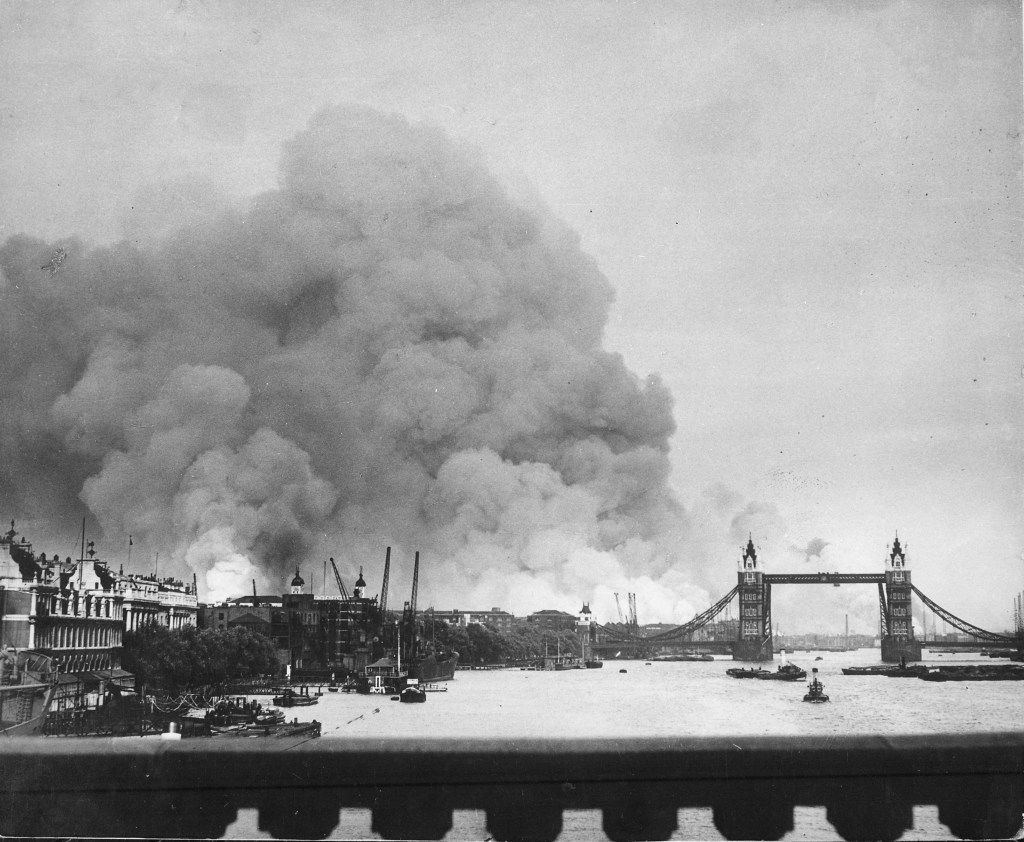
The codeword “Cromwell” remains in effect on 8 September 1940, indicating that a German invasion is imminent. Unfortunately, the meaning of the codeword is not understood by everyone. During September 7th, poorly trained local Home Guard commanders around the country begin taking extreme actions as if the codeword means that the Germans are on the beaches already. This includes ringing church bells — an accepted signal of enemy troops in the vicinity — and other crazy stuff like shooting at innocent passing cars. Other troops who hear the church bells assume that this mistaken bell-ringing is confirmation of an invasion in progress, so they set their own extreme plans in motion. A vast chain-reaction spreads across the country. Some Home Guard forces lay unmarked minefields at strategic spots, and three Guards officers drive over such a field in Lincolnshire and are killed. Several East Anglian bridges are blown up to prevent their “capture.” The chaos peaks during the night of the 7th-8th and is slowly brought under control during the day as the BBC spreads the word that all is well.
To many Londoners’ this night of 7-8 August 1940 had been the first time that they had really experienced the effects of saturation bombing. It had been a sleepless night for most as the bombing attacks that commenced during the afternoon of the previous day carried on through the night. Anderson shelters rocked as each bomb exploded, dust managed to find its way into every hole and crack, children were screaming and crying, mothers were doing their best to comfort them. It had been a night that ‘terror ran amok’ and by the early morning light of September 8th after the last of the enemy bombers had returned back to their bases, most would have said…..’We never want to go through another night like that….ever’. Little did they know that soon, London would come under heavy bombardment for fifty-seven consecutive nights, just like what they had just experienced on the night of September 7th — 8th.
But as the first light of Sunday emerged, a strange phenomenon took place, quite different from that of the previous twelve hours as London’s “Daily Telegraph” reports:
After a sleepless night, while their Anderson shelters rocked with the explosion of bombs and the crash of guns, the people of East London carried on today with their usual amazing spirit.
Several hundred began their search for new homes as soon as the “all clear” sounded. Whole streets had been destroyed and many other houses demolished. But people gathered their possessions together and piled them into perambulators. With children in their arms, they started their walk to friends or relatives.
Their morale was astonishing. As they were walking to their new homes many were laughing and joking among themselves.
Some families took care of children whose parents were dead or injured, and made long journeys across London to escort them to the homes of relatives.
Women went on preparing the Sunday dinner, even though they had no water or gas. They borrowed water from more fortunate neighbours and lit fires to roast the joints. One of them, Mrs. W. Johnson, who had spent the night in a shelter, was preparing her meal in a house where the dividing wall between dining-room and drawing-room lay in chunks across the floors.
In a dockland tavern, where every window bad been blown out by a bomb which fell across the road, they were collecting for a Spitfire fund.
The licensee of a hotel gave up his saloon bar for housing people whose houses were no longer tenable. In several streets neighbours were making a whip-round for those who had lost their belongings.
“It was an experience far worse than the Silvertown explosion in the last war,” Mrs. Cook, who with her husband and five children escaped injury, said. “The heat from the fires was terrific. We do not intend moving from the district, despite this ghastly raid.”
The morale of the people was summed up in the words of one Mayor, who said: “They have taken it on the chin.”
At 8 p.m. another all-night raid began, while London’s anti-aircraft guns put up a terrific barrage.
But for those at Fighter Command, and at the sector and satellite stations, today was to be just ‘another day at the office’.
Weather over Great Britain: After a clear night, clouds were expected to develop over most of Britain and remain at eight tenths for most of the day. Although cloudy, it was anticipated that the day would remain dry with only far northern Scotland expecting a shower or two. Temperatures were expected to be a little cooler because of the cloud cover but this cloud was expected to break up late in the afternoon.
After almost twelve hours on nonstop continuous bombing, the people emerge from shelters, basements and underground stations, wherever they thought that may have been safe. Many had heard on the radio overnight that “German Military forces have been reported to have landed on the south coast of England…..” and that many were afraid to emerge. But on the early morning news broadcasts it was confirmed that no enemy paratroop sightings had been made, nor had any German ships or barges crossed the Channel during the night and that it was perfectly safe with no need to confine oneself into an air raid shelter.
Air Marshal Hugh Dowding continues his triage operations on RAF Fighter Command. While rational and productive, these decisions exacerbate political issues within the RAF. Along with Vice Air Marshal Keith Park in command of Fighter Command in southeast England, Dowding is no fan of the “Big Wing” concept preferred by Air Vice Marshal Leigh-Mallory of No. 12 Group. That tactic has been proven time and again to take too long to assemble the formations, during which time the Luftwaffe accomplishes its objectives and leaves before the fighters can arrive. It is very similar to the divisions between the “battleship Admirals” and the “airpower Admirals.” However, Dowding is unable to kill the idea because Leigh-Mallory is backed by the Air Ministry.
From the outcome of the meeting on the previous day with Hugh Dowding, Parks issued fresh orders that were to be effective immediately. Figures stated at the meeting was that during the last four weeks, pilot casualties amounted to 348, although Keith Park states that pilot casualties in 11 Group amount to nearly 100 per week. One of the problems is that because of pilot shortage in 11 Group, many pilots straight out of OTU (Operational Training Units) are being posted to fully operational squadrons that are in some of the busiest areas of 11 Group. Keith Park makes the suggestion that pilots straight out of OTU should be posted to squadrons that are in the north where they can be drawn into combat operations slowly. This way they would receive additional training with a squadron rested from top combat duties.
Basically, Park is allowed to cherry-pick pilots from other units to fill gaps in his own. This decision increases the political frictions within the uppermost echelons of the RAF which have been boiling over recently.
Park leads from the front. During the morning, when things are quiet, he flies his own Hurricane over London. He shrewdly notes that, while the scene is one of horror, it contains the seeds of ultimate victory:
“It was burning all down the river. It was a horrid sight. But I looked down and said ‘Thank God for that,’ because I knew that the Germans had switched their attack from the fighter stations thinking that they were knocked out. They weren’t, but they were pretty groggy.”
Squadrons would also be re-classified. Up until now, Park has been able to call upon squadrons that have been located at the most suitable locations for any given attack. It was quite feasible that one of those squadrons called on may have not had the combat operational experience required and therefore they would be going into an attack very ‘green’ and not only putting themselves at risk, but the more valuable and experienced pilots as well. The re-classification of squadrons is as follows:
Class A —
All those squadrons that are to be based within 11 Group, and those that are in both 10 and 12 Groups which might be called upon by AVM Keith Park that are to provide a first line of reinforcements.
Class B —
Squadrons of all Groups other than those of 11 Group that are fully established in men and machines, which the southern Groups can call into action with consideration to fatigue or lack of combat experience.
Class C —
All the remaining squadrons which, although possessing combat experience, have suffered crippling losses in action and are obviously overdue for rest and the training of new pilots. Experienced airmen will be ‘milked’ from these squadrons after a short rest to provide replacements for those in Class A and Class B.
Park concludes that Hermann Göring has made a huge error in allowing the fighter bases to recover. In effect, quite unintentionally, Fighter Command has duped the Germans into thinking it was dead by playing possum.
In vastly oversimplified terms, there now are two power blocks at war within the RAF: Dowding and Park, attuned to the needs of the moment, versus the old guard of the Air Ministry and Leigh-Mallory (among others), anxious to preserve their power and prestige. One side or the other ultimately must prevail, because they cannot coexist indefinitely. Decisions made now will affect the careers of the parties involved, but not until the battle is decided. These folks all hold grudges, regardless of what their public statements or official histories may indicate.
During the night of September 7th and 8th 1940, while London was under its first constant day and night attack, Bomber Command sent 92 aircraft including the Fairy Battle to various targets along the Channel coast attacking many targets that were bases for numerous invasion barges and barge installations. Other attacks were made in many of the forest areas and to the Ruhr Dam area. Dunkirk and Calais come under heavy attack from Bomber Command. They return just prior to daybreak without loss.
Clouds started to roll in on this day, and this was possibly the reason that Lufwaffe activity was relatively quiet. Park also issued the order that paired squadrons would be used for the purpose of intercepting the enemy. The first squadrons using this pairing was 253 Squadron Kenley (Hurricanes) and 605 Squadron Croydon (Hurricanes). They had intercepted a small formation that approached from the Thames Estuary and although West Malling and Detling were attacked, no serious damage was done.
0430 Hours: The last of the German bombers leave London and head for home hoping to cross the Channel before the first light of day emerges. With the exception of the hour just before 2000 hours, London had been subjected to nearly twelve hours of continuous bombing. The departure of the bombers was observed by radar, but Park was to let them go and no squadrons had been dispatched. Daylight revealed more than was first thought. Reports now came in that three of London’s main railway termini were out of action, London Bridge, Victoria and Waterloo stations were closed until further notice. Ironically, all these three railway stations were on the same Southern Railway network. Reports came in that at least ten of London’s other railway stations had been damaged, but after clearing operations they were seen fit to operate. One of the two road tunnels under the River Thames, Rotherithe suffered considerable damage on the northern approaches and the tunnel would be closed for an indefinite period of time.
0930 Hours: Air Vice Marshal Keith Park taxis his personal Hurricane across Northolt, takes off and heads towards the other side of London to see firsthand the damage done to the East End and to other areas that sustained damage the previous night. He is astounded to what he saw. Warehouses and stores from Tower Bridge to a point as far east as Woolwich were still burning. He saw streets flattened as a result of the attack, but he could not help himself from thinking that if the Luftwaffe keep up these attacks on London and not his vital airfields, it would give him the time that he needed to rebuild aerodromes and restock his fighter supply.
“It was burning all down the river. It was a horrid sight. But I looked down and said ‘Thank God for that’, because I knew that the Nazis had switched their attack from the fighter stations thinking that they were knocked out. They weren’t, but they were pretty groggy”
- Air Vice Marshal Keith Park AOC 11 Group flying over the devasted area of London.
1030 Hours: 43 Squadron departs from Tangmere. They had been under pressure for an extraordinary length of time, and their involvement on September 7th over Kent and South London did not help their cause. Like many other squadrons, they were tired, and Park ordered them to make haste and make for Usworth for a rest. One of their Hurricanes, during the ferry flight north, had the engine seize up over Gedney Dye in Lincolnshire. Pilot Officer C.K.Gray managed to make a forced landing and saved the aircraft from destruction.
607 Squadron flying Hurricanes is based at Usworth, and is ordered to exchange places with 43 Squadron. 607 Squadron, although having seen action in France during May 1940, and also the attacks on North-East England by Luftfotte 5, had never seen action in the south of England during the Battle of Britain were now to see for themselves at Tangmere why so many squadrons were being sent back north. Other squadrons on the move during the morning were 111 Squadron who were to move from Croydon to Drem, 79 Squadron who were also busy the previous day are moved from Biggin Hill across to the South Wales airfield at Pembrey. 92 Squadron, who had been having a rather busy time for an isolated aerodrome, were moved closer to the action at Biggin Hill.
1130 Hours: Radar detects a formation over the Channel as it heads on a north-westerly course crossing the coast near Deal. 41 Squadron Hornchurch (Spitfires) already on routine patrol are vectored towards the Dover area, while 46 Squadron Stapleford (Hurricanes), 222 Squadron Hornchurch (Spitfires) and 605 Squadron Croydon (Hurricanes) were scrambled to intercept. Target is identified as 20 plus Do 17 bombers with 30 Bf 109s as escort.
1215 Hours: 41 Squadron Hornchurch (Spitfires) is first on the scene as the formation begins crossing the coast at Deal. They dive in to attack the bombers but the Bf 109s are soon onto them and they are forced to engage combat with the 109s while the bomber formation continues across Kent. One of the Bf 109s takes a hit but does not crash. One Spitfire is seen to leave a trail of smoke, although it is not close enough to establish any identity, and disappears from the scene. Soon, they will be forced to leave the combat because of their fuel situation.
1230 Hours: 41 Squadron Hornchurch were hopelessly outnumbered fighting the Bf 109s on their own, but they were relieved when 46 Squadron Stapleford (Hurricanes) arrived followed soon after by 605 Squadron Croydon (Hurricanes). One of the Hurricanes of 46 Squadron receives damage caused by a Bf 109 and is forced to break off and return to base. Within minutes while over the Isle of Sheppy another Hurricane of 46 Squadron is shot down, the pilot manages to bail out but is dead when found by wardens, his aircraft crashed at Bearsted. One of the Hurricanes of 605 Squadron Croydon becomes involved with a Bf 109 over Tunbridge and is on the wrong end of its canon fire. the pilot manages to bail out and the aircraft crashes and explodes in flames at Trottiscliffe. The Bf 109s sweep again, and in quick succession claim two more Hurricanes of 46 Squadron.
1240 Hours: Although badly mauled, 46 Squadron keeps up the attack, and together with 222 Squadron and 605 Squadron chase one of the Bf 109s and shoots it down near Sevenoaks while two Hurricanes move in and finally bring down one of the Do 17s over Maidstone. Forcing the scattered Dorniers inland, many come under attack by AA gunfire in which it is claimed that two more of the bombers are brought down, both near Maidstone.
The formation fails to reach their target which was thought to be London, and are turned back. Things were not good for the Stapleford squadron losing two aircraft and damaging two others, but only one pilot was posted as missing.
The afternoon period was quiet, with no activity at all. Personnel at all of the aerodromes were now working in far more pleasant circumstances to repair damaged airfields. It had been two whole days, and not one of Fighter Commands aerodromes had suffered any enemy attack, it was just what Park wanted. Airfield damage had been repaired, damaged buildings were being made habitable and aircraft were either being repaired or undergoing minor servicing thus building up squadron strength.
But it was a far different story in bomb raged London during the day. There was a mixture of frustration, helplessness, sorrow and heartbreak, but one could not help to notice the inner feelings of most people. Despite their own ordeals, they would bend over backwards to help neighbors, friends or even strangers who may have lived in the next street. They may have lost their homes and possessions, but not their morale.
Hundreds of people, especially in the East End were still looking for cherished possessions and piling them into carts and perambulators and were making their way to friends or relatives. Whole streets had been destroyed and they searched through the debris to gather whatever they could. Some broke down beside the roadway, many cried, but as soon as they found friends and loved ones, a sudden change came over them and they walked away from demolished homes laughing and joking some of them making long journeys across London.
Those that stayed, made the most of what they had, improvisation was the key. It was Sunday, and in the East End, Sunday isn’t Sunday without the Sunday roast. So the women went on preparing the Sunday dinner, there was no water or gas, the mains had blown the previous night, but a couple of streets away someone may have been lucky enough to have their water still on, so they shared. There was plenty of demolished houses now, and plenty of firewood, so they made fires, rummaged through what may have been somebody’s kitchen once, and they cooked. The children, what there was of them, had a ball as well. They were told to go and search for some salt shakers or maybe a bottle of sauce, scrumping the kids called it, but once the treasure was found, it was shared by one and all.
One licensee of one of the dockland pubs, although most of the windows had been blown in invited anybody who had lost their home to come to the pub as he closed two of the bars, collected mattresses, lined, beds and housed whoever wanted a roof over their head, and he still continued to collect for the Spitfire Fund!! But where most articles and books often depict the brave a generous side to the civilians, there were also stories of horror and despair.
“After one of the raids, we emerged from our Anderson shelter. The first thing you seem to look for is your house; you just pray that it is still standing. Then we looked up the street from our back garden to see where the ‘big one’ had gone off. We had heard it and the shelter shook and pieces of earth dropped down out of the joints, we knew that it had been close. Then we saw the Harbutt’s house three doors up the road, they were lifelong friends of ours, we had grown up in the same street together, even gone to the same school. Now, the house had been flattened and small areas of flame could be seen, then a portion of the front wall and floor collapsed bringing down the bed and wardrobe smashing it to pieces.
“We ran up to the debris, that was all was now and looked for the Harbutt’s, there was no sign of them. ‘God I hope that they were not in house’ I thought, the shelter, at the back. We rushed around but all was quiet, not a sign of anybody, but it was dark so another neighbor who had thought to bring a torch shone it inside. It was terrible, there was no damage, but all had burns to their exposed skin many still tight against their bones, the young girl had blood coming from her mouth and ears. They were just killed by the force of such a close blast.”
- Enid Turner, East Ham London.
“It was the most shocking time when London was bombed. I had nightmares for many years afterwards. I saw hysterical people, men as well as women, I saw streets completely gone, how many people would have died I have no idea. Then they sing and joke, I could not come to grips with that, because tomorrow hundreds more would be dead.”
Shirley Jones, Southwark London.
“I suppose it was opportunity really. You are in an organization that has a duty to perform, but is it temptation that gets hold of you or what? I saw in one place crates of beer and spirits, well, they won’t be any good to anybody else, so two trips and I had my beer and wine supply for a month.”
Jimmy Coughlan, Whitechapel Civil Defence London.
1930 hours: The air raid sirens sound again as London is placed under a Red Alert. Hundreds flock to whatever shelters they could find, anything that seemed to provide a strong cover over your head was regarded as safe, but of course, nowhere was safe if a direct hit occurs. It is now almost dark, too late for Fighter Command to do anything about it, as bombers from Luftflotte 3 including Do 17s, He 111 and Ju 88s. Again, as it was the previous night all loaded with high explosive bombs, delayed action bombs and incendiaries. The people were subject to the steady, dull drone of the engines of some 250 bombers overhead, then, the drone was broken by the sudden shrill whistling sound as sticks of bombs came down, the whistle getting louder as the bombs got to a few hundred feet above them.
Many of the warehouses along the Thames again became targets, and buildings that were still burning were re-stoked, the inferno was to light up once again, hundreds of fires, many joining together to become one. The damage was to be more widespread on this night as bombers targeted more inland residential areas, while others again went for railway stations and city buildings. The casualty rate on this night totaled 412 people dead with 747 injured. Compared to the previous night, that was more people killed, but the injured list was much lighter. In an infamous incident, a direct hit on a shelter at the Peabody Estate, Whitechapel kills 78 people, including entire families.
The Luftwaffe loses about 25 planes and the RAF only 6. Most importantly for the future conduct of the battle, the RAF has another day to repair its vital airfields and other infrastructure necessary to fight the Luftwaffe in the air. It is like a boxer, having staggered his opponent, suddenly going off to shout at the other boxer’s manager. It may feel good… but it allows the man on the ropes to recover. Everyone in the RAF sees this at the time, but apparently, nobody in the Luftwaffe does.
RAF Casualties:
1215 Hours: Dover. Spitfire R6756. 41 Squadron Hornchurch
F/O W.J. Scott killed. (Possibly shot down by Bf 109. Crashed in flames)
1230 Hours: Isle of Sheppy. Hurricane P3201. 46 Squadron Stapleford
Sub/Lt J.C. Carpenter killed. (Shot down by E/A. Pilot Bailed out but killed. Aircraft crashed at Maidstone)
Adolf Galland was nearly shot down on the French coast by fellow pilot Ulrich Steinhilper in an episode of misidentification. Oberleutnant Ulrich Steinhilper of I,/JG52 is leading a group of new pilots in a training mission on the French coast when he spots a Hawker Hurricane flying nearby. He attacks it to demonstrate a good attack technique to his charges. The Hurricane turns out to be a Bf 109 flown by Kommandeur of JG 26 Adolf Galland which Steinhilper has misidentified (Galland is known for engaging in solo flights). Galland, who doesn’t particularly care for radios in fighter planes (too heavy and unnecessary in his opinion), uses his to warn Steinhilper off at the last minute with bullets flying around him.
Ulrich Steinhilper never became a top fighter pilot, but in the 1950s he achieved recognition in another line of work. He is credited with coming up with the phrase “word processing” (in German) while working for IBM Germany. Although apparently the phrase previously had been used here and there in the English language, Steinhilper’s usage led to its mass acceptance and popularization. If anyone can be credited with coming up with the phrase, it is Steinhilper. IBM eventually rewarded him with an around-the-world cruise.
Oberleutnant Helmut Wick of 6,/JG 2 gainst his 28th victory.
The night time raid saw bombs dropped on East End in London once more; 3 of the German night raiders were shot down by anti-aircraft guns. Meanwhile, the British War Cabinet was convinced that the German invasion of Britain would take place very soon. The warnings passed to local Home Forces commanders led to many church bells across England being rung as some commanders thought the invasion had already started; some of them went as far as blowing up bridges. Finally, on this day, the British government declared the National Day of Prayer.
RAF Bomber Command dispatches 30 aircraft in daylight cloud-cover raids to Germany, attacks on Dutch and Belgian airfields, reconnaissance of Channel ports and sea sweeps. 6 aircraft bombed various targets; 3 Blenheims lost.
RAF Bomber Command dispatches 133 Blenheims, Hampdens, Wellingtons and Whitleys overnight to Hamburg, Bremen, Emden, Ostend and Boulogne. The heaviest raid was by 49 Hampdens on the Blohm & Voss shipyard in Hamburg. 8 aircraft were lost: 5 Blenheims and 2 Wellingtons in the Boulogne and Ostend raids and 1 Hampden in the Hamburg raid.
Field Marshall Rodolfo Graziani agreed to begin an offensive against the British in North Africa the following day. This action was taken after Graziani was threatened with dismissal by Italian Prime Minister Benito Mussolini. Italian Duce Benito Mussolini is furious that the offensive in Libya that he wished to begin in early August still is not happening. He orders Marshal Rodolfo Graziani to attack by the 9th or face dismissal. Graziani, new to his post, has much less prestige than his predecessor (killed in an air crash over the summer) and no leverage. He realizes, however, that his forces, while numerically superior to the British forces on the frontier, are vastly inferior on a qualitative basis.
Britain reinforced her Middle Eastern fighting forces with thousands of troops who landed on the sun-baked quays of an Egyptian port today from the biggest convoy ever to reach Egypt.
The British Government proclaims a national day of prayer.
Three deposed top leaders of old France, held in the “war blame” cases — former Premiers Edouard Daladier and Paul Reynaud and former Generalissimo Maurice Gustave Gamelin — were taken into custody under a decree that M. Daladier himself sponsored, it was disclosed today.
A street battle at The Hague between Netherland Nazis and their opponents, in which one man was killed and a number injured, was disclosed tonight with the dismissal of Police Chief E. van der Mey of The Hague.
Battleship Bismarck fired 72 3.7cm and 65 2cm shells against raiding British aircraft without any hits.
Germany warns that all ships in war zones prescribed by Axis are subject to attack “regardless of nationality.”
Treaty of Craiova: The Bulgarian government demanded that the Romanians cede Southern Dobruja and the Romanian government capitulated in the Treaty of Craiova. The Romanians lost another 4 million people and 40,000 square miles of territory to Bulgaria.
It is Malta’s National Day. Lord Lloyd, Secretary of State for the Colonies, broadcasts an appeal to the islanders:
“The old Maltese spirit rises again, and with hearts steeled they cherish the sacred soil of Malta, defying all who would attack their Island.”
The Yellow Garage under Valletta is turned into a temporary chapel to mark the occasion. The enclosed space magnifies the hymns sung by the 200 people living there.
The minor penetrations continue by both sides along the border between British-held Kenya and Italian Abyssinia. Today, a British patrol stages a raid on the remote Italian garrison at Gara Gorai, 16 miles north of the border.
During the night of 8/9 September, light cruiser HMS Galatea with destroyers HMS Campbell, HMS Garth, and HMS Vesper plus light cruiser HMS Aurora with destroyers HMS Hambledon, HMS Holderness, and HMS Venetia were to shell German shipping concentrations off Calais and Boulogne. From 0225 to 0245, British Anson aircraft dropped flares over both ports. No shipping was found in Calais Roads, and Galatea did not conduct a bombardment. However, Aurora did bombard the Boulogne Harbor area. Destroyers HMS Atherstone, HMS Berkeley, HMS Bulldog, HMS Beagle, and HMS Fernie swept along the French coast in a broad sweep from Le Tonquet to the southwest up to five miles north of Cape Antifer. The cruisers arrived back at Sheerness on the 9th. On her return, Galatea struck a mine at 0525 off Sheerness and was repaired at Chatham until 8 January 1941.
Armed merchant cruiser HMS Chitral was at sea escorted by destroyers HMS Amazon and HMS Antelope in the Western Approaches. The two destroyers were detached for anti-submarine operations, and replaced by Canadian destroyer HMCS Skeena.
Motor torpedo boats MTB.15 and MTB.17 attacked and reported sinking a German ammunition ship and damaging a cargo vessel off Ostend. MTB.14 was also in the attack.
S/Lt J. C. Carpenter, flying a Hurricane of RAF 46 Squadron from Stapleford Tawney, was killed when his aircraft was shot down near Sheerness.
Italian submarine Faa Di Bruno made an unsuccessful attack on a tanker in 37N, 21W.
In continued German air attacks on the Port of London, British steamers Tynemouth (3168grt) and Sherwood (1530grt), Belgian tanker President Franqui (4919grt) and steamer Anna (695grt), and Dutch steamer Thea (273grt) were damaged.
In German air attacks, sloop HMS Stork was torpedoed at anchor in Methil Roads. Her stern was wrecked and she was badly damaged. Gunner R. Motts was wounded. Stork repaired at Grangemouth, completing on 16 March 1941. Dutch steamer Stad Vlaardingen (8501grt) was damaged by German bombing, also in Methil Roads. She was taken in tow by Norwegian destroyer HNoMS Sleipner, but was then in a collision with Dutch steamer Algorab (4938grt).
In an air raid on Malta, submarine HMS Olympus in dock suffered slight damage.
Heavy cruiser HMS Cornwall departed Simonstown for Freetown, arriving on the 15th.
German armed merchant cruiser Schiff 21/Widder captured Greek collier Antonios Chandris (5866grt) in the Central Atlantic in 11-25N, 34-10W. Twenty two crewmen were landed at Rio de Janeiro, and ten at Buenos Aires.
Convoy OA.211 departed Methil escorted by sloop HMS Weston and corvette HMS Primrose.
Convoy OB.210 departed Liverpool escorted by destroyer HMS Skate with corvettes HMS Anemone and HMS Arabis. Destroyer HMS Shikari joined on the 9th. The escort was detached on the 10th.
The United States-Canadian joint defense board meets tomorrow to resume its unprecedented planning for cooperative military efforts in event of any attempt to invade the northern part of the western hemisphere. U. S. members of the hoard, headed by Mayor Fiorello H. LaGuardia of New York, will gather in a conference room at the Army war college with Canadian military, naval and aeronautic experts to continue the discussion of mutual defense problems which they initiated two weeks ago at Ottawa. Despite the noticeable absence of any official pronouncement concerning the exact nature of the problems canvassed, LaGuardia described the conversations as highly satisfactory and said that the board was making progress. He also indicated that this country might turn over to Canada extensive supplies of old army equipment, as suggested by General George C. Marshall, U. S. Army chief of staff.
Inadequate equipment, a high percentage of “green” officers and raw recruits in all units of the Regular Army and National Guard, and serious deficiencies in staff and command work and even in the elementary fundamentals of “soldiering” were revealed by the unprecedented series of Army maneuvers which were held last month. The Second Army exercises in Wisconsin — last of a series of field problems held in five different areas of the country — ended three weeks of intensive training for about 291,000 Regulars, National Guardsmen and Reserves from all the fortyeight States.
The forces which participated in the largest simultaneous exercises ever conducted in the United States in peacetime represented from 75 to 85 percent of the nation’s mobile field forces, and the officers, men, and equipment were a cross-section of the land power of the country. All of the Guard’s infantry divisions, eighteen in number; three of the Guard’s four organized cavalry divisions, and the five Regular Army infantry divisions and one cavalry division, the only fully organized divisions in the Army, took part in the field problems which were held in five different maneuver areas in upstate New York, Wisconsin, Minnesota, Washington and Louisiana.
Of them all not a single division is ready for immediate action, and even the Regular Army divisions are well below peace strength, half or more of their officers are Reserve officers with little experience, and from 30 to 50 percent of their men are recruits. Handicapped by their shortages in officers, men, and equipment, and their urgent need for training, none of the Regular Army divisions could be considered qualified combat troops in less than three to six months, in the opinion of most of their commanding officers.
A work-weary Congress that has been in session since January 4 is expected to put the finishing touches to one momentous piece of legislation this week and to whip into shape for action next week another major bill. This done, the decks will be almost clear and adjournment by September 21, a goal now definitely set by the leaders, will be possible. There are three main pieces of legislation that must be disposed of before Congressmen can go home to attend to their political fences, some of which need a lot of repairing before the November elections.
First is the Burke-Wadsworth compulsory military service bill, and that is the one that is expected to complete its legislative journey before the coming weekend. Second is the excess profits tax bill, which is likely to be the major item on next week’s program. Third is a $1,200,000,000 appropriation bill to pay the expenses of the trainees which the Burke-Wadsworth bill will provide for the Army.
American industry was advised today by Robert P. Patterson, Assistant Secretary of War, that it “need feel no anxiety whatever” over the Smith industrial conscription plan adopted yesterday by the House as part of the Burke-Wadsworth Compulsory Selective Military Service Bill.
A 16-year-old Black teen, Austin Callaway, charged with an attempted attack on a white woman, was taken from city jail in Lagrange, Georgia early today and lynched. Chief of Police J. E. Mathews, announced tonight. Chief Mathews said the masked men took Callaway from the jail, by forcing the jailer at gunpoint to open the cell door.
Classing it as urgently needed to aid the drive on fifth columnists, the administration is seeking quick passage of legislation to purge citizen rolls of many “doubtful” Americans and generally tighten citizenship requirements.
A prayer for enduring peace among nations of the world arose today from an estimated 50,000 Catholics, gathered at a solemn ceremony in San Francisco’s Kezar stadium. The throng, nearly filling the large bowl, gathered from parishes in the city and neighboring areas for the final rites of the fourth annual Eucharistic congress of the archdiocese of San Francisco. With all the measured pomp of the church, the ceremony began with the procession of the Blessed Sacrament. Long columns of priests, nuns and seminarians preceded Archbishop John J. Mitty, who bore the host under a canopy of gold cloth. He was escorted by monsignor of the archdiocese.
President Roosevelt sat today in his family pew in St. James’s Episcopal Church in the village of Hude Park, New York, a silent participant in the nationwide religious services proclaimed by him formally as an occasion for prayers for peace in the world.
The U.S. Navy light cruiser USS St. Louis departed Hamilton, Bermuda for Norfolk, Virginia with the Greenslade Board aboard. The Greenslade Board was a committee formed “to make a comprehensive study of the shore establishment (naval and commercial) necessary to support the Fleet in peace and war.” With the strategic requirements of the fleet in mind, the board was instructed to make recommendations for additional facilities in new locations and as to the expansion, limitation, contraction, abandonment, or conversion of existing shore facilities. The board was known by its senior member, Rear Admiral John W. Greenslade.
Major League Baseball:
In a 9–4 win against the Red Sox, Yankee Joe Gordon hits for the cycle, starting with his 25th homer, to back Spud Chandler’s eight-hit pitching. A four-run eighth inning puts the game away.
Cleveland’s Bob Feller, coming in to relieve Pitcher Al Milnar in the ninth inning with the score 4–all, scored his twenty-fourth victory of the year when the Indians defeated the White Sox, 5–4, in ten innings today. Ray Mack singled home the winning run after Jeff Heath doubled and took third on a passed ball.
The Detroit Tigers came from behind for the fourth straight time today for victory, conquering the St. Louis Browns, 5–4, and now are one percentage point behind the Indians. Rudy York’s eighth-inning homer won it for the Tigers.
Washington and Philadelphia split their double-header today, with the Senators winning the first game, 7–6, while the Athletics took the five-inning nightcap, 4–0, behind the three-hit hurling of Bill Beckman.
In the opener of a Sunday doubleheader, Johnny Mize of the St. Louis Cardinals sets 4 Major League records as he rips 3 consecutive home runs, his second 3–homer game of the season and the 4th time in his career. For “Big John,” it is number 38 through 40 homers of the year. Pittsburgh still sweeps the 2 games, 16–14 on 21 hits, and 9–4 in 5 innings.
Vern Olsen, prize rookie of the Cubs, pitched his floundering teammates to a seven-hit, 3–1 victory over the league leading Reds today before 20,613 spectators at Wrigley Field. The victory was Olsen’s eleventh of the season as against nine defeats.
The Dodgers won a double-header with the Giants that went on until dusk tonight. The scores were 7–2 and 4–2. The Dodgers hammered Carl Hubbell in the opener, principally through Dolf Camilli’s nineteenth home run in the fifth inning with two aboard. This was Curt Davis’s seventh pitching victory of the season. The nightcap Brooklyn won in eleven innings with a barrage of twelve hits against Bill Lohrman. Three solid shots crushed the Giant right-hander. Jimmy Wasdell and Pete Coscarart hammered in the deciding runs at a time when Umpire Johnny Reardon was thinking of calling the game.
The last-place Phillies handed the Bees a double setback today, going twelve innings to take the first game of a twin bill, 2–1, and winning the nightcap, 3–1. Pitcher Kirby Higbe took personal charge of the first game, limiting the Bees to six hits and scoring the winning run on Ham Schulte’s single.
New York Yankees 9, Boston Red Sox 4
Cincinnati Reds 1, Chicago Cubs 3
Chicago White Sox 4, Cleveland Indians 5
St. Louis Browns 4, Detroit Tigers 5
Brooklyn Dodgers 7, New York Giants 2
Brooklyn Dodgers 4, New York Giants 2
Boston Bees 1, Philadelphia Phillies 2
Boston Bees 1, Philadelphia Phillies 3
Pittsburgh Pirates 16, St. Louis Cardinals 14
Pittsburgh Pirates 5, St. Louis Cardinals 4
Philadelphia Athletics 6, Washington Senators 7
Philadelphia Athletics 4, Washington Senators 0
After a long debate the Bolivian Chamber of Deputies approved the first reading of a bill by which immigration permits in favor of Jews would be canceled “in general and without exception,” including permits already granted.
21-year-old Jayachamarajendra Wadiyar is the new Maharaja of the Kingdom of Mysore (southern India). His father, Krishnaraja IV, has been progressive and worked with the British. Even Mahatma Gandhi has praised Krishnaraja as a “saintly king” for his progressive efforts in education and infrastructure. One could call the dynasty “Anglophiles.” Mysore is a key element in the British administration of India, whose politics are very much in flux.
Secretary of State Cordell Hull’s statement on the interest of the United States in Japanese activity in French Indo-China is credited by Dr. Wang Chung-hui, the Chinese Foreign Minister, as the major reason why the Japanese pulled up short and began negotiations with Vice Admiral Jean Decoux, Governor of Indo-China. Dr. Wang, former judge of the World Court and once a student at the University of California, is now official spokesman for the Chungking Government. He said in an interview that China appreciated Secretary Hull’s warning to the Japanese, because Japan will have to think carefully before embarking on an Indo-China venture as China is pledged to fight if the Japanese move troops across IndoChina to the Yunnan border.
Japan was reported to have issued an ultimatum to Indo-China, demanding use of Indo-China bases for military operations against China and free passage of Japanese troops.
Born:
Quentin L. Cook, American lawyer and Mormon religious leader (Quorum of the Twelve Apostles), in Logan, Utah.
Willie Tyler, American ventriloquist (Lester), in Red Level, Alabama.
Gary Henson, NFL and AFL wide receiver (Philadelphia Eagles; Denver Broncos), in Oklahoma City, Oklahoma (d. 2015).
Naval Construction:
The Royal Navy Bangor-class (VTE reciprocating-engined) minesweeper HMCS Cowichan (J 146) is launched by the North Vancouver Ship Repairs Ltd. (Vancouver, British Columbia, Canada).
 History Diaries